

AI and Beauty Tech (Large Print Book)
 |
Description
Book Introduction
The beauty industry is shifting from standardized beauty standards to data-driven sensory design.
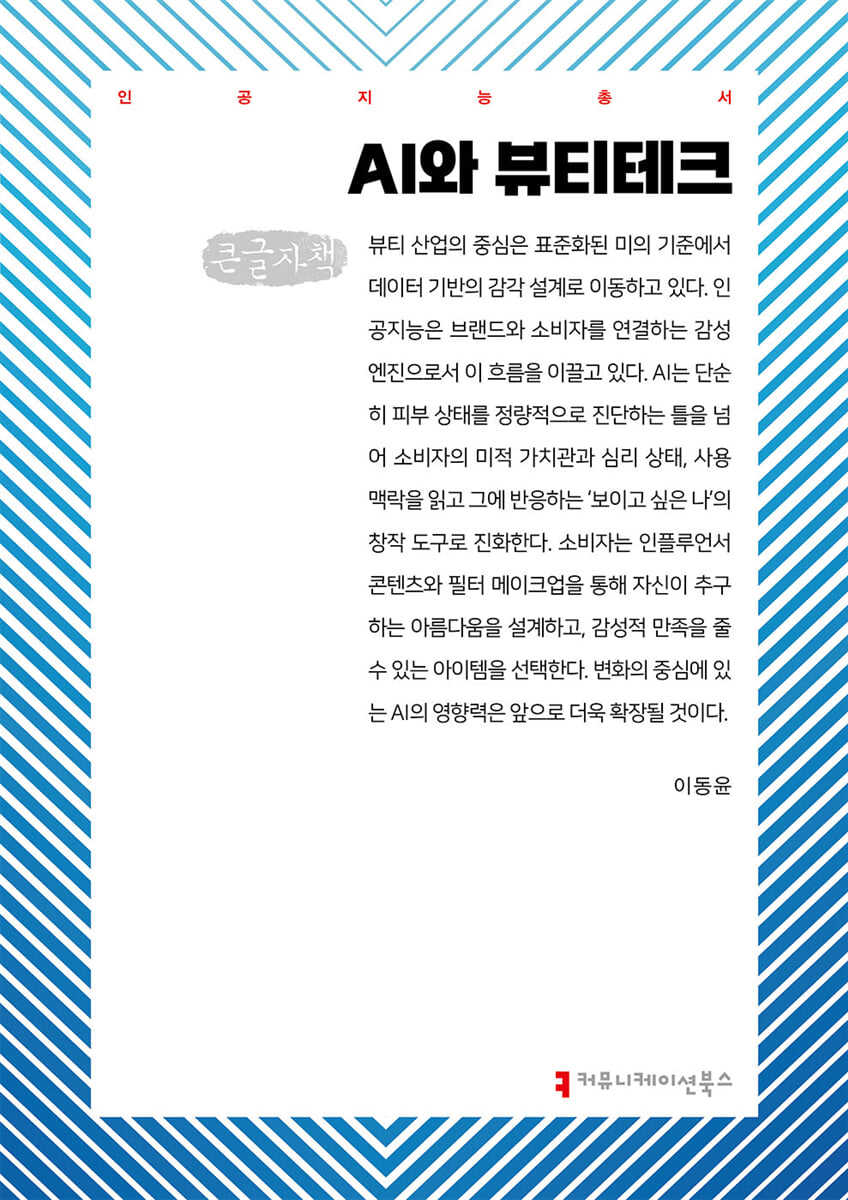
Artificial intelligence is driving this trend as an emotional engine connecting brands and consumers. Beyond simply providing quantitative skin diagnosis, AI is evolving into a creative tool that interprets and responds to consumers' aesthetic values, psychological states, and usage contexts, creating a "self you want to be seen as."
Consumers design the beauty they seek through influencer content and filter makeup, and select items that can provide emotional satisfaction.
The influence of AI, which is at the center of change, will expand further in the future.
Artificial intelligence is driving this trend as an emotional engine connecting brands and consumers. Beyond simply providing quantitative skin diagnosis, AI is evolving into a creative tool that interprets and responds to consumers' aesthetic values, psychological states, and usage contexts, creating a "self you want to be seen as."
Consumers design the beauty they seek through influencer content and filter makeup, and select items that can provide emotional satisfaction.
The influence of AI, which is at the center of change, will expand further in the future.
- You can preview some of the book's contents.
Preview
index
The era of designing the face you want to buy
01 AI and Beauty Tech
02 Smart Production Technology and Beauty Manufacturing Innovation
03 Beauty Retail and AI
04 AI Marketing: Completing the Hyper-Personalized Beauty Experience
05 Beauty Filters: Your True Look Designed with AI
06 Influencers: The New Engine of the Beauty Industry
07 Virtual Beauty, AI Companion
08 Medical Aesthetics and AI
09 AI and Robotics Meet Beauty Salons
10 Home Care Devices and AI
01 AI and Beauty Tech
02 Smart Production Technology and Beauty Manufacturing Innovation
03 Beauty Retail and AI
04 AI Marketing: Completing the Hyper-Personalized Beauty Experience
05 Beauty Filters: Your True Look Designed with AI
06 Influencers: The New Engine of the Beauty Industry
07 Virtual Beauty, AI Companion
08 Medical Aesthetics and AI
09 AI and Robotics Meet Beauty Salons
10 Home Care Devices and AI
Into the book
Unilever has introduced an AI system to optimize its automatic cleaning system called 'Clean-in-Place (CIP)'.
Previously, it was difficult to accurately measure contamination levels during the cleaning process, which often resulted in excessive use of water and energy.
To address these issues, Unilever has deployed AI algorithms that can adjust wash cycles and detergent usage in real time, predict contamination levels based on process data, and perform only the necessary washing, preventing overwashing.
As a result, cleaning times were reduced by an average of 20%, energy consumption was reduced by more than 10%, and operating costs were reduced by approximately 100,000 euros per year.
This case is a prime example of how integrating AI technology into the production process can simultaneously achieve environmental sustainability and operational efficiency.
--- From "02_“Smart Production Technology and Beauty Manufacturing Innovation”"
In the beauty industry, brand loyalty lies more in emotional resonance than functional performance, and AI plays a crucial role in interpreting this emotional language into data and transforming it into a messaging strategy.
In particular, generative AI is evolving into a tool that automates content production for beauty brands, complements creativity, and strengthens brand identity (narrative) and emotional connections with consumers.
--- From "04_“AI Marketing, Completing the Hyper-Personalized Beauty Experience”"
One of the biggest impacts virtual beauties have had on the beauty industry is that they have redefined the standards of beauty.
They present a diversity that goes beyond the existing standardized standards of beauty by reflecting different races, body types, and styles.
For example, Roji is a case study that reinterprets Korean beauty standards in a modern way, and is gaining strong recognition in the Asian market in line with the K-beauty trend.
--- From 「07_“Virtual Beauty, AI Companion”」
InBody, a body composition analysis company, has launched 'InBodyFit+', an AI body composition analysis app for the home care market in 2024, and 'InBodyFit', a home device linked to the app.
This app is based on AI body composition management analysis function created based on over 140 million body composition big data, and provides a unique 'Fitscore' scoring system, allowing users to compare their health status with that of others of the same gender and age group.
Previously, it was difficult to accurately measure contamination levels during the cleaning process, which often resulted in excessive use of water and energy.
To address these issues, Unilever has deployed AI algorithms that can adjust wash cycles and detergent usage in real time, predict contamination levels based on process data, and perform only the necessary washing, preventing overwashing.
As a result, cleaning times were reduced by an average of 20%, energy consumption was reduced by more than 10%, and operating costs were reduced by approximately 100,000 euros per year.
This case is a prime example of how integrating AI technology into the production process can simultaneously achieve environmental sustainability and operational efficiency.
--- From "02_“Smart Production Technology and Beauty Manufacturing Innovation”"
In the beauty industry, brand loyalty lies more in emotional resonance than functional performance, and AI plays a crucial role in interpreting this emotional language into data and transforming it into a messaging strategy.
In particular, generative AI is evolving into a tool that automates content production for beauty brands, complements creativity, and strengthens brand identity (narrative) and emotional connections with consumers.
--- From "04_“AI Marketing, Completing the Hyper-Personalized Beauty Experience”"
One of the biggest impacts virtual beauties have had on the beauty industry is that they have redefined the standards of beauty.
They present a diversity that goes beyond the existing standardized standards of beauty by reflecting different races, body types, and styles.
For example, Roji is a case study that reinterprets Korean beauty standards in a modern way, and is gaining strong recognition in the Asian market in line with the K-beauty trend.
--- From 「07_“Virtual Beauty, AI Companion”」
InBody, a body composition analysis company, has launched 'InBodyFit+', an AI body composition analysis app for the home care market in 2024, and 'InBodyFit', a home device linked to the app.
This app is based on AI body composition management analysis function created based on over 140 million body composition big data, and provides a unique 'Fitscore' scoring system, allowing users to compare their health status with that of others of the same gender and age group.
--- From “10_“Home Care Devices and AI””
Publisher's Review
A major shift in the beauty industry: designing the "ideal me."
Today, we live in an age where we design our own 'faces we want to buy.'
In the past, imitating the looks of celebrities was the standard for beauty, but now, each person designs their own ideal face through beauty filters on TikTok and Instagram.
Amid these changes, AI has evolved beyond mere technology into an “emotional creator.”
The face shape and color tone selected by the user through the filter is a blueprint that embodies 'the me I want to become', and AI acts as a tool to interpret that desire and turn it into reality.
The "accuracy" of beauty AI no longer depends on how precisely it analyzes a user's current appearance, but on how close it is to the user's desired ideal appearance. AI is evolving from a machine that simply measures skin dryness to an emotional interpreter that interprets why a person feels that way and what kind of appearance they want to achieve.
This is moving AI beyond personalized analysis to understanding emotions and context, shifting the focus of the beauty industry from technology to emotion.
The desire to be beautiful is a fundamental human instinct, and the beauty industry is a stage for emotionally embodying this desire. In the age of AI, brands no longer simply sell products.
Brands now leverage AI and social media to visually design their customers' emotions and aesthetic desires.
Although AI utilization in the beauty industry is still in its early stages, the market landscape will fundamentally change as AI emerges to interpret data on sensory and taste data that is difficult to quantify.
Whoever first secures this data and implements an emotion-reading algorithm will determine future industry leadership.
The focus of consumption has shifted from functionality to visuals.
Consumers are stimulated by desires in videos, filters, and short-form content, and brands transform these desires into "emotional stories." In this process, AI goes beyond simple recommendations and functions as a "storyteller," analyzing consumer psychology and aesthetic preferences to build emotional resonance.
These emotional connections lead to brand loyalty and repeat purchases.
AI currently permeates all areas of the beauty industry, including manufacturing, new industries, and services.
In the manufacturing industry, it optimizes cosmetic formula design and increases development efficiency, while in new industries, it embodies the "ideal self" through beauty filters and virtual humans.
In the service industry, AI diagnostics and robotics are combined to provide personalized care and premium services.
As data, emotion, design, and technology intersect, the beauty value chain is being reorganized.
In particular, K-beauty is securing new global competitiveness through AI.
In 2024, Korean cosmetics exports will exceed $10.2 billion, surpassing France to take first place in the US market.
This is thanks to a cultural ecosystem that combines K-pop, medical aesthetics, and fashion, and AI is at the center of it.
The fusion of emotion, technology, and culture is the true competitive edge of K-beauty, and AI is the key infrastructure that accelerates this.
Ultimately, in the beauty industry, AI is moving beyond a technology that enhances productivity and efficiency to a creator that interprets human desires, designs emotions, and realizes the "ideal self." By redefining the standards of beauty and communicating with consumers through the language of emotion, AI is shifting the paradigm of the entire beauty industry.
Today, we live in an age where we design our own 'faces we want to buy.'
In the past, imitating the looks of celebrities was the standard for beauty, but now, each person designs their own ideal face through beauty filters on TikTok and Instagram.
Amid these changes, AI has evolved beyond mere technology into an “emotional creator.”
The face shape and color tone selected by the user through the filter is a blueprint that embodies 'the me I want to become', and AI acts as a tool to interpret that desire and turn it into reality.
The "accuracy" of beauty AI no longer depends on how precisely it analyzes a user's current appearance, but on how close it is to the user's desired ideal appearance. AI is evolving from a machine that simply measures skin dryness to an emotional interpreter that interprets why a person feels that way and what kind of appearance they want to achieve.
This is moving AI beyond personalized analysis to understanding emotions and context, shifting the focus of the beauty industry from technology to emotion.
The desire to be beautiful is a fundamental human instinct, and the beauty industry is a stage for emotionally embodying this desire. In the age of AI, brands no longer simply sell products.
Brands now leverage AI and social media to visually design their customers' emotions and aesthetic desires.
Although AI utilization in the beauty industry is still in its early stages, the market landscape will fundamentally change as AI emerges to interpret data on sensory and taste data that is difficult to quantify.
Whoever first secures this data and implements an emotion-reading algorithm will determine future industry leadership.
The focus of consumption has shifted from functionality to visuals.
Consumers are stimulated by desires in videos, filters, and short-form content, and brands transform these desires into "emotional stories." In this process, AI goes beyond simple recommendations and functions as a "storyteller," analyzing consumer psychology and aesthetic preferences to build emotional resonance.
These emotional connections lead to brand loyalty and repeat purchases.
AI currently permeates all areas of the beauty industry, including manufacturing, new industries, and services.
In the manufacturing industry, it optimizes cosmetic formula design and increases development efficiency, while in new industries, it embodies the "ideal self" through beauty filters and virtual humans.
In the service industry, AI diagnostics and robotics are combined to provide personalized care and premium services.
As data, emotion, design, and technology intersect, the beauty value chain is being reorganized.
In particular, K-beauty is securing new global competitiveness through AI.
In 2024, Korean cosmetics exports will exceed $10.2 billion, surpassing France to take first place in the US market.
This is thanks to a cultural ecosystem that combines K-pop, medical aesthetics, and fashion, and AI is at the center of it.
The fusion of emotion, technology, and culture is the true competitive edge of K-beauty, and AI is the key infrastructure that accelerates this.
Ultimately, in the beauty industry, AI is moving beyond a technology that enhances productivity and efficiency to a creator that interprets human desires, designs emotions, and realizes the "ideal self." By redefining the standards of beauty and communicating with consumers through the language of emotion, AI is shifting the paradigm of the entire beauty industry.
GOODS SPECIFICS
- Date of issue: October 31, 2025
- Page count, weight, size: 102 pages | 210*290*6mm
- ISBN13: 9791143006721
You may also like
카테고리
korean


korean

![ELLE 엘르 A형 (여성월간) : 1월 [2026]](http://librairie.coreenne.fr/cdn/shop/files/3b70e1cf77cf67d6da56e0eb041901e8.jpg?v=1767265322&width=3840)


