

AI and Japanese Literature Translation
 |
Description
Book Introduction
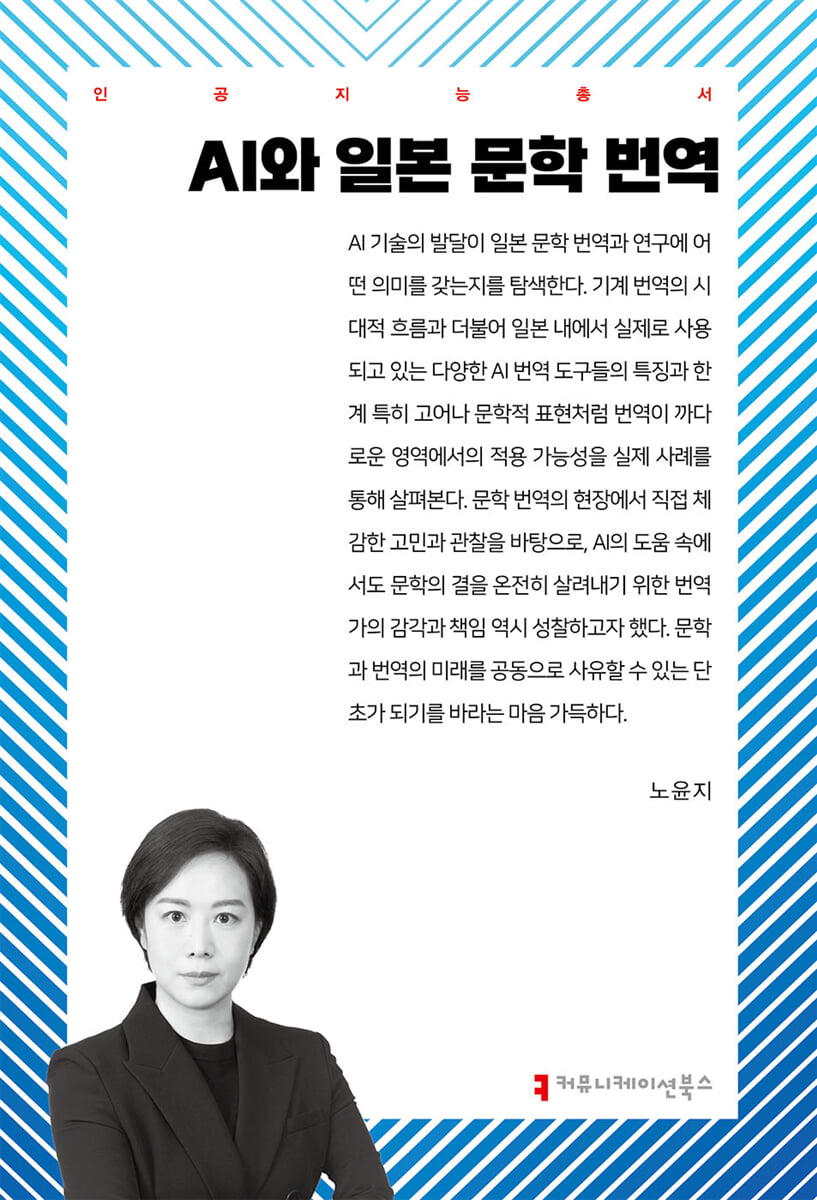
Can AI translate literature? Beyond speed and efficiency, can it convey emotion and context? This book explores the intersection of technology and human interpretation through the translation of Japanese literature, proposing a new meaning for literary translation in the AI era.
Artificial Intelligence Encyclopedia.
You can find the artificial intelligence knowledge you need at aiseries.oopy.io.
Artificial Intelligence Encyclopedia.
You can find the artificial intelligence knowledge you need at aiseries.oopy.io.
- You can preview some of the book's contents.
Preview
index
Reflecting on the Future of AI Translation
01 Advances in Machine Translation
02 Japan's online AI translation
03 Japanese Literature and the Use of AI
04 The flow of Japanese literature translation
05 Characteristics of Japanese Literature Translation
06 AI and Gore Translation
07 Examples of AI Translation
08 The Capabilities of Translators in the AI Era
09 Translation Ethics and Copyright Issues in the AI Era
10 The Future of AI Translation and the Prospects for Japanese Literature Research
01 Advances in Machine Translation
02 Japan's online AI translation
03 Japanese Literature and the Use of AI
04 The flow of Japanese literature translation
05 Characteristics of Japanese Literature Translation
06 AI and Gore Translation
07 Examples of AI Translation
08 The Capabilities of Translators in the AI Era
09 Translation Ethics and Copyright Issues in the AI Era
10 The Future of AI Translation and the Prospects for Japanese Literature Research
Into the book
Novelist Rie Kudan, who won the 170th Akutagawa Prize for her novel “Tokyo Tower of Sympathy” (2024), garnered attention by revealing that 5% of the novel was written using generative AI.
He then participated in an AI-based creative experiment hosted by a magazine in March 2025 and published a short story titled "Shadow Rain" that relied 95% on generative AI. It is known that he personally wrote the beginning and end of the novel to set the direction, and the remaining 95% was written through ChatGP.
We inputted a prompt of 200,000 characters for a novel of approximately 4,000 characters, and made the entire prompt public along with the work to show how the creative dialogue and idea structure between the AI and the writer took place.
--- From "03_“Japanese Literature and the Use of AI”"
In a competition between AI machine translation and human translation, co-hosted by the International Interpretation and Translation Association, Sejong University, and Sejong Cyber University in February 2017, AI outperformed humans in translation speed, but humans won by a significant margin in three categories: accuracy, linguistic expressiveness, and logical validity.
Regarding this, it was evaluated that 'the translator is not yet able to keep up with humans because it simply translates without understanding the polysemous nature and context of words', and through this, we can confirm that the role of human translators cannot yet be replaced in fields that require creative reinterpretation, such as literary translation.
--- From “05_“Characteristics of Japanese Literature Translation””
This translation method not only reduces the time and effort required for translation, but also offers new opportunities for translators, ultimately holding the potential to improve translation quality. Advances in AI technology are being utilized as tools to increase translation speed and efficiency, freeing translators to take on more creative and strategic roles.
This reduces the workload of translators and provides them with the opportunity to devote more time to creative and professional work.
Ultimately, machine translation post-editing is a crucial process that improves translation quality and produces better results through collaboration between AI and humans.
He then participated in an AI-based creative experiment hosted by a magazine in March 2025 and published a short story titled "Shadow Rain" that relied 95% on generative AI. It is known that he personally wrote the beginning and end of the novel to set the direction, and the remaining 95% was written through ChatGP.
We inputted a prompt of 200,000 characters for a novel of approximately 4,000 characters, and made the entire prompt public along with the work to show how the creative dialogue and idea structure between the AI and the writer took place.
--- From "03_“Japanese Literature and the Use of AI”"
In a competition between AI machine translation and human translation, co-hosted by the International Interpretation and Translation Association, Sejong University, and Sejong Cyber University in February 2017, AI outperformed humans in translation speed, but humans won by a significant margin in three categories: accuracy, linguistic expressiveness, and logical validity.
Regarding this, it was evaluated that 'the translator is not yet able to keep up with humans because it simply translates without understanding the polysemous nature and context of words', and through this, we can confirm that the role of human translators cannot yet be replaced in fields that require creative reinterpretation, such as literary translation.
--- From “05_“Characteristics of Japanese Literature Translation””
This translation method not only reduces the time and effort required for translation, but also offers new opportunities for translators, ultimately holding the potential to improve translation quality. Advances in AI technology are being utilized as tools to increase translation speed and efficiency, freeing translators to take on more creative and strategic roles.
This reduces the workload of translators and provides them with the opportunity to devote more time to creative and professional work.
Ultimately, machine translation post-editing is a crucial process that improves translation quality and produces better results through collaboration between AI and humans.
--- From "08_“The Capabilities of Translators in the AI Era”"
Publisher's Review
Rethinking the Meaning of Literary Translation in the AI Age
Advances in AI technology have fundamentally changed the landscape of translation.
The advent of artificial neural network translation has expanded translation from the domain of experts to an automated function accessible to everyone, but it has also forced us to question the very reason for the existence of translators and the very essence of literary translation.
In particular, Japanese literature clearly reveals the limitations of machine translation due to its high linguistic complexity, including the mixed use of kanji and kana, subject omission, and emotional nuance.
This book closely explores how the sensibilities of human translators and AI technology can coexist within these complex linguistic structures.
This book explores the history of machine translation, from rule-based to neural network-based, covering the application of cutting-edge tools like DeepL and ChatGP.T., and the history of Japanese literature and the translation of ancient documents. It explores the balance between technical sophistication and human interpretation. As AI rapidly processes language, the value of "literary translation," which conveys human emotion, culture, and context, becomes increasingly evident.
This book centers on the question, "What is it about humanity that AI cannot translate?" and explores the philosophical future of AI translation through the translation of Japanese literature.
Advances in AI technology have fundamentally changed the landscape of translation.
The advent of artificial neural network translation has expanded translation from the domain of experts to an automated function accessible to everyone, but it has also forced us to question the very reason for the existence of translators and the very essence of literary translation.
In particular, Japanese literature clearly reveals the limitations of machine translation due to its high linguistic complexity, including the mixed use of kanji and kana, subject omission, and emotional nuance.
This book closely explores how the sensibilities of human translators and AI technology can coexist within these complex linguistic structures.
This book explores the history of machine translation, from rule-based to neural network-based, covering the application of cutting-edge tools like DeepL and ChatGP.T., and the history of Japanese literature and the translation of ancient documents. It explores the balance between technical sophistication and human interpretation. As AI rapidly processes language, the value of "literary translation," which conveys human emotion, culture, and context, becomes increasingly evident.
This book centers on the question, "What is it about humanity that AI cannot translate?" and explores the philosophical future of AI translation through the translation of Japanese literature.
GOODS SPECIFICS
- Date of issue: October 24, 2025
- Page count, weight, size: 118 pages | 128*188*5mm
- ISBN13: 9791143008589
You may also like
카테고리
korean


korean

![GQ KOREA Mark (Monthly): December [2025]](http://librairie.coreenne.fr/cdn/shop/files/8ef265dbbfbf186523ed75ba7319009d.jpg?v=1765340328&width=3840)


