

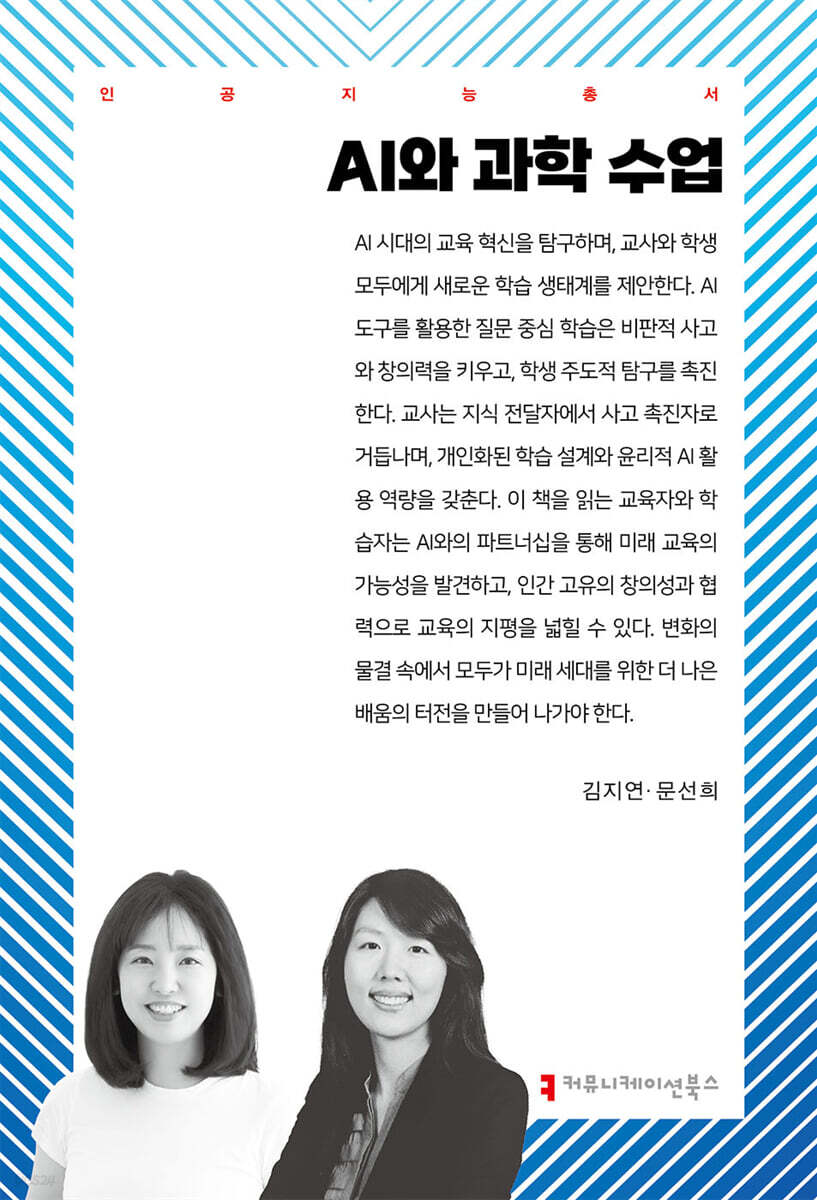
AI and Science Classes
 |
Description
Book Introduction
AI is an intelligent companion that visualizes experiments in science classes, supports personalized learning, and fosters student exploration.
It presents the direction of classroom innovation by examining both possibilities and risks.
Artificial Intelligence Encyclopedia.
You can find the artificial intelligence knowledge you need at aiseries.oopy.io.
It presents the direction of classroom innovation by examining both possibilities and risks.
Artificial Intelligence Encyclopedia.
You can find the artificial intelligence knowledge you need at aiseries.oopy.io.
- You can preview some of the book's contents.
Preview
index
A major shift in the education paradigm and the emergence of AI
01 A New Ecosystem of Question-Based Learning
02 Educational Use of AI Tools
03 Core Principles of AI Partnerships
04 Redefining the Role of Teachers in the AI Era
05 Teacher Expertise in the Era of AI Partnerships
06 AI-Changed Classrooms
07 AI and Writing Classes, and Assessment
08 Limitations and Risks of Using AI in Education
09 Specific limitations and approach principles for AI utilization by field
10 The Future of Science Education in the AI Era
01 A New Ecosystem of Question-Based Learning
02 Educational Use of AI Tools
03 Core Principles of AI Partnerships
04 Redefining the Role of Teachers in the AI Era
05 Teacher Expertise in the Era of AI Partnerships
06 AI-Changed Classrooms
07 AI and Writing Classes, and Assessment
08 Limitations and Risks of Using AI in Education
09 Specific limitations and approach principles for AI utilization by field
10 The Future of Science Education in the AI Era
Into the book
In modern science education, generative AI is emerging as a new educational partner that can explore students' natural curiosity in a richer and more systematic way. AI is not simply an information retrieval tool that provides answers; it functions as an intellectual companion that explores questions alongside students, generates new ones, and enriches the thinking process itself.
Ultimately, AI can dramatically expand the possibilities for student-led inquiry learning and create educational environments where every student can fully unleash their scientific curiosity.
--- From “01_“A New Ecosystem of Inquiry-Centered Learning””
In partnership with AI, the role of teachers will not disappear, but rather become more important and specialized.
It is a shift from being a transmitter of knowledge to a facilitator of inquiry.
Traditionally, teachers have been responsible for possessing scientific knowledge and conveying it to students, but in the AI era, this information-transferring function may be largely replaced by AI.
However, this does not mean that the role of teachers is being reduced, but rather that it is being transformed into a more high-level and specialized role.
--- From “03_“Core Principles of AI Partnership””
What's more interesting is that students will have the opportunity to naturally develop metacognitive skills through conversations with AI.
A middle school student asks Claude, “Explain cell division,” and upon hearing the AI’s answer, he replies, “Wait, that’s not what I’m wondering about.
If students can rephrase their question as, “I wonder why cell division occurs,” they are developing the metacognitive ability to self-monitor and regulate their own learning process.
To guide this process, teachers can say, “Let’s listen to the AI’s answer and see if it really answers your questions.”
--- From "06_“Classrooms Changed by AI”"
The educational use of AI technology must be approached from a human-centered perspective, moving away from a technology-centric mindset.
Rather than hastily adopting AI, lured by technological efficiency and convenience, ethical reflection should precede, prioritizing the essential value of education and the holistic development of learners.
Only through this approach, which carefully limits the role of AI while respecting the unique characteristics and purposes of each educational domain, can AI technology truly contribute to the advancement of education.
Ultimately, AI can dramatically expand the possibilities for student-led inquiry learning and create educational environments where every student can fully unleash their scientific curiosity.
--- From “01_“A New Ecosystem of Inquiry-Centered Learning””
In partnership with AI, the role of teachers will not disappear, but rather become more important and specialized.
It is a shift from being a transmitter of knowledge to a facilitator of inquiry.
Traditionally, teachers have been responsible for possessing scientific knowledge and conveying it to students, but in the AI era, this information-transferring function may be largely replaced by AI.
However, this does not mean that the role of teachers is being reduced, but rather that it is being transformed into a more high-level and specialized role.
--- From “03_“Core Principles of AI Partnership””
What's more interesting is that students will have the opportunity to naturally develop metacognitive skills through conversations with AI.
A middle school student asks Claude, “Explain cell division,” and upon hearing the AI’s answer, he replies, “Wait, that’s not what I’m wondering about.
If students can rephrase their question as, “I wonder why cell division occurs,” they are developing the metacognitive ability to self-monitor and regulate their own learning process.
To guide this process, teachers can say, “Let’s listen to the AI’s answer and see if it really answers your questions.”
--- From "06_“Classrooms Changed by AI”"
The educational use of AI technology must be approached from a human-centered perspective, moving away from a technology-centric mindset.
Rather than hastily adopting AI, lured by technological efficiency and convenience, ethical reflection should precede, prioritizing the essential value of education and the holistic development of learners.
Only through this approach, which carefully limits the role of AI while respecting the unique characteristics and purposes of each educational domain, can AI technology truly contribute to the advancement of education.
--- From “09_“Specific limitations and approach principles of AI utilization by field”
Publisher's Review
Experimenting with a New Classroom with AI
AI is not a replacement for teachers, but an intelligent partner that expands learners' thinking.
In science education, AI can visualize complex concepts, enable virtual experiments, and present inquiry questions tailored to each student's level of understanding.
Through this, classes move beyond simple knowledge transfer to inquiry and inquiry-centered learning, and teachers transform from knowledge providers to thought facilitators and mentors.
However, along with these possibilities, we must not overlook the risks such as AI hallucinations, data bias, learning dependency, and deepening educational inequality.
Defining AI as a collaborative partner, not a mere tool, the book broadly explores the emerging roles of teachers, students' critical thinking skills, and the ethical challenges of educational administration, along with specific examples of AI utilization in science classes. AI is merely a means to expand human capabilities, like a telescope, while the essence of education remains human inquiry and reflection.
This book is a guide for teachers, students, and researchers to explore the path of education in the AI era.
AI is not a replacement for teachers, but an intelligent partner that expands learners' thinking.
In science education, AI can visualize complex concepts, enable virtual experiments, and present inquiry questions tailored to each student's level of understanding.
Through this, classes move beyond simple knowledge transfer to inquiry and inquiry-centered learning, and teachers transform from knowledge providers to thought facilitators and mentors.
However, along with these possibilities, we must not overlook the risks such as AI hallucinations, data bias, learning dependency, and deepening educational inequality.
Defining AI as a collaborative partner, not a mere tool, the book broadly explores the emerging roles of teachers, students' critical thinking skills, and the ethical challenges of educational administration, along with specific examples of AI utilization in science classes. AI is merely a means to expand human capabilities, like a telescope, while the essence of education remains human inquiry and reflection.
This book is a guide for teachers, students, and researchers to explore the path of education in the AI era.
GOODS SPECIFICS
- Date of issue: October 20, 2025
- Page count, weight, size: 136 pages | 128*188*7mm
- ISBN13: 9791143010094
You may also like
카테고리
korean


korean

![ELLE 엘르 A형 (여성월간) : 1월 [2026]](http://librairie.coreenne.fr/cdn/shop/files/3b70e1cf77cf67d6da56e0eb041901e8.jpg?v=1767265322&width=3840)


