

AI video mise-en-scène analysis
 |
Description
Book Introduction
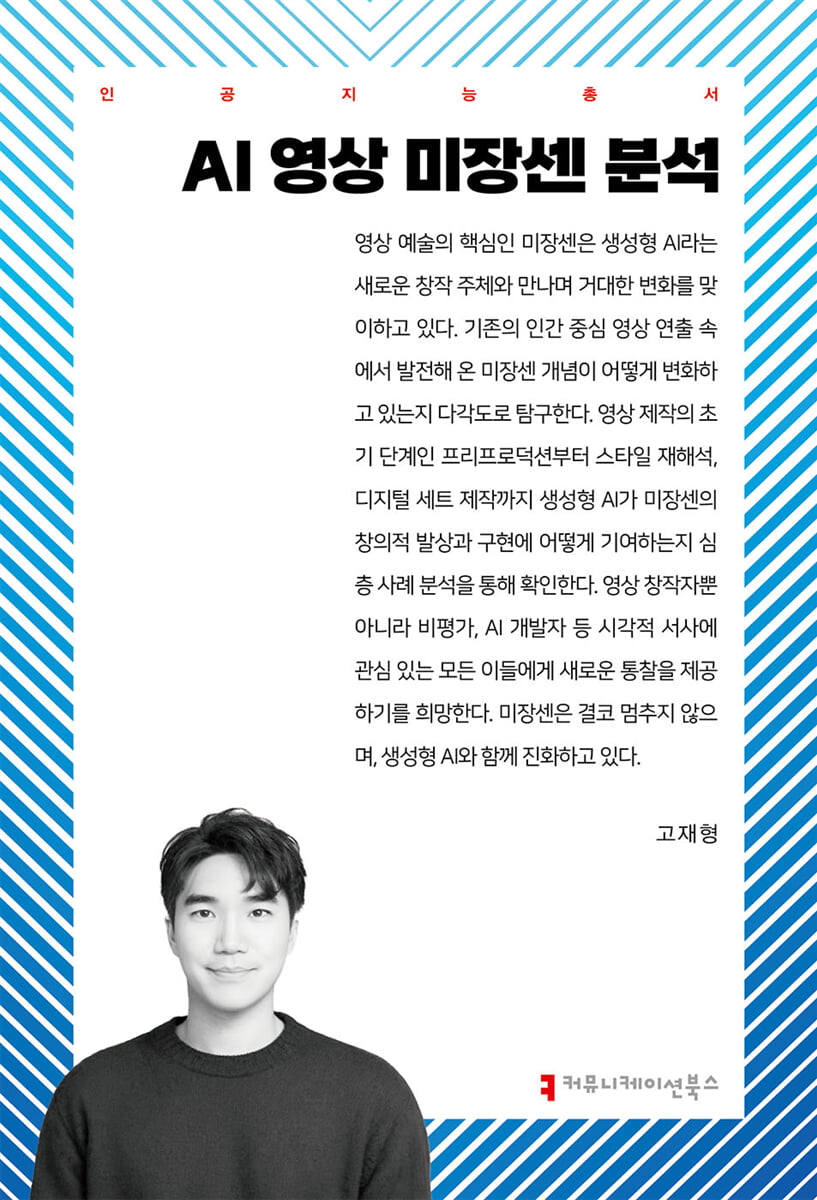
Generative AI reinterprets the entire scope of video mise-en-scène, from composition and color to lighting and sound, opening up new creative possibilities.
This book explores how the meaning of mise-en-scène is reborn through collaboration between humans and AI.
Artificial Intelligence Encyclopedia.
You can find the artificial intelligence knowledge you need at aiseries.oopy.io.
This book explores how the meaning of mise-en-scène is reborn through collaboration between humans and AI.
Artificial Intelligence Encyclopedia.
You can find the artificial intelligence knowledge you need at aiseries.oopy.io.
- You can preview some of the book's contents.
Preview
index
The never-ending evolution of mise-en-scène with generative AI
01 The Concept and Evolution of Mise-en-scène
02 Generative AI Mise-en-scène Case Study
03 Genre-specific generative AI video mise-en-scène analysis
04 Composition created by generative AI
05 The Evolution of Generative AI and Video Camerawork
06 Generative AI and Image Blocking
07 Reinterpreting Colors Created by Algorithms
08 Generative AI Video Lighting Mise-en-scène
09 Generative AI Sound Mise-en-scène
10 Future Prospects for Generative AI Video Mise-en-scène
01 The Concept and Evolution of Mise-en-scène
02 Generative AI Mise-en-scène Case Study
03 Genre-specific generative AI video mise-en-scène analysis
04 Composition created by generative AI
05 The Evolution of Generative AI and Video Camerawork
06 Generative AI and Image Blocking
07 Reinterpreting Colors Created by Algorithms
08 Generative AI Video Lighting Mise-en-scène
09 Generative AI Sound Mise-en-scène
10 Future Prospects for Generative AI Video Mise-en-scène
Into the book
In the mid-21st century, the emergence of generative AI heralds unprecedented changes in the concept of mise-en-scène and its practice.
Generative AI platforms such as Midjourney, DALL-E, Runway, and Sora visually generate images with specific moods, time and space, and style using only verbal instructions called text prompts.
This technology can automatically generate and combine individual elements that make up mise-en-scène, replacing or supporting a wide range of areas, including conventional set construction, lighting design, costume design, and even character blocking.
--- From “01_“The Concept and Evolution of Mise-en-scène””
This flexible combination of genres demonstrates that generative AI deeply understands the essence of each genre, while simultaneously serving as a catalyst for infinitely expanding the expressive realm of visual art.
Generative AI not only contributes to designing mise-en-scène appropriate for each genre, but is also solidifying its position as the ultimate tool for creating visual expressions of mise-en-scène that transcend genre limitations.
--- From 「03_“Genre-specific generative AI video mise-en-scène analysis”」
Data-driven representations enable audiences to reason about blocking, ensuring that blocking proposals consider narrative plausibility rather than mere aesthetic optimization.
Blocking is a key artistic device that reveals the inner workings of characters and their relationships with each other through space.
It is also a powerful means of visually expressing complex social interactions, such as subtle psychological distances, power relations, and exchanges of glances between characters.
Generative AI can learn and creatively apply these human elements to blocking, adding artistic depth beyond mere technical efficiency.
--- From “06_“Generative AI and Image Blocking””
The traditional understanding of mise-en-scène has centered on the arrangement and interrelationship of visual elements within the screen, but sound, especially acoustic elements that convey temporal, spatial, and material information, goes beyond being a simple 'emotional aid' and functions as a structural and perceptual axis of mise-en-scène.
The auditory dimension of mise-en-scène allows the audience to imagine the invisible space beyond the screen, reconstructing the depth, texture, and movement of the scene, revealing the implicit flow of the narrative that the image cannot provide.
Generative AI platforms such as Midjourney, DALL-E, Runway, and Sora visually generate images with specific moods, time and space, and style using only verbal instructions called text prompts.
This technology can automatically generate and combine individual elements that make up mise-en-scène, replacing or supporting a wide range of areas, including conventional set construction, lighting design, costume design, and even character blocking.
--- From “01_“The Concept and Evolution of Mise-en-scène””
This flexible combination of genres demonstrates that generative AI deeply understands the essence of each genre, while simultaneously serving as a catalyst for infinitely expanding the expressive realm of visual art.
Generative AI not only contributes to designing mise-en-scène appropriate for each genre, but is also solidifying its position as the ultimate tool for creating visual expressions of mise-en-scène that transcend genre limitations.
--- From 「03_“Genre-specific generative AI video mise-en-scène analysis”」
Data-driven representations enable audiences to reason about blocking, ensuring that blocking proposals consider narrative plausibility rather than mere aesthetic optimization.
Blocking is a key artistic device that reveals the inner workings of characters and their relationships with each other through space.
It is also a powerful means of visually expressing complex social interactions, such as subtle psychological distances, power relations, and exchanges of glances between characters.
Generative AI can learn and creatively apply these human elements to blocking, adding artistic depth beyond mere technical efficiency.
--- From “06_“Generative AI and Image Blocking””
The traditional understanding of mise-en-scène has centered on the arrangement and interrelationship of visual elements within the screen, but sound, especially acoustic elements that convey temporal, spatial, and material information, goes beyond being a simple 'emotional aid' and functions as a structural and perceptual axis of mise-en-scène.
The auditory dimension of mise-en-scène allows the audience to imagine the invisible space beyond the screen, reconstructing the depth, texture, and movement of the scene, revealing the implicit flow of the narrative that the image cannot provide.
--- From “09_“Generative AI Sound Mise-en-scène””
Publisher's Review
AI and Mise-en-scène: Reconstructing Visual Language
The essence of visual art is not a simple arrangement of images, but mise-en-scène, which conveys emotions and messages through the arrangement of people, objects, lighting, color, and movement.
In this field, long dominated by the intuition and aesthetics of human creators, generative AI has emerged as a new variable. By learning vast amounts of data, AI reinterprets traditional principles like composition, color, lighting, and blocking, presenting visual combinations beyond human imagination.
This expands mise-en-scène from a simple directing technique to a creative language in which human and non-human subjects collaborate to reconstruct it.
This book systematically explores how AI learns and creates mise-en-scène, covering everything from the visual grammar of classic films to cutting-edge deep learning-based image analysis.
It provides a balanced view of the creative possibilities and limitations of AI through specific examples such as previsualization, virtual sets, camera work, color scripts, lighting simulations, and auditory mise-en-scène.
Furthermore, it presents a new paradigm of visual language for creators, critics, and researchers collaborating with AI, and shows how the age-old concept of mise-en-scène is being reborn with generative AI.
The essence of visual art is not a simple arrangement of images, but mise-en-scène, which conveys emotions and messages through the arrangement of people, objects, lighting, color, and movement.
In this field, long dominated by the intuition and aesthetics of human creators, generative AI has emerged as a new variable. By learning vast amounts of data, AI reinterprets traditional principles like composition, color, lighting, and blocking, presenting visual combinations beyond human imagination.
This expands mise-en-scène from a simple directing technique to a creative language in which human and non-human subjects collaborate to reconstruct it.
This book systematically explores how AI learns and creates mise-en-scène, covering everything from the visual grammar of classic films to cutting-edge deep learning-based image analysis.
It provides a balanced view of the creative possibilities and limitations of AI through specific examples such as previsualization, virtual sets, camera work, color scripts, lighting simulations, and auditory mise-en-scène.
Furthermore, it presents a new paradigm of visual language for creators, critics, and researchers collaborating with AI, and shows how the age-old concept of mise-en-scène is being reborn with generative AI.
GOODS SPECIFICS
- Date of issue: October 15, 2025
- Page count, weight, size: 149 pages | 128*188*7mm
- ISBN13: 9791143013330
You may also like
카테고리
korean


korean

![ELLE 엘르 A형 (여성월간) : 1월 [2026]](http://librairie.coreenne.fr/cdn/shop/files/3b70e1cf77cf67d6da56e0eb041901e8.jpg?v=1767265322&width=3840)


