

AI, metaverse, digital culture and arts
 |
Description
Book Introduction
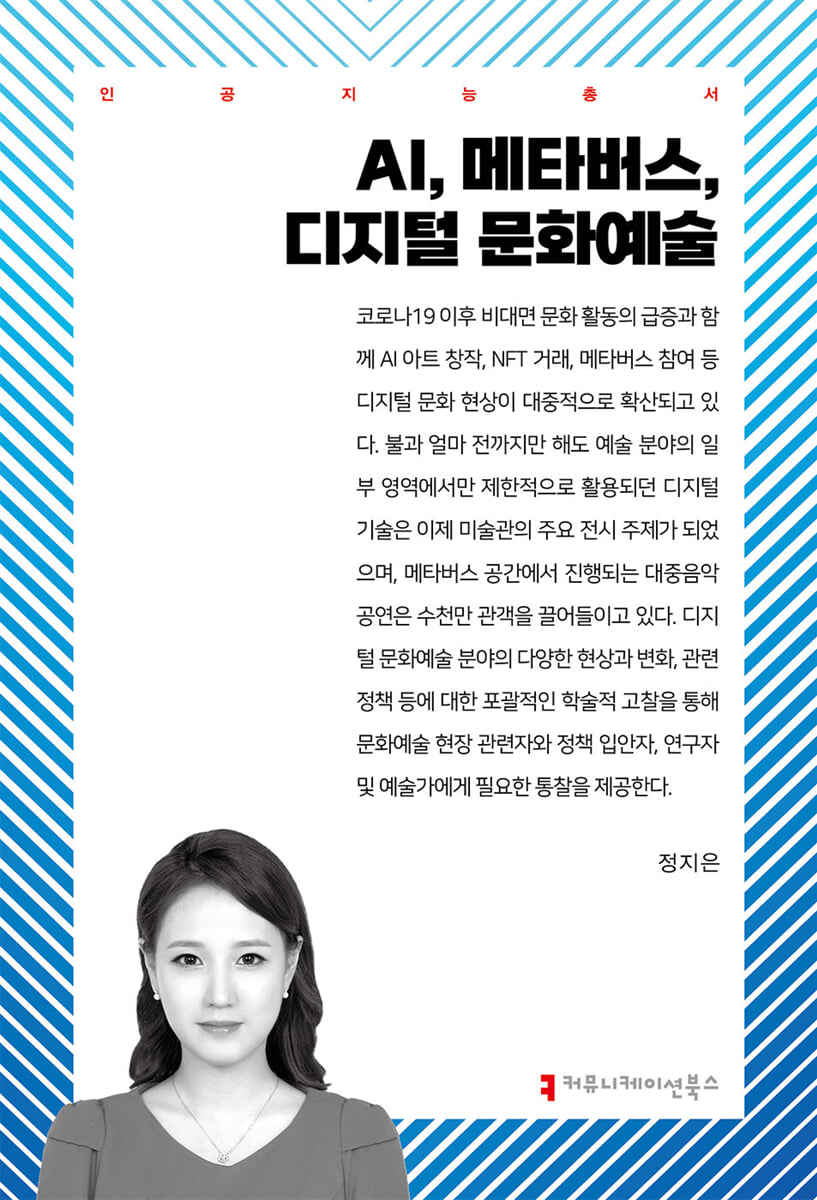
AI, the metaverse, and NFTs are revolutionizing how we create and enjoy art.
This book synthesizes global cases and Korean policies to provide a balanced analysis of the potential and ethical challenges of digital culture and arts.
Artificial Intelligence Encyclopedia.
You can find the artificial intelligence knowledge you need at aiseries.oopy.io.
This book synthesizes global cases and Korean policies to provide a balanced analysis of the potential and ethical challenges of digital culture and arts.
Artificial Intelligence Encyclopedia.
You can find the artificial intelligence knowledge you need at aiseries.oopy.io.
- You can preview some of the book's contents.
Preview
index
New Horizons in Digital Culture and Arts
01 Digital Innovation and Culture and Arts
02 Changes in Digital Culture and Arts Policy
03 Metaverse and Cultural Content
04 Metaverse and Artists
05 Cultural and Arts Education Transformed by AI and Virtual Reality
06 AI and Art Creation
07 Digitization of Cultural Heritage
08 Convergence of Metaverse and AI
09 Ethics of Digital Culture and Arts
10 The Future of Culture and Arts in the Digital Age
01 Digital Innovation and Culture and Arts
02 Changes in Digital Culture and Arts Policy
03 Metaverse and Cultural Content
04 Metaverse and Artists
05 Cultural and Arts Education Transformed by AI and Virtual Reality
06 AI and Art Creation
07 Digitization of Cultural Heritage
08 Convergence of Metaverse and AI
09 Ethics of Digital Culture and Arts
10 The Future of Culture and Arts in the Digital Age
Into the book
The key to digital transformation lies in connectivity and data.
Advances in mobile network technology have ushered in an era of hyperconnectivity, creating a new technological environment that connects people and things in real time. Advances in AI and computer technology have enabled massive, real-time data analysis and processing, laying the technological foundation for the era of digital transformation (Joo Young-seop, 2022).
The digital transformation is particularly important in the cultural and artistic fields, as it serves as the foundation for fundamentally restructuring the relationship between creators and audiences and the distribution methods of works.
--- From “01_“Digital Innovation and Culture and Arts””
The early metaverse was dominated by simple games and 2D electronic games.
However, with the development of 3D graphics technology and the Internet, the scope of use of virtual worlds has expanded.
Currently, the metaverse platform is expanding beyond simple content consumption to encompass gaming, entertainment, and B2C (Business to Consumer) sectors. B2C refers to a business model in which companies sell products or services directly to consumers.
--- From “03_“Metaverse and Cultural Content””
The emergence of AI poets and novelists opens up new possibilities for literary creation.
Of course, it is currently difficult for AI to completely reproduce the deep insights and emotions of human writers.
However, it does a good job of serving as a useful 'assistant tool', providing creative ideas, drafting, and helping with repetitive sentence generation.
These technological advancements present challenges that must be addressed. Ethical issues such as copyright in AI creations, criteria for determining originality, and the difficulty of verifying plagiarism are constantly being raised.
--- From “06_“AI and Art Creation””
Along with the Getty Images lawsuit, several prominent illustrators have also filed class-action lawsuits against AI companies.
Their core argument is that the training phase of the AI model constitutes unauthorized copying of the work.
In other words, they are taking issue with the fact that their work was used as AI learning data without permission.
These legal battles demonstrate how complex copyright issues are in the AI era.
Ultimately, finding a balance between protecting the rights of human creators and technological innovation is one of the most difficult ethical challenges facing our time.
Advances in mobile network technology have ushered in an era of hyperconnectivity, creating a new technological environment that connects people and things in real time. Advances in AI and computer technology have enabled massive, real-time data analysis and processing, laying the technological foundation for the era of digital transformation (Joo Young-seop, 2022).
The digital transformation is particularly important in the cultural and artistic fields, as it serves as the foundation for fundamentally restructuring the relationship between creators and audiences and the distribution methods of works.
--- From “01_“Digital Innovation and Culture and Arts””
The early metaverse was dominated by simple games and 2D electronic games.
However, with the development of 3D graphics technology and the Internet, the scope of use of virtual worlds has expanded.
Currently, the metaverse platform is expanding beyond simple content consumption to encompass gaming, entertainment, and B2C (Business to Consumer) sectors. B2C refers to a business model in which companies sell products or services directly to consumers.
--- From “03_“Metaverse and Cultural Content””
The emergence of AI poets and novelists opens up new possibilities for literary creation.
Of course, it is currently difficult for AI to completely reproduce the deep insights and emotions of human writers.
However, it does a good job of serving as a useful 'assistant tool', providing creative ideas, drafting, and helping with repetitive sentence generation.
These technological advancements present challenges that must be addressed. Ethical issues such as copyright in AI creations, criteria for determining originality, and the difficulty of verifying plagiarism are constantly being raised.
--- From “06_“AI and Art Creation””
Along with the Getty Images lawsuit, several prominent illustrators have also filed class-action lawsuits against AI companies.
Their core argument is that the training phase of the AI model constitutes unauthorized copying of the work.
In other words, they are taking issue with the fact that their work was used as AI learning data without permission.
These legal battles demonstrate how complex copyright issues are in the AI era.
Ultimately, finding a balance between protecting the rights of human creators and technological innovation is one of the most difficult ethical challenges facing our time.
--- From “09_“Ethics of Digital Culture and Arts””
Publisher's Review
AI and the Metaverse: Expanding the Horizons of Digital Art
AI, the metaverse, and digital transformation are fundamentally changing how we create, distribute, and enjoy culture and art.
Artists are creating music and paintings with AI, performing in the metaverse, and creating new revenue models with NFTs and blockchain.
As traditional art museums expand into virtual spaces and avatars and digital artists emerge as new creative entities, art is expanding beyond the constraints of time and space.
But at the same time, new ethical challenges are emerging, such as copyright infringement, algorithmic bias, and the digital divide.
This book covers a wide range of topics, including international policies and cases, Korea's digital arts and culture strategy, generative AI and cultural heritage preservation, and the NFT art market.
We explore the possibilities and risks of the convergence of technology and art through specific examples such as teamLab, Google Arts and Culture, Blackpink's metaverse performance, and the issuance of Uffizi NFTs.
Furthermore, it sheds light on key issues such as copyright in AI art, the authenticity of metaverse performances, and securing publicness, and asks what meaning digital culture and art have for society and human life beyond mere trends.
AI, the metaverse, and digital transformation are fundamentally changing how we create, distribute, and enjoy culture and art.
Artists are creating music and paintings with AI, performing in the metaverse, and creating new revenue models with NFTs and blockchain.
As traditional art museums expand into virtual spaces and avatars and digital artists emerge as new creative entities, art is expanding beyond the constraints of time and space.
But at the same time, new ethical challenges are emerging, such as copyright infringement, algorithmic bias, and the digital divide.
This book covers a wide range of topics, including international policies and cases, Korea's digital arts and culture strategy, generative AI and cultural heritage preservation, and the NFT art market.
We explore the possibilities and risks of the convergence of technology and art through specific examples such as teamLab, Google Arts and Culture, Blackpink's metaverse performance, and the issuance of Uffizi NFTs.
Furthermore, it sheds light on key issues such as copyright in AI art, the authenticity of metaverse performances, and securing publicness, and asks what meaning digital culture and art have for society and human life beyond mere trends.
GOODS SPECIFICS
- Date of issue: October 16, 2025
- Page count, weight, size: 124 pages | 128*188*7mm
- ISBN13: 9791143008282
You may also like
카테고리
korean


korean

![ELLE 엘르 A형 (여성월간) : 1월 [2026]](http://librairie.coreenne.fr/cdn/shop/files/3b70e1cf77cf67d6da56e0eb041901e8.jpg?v=1767265322&width=3840)


