

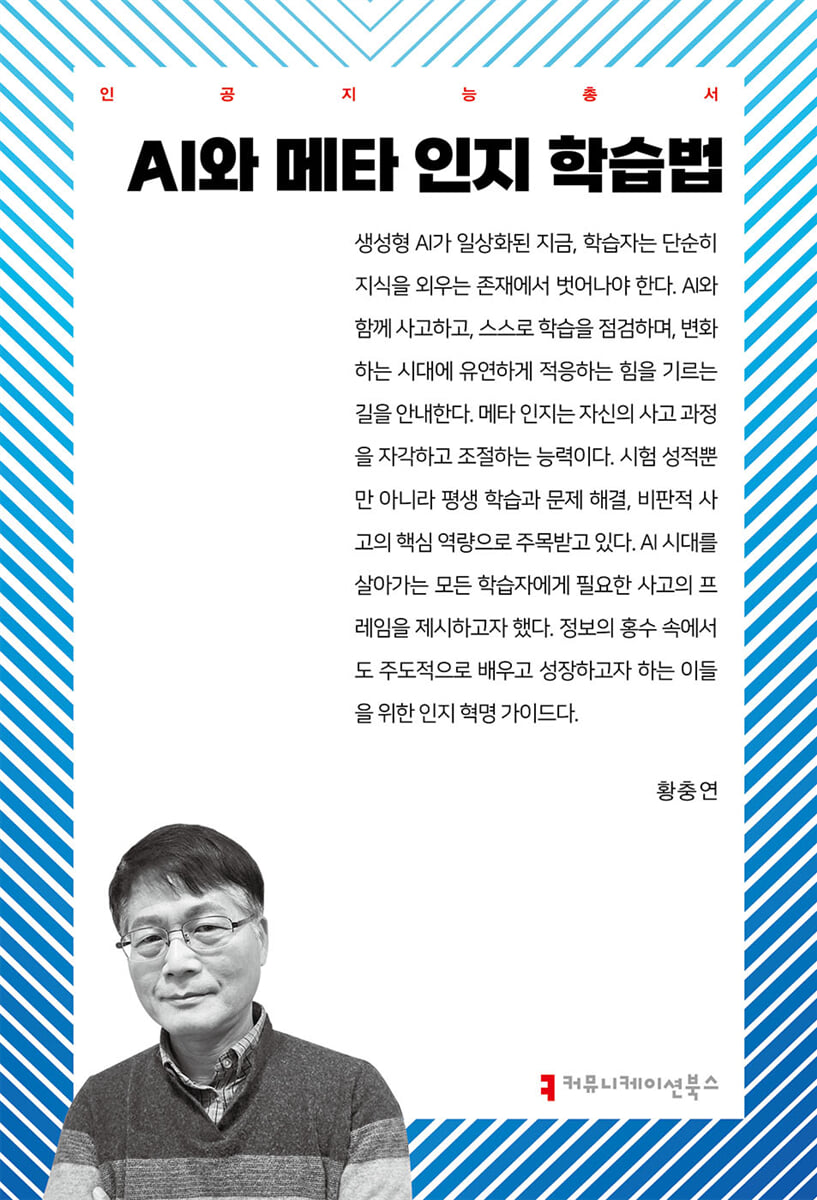
AI and Metacognitive Learning Methods
 |
Description
Book Introduction
Information is easy to obtain, but real learning is completed when you examine yourself.
This book shows how learners can develop into active agents through metacognition. It presents the reflections and strategies necessary for the AI era.
Artificial Intelligence Encyclopedia.
You can find the artificial intelligence knowledge you need at aiseries.oopy.io.
This book shows how learners can develop into active agents through metacognition. It presents the reflections and strategies necessary for the AI era.
Artificial Intelligence Encyclopedia.
You can find the artificial intelligence knowledge you need at aiseries.oopy.io.
- You can preview some of the book's contents.
Preview
index
AI and the Third Eye: Rethinking Learning in the Age of Cognition
01 What is metacognition?
02 History and Evolution of Metacognitive Learning Methods
03 Self-assessment learning through AI
04 Goal Setting and Metacognition in the AI Era
05 Strategic Learning Methods and AI-Based Scaffolding
06 Adjusting learning with real-time data
07 Learning from Failure: Metacognitive Recovery Strategies
08 Autonomy and Self-Directed Learning in the AI Era
09 Collaboration, Reflection, and Social Metacognition
10 Metacognition and the Future of Learning
01 What is metacognition?
02 History and Evolution of Metacognitive Learning Methods
03 Self-assessment learning through AI
04 Goal Setting and Metacognition in the AI Era
05 Strategic Learning Methods and AI-Based Scaffolding
06 Adjusting learning with real-time data
07 Learning from Failure: Metacognitive Recovery Strategies
08 Autonomy and Self-Directed Learning in the AI Era
09 Collaboration, Reflection, and Social Metacognition
10 Metacognition and the Future of Learning
Into the book
Metacognition is the ability to recognize and regulate one's own thought processes, and is a key driver of learning that goes beyond simple knowledge acquisition.
True understanding begins when learners plan strategies, detect errors, and adapt their thinking flexibly.
It serves as the foundation for self-directed thinking that can be transferred to any learning context and is an essential competency for learners in the era of lifelong learning.
--- From “01_“What is Metacognition?””
AI is particularly good at asking personalized questions, summarizing thought processes, and suggesting next learning steps.
This shows that AI can function not only as a tool but also as a 'companion for reflective thinking'.
Of course, AI cannot replace human teachers.
However, it is clear that working with teachers can be a powerful tool to support students' metacognitive growth.
--- From “03_“Self-assessment learning through AI””
Beyond visual information, some AI systems use physiological signals like heart rate and skin conductance, or interaction data like random clicks, to infer attentional states.
When low focus is detected, it can trigger mini-quizzes or suggest short breaks. The AI chatbot uses adaptive questions to prompt learners to respond.
If a student gets a question wrong or hesitates, provide a response such as, “What part were you confused about?” or “Can I explain the key concept again?”
This goes beyond simple knowledge verification to maintain learner engagement and stimulate metacognitive activity.
--- From “06_“Adjusting Learning with Real-Time Data””
Cognitive biases cloud our judgment of the credibility of a source.
Learners who want to believe a particular claim are likely to only accept information that supports their own position and ignore opposing views.
Metacognitive strategy education begins with awareness of these biases.
Teachers encourage students to reflect on their own judgments by asking questions like, “What assumptions did I have in trusting this source?”
This is a metacognitive training that goes beyond simply evaluating information and examines one's own way of thinking.
True understanding begins when learners plan strategies, detect errors, and adapt their thinking flexibly.
It serves as the foundation for self-directed thinking that can be transferred to any learning context and is an essential competency for learners in the era of lifelong learning.
--- From “01_“What is Metacognition?””
AI is particularly good at asking personalized questions, summarizing thought processes, and suggesting next learning steps.
This shows that AI can function not only as a tool but also as a 'companion for reflective thinking'.
Of course, AI cannot replace human teachers.
However, it is clear that working with teachers can be a powerful tool to support students' metacognitive growth.
--- From “03_“Self-assessment learning through AI””
Beyond visual information, some AI systems use physiological signals like heart rate and skin conductance, or interaction data like random clicks, to infer attentional states.
When low focus is detected, it can trigger mini-quizzes or suggest short breaks. The AI chatbot uses adaptive questions to prompt learners to respond.
If a student gets a question wrong or hesitates, provide a response such as, “What part were you confused about?” or “Can I explain the key concept again?”
This goes beyond simple knowledge verification to maintain learner engagement and stimulate metacognitive activity.
--- From “06_“Adjusting Learning with Real-Time Data””
Cognitive biases cloud our judgment of the credibility of a source.
Learners who want to believe a particular claim are likely to only accept information that supports their own position and ignore opposing views.
Metacognitive strategy education begins with awareness of these biases.
Teachers encourage students to reflect on their own judgments by asking questions like, “What assumptions did I have in trusting this source?”
This is a metacognitive training that goes beyond simply evaluating information and examines one's own way of thinking.
--- From “09_“Collaboration, Reflection, and Social Metacognition””
Publisher's Review
The Path to Reflective Learning with AI
In today's world of easy access to information, learners are no longer simply beings who acquire knowledge.
What's important is not simply accepting the given answer, but rather the ability to examine and utilize that answer yourself.
The power that makes this possible is metacognition.
It is necessary to go through a process of checking one's own level of understanding, adjusting strategies, and reflecting on failures to lead to new learning.
Learners with metacognition do not get lost in the vast amount of information and continue their learning journey proactively.
This book explores the concept and roots of metacognition, as well as specific practical strategies.
It covers key elements such as goal setting, self-assessment, strategy coordination, and critical thinking with case studies, and demonstrates how tools like ChatGPT and Kanmigo can act as thought partners.
At the same time, we warn against the 'metacognitive laziness' that uncritical dependence can bring about, and suggest ways to maintain reflective thinking and intellectual autonomy even amidst the convenience of technology.
A practical guide that guides learners to find ways to teach and expand themselves.
In today's world of easy access to information, learners are no longer simply beings who acquire knowledge.
What's important is not simply accepting the given answer, but rather the ability to examine and utilize that answer yourself.
The power that makes this possible is metacognition.
It is necessary to go through a process of checking one's own level of understanding, adjusting strategies, and reflecting on failures to lead to new learning.
Learners with metacognition do not get lost in the vast amount of information and continue their learning journey proactively.
This book explores the concept and roots of metacognition, as well as specific practical strategies.
It covers key elements such as goal setting, self-assessment, strategy coordination, and critical thinking with case studies, and demonstrates how tools like ChatGPT and Kanmigo can act as thought partners.
At the same time, we warn against the 'metacognitive laziness' that uncritical dependence can bring about, and suggest ways to maintain reflective thinking and intellectual autonomy even amidst the convenience of technology.
A practical guide that guides learners to find ways to teach and expand themselves.
GOODS SPECIFICS
- Date of issue: October 15, 2025
- Page count, weight, size: 137 pages | 128*188*7mm
- ISBN13: 9791143007988
You may also like
카테고리
korean


korean

![ELLE 엘르 A형 (여성월간) : 1월 [2026]](http://librairie.coreenne.fr/cdn/shop/files/3b70e1cf77cf67d6da56e0eb041901e8.jpg?v=1767265322&width=3840)


