

AI and Grammar Education
 |
Description
Book Introduction
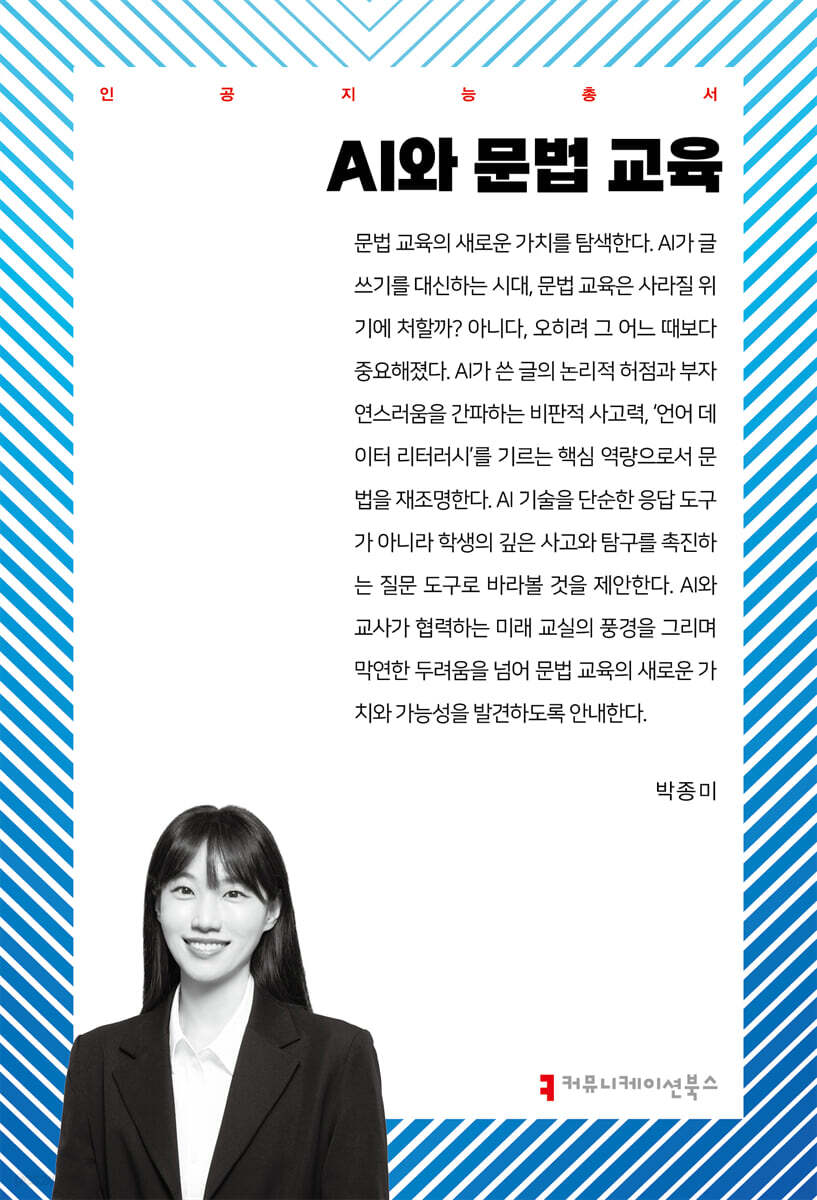
In grammar education, we propose a new educational paradigm that expands thinking through questioning, fostering both teacher expertise and student inquiry. We view AI as a learning partner, not a machine that simply provides answers.
Artificial Intelligence Encyclopedia.
You can find the artificial intelligence knowledge you need at aiseries.oopy.io.
Artificial Intelligence Encyclopedia.
You can find the artificial intelligence knowledge you need at aiseries.oopy.io.
- You can preview some of the book's contents.
Preview
index
AI's touching comfort and encouragement
01 AI and Grammar Education Trends
02 Kanmigo and AI Digital Textbook
03 AI Grammar and Human Grammar
04 AI Grammar Teacher with Bad Grammar
05 Grammar Exploration with ChatGPT
06 The Importance of High-Quality Data
07 The Importance of Grammar Teachers in the AI Era
08 The Importance of Grammar in the AI Era
09 Direction of change in grammar education content
10 The Future of Grammar Education in the AI Era
01 AI and Grammar Education Trends
02 Kanmigo and AI Digital Textbook
03 AI Grammar and Human Grammar
04 AI Grammar Teacher with Bad Grammar
05 Grammar Exploration with ChatGPT
06 The Importance of High-Quality Data
07 The Importance of Grammar Teachers in the AI Era
08 The Importance of Grammar in the AI Era
09 Direction of change in grammar education content
10 The Future of Grammar Education in the AI Era
Into the book
So, how is the field of grammar education responding to the emergence of AI amidst this massive wave of change? Unfortunately, compared to other fields, its response has been relatively muted.
Nearly three years have passed since ChatGPIT was introduced, but domestic research on AI-based grammar education for native speakers is still scarce.
This silence is even more striking compared to the active discussion about introducing AI in the fields of writing and literature education, not to mention math and English, even within the Korean language curriculum.
Why is this? There are three main reasons.
First, it may be because there is still no clear picture of what role AI can play in grammar education.
Second, it may be premature to use AI in education due to its imperfect performance in Korean grammar.
Third, the confusion may stem from the fact that AI does not explicitly learn grammar rules but rather uses language patterns from data, which is a very different approach from the way grammar education has been conducted so far.
--- From “01_“AI and Grammar Education Trends””
Piantadosi also suggests that AI may have a sense of grammar.
When he showed GPT-3.5 the famous example Chomsky gave, “Colorless green ideas sleep furiously,” the AI responded that the sentence was grammatically correct but semantically strange.
On the other hand, when “Green sleep furiously colorless ideas” was presented, it was pointed out that it was grammatically awkward.
This suggests that, contrary to Chomsky's claims, AI has internalized the ability to judge the 'grammaticality' of a sentence independently of its meaning.
--- From "03_“AI Grammar and Human Grammar”"
Above all, the involvement of a professional grammar teacher is essential.
Those who best understand the real-world context of grammar education are teachers in the field.
This is because they are the 'field experts' who know best which grammar concepts students frequently misunderstand, which explanation methods are effective, and when and how feedback should be provided.
Teachers are also those who can transform the same grammar knowledge into diverse "pedagogical content knowledge (PCK)" tailored to the learner's situation. For AI to become a competent tutor, it must learn from high-quality data directly created by these teachers.
But teachers alone are not enough.
Collaboration with data experts is essential for teachers' expertise and know-how to be converted into "data" that AI can learn from.
Since the explanations or conversation materials provided by the teacher are in natural language, they must be converted into a structure that AI can understand.
This process requires technical work such as attaching part-of-speech information to sentences (tagging), analyzing syntactic structure, and classifying types of feedback.
Additionally, designing the hierarchy and relationships of grammatical concepts in the form of ontology also requires a technical understanding of knowledge representation languages (e.g., RDF, OWL).
--- From “06_“The Importance of High-Quality Data””
The view on word meaning according to neostructuralism is summarized in the distributional hypothesis.
This can be summarized in the words of linguist John Firth: “You shall know a word by the company it keeps.”
That is, the meaning of a word is determined by the statistical distribution information of which words the word mainly appears with in a large text.
For example, 'warm' tends to appear with 'coffee', 'weather', and 'heart', and 'cold' tends to appear with 'ice', 'wind', and 'expression'.
By statistically analyzing the patterns of words that appear together like this, we can objectively define the semantic difference between 'warm' and 'cold'.
This distribution hypothesis becomes the principle of natural language processing technology in modern artificial intelligence.
Word embedding models such as Word2Vec are representative examples of mathematical implementations of the distributional hypothesis.
Nearly three years have passed since ChatGPIT was introduced, but domestic research on AI-based grammar education for native speakers is still scarce.
This silence is even more striking compared to the active discussion about introducing AI in the fields of writing and literature education, not to mention math and English, even within the Korean language curriculum.
Why is this? There are three main reasons.
First, it may be because there is still no clear picture of what role AI can play in grammar education.
Second, it may be premature to use AI in education due to its imperfect performance in Korean grammar.
Third, the confusion may stem from the fact that AI does not explicitly learn grammar rules but rather uses language patterns from data, which is a very different approach from the way grammar education has been conducted so far.
--- From “01_“AI and Grammar Education Trends””
Piantadosi also suggests that AI may have a sense of grammar.
When he showed GPT-3.5 the famous example Chomsky gave, “Colorless green ideas sleep furiously,” the AI responded that the sentence was grammatically correct but semantically strange.
On the other hand, when “Green sleep furiously colorless ideas” was presented, it was pointed out that it was grammatically awkward.
This suggests that, contrary to Chomsky's claims, AI has internalized the ability to judge the 'grammaticality' of a sentence independently of its meaning.
--- From "03_“AI Grammar and Human Grammar”"
Above all, the involvement of a professional grammar teacher is essential.
Those who best understand the real-world context of grammar education are teachers in the field.
This is because they are the 'field experts' who know best which grammar concepts students frequently misunderstand, which explanation methods are effective, and when and how feedback should be provided.
Teachers are also those who can transform the same grammar knowledge into diverse "pedagogical content knowledge (PCK)" tailored to the learner's situation. For AI to become a competent tutor, it must learn from high-quality data directly created by these teachers.
But teachers alone are not enough.
Collaboration with data experts is essential for teachers' expertise and know-how to be converted into "data" that AI can learn from.
Since the explanations or conversation materials provided by the teacher are in natural language, they must be converted into a structure that AI can understand.
This process requires technical work such as attaching part-of-speech information to sentences (tagging), analyzing syntactic structure, and classifying types of feedback.
Additionally, designing the hierarchy and relationships of grammatical concepts in the form of ontology also requires a technical understanding of knowledge representation languages (e.g., RDF, OWL).
--- From “06_“The Importance of High-Quality Data””
The view on word meaning according to neostructuralism is summarized in the distributional hypothesis.
This can be summarized in the words of linguist John Firth: “You shall know a word by the company it keeps.”
That is, the meaning of a word is determined by the statistical distribution information of which words the word mainly appears with in a large text.
For example, 'warm' tends to appear with 'coffee', 'weather', and 'heart', and 'cold' tends to appear with 'ice', 'wind', and 'expression'.
By statistically analyzing the patterns of words that appear together like this, we can objectively define the semantic difference between 'warm' and 'cold'.
This distribution hypothesis becomes the principle of natural language processing technology in modern artificial intelligence.
Word embedding models such as Word2Vec are representative examples of mathematical implementations of the distributional hypothesis.
--- From “09_“Changes in the Content of Grammar Education””
Publisher's Review
AI and Grammar Education: Questions Create Answers
We provide specific suggestions on how AI can be used to expand learners' thinking and enhance teachers' expertise in teaching grammar.
Starting with the awareness that artificial intelligence should be utilized as an 'exploration partner' rather than a 'provider of correct answers', the author emphasizes that learning is a process of growth through uncomfortable conflicts and trial and error, based on Jean Piaget's learning theory and the author's educational experience.
But if AI provides all the answers, students may lose the opportunity to learn.
This paper explores the direction of grammar education in the AI era through examples such as Korea's AI digital textbook and Khan Academy's Kanmigo, AI's grammatical errors and limitations, and actual classroom learning using ChatGPiT. We must critically embrace AI and design educational environments centered on inquiry.
The goal of grammar education is not simply memorizing rules, but expanding linguistic thinking skills, and AI can serve as a conversationalist and facilitator to help achieve this.
Rather than a technological solution, we consider the coexistence of AI and grammar education from a humanist's perspective.
We provide specific suggestions on how AI can be used to expand learners' thinking and enhance teachers' expertise in teaching grammar.
Starting with the awareness that artificial intelligence should be utilized as an 'exploration partner' rather than a 'provider of correct answers', the author emphasizes that learning is a process of growth through uncomfortable conflicts and trial and error, based on Jean Piaget's learning theory and the author's educational experience.
But if AI provides all the answers, students may lose the opportunity to learn.
This paper explores the direction of grammar education in the AI era through examples such as Korea's AI digital textbook and Khan Academy's Kanmigo, AI's grammatical errors and limitations, and actual classroom learning using ChatGPiT. We must critically embrace AI and design educational environments centered on inquiry.
The goal of grammar education is not simply memorizing rules, but expanding linguistic thinking skills, and AI can serve as a conversationalist and facilitator to help achieve this.
Rather than a technological solution, we consider the coexistence of AI and grammar education from a humanist's perspective.
GOODS SPECIFICS
- Date of issue: September 19, 2025
- Page count, weight, size: 120 pages | 128*188*8mm
- ISBN13: 9791143008190
You may also like
카테고리
korean


korean

![ELLE 엘르 A형 (여성월간) : 1월 [2026]](http://librairie.coreenne.fr/cdn/shop/files/3b70e1cf77cf67d6da56e0eb041901e8.jpg?v=1767265322&width=3840)


