

Urban Jungle
 |
Description
Book Introduction
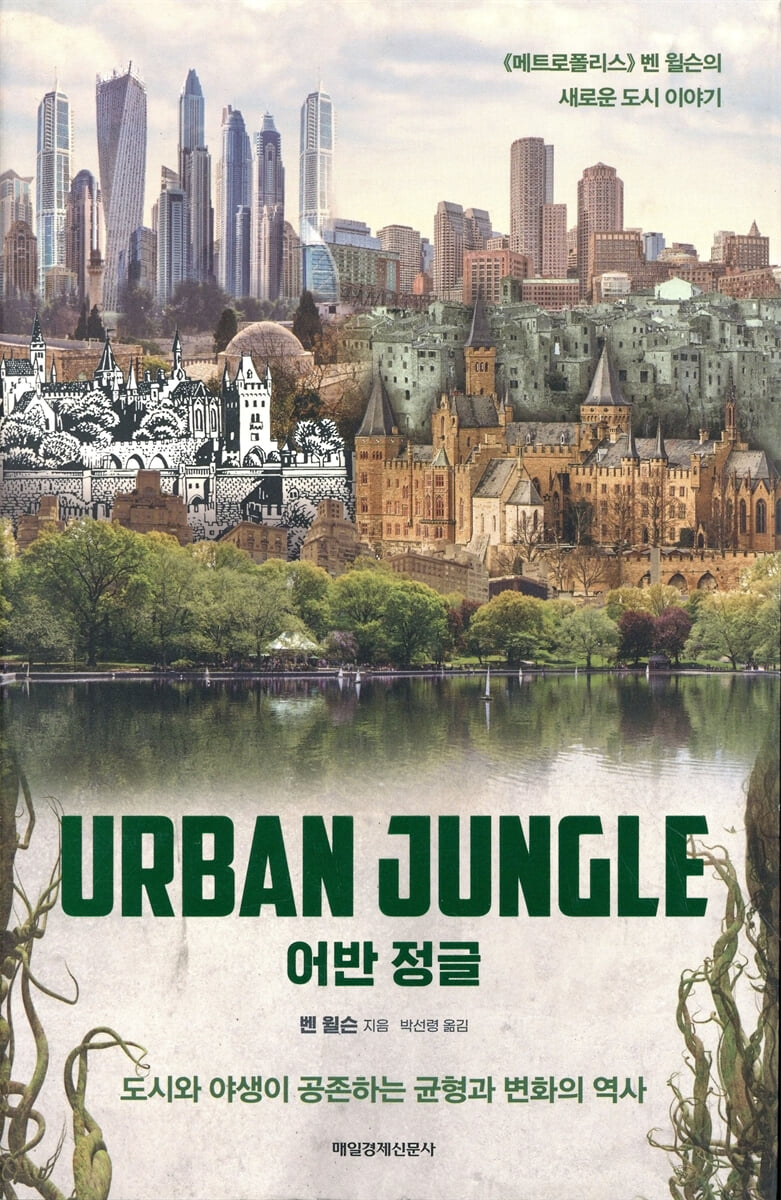
Explore the wild world hidden within the city, behind the facade of civilization. Why are more species found in cities than in forests? How can we read the power of place in nature within the city? Where should urban ecosystems go in the era of climate crisis? In "Metropolis," Ben Wilson explored 26 cities that flourished over 6,000 years of human civilization. In "Urban Jungle," he explores the wilder parts of cities that have long escaped the gaze of historians. In the unseen, unsightly corners of our cities—in cracks in pavement, building sites, hidden swamps, and squalid wastelands—nature thrives unchecked, enjoying unchecked freedom. The abundance of nature within the city is astonishing, but what is most striking is the sheer dynamism of the urban ecosystem. On the other hand, humans created urban parks due to industrialization. It is there that nature is organized and simplified, the spontaneity and messiness of wildlife are suppressed, and the human impulse to dominate is most evident. However, the unnatural forms of nature that people despised continued to survive and learned to coexist quietly with humans. Only recently have we come to appreciate the beauty and immeasurable value contained within this wild mess. In these times of climate emergency and biodiversity loss, everyone is interested in urban nature. Beyond such simple concerns, this book examines the long and complex relationship that exists between city dwellers and their environments within and around the metropolis. |
- You can preview some of the book's contents.
Preview
index
Entering.
Let's return the city to its wildness
Chapter 1.
city boundaries
Chapter 2.
Parks and Recreation
Chapter 3.
concrete cracks
Chapter 4.
canopy
Chapter 5.
vitality
Chapter 6.
harvest
Chapter 7.
Zootropolis
Epilogue.
last
America.
Words of gratitude.
Let's return the city to its wildness
Chapter 1.
city boundaries
Chapter 2.
Parks and Recreation
Chapter 3.
concrete cracks
Chapter 4.
canopy
Chapter 5.
vitality
Chapter 6.
harvest
Chapter 7.
Zootropolis
Epilogue.
last
America.
Words of gratitude.
Detailed image
.jpg)
Into the book
Owen graduated from Oxford University in 1958 and received his doctorate from the University of Michigan, after which he held professorships in Uganda and Sierra Leone.
When she lived in Sierra Leone, she noticed that there was more wildlife in her garden than in the nearby forest.
Returning to the University of Leicester in England in 1971, Owen began a 30-year study of a suburban garden measuring just 741 square meters.
During that period, Owen observed and recorded a total of 2,673 species of organisms, including 474 species of plants, 1,997 species of insects, 138 species of invertebrates, and 64 species of vertebrates.
…Owen's garden wasn't intentionally managed as a biodiverse habitat, it was just an ordinary backyard.
However, about 9 per cent of all species found in Britain are found there.
Additional scientific studies examining gardens in other cities echoed Jennifer Owen's findings.
Urban gardens have been found to contain more species per square foot than semi-wild rural habitats.
It is the opposite of a 'biological desert', a term more appropriate for the numerous farms in rural areas that grow a single plant species.
In comparison, the suburbs of the city can be said to be a vibrant land.
--- p.58-59, from “Chapter 1: The Boundaries of the City”
The garden is also used for other purposes.
One of them is the indelible seal of conquest and subjugation.
What could be a greater demonstration of power than rearranging an entire landscape? Gardens also make cities more pleasant.
The Mughal elite were not very fond of Agra's dust and hot climate and wanted to leave with their spoils.
Babur transformed Agra into a garden city reminiscent of Kabul.
…when Shah Jahan's paradise was completed, the face of Lahore changed, and nobles competed with each other to create their own paradise gardens.
In Lahore, landscaping was consciously used to fuse city and countryside, people and nature, into a unified whole.
The desire to harmonize the artificial and the natural led to a succession of garden cities from Persia to the Bay of Bengal, similar in many ways to the vast city-states of Mesoamerica before the Spanish conquest.
…those who visit New York's Central Park might think of it as a remnant of Manhattan's pristine landscape preserved within the ruthless human cityscape, a remnant of nature left behind within the iron logic of modern society.
But in reality, it is a direct reflection of the engineered and artificial surroundings, such as Shah Jahan's Shalimar Gardens or today's Fresh Kills Park.
--- p.84-86, from “Chapter 2 Parks and Recreation”
The widespread destruction of cities has allowed botanists to investigate how nature operates in urban environments.
It provided a valuable opportunity to investigate how native plants, which have always been removed from parks and urban settings in favor of ornamental plants that are particularly attractive to the eye, grow.
Ultimately, the devastation of war led to the emergence of urban ecosystems, fundamentally changing how we understand cities.
…disruption of the ecosystem benefits biodiversity.
In the years following a natural or man-made disaster, species numbers increase rapidly as plants and insects compete with each other for control of the barren land and rocky outcrops.
And then, over the next few decades, ecological transitions occur.
When a few tall, branchy species dominate an area and crowd out smaller plants, biodiversity decreases.
That's why bombed areas and construction sites are surprisingly rich in wildlife.
Transforming urban landscapes, temporarily dug-up wastelands, and polluted and abandoned industrial sites (brownfields) also harbor exceptionally diverse biodiversity.
--- p.118-121, from “Chapter 3 Concrete Cracks”
Trees were a sought-after architectural ornament for the wealthy, softening the rough edges of the city and lending the grandeur of a country estate to an urban setting.
London's Leicester Square became Europe's first city square with a tree-lined 'promenade' in the 1660s.
Until the late 18th century, London's fashionable squares were filled with trees taller than the surrounding houses.
When cities expand or create new streets within existing districts, trees become an essential element of the design, at least in splendid areas like Paris, Toulouse, Lyon, and London.
…the trees marched into the city.
Trees were planted along the main thoroughfares and suburban streets, adorned the newly created municipal parks of the late 19th century, and became a prominent feature of the city's cemeteries.
Even after Japan began to modernize following the Meiji Restoration in 1868, stately ornamental trees became a feature of city roadsides.
Black pine, cherry, maple, and acacia trees were planted around the European-style building in Ginza, Tokyo.
--- p.182-184, from “Chapter 4 Canopy”
Before the Dutch arrived in the Hudson Bay area in 1609, New Amsterdam, later the outskirts of New York, was awash with water.
It was surrounded by the sea on three sides and a wetland to the north.
The city was surrounded by an estuarine ecosystem teeming with unparalleled biodiversity.
The coastline between New York and New Jersey was nearly 1,600 kilometers long, with forests, mudflats, pastures, white cedar swamps, and marshes so lush and flowery that "you couldn't see the other side."
…this wetland later became East Village, Alphabet City, and Gramercy Park.
There is still a world buried beneath the concrete, asphalt, and high-rise buildings, a world filled with water.
Normally, New York City transit authorities must pump out 13 million gallons of water to keep the subways running, but after a storm, that amount doubles.
If water wasn't removed daily, Manhattan's asphalt surface would quickly crack and crumble.
--- p.228-230, from “Chapter 5: Vitality”
After fleeing poverty in the countryside and coming to Beijing in the 1920s, Xu Chuanxiang took any job he could find.
It was a sewage worker who emptied the toilet by hand and carried the sewage in 50-kilogram buckets.
He slept in a barn with his donkey and fifteen fellow workers, and lived on coarse grains instead of rice.
His work was not only dirty, but also dangerous.
'Fenbas' (shit bosses) competed with each other for the most profitable sewage collection routes in Beijing and fought fiercely to profit from the waste.
Although he was a pawn in this exploitative criminal organization, he diligently carried out his duties.
After the People's Republic of China was founded in 1949, Xu's fortunes improved as he became a member of his local sanitation workers' committee and a deputy representative to the National People's Congress.
He was selected as a model worker in 1959, declared a Socialist Hero, and invited to speak at a ceremony held at the Great Hall of the People.
After meeting Chairman Liu Shaoqi there, Xu became an overnight celebrity, being interviewed on television and in newspapers, having his portrait painted and his life story dramatized in a play.
Xu's speech was met with "thunderous applause."
…he deserves the recognition he gets, but the accolades he gets are just hasty publicity stunts.
In 1959, China launched a national effort to collect more sewage from cities than ever before as part of its Great Leap Forward in agriculture.
The goal was to collect 12.5 billion kilograms of manure to spread on fields.
The newspaper urged city dwellers to "join in and fight for a much bigger and more bountiful harvest by collecting fertilizer!"
--- p.265-266, from “Chapter 6 Harvest”
The global skyscraper boom of the early 21st century was a blessing for the falcon.
Because the number of cliffs has increased several times.
The skyscrapers favored by globalized capitalism are perfect for plunging into the air.
A peregrine falcon in New York City uses the wind tunnels between skyscrapers to push flocks of pigeons out to sea, where they are caught.
Meanwhile, in Delhi, as pigeon numbers increased, peregrine falcons, Bengal eagle owls, sikras, kestrels and Bonelli's eagles flocked to try their luck in the metropolis in the late 2010s.
The presence of falcons is perhaps a sign of a healthy city.
They are top predators, relying on a food chain of microorganisms, insects, small mammals, and birds.
The reason falcons live in cities is because the biodiversity here is higher than ever before.
There are no animals that are native to the city.
All urban species, like us humans, falcons, and rats, are migrants trying their luck in new ecosystems.
Wild animals that have learned to urbanize undergo a process called 'synurbanization'.
The falcon is a symbol of neourbanization because it re-envisions the human metropolis as a prosperous environment.
Urbanized animals are highly plastic.
It is the ability to adapt a variety of behaviors to new and confusing environments, especially those in which humans are close.
Rats, cockroaches, pigeons, and monkeys have been doing this for thousands of years.
Now a huge variety of animals are joining us.
And like their predecessors, they are adapting quickly.
When she lived in Sierra Leone, she noticed that there was more wildlife in her garden than in the nearby forest.
Returning to the University of Leicester in England in 1971, Owen began a 30-year study of a suburban garden measuring just 741 square meters.
During that period, Owen observed and recorded a total of 2,673 species of organisms, including 474 species of plants, 1,997 species of insects, 138 species of invertebrates, and 64 species of vertebrates.
…Owen's garden wasn't intentionally managed as a biodiverse habitat, it was just an ordinary backyard.
However, about 9 per cent of all species found in Britain are found there.
Additional scientific studies examining gardens in other cities echoed Jennifer Owen's findings.
Urban gardens have been found to contain more species per square foot than semi-wild rural habitats.
It is the opposite of a 'biological desert', a term more appropriate for the numerous farms in rural areas that grow a single plant species.
In comparison, the suburbs of the city can be said to be a vibrant land.
--- p.58-59, from “Chapter 1: The Boundaries of the City”
The garden is also used for other purposes.
One of them is the indelible seal of conquest and subjugation.
What could be a greater demonstration of power than rearranging an entire landscape? Gardens also make cities more pleasant.
The Mughal elite were not very fond of Agra's dust and hot climate and wanted to leave with their spoils.
Babur transformed Agra into a garden city reminiscent of Kabul.
…when Shah Jahan's paradise was completed, the face of Lahore changed, and nobles competed with each other to create their own paradise gardens.
In Lahore, landscaping was consciously used to fuse city and countryside, people and nature, into a unified whole.
The desire to harmonize the artificial and the natural led to a succession of garden cities from Persia to the Bay of Bengal, similar in many ways to the vast city-states of Mesoamerica before the Spanish conquest.
…those who visit New York's Central Park might think of it as a remnant of Manhattan's pristine landscape preserved within the ruthless human cityscape, a remnant of nature left behind within the iron logic of modern society.
But in reality, it is a direct reflection of the engineered and artificial surroundings, such as Shah Jahan's Shalimar Gardens or today's Fresh Kills Park.
--- p.84-86, from “Chapter 2 Parks and Recreation”
The widespread destruction of cities has allowed botanists to investigate how nature operates in urban environments.
It provided a valuable opportunity to investigate how native plants, which have always been removed from parks and urban settings in favor of ornamental plants that are particularly attractive to the eye, grow.
Ultimately, the devastation of war led to the emergence of urban ecosystems, fundamentally changing how we understand cities.
…disruption of the ecosystem benefits biodiversity.
In the years following a natural or man-made disaster, species numbers increase rapidly as plants and insects compete with each other for control of the barren land and rocky outcrops.
And then, over the next few decades, ecological transitions occur.
When a few tall, branchy species dominate an area and crowd out smaller plants, biodiversity decreases.
That's why bombed areas and construction sites are surprisingly rich in wildlife.
Transforming urban landscapes, temporarily dug-up wastelands, and polluted and abandoned industrial sites (brownfields) also harbor exceptionally diverse biodiversity.
--- p.118-121, from “Chapter 3 Concrete Cracks”
Trees were a sought-after architectural ornament for the wealthy, softening the rough edges of the city and lending the grandeur of a country estate to an urban setting.
London's Leicester Square became Europe's first city square with a tree-lined 'promenade' in the 1660s.
Until the late 18th century, London's fashionable squares were filled with trees taller than the surrounding houses.
When cities expand or create new streets within existing districts, trees become an essential element of the design, at least in splendid areas like Paris, Toulouse, Lyon, and London.
…the trees marched into the city.
Trees were planted along the main thoroughfares and suburban streets, adorned the newly created municipal parks of the late 19th century, and became a prominent feature of the city's cemeteries.
Even after Japan began to modernize following the Meiji Restoration in 1868, stately ornamental trees became a feature of city roadsides.
Black pine, cherry, maple, and acacia trees were planted around the European-style building in Ginza, Tokyo.
--- p.182-184, from “Chapter 4 Canopy”
Before the Dutch arrived in the Hudson Bay area in 1609, New Amsterdam, later the outskirts of New York, was awash with water.
It was surrounded by the sea on three sides and a wetland to the north.
The city was surrounded by an estuarine ecosystem teeming with unparalleled biodiversity.
The coastline between New York and New Jersey was nearly 1,600 kilometers long, with forests, mudflats, pastures, white cedar swamps, and marshes so lush and flowery that "you couldn't see the other side."
…this wetland later became East Village, Alphabet City, and Gramercy Park.
There is still a world buried beneath the concrete, asphalt, and high-rise buildings, a world filled with water.
Normally, New York City transit authorities must pump out 13 million gallons of water to keep the subways running, but after a storm, that amount doubles.
If water wasn't removed daily, Manhattan's asphalt surface would quickly crack and crumble.
--- p.228-230, from “Chapter 5: Vitality”
After fleeing poverty in the countryside and coming to Beijing in the 1920s, Xu Chuanxiang took any job he could find.
It was a sewage worker who emptied the toilet by hand and carried the sewage in 50-kilogram buckets.
He slept in a barn with his donkey and fifteen fellow workers, and lived on coarse grains instead of rice.
His work was not only dirty, but also dangerous.
'Fenbas' (shit bosses) competed with each other for the most profitable sewage collection routes in Beijing and fought fiercely to profit from the waste.
Although he was a pawn in this exploitative criminal organization, he diligently carried out his duties.
After the People's Republic of China was founded in 1949, Xu's fortunes improved as he became a member of his local sanitation workers' committee and a deputy representative to the National People's Congress.
He was selected as a model worker in 1959, declared a Socialist Hero, and invited to speak at a ceremony held at the Great Hall of the People.
After meeting Chairman Liu Shaoqi there, Xu became an overnight celebrity, being interviewed on television and in newspapers, having his portrait painted and his life story dramatized in a play.
Xu's speech was met with "thunderous applause."
…he deserves the recognition he gets, but the accolades he gets are just hasty publicity stunts.
In 1959, China launched a national effort to collect more sewage from cities than ever before as part of its Great Leap Forward in agriculture.
The goal was to collect 12.5 billion kilograms of manure to spread on fields.
The newspaper urged city dwellers to "join in and fight for a much bigger and more bountiful harvest by collecting fertilizer!"
--- p.265-266, from “Chapter 6 Harvest”
The global skyscraper boom of the early 21st century was a blessing for the falcon.
Because the number of cliffs has increased several times.
The skyscrapers favored by globalized capitalism are perfect for plunging into the air.
A peregrine falcon in New York City uses the wind tunnels between skyscrapers to push flocks of pigeons out to sea, where they are caught.
Meanwhile, in Delhi, as pigeon numbers increased, peregrine falcons, Bengal eagle owls, sikras, kestrels and Bonelli's eagles flocked to try their luck in the metropolis in the late 2010s.
The presence of falcons is perhaps a sign of a healthy city.
They are top predators, relying on a food chain of microorganisms, insects, small mammals, and birds.
The reason falcons live in cities is because the biodiversity here is higher than ever before.
There are no animals that are native to the city.
All urban species, like us humans, falcons, and rats, are migrants trying their luck in new ecosystems.
Wild animals that have learned to urbanize undergo a process called 'synurbanization'.
The falcon is a symbol of neourbanization because it re-envisions the human metropolis as a prosperous environment.
Urbanized animals are highly plastic.
It is the ability to adapt a variety of behaviors to new and confusing environments, especially those in which humans are close.
Rats, cockroaches, pigeons, and monkeys have been doing this for thousands of years.
Now a huge variety of animals are joining us.
And like their predecessors, they are adapting quickly.
--- p.298-299, from “Chapter 7 Zootropolis”
Publisher's Review
Ben Wilson of Metropolis presents an urban wilderness adventure.
Amazing stories unfold in cracked concrete, parks, and backyards.
"To adapt to a warming climate, we must learn to reread the city." - Lee Mi-kyung, CEO of the Environmental Foundation
"The modern city is another ecological treasure trove." - Choi Jae-hong, Deputy Director of the Green Law Center, Green Korea United
“A huge, fascinating, and wonderfully detailed account of the city and the wilderness” - Literary Review
In Urban Jungle, Ben Wilson travels through the past, present, and future, exploring countless cities and parks, trees and forests, rivers and wetlands, farms and gardens around the world.
The place we live in is becoming urbanized, and the pace of urbanization is accelerating.
This book discusses how urbanization damages nature, what kind of wild ecosystems are created within it, and what we need to recognize and address.
On the other hand, it also highlights that cities have the potential to conserve biodiversity and drive sustainable change, much more than we might think.
A greater variety of species is found in urban wilderness than in rural forests.
A book full of ideas that break stereotypes and allow cities and nature to coexist.
In these times of climate emergency and biodiversity loss, there is a growing interest in urban nature.
Beyond such simple concerns, Urban Jungle delves into the long and complex relationship that exists between city dwellers and their surroundings.
It also highlights the irony that the heart of modern biodiversity may lie within cities rather than in farmland or nature reserves.
Unlike industrial agricultural practices that simplify crops and overuse chemical pesticides worldwide, diverse wildlife is thriving in cities.
In the cracks of cities destroyed by world wars, inaccessible and forbidden lands like the Berlin Wall, and amidst the ruins of cities ravaged by great fires, a hidden wilderness unfolds.
The power of space revealed by nature in the city
Why are the trees lined up in such an orderly fashion, and why is there a park there?
Amsterdam and Paris set new standards for urban beauty.
As the city expanded, suburban boulevards, shopping districts, and streets became incorporated into the city's social and cultural fabric.
Places on the periphery of cities became central, and trees played a role in making such places majestic.
The tree, which was once part of the aristocratic leisure facilities, became a symbol of power.
Unter den Linden was formed by connecting to the Brandenburg Gate, the Mall to Buckingham Palace, and the Champs-Élysées to the Arc de Triomphe and the Place de la Concorde.
The trees showed the structure of urban power.
In Asian countries such as Korea, Japan, and India, trees that were once objects of worship in villages were transformed into devices that displayed the glory of imperialist nations.
The climate crisis is both a natural and human problem.
Reducing the ecological footprint to make the city itself an interesting and valuable ecosystem.
Throughout the history of humankind's existence in cities, we have tried to make cities greener and more livable in various ways.
The history unraveled in this book demonstrates the power of the impulse to live in harmony with nature.
If we come to regard cities themselves as interesting and valuable ecosystems, we will be able to reexamine their place within the Earth's ecosystem.
Expanding the latent or hidden biodiversity in cities, conserving forests around cities, and drastically reducing the ecological footprint in wetlands, rivers, and farms will be the starting point for efforts to address the climate crisis and create sustainable cities.
Ben Wilson offers a fresh perspective that looks beyond the concrete and asphalt of the city.
It also speaks of a hopeful future ahead thanks to our efforts to preserve the ecosystem that surrounds us.
Associated Press
Ben Wilson soars like a gliding falcon, leading the reader through centuries of history.
His writing is full of interesting and captivating material.
The Washington Post
Ben Wilson says nature extends further than we usually realize, and it's a joy to discover little facts about the natural world.
Urban Jungle offers city dwellers a new way to perceive their relationship with nature.
Publisher's Weekly
The book is full of huge, fascinating, and wonderful details about the city and the wilderness.
It is a great work that is impressive not only for the breadth of its subject matter but also for its surprising ideas.
Literary Review
Amazing stories unfold in cracked concrete, parks, and backyards.
"To adapt to a warming climate, we must learn to reread the city." - Lee Mi-kyung, CEO of the Environmental Foundation
"The modern city is another ecological treasure trove." - Choi Jae-hong, Deputy Director of the Green Law Center, Green Korea United
“A huge, fascinating, and wonderfully detailed account of the city and the wilderness” - Literary Review
In Urban Jungle, Ben Wilson travels through the past, present, and future, exploring countless cities and parks, trees and forests, rivers and wetlands, farms and gardens around the world.
The place we live in is becoming urbanized, and the pace of urbanization is accelerating.
This book discusses how urbanization damages nature, what kind of wild ecosystems are created within it, and what we need to recognize and address.
On the other hand, it also highlights that cities have the potential to conserve biodiversity and drive sustainable change, much more than we might think.
A greater variety of species is found in urban wilderness than in rural forests.
A book full of ideas that break stereotypes and allow cities and nature to coexist.
In these times of climate emergency and biodiversity loss, there is a growing interest in urban nature.
Beyond such simple concerns, Urban Jungle delves into the long and complex relationship that exists between city dwellers and their surroundings.
It also highlights the irony that the heart of modern biodiversity may lie within cities rather than in farmland or nature reserves.
Unlike industrial agricultural practices that simplify crops and overuse chemical pesticides worldwide, diverse wildlife is thriving in cities.
In the cracks of cities destroyed by world wars, inaccessible and forbidden lands like the Berlin Wall, and amidst the ruins of cities ravaged by great fires, a hidden wilderness unfolds.
The power of space revealed by nature in the city
Why are the trees lined up in such an orderly fashion, and why is there a park there?
Amsterdam and Paris set new standards for urban beauty.
As the city expanded, suburban boulevards, shopping districts, and streets became incorporated into the city's social and cultural fabric.
Places on the periphery of cities became central, and trees played a role in making such places majestic.
The tree, which was once part of the aristocratic leisure facilities, became a symbol of power.
Unter den Linden was formed by connecting to the Brandenburg Gate, the Mall to Buckingham Palace, and the Champs-Élysées to the Arc de Triomphe and the Place de la Concorde.
The trees showed the structure of urban power.
In Asian countries such as Korea, Japan, and India, trees that were once objects of worship in villages were transformed into devices that displayed the glory of imperialist nations.
The climate crisis is both a natural and human problem.
Reducing the ecological footprint to make the city itself an interesting and valuable ecosystem.
Throughout the history of humankind's existence in cities, we have tried to make cities greener and more livable in various ways.
The history unraveled in this book demonstrates the power of the impulse to live in harmony with nature.
If we come to regard cities themselves as interesting and valuable ecosystems, we will be able to reexamine their place within the Earth's ecosystem.
Expanding the latent or hidden biodiversity in cities, conserving forests around cities, and drastically reducing the ecological footprint in wetlands, rivers, and farms will be the starting point for efforts to address the climate crisis and create sustainable cities.
Ben Wilson offers a fresh perspective that looks beyond the concrete and asphalt of the city.
It also speaks of a hopeful future ahead thanks to our efforts to preserve the ecosystem that surrounds us.
Associated Press
Ben Wilson soars like a gliding falcon, leading the reader through centuries of history.
His writing is full of interesting and captivating material.
The Washington Post
Ben Wilson says nature extends further than we usually realize, and it's a joy to discover little facts about the natural world.
Urban Jungle offers city dwellers a new way to perceive their relationship with nature.
Publisher's Weekly
The book is full of huge, fascinating, and wonderful details about the city and the wilderness.
It is a great work that is impressive not only for the breadth of its subject matter but also for its surprising ideas.
Literary Review
GOODS SPECIFICS
- Date of issue: September 7, 2023
- Format: Hardcover book binding method guide
- Page count, weight, size: 384 pages | 794g | 152*232*34mm
- ISBN13: 9791164846030
You may also like
카테고리
korean


korean

![GQ KOREA Mark (Monthly): December [2025]](http://librairie.coreenne.fr/cdn/shop/files/8ef265dbbfbf186523ed75ba7319009d.jpg?v=1765340328&width=3840)


