

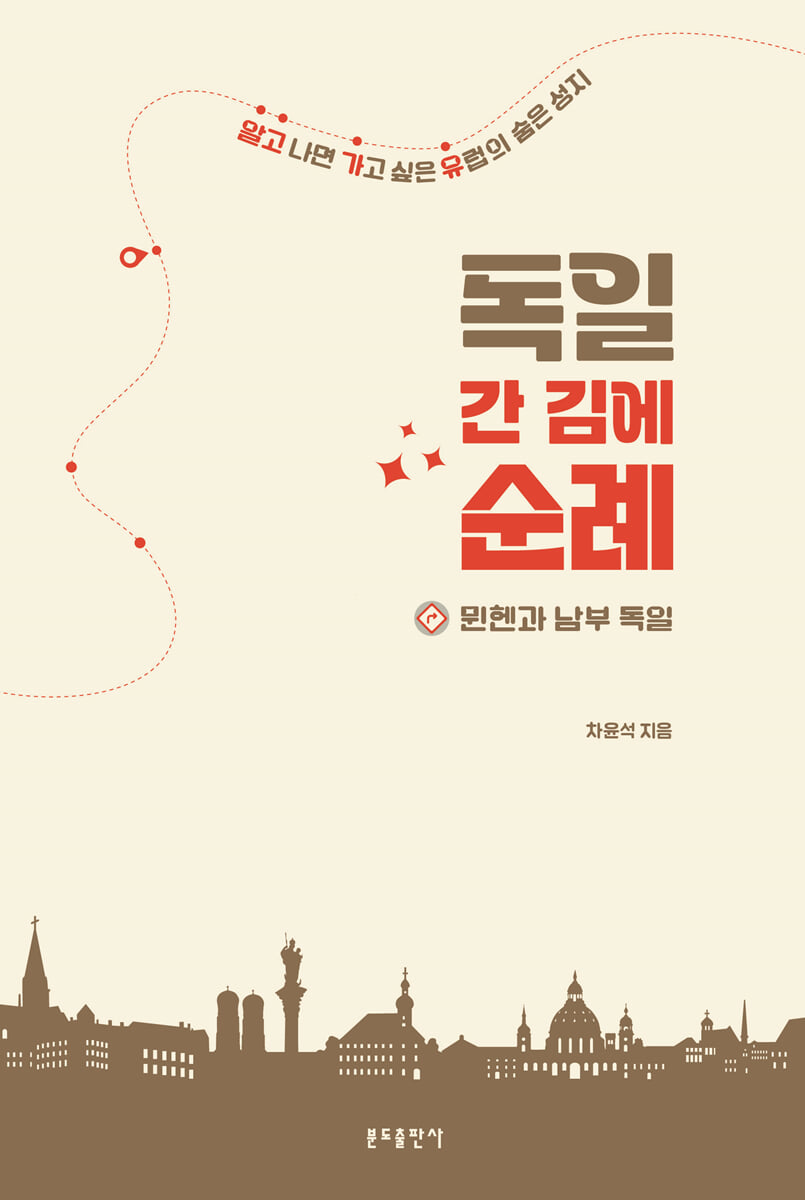
Pilgrimage while in Germany
 |
Description
Book Introduction
This is the first volume of the "Pilgrimage While You're There" series, which introduces everyday holy sites and pilgrimage sites that you can visit when visiting Europe, a Christian cultural sphere, on a business trip or family trip.
We introduce the monasteries and cathedrals of Munich and Bavaria, known as the heart of German faith, and places with deep ties to the Korean Church from a political and cultural historical perspective, while providing practical information necessary for pilgrims.
For us Christians, for whom life itself is a pilgrimage, this book will be a bridge to the place where His feet stand, a moment of joy in which we rediscover God in our daily lives, a moment we have forgotten.
We introduce the monasteries and cathedrals of Munich and Bavaria, known as the heart of German faith, and places with deep ties to the Korean Church from a political and cultural historical perspective, while providing practical information necessary for pilgrims.
For us Christians, for whom life itself is a pilgrimage, this book will be a bridge to the place where His feet stand, a moment of joy in which we rediscover God in our daily lives, a moment we have forgotten.
- You can preview some of the book's contents.
Preview
index
introduction
Departing for Munich, Germany!
Stumps of Light: Bavarian Cathedrals and Benedictine Monasteries: Fountains of Spirituality
D1 Finding Light in the Heart of Munich 15
Benedict Tour Around: The Lord's House in Dachau Concentration Camp
D2 Hiking Pilgrimage to the Holy Mountain
Benedict Tour Around: A Circle Along Lake Ammersee ∥ Tegernsee Abbey
D3 Altötting, the place of grace where Bavaria's faith began
Benedict Tour Around: Passau ∥ Discovering the Two Islands of the 'Bavarian Sea'
D4 Alps Foothills: In Search of an Oasis for the Soul
Benedict Tour Around: Experiencing God's Grace ∥ Meeting God and Me Under the Zugspitze
D5 Finding an example of family sanctification
Benedict Tour Around: Cheyenne Benedictine Abbey
D6 Visiting Regensburg, the cradle of Danube faith
Benedict Tour Around: Discovering the Millennium-Old Monasteries of the Danube Gorge
D7 In Search of the Roots of the Korean Church
Benedict Tour Around: Hidden Pearls of Lake Starnberg
Photo source
Departing for Munich, Germany!
Stumps of Light: Bavarian Cathedrals and Benedictine Monasteries: Fountains of Spirituality
D1 Finding Light in the Heart of Munich 15
Benedict Tour Around: The Lord's House in Dachau Concentration Camp
D2 Hiking Pilgrimage to the Holy Mountain
Benedict Tour Around: A Circle Along Lake Ammersee ∥ Tegernsee Abbey
D3 Altötting, the place of grace where Bavaria's faith began
Benedict Tour Around: Passau ∥ Discovering the Two Islands of the 'Bavarian Sea'
D4 Alps Foothills: In Search of an Oasis for the Soul
Benedict Tour Around: Experiencing God's Grace ∥ Meeting God and Me Under the Zugspitze
D5 Finding an example of family sanctification
Benedict Tour Around: Cheyenne Benedictine Abbey
D6 Visiting Regensburg, the cradle of Danube faith
Benedict Tour Around: Discovering the Millennium-Old Monasteries of the Danube Gorge
D7 In Search of the Roots of the Korean Church
Benedict Tour Around: Hidden Pearls of Lake Starnberg
Photo source
Detailed image

Into the book
Even evening hours after the sun has set are fine.
The cathedral's soft lighting warmly embraces visitors attending mass, creating a different atmosphere from the daytime.
A priest's words that the liturgy of a cathedral is completed with light and illumination come to mind again.
If you sit down for a while, your excitement from the long journey will naturally subside.
“Come to me, all you who are weary and burdened,
As the Lord said, “Come and I will give you rest” (Matthew 11:28), sitting in a foreign church away from everyday life, I realize anew that God is with us anytime, anywhere.
--- From "Munich Cathedral"
Altötting, or Old Oetting, appears in literature as early as 748 under the name 'Autingas' as the location of the palace of the Duke of Bavaria.
However, this area was occupied by Germanic peoples much earlier, starting around 1300 BC.
This was because the wide pastures and dense forests around the river made it an ideal place for the Germanic people to live, farming, hunting, and raising livestock.
Looking at the urns unearthed under the barley tree in the now-vanished square, it appears that this was a sacred place for the ancient Germanic peoples and a place where 'tings', a council meeting where important matters were discussed and decided, were held.
So, the fact that the Duke of Bavaria, who was not a native of the region, was baptized in a pagan holy place and built a cathedral clearly had political and religious implications.
Now it was a declaration that this place was God's land.
--- From "Altoeting"
The great German writer Johann Wolfgang von Goethe also traveled along this route to Italy, a place he had longed for since childhood.
On September 7, 1786, Goethe's carriage left Munich and headed south along the foggy road beside the Isar River.
Around noon, the Alps began to appear before Goethe's eyes, and a new world unfolded before his eyes.
On a wide plain bordering the lake stood a tall, broad building with onion-shaped towers, and behind it rose a towering, snow-capped white rock face.
What Goethe saw was the Benediktbeuern Abbey, located on the sedimentary plain between the Loisach and Isar rivers, and the Benediktenband, a ridge 1,800 meters above sea level.
--- From "Benedict Beuern"
Modern people sometimes see the death of Bishop Emmeramus, a Frank, as a result of the power dynamics and palace infighting of the time.
It is said that during the period when Bavarian independence was progressing, the opposition or fear against Frankish rule was symbolically revealed.
But to medieval people, the image of a shepherd who took upon himself the sins of the weak, like Christ, would have been more appealing.
Saint Wolfgang, who was loved and called a great philanthropist, quietly withdrew from his parish and chose the life of a hermit on the lakeside near Salzburg.
It seems that this kind of lifestyle still attracts pilgrims.
--- From the Abbey of St. Emmeram
During the Korean War, 25 German male and female monks, including Bishop Sauer, were martyred during the 'Death March'.
Additionally, 11 Korean priests, including Father Kim Chi-ho, and 2 Korean nuns were martyred.
Fortunately, there were male and female monks who had gone to South Korea in advance to prepare for the future.
They fled to Busan and began new activities in Waegwan and Daegu after the war ended.
Just as new shoots grow from a stump, the mustard seeds sown by German missionaries have grown into large trees where believers can come and rest.
The cathedral's soft lighting warmly embraces visitors attending mass, creating a different atmosphere from the daytime.
A priest's words that the liturgy of a cathedral is completed with light and illumination come to mind again.
If you sit down for a while, your excitement from the long journey will naturally subside.
“Come to me, all you who are weary and burdened,
As the Lord said, “Come and I will give you rest” (Matthew 11:28), sitting in a foreign church away from everyday life, I realize anew that God is with us anytime, anywhere.
--- From "Munich Cathedral"
Altötting, or Old Oetting, appears in literature as early as 748 under the name 'Autingas' as the location of the palace of the Duke of Bavaria.
However, this area was occupied by Germanic peoples much earlier, starting around 1300 BC.
This was because the wide pastures and dense forests around the river made it an ideal place for the Germanic people to live, farming, hunting, and raising livestock.
Looking at the urns unearthed under the barley tree in the now-vanished square, it appears that this was a sacred place for the ancient Germanic peoples and a place where 'tings', a council meeting where important matters were discussed and decided, were held.
So, the fact that the Duke of Bavaria, who was not a native of the region, was baptized in a pagan holy place and built a cathedral clearly had political and religious implications.
Now it was a declaration that this place was God's land.
--- From "Altoeting"
The great German writer Johann Wolfgang von Goethe also traveled along this route to Italy, a place he had longed for since childhood.
On September 7, 1786, Goethe's carriage left Munich and headed south along the foggy road beside the Isar River.
Around noon, the Alps began to appear before Goethe's eyes, and a new world unfolded before his eyes.
On a wide plain bordering the lake stood a tall, broad building with onion-shaped towers, and behind it rose a towering, snow-capped white rock face.
What Goethe saw was the Benediktbeuern Abbey, located on the sedimentary plain between the Loisach and Isar rivers, and the Benediktenband, a ridge 1,800 meters above sea level.
--- From "Benedict Beuern"
Modern people sometimes see the death of Bishop Emmeramus, a Frank, as a result of the power dynamics and palace infighting of the time.
It is said that during the period when Bavarian independence was progressing, the opposition or fear against Frankish rule was symbolically revealed.
But to medieval people, the image of a shepherd who took upon himself the sins of the weak, like Christ, would have been more appealing.
Saint Wolfgang, who was loved and called a great philanthropist, quietly withdrew from his parish and chose the life of a hermit on the lakeside near Salzburg.
It seems that this kind of lifestyle still attracts pilgrims.
--- From the Abbey of St. Emmeram
During the Korean War, 25 German male and female monks, including Bishop Sauer, were martyred during the 'Death March'.
Additionally, 11 Korean priests, including Father Kim Chi-ho, and 2 Korean nuns were martyred.
Fortunately, there were male and female monks who had gone to South Korea in advance to prepare for the future.
They fled to Busan and began new activities in Waegwan and Daegu after the war ended.
Just as new shoots grow from a stump, the mustard seeds sown by German missionaries have grown into large trees where believers can come and rest.
--- From "The Martyrs of Deokwon"
Publisher's Review
What does pilgrimage mean to busy modern people?
8 nights and 9 days of pilgrimage to the Holy Land in Israel, 12 nights and 13 days of pilgrimage to the apparition sites of the Virgin Mary in 4 European countries.
Most of the holy places are concentrated in Europe and Western Asia, making it a time-consuming and expensive itinerary, but the reality for modern workers is that it is difficult to take a long vacation.
That is why pilgrimage to the Holy Land is considered a difficult, special event that can be done once or twice in a lifetime and requires long-term planning.
Wouldn't such seriousness actually raise the barrier to pilgrimage?
Pope Francis said, “The Christian pilgrimage is a journey of discovery, nourished by relationships with others, of God’s love and, at the same time, of ourselves.”
Pilgrimage is not only about going to a holy place with the intention of meeting God, but it is also a time to feel God's love and reflect on ourselves during the process.
These days, many people visit Europe for business trips or family vacations.
There are also frequent opportunities to stay for a day or two longer than originally scheduled, or during spare time.
Most people tend to only visit well-known tourist attractions, but what if you could make a pilgrimage to encounter God during those times? Although it's an unfamiliar environment, Europe, a Christian cultural sphere, offers a chance to encounter God in a close-knit setting and reflect on your life and faith.
An unexpected moment, an unexpected God
Europe is full of pilgrimage sites where you can encounter God in your daily life.
Not only in the city center of a large city, but also in its suburbs, there are holy sites and religious sites where the faith of local residents has been deeply rooted for hundreds of years.
However, most of them are unknown to us, and there are places that are only known as tourist attractions and we pass by them without knowing that they are pilgrimage sites.
The author introduces such hidden pilgrimage sites and invites us to go together.
He says that the time spent in Europe will become more meaningful, that unexpected moments can become pilgrimages, and that unexpected steps can become a process leading to grace.
Southern Germany, particularly Bavaria, centered around Munich, which is introduced in this book, is a region in Germany that has maintained the Catholic faith. It is filled with beautiful scenery, colorful architecture and art, and spiritual places where heaven and earth meet.
At its heart are Munich, a city of Marian devotion; Altötting, famous for its Black Madonna and Child; and the Benedictine monasteries, pioneers of the Gospel in Europe and bastions of faith in each region.
The Benedictine monastery, which lives according to the teachings of St. Benedict, “Pray and Work,” is the beginning of Bavarian Catholicism and has served as a religious center from the early Middle Ages to the present.
While early Benedictine monasteries and other institutions sown the seeds of faith in Bavaria, since the 20th century the Abbey of St. Ottilien has seen its fruits bear fruit all over the world.
For modern people tired of their busy lives, these pilgrimage sites are a great place to rest.
It is a place of healing for ourselves, who have lost the leisure to care for others, immersed in the pursuit of gold and endless competition, and a place of grace where we can put down for a moment and completely entrust the cross we each carry to God.
A series that makes pilgrimages familiar
The “Pilgrimage While You’re at It” series is a pilgrimage guide created with the help of experts from various countries with extensive experience in operating pilgrimage programs to European monasteries and holy sites. We hope that pilgrimage will not be considered too difficult, and that anyone can easily seek God on their own when they have time in Europe.
Personal impressions are restrained, and the author shows what the reader should see and feel in the mysterious yet unfamiliar spaces of European cathedrals and monasteries.
Accompanied by hundreds of photographs and images, it not only explains the historical background of the pilgrimage site where faith blossomed, but also provides practical information needed for the pilgrimage, such as maps and accommodation.
In addition, the introduction of attractions around the pilgrimage site where you can enjoy the nature and culture of Europe further encourages you to visit the pilgrimage site.
As the author says, this series aims to be a bridge that leads us to the place where His feet stand, a moment of joy in which we, as a pilgrim living our lives, rediscover God whom we have forgotten.
If our hearts are always turned toward God, this series will help pilgrimage become a natural part of our lives, like the arrow prayers we offer in our daily lives.
8 nights and 9 days of pilgrimage to the Holy Land in Israel, 12 nights and 13 days of pilgrimage to the apparition sites of the Virgin Mary in 4 European countries.
Most of the holy places are concentrated in Europe and Western Asia, making it a time-consuming and expensive itinerary, but the reality for modern workers is that it is difficult to take a long vacation.
That is why pilgrimage to the Holy Land is considered a difficult, special event that can be done once or twice in a lifetime and requires long-term planning.
Wouldn't such seriousness actually raise the barrier to pilgrimage?
Pope Francis said, “The Christian pilgrimage is a journey of discovery, nourished by relationships with others, of God’s love and, at the same time, of ourselves.”
Pilgrimage is not only about going to a holy place with the intention of meeting God, but it is also a time to feel God's love and reflect on ourselves during the process.
These days, many people visit Europe for business trips or family vacations.
There are also frequent opportunities to stay for a day or two longer than originally scheduled, or during spare time.
Most people tend to only visit well-known tourist attractions, but what if you could make a pilgrimage to encounter God during those times? Although it's an unfamiliar environment, Europe, a Christian cultural sphere, offers a chance to encounter God in a close-knit setting and reflect on your life and faith.
An unexpected moment, an unexpected God
Europe is full of pilgrimage sites where you can encounter God in your daily life.
Not only in the city center of a large city, but also in its suburbs, there are holy sites and religious sites where the faith of local residents has been deeply rooted for hundreds of years.
However, most of them are unknown to us, and there are places that are only known as tourist attractions and we pass by them without knowing that they are pilgrimage sites.
The author introduces such hidden pilgrimage sites and invites us to go together.
He says that the time spent in Europe will become more meaningful, that unexpected moments can become pilgrimages, and that unexpected steps can become a process leading to grace.
Southern Germany, particularly Bavaria, centered around Munich, which is introduced in this book, is a region in Germany that has maintained the Catholic faith. It is filled with beautiful scenery, colorful architecture and art, and spiritual places where heaven and earth meet.
At its heart are Munich, a city of Marian devotion; Altötting, famous for its Black Madonna and Child; and the Benedictine monasteries, pioneers of the Gospel in Europe and bastions of faith in each region.
The Benedictine monastery, which lives according to the teachings of St. Benedict, “Pray and Work,” is the beginning of Bavarian Catholicism and has served as a religious center from the early Middle Ages to the present.
While early Benedictine monasteries and other institutions sown the seeds of faith in Bavaria, since the 20th century the Abbey of St. Ottilien has seen its fruits bear fruit all over the world.
For modern people tired of their busy lives, these pilgrimage sites are a great place to rest.
It is a place of healing for ourselves, who have lost the leisure to care for others, immersed in the pursuit of gold and endless competition, and a place of grace where we can put down for a moment and completely entrust the cross we each carry to God.
A series that makes pilgrimages familiar
The “Pilgrimage While You’re at It” series is a pilgrimage guide created with the help of experts from various countries with extensive experience in operating pilgrimage programs to European monasteries and holy sites. We hope that pilgrimage will not be considered too difficult, and that anyone can easily seek God on their own when they have time in Europe.
Personal impressions are restrained, and the author shows what the reader should see and feel in the mysterious yet unfamiliar spaces of European cathedrals and monasteries.
Accompanied by hundreds of photographs and images, it not only explains the historical background of the pilgrimage site where faith blossomed, but also provides practical information needed for the pilgrimage, such as maps and accommodation.
In addition, the introduction of attractions around the pilgrimage site where you can enjoy the nature and culture of Europe further encourages you to visit the pilgrimage site.
As the author says, this series aims to be a bridge that leads us to the place where His feet stand, a moment of joy in which we, as a pilgrim living our lives, rediscover God whom we have forgotten.
If our hearts are always turned toward God, this series will help pilgrimage become a natural part of our lives, like the arrow prayers we offer in our daily lives.
GOODS SPECIFICS
- Date of issue: June 12, 2025
- Page count, weight, size: 200 pages | 388g | 151*225*13mm
- ISBN13: 9788941925071
- ISBN10: 894192507X
You may also like
카테고리
korean


korean

![GQ KOREA Mark (Monthly): December [2025]](http://librairie.coreenne.fr/cdn/shop/files/8ef265dbbfbf186523ed75ba7319009d.jpg?v=1765340328&width=3840)


