

Once in a while, a museum
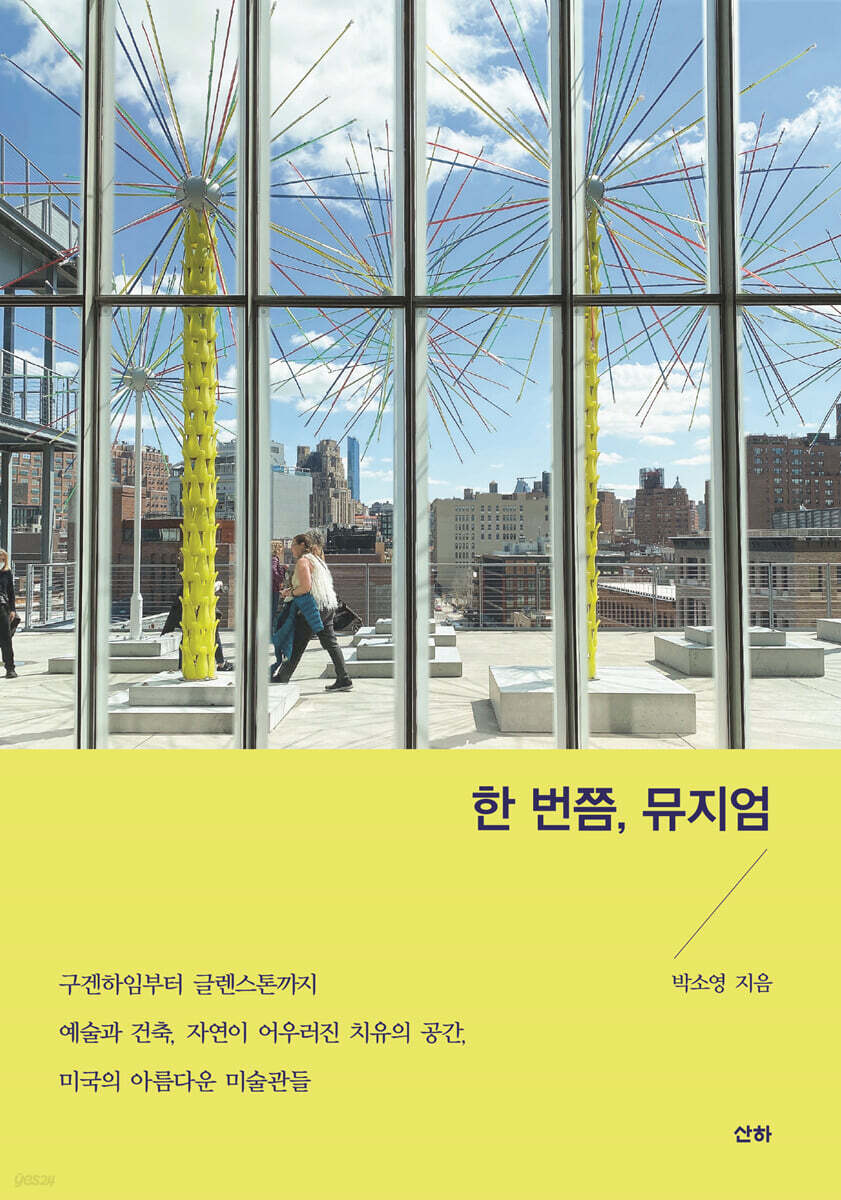 |
Description
Book Introduction
The country with the hottest art market right now, the United States
Discover the story of contemporary art at 26 museums designed by Pritzker Prize-winning architects.
Art travel planner Park So-young's new book, "Once in a while, a museum," has been published by Sanha.
《Once in a while, Museum》 focuses on major museums in the United States, which currently have the hottest art market, and the contemporary art pieces housed there.
The American art collection, born from overwhelming capital power, boasts world-class quality and quantity.
Not only does it house works by famous artists such as James Turrell, Andy Warhol, Edward Hopper, and Jeff Koons, but there are also unique museums across the United States designed by leading architects such as Renzo Piano, Yoshio Taniguchi, and Frank Lloyd Wright.
It is also a country with a great interest in and influence over art, as most museums are built on the private collections and patronage of their founders, which include hundreds or thousands of pieces.
As a planner who has guided art lectures and travel, author Park So-young wrote this book because she felt regretful that the stereotype that Europe is still associated with 'art' still exists.
The author says that the center of the art market has long since shifted from Europe to the United States, and that the United States also possesses many famous works, including the most expensive modern works.
The author, who has visited museums around the world, introduces 26 American museums in this book based on his own experiences.
From the museum's founding story to descriptions of its representative works, this book will satisfy your curiosity about American museums.
To help readers understand, we also included photos of works by various authors.
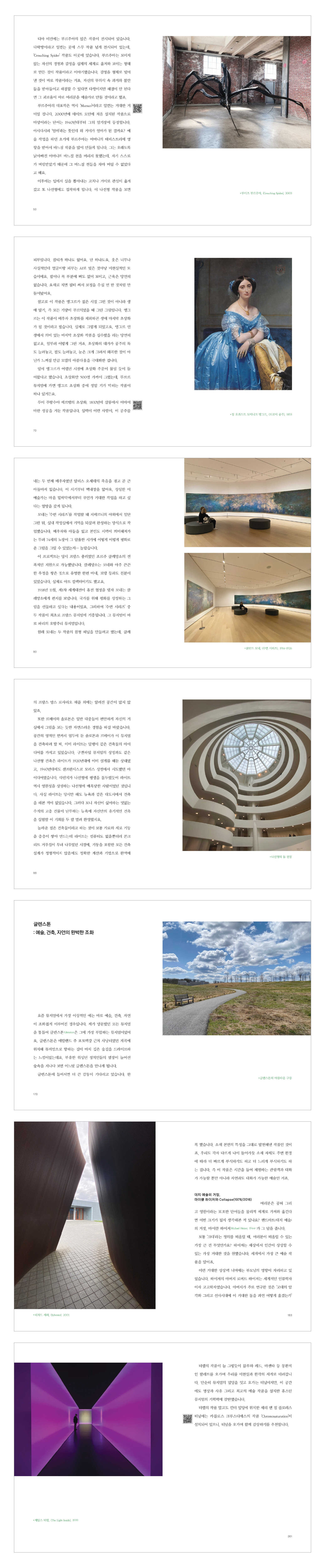
Readers who wish to see more works other than those included in the book can use the QR codes attached next to the descriptions of the works.
Discover the story of contemporary art at 26 museums designed by Pritzker Prize-winning architects.
Art travel planner Park So-young's new book, "Once in a while, a museum," has been published by Sanha.
《Once in a while, Museum》 focuses on major museums in the United States, which currently have the hottest art market, and the contemporary art pieces housed there.
The American art collection, born from overwhelming capital power, boasts world-class quality and quantity.
Not only does it house works by famous artists such as James Turrell, Andy Warhol, Edward Hopper, and Jeff Koons, but there are also unique museums across the United States designed by leading architects such as Renzo Piano, Yoshio Taniguchi, and Frank Lloyd Wright.
It is also a country with a great interest in and influence over art, as most museums are built on the private collections and patronage of their founders, which include hundreds or thousands of pieces.
As a planner who has guided art lectures and travel, author Park So-young wrote this book because she felt regretful that the stereotype that Europe is still associated with 'art' still exists.
The author says that the center of the art market has long since shifted from Europe to the United States, and that the United States also possesses many famous works, including the most expensive modern works.
The author, who has visited museums around the world, introduces 26 American museums in this book based on his own experiences.
From the museum's founding story to descriptions of its representative works, this book will satisfy your curiosity about American museums.
To help readers understand, we also included photos of works by various authors.
Readers who wish to see more works other than those included in the book can use the QR codes attached next to the descriptions of the works.
- You can preview some of the book's contents.
Preview
index
To all of you who have arrived at the Seomun Museum
Chapter 1: How to Get the Most Out of a Museum in Two Hours
- The museum is an architectural gem
- The museum shop first?
- When should I listen to the docent?
- The work is at arm's length in front of you
- It's a famous work, so why am I not moved?
Chapter 2: Let's go to New York!_New York
- Dia Beacon: An overwhelming repository of contemporary art
- The Metropolitan Museum of Art: The majesty of one of the world's top three museums
- MOMA: Modern and contemporary art from around the world is here.
- Guggenheim Museum: The World Solomon Guggenheim Dreamed of
- Whitney Museum: The Essence of Modern American Art
- Must go Frick Collection | Morgan Library Museum | Neue Galerie | New Museum
Chapter 3: Philadelphia: A City of Art and Haughtiness
- Philadelphia Museum of Art: A Place of Majesty
- The Barnes Foundation: A Surprising Collection of Antibiotic Inventors
Chapter 4: The Best Museum Restaurants in the U.S.: Washington, DC
Glenstone: A Perfect Harmony of Art, Architecture, and Nature
- National Gallery: The only gallery in the United States that houses a da Vinci
- Hirshhorn Museum: A Collection of Art by Successful Immigrants
Must go Krieger Museum | Phillips Collection
Chapter 5: Museum Lover's Bucket List_Houston
- The Menil Collection: A Billionaire's Collection You Can't Miss
- Rothko Chapel: Not just a Rothko viewing, but a Rothko experience.
- Houston Museum of Art: Texas' largest museum connected by a tunnel
Chapter 6: Now Art is in La La Land_LA
- The Broad: The world's most expensive contemporary art pieces are here!
- Getty Center: The Great Journey of Oil Tycoon Paul Getty
- LACMA: A factory of light serving contemporary art
And must-see American museums
: Chicago Museum of Fine Arts | Boston Museum of Fine Arts | Isabella Stewart Gardner Museum
San Francisco Museum of Modern Art | Vizcaya Museum and Gardens
Chapter 1: How to Get the Most Out of a Museum in Two Hours
- The museum is an architectural gem
- The museum shop first?
- When should I listen to the docent?
- The work is at arm's length in front of you
- It's a famous work, so why am I not moved?
Chapter 2: Let's go to New York!_New York
- Dia Beacon: An overwhelming repository of contemporary art
- The Metropolitan Museum of Art: The majesty of one of the world's top three museums
- MOMA: Modern and contemporary art from around the world is here.
- Guggenheim Museum: The World Solomon Guggenheim Dreamed of
- Whitney Museum: The Essence of Modern American Art
- Must go Frick Collection | Morgan Library Museum | Neue Galerie | New Museum
Chapter 3: Philadelphia: A City of Art and Haughtiness
- Philadelphia Museum of Art: A Place of Majesty
- The Barnes Foundation: A Surprising Collection of Antibiotic Inventors
Chapter 4: The Best Museum Restaurants in the U.S.: Washington, DC
Glenstone: A Perfect Harmony of Art, Architecture, and Nature
- National Gallery: The only gallery in the United States that houses a da Vinci
- Hirshhorn Museum: A Collection of Art by Successful Immigrants
Must go Krieger Museum | Phillips Collection
Chapter 5: Museum Lover's Bucket List_Houston
- The Menil Collection: A Billionaire's Collection You Can't Miss
- Rothko Chapel: Not just a Rothko viewing, but a Rothko experience.
- Houston Museum of Art: Texas' largest museum connected by a tunnel
Chapter 6: Now Art is in La La Land_LA
- The Broad: The world's most expensive contemporary art pieces are here!
- Getty Center: The Great Journey of Oil Tycoon Paul Getty
- LACMA: A factory of light serving contemporary art
And must-see American museums
: Chicago Museum of Fine Arts | Boston Museum of Fine Arts | Isabella Stewart Gardner Museum
San Francisco Museum of Modern Art | Vizcaya Museum and Gardens
Detailed image
Publisher's Review
The Getty Center and LACMA in LA, where you can enjoy the warm sunshine of the West.
Hidden treasures in Houston, Texas, from the Menil Collection to the Rothko Chapel.
The more you learn about American museums, the more surprising and beautiful they become.
The book consists of six chapters in total.
Chapter 1 contains all the information you need before visiting a museum: why the museum is famous for its architecture, why you should visit the museum shop first, and where to best view the works of art.
Chapter 2 introduces a selection of museums from five regions across the United States.
The first region is New York.
We introduce places like MOMA, which is a symbol of New York, and Dia Beacon, which is famous for the live performance by BTS member RM.
The representative works you will see at Dia Beacon are those of Donald Judd, Louise Bourgeois, and Andy Warhol. The author, who has been teaching art for a long time, explains these works in an easy-to-understand way, so you will be able to grasp their meaning without difficulty.
You can feel the joy of encountering not only modern works but also classic works.
At the Metropolitan Museum of Art, you can see the portrait master Jean-Auguste-Dominique Ingres's work, Princess Broglie (1853), while at MOMA, you can see Picasso's The Lovers of Avignon (1907) and Monet's Water Lilies series (1914-1926).
At the Guggenheim Museum, the most notable feature is the bizarre spiral architecture designed by Frank Lloyd Wright.
Here, you can fully enjoy the works of Wassily Kandinsky, a master of abstract painting, which are as interesting as the bizarre architecture.
The Whitney Museum, newly reborn with architecture by Renzo Piano, displays a variety of Edward Hopper's works, making it a must-visit for Hopper enthusiasts.
Chapter 3 introduces several museums in Philadelphia.
The Philadelphia Museum of Art, which exudes a majestic atmosphere as if visiting an old historic site, houses representative works such as Duchamp's last works and Monet's [The Great Bathers] (1900-1906).
This chapter also introduces the Barnes Foundation, which was not disclosed to the public for a long time due to the eccentric personality of its founder, Albert Barnes.
Originally, Albert Barnes' collection was only accessible to a select few, but with the museum's renovation, everyone can now visit and admire the works.
The author recommends paying particular attention to the unique exhibition style that Albert Barnes insisted on.
Henri Matisse's mural [Dance] (1932-1933), which Albert Barnes commissioned for his private viewing, can also be seen here.
If you're curious about museums that perfectly harmonize art, architecture, and nature, check out Chapter 4: Washington, DC.
It would be good to unfold the story first.
Glenstone, located in a forest lined with villas of wealthy politicians, allows visitors to enjoy the exhibitions while strolling through the 360,000-square-foot grounds, as one media outlet stated, “The core and strength of this museum is not the artwork, but nature” (p. 172).
Exhibited here are Richard Serra's steel work [Sylvester] (2001) and land art master Michael Heiser's work [Collapse] (1976).
Chapter 4 also introduces the National Gallery of Art, the only museum in the United States with a collection of Leonardo da Vinci's works, and the Hirshhorn Museum, founded by Joseph Hirshhorn, a poor Latvian immigrant who rose to fame.
At the National Gallery, you can see Rembrandt's [Self-Portrait] (1659), which brought the author to tears, and at the Hirshhorn Museum, you can see Yayoi Kusama's famous [Pumpkin] (2016), which showed a new world of art through dot patterns.
In Chapter 5, the author selects the Menil Collection, the Rothko Chapel, and the Houston Museum of Art as representative museums in Houston.
The Menil Collection, newly designed by architect Renzo Piano, features Dan Flavin's fluorescent light installation [Untitle] (1996) occupying an entire hall, making you think about what the word "overwhelming" really means.
Meanwhile, there is another place that Dominique and John de Menil, who founded the Menil Collection, poured their heart and soul into: the Rothko Chapel.
This small chapel houses only 14 large-scale murals by Mark Rothko.
The author describes his visit to the Roscoe Chapel to admire the artwork, saying it was an opportunity to immerse himself in his own world and pour out all his emotions.
The Houston Museum of Art, the largest museum in Texas and spanning three buildings, even uses the passageways connecting the buildings as spaces for art.
Artist James Turrell's work [The Light Inside] (1999) is installed in the passageway, presenting a fantastic feast of light to visitors.
The first museum we'll visit in Chapter 6, LA, is The Broad.
The Broad, with its unique honeycomb-shaped architecture, creates a unique space where exhibition spaces and storage are combined, unlike any other museum.
The steep elevator leading to the exhibition hall and the honeycomb-shaped ceiling are also unique designs.
What makes The Broad even more special is that it houses Jeff Koons' [Rabbit] (1986), currently the most expensive work of art ever exhibited.
This work is displayed alongside another of his works, [Balloon Dog](blue)(1994-2000). As for must-see works at the Getty Center, another major LA museum, the author cites Rembrandt's [Portrait of Martin Luten] (1632), a work so beloved by the museum's founder, Paul Getty.
The Central Garden, designed by Robert Irwin, is a must-see attraction at the Getty Center, just as much as the artwork itself.
Finally, LACMA exhibits works by representative American artists Barbara Kruger, Michael Heizer, and Chris Burden.
Michael Heizer's [Levitated Mass] (2012), which features a massive boulder placed over a walkway for visitors, and Chris Burden's [Urban Light] (2008) can be seen here at LACMA.
The author additionally provides a separate 'Must go' section in the New York and Washington DC editions, briefly explaining some museums that are too good to pass up.
The book also concludes with a list of five must-see museums in the United States, regardless of region.
As a nation with a diverse population living in a vast landmass, the Museum of Modern Art has a vast art collection, and each collection has its own unique characteristics, so we have gathered useful information.
For readers who not only love art but are also curious about where the current art market is headed and which artists are doing well, it's time to turn your attention from Europe to the United States.
Hidden treasures in Houston, Texas, from the Menil Collection to the Rothko Chapel.
The more you learn about American museums, the more surprising and beautiful they become.
The book consists of six chapters in total.
Chapter 1 contains all the information you need before visiting a museum: why the museum is famous for its architecture, why you should visit the museum shop first, and where to best view the works of art.
Chapter 2 introduces a selection of museums from five regions across the United States.
The first region is New York.
We introduce places like MOMA, which is a symbol of New York, and Dia Beacon, which is famous for the live performance by BTS member RM.
The representative works you will see at Dia Beacon are those of Donald Judd, Louise Bourgeois, and Andy Warhol. The author, who has been teaching art for a long time, explains these works in an easy-to-understand way, so you will be able to grasp their meaning without difficulty.
You can feel the joy of encountering not only modern works but also classic works.
At the Metropolitan Museum of Art, you can see the portrait master Jean-Auguste-Dominique Ingres's work, Princess Broglie (1853), while at MOMA, you can see Picasso's The Lovers of Avignon (1907) and Monet's Water Lilies series (1914-1926).
At the Guggenheim Museum, the most notable feature is the bizarre spiral architecture designed by Frank Lloyd Wright.
Here, you can fully enjoy the works of Wassily Kandinsky, a master of abstract painting, which are as interesting as the bizarre architecture.
The Whitney Museum, newly reborn with architecture by Renzo Piano, displays a variety of Edward Hopper's works, making it a must-visit for Hopper enthusiasts.
Chapter 3 introduces several museums in Philadelphia.
The Philadelphia Museum of Art, which exudes a majestic atmosphere as if visiting an old historic site, houses representative works such as Duchamp's last works and Monet's [The Great Bathers] (1900-1906).
This chapter also introduces the Barnes Foundation, which was not disclosed to the public for a long time due to the eccentric personality of its founder, Albert Barnes.
Originally, Albert Barnes' collection was only accessible to a select few, but with the museum's renovation, everyone can now visit and admire the works.
The author recommends paying particular attention to the unique exhibition style that Albert Barnes insisted on.
Henri Matisse's mural [Dance] (1932-1933), which Albert Barnes commissioned for his private viewing, can also be seen here.
If you're curious about museums that perfectly harmonize art, architecture, and nature, check out Chapter 4: Washington, DC.
It would be good to unfold the story first.
Glenstone, located in a forest lined with villas of wealthy politicians, allows visitors to enjoy the exhibitions while strolling through the 360,000-square-foot grounds, as one media outlet stated, “The core and strength of this museum is not the artwork, but nature” (p. 172).
Exhibited here are Richard Serra's steel work [Sylvester] (2001) and land art master Michael Heiser's work [Collapse] (1976).
Chapter 4 also introduces the National Gallery of Art, the only museum in the United States with a collection of Leonardo da Vinci's works, and the Hirshhorn Museum, founded by Joseph Hirshhorn, a poor Latvian immigrant who rose to fame.
At the National Gallery, you can see Rembrandt's [Self-Portrait] (1659), which brought the author to tears, and at the Hirshhorn Museum, you can see Yayoi Kusama's famous [Pumpkin] (2016), which showed a new world of art through dot patterns.
In Chapter 5, the author selects the Menil Collection, the Rothko Chapel, and the Houston Museum of Art as representative museums in Houston.
The Menil Collection, newly designed by architect Renzo Piano, features Dan Flavin's fluorescent light installation [Untitle] (1996) occupying an entire hall, making you think about what the word "overwhelming" really means.
Meanwhile, there is another place that Dominique and John de Menil, who founded the Menil Collection, poured their heart and soul into: the Rothko Chapel.
This small chapel houses only 14 large-scale murals by Mark Rothko.
The author describes his visit to the Roscoe Chapel to admire the artwork, saying it was an opportunity to immerse himself in his own world and pour out all his emotions.
The Houston Museum of Art, the largest museum in Texas and spanning three buildings, even uses the passageways connecting the buildings as spaces for art.
Artist James Turrell's work [The Light Inside] (1999) is installed in the passageway, presenting a fantastic feast of light to visitors.
The first museum we'll visit in Chapter 6, LA, is The Broad.
The Broad, with its unique honeycomb-shaped architecture, creates a unique space where exhibition spaces and storage are combined, unlike any other museum.
The steep elevator leading to the exhibition hall and the honeycomb-shaped ceiling are also unique designs.
What makes The Broad even more special is that it houses Jeff Koons' [Rabbit] (1986), currently the most expensive work of art ever exhibited.
This work is displayed alongside another of his works, [Balloon Dog](blue)(1994-2000). As for must-see works at the Getty Center, another major LA museum, the author cites Rembrandt's [Portrait of Martin Luten] (1632), a work so beloved by the museum's founder, Paul Getty.
The Central Garden, designed by Robert Irwin, is a must-see attraction at the Getty Center, just as much as the artwork itself.
Finally, LACMA exhibits works by representative American artists Barbara Kruger, Michael Heizer, and Chris Burden.
Michael Heizer's [Levitated Mass] (2012), which features a massive boulder placed over a walkway for visitors, and Chris Burden's [Urban Light] (2008) can be seen here at LACMA.
The author additionally provides a separate 'Must go' section in the New York and Washington DC editions, briefly explaining some museums that are too good to pass up.
The book also concludes with a list of five must-see museums in the United States, regardless of region.
As a nation with a diverse population living in a vast landmass, the Museum of Modern Art has a vast art collection, and each collection has its own unique characteristics, so we have gathered useful information.
For readers who not only love art but are also curious about where the current art market is headed and which artists are doing well, it's time to turn your attention from Europe to the United States.
GOODS SPECIFICS
- Date of issue: September 20, 2024
- Page count, weight, size: 316 pages | 484g | 140*200*19mm
- ISBN13: 9788976506177
You may also like
카테고리
korean


korean

![GQ KOREA Mark (Monthly): December [2025]](http://librairie.coreenne.fr/cdn/shop/files/8ef265dbbfbf186523ed75ba7319009d.jpg?v=1765340328&width=3840)


