

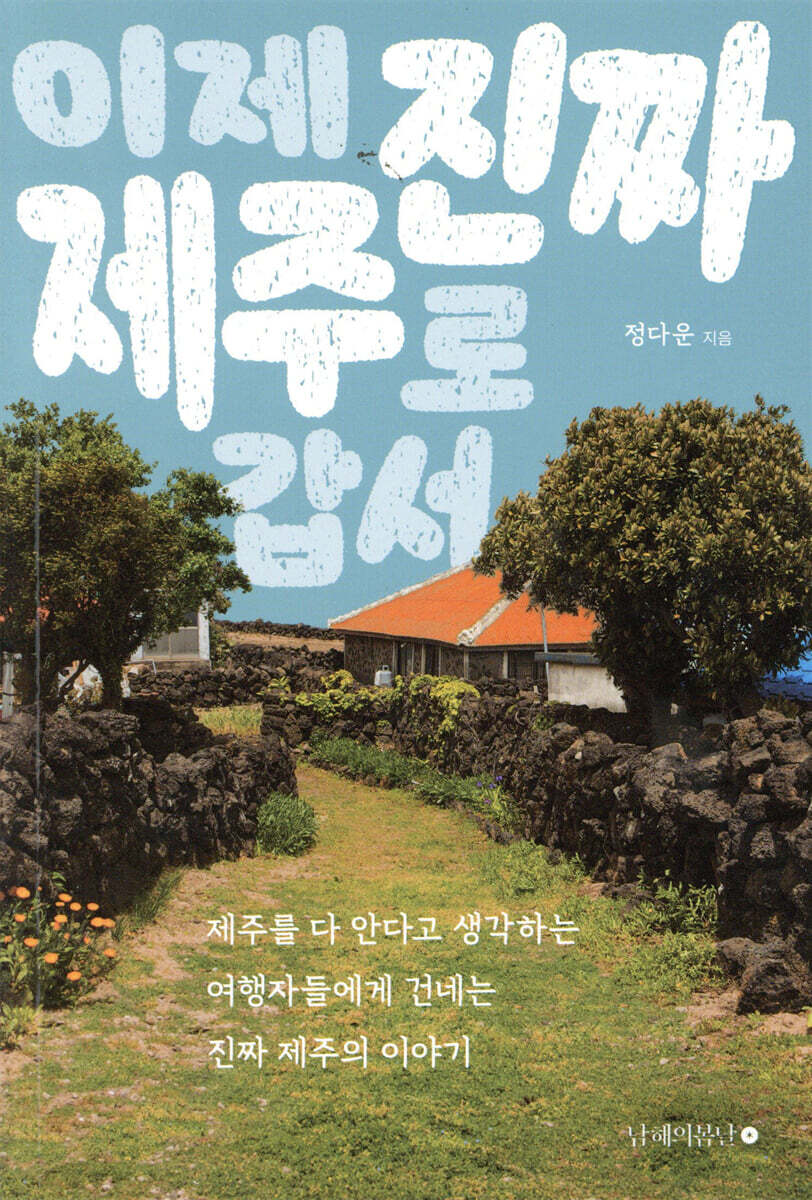
Now let's really go to Jeju
 |
Description
Book Introduction
Jeju is obvious?
It is visible only after walking with the village elders
Mysterious, beautiful, and heartbreaking true Jeju story
Before being a tourist destination, Jeju is a living space where people work and live.
There are people there who are full of vitality and have lived there for a long time, helping each other and living in the harsh nature.
Their unique culture and stories, big and small, are what make up this village.
The nice cafes and famous restaurants are nice, and the deep blue sea and various mountain peaks are nice, but now let's go to the village.
Clearly, your perspective and heart towards Jeju will change.
The real Jeju, which we never knew about, is hidden all over the village streets.
This book was created by walking around Jeju villages with the children of Samchun.
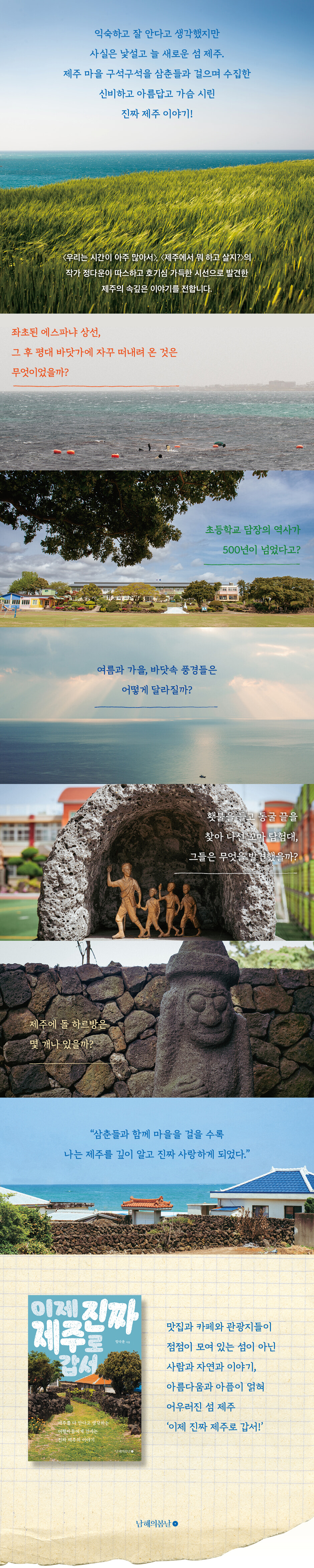
The story of a Spanish merchant ship stranded in the sea off Pyeongdae, the adventures of a small group of explorers who set out to explore caves with torches and ropes, the history of an elementary school wall that is over 500 years old, and the scenery of Udo Island after all the travelers have left. These are beautiful, mysterious, and interesting Jeju stories known only to the locals.
Even simple scenery that could be easily overlooked becomes the most shining and precious treasure in the world when you listen to the hidden stories of the village elders and savor them as if chatting with a good travel companion.
As you turn the pages of 『Now, Let's Go to Jeju for Real』, you will feel like you are walking with the village elders and travel friends.
And maybe you'll fall in love with Jeju.
It is visible only after walking with the village elders
Mysterious, beautiful, and heartbreaking true Jeju story
Before being a tourist destination, Jeju is a living space where people work and live.
There are people there who are full of vitality and have lived there for a long time, helping each other and living in the harsh nature.
Their unique culture and stories, big and small, are what make up this village.
The nice cafes and famous restaurants are nice, and the deep blue sea and various mountain peaks are nice, but now let's go to the village.
Clearly, your perspective and heart towards Jeju will change.
The real Jeju, which we never knew about, is hidden all over the village streets.
This book was created by walking around Jeju villages with the children of Samchun.
The story of a Spanish merchant ship stranded in the sea off Pyeongdae, the adventures of a small group of explorers who set out to explore caves with torches and ropes, the history of an elementary school wall that is over 500 years old, and the scenery of Udo Island after all the travelers have left. These are beautiful, mysterious, and interesting Jeju stories known only to the locals.
Even simple scenery that could be easily overlooked becomes the most shining and precious treasure in the world when you listen to the hidden stories of the village elders and savor them as if chatting with a good travel companion.
As you turn the pages of 『Now, Let's Go to Jeju for Real』, you will feel like you are walking with the village elders and travel friends.
And maybe you'll fall in love with Jeju.
- You can preview some of the book's contents.
Preview
index
prolog
Walking with the village uncles
Jeju as I discovered it through imagination
The First Village_The Beginning of the Story, Pyeongdae-ri
Every village has an old story.
_Reading the Pyeongdaeri, Bu Seok-hee Samchun
_A treasured village space and bookstore
Second Village_Susan-ri and Susan-ri
The village that never disappears
_Eun-ju Oh, Samchun, reading Susan-ri
_A treasured village space and bookstore
Third Village_Udo and Gapado
Island within an island, night and morning air
Uncle Kang Yun-hee, who reads Udo
_A treasured village space and bookstore
The Fourth Village: Kimnyeong Village, Embracing the Sea and Cave
A small group of explorers set out to find the end of a dark cave.
_A treasured village space and bookstore
The Fifth Village_A History of Pain Encountered in Moseulpo
Jeju, the Island of Peace, and the Tears Within
_A treasured village space and bookstore
The Sixth Village_Where Jeju People Live, the Downtown
Shall we meet in the castle?
_A treasured village space and bookstore
And, the village_my Jeju village
Where will I grow old in Samchun?
_The Jeju Bookstore I Love
Epilogue
A road that begins with travel and ends with life
Walking with the village uncles
Jeju as I discovered it through imagination
The First Village_The Beginning of the Story, Pyeongdae-ri
Every village has an old story.
_Reading the Pyeongdaeri, Bu Seok-hee Samchun
_A treasured village space and bookstore
Second Village_Susan-ri and Susan-ri
The village that never disappears
_Eun-ju Oh, Samchun, reading Susan-ri
_A treasured village space and bookstore
Third Village_Udo and Gapado
Island within an island, night and morning air
Uncle Kang Yun-hee, who reads Udo
_A treasured village space and bookstore
The Fourth Village: Kimnyeong Village, Embracing the Sea and Cave
A small group of explorers set out to find the end of a dark cave.
_A treasured village space and bookstore
The Fifth Village_A History of Pain Encountered in Moseulpo
Jeju, the Island of Peace, and the Tears Within
_A treasured village space and bookstore
The Sixth Village_Where Jeju People Live, the Downtown
Shall we meet in the castle?
_A treasured village space and bookstore
And, the village_my Jeju village
Where will I grow old in Samchun?
_The Jeju Bookstore I Love
Epilogue
A road that begins with travel and ends with life
Detailed image
Into the book
It took a long time.
And now I think I know the real Jeju a little bit.
Jeju is not an island dotted with restaurants, cafes, and tourist attractions, but rather an island where people, nature, stories, beauty, and pain are intertwined.
As I walked through the village with my friends, dark lines appeared between the dots, and the lines became surfaces.
This book, which contains Jeju's dotted lines, was written from beginning to end with our three children.
--- p.10
I met Bu Seok-hee and Samchun, and as we walked through Pyeongdae-ri together, I encountered an alley I had never walked through before and heard a story I had never heard before.
After walking through Pyeongdae-ri with Samchun, I walked through Pyeongdae-ri alone again and the small village I knew felt incredibly large.
So, it feels like we've become closer, but in fact, we're a bit unfamiliar.
I think this is the beginning of love.
When you like someone, you feel like you know them, like you've come to know them, and like they're similar to you.
Then, when you become really close, you get to know things about them that you didn't know before, and you discover things that are very different from you.
And the other person becomes unfamiliar.
The process of turning that unfamiliarity into familiarity is love, and love lasts only when unfamiliarity is overcome.
--- p.37
The story I heard when I first met the old man was so powerful.
So I thought it was a big problem.
I thought I had to meet people quickly, so I started meeting them.
I get along well with the elders in the neighborhood, so I sometimes lie under the covers with them and listen, or I just sit there with them drinking a cup of coffee. When I'm comfortable in the same space as the elders, I can let out the pain I've been holding back.
The reason I tell such stories while guiding you through the village is because the scenery and the stories overlap.
So that's what I'm telling you.
I want to share the stories they tell with the many travelers I meet, and make them feel something.
The fact that ‘the place you are staying is truly precious.’
--- p.64
What lies behind the school? It's hard for people on the mainland to guess, but Jeju residents can easily guess.
The correct answer is tangerine orchard.
They say that back then, all the students grew tangerine trees together.
In order to prevent weeds from growing in the tangerine orchard, straw was spread over the ground in the winter, and the students were given homework to bring the necessary straw from home.
Parents would gather straw and put it firmly on their shoulders, and students would carry it on their backs and go to school.
--- p.88
There are journeys that begin only when an unfamiliar street becomes familiar.
When your accommodation becomes your home and you have a favorite restaurant, the tension eases and only then does a new journey of resolution begin.
I like that trip.
So I decided to stay for a while.
What will happen once you become familiar with this island?
--- p.117
Living in Jeju means encountering the blue sea and the majestic Hallasan Mountain every day, but at the same time, it means constantly encountering modern and contemporary history, including the April 3 Incident, in everyday life.
Living in Jeju, I have come to encounter wounds that the residents do not hide, but do not necessarily reveal.
It was heard and seen naturally.
Then I became interested and started looking into it.
I began to look at the wound with a longing heart.
And I came to love Jeju even more.
--- p.176
When we travel to Jeju, we are preoccupied with the question, 'What should we do in Jeju?'
All I think about is where to go and what to eat.
Let's put that thought aside for a moment and approach Jeju Island with imagination, rather than just viewing it as a tourist destination.
How about thinking, 'How should I travel to Jeju?'
I would be happy if this book could keep that thought close.
And now I think I know the real Jeju a little bit.
Jeju is not an island dotted with restaurants, cafes, and tourist attractions, but rather an island where people, nature, stories, beauty, and pain are intertwined.
As I walked through the village with my friends, dark lines appeared between the dots, and the lines became surfaces.
This book, which contains Jeju's dotted lines, was written from beginning to end with our three children.
--- p.10
I met Bu Seok-hee and Samchun, and as we walked through Pyeongdae-ri together, I encountered an alley I had never walked through before and heard a story I had never heard before.
After walking through Pyeongdae-ri with Samchun, I walked through Pyeongdae-ri alone again and the small village I knew felt incredibly large.
So, it feels like we've become closer, but in fact, we're a bit unfamiliar.
I think this is the beginning of love.
When you like someone, you feel like you know them, like you've come to know them, and like they're similar to you.
Then, when you become really close, you get to know things about them that you didn't know before, and you discover things that are very different from you.
And the other person becomes unfamiliar.
The process of turning that unfamiliarity into familiarity is love, and love lasts only when unfamiliarity is overcome.
--- p.37
The story I heard when I first met the old man was so powerful.
So I thought it was a big problem.
I thought I had to meet people quickly, so I started meeting them.
I get along well with the elders in the neighborhood, so I sometimes lie under the covers with them and listen, or I just sit there with them drinking a cup of coffee. When I'm comfortable in the same space as the elders, I can let out the pain I've been holding back.
The reason I tell such stories while guiding you through the village is because the scenery and the stories overlap.
So that's what I'm telling you.
I want to share the stories they tell with the many travelers I meet, and make them feel something.
The fact that ‘the place you are staying is truly precious.’
--- p.64
What lies behind the school? It's hard for people on the mainland to guess, but Jeju residents can easily guess.
The correct answer is tangerine orchard.
They say that back then, all the students grew tangerine trees together.
In order to prevent weeds from growing in the tangerine orchard, straw was spread over the ground in the winter, and the students were given homework to bring the necessary straw from home.
Parents would gather straw and put it firmly on their shoulders, and students would carry it on their backs and go to school.
--- p.88
There are journeys that begin only when an unfamiliar street becomes familiar.
When your accommodation becomes your home and you have a favorite restaurant, the tension eases and only then does a new journey of resolution begin.
I like that trip.
So I decided to stay for a while.
What will happen once you become familiar with this island?
--- p.117
Living in Jeju means encountering the blue sea and the majestic Hallasan Mountain every day, but at the same time, it means constantly encountering modern and contemporary history, including the April 3 Incident, in everyday life.
Living in Jeju, I have come to encounter wounds that the residents do not hide, but do not necessarily reveal.
It was heard and seen naturally.
Then I became interested and started looking into it.
I began to look at the wound with a longing heart.
And I came to love Jeju even more.
--- p.176
When we travel to Jeju, we are preoccupied with the question, 'What should we do in Jeju?'
All I think about is where to go and what to eat.
Let's put that thought aside for a moment and approach Jeju Island with imagination, rather than just viewing it as a tourist destination.
How about thinking, 'How should I travel to Jeju?'
I would be happy if this book could keep that thought close.
--- p.270
Publisher's Review
Collected while walking along the Jeju village road with my friends
Old but new, the real Jeju!
"Now Let's Go to Jeju for Real" is a book that vividly contains stories collected by author Jeong Da-un while walking with the village elders of Pyeongdae-ri, Udo, and Susan-ri.
Even though Jeju is a neighboring village, it has a completely different environment, ecology, and people's lives.
The village elders each have different stories to tell and collect.
If there is one thing they have in common, it is their strong affection for Jeju and their village.
We carefully collect stories that can only be told through love and pass them on to travelers.
“The story I heard when I first met the old man was so powerful.
So I thought it was a big problem.
I thought I had to meet people quickly, so I started meeting them.
I get along well with the elders in the neighborhood, so I sometimes lie under the blanket with them and listen, or I just sit there with them drinking a cup of coffee. When I'm comfortable in the same space as the elders, I can let out the pain I've been holding back.
The reason I tell such stories while guiding you through the village is because the scenery and the stories overlap.
So that's what I'm telling you.
I want to share the stories they tell with the many travelers I meet, and make them feel something.
“The fact that the place you are staying is truly precious.” - From the book
Samchun Bu Seok-hee of Pyeongdae-ri visits the elderly villagers and finds forgotten memories, such as the story of the sunken treasure ship that has faded among the villagers and the story of the Three Musketeers who lived in the village, and passes them on to the people so that they do not disappear.
Samchun Oh, who says that she was raised by Susang-ri, shows the old scenery of Susang Elementary School, which is over 500 years old, and the chestnut trees, and the simple but beautiful things that are destined to disappear when Jeju's second airport is built.
The scenery of Udo Island, discovered thanks to Samchun Kang Eun-hee, is completely different from what I knew before, such as Udo Peak, which rises in the wind after the boats carrying tourists stopped operating, and the underwater scenery that changes with the seasons.
This book contains the hidden stories of villages that any Jeju traveler would have visited at least once, including the adventures leading up to the discovery of Manjanggul Cave in Gimnyeong Village, and the history of Moseulpo, which still bears heartbreaking traces from the Japanese colonial period, the April 3 Incident, and the Korean War.
With 『Now Let's Go to Jeju for Real』, which is full of old yet new stories, even travelers who have visited Jeju many times, or people who live in Jeju or know Jeju well, will be able to discover the charm of Jeju that they had not known before through unfamiliar eyes.
A gentle voice, a writing that makes you imagine
This is love, clear love
Author Jeong Da-un, who wrote the book, confesses that although she has lived in Jeju for over 10 years, she realized that she “knew nothing” about Jeju while walking the village streets with her friends and doing research.
And he says that love is the process of discovering new things and getting to know things one by one from someone you thought you knew well.
Thanks to the affectionate writing of Jeong Da-un, who lives in Jeju but has not lost her traveler's heart, conveying her discoveries in a thoughtful voice, the events and scenery of Jeju feel closer to her.
As you read the text that makes you keep imagining things, as if you were walking along with me, you can't help but fall in love with Jeju.
And before you know it, your steps might be heading towards Jeju.
“I think this is the beginning of love.
When you like someone, you feel like you know them, like you've come to know them, and like they're similar to you.
Then, when you become really close, you get to know things about them that you didn't know before, and you discover things that are very different from you.
And the other person becomes unfamiliar.
“The process of turning that unfamiliarity into familiarity is love, and love lasts only when unfamiliarity is overcome.” - From the book
Old but new, the real Jeju!
"Now Let's Go to Jeju for Real" is a book that vividly contains stories collected by author Jeong Da-un while walking with the village elders of Pyeongdae-ri, Udo, and Susan-ri.
Even though Jeju is a neighboring village, it has a completely different environment, ecology, and people's lives.
The village elders each have different stories to tell and collect.
If there is one thing they have in common, it is their strong affection for Jeju and their village.
We carefully collect stories that can only be told through love and pass them on to travelers.
“The story I heard when I first met the old man was so powerful.
So I thought it was a big problem.
I thought I had to meet people quickly, so I started meeting them.
I get along well with the elders in the neighborhood, so I sometimes lie under the blanket with them and listen, or I just sit there with them drinking a cup of coffee. When I'm comfortable in the same space as the elders, I can let out the pain I've been holding back.
The reason I tell such stories while guiding you through the village is because the scenery and the stories overlap.
So that's what I'm telling you.
I want to share the stories they tell with the many travelers I meet, and make them feel something.
“The fact that the place you are staying is truly precious.” - From the book
Samchun Bu Seok-hee of Pyeongdae-ri visits the elderly villagers and finds forgotten memories, such as the story of the sunken treasure ship that has faded among the villagers and the story of the Three Musketeers who lived in the village, and passes them on to the people so that they do not disappear.
Samchun Oh, who says that she was raised by Susang-ri, shows the old scenery of Susang Elementary School, which is over 500 years old, and the chestnut trees, and the simple but beautiful things that are destined to disappear when Jeju's second airport is built.
The scenery of Udo Island, discovered thanks to Samchun Kang Eun-hee, is completely different from what I knew before, such as Udo Peak, which rises in the wind after the boats carrying tourists stopped operating, and the underwater scenery that changes with the seasons.
This book contains the hidden stories of villages that any Jeju traveler would have visited at least once, including the adventures leading up to the discovery of Manjanggul Cave in Gimnyeong Village, and the history of Moseulpo, which still bears heartbreaking traces from the Japanese colonial period, the April 3 Incident, and the Korean War.
With 『Now Let's Go to Jeju for Real』, which is full of old yet new stories, even travelers who have visited Jeju many times, or people who live in Jeju or know Jeju well, will be able to discover the charm of Jeju that they had not known before through unfamiliar eyes.
A gentle voice, a writing that makes you imagine
This is love, clear love
Author Jeong Da-un, who wrote the book, confesses that although she has lived in Jeju for over 10 years, she realized that she “knew nothing” about Jeju while walking the village streets with her friends and doing research.
And he says that love is the process of discovering new things and getting to know things one by one from someone you thought you knew well.
Thanks to the affectionate writing of Jeong Da-un, who lives in Jeju but has not lost her traveler's heart, conveying her discoveries in a thoughtful voice, the events and scenery of Jeju feel closer to her.
As you read the text that makes you keep imagining things, as if you were walking along with me, you can't help but fall in love with Jeju.
And before you know it, your steps might be heading towards Jeju.
“I think this is the beginning of love.
When you like someone, you feel like you know them, like you've come to know them, and like they're similar to you.
Then, when you become really close, you get to know things about them that you didn't know before, and you discover things that are very different from you.
And the other person becomes unfamiliar.
“The process of turning that unfamiliarity into familiarity is love, and love lasts only when unfamiliarity is overcome.” - From the book
GOODS SPECIFICS
- Date of issue: August 15, 2024
- Page count, weight, size: 272 pages | 354g | 128*188*17mm
- ISBN13: 9791193027349
- ISBN10: 1193027349
You may also like
카테고리
korean


korean

![GQ KOREA Mark (Monthly): December [2025]](http://librairie.coreenne.fr/cdn/shop/files/8ef265dbbfbf186523ed75ba7319009d.jpg?v=1765340328&width=3840)


