

Encyclopedia of Atlanta, Georgia
 |
Description
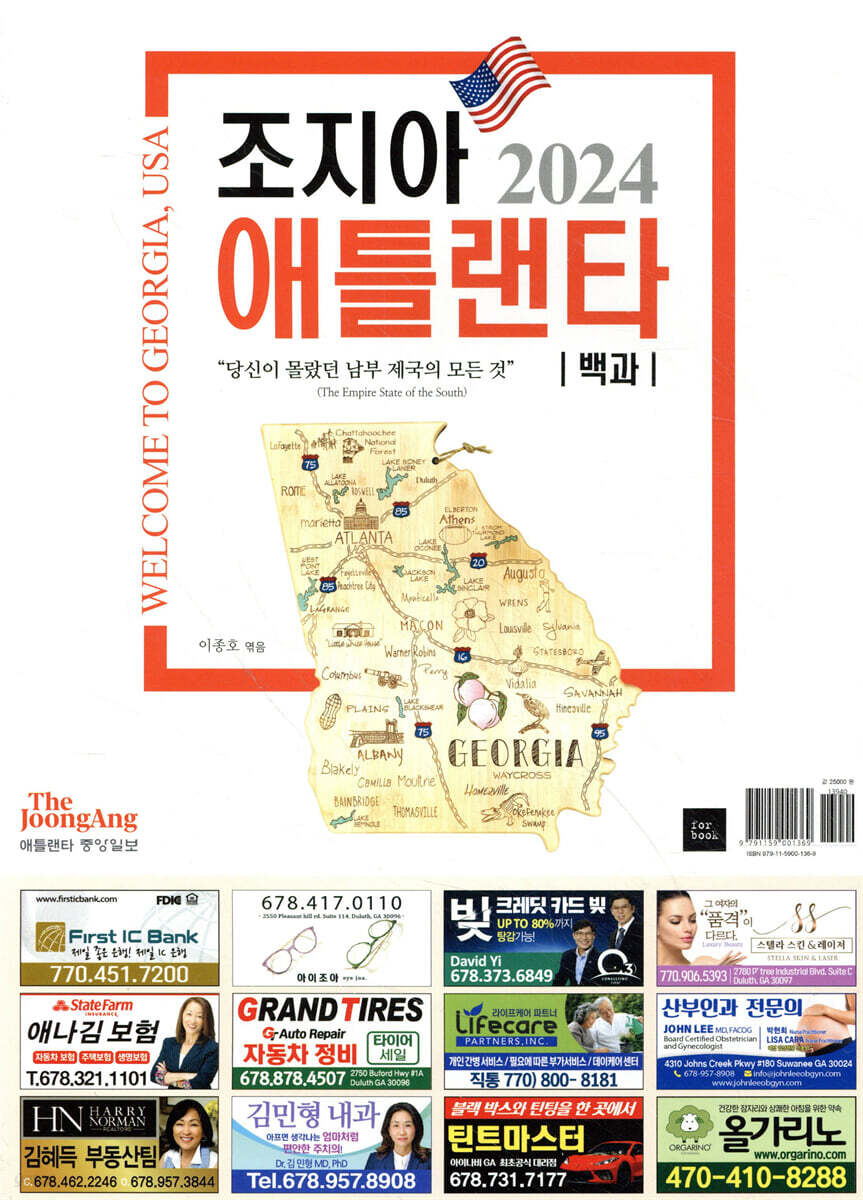
Book Introduction
Georgia: America's New Growth Engine for the 21st Century
The US state of Georgia is becoming a new growth engine for 21st century America.
Not only is it receiving significant attention economically and politically, its population is also growing rapidly.
This is because companies in various industries are creating jobs, and the combination of racial and cultural diversity and its advantages as a transportation and logistics hub are encouraging population inflow.
The relationship with Korea is also close.
More than 150 Korean companies, including Kia Motors, Hyundai Motors, SK, and Hanwha, have operations in Georgia.
Hundreds of thousands of Koreans travel to Georgia annually via direct flights between Incheon and Atlanta twice daily.
The growth of the Korean community is even more dazzling.
The influx of Koreans to New York, Chicago, LA, Washington, and Florida continues, as do Korean residents and international students.
There is nothing that is not there, including Korean restaurants, Korean hospitals, Korean markets, and Korean banks.
The Korean population in Atlanta is already estimated at over 150,000, and is expected to reach 200,000 in the near future.
In terms of density, Atlanta has become one of the three largest Korean-American cities in the United States, along with LA and New York.
There's a reason Georgia is in the spotlight.
This is because new jobs are constantly being created thanks to the excellent business environment and pro-business policies.
The relatively low cost of living, housing costs, and living expenses compared to other major cities in the United States are also a major attraction.
The forests and trees covering the entire city, the mountains and lakes, the four seasons, the mild weather year-round, and the absence of natural disasters are also natural blessings.
But these advantages of Georgia are not well known.
Many people still think of it as something like the American South's outskirts or a remote rural village.
This book was designed to help alleviate this prejudice and lack of understanding about the state of Georgia.
The US state of Georgia is becoming a new growth engine for 21st century America.
Not only is it receiving significant attention economically and politically, its population is also growing rapidly.
This is because companies in various industries are creating jobs, and the combination of racial and cultural diversity and its advantages as a transportation and logistics hub are encouraging population inflow.
The relationship with Korea is also close.
More than 150 Korean companies, including Kia Motors, Hyundai Motors, SK, and Hanwha, have operations in Georgia.
Hundreds of thousands of Koreans travel to Georgia annually via direct flights between Incheon and Atlanta twice daily.
The growth of the Korean community is even more dazzling.
The influx of Koreans to New York, Chicago, LA, Washington, and Florida continues, as do Korean residents and international students.
There is nothing that is not there, including Korean restaurants, Korean hospitals, Korean markets, and Korean banks.
The Korean population in Atlanta is already estimated at over 150,000, and is expected to reach 200,000 in the near future.
In terms of density, Atlanta has become one of the three largest Korean-American cities in the United States, along with LA and New York.
There's a reason Georgia is in the spotlight.
This is because new jobs are constantly being created thanks to the excellent business environment and pro-business policies.
The relatively low cost of living, housing costs, and living expenses compared to other major cities in the United States are also a major attraction.
The forests and trees covering the entire city, the mountains and lakes, the four seasons, the mild weather year-round, and the absence of natural disasters are also natural blessings.
But these advantages of Georgia are not well known.
Many people still think of it as something like the American South's outskirts or a remote rural village.
This book was designed to help alleviate this prejudice and lack of understanding about the state of Georgia.
index
preface
Chapter 1.
Why Georgia
- Georgia State Overview
- History, nature, transportation, population
- Economic, industrial and investment environment
- Religion, sports
- Car life
- Georgia slang and abbreviations
- Media reports related to Georgia
Chapter 2.
Introduction to major cities in Georgia
1.
Areas with many Koreans
- Atlanta / Duluth
- Suwanee / Johns Creek
- Doraville / Lawrenceville
- Buford / Norcross
- Cumming / Alpharetta
- Dunwoody / Sandy Springs
- Marietta / Kennesaw
- Hamilton Mill / Flowery Branch
- La Grange / Newnan
2.
Major hub cities
- Augusta / Columbus
- Athens / Macon
- Savannah
Chapter 3.
Georgia Living Information
- Korean Community: Current Status, Markets, Banks, Organizations, Media
- Shopping malls, general hospitals, public libraries
- Restaurants and restaurants worth visiting
- Georgia Social Welfare Program
- Georgia Living Legal Knowledge
- Cons of living in Georgia
Chapter 4.
Georgia Education and School Districts
- Georgia's educational environment
- Public schools
- Private school
- Information on major universities
Chapter 5.
How to buy a house
- Types of Georgia homes
- Should I buy an old house or a new house?
- Real estate transaction procedures
- Home insurance and tax benefits
- Living in a rental
- Real estate terminology
- Media coverage of Georgia real estate
Chapter 6 Leisure & Travel
- Places to visit around Atlanta
- Georgia tourist attractions
- Hiking and mountaineering spots
- 48 state parks in Georgia
- Federal government parks and attractions
- Public golf course preferred by Koreans
Chapter 1.
Why Georgia
- Georgia State Overview
- History, nature, transportation, population
- Economic, industrial and investment environment
- Religion, sports
- Car life
- Georgia slang and abbreviations
- Media reports related to Georgia
Chapter 2.
Introduction to major cities in Georgia
1.
Areas with many Koreans
- Atlanta / Duluth
- Suwanee / Johns Creek
- Doraville / Lawrenceville
- Buford / Norcross
- Cumming / Alpharetta
- Dunwoody / Sandy Springs
- Marietta / Kennesaw
- Hamilton Mill / Flowery Branch
- La Grange / Newnan
2.
Major hub cities
- Augusta / Columbus
- Athens / Macon
- Savannah
Chapter 3.
Georgia Living Information
- Korean Community: Current Status, Markets, Banks, Organizations, Media
- Shopping malls, general hospitals, public libraries
- Restaurants and restaurants worth visiting
- Georgia Social Welfare Program
- Georgia Living Legal Knowledge
- Cons of living in Georgia
Chapter 4.
Georgia Education and School Districts
- Georgia's educational environment
- Public schools
- Private school
- Information on major universities
Chapter 5.
How to buy a house
- Types of Georgia homes
- Should I buy an old house or a new house?
- Real estate transaction procedures
- Home insurance and tax benefits
- Living in a rental
- Real estate terminology
- Media coverage of Georgia real estate
Chapter 6 Leisure & Travel
- Places to visit around Atlanta
- Georgia tourist attractions
- Hiking and mountaineering spots
- 48 state parks in Georgia
- Federal government parks and attractions
- Public golf course preferred by Koreans
Into the book
In the United States, there is a county, which is an administrative unit above a city and below a state.
There are 159 counties in Georgia.
As of 2023, the most populous county in Georgia is Fulton County, with approximately 1.08 million people.
Fulton County, which stretches long from north to south, has many wealthy towns such as Johns Creek, Sandy Springs, and Roswell in the north, and the surrounding area of Atlanta in the south.
Gwinnett County, home to the largest Korean population, has the second-largest population in Georgia, at 983,526, and is on the verge of surpassing 1 million.
Duluth, Suwanee, Buford, Lawrenceville, and Norcross are all Gwinnett County cities with large Korean populations.
--- p.44 From “Chapter 1: Overview of Georgia”
Duluth, located north of Atlanta, is the undisputed center of Georgia's Koreatown.
It has the highest concentration of Korean businesses and the largest resident population.
The arrival of H Mart in 2004 was a decisive factor in Duluth's rapid growth as a center for Korean businesses.
In addition to H Mart, there are four Korean markets within a one-mile radius around Pleasant Hill Road, including Zion Market, Mega Mart, and Namdaemun Market, making it the largest Koreatown in the Southeastern United States.
There are also numerous Korean businesses, including restaurants, coffee shops, bakeries, banks, real estate agencies, travel agencies, lawyers, and loan offices.
--- p.76 From “Chapter 2 Major Cities in Georgia”
Georgia is far from the sea, but Georgia has a sea too.
The beautiful Atlantic coast stretches from Savannah south to Florida.
There are many beautiful islands.
However, it is a 5-6 hour drive from Atlanta.
This is a big drawback for people who love the sea.
But instead of the sea, there are lakes and rivers everywhere where you can enjoy water sports and boating.
--- p.117 From “Chapter 3: Information on Living in Georgia”
Georgia offers more scholarship benefits than other states.
If you enroll in a state university in Georgia, you can cover 80-90% of your tuition with the state government's "HOPE Scholarship," and even if you enroll in a private university, you can receive a considerable amount of scholarship money.
Recently, Korean parents in Georgia have also been preferring universities in Georgia, which offer lower tuition and better quality of education, over the Ivy League, which has excessively high tuition.
--- p.153 From “Georgia’s Educational Environment”
To buy a median-priced home in metro Atlanta, you need an annual income of $115,430.
This is almost double the amount before the pandemic.
According to housing market analysis firm Markets & Sight, the median home sale price in metro Atlanta has jumped 67% over the past five years.
The median home listing price in the area also came to $409,000.
This represents a 2.3% increase over the same month last year, or a 4.1% increase per square foot.
--- p.220 From “Chapter 5 Georgia Real Estate Information”
Atlanta was the site of the fiercest battles and the most devastating casualties of the Civil War.
As the center of the South, the scars of defeat were too great.
Today's Atlanta is a miraculous city built on top of that pain.
The Atlanta History Center is where the entire process is captured.
Located in Buckhead, Atlanta's wealthiest neighborhood, this is the largest history museum and research center in the United States, featuring nine permanent exhibition halls and temporary themed exhibits.
--- p.248 From “Chapter 6 Places to Visit in Atlanta”
President Carter was not very popular while in office.
But after leaving office, he received more love from Americans than anyone else.
His greatest virtue as a human being was that he remained consistent throughout his life.
Not only was his belief in peace, human rights, and faith evident, but so was his life of action, including his Sunday school service that he never missed until his mid-90s and his unwavering love for his wife of 77 years.
In today's world, where so many people throw away their past, which they have walked their entire lives on, like an old shoe, for the sake of immediate gain or loss, his honest life stands out even more.
This may be why people still visit Carter's hometown, Plains.
--- p.262 From “Chapter 6 Georgia Tourist Attractions”
If you look at a map of the United States, you will see three large mountain ranges running north to south.
The eastern Atlantic side is the Appalachian Mountains, the western Pacific side is the Sierra Nevada Mountains, and the central west is the Rocky Mountains.
There are hiking trails that run north to south along these mountain ranges.
The three major long-distance trails in the United States are the Appalachian Trail (2,190 miles), the Pacific Crest Trail (2,650 miles), and the Continental Divide Trail (3,028 miles).
One of the three trails is in Georgia.
--- p.270 From “Chapter 6 Mountain Climbing and Hiking Spots”
Georgia also has many federally managed parks.
All areas administered by the National Park Service (NPS) are prefixed with the word national or federal.
As of 2024, there are 63 national parks in the United States.
There are 84 quasi-national parks and 63 national historical parks.
There are no national parks in Georgia.
Still, there are quite a few places that have the word national in their name, such as semi-national parks, national historical parks, and national recreation areas.
These are places that every Georgian should visit at least once.
There are 159 counties in Georgia.
As of 2023, the most populous county in Georgia is Fulton County, with approximately 1.08 million people.
Fulton County, which stretches long from north to south, has many wealthy towns such as Johns Creek, Sandy Springs, and Roswell in the north, and the surrounding area of Atlanta in the south.
Gwinnett County, home to the largest Korean population, has the second-largest population in Georgia, at 983,526, and is on the verge of surpassing 1 million.
Duluth, Suwanee, Buford, Lawrenceville, and Norcross are all Gwinnett County cities with large Korean populations.
--- p.44 From “Chapter 1: Overview of Georgia”
Duluth, located north of Atlanta, is the undisputed center of Georgia's Koreatown.
It has the highest concentration of Korean businesses and the largest resident population.
The arrival of H Mart in 2004 was a decisive factor in Duluth's rapid growth as a center for Korean businesses.
In addition to H Mart, there are four Korean markets within a one-mile radius around Pleasant Hill Road, including Zion Market, Mega Mart, and Namdaemun Market, making it the largest Koreatown in the Southeastern United States.
There are also numerous Korean businesses, including restaurants, coffee shops, bakeries, banks, real estate agencies, travel agencies, lawyers, and loan offices.
--- p.76 From “Chapter 2 Major Cities in Georgia”
Georgia is far from the sea, but Georgia has a sea too.
The beautiful Atlantic coast stretches from Savannah south to Florida.
There are many beautiful islands.
However, it is a 5-6 hour drive from Atlanta.
This is a big drawback for people who love the sea.
But instead of the sea, there are lakes and rivers everywhere where you can enjoy water sports and boating.
--- p.117 From “Chapter 3: Information on Living in Georgia”
Georgia offers more scholarship benefits than other states.
If you enroll in a state university in Georgia, you can cover 80-90% of your tuition with the state government's "HOPE Scholarship," and even if you enroll in a private university, you can receive a considerable amount of scholarship money.
Recently, Korean parents in Georgia have also been preferring universities in Georgia, which offer lower tuition and better quality of education, over the Ivy League, which has excessively high tuition.
--- p.153 From “Georgia’s Educational Environment”
To buy a median-priced home in metro Atlanta, you need an annual income of $115,430.
This is almost double the amount before the pandemic.
According to housing market analysis firm Markets & Sight, the median home sale price in metro Atlanta has jumped 67% over the past five years.
The median home listing price in the area also came to $409,000.
This represents a 2.3% increase over the same month last year, or a 4.1% increase per square foot.
--- p.220 From “Chapter 5 Georgia Real Estate Information”
Atlanta was the site of the fiercest battles and the most devastating casualties of the Civil War.
As the center of the South, the scars of defeat were too great.
Today's Atlanta is a miraculous city built on top of that pain.
The Atlanta History Center is where the entire process is captured.
Located in Buckhead, Atlanta's wealthiest neighborhood, this is the largest history museum and research center in the United States, featuring nine permanent exhibition halls and temporary themed exhibits.
--- p.248 From “Chapter 6 Places to Visit in Atlanta”
President Carter was not very popular while in office.
But after leaving office, he received more love from Americans than anyone else.
His greatest virtue as a human being was that he remained consistent throughout his life.
Not only was his belief in peace, human rights, and faith evident, but so was his life of action, including his Sunday school service that he never missed until his mid-90s and his unwavering love for his wife of 77 years.
In today's world, where so many people throw away their past, which they have walked their entire lives on, like an old shoe, for the sake of immediate gain or loss, his honest life stands out even more.
This may be why people still visit Carter's hometown, Plains.
--- p.262 From “Chapter 6 Georgia Tourist Attractions”
If you look at a map of the United States, you will see three large mountain ranges running north to south.
The eastern Atlantic side is the Appalachian Mountains, the western Pacific side is the Sierra Nevada Mountains, and the central west is the Rocky Mountains.
There are hiking trails that run north to south along these mountain ranges.
The three major long-distance trails in the United States are the Appalachian Trail (2,190 miles), the Pacific Crest Trail (2,650 miles), and the Continental Divide Trail (3,028 miles).
One of the three trails is in Georgia.
--- p.270 From “Chapter 6 Mountain Climbing and Hiking Spots”
Georgia also has many federally managed parks.
All areas administered by the National Park Service (NPS) are prefixed with the word national or federal.
As of 2024, there are 63 national parks in the United States.
There are 84 quasi-national parks and 63 national historical parks.
There are no national parks in Georgia.
Still, there are quite a few places that have the word national in their name, such as semi-national parks, national historical parks, and national recreation areas.
These are places that every Georgian should visit at least once.
--- p.290 From “Chapter 6 Federal Government Sites”
Publisher's Review
Everything You Never Knew About the Empire State of the South
This book contains everything about Georgia in 2024 that Koreans might be curious about.
It meticulously covers the current status and characteristics of Atlanta and surrounding cities, information on living and moving to Georgia, education and school districts, real estate information, and the latest travel and leisure information.
We also didn't miss out on information about the rapidly growing Korean community.
Information on popular Korean restaurants, banks, markets, hospitals, and libraries will be a useful guide for both Atlanta residents and visitors.
Additionally, the latest information and newspaper articles about Georgia have been organized with photos and diagrams to greatly improve readability.
The editor is a veteran journalist who wrote Atlanta's first Korean hiking travel guide, "Georgia, I Want to Walk There."
He said, “This book is a kind of comprehensive report on the U.S. state of Georgia, which was called the Southern Empire,” and recommended reading it, saying, “I am confident that there is no other book with as much information as this as an introductory book to Korean for immigrants or migrants starting a new life in Georgia, as well as international students, Korean corporate dispatch workers, and short-term and long-term expatriates.”
Note
- The content included in this book is a collection of articles published in the Atlanta JoongAng Ilbo and various volumes of the JoongAng Ilbo, with necessary parts revised and added, and some parts were rewritten.
- The numbers, addresses, and phone numbers mentioned in this book were provided or made publicly available by relevant organizations, groups, and businesses between 2022 and 2024.
- The photographs, diagrams, and images in this book were taken or produced directly by the Atlanta JoongAng Ilbo, and some were legally purchased or made freely available.
- This book contains advertisements for many Atlanta Korean businesses throughout the book.
These are the places that supported the publication of the book.
The advertisement was also kept as it is a meaningful record that provides a glimpse into the lives of Koreans in Georgia and provides important information about their lives.
This book contains everything about Georgia in 2024 that Koreans might be curious about.
It meticulously covers the current status and characteristics of Atlanta and surrounding cities, information on living and moving to Georgia, education and school districts, real estate information, and the latest travel and leisure information.
We also didn't miss out on information about the rapidly growing Korean community.
Information on popular Korean restaurants, banks, markets, hospitals, and libraries will be a useful guide for both Atlanta residents and visitors.
Additionally, the latest information and newspaper articles about Georgia have been organized with photos and diagrams to greatly improve readability.
The editor is a veteran journalist who wrote Atlanta's first Korean hiking travel guide, "Georgia, I Want to Walk There."
He said, “This book is a kind of comprehensive report on the U.S. state of Georgia, which was called the Southern Empire,” and recommended reading it, saying, “I am confident that there is no other book with as much information as this as an introductory book to Korean for immigrants or migrants starting a new life in Georgia, as well as international students, Korean corporate dispatch workers, and short-term and long-term expatriates.”
Note
- The content included in this book is a collection of articles published in the Atlanta JoongAng Ilbo and various volumes of the JoongAng Ilbo, with necessary parts revised and added, and some parts were rewritten.
- The numbers, addresses, and phone numbers mentioned in this book were provided or made publicly available by relevant organizations, groups, and businesses between 2022 and 2024.
- The photographs, diagrams, and images in this book were taken or produced directly by the Atlanta JoongAng Ilbo, and some were legally purchased or made freely available.
- This book contains advertisements for many Atlanta Korean businesses throughout the book.
These are the places that supported the publication of the book.
The advertisement was also kept as it is a meaningful record that provides a glimpse into the lives of Koreans in Georgia and provides important information about their lives.
GOODS SPECIFICS
- Date of issue: May 15, 2024
- Page count, weight, size: 304 pages | 190*260*30mm
- ISBN13: 9791159001369
- ISBN10: 1159001367
You may also like
카테고리
korean


korean

![GQ KOREA Mark (Monthly): December [2025]](http://librairie.coreenne.fr/cdn/shop/files/8ef265dbbfbf186523ed75ba7319009d.jpg?v=1765340328&width=3840)


