

daegu
 |
Description
Book Introduction
Was Daegu such a fun city?
A cheerful and lively humanities travel book that shatters preconceptions.
A guide to Daegu's cultural tourism for discerning city travelers.
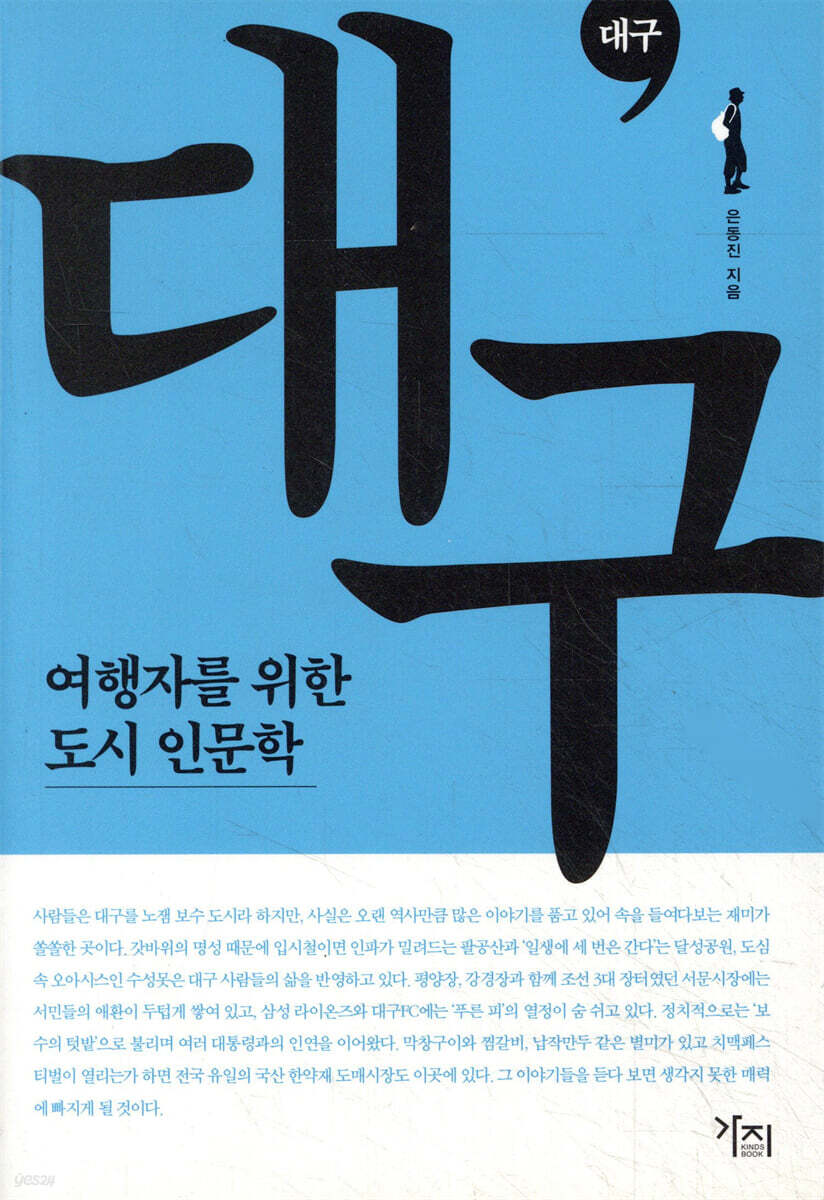
Daegu is not a top tourist city, but it has surprisingly many famous attractions and landmarks, making it a city that becomes more interesting the more you learn about it.
Palgongsan Mountain, which is crowded with people during college entrance exam season due to the fame of Gotbawi Rock, Dalseong Park, which is said to be a place that "every Daegu citizen must visit three times in their lifetime," and Suseongmot Lake, an oasis in the city center, reflect the lives of Daegu residents.
Seomun Market, one of the three major marketplaces of Joseon Dynasty, is steeped in the joys and sorrows of the common people, and the passion of the "blue blood" breathes in the Samsung Lions and Daegu FC.
There are delicacies like grilled makchang, steamed ribs, and flat dumplings, a chicken and beer festival, and the only domestic herbal medicine wholesale market in the country.
The author, who has been active as a history lecturer for a long time, tells common historical stories in an interesting way, and through this book, completely shatters the stereotype of Daegu as a boring and conservative city.
Reading his writing makes me want to run to Daepak and cheer him on with a “thump thump~ gol~” sound, and drink soju with grilled makchang as an appetizer.
It is a cheerful and lively travel book that is just like the author.
A cheerful and lively humanities travel book that shatters preconceptions.
A guide to Daegu's cultural tourism for discerning city travelers.
Daegu is not a top tourist city, but it has surprisingly many famous attractions and landmarks, making it a city that becomes more interesting the more you learn about it.
Palgongsan Mountain, which is crowded with people during college entrance exam season due to the fame of Gotbawi Rock, Dalseong Park, which is said to be a place that "every Daegu citizen must visit three times in their lifetime," and Suseongmot Lake, an oasis in the city center, reflect the lives of Daegu residents.
Seomun Market, one of the three major marketplaces of Joseon Dynasty, is steeped in the joys and sorrows of the common people, and the passion of the "blue blood" breathes in the Samsung Lions and Daegu FC.
There are delicacies like grilled makchang, steamed ribs, and flat dumplings, a chicken and beer festival, and the only domestic herbal medicine wholesale market in the country.
The author, who has been active as a history lecturer for a long time, tells common historical stories in an interesting way, and through this book, completely shatters the stereotype of Daegu as a boring and conservative city.
Reading his writing makes me want to run to Daepak and cheer him on with a “thump thump~ gol~” sound, and drink soju with grilled makchang as an appetizer.
It is a cheerful and lively travel book that is just like the author.
- You can preview some of the book's contents.
Preview
index
introduction
Daegu Humanities Map
Part 1.
The scenery that makes Daegu Daegu
The Daegu dialect can be heard far and wide, even through the air.
Is it really as hot as Africa? The scorching heat of Great Africa
Palgongsan National Park, embodying the soul and spirit of Daegu
Dalseong Park, a healing space for citizens in the city center
A place that sells even the most obscure items: Seomun Market's 100-year history
Dongseong-ro, a fashion hub filled with memories of Daegu Department Store
Bukseong-ro is transforming, harmonizing past and present.
How Daegu Became the Heart of Conservatism
Part 2.
Style and taste that make everyday life special
Blue blood flows through my veins, Samsung Lions
Daegu FC, a civic club dreaming of becoming Korea's Barcelona
An oasis in the city, Suseongmot Recreation Area
The most delicious experience in Daegu: grilled makchang
Wisdom in Spicy Flavors: Dongindong Jjimgalbi Alley
Flat dumplings that filled the stomachs of the common people with simple ingredients
The mecca of chicken where the Chimac Festival is held
They say he left behind only the scent of flowers, a land of apples without apples.
Part 3.
A historical walk in the city center
The Failed Relocation of the Capital to Dalgubeol Changed the Course of History
Gyeongsanggamyeong, the driving force behind Daegu's development
Daegu Eupseong Fortress remains as a street name
Yakjeon Alley, the only domestic herbal medicine wholesale market in the country
Daegu First Church, showing what society needs
Cheongna Hill, a space filled with modern time and culture
Gyesan Cathedral, a holy site for Catholics in Daegu
The National Debt Redemption Movement, in which everyone from slaves to emperors participated
Students Fight Against Injustice: The February 28th Democracy Movement
Part 4.
People who became stars in Daegu
Shin Sung-gyeom, a founding contributor to the Goryeo Dynasty, died on behalf of the king.
Hong Ui-Jang-Gwan, the first volunteer army leader of the Imjin War, Gwak Jae-u
General Kim Chung-seon, a Japanese samurai who became a Korean
Hyun Jin-geon, the novelist who laid the foundation for realist literature
Poet Lee Sang-hwa, who sang of spring in the stolen fields
Resistance poet Lee Yuk-sa, with a pen in one hand and a gun in the other
Singer Kim Kwang-seok revived Bangcheon Market with his down-to-earth sensibility.
Part 5.
Stories the City Tells
The slowly proven starting point of Korean civilization
The capital of dinosaurs, with footprints all over the city
Stop Distorting the History of Pain: The Hope Museum of Japanese Military Comfort Women
Dual role as base and refuge, temporary capital during the Korean War
A special heartfelt regret, the President's city
Samsung Trading Company, the parent company of Samsung Group
An outing to Apsan Mountain, where an observatory and a street of cafes await
supplement
Recommended Courses for a Walking Tour of Daegu
#1 Time to walk through the city center and hear about history
#2 Fall in love with the exotic charm of modern architecture.
#3 The joy of riding the monorail through the sky
#4 Places for City People in Need of Healing
#5 Let's make a wish at the foot of Palgongsan Mountain.
References
Search_Reading Daegu by Keyword
Daegu Humanities Map
Part 1.
The scenery that makes Daegu Daegu
The Daegu dialect can be heard far and wide, even through the air.
Is it really as hot as Africa? The scorching heat of Great Africa
Palgongsan National Park, embodying the soul and spirit of Daegu
Dalseong Park, a healing space for citizens in the city center
A place that sells even the most obscure items: Seomun Market's 100-year history
Dongseong-ro, a fashion hub filled with memories of Daegu Department Store
Bukseong-ro is transforming, harmonizing past and present.
How Daegu Became the Heart of Conservatism
Part 2.
Style and taste that make everyday life special
Blue blood flows through my veins, Samsung Lions
Daegu FC, a civic club dreaming of becoming Korea's Barcelona
An oasis in the city, Suseongmot Recreation Area
The most delicious experience in Daegu: grilled makchang
Wisdom in Spicy Flavors: Dongindong Jjimgalbi Alley
Flat dumplings that filled the stomachs of the common people with simple ingredients
The mecca of chicken where the Chimac Festival is held
They say he left behind only the scent of flowers, a land of apples without apples.
Part 3.
A historical walk in the city center
The Failed Relocation of the Capital to Dalgubeol Changed the Course of History
Gyeongsanggamyeong, the driving force behind Daegu's development
Daegu Eupseong Fortress remains as a street name
Yakjeon Alley, the only domestic herbal medicine wholesale market in the country
Daegu First Church, showing what society needs
Cheongna Hill, a space filled with modern time and culture
Gyesan Cathedral, a holy site for Catholics in Daegu
The National Debt Redemption Movement, in which everyone from slaves to emperors participated
Students Fight Against Injustice: The February 28th Democracy Movement
Part 4.
People who became stars in Daegu
Shin Sung-gyeom, a founding contributor to the Goryeo Dynasty, died on behalf of the king.
Hong Ui-Jang-Gwan, the first volunteer army leader of the Imjin War, Gwak Jae-u
General Kim Chung-seon, a Japanese samurai who became a Korean
Hyun Jin-geon, the novelist who laid the foundation for realist literature
Poet Lee Sang-hwa, who sang of spring in the stolen fields
Resistance poet Lee Yuk-sa, with a pen in one hand and a gun in the other
Singer Kim Kwang-seok revived Bangcheon Market with his down-to-earth sensibility.
Part 5.
Stories the City Tells
The slowly proven starting point of Korean civilization
The capital of dinosaurs, with footprints all over the city
Stop Distorting the History of Pain: The Hope Museum of Japanese Military Comfort Women
Dual role as base and refuge, temporary capital during the Korean War
A special heartfelt regret, the President's city
Samsung Trading Company, the parent company of Samsung Group
An outing to Apsan Mountain, where an observatory and a street of cafes await
supplement
Recommended Courses for a Walking Tour of Daegu
#1 Time to walk through the city center and hear about history
#2 Fall in love with the exotic charm of modern architecture.
#3 The joy of riding the monorail through the sky
#4 Places for City People in Need of Healing
#5 Let's make a wish at the foot of Palgongsan Mountain.
References
Search_Reading Daegu by Keyword
Detailed image
.jpg)
Into the book
You may be wondering why Busan and Daegu, which are close together, have such different dialects.
According to linguists, Daegu, a basin region, developed a strong accent from the first syllable so that speech could be heard over long distances despite the resonance of the air, while Busan, a coastal region, developed an accent so that speech could be heard even over the sound of waves.
The local scenery, customs, and way of life are reflected in the dialect.
--- p.20 From “Daegu Dialect”
Because of this rock, Palgongsan Mountain has become a 'star mountain' that appears in the media at least once a year.
People in Daegu believe in the reputation of Gotbawi Rock, which is said to grant one wish, and regardless of whether they believe in Buddhism or not, they pray earnestly at Gotbawi Rock when they have a fervent wish.
In particular, the top of the building resembles a graduation cap, so every year during the college entrance exam season, parents bow to pray for their children's success, leaving no room to even step.
--- p.34 From “Palgongsan National Park”
Daegu was not originally conservative.
In the past, Daegu was known as the 'Moscow of Korea' with a strong left wing and was considered a representative 'opposition city' and 'progressive city.'
The October Struggle against the US military government first broke out in Daegu in 1946, immediately after liberation.
The October Struggle was an incident in which approximately 7,500 Daegu citizens protested against the US military government's hiring of pro-Japanese officials and the forced confiscation of rice from rural areas, and hundreds of people were killed by police gunfire.
--- p.62 From “The Heart of Conservatism”
The title of dynasty cannot be earned by simply winning the Korean Series a few times.
They must consistently achieve top-level performance for at least five years and demonstrate strength in short-term matches.
The Samsung Lions ushered in the most powerful and perfect dynasty in professional baseball history, winning four consecutive championships from 2011 to 2014 and five consecutive regular season championships through 2015.
--- p.83 From "Samsung Lions"
A visit to a flat dumpling shop in Daegu will be a feast for both the eyes and the mouth.
The sight of baking paper-thin dumpling skins without tearing, the fun of eating them with soy sauce and chili powder floating green onions on top of the baked dumpling skins or sprinkling them all over them at once, the simple pleasure of taste will come flooding back.
--- p.115 From “Flat Dumplings”
Some may argue that it is not enough to call Daegu the mecca of chicken.
Well then, let me show you some conclusive evidence.
Daegu is the home of famous domestic chicken franchises such as Kyochon Chicken, Cheogatjip Yangnyeom Chicken, Mexicana, Hosiki Two Chickens, Ttangttang Chicken, Mexican Chicken, and Boo Chicken, which everyone has eaten or heard of at least once.
--- p.118 From “Chicken’s Holy Land”
At that time, going around the medicinal herb markets across the country was expressed as ‘taking a walk in the wind.’
However, the Daegu Herbal Medicine Market is so famous that there is a saying that no matter how good a medicinal herb is, it will not be effective if it is not exposed to the Daegu breeze. It is said that there were incidents where medicinal herbs produced in Wonsan or Hamheung were brought to the Daegu Herbal Medicine Market and then shipped back to the production site.
--- p.149 From “Yakjeon Alley”
If France has Montmartre Hill, which overlooks the entire city of Paris, Daegu has Cheongna Hill, a space filled with modern time and culture.
If you pass the Keimyung University Dongsan Medical Center across from Seomun Market and walk towards the Gothic-style spire of Daegu First Church, you will reach Cheongna Hill.
--- p.160 From "Cheongna Hill"
Not only farmers, merchants, soldiers, and students, but also women, gisaengs, and monks participated, and through activities such as quitting smoking, abstaining from drinking, and donating gold and silver jewelry, a total of 200,000 won was raised in donations in just three months.
Then, the Japanese Government-General considered the National Debt Redemption Movement not simply a movement to repay the national debt, but a movement to restore national sovereignty and an anti-Japanese movement.
--- p.179 From the “National Debt Redemption Movement”
The natural elements of Joseon sung in “Does Spring Come to the Stolen Fields” are things he experienced or discovered in colonial Daegu.
Lee Sang-baek, the younger brother of Lee Sang-hwa, identified the background as 'a barley field on the front mountain in Daemyeong-dong, Nam-gu, Daegu.'
Scholars have interpreted the work as being conceived 'while looking at the water castles from the bank of Susongmot Pond' or 'while looking at the water castles from Cheongna Hill'.
--- p.222 From “Poet Lee Sang-hwa”
The 'Munjeonseongsi Project' is a project that provides artists with abandoned shops in the market and supports them to create and exhibit their works.
The expectation was that by attracting audiences with artwork, the market would naturally be revitalized.
The young artists who participated in the project decided that the lonely alley atmosphere suited Kim Kwang-seok's music well.
--- p.237 From "Singer Kim Kwang-seok"
If people in Seoul have Namsan, people in Daegu have Apsan.
Namsan and Apsan have many similarities.
Starting with the fact that it is a representative citizen shelter, it has in common the fact that during the military dictatorship, there was the Central Intelligence Agency or the Agency for National Security Planning at the foot of the mountain, there was a US military base in Korea, lovers put locks on the observation deck, there is an integrated transmission tower for each broadcasting station, and there is a tunnel that runs through the mountain.
According to linguists, Daegu, a basin region, developed a strong accent from the first syllable so that speech could be heard over long distances despite the resonance of the air, while Busan, a coastal region, developed an accent so that speech could be heard even over the sound of waves.
The local scenery, customs, and way of life are reflected in the dialect.
--- p.20 From “Daegu Dialect”
Because of this rock, Palgongsan Mountain has become a 'star mountain' that appears in the media at least once a year.
People in Daegu believe in the reputation of Gotbawi Rock, which is said to grant one wish, and regardless of whether they believe in Buddhism or not, they pray earnestly at Gotbawi Rock when they have a fervent wish.
In particular, the top of the building resembles a graduation cap, so every year during the college entrance exam season, parents bow to pray for their children's success, leaving no room to even step.
--- p.34 From “Palgongsan National Park”
Daegu was not originally conservative.
In the past, Daegu was known as the 'Moscow of Korea' with a strong left wing and was considered a representative 'opposition city' and 'progressive city.'
The October Struggle against the US military government first broke out in Daegu in 1946, immediately after liberation.
The October Struggle was an incident in which approximately 7,500 Daegu citizens protested against the US military government's hiring of pro-Japanese officials and the forced confiscation of rice from rural areas, and hundreds of people were killed by police gunfire.
--- p.62 From “The Heart of Conservatism”
The title of dynasty cannot be earned by simply winning the Korean Series a few times.
They must consistently achieve top-level performance for at least five years and demonstrate strength in short-term matches.
The Samsung Lions ushered in the most powerful and perfect dynasty in professional baseball history, winning four consecutive championships from 2011 to 2014 and five consecutive regular season championships through 2015.
--- p.83 From "Samsung Lions"
A visit to a flat dumpling shop in Daegu will be a feast for both the eyes and the mouth.
The sight of baking paper-thin dumpling skins without tearing, the fun of eating them with soy sauce and chili powder floating green onions on top of the baked dumpling skins or sprinkling them all over them at once, the simple pleasure of taste will come flooding back.
--- p.115 From “Flat Dumplings”
Some may argue that it is not enough to call Daegu the mecca of chicken.
Well then, let me show you some conclusive evidence.
Daegu is the home of famous domestic chicken franchises such as Kyochon Chicken, Cheogatjip Yangnyeom Chicken, Mexicana, Hosiki Two Chickens, Ttangttang Chicken, Mexican Chicken, and Boo Chicken, which everyone has eaten or heard of at least once.
--- p.118 From “Chicken’s Holy Land”
At that time, going around the medicinal herb markets across the country was expressed as ‘taking a walk in the wind.’
However, the Daegu Herbal Medicine Market is so famous that there is a saying that no matter how good a medicinal herb is, it will not be effective if it is not exposed to the Daegu breeze. It is said that there were incidents where medicinal herbs produced in Wonsan or Hamheung were brought to the Daegu Herbal Medicine Market and then shipped back to the production site.
--- p.149 From “Yakjeon Alley”
If France has Montmartre Hill, which overlooks the entire city of Paris, Daegu has Cheongna Hill, a space filled with modern time and culture.
If you pass the Keimyung University Dongsan Medical Center across from Seomun Market and walk towards the Gothic-style spire of Daegu First Church, you will reach Cheongna Hill.
--- p.160 From "Cheongna Hill"
Not only farmers, merchants, soldiers, and students, but also women, gisaengs, and monks participated, and through activities such as quitting smoking, abstaining from drinking, and donating gold and silver jewelry, a total of 200,000 won was raised in donations in just three months.
Then, the Japanese Government-General considered the National Debt Redemption Movement not simply a movement to repay the national debt, but a movement to restore national sovereignty and an anti-Japanese movement.
--- p.179 From the “National Debt Redemption Movement”
The natural elements of Joseon sung in “Does Spring Come to the Stolen Fields” are things he experienced or discovered in colonial Daegu.
Lee Sang-baek, the younger brother of Lee Sang-hwa, identified the background as 'a barley field on the front mountain in Daemyeong-dong, Nam-gu, Daegu.'
Scholars have interpreted the work as being conceived 'while looking at the water castles from the bank of Susongmot Pond' or 'while looking at the water castles from Cheongna Hill'.
--- p.222 From “Poet Lee Sang-hwa”
The 'Munjeonseongsi Project' is a project that provides artists with abandoned shops in the market and supports them to create and exhibit their works.
The expectation was that by attracting audiences with artwork, the market would naturally be revitalized.
The young artists who participated in the project decided that the lonely alley atmosphere suited Kim Kwang-seok's music well.
--- p.237 From "Singer Kim Kwang-seok"
If people in Seoul have Namsan, people in Daegu have Apsan.
Namsan and Apsan have many similarities.
Starting with the fact that it is a representative citizen shelter, it has in common the fact that during the military dictatorship, there was the Central Intelligence Agency or the Agency for National Security Planning at the foot of the mountain, there was a US military base in Korea, lovers put locks on the observation deck, there is an integrated transmission tower for each broadcasting station, and there is a tunnel that runs through the mountain.
--- p.273 From "A Picnic in the Front Mountain"
Publisher's Review
A strong culture of subjectivity formed within the basin
How did Daegu become the 'heart of conservatism'?
It is said that the Daegu dialect, which emphasizes the first syllable, was a way to transmit speech over long distances despite the resonance of the air, in line with the geographical characteristics of a basin.
Daegu's sweltering heat, nicknamed 'Daeafrica', also originates from the basin.
The Yeongnam Basin, where the Sobaek Mountains to the west and the Taebaek Mountains to the east block the winds blowing from the West and East Seas, has a continental climate with hot summers and cold winters. Daegu, in particular, remains hot because Palgongsan Mountain and Biseulsan Mountain block the hot air to the north and south, respectively, preventing it from escaping.
There is also a view that the political tendency of the region, which is called the 'heart of conservatism', has fostered conservatism by forming a closed ruling structure due to the characteristics of the basin with little outward population movement.
Daegu's unique culture, formed in a basin within a basin, has strong subjectivity.
The hot climate, the refreshing and cool temperament, and the fiery, direct, and persistent temperament have naturally perfected the 'Daegu style' in all aspects of life and daily life.
Seomun Market, where fires of various sizes have occurred periodically for over 70 years since liberation, was hit hard by a large fire that shook the Daegu economy and even led to an economic depression with a surge in bankruptcies. However, the merchants rose from the ruins, built new buildings, and helped each other overcome the difficulties.
The market is a space formed through mutual checks and balances in a time of fierce competition, making it difficult to allow change. However, the people of Daegu used the fire as an opportunity to reorganize and modernize the space.
After the fire had ravaged the market, we waited for seven years and prepared for ten years to create a new model for the modern traditional market.
Fans of the professional baseball team Samsung Lions still gather at Samsung Lions Park on weekends to cheer on their "blue bloods," even though the team enjoyed a dynasty era, winning four consecutive championships from 2011 to 2014 and five consecutive regular season championships until 2015, and has been in the lower ranks since 2016.
It was the citizens of Daegu, the 12th player, who made Daegu FC, which had more losses than wins, the FA Cup champions.
The 18,351 Daegu citizens who gathered to cheer on the second leg of the 2018 final set a new record for the largest single-day attendance that year.
Daegu style can also be found in food.
Because it is a place where you have to spend hot summers, food that spoils easily is stored with strong seasoning, so dishes with a more spicy taste than those in other regions have developed.
Steamed ribs, which have been seasoned with red pepper and garlic, are steamed to remove the oil and add a spicy kick. This spicy dish is a fiery dish that captures the heat of Daegu.
Dongindong Jjimgalbi Alley, a place frequented by gourmets from all over the country, is also the first 'good alley' in the country.
All the galbi restaurants in the alley donate a certain amount of money to the Community Chest of Korea every month.
This kind of strong solidarity of care and sharing is also reflected in flat dumplings.
Flat dumplings, made by stuffing chopped noodles and a few vegetables into a thin wheat flour skin and frying them like pancakes, were a food that satisfied the hunger of hungry common people.
After the Korean War, dumpling skins were made with cheap and common wheat flour, but when there was no suitable material to use as dumpling filling, they used glass noodles, which are easy to store and have a chewy texture.
Daegu's unique culture is not a flashy tourist attraction, so it is not as popular as other regions in Gyeongsang Province as a travel destination.
But a walk into the basin and a glimpse into its history and traditions reveals that Daegu is anything but a boring, conservative city.
In the past, Daegu was a 'Moscow of Korea' with a strong left wing and was a representative 'opposition city' and 'progressive city.'
In 1907, the National Debt Redemption Movement, which sought to repay the debt owed to Japan and secure economic independence, began in Daegu, and in 1946, the October Uprising against the US military government first broke out in Daegu.
During the April 19 Revolution, he was the first to take to the streets and launch the February 28 Democracy Movement.
When and how did Daegu become a symbol of conservatism? The answer, too, can only be found by delving into the basin.
This book is a historical and cultural commentary and travel guide that guides city travelers to the unknown basin that is Daegu.
The author has compiled a table of contents to help even first-time visitors to Daegu find their travels easy and enjoyable, including stories from the city's history, memories of living in Daegu, and hopes for a future where they will return to live.
It is clearly Daegu style, but the fresh and enjoyable commentary makes it seem like it is not a Daegu story, and you will quickly become immersed in the story.
The places introduced in the book are concentrated in Jung-gu.
Since it is an easy route to explore on foot, following the recommended course of 'Daegu Humanities Tour on Foot' introduced in the appendix will be a great help in becoming familiar with Daegu.
Wouldn't it be wonderful to take a city tour while looking at the water fountains from Cheongna Hill and reciting "Does Spring Come to the Stolen Fields?"
About the "Urban Humanities for Travelers" series
Rediscovering local culture that you'll love even more the more you know about it
The "Urban Humanities for Travelers" series, abbreviated as "Yedoin," is a cultural guidebook that takes a deeper look at cities across the country beloved by domestic travelers through a humanistic perspective, revealing the roots and spirit behind the scenery.
Authors who were born in the city or have stayed there for a long time for various reasons and have witnessed the flow and changes of culture draw stories from the region's major historical and geographical backgrounds, unique foods and festivals, architecture and residential culture, local language and representative figures, and various customs and lifestyles, allowing readers to understand the uniqueness and differences of the region.
It was planned to provide the information necessary to discover and understand the narrative of space to those who enjoy slow city travel in search of humanistic stories, those who plan to live in or move to the city at least once, and today's young generation who are attempting to 'rediscover the local'.
How did Daegu become the 'heart of conservatism'?
It is said that the Daegu dialect, which emphasizes the first syllable, was a way to transmit speech over long distances despite the resonance of the air, in line with the geographical characteristics of a basin.
Daegu's sweltering heat, nicknamed 'Daeafrica', also originates from the basin.
The Yeongnam Basin, where the Sobaek Mountains to the west and the Taebaek Mountains to the east block the winds blowing from the West and East Seas, has a continental climate with hot summers and cold winters. Daegu, in particular, remains hot because Palgongsan Mountain and Biseulsan Mountain block the hot air to the north and south, respectively, preventing it from escaping.
There is also a view that the political tendency of the region, which is called the 'heart of conservatism', has fostered conservatism by forming a closed ruling structure due to the characteristics of the basin with little outward population movement.
Daegu's unique culture, formed in a basin within a basin, has strong subjectivity.
The hot climate, the refreshing and cool temperament, and the fiery, direct, and persistent temperament have naturally perfected the 'Daegu style' in all aspects of life and daily life.
Seomun Market, where fires of various sizes have occurred periodically for over 70 years since liberation, was hit hard by a large fire that shook the Daegu economy and even led to an economic depression with a surge in bankruptcies. However, the merchants rose from the ruins, built new buildings, and helped each other overcome the difficulties.
The market is a space formed through mutual checks and balances in a time of fierce competition, making it difficult to allow change. However, the people of Daegu used the fire as an opportunity to reorganize and modernize the space.
After the fire had ravaged the market, we waited for seven years and prepared for ten years to create a new model for the modern traditional market.
Fans of the professional baseball team Samsung Lions still gather at Samsung Lions Park on weekends to cheer on their "blue bloods," even though the team enjoyed a dynasty era, winning four consecutive championships from 2011 to 2014 and five consecutive regular season championships until 2015, and has been in the lower ranks since 2016.
It was the citizens of Daegu, the 12th player, who made Daegu FC, which had more losses than wins, the FA Cup champions.
The 18,351 Daegu citizens who gathered to cheer on the second leg of the 2018 final set a new record for the largest single-day attendance that year.
Daegu style can also be found in food.
Because it is a place where you have to spend hot summers, food that spoils easily is stored with strong seasoning, so dishes with a more spicy taste than those in other regions have developed.
Steamed ribs, which have been seasoned with red pepper and garlic, are steamed to remove the oil and add a spicy kick. This spicy dish is a fiery dish that captures the heat of Daegu.
Dongindong Jjimgalbi Alley, a place frequented by gourmets from all over the country, is also the first 'good alley' in the country.
All the galbi restaurants in the alley donate a certain amount of money to the Community Chest of Korea every month.
This kind of strong solidarity of care and sharing is also reflected in flat dumplings.
Flat dumplings, made by stuffing chopped noodles and a few vegetables into a thin wheat flour skin and frying them like pancakes, were a food that satisfied the hunger of hungry common people.
After the Korean War, dumpling skins were made with cheap and common wheat flour, but when there was no suitable material to use as dumpling filling, they used glass noodles, which are easy to store and have a chewy texture.
Daegu's unique culture is not a flashy tourist attraction, so it is not as popular as other regions in Gyeongsang Province as a travel destination.
But a walk into the basin and a glimpse into its history and traditions reveals that Daegu is anything but a boring, conservative city.
In the past, Daegu was a 'Moscow of Korea' with a strong left wing and was a representative 'opposition city' and 'progressive city.'
In 1907, the National Debt Redemption Movement, which sought to repay the debt owed to Japan and secure economic independence, began in Daegu, and in 1946, the October Uprising against the US military government first broke out in Daegu.
During the April 19 Revolution, he was the first to take to the streets and launch the February 28 Democracy Movement.
When and how did Daegu become a symbol of conservatism? The answer, too, can only be found by delving into the basin.
This book is a historical and cultural commentary and travel guide that guides city travelers to the unknown basin that is Daegu.
The author has compiled a table of contents to help even first-time visitors to Daegu find their travels easy and enjoyable, including stories from the city's history, memories of living in Daegu, and hopes for a future where they will return to live.
It is clearly Daegu style, but the fresh and enjoyable commentary makes it seem like it is not a Daegu story, and you will quickly become immersed in the story.
The places introduced in the book are concentrated in Jung-gu.
Since it is an easy route to explore on foot, following the recommended course of 'Daegu Humanities Tour on Foot' introduced in the appendix will be a great help in becoming familiar with Daegu.
Wouldn't it be wonderful to take a city tour while looking at the water fountains from Cheongna Hill and reciting "Does Spring Come to the Stolen Fields?"
About the "Urban Humanities for Travelers" series
Rediscovering local culture that you'll love even more the more you know about it
The "Urban Humanities for Travelers" series, abbreviated as "Yedoin," is a cultural guidebook that takes a deeper look at cities across the country beloved by domestic travelers through a humanistic perspective, revealing the roots and spirit behind the scenery.
Authors who were born in the city or have stayed there for a long time for various reasons and have witnessed the flow and changes of culture draw stories from the region's major historical and geographical backgrounds, unique foods and festivals, architecture and residential culture, local language and representative figures, and various customs and lifestyles, allowing readers to understand the uniqueness and differences of the region.
It was planned to provide the information necessary to discover and understand the narrative of space to those who enjoy slow city travel in search of humanistic stories, those who plan to live in or move to the city at least once, and today's young generation who are attempting to 'rediscover the local'.
GOODS SPECIFICS
- Date of issue: May 1, 2024
- Page count, weight, size: 312 pages | 330g | 128*188*20mm
- ISBN13: 9791193810040
- ISBN10: 1193810043
You may also like
카테고리
korean


korean

![GQ KOREA Mark (Monthly): December [2025]](http://librairie.coreenne.fr/cdn/shop/files/8ef265dbbfbf186523ed75ba7319009d.jpg?v=1765340328&width=3840)


