

Up in the park
 |
Description
Book Introduction
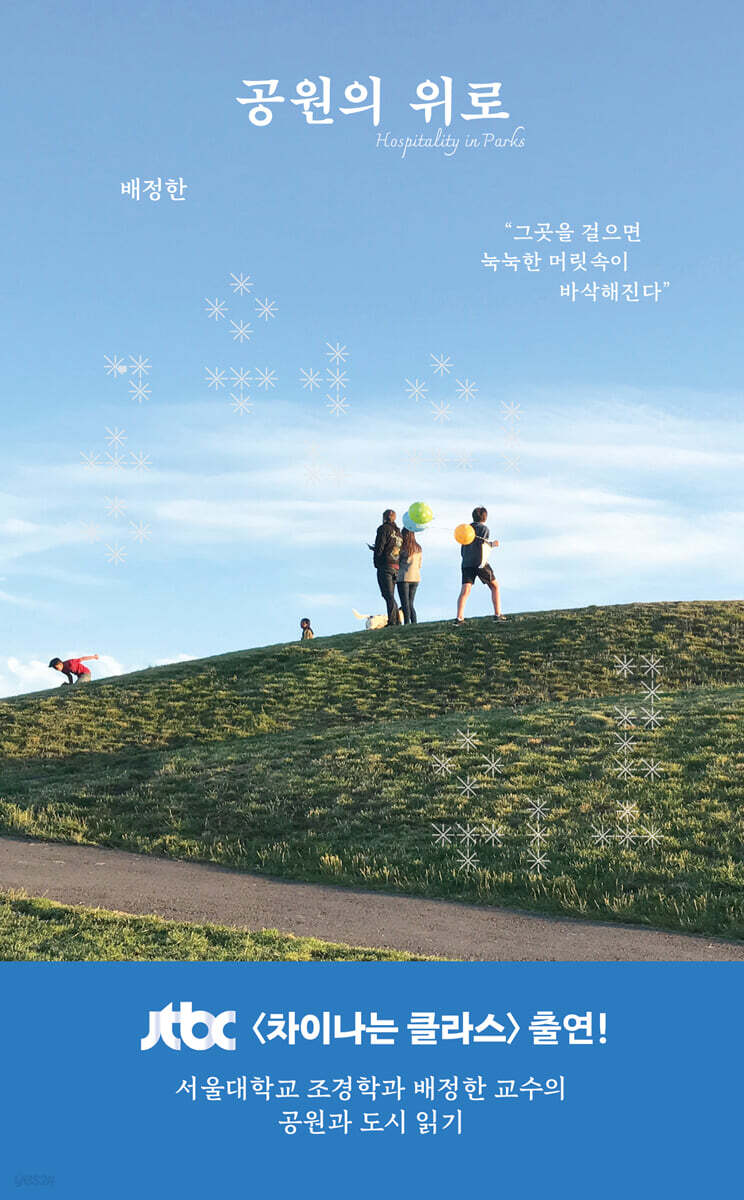
“When you don’t know where to go “I go to the park.” Appearing on JTBC's "China Class"! Reading Parks and Cities by Professor Bae Jeong-han of the Department of Landscape Architecture at Seoul National University Included in the author's recommended park list, "20 Parks for These Times" What Professor Bae Jeong-han, a landscape architect, thought about while walking through various parks and cities at home and abroad. In 58 essays, the book explores the meaning of urban parks by covering approximately 40 diverse spaces, including metropolitan parks such as Gyeongui Line Forest Park and Gwanggyo Lake Park, regional parks such as Jeonju Mamkkeut Forest Playground and Masan Imhang Line Greenway, and foreign parks such as New York Domino Park and Paris Champs-Élysées. If you start reading with a light heart, as if you were taking a walk, you will feel like you are walking through a park, and before you know it, you will be thinking about the structure and aesthetics of the park and its relationship with the city. A book that shows the diverse aspects of 'urban multiplayer' parks and asks what our parks truly look like today and how we want to live in these public spaces and cities. “Parks are the parentheses of the city. It is a place where you can escape from the hustle and bustle of the city and drift away voluntarily. Parks are the cultural powerhouses of cities. It captures the diverse lifestyles of the city and fosters aesthetic literacy in everyday life. Parks are social glue. It is a social infrastructure that supports the health of local communities. Parks are the margins of the city. It is a breath of fresh air for future generations. And the park is a hybrid landscape where not only humans but also various non-human creatures and objects coexist. …the park is a place of comfort that gives space to everyone and a space that welcomes everyone.”_From the introduction |
- You can preview some of the book's contents.
Preview
index
At the beginning of the book | The park is coming
Part 1 * Finding My Park
Where is your park? Seattle Gasworks Park
Parks are the city's parentheses. Seonyudo Park
Nanjido, the land that dreams of the reverse flow of time, Sky Park
Nodeul Island, an island welcoming voluntary drifting
Autumn Ending · Yanghwa Hangang Park
On my little rooftop
Snowy map
Walking through the cold city · Gyeongui Line Forest Park
Wild Comfort
Where the Sea Calls to the Land · Siheung Gaetgol Ecological Park
The baseball field is a park
A Day in Search of Clouds · Gwanggyo Lake Park
Editing of Selected Memories · Seosomun Historical Park
Parks outside the map · Seoul Children's Grand Park
Part 2 * A park that welcomes everyone
Jeonju Mamkkeut Forest Playground: A place where children can find their own fun and run around to their heart's content.
In a small park in an unfamiliar neighborhood · Huam-dong, Saenara Children's Park
Brickwell in Tongui-dong, a city well we use together
A Space for Communication and Solidarity · Amorepacific's New Headquarters
Experimental Shared Garden · Timewalk Myeongdong Noknok
Daegu Mirae Farm: A Land Where Trees Are the Main Characters
Park Chair · Nodeul Island, Bryant Park, New York
Long-stay parks, urban lounges, and concave parks
Everyone's Field, a Healthy and Beautiful Production Park · Goesan Whatha Nong
Parks in the COVID Era · Gwanggyo Lake Park
How to Use Parks in Infected Cities · New York Domino Park
Again, recalling Olmsted's park theory
Reality and Fantasy in the Park
Part 3 * Parks that Create Cities
A city built on parks · Sejong City Central Park
Seoul Forest Park, a park that grows with the city
Parks, the social glue of the city
Walking Through Time in an Urban Vacant Lot · Seoul Museum of Craft
From Forbidden Land to the Urban Margins · Songhyeon-dong Vacant Lot
I want to walk through the beautiful streets of Seoul · Seoulro 7017
From Flour Mill to Cultural Powerhouse · Daesun Flour Mill in Yeongdeungpo
The Power of the Park on the Abandoned Railroad Site · Masan Imhang Line Greenway
It feels just like a foreign country
Do not enter the lawn
Again, the fields of the Elysee dreaming of transformation · Paris' Champs-Élysées
Preservation and Regeneration of Parks: Remembering Lawrence Halprin
From the square to the park, and then to Yeouido Park
Memories of a Square · Pershing Square, LA
Can a park save the square? · The new Gwanghwamun Square
Part 4 * Lost in the City
Walking slowly through the city
Get lost in the city
The smell of the city
A city lost in memory, a foreign land for everyone: Jamsil Public Housing Complex 5
Anna's Seoul, a city without records
Hot neighborhood cliché: Sharosu-gil
Ikseon-dong Disneyland · Ikseon-dong
Blue Bottle in Seongsu-dong, a blue water bottle with red brick walls
Green Vaccine in the City: London Cholera Map
Cross the Han River on foot
A Hybrid Landscape: A Different Face of the Han River · A Han Riverside Pedestrian Network
I mostly lie down on weekends
How to do nothing
Invisible City · Noryangjin Underground Drainage Channel
Dreaming of Yongsan Park, a space for the city's future
It will be solved if you walk.
References and books
In times like these, this park is 20
Part 1 * Finding My Park
Where is your park? Seattle Gasworks Park
Parks are the city's parentheses. Seonyudo Park
Nanjido, the land that dreams of the reverse flow of time, Sky Park
Nodeul Island, an island welcoming voluntary drifting
Autumn Ending · Yanghwa Hangang Park
On my little rooftop
Snowy map
Walking through the cold city · Gyeongui Line Forest Park
Wild Comfort
Where the Sea Calls to the Land · Siheung Gaetgol Ecological Park
The baseball field is a park
A Day in Search of Clouds · Gwanggyo Lake Park
Editing of Selected Memories · Seosomun Historical Park
Parks outside the map · Seoul Children's Grand Park
Part 2 * A park that welcomes everyone
Jeonju Mamkkeut Forest Playground: A place where children can find their own fun and run around to their heart's content.
In a small park in an unfamiliar neighborhood · Huam-dong, Saenara Children's Park
Brickwell in Tongui-dong, a city well we use together
A Space for Communication and Solidarity · Amorepacific's New Headquarters
Experimental Shared Garden · Timewalk Myeongdong Noknok
Daegu Mirae Farm: A Land Where Trees Are the Main Characters
Park Chair · Nodeul Island, Bryant Park, New York
Long-stay parks, urban lounges, and concave parks
Everyone's Field, a Healthy and Beautiful Production Park · Goesan Whatha Nong
Parks in the COVID Era · Gwanggyo Lake Park
How to Use Parks in Infected Cities · New York Domino Park
Again, recalling Olmsted's park theory
Reality and Fantasy in the Park
Part 3 * Parks that Create Cities
A city built on parks · Sejong City Central Park
Seoul Forest Park, a park that grows with the city
Parks, the social glue of the city
Walking Through Time in an Urban Vacant Lot · Seoul Museum of Craft
From Forbidden Land to the Urban Margins · Songhyeon-dong Vacant Lot
I want to walk through the beautiful streets of Seoul · Seoulro 7017
From Flour Mill to Cultural Powerhouse · Daesun Flour Mill in Yeongdeungpo
The Power of the Park on the Abandoned Railroad Site · Masan Imhang Line Greenway
It feels just like a foreign country
Do not enter the lawn
Again, the fields of the Elysee dreaming of transformation · Paris' Champs-Élysées
Preservation and Regeneration of Parks: Remembering Lawrence Halprin
From the square to the park, and then to Yeouido Park
Memories of a Square · Pershing Square, LA
Can a park save the square? · The new Gwanghwamun Square
Part 4 * Lost in the City
Walking slowly through the city
Get lost in the city
The smell of the city
A city lost in memory, a foreign land for everyone: Jamsil Public Housing Complex 5
Anna's Seoul, a city without records
Hot neighborhood cliché: Sharosu-gil
Ikseon-dong Disneyland · Ikseon-dong
Blue Bottle in Seongsu-dong, a blue water bottle with red brick walls
Green Vaccine in the City: London Cholera Map
Cross the Han River on foot
A Hybrid Landscape: A Different Face of the Han River · A Han Riverside Pedestrian Network
I mostly lie down on weekends
How to do nothing
Invisible City · Noryangjin Underground Drainage Channel
Dreaming of Yongsan Park, a space for the city's future
It will be solved if you walk.
References and books
In times like these, this park is 20
Detailed image

Into the book
"It's really hard to live, work, and live in a good place.
The only place an ordinary city dweller can have is a small house and a small workplace.
We need another place to escape the routine of city life, where we commute between home and work, and enjoy a little leisure and fun.
To borrow a concept from sociologist Ray Oldenburg, we could call it a 'third place'.
A place of comfort and hospitality where you can briefly escape the shackles of everyday life.
But in a capitalist city, such a position is not easily given to us.
That's why public spaces are needed and shared parks are important.
My park, not mine, but where everyone can enjoy themselves comfortably and safely.
"A city with many parks like this is a healthy and beautiful city."
---From "Introduction: The Park Comes"
“What the landscape architects Park Yun-jin and Kim Jeong-yoon, who designed Yanghwa Hangang Park, focused on was the mud of the Hangang River.
The embankment-type embankment was dismantled and the terrain redesigned to allow the massive amount of mud that accumulates on the embankment during the summer floods to be carried away smoothly.
The terrain was treated as mud and a new plant ecosystem was established using the mud.
As the water level rises, the shape of the revetment changes and the boundary between water and land disappears.
“Thanks to the numerous beautiful slopes that gently transition from the highlands to the riverside, the park offers panoramic views of the Han River from anywhere in the park, and access to the water’s edge is possible without stairs or steep slopes.”
---From "Autumn Ending · Yangwha Hangang Park"
“It’s a long linear route, but there’s no reason to complete the entire route.
You can walk, rest, and leave the tracks at any time.
You can come in from anywhere and go out from anywhere.
There are no separate entrances or exits, and no fences dividing the inside and outside of the park.
It allows you the freedom to wander and get sidetracked.
The selection of flooring materials that preserve or reproduce the railroad tracks is delicate and neat, and the design of the zigzag pedestrian path that connects the bends of the park path with the surrounding neighborhood path is outstanding.
The typical city park in the shape of a square gives the feeling of a paradise away from the hustle and bustle of the city the further you go in, but in a sense, it is a deliberate refuge and artificial isolation.
“On the other hand, the long, linear Gyeongui Line Forest Road coexists alongside the city’s desires, chaos, and disorder.”
---From "Walking through the Cold City · Gyeongui Line Forest Park"
“As is well known, parks are a product of the modern city.
Parks were introduced as a 'spatial antidote' to the rapid industrialization of the 19th century that resulted in the explosion of urban population, overcrowding, the gap between rich and poor, workers' leisure problems, deteriorating sanitation, and epidemics of infectious diseases.
Frederick Law Olmsted, who designed Central Park, had a vision that parks could improve poor urban sanitation and restore the health of citizens.
Today, 160 years later, this long-forgotten classic benefit of the park is being rediscovered.
We dream of smart cities, but disease remains a constant companion to cities.
“City dwellers in the age of COVID-19, seeking safety and solace in parks, reflect the fate of uncertain and imperfect cities.”
---From "Parks in the Corona Era · Gwanggyo Lake Park"
“Setting one correct answer and then modifying it if it doesn’t fit may be an over-plan born of short-sighted desire.
There is also a flexible way to block the road and use it as a plaza whenever necessary.
We can create a pedestrian sanctuary by completely blocking traffic on weekends.
Improving pedestrian accessibility toward Sejong Center for the Performing Arts is not the only way to rectify the plaza.
If the plaza is built toward the U.S. Embassy, which is scheduled to be relocated, the pedestrian flow toward Jongno and Cheonggyecheon will be relieved.
Like the Champs-Élysées in Paris, the sidewalks on both sides of the road could be significantly expanded to create a plaza.
In the long term, we can draw up a grand plan to send vehicles underground and turn the entire Sejong-ro into a pedestrian-only plaza.
“Such a grand plan requires extensive research and experimentation.”
---From "Can a park save a plaza?"
“Those ‘unique shops’ were mostly located on the first floors of buildings in haphazardly built residential areas in the 1980s.
Often, the unsightly facades are transformed into cool, glass-encased facades, or rough-textured wood is added, or panels imitating exposed concrete are added.
Bricks that have been deliberately broken to look old are also a common material.
Japanese taverns sometimes have lattice doors or curtains.
There are also places with signs that look like they have something going on, signs that give off the artist’s vibe, and signs with a ‘retro look’ reminiscent of Reply 1988.”
The only place an ordinary city dweller can have is a small house and a small workplace.
We need another place to escape the routine of city life, where we commute between home and work, and enjoy a little leisure and fun.
To borrow a concept from sociologist Ray Oldenburg, we could call it a 'third place'.
A place of comfort and hospitality where you can briefly escape the shackles of everyday life.
But in a capitalist city, such a position is not easily given to us.
That's why public spaces are needed and shared parks are important.
My park, not mine, but where everyone can enjoy themselves comfortably and safely.
"A city with many parks like this is a healthy and beautiful city."
---From "Introduction: The Park Comes"
“What the landscape architects Park Yun-jin and Kim Jeong-yoon, who designed Yanghwa Hangang Park, focused on was the mud of the Hangang River.
The embankment-type embankment was dismantled and the terrain redesigned to allow the massive amount of mud that accumulates on the embankment during the summer floods to be carried away smoothly.
The terrain was treated as mud and a new plant ecosystem was established using the mud.
As the water level rises, the shape of the revetment changes and the boundary between water and land disappears.
“Thanks to the numerous beautiful slopes that gently transition from the highlands to the riverside, the park offers panoramic views of the Han River from anywhere in the park, and access to the water’s edge is possible without stairs or steep slopes.”
---From "Autumn Ending · Yangwha Hangang Park"
“It’s a long linear route, but there’s no reason to complete the entire route.
You can walk, rest, and leave the tracks at any time.
You can come in from anywhere and go out from anywhere.
There are no separate entrances or exits, and no fences dividing the inside and outside of the park.
It allows you the freedom to wander and get sidetracked.
The selection of flooring materials that preserve or reproduce the railroad tracks is delicate and neat, and the design of the zigzag pedestrian path that connects the bends of the park path with the surrounding neighborhood path is outstanding.
The typical city park in the shape of a square gives the feeling of a paradise away from the hustle and bustle of the city the further you go in, but in a sense, it is a deliberate refuge and artificial isolation.
“On the other hand, the long, linear Gyeongui Line Forest Road coexists alongside the city’s desires, chaos, and disorder.”
---From "Walking through the Cold City · Gyeongui Line Forest Park"
“As is well known, parks are a product of the modern city.
Parks were introduced as a 'spatial antidote' to the rapid industrialization of the 19th century that resulted in the explosion of urban population, overcrowding, the gap between rich and poor, workers' leisure problems, deteriorating sanitation, and epidemics of infectious diseases.
Frederick Law Olmsted, who designed Central Park, had a vision that parks could improve poor urban sanitation and restore the health of citizens.
Today, 160 years later, this long-forgotten classic benefit of the park is being rediscovered.
We dream of smart cities, but disease remains a constant companion to cities.
“City dwellers in the age of COVID-19, seeking safety and solace in parks, reflect the fate of uncertain and imperfect cities.”
---From "Parks in the Corona Era · Gwanggyo Lake Park"
“Setting one correct answer and then modifying it if it doesn’t fit may be an over-plan born of short-sighted desire.
There is also a flexible way to block the road and use it as a plaza whenever necessary.
We can create a pedestrian sanctuary by completely blocking traffic on weekends.
Improving pedestrian accessibility toward Sejong Center for the Performing Arts is not the only way to rectify the plaza.
If the plaza is built toward the U.S. Embassy, which is scheduled to be relocated, the pedestrian flow toward Jongno and Cheonggyecheon will be relieved.
Like the Champs-Élysées in Paris, the sidewalks on both sides of the road could be significantly expanded to create a plaza.
In the long term, we can draw up a grand plan to send vehicles underground and turn the entire Sejong-ro into a pedestrian-only plaza.
“Such a grand plan requires extensive research and experimentation.”
---From "Can a park save a plaza?"
“Those ‘unique shops’ were mostly located on the first floors of buildings in haphazardly built residential areas in the 1980s.
Often, the unsightly facades are transformed into cool, glass-encased facades, or rough-textured wood is added, or panels imitating exposed concrete are added.
Bricks that have been deliberately broken to look old are also a common material.
Japanese taverns sometimes have lattice doors or curtains.
There are also places with signs that look like they have something going on, signs that give off the artist’s vibe, and signs with a ‘retro look’ reminiscent of Reply 1988.”
---From "Hot Neighborhood Cliches · Sharosu-gil"
Publisher's Review
“When you don’t know where to go
“I go to the park.”
Appearing on JTBC's "China Class"!
Reading Parks and Cities by Professor Bae Jeong-han of the Department of Landscape Architecture at Seoul National University
Included in the author's recommended park list, "20 Parks for These Times"
What does a park mean to you?
Thoughts from a walk through the city's multiplayer park
A book containing thoughts from Professor Bae Jeong-han of the Department of Landscape Architecture at Seoul National University as he walked through various parks and cities at home and abroad.
In a total of 58 essays, the book explores the meaning of urban parks by covering approximately 40 diverse spaces, including metropolitan parks such as Gyeongui Line Forest Park and Gwanggyo Lake Park, regional parks such as Jeonju Mamkkeut Forest Playground and Masan Imhang Line Greenway, and foreign parks such as New York's Domino Park and Paris' Champs-Élysées.
If you start reading with a light heart, as if you were taking a walk, you will feel like you are walking through a park, and before you know it, you will be thinking about the structure and aesthetics of the park and its relationship with the city.
“Parks are the parentheses of the city.
It is a place where you can escape from the hustle and bustle of the city and drift away voluntarily.
Parks are the cultural powerhouses of cities.
It captures the diverse lifestyles of the city and fosters aesthetic literacy in everyday life.
Parks are social glue.
It is a social infrastructure that supports the health of local communities.
Parks are the margins of the city.
It is a breath of fresh air for future generations.
And the park is a hybrid landscape where not only humans but also various non-human creatures and objects coexist.
… the park is a place of comfort that gives space to everyone and a space that welcomes everyone.”_Page 6, from “Preface: The Park Comes”
In this way, this book details the diverse aspects and history of parks, which can be called "urban multiplayers," and asks what our parks truly look like today and how we should cultivate these public spaces and cities.
This question is also a question about what kind of society and life we want.
Most of the articles focus on a single park, making it fun to explore a different park in each article. The author's witty and sensuous descriptions of his spatial experiences further enhance the enjoyment.
This is a passage that primarily expresses the author's wish for readers to experience the park 'sensorily'.
But at the same time, it does not miss out on guidance and critical perspectives on the park's history and philosophy.
Readers will feel as if they have visited a park near or far through this book, and will want to go out and take a walk in the park right away.
Parks are places of comfort and hospitality.
And perhaps the space of comfort and hospitality is a park.
In this book, the author cites Lee Eo-ryeong's theory of parks and says that parks are an absolutely necessary empty space, like the navel of the body.
In an age where every space is filled with the logic of efficiency and commercialism, the thoughts about the "empty space" you will have while reading this book will also lead you to think about alternative lives.
This book not only explores spaces that have been specifically designed to embody alternative lifestyles, such as Jeonju's Mamkyeo Forest Playground and Goesan's Mwohanong, but also explores urban spaces that can be found in between busy city life, such as Gwanghwamun Square, museums, office buildings, and baseball stadiums, as places where we can live different lives, and each space is treated as a theme.
“Surprisingly, baseball fields vary in size.
The dimensions of the infield, including the distance between bases, are fixed like the block sizes of a grid-like city, but the width of the outfield, fence height, and material are as varied as wild nature.
The city (infield) and nature (outfield) meet to create various variations.
As such, the baseball field is a typical example of a park.
Of course, my wife would not have nodded to this kind of logic.”_Page 78, from “The Baseball Field is a Park”
The author's perspective that parks are, above all, places of comfort and hospitality, and that such spaces can themselves be parks, provides a new perspective on urban spaces.
This book allows readers to think about spaces in our cities that comfort and welcome us, even if they are not typical "parks."
What kind of life, city, and society do parks create?
The questions that spaces with many stories pose to us
The latter part of the book expands the scope beyond parks to include streets, commercial spaces, and land with undetermined uses.
Just as we don't just walk through the park when we go to the park, through this book we encounter the streets and the city surrounding the park.
Among these spaces, there are many that are historically 'stories', and this book tells the details of their history.
Readers will be able to explore every nook and cranny of a specific urban space as if they were taking a stroll here and there, and before they know it, they will find themselves pondering critical perspectives on space and urban sociological issues.
“It is said that [LA Pershing Square] became a place of avoidance and alienation due to the renovation work in the 1950s.
The mistake was to raise the ground level higher than the surrounding streets and enclose the plaza with a high wall to put an underground parking lot.
And then, no matter how much I changed and fixed it, I couldn’t erase the place of fear and exclusion.”_Pages 251-252, from “Memories of a Square”
“Most of the demolition and restoration activities that have taken place in the Sejong-ro and Gwanghwamun areas since liberation have taken the form of fragmentary recall of the pre-modern Joseon Dynasty as the original form of purity.
There were many cases where erasing the legacy of Japanese colonialism and superficially restoring traces of Joseon were used to create political spectacle.
“There needs to be an in-depth discussion about the ‘recovery of lost historical significance’ that the new Gwanghwamun Plaza advocates.”_Page 259, from “Can a Plaza Be Saved as a Park?”
The author's ambition to write an essay that conveys not only his experiences in parks and cities, but also his perspective and knowledge of space as a landscape architect can be seen in the composition of the book.
Part 1 mainly includes writings that can be grouped into the personal dimension of the park, that is, everyday, sensory, and aesthetic experiences.
Part 2, which could be subtitled "Sociology of Parks" if it's a bit of a stretch, deals with parks as spaces for relating to others.
Part 3 mainly contains articles that deal with the multi-layered functional relationship between parks and the city (its space and culture), while Part 4 contains articles that go beyond parks and cover experiences and lifestyles of various urban spaces, urban walking, and urban regeneration.
We have included a wealth of image material, including photographs and design plans, and as an appendix, we have included a list of 20 recommended parks, filled with the author's personal thoughts.
It will be the perfect gift for anyone who wants to go to the park, both in their head and body.
“I go to the park.”
Appearing on JTBC's "China Class"!
Reading Parks and Cities by Professor Bae Jeong-han of the Department of Landscape Architecture at Seoul National University
Included in the author's recommended park list, "20 Parks for These Times"
What does a park mean to you?
Thoughts from a walk through the city's multiplayer park
A book containing thoughts from Professor Bae Jeong-han of the Department of Landscape Architecture at Seoul National University as he walked through various parks and cities at home and abroad.
In a total of 58 essays, the book explores the meaning of urban parks by covering approximately 40 diverse spaces, including metropolitan parks such as Gyeongui Line Forest Park and Gwanggyo Lake Park, regional parks such as Jeonju Mamkkeut Forest Playground and Masan Imhang Line Greenway, and foreign parks such as New York's Domino Park and Paris' Champs-Élysées.
If you start reading with a light heart, as if you were taking a walk, you will feel like you are walking through a park, and before you know it, you will be thinking about the structure and aesthetics of the park and its relationship with the city.
“Parks are the parentheses of the city.
It is a place where you can escape from the hustle and bustle of the city and drift away voluntarily.
Parks are the cultural powerhouses of cities.
It captures the diverse lifestyles of the city and fosters aesthetic literacy in everyday life.
Parks are social glue.
It is a social infrastructure that supports the health of local communities.
Parks are the margins of the city.
It is a breath of fresh air for future generations.
And the park is a hybrid landscape where not only humans but also various non-human creatures and objects coexist.
… the park is a place of comfort that gives space to everyone and a space that welcomes everyone.”_Page 6, from “Preface: The Park Comes”
In this way, this book details the diverse aspects and history of parks, which can be called "urban multiplayers," and asks what our parks truly look like today and how we should cultivate these public spaces and cities.
This question is also a question about what kind of society and life we want.
Most of the articles focus on a single park, making it fun to explore a different park in each article. The author's witty and sensuous descriptions of his spatial experiences further enhance the enjoyment.
This is a passage that primarily expresses the author's wish for readers to experience the park 'sensorily'.
But at the same time, it does not miss out on guidance and critical perspectives on the park's history and philosophy.
Readers will feel as if they have visited a park near or far through this book, and will want to go out and take a walk in the park right away.
Parks are places of comfort and hospitality.
And perhaps the space of comfort and hospitality is a park.
In this book, the author cites Lee Eo-ryeong's theory of parks and says that parks are an absolutely necessary empty space, like the navel of the body.
In an age where every space is filled with the logic of efficiency and commercialism, the thoughts about the "empty space" you will have while reading this book will also lead you to think about alternative lives.
This book not only explores spaces that have been specifically designed to embody alternative lifestyles, such as Jeonju's Mamkyeo Forest Playground and Goesan's Mwohanong, but also explores urban spaces that can be found in between busy city life, such as Gwanghwamun Square, museums, office buildings, and baseball stadiums, as places where we can live different lives, and each space is treated as a theme.
“Surprisingly, baseball fields vary in size.
The dimensions of the infield, including the distance between bases, are fixed like the block sizes of a grid-like city, but the width of the outfield, fence height, and material are as varied as wild nature.
The city (infield) and nature (outfield) meet to create various variations.
As such, the baseball field is a typical example of a park.
Of course, my wife would not have nodded to this kind of logic.”_Page 78, from “The Baseball Field is a Park”
The author's perspective that parks are, above all, places of comfort and hospitality, and that such spaces can themselves be parks, provides a new perspective on urban spaces.
This book allows readers to think about spaces in our cities that comfort and welcome us, even if they are not typical "parks."
What kind of life, city, and society do parks create?
The questions that spaces with many stories pose to us
The latter part of the book expands the scope beyond parks to include streets, commercial spaces, and land with undetermined uses.
Just as we don't just walk through the park when we go to the park, through this book we encounter the streets and the city surrounding the park.
Among these spaces, there are many that are historically 'stories', and this book tells the details of their history.
Readers will be able to explore every nook and cranny of a specific urban space as if they were taking a stroll here and there, and before they know it, they will find themselves pondering critical perspectives on space and urban sociological issues.
“It is said that [LA Pershing Square] became a place of avoidance and alienation due to the renovation work in the 1950s.
The mistake was to raise the ground level higher than the surrounding streets and enclose the plaza with a high wall to put an underground parking lot.
And then, no matter how much I changed and fixed it, I couldn’t erase the place of fear and exclusion.”_Pages 251-252, from “Memories of a Square”
“Most of the demolition and restoration activities that have taken place in the Sejong-ro and Gwanghwamun areas since liberation have taken the form of fragmentary recall of the pre-modern Joseon Dynasty as the original form of purity.
There were many cases where erasing the legacy of Japanese colonialism and superficially restoring traces of Joseon were used to create political spectacle.
“There needs to be an in-depth discussion about the ‘recovery of lost historical significance’ that the new Gwanghwamun Plaza advocates.”_Page 259, from “Can a Plaza Be Saved as a Park?”
The author's ambition to write an essay that conveys not only his experiences in parks and cities, but also his perspective and knowledge of space as a landscape architect can be seen in the composition of the book.
Part 1 mainly includes writings that can be grouped into the personal dimension of the park, that is, everyday, sensory, and aesthetic experiences.
Part 2, which could be subtitled "Sociology of Parks" if it's a bit of a stretch, deals with parks as spaces for relating to others.
Part 3 mainly contains articles that deal with the multi-layered functional relationship between parks and the city (its space and culture), while Part 4 contains articles that go beyond parks and cover experiences and lifestyles of various urban spaces, urban walking, and urban regeneration.
We have included a wealth of image material, including photographs and design plans, and as an appendix, we have included a list of 20 recommended parks, filled with the author's personal thoughts.
It will be the perfect gift for anyone who wants to go to the park, both in their head and body.
GOODS SPECIFICS
- Publication date: November 24, 2023
- Page count, weight, size: 356 pages | 382g | 124*200*30mm
- ISBN13: 9788934955078
- ISBN10: 8934955074
You may also like
카테고리
korean


korean

![GQ KOREA Mark (Monthly): December [2025]](http://librairie.coreenne.fr/cdn/shop/files/8ef265dbbfbf186523ed75ba7319009d.jpg?v=1765340328&width=3840)


