

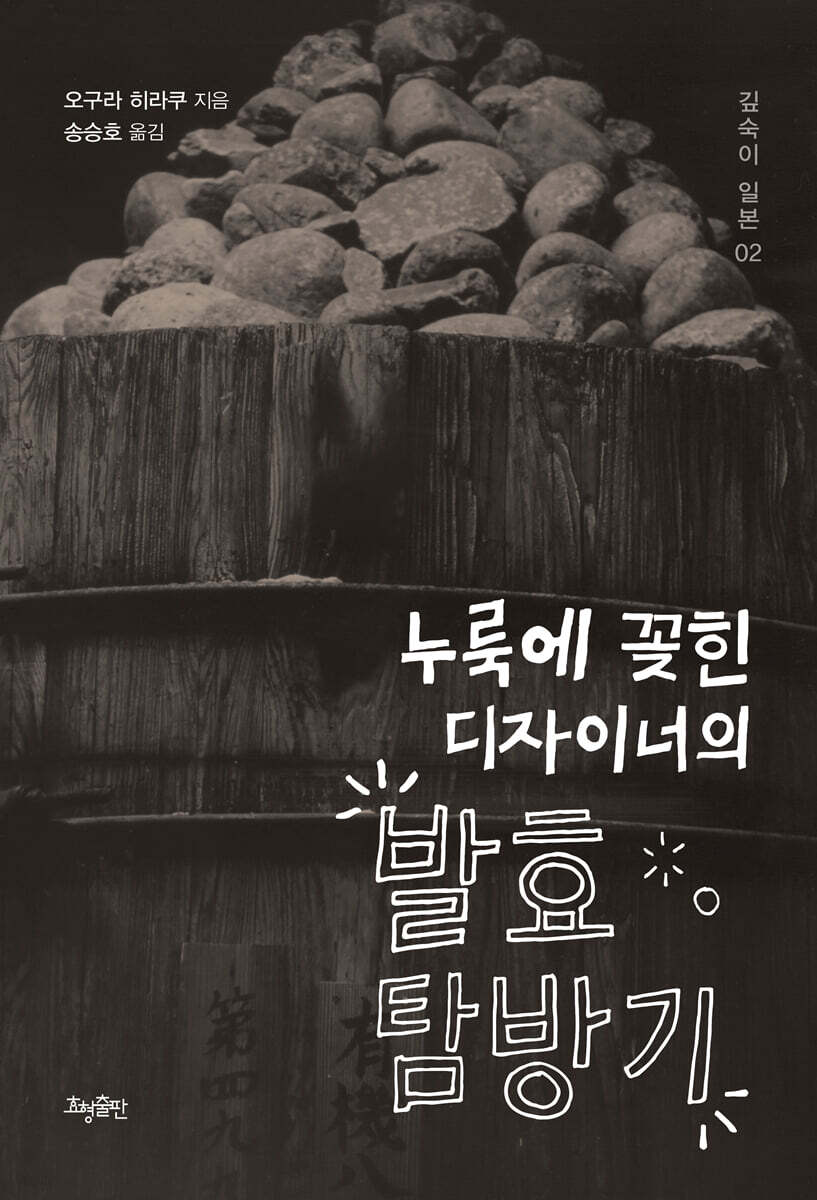
A Designer's Fermentation Journey, Obsessed with Yeast
 |
Description
Book Introduction
From one end of the Japanese archipelago to the other,
Cultivated by microorganisms, humans, nature and culture
Discover the deep flavor of local fermentation culture!
“In the season when the trees drop their leaves and the creatures in the soil and water hold their breath, a cheerful ‘poo, poo’ can be heard from the brewery on the outskirts.
“This is the sound that indicates that microorganisms have started to move inside the wooden barrel.”
The person who described the movement of yeast so delicately is none other than designer Hiraku Ogura, who turns 40 this year.
He introduces himself as a 'fermentation designer'.
How did he become so engrossed in the world of fermentation?
“I started eating fermented foods because my health wasn’t good.”
He began to open his eyes to fermentation after an experience that everyone has experienced, and while pondering ways to save a local culture that was on the verge of extinction, he found a solution in 'fermentation'.
And we began to discover and promote unique fermented foods by visiting hidden breweries throughout the archipelago.
He became a so-called 'fermentation evangelist'.
He is currently actively involved in launching a fermentation specialty shop and brand, giving lectures, and writing, presenting a unique perspective that "locality also exists in fermentation culture."
This book contains the author's fermentation journey that lasted approximately eight months starting in the late summer of 2018.
Representative and characteristic fermented foods of Japan are introduced in nine chapters, from the Tokai, Kinki, and Setouchi regions, to the northern regions of Hokuriku, Tohoku, and Hokkaido, and to the southern regions of Kanto, Kyushu, and Okinawa.
In addition to the regional specialties that are relatively familiar to us, such as miso, soy sauce, vinegar, and sake (nihonshu), there are also some local dishes that even the locals don't know about.
Here, the author does not stop at describing the taste and introducing the recipe.
I carefully observe the signals sent by the yeast and the conversation between the brewer and the microorganisms, and silently write them down from the side.
In a corner of the brewery, I contemplate the meaning of travel and the existence of humans and microorganisms.
Through his travels, the author ponders the future of local fermentation culture, which is on the verge of extinction.
It's a fermentation designer's idea.
He further points out fermentation as a core code of locality.
The book's ingredients, recipes, and stories about the local lifestyles and natural environments embedded in mysterious local fermented foods offer a multifaceted perspective on fermentation.
The author's background as an 'information design designer' prior to becoming a fermentation designer is also reflected in various columns.
All the knowledge about fermented foods, written with love that goes beyond just being a 'fermentation enthusiast', is contained here.
The well-organized knowledge of fermentation, from the principles of fermentation and its uses to regional differences in fermented foods and even the landscapes and beliefs associated with fermentation, is concise and well-structured.
In particular, the attempt to examine the trajectory of the development of fermented foods through the story of the Kitamaebune, a sailing ship that led the revival of Japanese maritime industry, is surprising.
Cultivated by microorganisms, humans, nature and culture
Discover the deep flavor of local fermentation culture!
“In the season when the trees drop their leaves and the creatures in the soil and water hold their breath, a cheerful ‘poo, poo’ can be heard from the brewery on the outskirts.
“This is the sound that indicates that microorganisms have started to move inside the wooden barrel.”
The person who described the movement of yeast so delicately is none other than designer Hiraku Ogura, who turns 40 this year.
He introduces himself as a 'fermentation designer'.
How did he become so engrossed in the world of fermentation?
“I started eating fermented foods because my health wasn’t good.”
He began to open his eyes to fermentation after an experience that everyone has experienced, and while pondering ways to save a local culture that was on the verge of extinction, he found a solution in 'fermentation'.
And we began to discover and promote unique fermented foods by visiting hidden breweries throughout the archipelago.
He became a so-called 'fermentation evangelist'.
He is currently actively involved in launching a fermentation specialty shop and brand, giving lectures, and writing, presenting a unique perspective that "locality also exists in fermentation culture."
This book contains the author's fermentation journey that lasted approximately eight months starting in the late summer of 2018.
Representative and characteristic fermented foods of Japan are introduced in nine chapters, from the Tokai, Kinki, and Setouchi regions, to the northern regions of Hokuriku, Tohoku, and Hokkaido, and to the southern regions of Kanto, Kyushu, and Okinawa.
In addition to the regional specialties that are relatively familiar to us, such as miso, soy sauce, vinegar, and sake (nihonshu), there are also some local dishes that even the locals don't know about.
Here, the author does not stop at describing the taste and introducing the recipe.
I carefully observe the signals sent by the yeast and the conversation between the brewer and the microorganisms, and silently write them down from the side.
In a corner of the brewery, I contemplate the meaning of travel and the existence of humans and microorganisms.
Through his travels, the author ponders the future of local fermentation culture, which is on the verge of extinction.
It's a fermentation designer's idea.
He further points out fermentation as a core code of locality.
The book's ingredients, recipes, and stories about the local lifestyles and natural environments embedded in mysterious local fermented foods offer a multifaceted perspective on fermentation.
The author's background as an 'information design designer' prior to becoming a fermentation designer is also reflected in various columns.
All the knowledge about fermented foods, written with love that goes beyond just being a 'fermentation enthusiast', is contained here.
The well-organized knowledge of fermentation, from the principles of fermentation and its uses to regional differences in fermented foods and even the landscapes and beliefs associated with fermentation, is concise and well-structured.
In particular, the attempt to examine the trajectory of the development of fermented foods through the story of the Kitamaebune, a sailing ship that led the revival of Japanese maritime industry, is surprising.
- You can preview some of the book's contents.
Preview
index
Entering… 6
Chapter 1: The Origin of Deep-Rooted Tastes - Tokai Region 18
Column 1: Various Fermentation Technologies and Their Uses
Chapter 2: An Air Pocket Beyond Time and Space—Kinki Region 42
Column 2 Fermentation Culture of the Sea, Mountains, Streets (Cities), and Islands
Chapter 3: The Path of Fish and Vinegar—Setouchi Area 66
Column 3: The Evolution of Sushi
Chapter 4: The Tempting Sound of Microorganisms - A Remote Island in Tokyo 94
Column 4 Japanese: What have they been eating?
Chapter 5: A Silver Journey to the North: Hokuriku, North of Tohoku 112
Column 5 Kitamaebune, the stage of Japanese dreams
Chapter 6: Fermented Snacks That Became Local Specialties—Kantō Region 152
Column 6 Fermentation Creates a Beautiful Landscape
Chapter 7: Fermentation Drives Industrialization: A Journey Through Japan's Modernization 166
Column 7: Where there is fermentation, there is faith.
Chapter 8: The Wisdom of the Coastal People - Kyushu Region 210
Chapter 9: The Ark of Memory 240
Special Episode 252
261 Well-Kept Fermented Foods
Translator's Note 266
Fermented food company website 270
Chapter 1: The Origin of Deep-Rooted Tastes - Tokai Region 18
Column 1: Various Fermentation Technologies and Their Uses
Chapter 2: An Air Pocket Beyond Time and Space—Kinki Region 42
Column 2 Fermentation Culture of the Sea, Mountains, Streets (Cities), and Islands
Chapter 3: The Path of Fish and Vinegar—Setouchi Area 66
Column 3: The Evolution of Sushi
Chapter 4: The Tempting Sound of Microorganisms - A Remote Island in Tokyo 94
Column 4 Japanese: What have they been eating?
Chapter 5: A Silver Journey to the North: Hokuriku, North of Tohoku 112
Column 5 Kitamaebune, the stage of Japanese dreams
Chapter 6: Fermented Snacks That Became Local Specialties—Kantō Region 152
Column 6 Fermentation Creates a Beautiful Landscape
Chapter 7: Fermentation Drives Industrialization: A Journey Through Japan's Modernization 166
Column 7: Where there is fermentation, there is faith.
Chapter 8: The Wisdom of the Coastal People - Kyushu Region 210
Chapter 9: The Ark of Memory 240
Special Episode 252
261 Well-Kept Fermented Foods
Translator's Note 266
Fermented food company website 270
Detailed image

Into the book
I thought it was just a food company that makes alcohol, soybean paste, and soy sauce, but when I looked closely at how they work, it was a different world from what I was used to.
Every day in breweries and factories, we struggle with invisible, enigmatic beings called 'microorganisms'.
By entrusting myself to microorganisms that I cannot communicate with, I create food with deep flavor.
…it is not humans who create it, but microorganisms.
Humans are nothing more than beings that provide the environment in which microorganisms can work.
---From "Entering"
From the end of summer onwards, the murmur turns to whispers, and mature microorganisms seem to be moving cautiously.
During this maturation period, the flavors and aromas that had been asserting their own opinions until then begin to converse and move in the same direction.
Each of the energetic things gathers strength and transforms into a ‘social being.’
Fermentation is creation.
Maturity is harmony.
Only after going through these two processes can a deep flavor be created.
---From "Chapter 1: The Origin of Deep-Rooted Taste - Tokai Region"
A brewery is an unusual place where time and space expand and contract.
The episodes heard on site also have a scale that distorts time and space.
… most of the microbes that fill the brewery, though invisible to the eye, exist on an incredibly long time scale, long before the birth of humans, long before mammals.
---From "Chapter 2: Air Pockets That Seem to Be Beyond Time and Space - Kinki Region"
As I continued my journey, I occasionally remembered Mrs. Katsuko's hands holding sushi.
Round hands that have been picking persimmon leaves from the garden and wrapping them in rice for over half a century.
Instead of the mouth of the woman of few words, her hands spoke eloquently to me about the memories of that place.
This hand-wrapped sushi is a 'non-verbal language' that conveys memories of the hometown.
As I savor each and every word of the woman's story, I find myself getting emotional again.
---From "Chapter 3: The Path of Fish and Vinegar - The Setouchi Area"
Many remote islands do not have free access to food.
It is difficult to obtain water, and it is also difficult to sell what is produced as a product.
So, we make thorough use of limited local materials.
As a result, mysterious fermentation techniques that are generally unthinkable are created.
A shift in thinking that began with the question, "Why did it turn out like that?", an enormous amount of effort that seemed absurd, and all kinds of contrivances to ensure sustainability.
On remote islands lies the culmination of wisdom that common people in most parts of the Japanese archipelago once accumulated to survive.
---From "Chapter 4: The Tempting Sound of Microorganisms - A Remote Island in Tokyo"
Yukisarashi are large, palm-sized peppers harvested in summer and fall, lightly pickled in salt water to soften them, and then thrown into the snow-covered fields as if they were a bed.
It may seem simple at first, but imagine women in black and white puffy dresses on a snow-covered field, tossing red peppers from blue baskets.
It seems like the whole world is made up of only white, black, blue, and red.
It is as pious and mysterious as the rituals performed by the little people in the fairy tale land.
---From "Chapter 5: A Silver Journey to the North - From Hokuriku, Tohoku to the North"
The sweets are filled with the breath of the local people and the joy of everyday life.
Simple 'joy' is engraved on it.
It's not a necessity, but I think that something that makes you feel empty and lifeless without it is called 'culture'.
…processing technology also originated from fermentation.
This evolved into recipes that provide everyday pleasure, such as baked manju or kuzumochi.
'A way to live' becomes a 'way to enjoy', and the community that gathers to find enjoyment becomes the mother of culture.
---From "Chapter 6: Fermented Snacks That Became Local Specialties - Kanto Region"
As the accumulation of history is deep, the possibility of fermentation as a culture that preserves the local characteristics of the region and that no one else can imitate is limitless.
And because that individuality is local, it can be connected to local people in other countries across borders, allowing for a deep understanding and acceptance of each other.
A new trend surrounding fermentation is emerging across Japan, and this is connected to a movement occurring not only in Japan but also around the world.
Small things are not swallowed up by big things and disappear, but can create changes that become bigger while remaining small.
Like a microorganism.
---From "Chapter 7 Fermentation Leads to Industrialization - A Journey to Japan's Modernization"
When I traveled around the world with a backpack, I thought that travel was about 'opening up one's own world.'
…that ‘anxiety about the unknown’ gradually faded over the years when travel became part of my job.
Instead, he was faced with the moment when 'his world closed'.
A world that once seemed close to him, but now somehow eerily weathered, sunk into the dark recesses of his memory.
Travel isn't just about opening doors to the unknown and illuminating the mind.
There is also a journey to find a rusty door in the dark that has been closed all along.
---From "Chapter 8: The Wisdom of the Coastal People - Kyushu Region"
Let us look into the darkness in life.
A small, forgotten sound, a small light flickers, of a forgotten being that has continued to live since the past.
Let's listen and think about it.
The connection with the past has not been broken.
Being connected to the past means there is a path to the future.
As the type of crisis changes, so does the hope.
This is the history of how the Japanese people have lived, and it is the future that tells us how we will live in this country.
It is an ark of memories, an ark for moving forward into the future.
Every day in breweries and factories, we struggle with invisible, enigmatic beings called 'microorganisms'.
By entrusting myself to microorganisms that I cannot communicate with, I create food with deep flavor.
…it is not humans who create it, but microorganisms.
Humans are nothing more than beings that provide the environment in which microorganisms can work.
---From "Entering"
From the end of summer onwards, the murmur turns to whispers, and mature microorganisms seem to be moving cautiously.
During this maturation period, the flavors and aromas that had been asserting their own opinions until then begin to converse and move in the same direction.
Each of the energetic things gathers strength and transforms into a ‘social being.’
Fermentation is creation.
Maturity is harmony.
Only after going through these two processes can a deep flavor be created.
---From "Chapter 1: The Origin of Deep-Rooted Taste - Tokai Region"
A brewery is an unusual place where time and space expand and contract.
The episodes heard on site also have a scale that distorts time and space.
… most of the microbes that fill the brewery, though invisible to the eye, exist on an incredibly long time scale, long before the birth of humans, long before mammals.
---From "Chapter 2: Air Pockets That Seem to Be Beyond Time and Space - Kinki Region"
As I continued my journey, I occasionally remembered Mrs. Katsuko's hands holding sushi.
Round hands that have been picking persimmon leaves from the garden and wrapping them in rice for over half a century.
Instead of the mouth of the woman of few words, her hands spoke eloquently to me about the memories of that place.
This hand-wrapped sushi is a 'non-verbal language' that conveys memories of the hometown.
As I savor each and every word of the woman's story, I find myself getting emotional again.
---From "Chapter 3: The Path of Fish and Vinegar - The Setouchi Area"
Many remote islands do not have free access to food.
It is difficult to obtain water, and it is also difficult to sell what is produced as a product.
So, we make thorough use of limited local materials.
As a result, mysterious fermentation techniques that are generally unthinkable are created.
A shift in thinking that began with the question, "Why did it turn out like that?", an enormous amount of effort that seemed absurd, and all kinds of contrivances to ensure sustainability.
On remote islands lies the culmination of wisdom that common people in most parts of the Japanese archipelago once accumulated to survive.
---From "Chapter 4: The Tempting Sound of Microorganisms - A Remote Island in Tokyo"
Yukisarashi are large, palm-sized peppers harvested in summer and fall, lightly pickled in salt water to soften them, and then thrown into the snow-covered fields as if they were a bed.
It may seem simple at first, but imagine women in black and white puffy dresses on a snow-covered field, tossing red peppers from blue baskets.
It seems like the whole world is made up of only white, black, blue, and red.
It is as pious and mysterious as the rituals performed by the little people in the fairy tale land.
---From "Chapter 5: A Silver Journey to the North - From Hokuriku, Tohoku to the North"
The sweets are filled with the breath of the local people and the joy of everyday life.
Simple 'joy' is engraved on it.
It's not a necessity, but I think that something that makes you feel empty and lifeless without it is called 'culture'.
…processing technology also originated from fermentation.
This evolved into recipes that provide everyday pleasure, such as baked manju or kuzumochi.
'A way to live' becomes a 'way to enjoy', and the community that gathers to find enjoyment becomes the mother of culture.
---From "Chapter 6: Fermented Snacks That Became Local Specialties - Kanto Region"
As the accumulation of history is deep, the possibility of fermentation as a culture that preserves the local characteristics of the region and that no one else can imitate is limitless.
And because that individuality is local, it can be connected to local people in other countries across borders, allowing for a deep understanding and acceptance of each other.
A new trend surrounding fermentation is emerging across Japan, and this is connected to a movement occurring not only in Japan but also around the world.
Small things are not swallowed up by big things and disappear, but can create changes that become bigger while remaining small.
Like a microorganism.
---From "Chapter 7 Fermentation Leads to Industrialization - A Journey to Japan's Modernization"
When I traveled around the world with a backpack, I thought that travel was about 'opening up one's own world.'
…that ‘anxiety about the unknown’ gradually faded over the years when travel became part of my job.
Instead, he was faced with the moment when 'his world closed'.
A world that once seemed close to him, but now somehow eerily weathered, sunk into the dark recesses of his memory.
Travel isn't just about opening doors to the unknown and illuminating the mind.
There is also a journey to find a rusty door in the dark that has been closed all along.
---From "Chapter 8: The Wisdom of the Coastal People - Kyushu Region"
Let us look into the darkness in life.
A small, forgotten sound, a small light flickers, of a forgotten being that has continued to live since the past.
Let's listen and think about it.
The connection with the past has not been broken.
Being connected to the past means there is a path to the future.
As the type of crisis changes, so does the hope.
This is the history of how the Japanese people have lived, and it is the future that tells us how we will live in this country.
It is an ark of memories, an ark for moving forward into the future.
---From "Chapter 9: The Ark of Memory"
Publisher's Review
Fermentation is a creative product born of the will to survive.
When wisdom becomes joy, it becomes culture.
People constantly struggle to survive in a harsh environment and limited world.
Many of the places the author visited were environmentally 'closed places', and the lack of freedom to use anything fostered creativity.
The state of ‘nothingness’ gives birth to the will to ‘make something’, and the expression of this will leads to life.
Following his journey, microbes soon become like mirrors reflecting our lives.
The 'non-human time' flowing within the body, the true nature of time created by microorganisms, is a point that must not be missed while following the fermentation journey.
He explores the core elements of Japanese culture through fermentation research.
His words, “What I have witnessed and observed so far is the resilience, resilience, and diversity of people who can overcome any situation,” sum up this point.
Ultimately, the history of fermentation is a continuous process in which 'wisdom' becomes 'joy' for living better, and 'community' becomes the means to share that joy.
So what's the solution for local cultures on the brink of extinction? Let's borrow the author's words for a moment.
“The essence of tradition is not ‘form,’ but ‘idea,’ not ‘style,’ but ‘concept,’ and that is the core of the culture that will create a new era.” In other words, does this mean that ‘individual creativity’ determines the future of local culture, and that traditional culture can be reconceptualized to suit the coming era?
The author argues that as the world changes, the will to create something out of nothing is the source of living design, and that culture does not disappear in a crisis, but rather "survives because it is a crisis."
His insight, which he wrote by looking at fermentation culture from various angles and in depth, has great implications for us as well.
While publishing the "Deep into Japan" series
Korea and Japan, which share the same Chinese character culture, have more differences than similarities.
Although the COVID-19 pandemic brought a brief lull in communication, many people still travel between the two countries, and stories ranging from grand narratives to small glimpses of everyday life are shared almost in real time.
Many historically unclear issues remain unresolved, and long-standing issues remain hot potatoes, generating public interest and controversy.
"Deep Japan" is a humanities and arts series designed to broaden and deepen your interest and understanding by bringing you one step closer to various aspects of Japan, both known and unknown.
We aim to serve as a bridge between translated works and works by domestic authors, based on a balanced perspective and approach.
When wisdom becomes joy, it becomes culture.
People constantly struggle to survive in a harsh environment and limited world.
Many of the places the author visited were environmentally 'closed places', and the lack of freedom to use anything fostered creativity.
The state of ‘nothingness’ gives birth to the will to ‘make something’, and the expression of this will leads to life.
Following his journey, microbes soon become like mirrors reflecting our lives.
The 'non-human time' flowing within the body, the true nature of time created by microorganisms, is a point that must not be missed while following the fermentation journey.
He explores the core elements of Japanese culture through fermentation research.
His words, “What I have witnessed and observed so far is the resilience, resilience, and diversity of people who can overcome any situation,” sum up this point.
Ultimately, the history of fermentation is a continuous process in which 'wisdom' becomes 'joy' for living better, and 'community' becomes the means to share that joy.
So what's the solution for local cultures on the brink of extinction? Let's borrow the author's words for a moment.
“The essence of tradition is not ‘form,’ but ‘idea,’ not ‘style,’ but ‘concept,’ and that is the core of the culture that will create a new era.” In other words, does this mean that ‘individual creativity’ determines the future of local culture, and that traditional culture can be reconceptualized to suit the coming era?
The author argues that as the world changes, the will to create something out of nothing is the source of living design, and that culture does not disappear in a crisis, but rather "survives because it is a crisis."
His insight, which he wrote by looking at fermentation culture from various angles and in depth, has great implications for us as well.
While publishing the "Deep into Japan" series
Korea and Japan, which share the same Chinese character culture, have more differences than similarities.
Although the COVID-19 pandemic brought a brief lull in communication, many people still travel between the two countries, and stories ranging from grand narratives to small glimpses of everyday life are shared almost in real time.
Many historically unclear issues remain unresolved, and long-standing issues remain hot potatoes, generating public interest and controversy.
"Deep Japan" is a humanities and arts series designed to broaden and deepen your interest and understanding by bringing you one step closer to various aspects of Japan, both known and unknown.
We aim to serve as a bridge between translated works and works by domestic authors, based on a balanced perspective and approach.
GOODS SPECIFICS
- Date of issue: October 30, 2023
- Page count, weight, size: 272 pages | 128*188*17mm
- ISBN13: 9788958722168
- ISBN10: 8958722169
You may also like
카테고리
korean


korean

![GQ KOREA Mark (Monthly): December [2025]](http://librairie.coreenne.fr/cdn/shop/files/8ef265dbbfbf186523ed75ba7319009d.jpg?v=1765340328&width=3840)


