

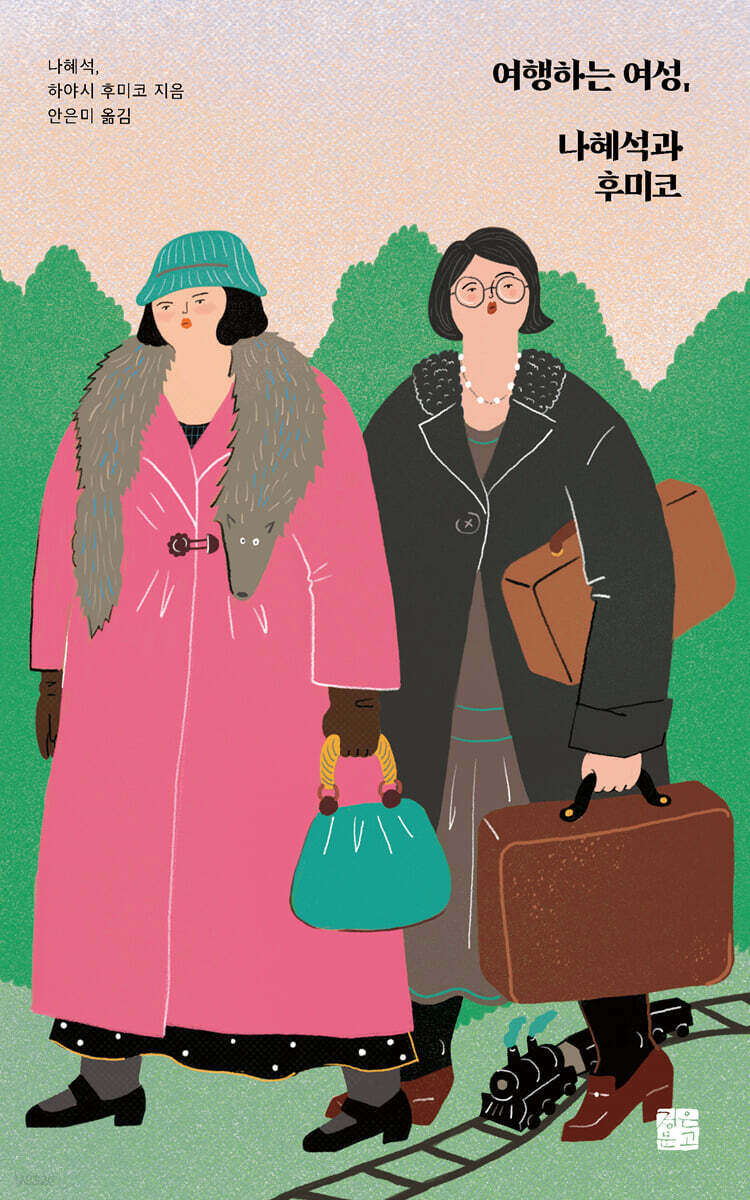
Traveling Women, Na Hye-seok and Fumiko
 |
Description
Book Introduction
Na Hye-seok, a colonial woman who rode first class
Fumiko Hayashi, an imperial woman riding in third class
This travelogue is the record of two 'women' of different nationalities and classes in a time when travel was only enjoyed by men.
‘Women’ were a class formed during the modern period of Korea and Japan.
Who is the new woman born in this new era called modernity?
She is a woman with her own world and work as a painter and writer.
She is a woman who can travel.
Na Hye-seok (1896-1948) and Hayashi Fumiko (1903-1951) took the same journey, taking a train from Busan to Manchuria via China and then traveling to Paris by Trans-Siberian Railway.
Na Hye-seok and Hayashi Fumiko, women representing the modern era of colonial Korea and colonial Japan, were born in the same era, but traveled to Europe by crossing Russia on the Trans-Siberian Railway four years apart.
And each of them left behind “Gumi Travelogue” and “Samdeung Travelogue.”
But their journeys are similar yet different.
At that time, Na Hye-seok, a colonial woman, traveled in first class, while Fumiko, an imperial woman, traveled in the cheapest third class.
Because of this, the people you meet and the scenery you see are all different.
Women, a new class born with modern times.
What were the lives of these two women like, set against the backdrop of colonialism and the colonized? What did it mean for an Asian woman to travel the world during the height of imperialism around 1930?
Fumiko Hayashi, an imperial woman riding in third class
This travelogue is the record of two 'women' of different nationalities and classes in a time when travel was only enjoyed by men.
‘Women’ were a class formed during the modern period of Korea and Japan.
Who is the new woman born in this new era called modernity?
She is a woman with her own world and work as a painter and writer.
She is a woman who can travel.
Na Hye-seok (1896-1948) and Hayashi Fumiko (1903-1951) took the same journey, taking a train from Busan to Manchuria via China and then traveling to Paris by Trans-Siberian Railway.
Na Hye-seok and Hayashi Fumiko, women representing the modern era of colonial Korea and colonial Japan, were born in the same era, but traveled to Europe by crossing Russia on the Trans-Siberian Railway four years apart.
And each of them left behind “Gumi Travelogue” and “Samdeung Travelogue.”
But their journeys are similar yet different.
At that time, Na Hye-seok, a colonial woman, traveled in first class, while Fumiko, an imperial woman, traveled in the cheapest third class.
Because of this, the people you meet and the scenery you see are all different.
Women, a new class born with modern times.
What were the lives of these two women like, set against the backdrop of colonialism and the colonized? What did it mean for an Asian woman to travel the world during the height of imperialism around 1930?
- You can preview some of the book's contents.
Preview
index
Compiling the Book - Editorial Department
Gumi travelogue
In lieu of the introduction
To Soviet Russia
CCCP
Berlin and Paris
Flowers' Paris Journey
From Berlin to London
Western Art and Nudity
Passionate journey to Spain
From Paris to New York
Across the Pacific to my homeland
After the trip
Na Hye-seok's chronology
Connecting text - Author Dahye Lee
Third class travelogue
Trans-Siberian Railway
Clear skies all the way to Paris
A fly that walks in a gutter
Street Angels, Prostitutes and Police Officers
Paris Kitchen, Tokyo Kitchen
Bathhouse during the day, cabaret at night
My solo trip to London
Stroll through the Forest of Fontainebleau
Adieu Marseille, Adieu France
Four pairs of shoes in eight months
In lieu of a review
Hayashi Fumiko Chronology
Gumi travelogue
In lieu of the introduction
To Soviet Russia
CCCP
Berlin and Paris
Flowers' Paris Journey
From Berlin to London
Western Art and Nudity
Passionate journey to Spain
From Paris to New York
Across the Pacific to my homeland
After the trip
Na Hye-seok's chronology
Connecting text - Author Dahye Lee
Third class travelogue
Trans-Siberian Railway
Clear skies all the way to Paris
A fly that walks in a gutter
Street Angels, Prostitutes and Police Officers
Paris Kitchen, Tokyo Kitchen
Bathhouse during the day, cabaret at night
My solo trip to London
Stroll through the Forest of Fontainebleau
Adieu Marseille, Adieu France
Four pairs of shoes in eight months
In lieu of a review
Hayashi Fumiko Chronology
Detailed image

Into the book
There were four issues that always gave me anxiety.
First, how should people live to live well? Second, how should men and women live peacefully? Third, what is the status of women? Fourth, what is the point of the painting? These are truly difficult questions to understand.
Moreover, I have no way of knowing with my knowledge, my learning, and my experience.
And yet, I suddenly felt a yearning and a desire to know more about it.
So, I admired the art worlds of Italy and France, and I wanted to see the activities of European and American women and get a taste of their lives.
--- p.19
Today, His Majesty the King [Prince Yeongchin] passes through Interlaken.
So, as he got off, he asked us in our language when we had arrived.
At 8 p.m., Governor-General Saito hosted a banquet for His Majesty at the Privaza Restaurant.
In addition, we invited the heads and deputy heads of the disarmament conference, as well as the ambassadors, ministers, and commissioned officers currently staying in the conference.
My husband and I, who were not allowed to attend due to our ranks, also participated.
Among the 70 or so guests, only five or six women accompanied the British representative, Mr. Friedman (currently the Lord Chancellor of the Navy), and his wife, and the American representative, Mr. Davidson and his wife.
When there are few wives, a woman can sit at the head of the table.
So the superior tells the woman to strengthen her body and mind.
This is why there are many cases where diplomats' wives are given important appointments.
Therefore, the more a diplomat's wife is, the more charming and nimble she must be.
The Canadian representative sat on my right, and the British deputy representative sat on my left.
It was a great pity that I could not have provided many useful introductions in this situation if I had been fluent in the language.
When it comes to language, if you are good at it, your shortcomings will be revealed, but if you are not good at it, you can be overlooked.
If it's right, it's fortunate, but if it's not, it makes you laugh and ends up being cute.
It's such a shame to be so ignorant.
--- pp.45~46
I decided to hire a teacher to learn English while I was in London.
She was a young woman, just sixty years old, a teacher at an elementary school, and a very energetic and good old woman who lived a single life.
Mrs. Pankhurst was a member of the Suffragettes League and was a leader during the demonstrations.
Even now, when women's rights are advocated, they are passionate.
He says this:
“Women should dress well, eat delicious food, and save money in the bank.
This becomes the first article in the search for women's rights.”
I never forget these words.
I can't help but admire the foresight of British women.
On August 15th, I returned to Paris.
--- p.76
Anyone who comes to Paris and knows that it is a good place does not want to leave.
So, if you don't have money to eat and don't want to go, all kinds of tragedy and tragedies will happen.
Such people are irresponsible, live by their feelings, and easily deceive and steal from others.
Paris itself is a beautiful place, but it is abandoned by foreigners.
Indeed, the Parisian people are so full of freedom, equality, and fraternity that anyone can live happily, and leaving this place feels like leaving a lover.
I don't know all about Paris.
But I didn't want to leave.
I was planning to continue studying the painting, but due to various circumstances, I decided to stop by the United States and return.
At 9:50 a.m. on September 17th, I left for the United States at the Gare de Saint-Lazare, seeing off some acquaintances.
No matter how much I heard about Paris and how much I longed for Paris, it has become a thing of the past.
--- pp.97~98
I am once again amazed at how true the saying, “Travel is companionship, the world is love.”
Germansky would laugh and point a finger at the German merchant in the visible right-hand room, calling him a bourgeois.
When asked why he was bourgeois, he said it was because he had a typewriter, a phonograph, and a camera.
The Germans were friendly, but the Russians who shared the same room with him were the friendliest people I met during my travels.
I used to have a room to myself as if I had rented it out, and when I woke up in the morning, I would get invitations from neighbors to have tea or play cards. I wonder if they thought I was cute because I made them laugh in broken Russian.
--- p.159
I ordered lunch on the 18th too.
This time, Mr. Minsk and I sat at the table alone.
All we had was soup (with a little bit of carrots like radish), sour flour dishes (like vinegar sprinkled on sujebi), and dishes made with buckwheat and chicken bones.
A meal that leaves you with pleasant fantasies until it comes out, but then you end up feeling disappointed after eating it.
In the evening, I paid six rubles for renting a pillow, a rug, and a blanket.
The blanket is just a worn-out piece of brown cloth.
If you don't mind carrying a lot of luggage, it's better to buy two blankets near Harbin, as they will last longer.
The only people who rent pillows or blankets on the train are foreigners, while my neighbors carry everything from pillows to blankets and kettles.
The sight of all kinds of household items coming out from the luggage carried on one's shoulders is a sight that can only be seen on a third-class train.
--- p.165
The third-class train to Europe is packed with people, just like a Japanese ferry boat.
At dawn, a family of what appeared to be French people and four or five lumpen men got on board.
They soon start chatting amicably, munching on long, cannon-shaped pieces of bread, and muttering about the recession.
Among them are artists with old-fashioned accordions slung over their shoulders, workers in the style of Affache [a term for a Parisian street thug] wearing red scarves, a man without a foot, an old man with a bullet wound on his cheek, a cute child, etc. They are all poor people.
Seeing the man without legs and the old man with bullet holes reminded me of the Battle of Verdun [the worst battle between Germany and France during World War I].
It seems that Germans and French people are on bad terms even on the train. “I can’t stand you coming to work next to me in this recession!” a German worker in the car across from me swears.
First, how should people live to live well? Second, how should men and women live peacefully? Third, what is the status of women? Fourth, what is the point of the painting? These are truly difficult questions to understand.
Moreover, I have no way of knowing with my knowledge, my learning, and my experience.
And yet, I suddenly felt a yearning and a desire to know more about it.
So, I admired the art worlds of Italy and France, and I wanted to see the activities of European and American women and get a taste of their lives.
--- p.19
Today, His Majesty the King [Prince Yeongchin] passes through Interlaken.
So, as he got off, he asked us in our language when we had arrived.
At 8 p.m., Governor-General Saito hosted a banquet for His Majesty at the Privaza Restaurant.
In addition, we invited the heads and deputy heads of the disarmament conference, as well as the ambassadors, ministers, and commissioned officers currently staying in the conference.
My husband and I, who were not allowed to attend due to our ranks, also participated.
Among the 70 or so guests, only five or six women accompanied the British representative, Mr. Friedman (currently the Lord Chancellor of the Navy), and his wife, and the American representative, Mr. Davidson and his wife.
When there are few wives, a woman can sit at the head of the table.
So the superior tells the woman to strengthen her body and mind.
This is why there are many cases where diplomats' wives are given important appointments.
Therefore, the more a diplomat's wife is, the more charming and nimble she must be.
The Canadian representative sat on my right, and the British deputy representative sat on my left.
It was a great pity that I could not have provided many useful introductions in this situation if I had been fluent in the language.
When it comes to language, if you are good at it, your shortcomings will be revealed, but if you are not good at it, you can be overlooked.
If it's right, it's fortunate, but if it's not, it makes you laugh and ends up being cute.
It's such a shame to be so ignorant.
--- pp.45~46
I decided to hire a teacher to learn English while I was in London.
She was a young woman, just sixty years old, a teacher at an elementary school, and a very energetic and good old woman who lived a single life.
Mrs. Pankhurst was a member of the Suffragettes League and was a leader during the demonstrations.
Even now, when women's rights are advocated, they are passionate.
He says this:
“Women should dress well, eat delicious food, and save money in the bank.
This becomes the first article in the search for women's rights.”
I never forget these words.
I can't help but admire the foresight of British women.
On August 15th, I returned to Paris.
--- p.76
Anyone who comes to Paris and knows that it is a good place does not want to leave.
So, if you don't have money to eat and don't want to go, all kinds of tragedy and tragedies will happen.
Such people are irresponsible, live by their feelings, and easily deceive and steal from others.
Paris itself is a beautiful place, but it is abandoned by foreigners.
Indeed, the Parisian people are so full of freedom, equality, and fraternity that anyone can live happily, and leaving this place feels like leaving a lover.
I don't know all about Paris.
But I didn't want to leave.
I was planning to continue studying the painting, but due to various circumstances, I decided to stop by the United States and return.
At 9:50 a.m. on September 17th, I left for the United States at the Gare de Saint-Lazare, seeing off some acquaintances.
No matter how much I heard about Paris and how much I longed for Paris, it has become a thing of the past.
--- pp.97~98
I am once again amazed at how true the saying, “Travel is companionship, the world is love.”
Germansky would laugh and point a finger at the German merchant in the visible right-hand room, calling him a bourgeois.
When asked why he was bourgeois, he said it was because he had a typewriter, a phonograph, and a camera.
The Germans were friendly, but the Russians who shared the same room with him were the friendliest people I met during my travels.
I used to have a room to myself as if I had rented it out, and when I woke up in the morning, I would get invitations from neighbors to have tea or play cards. I wonder if they thought I was cute because I made them laugh in broken Russian.
--- p.159
I ordered lunch on the 18th too.
This time, Mr. Minsk and I sat at the table alone.
All we had was soup (with a little bit of carrots like radish), sour flour dishes (like vinegar sprinkled on sujebi), and dishes made with buckwheat and chicken bones.
A meal that leaves you with pleasant fantasies until it comes out, but then you end up feeling disappointed after eating it.
In the evening, I paid six rubles for renting a pillow, a rug, and a blanket.
The blanket is just a worn-out piece of brown cloth.
If you don't mind carrying a lot of luggage, it's better to buy two blankets near Harbin, as they will last longer.
The only people who rent pillows or blankets on the train are foreigners, while my neighbors carry everything from pillows to blankets and kettles.
The sight of all kinds of household items coming out from the luggage carried on one's shoulders is a sight that can only be seen on a third-class train.
--- p.165
The third-class train to Europe is packed with people, just like a Japanese ferry boat.
At dawn, a family of what appeared to be French people and four or five lumpen men got on board.
They soon start chatting amicably, munching on long, cannon-shaped pieces of bread, and muttering about the recession.
Among them are artists with old-fashioned accordions slung over their shoulders, workers in the style of Affache [a term for a Parisian street thug] wearing red scarves, a man without a foot, an old man with a bullet wound on his cheek, a cute child, etc. They are all poor people.
Seeing the man without legs and the old man with bullet holes reminded me of the Battle of Verdun [the worst battle between Germany and France during World War I].
It seems that Germans and French people are on bad terms even on the train. “I can’t stand you coming to work next to me in this recession!” a German worker in the car across from me swears.
--- p.181
Publisher's Review
The woman is small.
But it's big.
Women are weak.
But it's strong.
- Na Hye-seok
When I get tired of people and cleaning
It reminds me of a trip.
- Hayashi Fumiko
Same road, different journeys, first and third class
Na Hye-seok's trip to Gumi was a reward given to her husband, Kim Woo-young, who served as vice-consul in Dandong, Manchuria.
When Kim Woo-young's term as Vice Consul in Dandong ended, the Japanese Ministry of Foreign Affairs sent him on a business trip to Europe and America as a consolation prize for completing his work in a remote area.
The couple spent an amount of money on their trip that would have taken an average salaryman 30 years to save.
The people Na Hye-seok and her husband met, who traveled only in first class, were of course first class passengers.
His companions included a nobleman going to Brazil, a House of Representatives staff member going to the Geneva Disarmament Conference, and an engineer going on an inspection tour of Germany.
The train scene depicted by Na Hye-seok, who rode in first-class, is one of equality and freedom regardless of nationality or gender hierarchy.
But the journey is not always peaceful.
In the United States, her husband Kim Woo-young was stabbed in a raid to punish pro-Japanese collaborators, and in Paris, after returning to Korea, they divorced due to a scandal involving Choi Rin and Na Hye-seok, and Na Hye-seok later died alone as a wanderer.
Fumiko decides to travel alone with the royalties she received from her best-selling autobiographical novel, "Wanderings," which was criticized as a novel that sells poverty.
There is no money for return travel.
The third-class cabin she was riding in was so expensive that she couldn't afford to buy an apple or an egg, and all she got for free was hot water.
The proletariat of the third-class train—a mother who nags for things at every opportunity, a boy who comes to get bread at every meal, a young Korean man who stands as if hiding in the bathroom, a man who doesn't hesitate to harass, a man with one foot missing, a German worker who curses, saying he can't stand people coming from a neighboring country to work during a recession—all suffer from hunger.
But even so, Fumiko says the third-class train is like family.
After getting off the train and being treated to a first-class meal, he confesses that he feels so guilty that he wants to close his eyes because he thinks of the poor people left behind in the third-class car.
Same place, different scenery: Na Hye-seok's Paris and Fumiko's Paris
For painter Na Hye-seok and writer Hayashi Fumiko, Paris is a must-visit place for any creative artist.
Both Na Hye-seok and Fumiko spend the most time in Paris during their trip.
Na Hye-seok's Paris records parks, transportation, and entertainment facilities, but the most impressive part is the art museum.
During her trip, Na Hye-seok says that she cannot help but be grateful for this happy fate and that she feels sorry for her compatriots in her homeland who are struggling with life.
On the other hand, Fumiko's Paris is a place where she only sleeps for a week after arriving due to severe travel sickness.
After coming to his senses, he wanders aimlessly around Paris, meets a homeless woman on the street and follows her home to live with her, and even visits a pawn shop to make ends meet.
Fumiko, who is known as the epitome of poverty, also sends her husband, who remains in Japan, a novel written in a proletarian dialect.
The harsh realities of the proletarian woman's struggles are revealed throughout the travelogue.
The Birth of a Traveling Woman: Na Hye-seok and Fumiko
Do we all live similar lives just because we lived in the same era? No.
A person born in an empire or a person born in a colony does not necessarily live a life befitting an empire or a colony.
In particular, in the case of Na Hye-seok, considering that she was a bourgeois new woman in colonial Korea at the time, her travelogue has a more complex character.
Because we cannot talk about Na Hye-seok without considering her unique identity.
She is not just a woman from colonial Korea.
As she was a problematic figure in our modern history, interpretations of Na Hye-seok are bound to vary as time passes.
“I always prefer hanging out with people I’ve never seen before to hanging out with people I’ve seen a lot of good things with.
“It is very pleasant to see that person happy and enjoying himself.” This may also be the reason why Na Hye-seok wrote “Travelogue of Gumi.”
I can't travel with all the women of Joseon, but if I leave it in a book, those who read it will like it, be happy, and maybe even dream of leaving.
But it's big.
Women are weak.
But it's strong.
- Na Hye-seok
When I get tired of people and cleaning
It reminds me of a trip.
- Hayashi Fumiko
Same road, different journeys, first and third class
Na Hye-seok's trip to Gumi was a reward given to her husband, Kim Woo-young, who served as vice-consul in Dandong, Manchuria.
When Kim Woo-young's term as Vice Consul in Dandong ended, the Japanese Ministry of Foreign Affairs sent him on a business trip to Europe and America as a consolation prize for completing his work in a remote area.
The couple spent an amount of money on their trip that would have taken an average salaryman 30 years to save.
The people Na Hye-seok and her husband met, who traveled only in first class, were of course first class passengers.
His companions included a nobleman going to Brazil, a House of Representatives staff member going to the Geneva Disarmament Conference, and an engineer going on an inspection tour of Germany.
The train scene depicted by Na Hye-seok, who rode in first-class, is one of equality and freedom regardless of nationality or gender hierarchy.
But the journey is not always peaceful.
In the United States, her husband Kim Woo-young was stabbed in a raid to punish pro-Japanese collaborators, and in Paris, after returning to Korea, they divorced due to a scandal involving Choi Rin and Na Hye-seok, and Na Hye-seok later died alone as a wanderer.
Fumiko decides to travel alone with the royalties she received from her best-selling autobiographical novel, "Wanderings," which was criticized as a novel that sells poverty.
There is no money for return travel.
The third-class cabin she was riding in was so expensive that she couldn't afford to buy an apple or an egg, and all she got for free was hot water.
The proletariat of the third-class train—a mother who nags for things at every opportunity, a boy who comes to get bread at every meal, a young Korean man who stands as if hiding in the bathroom, a man who doesn't hesitate to harass, a man with one foot missing, a German worker who curses, saying he can't stand people coming from a neighboring country to work during a recession—all suffer from hunger.
But even so, Fumiko says the third-class train is like family.
After getting off the train and being treated to a first-class meal, he confesses that he feels so guilty that he wants to close his eyes because he thinks of the poor people left behind in the third-class car.
Same place, different scenery: Na Hye-seok's Paris and Fumiko's Paris
For painter Na Hye-seok and writer Hayashi Fumiko, Paris is a must-visit place for any creative artist.
Both Na Hye-seok and Fumiko spend the most time in Paris during their trip.
Na Hye-seok's Paris records parks, transportation, and entertainment facilities, but the most impressive part is the art museum.
During her trip, Na Hye-seok says that she cannot help but be grateful for this happy fate and that she feels sorry for her compatriots in her homeland who are struggling with life.
On the other hand, Fumiko's Paris is a place where she only sleeps for a week after arriving due to severe travel sickness.
After coming to his senses, he wanders aimlessly around Paris, meets a homeless woman on the street and follows her home to live with her, and even visits a pawn shop to make ends meet.
Fumiko, who is known as the epitome of poverty, also sends her husband, who remains in Japan, a novel written in a proletarian dialect.
The harsh realities of the proletarian woman's struggles are revealed throughout the travelogue.
The Birth of a Traveling Woman: Na Hye-seok and Fumiko
Do we all live similar lives just because we lived in the same era? No.
A person born in an empire or a person born in a colony does not necessarily live a life befitting an empire or a colony.
In particular, in the case of Na Hye-seok, considering that she was a bourgeois new woman in colonial Korea at the time, her travelogue has a more complex character.
Because we cannot talk about Na Hye-seok without considering her unique identity.
She is not just a woman from colonial Korea.
As she was a problematic figure in our modern history, interpretations of Na Hye-seok are bound to vary as time passes.
“I always prefer hanging out with people I’ve never seen before to hanging out with people I’ve seen a lot of good things with.
“It is very pleasant to see that person happy and enjoying himself.” This may also be the reason why Na Hye-seok wrote “Travelogue of Gumi.”
I can't travel with all the women of Joseon, but if I leave it in a book, those who read it will like it, be happy, and maybe even dream of leaving.
GOODS SPECIFICS
- Date of issue: February 21, 2023
- Page count, weight, size: 280 pages | 238g | 125*200*20mm
- ISBN13: 9791185153544
- ISBN10: 1185153543
You may also like
카테고리
korean


korean

![GQ KOREA Mark (Monthly): December [2025]](http://librairie.coreenne.fr/cdn/shop/files/8ef265dbbfbf186523ed75ba7319009d.jpg?v=1765340328&width=3840)


