

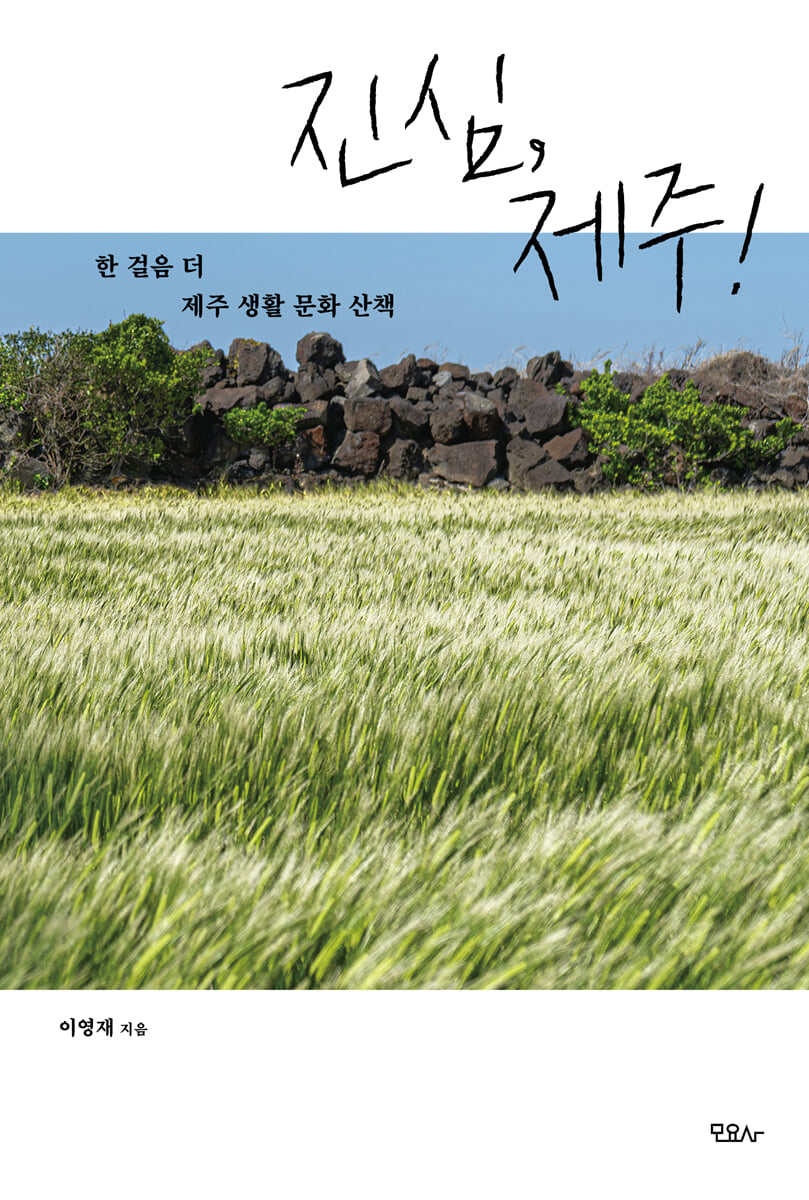
Seriously, Jeju!
 |
Description
Book Introduction
Living in Jeju for 20 years
The announcer who delivered Jeju news every day
A deep Jeju story!
The taste of living in Jeju!
Jeju Island is the hottest tourist destination in Korea.
When international travel was blocked due to the coronavirus outbreak, everyone flew to Jeju Island.
Over the years, countless books about Jeju have been published.
It is no exaggeration to say that almost every book that could be written has been published, from pilgrimages along the Olle Trail to introductions to famous cafes and restaurants, to even the trendy one-month stay experience.
But how much do we really know about Jeju, Korea's most beautiful destination and a national treasure? Perhaps we travel with only the latest trendy cafes, affordable restaurants, and stylish photo spots in mind.
Since this is a trip for fun, relaxation, and a change of pace, knowing this much might be enough.
Still, I'm always curious about the lives of the locals.
Even when introducing a restaurant, if it says "recommended by a local," I tend to believe it without hesitation.
I wish someone would write a book that tells the story of the locals' lives...
If you live in a city for 20 years, that city no longer feels new.
I don't really feel like exploring every nook and cranny.
But there are people who are curious about the foundation of their lives every day.
Even the commute to work is exciting.
The author of this book, Lee Young-jae, is a KBS announcer who longed for life in Jeju and requested a posting to Jeju. He lived there for nearly 20 years, starting in 2002.
And every day, we delivered news from Jeju.
Because I came here as a foreigner, every single scene of Jeju was enchanting, and because I lived there as a local, I came to deeply understand the pain and joy that Jeju holds.
Besides, isn't he the one who conveys the joys and sorrows of the citizens?
This one paragraph, which perfectly captures the essence of his life in Jeju, is not only enviable but also annoying.
“There are more than one or two good things about living in Jeju.
The greatest joy, surprisingly, comes when I am not in Jeju.
On the plane back to Jeju after a vacation abroad, I got goosebumps at the thought that the place where I would return to my daily life after my trip was none other than Jeju.
“Isn’t it a place to live that is much more beautiful than a vacation spot?”
The announcer who delivered Jeju news every day
A deep Jeju story!
The taste of living in Jeju!
Jeju Island is the hottest tourist destination in Korea.
When international travel was blocked due to the coronavirus outbreak, everyone flew to Jeju Island.
Over the years, countless books about Jeju have been published.
It is no exaggeration to say that almost every book that could be written has been published, from pilgrimages along the Olle Trail to introductions to famous cafes and restaurants, to even the trendy one-month stay experience.
But how much do we really know about Jeju, Korea's most beautiful destination and a national treasure? Perhaps we travel with only the latest trendy cafes, affordable restaurants, and stylish photo spots in mind.
Since this is a trip for fun, relaxation, and a change of pace, knowing this much might be enough.
Still, I'm always curious about the lives of the locals.
Even when introducing a restaurant, if it says "recommended by a local," I tend to believe it without hesitation.
I wish someone would write a book that tells the story of the locals' lives...
If you live in a city for 20 years, that city no longer feels new.
I don't really feel like exploring every nook and cranny.
But there are people who are curious about the foundation of their lives every day.
Even the commute to work is exciting.
The author of this book, Lee Young-jae, is a KBS announcer who longed for life in Jeju and requested a posting to Jeju. He lived there for nearly 20 years, starting in 2002.
And every day, we delivered news from Jeju.
Because I came here as a foreigner, every single scene of Jeju was enchanting, and because I lived there as a local, I came to deeply understand the pain and joy that Jeju holds.
Besides, isn't he the one who conveys the joys and sorrows of the citizens?
This one paragraph, which perfectly captures the essence of his life in Jeju, is not only enviable but also annoying.
“There are more than one or two good things about living in Jeju.
The greatest joy, surprisingly, comes when I am not in Jeju.
On the plane back to Jeju after a vacation abroad, I got goosebumps at the thought that the place where I would return to my daily life after my trip was none other than Jeju.
“Isn’t it a place to live that is much more beautiful than a vacation spot?”
- You can preview some of the book's contents.
Preview
index
Opening one layer
Oh my gosh
The moon that rises in Aewol: Aewol-eup, Jeju-si
Where is your personal space: Daejeong-eup Moseulpo Port ~ Hyeongje Coastal Road
Even if it's a crazy walk: Susan-ri, Aewol-eup
There is no labyrinth in Benghazi: Pyeongdae-ri, Gujwa-eup
Walking the Seaside Path Again: Jeju Olle Course 3-B
Baekjutto's Song of Love: Gyorae-ri, Jochon-eup, Songdang-ri, Gujwa-eup
Flashing in the East, Flashing in the West: From Chagyido to Suwolbong
Slowly and gently
Why Aging is a Comfort: Jeju City's Hanulnuri Park
There it is: Jeju City Folk Oil Market
Hello Mr.
Gureombi: Seogwipo Gangjeong Village
Shouting to the World from Jeju's Belly Button: Old Jeju University Road and Jeju City Hall
E=(MC)²: Cafe 'On the Way to Discharge'
Let's all be considerate
Expensive but still worth buying: Jeju's independent bookstores
Untitled Panorama: Kim Young-gap Gallery Dumoak
Green Tea Wars: Boseong Daehan Tea Garden vs. Jeju Green Tea Fields
The Million-Man Army's Advance: Aewol-eup Bathhouse
Let's be happy in the south: From Seogwipo's Lee Jung-seop Street to Saeyeon Bridge
Seafood Soup and Affogato: Seogwipo Sora's Castle and Honeymoon House
Shall we have a drink and part ways?: Jeju Beer Brewery in Hallim-eup
Back to longing
Oh my gosh
The moon that rises in Aewol: Aewol-eup, Jeju-si
Where is your personal space: Daejeong-eup Moseulpo Port ~ Hyeongje Coastal Road
Even if it's a crazy walk: Susan-ri, Aewol-eup
There is no labyrinth in Benghazi: Pyeongdae-ri, Gujwa-eup
Walking the Seaside Path Again: Jeju Olle Course 3-B
Baekjutto's Song of Love: Gyorae-ri, Jochon-eup, Songdang-ri, Gujwa-eup
Flashing in the East, Flashing in the West: From Chagyido to Suwolbong
Slowly and gently
Why Aging is a Comfort: Jeju City's Hanulnuri Park
There it is: Jeju City Folk Oil Market
Hello Mr.
Gureombi: Seogwipo Gangjeong Village
Shouting to the World from Jeju's Belly Button: Old Jeju University Road and Jeju City Hall
E=(MC)²: Cafe 'On the Way to Discharge'
Let's all be considerate
Expensive but still worth buying: Jeju's independent bookstores
Untitled Panorama: Kim Young-gap Gallery Dumoak
Green Tea Wars: Boseong Daehan Tea Garden vs. Jeju Green Tea Fields
The Million-Man Army's Advance: Aewol-eup Bathhouse
Let's be happy in the south: From Seogwipo's Lee Jung-seop Street to Saeyeon Bridge
Seafood Soup and Affogato: Seogwipo Sora's Castle and Honeymoon House
Shall we have a drink and part ways?: Jeju Beer Brewery in Hallim-eup
Back to longing
Detailed image

Into the book
There are more than one or two good things about living in Jeju.
The greatest joy, surprisingly, comes when I am not in Jeju.
On the plane back to Jeju after a vacation abroad, I got goosebumps at the thought that the place where I would return to my daily life after my trip was none other than Jeju.
Isn't it a place to live that is much more beautiful than a vacation spot?
--- p.173
The contrast between deep blue and dark brown felt at the boundary between the sea and the island, along with the dark sheen of the deep green fields and the stone walls surrounding them, unfolds an exotic blend of colors.
--- p.14
It would be rude to leave out the moonlit night scenery from the name Aewol (涯月).
On the day when the Aewol sea becomes a mirror reflecting the sky and gives birth to another full moon, everyone becomes part of the scenery.
The night sea of Aewol does not approach me as an object to be admired, but rather becomes one with me, allowing me to fall into a state of selflessness.
--- p.22
Susan-ri, Aewol-eup, is a place that is little known to tourists.
It is a village that is rare in Jeju to have a reservoir, and it has a unique charm where you can view both the sea and the reservoir at the same time when you climb to a high place.
It is called 'Susan-ri (水山里)' because it is famous for its water and mountains, and just by its name, you can tell that it is a place where you can live in the embrace of nature. It is a typical Jeju countryside village, and its old name, 'Mulmegol', feels even more affectionate.
--- p.43
Pyeongdae-ri is a pleasant place with few people even during the peak summer vacation season, but recently, even small beaches have been attracting quite a few people.
This may be because people who are tired of large-scale resorts are increasingly seeking smaller, cleaner places.
I don't really want to see Pyeongdaeri Beach, which is like an innocent girl, transform into a mature woman.
--- p.64
People who find happiness in 'slowly' completing things are probably the best suited to walking the Olle Trail.
With every step you take, you get 70 centimeters closer to your goal, and with the view guaranteed to be 70 centimeters ahead, how could you possibly stop?
If there was a job where I could earn as much money as I walked, I would raise my hand without hesitation.
--- p.76
No matter what style you choose, there is a heaven and earth that you cannot help but draw.
Jeju, where you can be enchanted by every nook and cranny you walk through, is destined to become an island filled with art.
On this island, I encourage you to draw, hear, and write.
Even if you come and go for a while.
--- p.82
I became curious about the 'tto' in Baekjutto because it's a cute pronunciation.
This is what Jeju people call their god.
Baekjutto's son, Gwanegi, is also called Gwanegi-tto.
It seems natural for a child of God, but it makes you wonder if it is right to give the status of a god to a bastard who plucked out his father's beard.
Compared to Greece, where there are gods who live while drunk, Jeju's gods are noble.
As I was walking down the street, imagining Baekjutto, a lottery ticket booth caught my eye.
Aha, who would have thought that calling the omnipotent God 'again' would be so touching.
There was a lottery that was a modern-day symbol of omnipotence.
--- p.97
The 2002 statistics show that there were less than 200,000 vehicles, which is a truly crazy increase in vehicles that far exceeds the population growth rate.
In the near future, among the elements of Samdado - stone, wind, and woman - we may have to replace 'woman' with 'car'.
--- p.133
The changes in the world are as overwhelming as the headwind hitting your face while driving.
When the daily grind of running against the wind weighs down on your weary heart, the island of Jeju simply offers a soothing embrace.
The grandmothers of the Jeju-like Halmang Market say through the wrinkles on their foreheads that nothing is burdensome in the end.
--- p.140
What brought citizens to the city hall was not simply their discontent with a society that failed to provide a safe working environment for workers.
It was anger at a world where human rights were merely optional rights given to the weak at times.
--- p.165
The way to my workplace, the filming location, is smooth, and the way back to the office after filming is brisk.
In short, living in Jeju is like living a traveler's life.
--- pp.173~174
It is inexplicable why the scenery of Jeju Oreum goes beyond mere scenery and pierces the very soul of the person.
--- p.205
Jeju was a gift.
How fortunate I was to be able to be held in the arms of the mercilessly beautiful Tamra for so long.
I am simply grateful for Jeju's mountains, Jeju's sea, and everything about Jeju.
The greatest joy, surprisingly, comes when I am not in Jeju.
On the plane back to Jeju after a vacation abroad, I got goosebumps at the thought that the place where I would return to my daily life after my trip was none other than Jeju.
Isn't it a place to live that is much more beautiful than a vacation spot?
--- p.173
The contrast between deep blue and dark brown felt at the boundary between the sea and the island, along with the dark sheen of the deep green fields and the stone walls surrounding them, unfolds an exotic blend of colors.
--- p.14
It would be rude to leave out the moonlit night scenery from the name Aewol (涯月).
On the day when the Aewol sea becomes a mirror reflecting the sky and gives birth to another full moon, everyone becomes part of the scenery.
The night sea of Aewol does not approach me as an object to be admired, but rather becomes one with me, allowing me to fall into a state of selflessness.
--- p.22
Susan-ri, Aewol-eup, is a place that is little known to tourists.
It is a village that is rare in Jeju to have a reservoir, and it has a unique charm where you can view both the sea and the reservoir at the same time when you climb to a high place.
It is called 'Susan-ri (水山里)' because it is famous for its water and mountains, and just by its name, you can tell that it is a place where you can live in the embrace of nature. It is a typical Jeju countryside village, and its old name, 'Mulmegol', feels even more affectionate.
--- p.43
Pyeongdae-ri is a pleasant place with few people even during the peak summer vacation season, but recently, even small beaches have been attracting quite a few people.
This may be because people who are tired of large-scale resorts are increasingly seeking smaller, cleaner places.
I don't really want to see Pyeongdaeri Beach, which is like an innocent girl, transform into a mature woman.
--- p.64
People who find happiness in 'slowly' completing things are probably the best suited to walking the Olle Trail.
With every step you take, you get 70 centimeters closer to your goal, and with the view guaranteed to be 70 centimeters ahead, how could you possibly stop?
If there was a job where I could earn as much money as I walked, I would raise my hand without hesitation.
--- p.76
No matter what style you choose, there is a heaven and earth that you cannot help but draw.
Jeju, where you can be enchanted by every nook and cranny you walk through, is destined to become an island filled with art.
On this island, I encourage you to draw, hear, and write.
Even if you come and go for a while.
--- p.82
I became curious about the 'tto' in Baekjutto because it's a cute pronunciation.
This is what Jeju people call their god.
Baekjutto's son, Gwanegi, is also called Gwanegi-tto.
It seems natural for a child of God, but it makes you wonder if it is right to give the status of a god to a bastard who plucked out his father's beard.
Compared to Greece, where there are gods who live while drunk, Jeju's gods are noble.
As I was walking down the street, imagining Baekjutto, a lottery ticket booth caught my eye.
Aha, who would have thought that calling the omnipotent God 'again' would be so touching.
There was a lottery that was a modern-day symbol of omnipotence.
--- p.97
The 2002 statistics show that there were less than 200,000 vehicles, which is a truly crazy increase in vehicles that far exceeds the population growth rate.
In the near future, among the elements of Samdado - stone, wind, and woman - we may have to replace 'woman' with 'car'.
--- p.133
The changes in the world are as overwhelming as the headwind hitting your face while driving.
When the daily grind of running against the wind weighs down on your weary heart, the island of Jeju simply offers a soothing embrace.
The grandmothers of the Jeju-like Halmang Market say through the wrinkles on their foreheads that nothing is burdensome in the end.
--- p.140
What brought citizens to the city hall was not simply their discontent with a society that failed to provide a safe working environment for workers.
It was anger at a world where human rights were merely optional rights given to the weak at times.
--- p.165
The way to my workplace, the filming location, is smooth, and the way back to the office after filming is brisk.
In short, living in Jeju is like living a traveler's life.
--- pp.173~174
It is inexplicable why the scenery of Jeju Oreum goes beyond mere scenery and pierces the very soul of the person.
--- p.205
Jeju was a gift.
How fortunate I was to be able to be held in the arms of the mercilessly beautiful Tamra for so long.
I am simply grateful for Jeju's mountains, Jeju's sea, and everything about Jeju.
--- p.300
Publisher's Review
Seriously, Jeju!
If you live in one place for a long time, introducing just one or two places is not enough.
It's not surprising anymore, but there are so many places to brag about and introduce to outsiders.
And what if it's Jeju Island? It's easy to feel lost and not know where to start.
So, rather than introducing each place one by one, the author introduces Jeju by region, connecting places to places, such as driving along the coast or taking a walk along a forest path.
The lives and concerns of Jeju people are naturally reflected here.
For example, when driving along the Brothers Coastal Road from Moseulpo Port, it tells you at what point you should take a breather to reach the peak of your anticipation.
So to speak, it is a point of excitement.
When introducing Pyeongdae-ri, Gujwa-eup, famous for Maze Land and Bijarim, we go a step further and explain the difference between 'Bangdwi' and 'Deureu', which are related to the place name Pyeongdae-ri.
The story of the Tamna legend, which penetrates even into the lives of Jeju people, makes us hope that Jeju mythology will be made into a movie soon.
Jeju Olle Trail is already famous, but the author specifically chose Olle Course 3-B, which offers a view of Seongsan Ilchulbong Peak.
However, I am not introducing only the sea paths that you would want to walk along.
The author also makes us think about Onpyeong-ri, Seongsan-eup, as the proposed site for Jeju's second airport, and what problems it may have.
The story of Gangjeong Village, which the author has reported countless times in the news, is filled with a sense of deep sorrow at the destruction of this beautiful village, with its azure sea and breathtaking views of Gureombi Rock and Beomseom Island, seemingly within reach.
When introducing photographer Kim Young-gap's Gallery Dumoak, which can now be considered a cultural heritage of Jeju, I feel a special affection.
This is because I had the opportunity to meet and interview author Kim Young-gap in person while he was still alive.
What about Lee Jung-seop Street?
Although it is already a representative cultural street of Jeju, it is often overlooked, and it points out the Seogwipo Tourist Theater, urging us to look beyond what is visible on the outside and take a look here as well.
After living for 20 years, there are many places that I had forgotten about and passed by without realizing their value.
That's the part where I went back to 'Sora's Castle' to eat seafood stew after hearing that it might be the work of Kim Jung-up, a pioneer of modern architecture in Korea.
The Honeymoon House, which was used as a vacation home by former President Syngman Rhee, has been the subject of controversy since it was later acquired by a large corporation, but it is pleasing to see that it has retained its original appearance.
The book ends with a refreshing glass of Jeju beer.
But while drinking a glass of craft beer, I hope that a world-class beer brand will be born from Jeju's clear water.
The author is truly 'sincere' about Jeju.
In this book, in addition to Jeju's beautiful roads, forests, and sea, the breath of Jeju and the scenes of life are vividly depicted.
If you're tired of the flashy tourist attractions that everyone visits, I recommend reading this book carefully.
Your feelings about traveling to Jeju will change completely.
The author's sincerity in loving and caring for Jeju will be properly conveyed.
If you live in one place for a long time, introducing just one or two places is not enough.
It's not surprising anymore, but there are so many places to brag about and introduce to outsiders.
And what if it's Jeju Island? It's easy to feel lost and not know where to start.
So, rather than introducing each place one by one, the author introduces Jeju by region, connecting places to places, such as driving along the coast or taking a walk along a forest path.
The lives and concerns of Jeju people are naturally reflected here.
For example, when driving along the Brothers Coastal Road from Moseulpo Port, it tells you at what point you should take a breather to reach the peak of your anticipation.
So to speak, it is a point of excitement.
When introducing Pyeongdae-ri, Gujwa-eup, famous for Maze Land and Bijarim, we go a step further and explain the difference between 'Bangdwi' and 'Deureu', which are related to the place name Pyeongdae-ri.
The story of the Tamna legend, which penetrates even into the lives of Jeju people, makes us hope that Jeju mythology will be made into a movie soon.
Jeju Olle Trail is already famous, but the author specifically chose Olle Course 3-B, which offers a view of Seongsan Ilchulbong Peak.
However, I am not introducing only the sea paths that you would want to walk along.
The author also makes us think about Onpyeong-ri, Seongsan-eup, as the proposed site for Jeju's second airport, and what problems it may have.
The story of Gangjeong Village, which the author has reported countless times in the news, is filled with a sense of deep sorrow at the destruction of this beautiful village, with its azure sea and breathtaking views of Gureombi Rock and Beomseom Island, seemingly within reach.
When introducing photographer Kim Young-gap's Gallery Dumoak, which can now be considered a cultural heritage of Jeju, I feel a special affection.
This is because I had the opportunity to meet and interview author Kim Young-gap in person while he was still alive.
What about Lee Jung-seop Street?
Although it is already a representative cultural street of Jeju, it is often overlooked, and it points out the Seogwipo Tourist Theater, urging us to look beyond what is visible on the outside and take a look here as well.
After living for 20 years, there are many places that I had forgotten about and passed by without realizing their value.
That's the part where I went back to 'Sora's Castle' to eat seafood stew after hearing that it might be the work of Kim Jung-up, a pioneer of modern architecture in Korea.
The Honeymoon House, which was used as a vacation home by former President Syngman Rhee, has been the subject of controversy since it was later acquired by a large corporation, but it is pleasing to see that it has retained its original appearance.
The book ends with a refreshing glass of Jeju beer.
But while drinking a glass of craft beer, I hope that a world-class beer brand will be born from Jeju's clear water.
The author is truly 'sincere' about Jeju.
In this book, in addition to Jeju's beautiful roads, forests, and sea, the breath of Jeju and the scenes of life are vividly depicted.
If you're tired of the flashy tourist attractions that everyone visits, I recommend reading this book carefully.
Your feelings about traveling to Jeju will change completely.
The author's sincerity in loving and caring for Jeju will be properly conveyed.
GOODS SPECIFICS
- Publication date: October 24, 2022
- Page count, weight, size: 304 pages | 444g | 135*200*30mm
- ISBN13: 9788997066773
- ISBN10: 8997066773
You may also like
카테고리
korean


korean

![GQ KOREA Mark (Monthly): December [2025]](http://librairie.coreenne.fr/cdn/shop/files/8ef265dbbfbf186523ed75ba7319009d.jpg?v=1765340328&width=3840)


