

The day I go is the season
 |
Description
Book Introduction
The more you know, the more you see?! The more you know, the more delicious it becomes!
Kim Jin-young's food story: Twenty laps around the world in search of ingredients.
Here is a food ingredient expert acknowledged even by Heo Young-man, the author of the Korean cooking manga [Sikgaek].
Kim Jin-young is Korea's representative food MD who became known to the world through TV programs such as 'Unexpected Adult' and 'Let's Eat Well'.
For the past 27 years, he has been searching all over the country in search of seasonal and healthy food.
The distance I have traveled on business trips so far is over 800,000 km, which is roughly equivalent to traveling around the Earth twenty times, all in search of just 'food ingredients'.
Just by looking at this, you can see that his passion for ingredients and food is extraordinary.
Artist Heo Young-man actually spoke highly of Kim Jin-young, saying, "Even I, who pride myself on knowing a little about food and taste, keep my mouth shut in front of him."
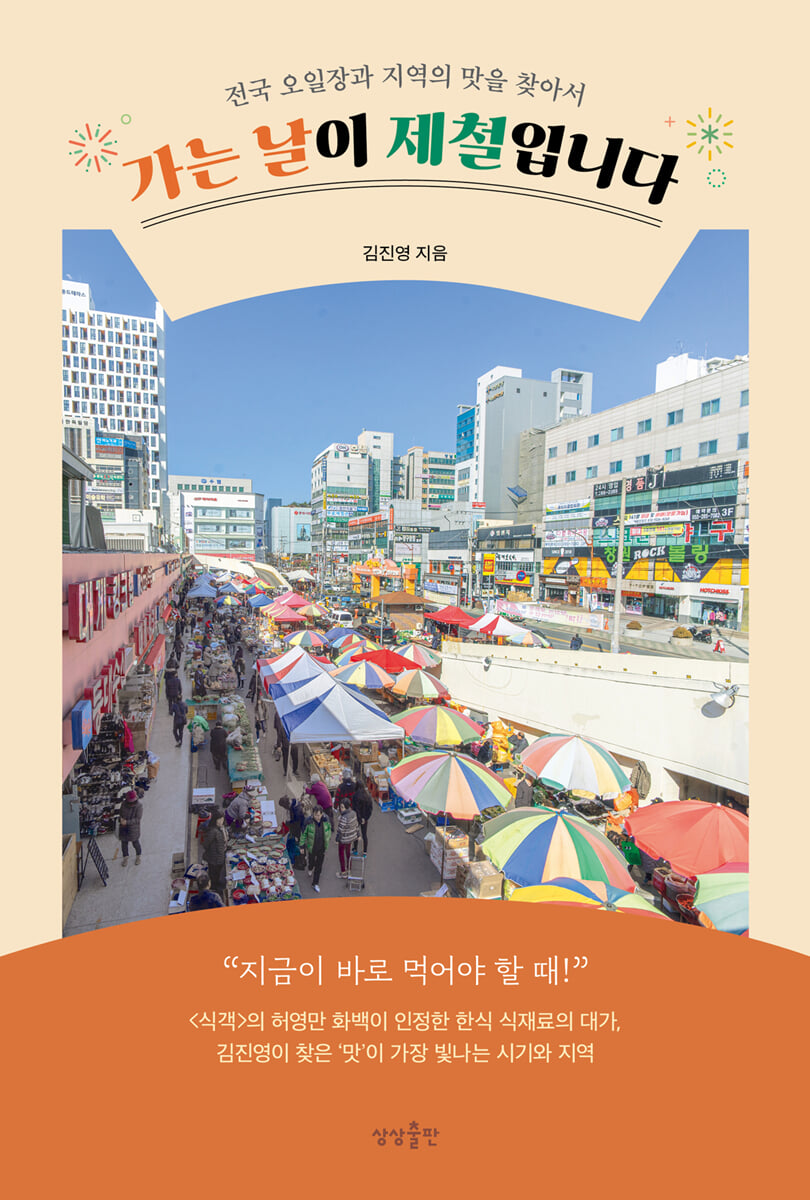
"The Day You Go is the Season" is the story of the author visiting oil fields across the country according to the season.
He traveled around South Korea, searching for ingredients that were plump and tasty, following the ever-changing weather and seasons, and chasing producers all over the country.
He tells the story of local oil fields in season across the country that he personally visited.
It contains more stories that were not included in his previous work, 『The Coming Day is Market Day』.
However, in this book, the table of contents is organized by region for easier viewing.
Following in the author's footsteps, you will learn about the oil market scenery, ingredients, local flavors, and even how to properly eat it.
Kim Jin-young's food story: Twenty laps around the world in search of ingredients.
Here is a food ingredient expert acknowledged even by Heo Young-man, the author of the Korean cooking manga [Sikgaek].
Kim Jin-young is Korea's representative food MD who became known to the world through TV programs such as 'Unexpected Adult' and 'Let's Eat Well'.
For the past 27 years, he has been searching all over the country in search of seasonal and healthy food.
The distance I have traveled on business trips so far is over 800,000 km, which is roughly equivalent to traveling around the Earth twenty times, all in search of just 'food ingredients'.
Just by looking at this, you can see that his passion for ingredients and food is extraordinary.
Artist Heo Young-man actually spoke highly of Kim Jin-young, saying, "Even I, who pride myself on knowing a little about food and taste, keep my mouth shut in front of him."
"The Day You Go is the Season" is the story of the author visiting oil fields across the country according to the season.
He traveled around South Korea, searching for ingredients that were plump and tasty, following the ever-changing weather and seasons, and chasing producers all over the country.
He tells the story of local oil fields in season across the country that he personally visited.
It contains more stories that were not included in his previous work, 『The Coming Day is Market Day』.
However, in this book, the table of contents is organized by region for easier viewing.
Following in the author's footsteps, you will learn about the oil market scenery, ingredients, local flavors, and even how to properly eat it.
- You can preview some of the book's contents.
Preview
index
prolog
Chapter 1 Gyeonggi-do
Ganghwa | Bandeng from early spring to early summer, Ganghwa eel during the hottest days of summer
Yangpyeong | There are many pretty cafes, but there's also a cute market.
Ongjin | Incheon, home to a diverse array of islands, a market where you can savor their diversity.
Chapter 2 Gangwon-do
Yangyang | Spring in Yangyang, the market is full of wild vegetables.
Now | Don't go to the market, go taste it instead
Yeongwol | I went to the market and saw a star.
Pyeongchang | Pyeongchang, the Korean Peninsula's summer garden. Plus, you can taste kudzu sauerkraut.
Hwacheon | Kosohyeon Kongtang and Chewy Surichwi Rice Cakes: The True Taste of Gangwon in Summer
Donghae·Samcheok | A market I'd been meaning to visit, but upon returning, it turned out to be the best in the country.
Jeongseon | In the past, Jeongseon was known for coal mines and wild vegetables, but these days, Jeongseon is known for jjambbong and boiled beef head.
Chapter 3 Chungcheong Province
Jecheon | Taste wild vegetable stir-fried chicken in Jecheon, the land of medicinal herbs.
Boryeong | Home of scallops and scallops, delicious both grilled and served in jjambbong
Goesan | For market sightseeing, visit Goesan Oil Market; for mushroom viewing, visit Cheongcheon Traditional Market
Seosan | It's okay if there's no oil market. There's a market.
Budget | It's not rainbow-colored, but it's not as red as red beans.
Taean | Taean, a town with a long coastline and a delicious food scene.
Chapter 4 Jeolla Province
Namwon | Berkshire pigs from the United States have now settled in Namwon.
Damyang | Daetongbap and tteokgalbi are just some of Damyang's flavors.
Hampyeong | A Market That's Changed Unrecognizably, A Taste of Octopus You've Never Seen Before
Yeonggwang | When you think of Yeonggwang, you think of gulbi. When you think of Yeonggwang, you think of sundae soup.
Jangheung | Have you tried grass-fed beef? It truly tastes different.
Goheung | Home to the nation's most beautiful coastal road
Haenam | Octopus, oysters, tuna—everything in winter in Haenam is delicious.
Chapter 5 Gyeongsang Province
Mungyeong | A stunningly beautiful inevitability gifted by chance
Sacheon | Why do I fall for Samcheonpo after doing well? Because everything I eat is delicious!
Changwon | From now on, in Changwon, instead of braised agu, try bok bulgogi.
Gyeongju | The allure of yellow pears grows sweeter as Chuseok approaches.
Bonghwa | A bite of bulgogi with the scent of pine trees, a piece of silver salmon soaked in the Nakdong River
Hamyang | A bite of a red-tinged Aori apple will make you forget the memories of green apples.
Chapter 6 Jeju Island
Sehwa | A trip to the ocean and the market
Seogwipo | Jeju's most delicious time of year: winter
Daejeong | Although small in size, it is the most vibrant market in Jeju.
Epilogue
Chapter 1 Gyeonggi-do
Ganghwa | Bandeng from early spring to early summer, Ganghwa eel during the hottest days of summer
Yangpyeong | There are many pretty cafes, but there's also a cute market.
Ongjin | Incheon, home to a diverse array of islands, a market where you can savor their diversity.
Chapter 2 Gangwon-do
Yangyang | Spring in Yangyang, the market is full of wild vegetables.
Now | Don't go to the market, go taste it instead
Yeongwol | I went to the market and saw a star.
Pyeongchang | Pyeongchang, the Korean Peninsula's summer garden. Plus, you can taste kudzu sauerkraut.
Hwacheon | Kosohyeon Kongtang and Chewy Surichwi Rice Cakes: The True Taste of Gangwon in Summer
Donghae·Samcheok | A market I'd been meaning to visit, but upon returning, it turned out to be the best in the country.
Jeongseon | In the past, Jeongseon was known for coal mines and wild vegetables, but these days, Jeongseon is known for jjambbong and boiled beef head.
Chapter 3 Chungcheong Province
Jecheon | Taste wild vegetable stir-fried chicken in Jecheon, the land of medicinal herbs.
Boryeong | Home of scallops and scallops, delicious both grilled and served in jjambbong
Goesan | For market sightseeing, visit Goesan Oil Market; for mushroom viewing, visit Cheongcheon Traditional Market
Seosan | It's okay if there's no oil market. There's a market.
Budget | It's not rainbow-colored, but it's not as red as red beans.
Taean | Taean, a town with a long coastline and a delicious food scene.
Chapter 4 Jeolla Province
Namwon | Berkshire pigs from the United States have now settled in Namwon.
Damyang | Daetongbap and tteokgalbi are just some of Damyang's flavors.
Hampyeong | A Market That's Changed Unrecognizably, A Taste of Octopus You've Never Seen Before
Yeonggwang | When you think of Yeonggwang, you think of gulbi. When you think of Yeonggwang, you think of sundae soup.
Jangheung | Have you tried grass-fed beef? It truly tastes different.
Goheung | Home to the nation's most beautiful coastal road
Haenam | Octopus, oysters, tuna—everything in winter in Haenam is delicious.
Chapter 5 Gyeongsang Province
Mungyeong | A stunningly beautiful inevitability gifted by chance
Sacheon | Why do I fall for Samcheonpo after doing well? Because everything I eat is delicious!
Changwon | From now on, in Changwon, instead of braised agu, try bok bulgogi.
Gyeongju | The allure of yellow pears grows sweeter as Chuseok approaches.
Bonghwa | A bite of bulgogi with the scent of pine trees, a piece of silver salmon soaked in the Nakdong River
Hamyang | A bite of a red-tinged Aori apple will make you forget the memories of green apples.
Chapter 6 Jeju Island
Sehwa | A trip to the ocean and the market
Seogwipo | Jeju's most delicious time of year: winter
Daejeong | Although small in size, it is the most vibrant market in Jeju.
Epilogue
Detailed image

Into the book
When I take a picture of a plum, my grandmother hands me one.
He said this with an expression that said, "What are you doing out in the rain?"
When I put it in my mouth and chew the flesh, I get a little shiver.
The sour taste that had been tickling my tongue seemed to disappear, but the sweetness quickly said goodbye and disappeared.
I heard a “Uh huh” sound, but I grabbed another one and ate it without realizing it.
I ate two for free, so I bought a small basket of plums worth 3,000 won with that money.
--- p.78, from “Pyeongchang, Gangwon-do”
Among the 400 types of mushrooms, the order is determined as one mushroom, two shiitake mushrooms, three neungi mushrooms, or one neungi mushrooms, and the rest are called miscellaneous mushrooms.
Even those that are collectively called miscellaneous mushrooms each have their own name, taste, and aroma.
Words like "Il-neung-i" and "I-song-i" are just words or references made by people who like to talk.
When I visited the production site, I saw that there were some trash in the world, but no weeds, mushrooms, or fish.
People just called them that way to distinguish them.
Just as everyone has a name, everything, including mushrooms, has a name.
People often call out names and most people know them.
Anything that people look for less or don't know about becomes 'junk'.
--- p.133, from “Goesan, South Chungcheong Province”
Mungyeong, located in the inland of the Korean Peninsula, shines brightest with its flavors in the fall.
Autumn in Mungyeong is full of the red hues of apples and five-flavor berries.
I was originally planning to go to Mungyeong this October.
Many of the apples grown in Mungyeong are of the domestically bred Gamheung variety, not the Fuji variety bred in Japan.
That's why the 'inspiration' doesn't disappear from the placards hanging in the apple shops.
The feeling is solid and the crunchy taste is superb.
--- p.246, from “‘Mungyeong, Gyeongsangbuk-do’”
I went to Naedong-ri, Bukil-myeon in search of the delicious taste of oysters.
I was just shucking some oysters that I had just harvested.
Open the shells that have a few oysters stuck together randomly and take out the oysters.
The small ones are used for salted seafood, and the meaty ones are used for raw fish.
As we chatted for a while by the campfire, he handed us a large oyster, as if to tell us to shut up.
The oysters that were soaking up seawater have a refreshing salty taste, but soon the savory taste covers the saltiness.
I just ate one, and the fragrant scent of the sea filled my mouth.
A delicious exclamation burst from my throat.
--- p.238, from “Haenam, Jeollanam-do”
Black pigs are raised for more than 13 months.
Even if you grow it like that, it only weighs about 70kg.
It is very different from white pigs, which grow to 130 kg in 6 months.
If you raise it for a long time, a lot of fat will accumulate in the belly.
In pork belly, fat takes over the place where there was meat.
Disappointment comes first with fatty meats.
But the moment you put the meat in your mouth, the disappointment disappears.
It has a chewy texture that is different from the mushy texture of pork belly that we are familiar with.
Moreover, the chewy texture and then melting texture like soft cream cheese give off a rich, rich flavor.
He said this with an expression that said, "What are you doing out in the rain?"
When I put it in my mouth and chew the flesh, I get a little shiver.
The sour taste that had been tickling my tongue seemed to disappear, but the sweetness quickly said goodbye and disappeared.
I heard a “Uh huh” sound, but I grabbed another one and ate it without realizing it.
I ate two for free, so I bought a small basket of plums worth 3,000 won with that money.
--- p.78, from “Pyeongchang, Gangwon-do”
Among the 400 types of mushrooms, the order is determined as one mushroom, two shiitake mushrooms, three neungi mushrooms, or one neungi mushrooms, and the rest are called miscellaneous mushrooms.
Even those that are collectively called miscellaneous mushrooms each have their own name, taste, and aroma.
Words like "Il-neung-i" and "I-song-i" are just words or references made by people who like to talk.
When I visited the production site, I saw that there were some trash in the world, but no weeds, mushrooms, or fish.
People just called them that way to distinguish them.
Just as everyone has a name, everything, including mushrooms, has a name.
People often call out names and most people know them.
Anything that people look for less or don't know about becomes 'junk'.
--- p.133, from “Goesan, South Chungcheong Province”
Mungyeong, located in the inland of the Korean Peninsula, shines brightest with its flavors in the fall.
Autumn in Mungyeong is full of the red hues of apples and five-flavor berries.
I was originally planning to go to Mungyeong this October.
Many of the apples grown in Mungyeong are of the domestically bred Gamheung variety, not the Fuji variety bred in Japan.
That's why the 'inspiration' doesn't disappear from the placards hanging in the apple shops.
The feeling is solid and the crunchy taste is superb.
--- p.246, from “‘Mungyeong, Gyeongsangbuk-do’”
I went to Naedong-ri, Bukil-myeon in search of the delicious taste of oysters.
I was just shucking some oysters that I had just harvested.
Open the shells that have a few oysters stuck together randomly and take out the oysters.
The small ones are used for salted seafood, and the meaty ones are used for raw fish.
As we chatted for a while by the campfire, he handed us a large oyster, as if to tell us to shut up.
The oysters that were soaking up seawater have a refreshing salty taste, but soon the savory taste covers the saltiness.
I just ate one, and the fragrant scent of the sea filled my mouth.
A delicious exclamation burst from my throat.
--- p.238, from “Haenam, Jeollanam-do”
Black pigs are raised for more than 13 months.
Even if you grow it like that, it only weighs about 70kg.
It is very different from white pigs, which grow to 130 kg in 6 months.
If you raise it for a long time, a lot of fat will accumulate in the belly.
In pork belly, fat takes over the place where there was meat.
Disappointment comes first with fatty meats.
But the moment you put the meat in your mouth, the disappointment disappears.
It has a chewy texture that is different from the mushy texture of pork belly that we are familiar with.
Moreover, the chewy texture and then melting texture like soft cream cheese give off a rich, rich flavor.
--- p.328, from “Daejeong, Seogwipo-si, Jeju-do”
Publisher's Review
"The more you know about the season, the more delicious it becomes."
The best food ingredient expert in Korea, recognized by cartoonist Heo Young-man of the comic [Sikgaek]!
Food MD who has been active in various media such as [Let's Eat Well] and [Somehow I Became an Adult]
The second story of a journey to find flavors according to the season begins!
Now is the time to eat!
Korea's top food ingredient expert explains where the season is right now.
This book is not simply a travelogue about finding oil fields.
He talks about local specialties, seasonal foods, and his own favorite restaurants that he has discovered while traveling around the country for decades.
But this is not a typical restaurant story.
Because it contains his ‘philosophy’ about food.
The author doesn't know much about good restaurants because he goes there to find delicious ingredients, not delicious food.
He says it's a shame that seasonal foods are being buried because of the gourmet culture.
People often think that they have to eat crab when they go to Yeongdeok in the winter, but it is better to eat pufferfish in season.
His philosophy is that rather than following standardized restaurants and menus, it is more efficient to know what ingredients are in season at the time of travel.
From Aori apples, which are said to taste even better when ripe, to winter tuna sashimi with its rich, fatty flavor, to mushrooms, which people rank but can't be ranked when in season, each has its own unique flavor and its most delicious time of year.
'In season'.
That is the keyword he wants to talk about from beginning to end.
This book is a must-read for any Korean who enjoys Korean food.
This is especially true for those who are ready to travel all over the country to buy delicious ingredients and find delicious local food.
This is especially true for people who have been trapped in stereotypes and prejudices about food.
I hope this book will provide an opportunity to look at ‘food ingredients’ again.
After reading this book, his philosophy will slowly seep into our dining table.
One is free to try, two are included.
Our emotional oil field story
Let us recall the forgotten landscapes of our country, the oil markets, large and small, all over the country.
Thanks to large supermarkets that emphasize neat product arrangements and competitive prices, and the growth of online shopping services in the era of contactless shopping, our traditional oil markets are gradually shrinking.
There are oil markets that are so popular that they make flies fly around in large supermarkets, but there are many places in small towns and villages in the provinces that are not like that.
The marketplace that the author saw and experienced was not just a place to buy things.
It is a place where locals gather, a place for meetings, a place where people talk until the next bus arrives every few hours.
A place where they give you one for free to try, and if you pay for it, they even give you a bonus.
Sometimes it's a sentimental place where the main purpose seems to be meeting rather than buying and selling.
That kind of market is disappearing.
Young people are losing their footsteps, and the market is maintained by a kind of inertia in which people just set up stalls in the same place where the market was held.
The author recommends that when traveling to a local area or searching for a good restaurant, you should also visit Oiljangdo.
As people gather and money circulates, we expect to see changes in the commonly-concerned disappearance of rural areas and the disappearing oil market landscape.
If you buy seasonal ingredients there, it's the icing on the cake.
My sister is good and my brother-in-law is good too.
Not only will your trip be enjoyable, but your steps back home will also be lighter and more enjoyable.
In that sense, I hope this book will be helpful.
If you know the seasonal foods and plan accordingly, your trip will be even more enjoyable.
A market where the more you know, the more delicious it becomes. I highly recommend visiting with [The Day You Go is the Season].
The best food ingredient expert in Korea, recognized by cartoonist Heo Young-man of the comic [Sikgaek]!
Food MD who has been active in various media such as [Let's Eat Well] and [Somehow I Became an Adult]
The second story of a journey to find flavors according to the season begins!
Now is the time to eat!
Korea's top food ingredient expert explains where the season is right now.
This book is not simply a travelogue about finding oil fields.
He talks about local specialties, seasonal foods, and his own favorite restaurants that he has discovered while traveling around the country for decades.
But this is not a typical restaurant story.
Because it contains his ‘philosophy’ about food.
The author doesn't know much about good restaurants because he goes there to find delicious ingredients, not delicious food.
He says it's a shame that seasonal foods are being buried because of the gourmet culture.
People often think that they have to eat crab when they go to Yeongdeok in the winter, but it is better to eat pufferfish in season.
His philosophy is that rather than following standardized restaurants and menus, it is more efficient to know what ingredients are in season at the time of travel.
From Aori apples, which are said to taste even better when ripe, to winter tuna sashimi with its rich, fatty flavor, to mushrooms, which people rank but can't be ranked when in season, each has its own unique flavor and its most delicious time of year.
'In season'.
That is the keyword he wants to talk about from beginning to end.
This book is a must-read for any Korean who enjoys Korean food.
This is especially true for those who are ready to travel all over the country to buy delicious ingredients and find delicious local food.
This is especially true for people who have been trapped in stereotypes and prejudices about food.
I hope this book will provide an opportunity to look at ‘food ingredients’ again.
After reading this book, his philosophy will slowly seep into our dining table.
One is free to try, two are included.
Our emotional oil field story
Let us recall the forgotten landscapes of our country, the oil markets, large and small, all over the country.
Thanks to large supermarkets that emphasize neat product arrangements and competitive prices, and the growth of online shopping services in the era of contactless shopping, our traditional oil markets are gradually shrinking.
There are oil markets that are so popular that they make flies fly around in large supermarkets, but there are many places in small towns and villages in the provinces that are not like that.
The marketplace that the author saw and experienced was not just a place to buy things.
It is a place where locals gather, a place for meetings, a place where people talk until the next bus arrives every few hours.
A place where they give you one for free to try, and if you pay for it, they even give you a bonus.
Sometimes it's a sentimental place where the main purpose seems to be meeting rather than buying and selling.
That kind of market is disappearing.
Young people are losing their footsteps, and the market is maintained by a kind of inertia in which people just set up stalls in the same place where the market was held.
The author recommends that when traveling to a local area or searching for a good restaurant, you should also visit Oiljangdo.
As people gather and money circulates, we expect to see changes in the commonly-concerned disappearance of rural areas and the disappearing oil market landscape.
If you buy seasonal ingredients there, it's the icing on the cake.
My sister is good and my brother-in-law is good too.
Not only will your trip be enjoyable, but your steps back home will also be lighter and more enjoyable.
In that sense, I hope this book will be helpful.
If you know the seasonal foods and plan accordingly, your trip will be even more enjoyable.
A market where the more you know, the more delicious it becomes. I highly recommend visiting with [The Day You Go is the Season].
GOODS SPECIFICS
- Date of issue: January 15, 2022
- Page count, weight, size: 336 pages | 600g | 152*225*21mm
- ISBN13: 9791167820518
- ISBN10: 1167820517
You may also like
카테고리
korean


korean

![GQ KOREA Mark (Monthly): December [2025]](http://librairie.coreenne.fr/cdn/shop/files/8ef265dbbfbf186523ed75ba7319009d.jpg?v=1765340328&width=3840)


