

Suwon Hwaseong Fortress, a long journey
 |
Description
Book Introduction
It has been over 200 years since the reformist monarch Jeongjo disappeared into history.
Mars is reborn.
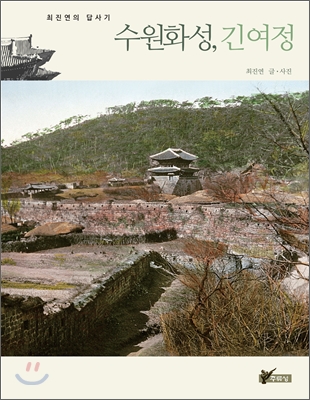
This book is a collection of beautiful scenes of Suwon Hwaseong Fortress captured by photographer Jinyeon Choi over the past 30 years.
In addition to the results of 30 years of work, this book also includes photographs of old facilities on Mars that have now disappeared and of the people who once passed through them.
These are photos of Mars from a hundred, fifty, and thirty years ago, which are difficult for readers to access.
The ancient beauty of Suwon Hwaseong Fortress, captured by visiting every nook and cranny for over 30 years, evokes no small amount of emotion.
You can experience Joseon during the reign of King Jeongjo in Hwaseong, which best embodies the history of the late Joseon Dynasty.
Meanwhile, no matter where you go in Suwon Hwaseong Fortress, there is no place without exciting stories and twists and turns.
The photographer, with his uniquely concise style, honestly portrays the past and present of Suwon Hwaseong Fortress, as well as the dreams and passion of King Jeongjo.
When traveling to Mars, it is recommended to read about the main characters and their stories.
Because there remains a sad yet beautiful historical story that moves people's hearts.
Mars is reborn.
This book is a collection of beautiful scenes of Suwon Hwaseong Fortress captured by photographer Jinyeon Choi over the past 30 years.
In addition to the results of 30 years of work, this book also includes photographs of old facilities on Mars that have now disappeared and of the people who once passed through them.
These are photos of Mars from a hundred, fifty, and thirty years ago, which are difficult for readers to access.
The ancient beauty of Suwon Hwaseong Fortress, captured by visiting every nook and cranny for over 30 years, evokes no small amount of emotion.
You can experience Joseon during the reign of King Jeongjo in Hwaseong, which best embodies the history of the late Joseon Dynasty.
Meanwhile, no matter where you go in Suwon Hwaseong Fortress, there is no place without exciting stories and twists and turns.
The photographer, with his uniquely concise style, honestly portrays the past and present of Suwon Hwaseong Fortress, as well as the dreams and passion of King Jeongjo.
When traveling to Mars, it is recommended to read about the main characters and their stories.
Because there remains a sad yet beautiful historical story that moves people's hearts.
- You can preview some of the book's contents.
Preview
index
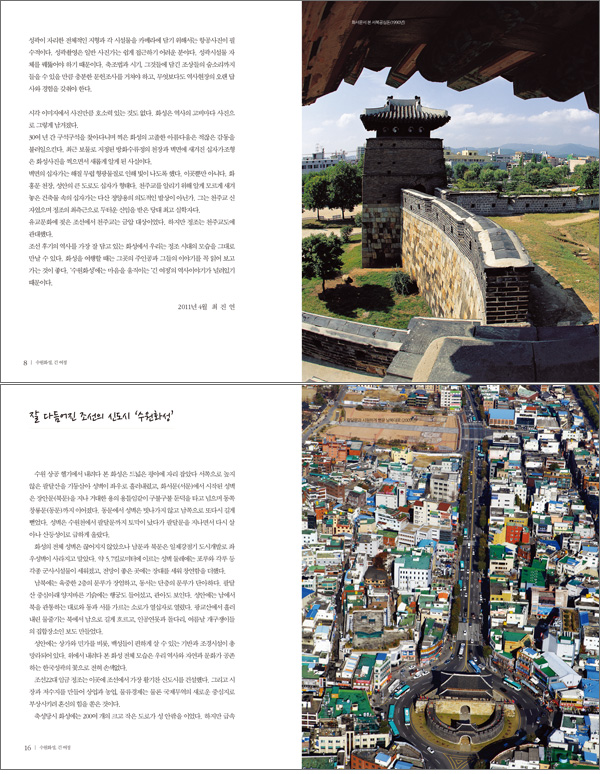
Suwon Hwaseong, a well-groomed new city of Joseon
The appearance of the bell as seen from Paldalmun Gate
Long-stretched dragon on the mountain ridge
The sad history of Seojangdae
A small door that is barely visible
The old road on Mars is revived.
When you climb up to the northwest corner tower, you feel like you've won the world.
Hwaseomun was once a city gate
Climbing the northwest observation tower reveals the pinnacle of fortress architecture.
Outside the walls is a cultural space for citizens.
Entering the Jangangmun Gate wearing golden armor
Hwahongmun Gate, with its many stories
The fire hydrant is covered with cross patterns.
The aesthetics of Mars are like firefighting water wells
The most heavily traveled secret gate
Dongbukporu Catholic Execution Site
A spacious parade ground for military training
The most unusual building on Mars
The alumni run away
Bongdon, a modern-day telephone used to exchange urgent messages
Namsumun waiting for someone to step on his back
The Dongnam Wall scenery remains only in one photograph
The owner of the palace disappeared
King Jeongjo's 8-day trip to Hwaseong
In Hwaryeongjeon, the spirit of King Jeongjo is
Hwaseong, reborn as a World Heritage Site
The appearance of the bell as seen from Paldalmun Gate
Long-stretched dragon on the mountain ridge
The sad history of Seojangdae
A small door that is barely visible
The old road on Mars is revived.
When you climb up to the northwest corner tower, you feel like you've won the world.
Hwaseomun was once a city gate
Climbing the northwest observation tower reveals the pinnacle of fortress architecture.
Outside the walls is a cultural space for citizens.
Entering the Jangangmun Gate wearing golden armor
Hwahongmun Gate, with its many stories
The fire hydrant is covered with cross patterns.
The aesthetics of Mars are like firefighting water wells
The most heavily traveled secret gate
Dongbukporu Catholic Execution Site
A spacious parade ground for military training
The most unusual building on Mars
The alumni run away
Bongdon, a modern-day telephone used to exchange urgent messages
Namsumun waiting for someone to step on his back
The Dongnam Wall scenery remains only in one photograph
The owner of the palace disappeared
King Jeongjo's 8-day trip to Hwaseong
In Hwaryeongjeon, the spirit of King Jeongjo is
Hwaseong, reborn as a World Heritage Site
Detailed image
Publisher's Review
The flower of the fortress, Suwon Hwaseong Fortress
Our country is called the 'country of castles' because it has the most castles in the world.
It is estimated that there are over 2,000, but the exact number is unknown because no nationwide survey has been conducted.
Moreover, if you include the fortresses in North Korea and Manchuria, it is difficult to estimate the number.
Since most of these castles are built on mountainsides or peaks, actually visiting them is not an easy and difficult task.
Unlike mountain fortresses, there are still town fortresses covered in moss from history on plains and along the coast.
Unlike mountain fortresses, the town fortresses that are distributed throughout the country are located close enough to our lives that we can visit them whenever we want.
Suwon Hwaseong Fortress, located an hour away from Seoul, is also such a place.
The most outstanding castle among the Joseon Dynasty castles is Suwon Hwaseong.
You can experience the sophisticated beauty of castle architecture that blends our history and nature.
That is why Suwon Hwaseong Fortress is also called the ‘flower of fortresses’ in Korea.
A place steeped in King Jeongjo's sorrow, ambition, and love for the people.
Suwon Hwaseong Fortress has a relatively short history of 220 years, but it is a unique fortress that harmoniously combines Eastern and Western military facilities.
From its construction, it has been evaluated as a "fortress of filial piety" that encompasses political and economic aspects, as well as the spiritual and philosophical values of the Joseon Dynasty, rather than military purposes.
In the days when kings ruled the country, the castle was the center of the world.
All power came from the castle, and all wealth was gathered in the castle.
The birth of Suwon Hwaseong Fortress, the darling of power and culture at the time, is imbued with the heartbreaking story of King Jeongjo, the 22nd king of the Joseon Dynasty, and his father, Crown Prince Sado.
Crown Prince Sado is the second son of King Yeongjo.
When he was appointed crown prince, his conflict with the powers that wanted to seize control of politics deepened.
The opposition forces were desperate to sow discord between the crown prince and King Yeongjo.
Eventually, the crown prince, caught up in a factional strife, is locked in a rice chest for eight days in the midsummer heat and suffocates to death.
Exhausted from hunger and heat, the crown prince dies locked in a rice chest at the young age of 26.
The record of the crown prince's death is recorded in the Annals of King Yeongjo.
King Jeongjo, who witnessed his father's death at the age of 11, waited for the right time to relieve his deep sorrow after becoming king.
And 13 years later, his father, who had been buried in a pitiful state on Baebongsan Mountain in Yangju (currently the mountain in front of Seoul City University in Hwigyeong-dong, Dongdaemun-gu), was moved to the best site, Hwasan (Yunggeonneung).
At the same time, the people living under the volcano were relocated to the bottom of Paldalsan Mountain in Suwon, and the castle that is now Hwaseong Fortress was built.
Construction of Hwaseong Fortress began in the 18th year of King Jeongjo's reign (1794).
Joseon's greatest scholar, Jeong Yak-yong, designed Hwaseong Fortress, and Chae Je-gong, a former Prime Minister, supervised its completion in two years.
Hwaseong built a wall that stretches approximately 5.8km, centered on Paldasan Mountain and running through the city of Suwon.
Four gates were built for the passage of the people, and five secret gates were also installed for the soldiers to use as emergency exits in times of emergency.
In the castle, a temporary palace where the king stayed, two long towers, and three watchtowers were built to serve as watchtowers.
Each building boasts an ancient appearance, including four turrets and five gun towers with cannons, five turrets with pavilions built on platforms on top of the ramparts, and beacon towers that signaled with smoke and torches in times of emergency.
First, to summarize the characteristics of Mars.
It used a combination of stone and flat bricks as construction materials, and secondly, it was equipped with modern military facilities that could block not only arrows and swords, but also guns and cannons.
Third, the castle walls were built using groundbreaking new mechanical devices at the time, such as cranes and potters.
Suwon Hwaseong Fortress holds great significance in architectural history because it was built by integrating Eastern and Western fortification techniques through meticulous planning and research by the greatest scholars of the time.
In particular, the 『Hwaseongseongyeok Uigwe』 published after the completion of Hwaseong Fortress was organized so that everything related to the construction could be viewed at a glance, including the construction plan, personal information of the participating personnel, materials, budget, construction machinery, material processing methods, and construction logs.
200 years ago, there was no country on Earth that kept accurate records of its construction.
The Korean Society of Fortress Walls says that the Hwaseong Fortress Wall Record alone is worthy of being listed as a World Cultural Heritage site.
King Jeongjo dreamed of a huge new city in Suwon Hwaseong where Joseon culture would breathe life into the city.
And in order to eradicate partisan politics and carry out grand politics with strong royal authority, a national defense fortress was built in Suwon.
However, with King Jeongjo's sudden death, the grand dream went up in smoke, and the station became a historical stop with only tears and filial piety left behind.
After King Jeongjo, Joseon rapidly entered a path of decline, and Hwaseong's fortunes also began to decline.
During the Japanese colonial period and the Korean War, the castle walls were destroyed and collapsed.
Of the 48 facilities, 7 were destroyed by floods and war.
Suwon Hwaseong Fortress, a World Heritage Site
About 200 years after the reformist monarch Jeongjo disappeared into history, Hwaseong was reborn.
The fortress walls were completely restored in the 1970s as part of a national defense heritage restoration project, and now even the government facilities are returning to their original appearance.
Hwaseong Fortress, which King Jeongjo passionately built and protected, is now recognized as a precious cultural heritage of humanity and was registered as a UNESCO World Heritage Site on December 6, 1997, and is under the protection and supervision of the international community.
Being designated as a World Cultural Heritage site is a great honor, as it certifies that a nation's history and culture contain values that benefit humanity.
In particular, it will be utilized as a tourist resource and will also have the effect of enhancing the national brand.
Our country is called the 'country of castles' because it has the most castles in the world.
It is estimated that there are over 2,000, but the exact number is unknown because no nationwide survey has been conducted.
Moreover, if you include the fortresses in North Korea and Manchuria, it is difficult to estimate the number.
Since most of these castles are built on mountainsides or peaks, actually visiting them is not an easy and difficult task.
Unlike mountain fortresses, there are still town fortresses covered in moss from history on plains and along the coast.
Unlike mountain fortresses, the town fortresses that are distributed throughout the country are located close enough to our lives that we can visit them whenever we want.
Suwon Hwaseong Fortress, located an hour away from Seoul, is also such a place.
The most outstanding castle among the Joseon Dynasty castles is Suwon Hwaseong.
You can experience the sophisticated beauty of castle architecture that blends our history and nature.
That is why Suwon Hwaseong Fortress is also called the ‘flower of fortresses’ in Korea.
A place steeped in King Jeongjo's sorrow, ambition, and love for the people.
Suwon Hwaseong Fortress has a relatively short history of 220 years, but it is a unique fortress that harmoniously combines Eastern and Western military facilities.
From its construction, it has been evaluated as a "fortress of filial piety" that encompasses political and economic aspects, as well as the spiritual and philosophical values of the Joseon Dynasty, rather than military purposes.
In the days when kings ruled the country, the castle was the center of the world.
All power came from the castle, and all wealth was gathered in the castle.
The birth of Suwon Hwaseong Fortress, the darling of power and culture at the time, is imbued with the heartbreaking story of King Jeongjo, the 22nd king of the Joseon Dynasty, and his father, Crown Prince Sado.
Crown Prince Sado is the second son of King Yeongjo.
When he was appointed crown prince, his conflict with the powers that wanted to seize control of politics deepened.
The opposition forces were desperate to sow discord between the crown prince and King Yeongjo.
Eventually, the crown prince, caught up in a factional strife, is locked in a rice chest for eight days in the midsummer heat and suffocates to death.
Exhausted from hunger and heat, the crown prince dies locked in a rice chest at the young age of 26.
The record of the crown prince's death is recorded in the Annals of King Yeongjo.
King Jeongjo, who witnessed his father's death at the age of 11, waited for the right time to relieve his deep sorrow after becoming king.
And 13 years later, his father, who had been buried in a pitiful state on Baebongsan Mountain in Yangju (currently the mountain in front of Seoul City University in Hwigyeong-dong, Dongdaemun-gu), was moved to the best site, Hwasan (Yunggeonneung).
At the same time, the people living under the volcano were relocated to the bottom of Paldalsan Mountain in Suwon, and the castle that is now Hwaseong Fortress was built.
Construction of Hwaseong Fortress began in the 18th year of King Jeongjo's reign (1794).
Joseon's greatest scholar, Jeong Yak-yong, designed Hwaseong Fortress, and Chae Je-gong, a former Prime Minister, supervised its completion in two years.
Hwaseong built a wall that stretches approximately 5.8km, centered on Paldasan Mountain and running through the city of Suwon.
Four gates were built for the passage of the people, and five secret gates were also installed for the soldiers to use as emergency exits in times of emergency.
In the castle, a temporary palace where the king stayed, two long towers, and three watchtowers were built to serve as watchtowers.
Each building boasts an ancient appearance, including four turrets and five gun towers with cannons, five turrets with pavilions built on platforms on top of the ramparts, and beacon towers that signaled with smoke and torches in times of emergency.
First, to summarize the characteristics of Mars.
It used a combination of stone and flat bricks as construction materials, and secondly, it was equipped with modern military facilities that could block not only arrows and swords, but also guns and cannons.
Third, the castle walls were built using groundbreaking new mechanical devices at the time, such as cranes and potters.
Suwon Hwaseong Fortress holds great significance in architectural history because it was built by integrating Eastern and Western fortification techniques through meticulous planning and research by the greatest scholars of the time.
In particular, the 『Hwaseongseongyeok Uigwe』 published after the completion of Hwaseong Fortress was organized so that everything related to the construction could be viewed at a glance, including the construction plan, personal information of the participating personnel, materials, budget, construction machinery, material processing methods, and construction logs.
200 years ago, there was no country on Earth that kept accurate records of its construction.
The Korean Society of Fortress Walls says that the Hwaseong Fortress Wall Record alone is worthy of being listed as a World Cultural Heritage site.
King Jeongjo dreamed of a huge new city in Suwon Hwaseong where Joseon culture would breathe life into the city.
And in order to eradicate partisan politics and carry out grand politics with strong royal authority, a national defense fortress was built in Suwon.
However, with King Jeongjo's sudden death, the grand dream went up in smoke, and the station became a historical stop with only tears and filial piety left behind.
After King Jeongjo, Joseon rapidly entered a path of decline, and Hwaseong's fortunes also began to decline.
During the Japanese colonial period and the Korean War, the castle walls were destroyed and collapsed.
Of the 48 facilities, 7 were destroyed by floods and war.
Suwon Hwaseong Fortress, a World Heritage Site
About 200 years after the reformist monarch Jeongjo disappeared into history, Hwaseong was reborn.
The fortress walls were completely restored in the 1970s as part of a national defense heritage restoration project, and now even the government facilities are returning to their original appearance.
Hwaseong Fortress, which King Jeongjo passionately built and protected, is now recognized as a precious cultural heritage of humanity and was registered as a UNESCO World Heritage Site on December 6, 1997, and is under the protection and supervision of the international community.
Being designated as a World Cultural Heritage site is a great honor, as it certifies that a nation's history and culture contain values that benefit humanity.
In particular, it will be utilized as a tourist resource and will also have the effect of enhancing the national brand.
GOODS SPECIFICS
- Date of issue: April 18, 2011
- Page count, weight, size: 216 pages | 575g | 188*254*20mm
- ISBN13: 9788962460551
- ISBN10: 8962460556
You may also like
카테고리
korean


korean

![GQ KOREA Mark (Monthly): December [2025]](http://librairie.coreenne.fr/cdn/shop/files/8ef265dbbfbf186523ed75ba7319009d.jpg?v=1765340328&width=3840)


