

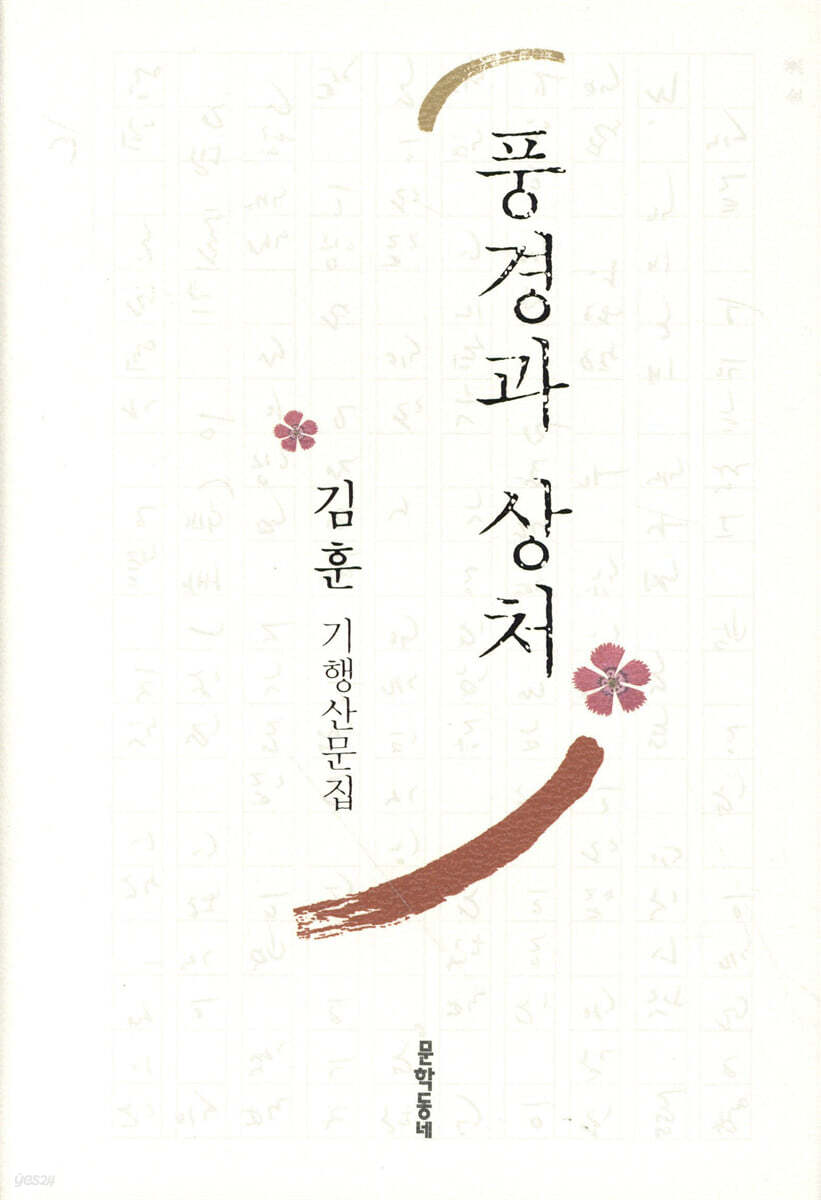
Landscape and wounds
 |
Description
Book Introduction
Kim Hoon's first travel essay collection, written with outstanding literary sensibility and intense reasoning.
All landscapes are merely landscapes of wounds, and the writer's free spirit of how wounds are contained in the landscape and how the landscape shows wounds is written in writing embodied in that spirit, unbound by genre or grammar.
All landscapes are merely landscapes of wounds, and the writer's free spirit of how wounds are contained in the landscape and how the landscape shows wounds is written in writing embodied in that spirit, unbound by genre or grammar.
- You can preview some of the book's contents.
Preview
index
Introduction - All landscapes are landscapes of wounds.
Landscape of Women, Landscape of Time
The crossing birds
Dog of AD 632
The Light of Gyemjae
My recent thoughts on Jeong Da-san
The Shame of Paradise
Summer that can't be escaped
Cornus officinalis
Love in the Stone
Forest of Instruments, Forest of Weapons
River and Tower
My current thoughts on the Daedongyeojido
Metaphysics in a Piss Bucket
Autumn in the salt fields
Time and the River
The frontier of food
Autumn Light
That sunset
The land of Bodhisattva covered with reeds
Reflections on the deep
Landscape of patterns
Helicopter and Jeong Hyeon-jong thoughts
A landscape called 'Cheon Sang-byeong'
Cheon Sang-byeong's political consciousness
In the revised edition
Landscape of Women, Landscape of Time
The crossing birds
Dog of AD 632
The Light of Gyemjae
My recent thoughts on Jeong Da-san
The Shame of Paradise
Summer that can't be escaped
Cornus officinalis
Love in the Stone
Forest of Instruments, Forest of Weapons
River and Tower
My current thoughts on the Daedongyeojido
Metaphysics in a Piss Bucket
Autumn in the salt fields
Time and the River
The frontier of food
Autumn Light
That sunset
The land of Bodhisattva covered with reeds
Reflections on the deep
Landscape of patterns
Helicopter and Jeong Hyeon-jong thoughts
A landscape called 'Cheon Sang-byeong'
Cheon Sang-byeong's political consciousness
In the revised edition
Publisher's Review
“All landscapes are just landscapes of wounds.”
For me, landscapes are interpreted and perceived only through wounds.
In the autumn of my youth, the word wound is masculine.
I don't know that,
My poor penmanship is enduring its masculinity.
The scenery is outside, and the wounds live inside me.
When we cross over to the landscape through the wound,
This world is reborn anew as it is reorganized within my wounds,
The new scenery at that time confirms the presence of the wound.
Therefore, all landscapes are merely landscapes of wounds.
_In the introduction
In 1994, when this book was first published, Kim Hoon, who was (as he put it) “old” (yet still) in his mid-forties, had not yet published his first novel, Memories of Comb-Patterned Pottery (1995, Munhakdongne).
Even before this book was published, he was already famous for his elegant sentences, but when talking about his sentences, 『Landscape and Wounds』 is a prose that cannot be left out.
Therefore, reading Kim Hoon's novels is in fact reading his sentences.
What disappears in the West Sea at sunset is always in progress.
The tiny particles of light that fill the sky, the sea, and the mudflats sometimes sparkle and fall as individual beings, but at each moment of their disappearance, they break down the boundaries with other individual beings, creating a new, unexperienced light and sinking toward the great darkness.
The swarming particles of light, vanishing in a swarm, arose and perished without any basis or base in space and time, being created only upon the annihilation of previous ones, and perishing upon the creation of previous ones, collapsing as a synthesis of creation and annihilation. _「That Sunset_West Sea/Daebu Island」
They depended on the mountains forming a double square for their existence, and on the rivers that embraced them in a great arc for their creation.
The band of ‘doem’ was used as the outer boundary of ‘is’.
How can we build a foundation for life on the hardened shell of time?
The sound of bird wings can be heard on the riverbank of the mandala, where existing things flow on top of what is created, and where flowing things flow and flow to return as new beings.
It is self-evident that we must build a fortress on the riverbank, without even asking the dead Jeong Do-jeon.
The verticals are solid, strong and tall.
They are floating beings.
Death is embedded within the very fabric of things that are not moving.
The river that flows between the floating things carries their shadows into the sea.
At the mouth where it meets the sea, the river unloads the weight of the beings it carries and ends on its own.
(……)
The silence of a megacity is frightening.
The landscape of the deserted megacity fills the riverbanks and fields like the shells of a life abandoned by nomadic tribes.
That desolate metropolis was enough to tickle the eye of an archaeologist, who, moved by the traces of human life, might even find a handful of comb-patterned pottery there.
A large river, choked by the fields of vertical structures, barely manages to flow, collecting the city's pus and sewage. _「River and Tower_Han River/Haengjusanseong Fortress」
Recently, when publishing 『Gongmudoha』, the author spoke about the powerful beauty of the ‘straight type’, but when republishing the book, he said, “I don’t write sentences like this anymore.” However, even in front of the ‘landscapes’ – landscapes that have passed through wounds, as he said – any other explanation would be superfluous in front of the beauty of these prose pieces written in ‘a new language born from the interweaving of images and humanistic thoughts’ without falling into a shallow sentimentality.
When I was writing the texts included here, I tried to paint the patterns of my thoughts using language like paint.
Just as a painter creates colors that were not there before on his palette, I sought to create a new language born from the interplay of images and thoughts.
I wanted to draw a new landscape where the body's breathing and the rhythm of writing are intertwined, and where external objects are carried by the inner language.
The search remains here as a trace, not a completion.
I don't write sentences like this anymore.
I try to write articles that capture the everydayness and specificity of life.
However, the writings I have included here still show the landscape of the wilderness in my heart.
_With the revised edition
Also, would it be an overinterpretation to say that novelist Kim Hoon's present can be read from his prose from over a decade ago, in which he read women, Gyemjae, weapons, instruments, and time in the landscapes of Eulsukdo, Dasan Chodang, the Han River, Soswaewon, and Gangjin...?
The flute, the bamboo spear, the musical instrument and the weapon are the two extremes of dreams and desires.
In the thick winter bamboo forest, I saw a spectacle where the dreams of musical instruments, the dreams of weapons, the dreams of a revolution in melody, all merged together, and only a vast silence greeted my eyes.
The dream of an instrument and the dream of a weapon are ultimately not different.
An Jung-geun's gun and Ureuk's gayageum are ultimately the same thing.
Their dream is to change the structure of the world and the content of time.
Musical instruments change the content of time, and weapons are involved in changing the structure of the world.
The dream of an instrument is fulfilled in a weapon, and the dream of a weapon is fulfilled in an instrument.
They are each other's lost halves, searching halves, but the more they search, the more the distance between them grows, and now they are separated by two poles of the world.
Instruments are the product of emptiness, weapons are the product of solidity.
Bamboo, like the alchemist's tangerine tree, cannot alchemize its own destiny, but when human eyes reach bamboo, humans, relying on the inner beam and solidity of the tree, develop a desire to shake and alchemize the world and time, and that desire is the very destiny of humanity.
_「Forest of Musical Instruments, Forest of Weapons _ Damyang, Subuk」
For me, landscapes are interpreted and perceived only through wounds.
In the autumn of my youth, the word wound is masculine.
I don't know that,
My poor penmanship is enduring its masculinity.
The scenery is outside, and the wounds live inside me.
When we cross over to the landscape through the wound,
This world is reborn anew as it is reorganized within my wounds,
The new scenery at that time confirms the presence of the wound.
Therefore, all landscapes are merely landscapes of wounds.
_In the introduction
In 1994, when this book was first published, Kim Hoon, who was (as he put it) “old” (yet still) in his mid-forties, had not yet published his first novel, Memories of Comb-Patterned Pottery (1995, Munhakdongne).
Even before this book was published, he was already famous for his elegant sentences, but when talking about his sentences, 『Landscape and Wounds』 is a prose that cannot be left out.
Therefore, reading Kim Hoon's novels is in fact reading his sentences.
What disappears in the West Sea at sunset is always in progress.
The tiny particles of light that fill the sky, the sea, and the mudflats sometimes sparkle and fall as individual beings, but at each moment of their disappearance, they break down the boundaries with other individual beings, creating a new, unexperienced light and sinking toward the great darkness.
The swarming particles of light, vanishing in a swarm, arose and perished without any basis or base in space and time, being created only upon the annihilation of previous ones, and perishing upon the creation of previous ones, collapsing as a synthesis of creation and annihilation. _「That Sunset_West Sea/Daebu Island」
They depended on the mountains forming a double square for their existence, and on the rivers that embraced them in a great arc for their creation.
The band of ‘doem’ was used as the outer boundary of ‘is’.
How can we build a foundation for life on the hardened shell of time?
The sound of bird wings can be heard on the riverbank of the mandala, where existing things flow on top of what is created, and where flowing things flow and flow to return as new beings.
It is self-evident that we must build a fortress on the riverbank, without even asking the dead Jeong Do-jeon.
The verticals are solid, strong and tall.
They are floating beings.
Death is embedded within the very fabric of things that are not moving.
The river that flows between the floating things carries their shadows into the sea.
At the mouth where it meets the sea, the river unloads the weight of the beings it carries and ends on its own.
(……)
The silence of a megacity is frightening.
The landscape of the deserted megacity fills the riverbanks and fields like the shells of a life abandoned by nomadic tribes.
That desolate metropolis was enough to tickle the eye of an archaeologist, who, moved by the traces of human life, might even find a handful of comb-patterned pottery there.
A large river, choked by the fields of vertical structures, barely manages to flow, collecting the city's pus and sewage. _「River and Tower_Han River/Haengjusanseong Fortress」
Recently, when publishing 『Gongmudoha』, the author spoke about the powerful beauty of the ‘straight type’, but when republishing the book, he said, “I don’t write sentences like this anymore.” However, even in front of the ‘landscapes’ – landscapes that have passed through wounds, as he said – any other explanation would be superfluous in front of the beauty of these prose pieces written in ‘a new language born from the interweaving of images and humanistic thoughts’ without falling into a shallow sentimentality.
When I was writing the texts included here, I tried to paint the patterns of my thoughts using language like paint.
Just as a painter creates colors that were not there before on his palette, I sought to create a new language born from the interplay of images and thoughts.
I wanted to draw a new landscape where the body's breathing and the rhythm of writing are intertwined, and where external objects are carried by the inner language.
The search remains here as a trace, not a completion.
I don't write sentences like this anymore.
I try to write articles that capture the everydayness and specificity of life.
However, the writings I have included here still show the landscape of the wilderness in my heart.
_With the revised edition
Also, would it be an overinterpretation to say that novelist Kim Hoon's present can be read from his prose from over a decade ago, in which he read women, Gyemjae, weapons, instruments, and time in the landscapes of Eulsukdo, Dasan Chodang, the Han River, Soswaewon, and Gangjin...?
The flute, the bamboo spear, the musical instrument and the weapon are the two extremes of dreams and desires.
In the thick winter bamboo forest, I saw a spectacle where the dreams of musical instruments, the dreams of weapons, the dreams of a revolution in melody, all merged together, and only a vast silence greeted my eyes.
The dream of an instrument and the dream of a weapon are ultimately not different.
An Jung-geun's gun and Ureuk's gayageum are ultimately the same thing.
Their dream is to change the structure of the world and the content of time.
Musical instruments change the content of time, and weapons are involved in changing the structure of the world.
The dream of an instrument is fulfilled in a weapon, and the dream of a weapon is fulfilled in an instrument.
They are each other's lost halves, searching halves, but the more they search, the more the distance between them grows, and now they are separated by two poles of the world.
Instruments are the product of emptiness, weapons are the product of solidity.
Bamboo, like the alchemist's tangerine tree, cannot alchemize its own destiny, but when human eyes reach bamboo, humans, relying on the inner beam and solidity of the tree, develop a desire to shake and alchemize the world and time, and that desire is the very destiny of humanity.
_「Forest of Musical Instruments, Forest of Weapons _ Damyang, Subuk」
GOODS SPECIFICS
- Date of issue: October 12, 2009
- Format: Hardcover book binding method guide
- Page count, weight, size: 223 pages | 320g | 135*195*20mm
- ISBN13: 9788954609319
- ISBN 10: 8954609317
You may also like
카테고리
korean


korean

![GQ KOREA Mark (Monthly): December [2025]](http://librairie.coreenne.fr/cdn/shop/files/8ef265dbbfbf186523ed75ba7319009d.jpg?v=1765340328&width=3840)


