

Chef of the Mediterranean Sun
 |
Description
Book Introduction
Transform from lazy editor to bumbling chef! Park Chan-il's delightful and refreshing story of cooking the human heart In his early 30s, while majoring in novels in college and working as an editor-in-chief of a monthly magazine, he suddenly became interested in cooking and decided to study abroad in Italy. A collection of essays by Park Chan-il, who is now known as an Italian chef and wine expert. Based on the author's study abroad experience, this book provides a delicious and friendly introduction to Italian food, culture, and traditions that we may not know about or misunderstand. The author's writing, which expresses profound thoughts and insights in a light and refreshing tone, not only overturns our prejudices and common sense, but also exudes a deep human touch, bringing emotion and joy. The author's wit and humor, which are permeated throughout the text, are exquisite and strongly draw the reader in. His sense of humor is so good that it makes you laugh out loud at every turn. The experiences and episodes he goes through while struggling with the hardships of studying abroad, working in a restaurant, and the loneliness and homesickness he feels in a foreign country lead us into a new world. Perhaps because of his background in novels, his light and powerful, individual sentences make reading prose a truly enjoyable experience. The main material of this collection of essays is the ups and downs of his daily life after graduating from culinary school and working at the restaurant 'Fatoria delle Torri' in Modica, a small town in Sicily, a rural part of Italy. Of course, cooking stories are the main focus. However, the author's strengths are demonstrated because his stories do not stop at cooking, but his imagination, which unfolds through cooking, reaches out to humans, nature, culture, customs, and traditions. This breaks the common sense we have about Italian cuisine and culture. Each episode features fascinating stories about how you don't eat steak often in Italy, how restaurants don't have pickles, how you don't enjoy garlic and peppers, and how you have misconceptions about pasta. It also humorously tells us about the Italians' unique gestures, passion for soccer, and their choleric and affectionate national character, which is similar to ours. |
- You can preview some of the book's contents.
Preview
index
1.
I was in Sicily, like a mess of pizza dough / 2.
Communists eat pasta too? / 3.
Don't show off your strength in the kitchen / 4.
Little Mac vs. Big Mac / 5.
A Midsummer Night's Scorpion Trouble / 6.
Boil the ravioli / 7.
Giuseppe appeared on a cooking show / 8.
There is no garlic masochism in Italy / 9.
Catch the Tuna / 10.
Struggle with customers, restaurants are battlefields / 11.
The Knight's Restaurant of Sicily / 12.
If there was no 'Cinema Paradiso' / 13.
Special Mission! Catch the Pig / 14.
Let's make real sausages / 15.
American guys, I'll give you a good tease / 16.
Are Italian and Korean food similar? / 17.
Fish Market in Sicily / 18.
I don't want to go to the police station even if I die / 19.
How to avoid roasting a whole chicken in 50 degree Celsius Sicily / 20.
Catch the Rat / 21.
Pornography / 22.
Pomodoro, boiling tomato sauce / 23.
Should I try for a Michelin star? / 24.
Michelin or 'Red Shrimp' / 25.
Please bear with the foie gras / 26.
Aunt Maria's Magic Power / 27.
Koreans live on rice / 28.
Pepe, how's 'Pomodoro' going? / 29.
Culinary school days / 30.
Red panties and memories of the World Cup / 31.
Last Sicily, Farewell / Author's Note
I was in Sicily, like a mess of pizza dough / 2.
Communists eat pasta too? / 3.
Don't show off your strength in the kitchen / 4.
Little Mac vs. Big Mac / 5.
A Midsummer Night's Scorpion Trouble / 6.
Boil the ravioli / 7.
Giuseppe appeared on a cooking show / 8.
There is no garlic masochism in Italy / 9.
Catch the Tuna / 10.
Struggle with customers, restaurants are battlefields / 11.
The Knight's Restaurant of Sicily / 12.
If there was no 'Cinema Paradiso' / 13.
Special Mission! Catch the Pig / 14.
Let's make real sausages / 15.
American guys, I'll give you a good tease / 16.
Are Italian and Korean food similar? / 17.
Fish Market in Sicily / 18.
I don't want to go to the police station even if I die / 19.
How to avoid roasting a whole chicken in 50 degree Celsius Sicily / 20.
Catch the Rat / 21.
Pornography / 22.
Pomodoro, boiling tomato sauce / 23.
Should I try for a Michelin star? / 24.
Michelin or 'Red Shrimp' / 25.
Please bear with the foie gras / 26.
Aunt Maria's Magic Power / 27.
Koreans live on rice / 28.
Pepe, how's 'Pomodoro' going? / 29.
Culinary school days / 30.
Red panties and memories of the World Cup / 31.
Last Sicily, Farewell / Author's Note
Publisher's Review
Transform from lazy editor to bumbling chef!
Park Chan-il's delightful and refreshing story of cooking the human heart
Park Chan-il (44), an Italian chef and wine expert who has worked at famous restaurants and is currently working as a chef at the Italian restaurant 'Nui Nui', has published a collection of essays titled 'Chef of the Mediterranean Sun: Park Chan-il's Tasting of Italy'.
This is a collection of 31 prose pieces serialized in Hankyoreh ESC for a year and a half.
The author, in his early 30s, was majoring in novels in college and working as an editor-in-chief of a monthly magazine when he suddenly became interested in cooking and decided to study abroad in Italy.
From 1999, he studied cooking and wine in Piedmont, Italy for three years, and worked as a chef in Sicily for a year before returning to Korea.
He has also served as a member of the Bordeaux wine tasting committee and has written columns for various media outlets, publishing four books including “Wine Scandal,” “Park Chan-il’s Wine Selection,” and “Choi Seung-joo and Park Chan-il’s Italian Cuisine.”
Based on the author's study abroad experience, this book provides a delicious and friendly introduction to Italian food, culture, and traditions that we may not know about or misunderstand.
The author's writing, which expresses profound thoughts and insights in a light and refreshing tone, not only overturns our prejudices and common sense, but also exudes a deep human touch, bringing emotion and joy.
Above all, his writing is interesting.
The author's wit and humor, which are permeated throughout the text, are exquisite and strongly draw the reader in.
His sense of humor is so unique that it will make you laugh out loud at every turn, making this collection of prose a rare and entertaining read these days.
The experiences and episodes he goes through while struggling with the hardships of studying abroad, working in a restaurant, and the loneliness and homesickness he feels in a foreign country lead us into a new world.
Perhaps because of his background in novels, his light and powerful, individual sentences make reading prose a truly enjoyable experience.
As novelist Kim Jung-hyuk put it, his writing "sometimes makes you laugh out loud, and sometimes it touches your heart." The reason his writing is so delicious is because it resembles a chef's cooking, "preparing ingredients for a long time and then cooking them over high heat for a short time." (Kim Jung-hyuk's recommendation)
The main material of this collection of essays is the ups and downs of his daily life after graduating from culinary school and working at the restaurant 'Fatoria delle Torri' in Modica, a small town in Sicily, a rural part of Italy.
Of course, cooking stories are the main focus.
However, the author's strengths are demonstrated because his stories do not stop at cooking, but his imagination, which unfolds through cooking, reaches out to humans, nature, culture, customs, and traditions.
This breaks the common sense we have about Italian cuisine and culture.
Each episode features fascinating stories about how you don't eat steak often in Italy, how restaurants don't have pickles, how you don't enjoy garlic and peppers, and how you have misconceptions about pasta.
It also tells us in an interesting way that Italy has dishes similar to ours, such as dumplings, red bean porridge, oxtail soup, beef bone soup, intestine soup, pig sundae, chicken liver, gizzard shad, and salted seafood ("Are Italian and Korean food similar?").
It also humorously tells us about the Italians' unique gestures, passion for soccer, and their choleric and affectionate national character, which is similar to ours.
The most important thing in this book is the author's philosophy on cooking.
This is in line with the thinking of his culinary and life mentor, Giuseppe Barone (founder of Slow Food Sicily).
If meat-eating is the destiny of mankind, then it is the role of the cook to slowly and willingly provide usefulness to the world so that death will not be in vain.
Giuseppe readily accepted the role.
He believed that a chef should not be someone who prepares food, but rather an observer who controls and monitors the process until each dish reaches the table.
I agreed with his thoughts.
Because I thought if we didn't do that, we would have no future.
Perhaps the fatty steak that appears on our tables is borrowed from future generations. (Page 138)
“To be a real chef, you have to know the markets and the fields.
You need to know when squid and tuna are available, and when tomatoes are at their peak ripeness.
You can never get good ingredients by sitting in a restaurant, holding the phone, and just using your fingers.
“Good ingredients are everything in cooking.” (p. 202)
The key point here is that chefs are not simply people who prepare food, but they play a pivotal role in keeping this world right and moving it forward.
The author's point that putting it into practice is not that difficult, but that this world is so accustomed to speed and industrialization that it is ignoring or overlooking the most basic and important facts, is painful to all of us.
He dreams of being a 'real' chef, someone who knows the markets and fields, who watches and observes the table at every moment.
This author's perspective naturally leads to the philosophy of 'slow food', 'local food', and 'organic'.
“The meaning of organic has already faded.
When city people buy pesticides and antibiotics to stay healthy, it is not truly organic.
Those people are idiots who complain that even organic food is eaten by bugs.”
Indeed, large organic farms in California employ Mexicans for minimum wage, forcing them to work under the blazing sun to catch bugs by hand on salad greens.
The vegetables then travel thousands of miles, slurping on gasoline, to the eastern United States.
Is this truly organic?
Could it be a truly organic farming with a healthy concept of harmony between humans and nature?
Are we drinking the oil that burns the planet, or are we eating the shellfish?
He preferred to stick to the long-established Sicilian methods of cultivation and farming, rather than to grand concepts like organic farming. (…) He also rejected corporate or greenhouse-grown organic farming.
Crops and livestock were considered factory-made products if they were not touched by the hands of the landowner, the farmer, and the oil used in greenhouse cultivation was cursed (pp. 122-23).
More than anything, what he instilled in me like a gene was the soul of cooking.
He taught me the three principles of cooking: 'Make the dish that your loved ones eat, using the most traditional recipes, using the ingredients closest to you.'
He showed us that the true triumph of Western cuisine and Italian cuisine, which were thought to be all about appearance and decoration, lies in these three elements.
He despised Michelin-starred chefs who didn't source their own ingredients but simply had them delivered over the phone, and he scolded chefs who boasted of importing ingredients from far away.
I mourned the history of materials being factory-farmed and mechanized, and I couldn't stand seeing pigs and chickens groaning in a swamp of antibiotics and hormones.
I was outraged by the reality that the food children ate was becoming animal feed, and I always had my head wrapped around teaching and researching what local children should eat and drink.
That's something that nutritionists and educators can't do, he said.
He emphasized that a cook is someone who feeds children like a mother. (p. 284)
The saying, 'Make the dish that your loved one eats with the most traditional recipe, using the ingredients closest to you' contains the philosophy of all cooking and life.
These words contain the path of a true chef who moves people and cooks their hearts.
The author's lament about this seemingly easy but unobservable reality appeals to all of us in this age who are accustomed to industrialization and mass production and accustomed to contaminated food.
The author's critical attitude does not hesitate to criticize the world's tendency to uniformly evaluate restaurants and become enthusiastic about them.
The part where the author criticizes and ridicules the violent restaurant reviews of gourmet magazines is a part where the author's wit is clearly demonstrated.
If it's bland, it's 'healthy food', and if it's salty, it's 'local food'.
If the meat is tough, it is 'fresh', and if it is old, it is 'well-aged'.
If there is little decoration and the seasoning is light, it means that the original taste of the ingredients is emphasized, and if it is the opposite, it means that there is creativity that completely changes the original character of the ingredients.
If the food is not tasty, people say, "The service is so good that it makes you forget how good the food is," and if the service is terrible, people say, "But the food is still tasty."
If you use expensive imported ingredients, it means you have 'difficult to obtain and airlift ingredients', and if you make it with only ingredients from the local area, it means 'localization of ingredients and realization of local food'.
Even a lazy chef who doesn't change his menu for ten years can become a "stubborn craftsman who maintains his craft for ten years," a restaurant critique in this world where everything depends on how you write and interpret it. (p. 211)
Tip 1: Chefs write, novelists draw.
There is another noteworthy point in this book.
The point is that the chef writes and the novelist draws illustrations.
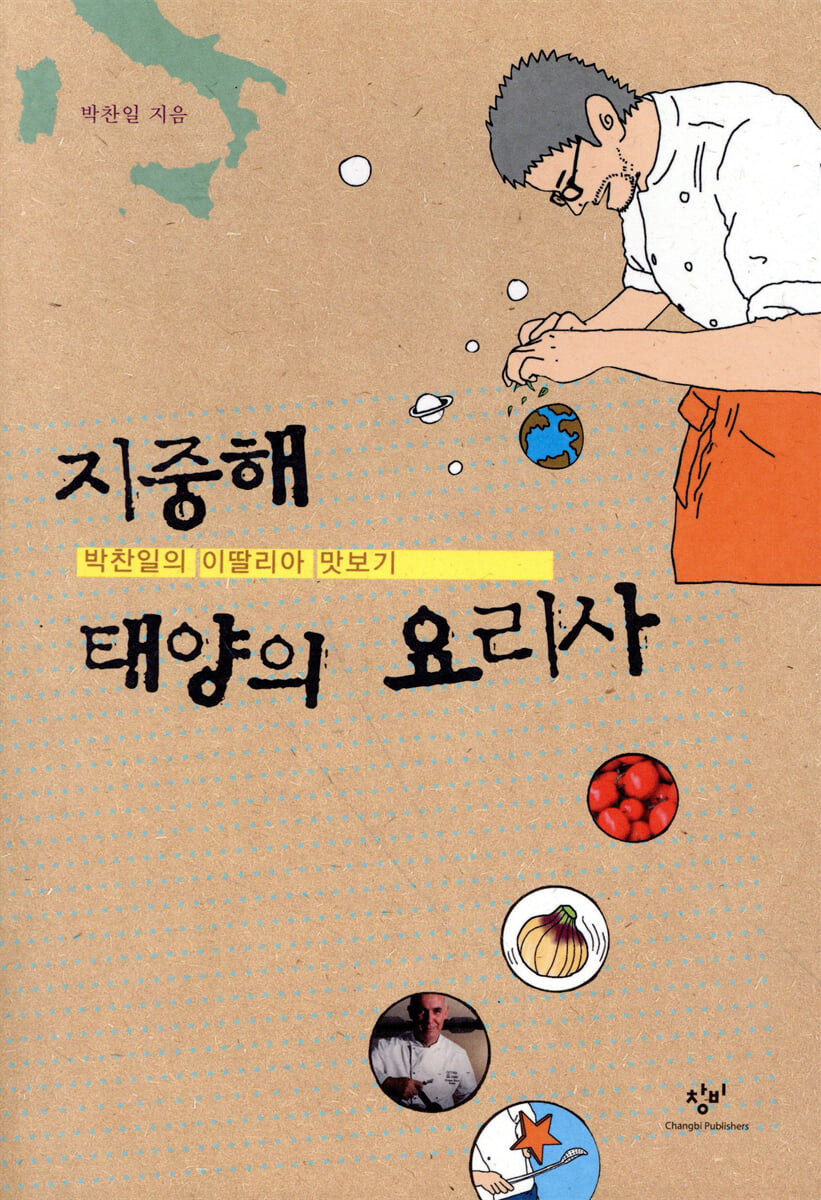
The humorous illustrations in striking colors on the cover and in each chapter are the work of novelist Kim Jung-hyuk, who is also active as an illustrator.
The illustrations, which Kim Jung-hyuk, who has maintained a long-standing relationship with the author since his days as a magazine reporter, has put his heart and soul into, are an interesting point where his deep understanding of the author and the sensibility of a novelist meet.
Tip 2: Top 10 Italian Recipes Anyone Can Make!
Super-easy, authentic Italian recipes recommended and demonstrated by Chef Park Chan-il.
The limited edition bonus DVD will also be a valuable gift to readers.
Author Chan-il Park selected ten Italian dishes that ordinary people can cook (spaghetti, risotto, fettuccine, linguine, tagliatelle, gnocchi, etc.) and produced a video demonstrating how to make them, with separate recipes included in the insert.
The author provides easy-to-follow recipes and tips, from how to choose ingredients, allowing anyone to experience the true essence of Italian cuisine firsthand.
It also helps you prepare a special table for your family, friends, and loved ones by recommending wines that go well with ten different dishes.
This DVD, which took about a month to complete with the help of about 20 people including filming, lighting, directing, and editing, is not just a supplement, but a work of art in itself that boasts outstanding perfection.
Park Chan-il captivates readers with his writing skills that are no less than his unique background.
His writing is full of funny and unfunny happenings.
He is a messenger who provides new entertainment to those who do not know much about the culinary industry and scratches an itch for those in the culinary industry.
Rather than hearing a long explanation about this book, you can check it out right away by opening the book.
If I had to summarize this book in three sentences, it would be this:
It's so funny, so funny, so touching.
Park Chan-il's delightful and refreshing story of cooking the human heart
Park Chan-il (44), an Italian chef and wine expert who has worked at famous restaurants and is currently working as a chef at the Italian restaurant 'Nui Nui', has published a collection of essays titled 'Chef of the Mediterranean Sun: Park Chan-il's Tasting of Italy'.
This is a collection of 31 prose pieces serialized in Hankyoreh ESC for a year and a half.
The author, in his early 30s, was majoring in novels in college and working as an editor-in-chief of a monthly magazine when he suddenly became interested in cooking and decided to study abroad in Italy.
From 1999, he studied cooking and wine in Piedmont, Italy for three years, and worked as a chef in Sicily for a year before returning to Korea.
He has also served as a member of the Bordeaux wine tasting committee and has written columns for various media outlets, publishing four books including “Wine Scandal,” “Park Chan-il’s Wine Selection,” and “Choi Seung-joo and Park Chan-il’s Italian Cuisine.”
Based on the author's study abroad experience, this book provides a delicious and friendly introduction to Italian food, culture, and traditions that we may not know about or misunderstand.
The author's writing, which expresses profound thoughts and insights in a light and refreshing tone, not only overturns our prejudices and common sense, but also exudes a deep human touch, bringing emotion and joy.
Above all, his writing is interesting.
The author's wit and humor, which are permeated throughout the text, are exquisite and strongly draw the reader in.
His sense of humor is so unique that it will make you laugh out loud at every turn, making this collection of prose a rare and entertaining read these days.
The experiences and episodes he goes through while struggling with the hardships of studying abroad, working in a restaurant, and the loneliness and homesickness he feels in a foreign country lead us into a new world.
Perhaps because of his background in novels, his light and powerful, individual sentences make reading prose a truly enjoyable experience.
As novelist Kim Jung-hyuk put it, his writing "sometimes makes you laugh out loud, and sometimes it touches your heart." The reason his writing is so delicious is because it resembles a chef's cooking, "preparing ingredients for a long time and then cooking them over high heat for a short time." (Kim Jung-hyuk's recommendation)
The main material of this collection of essays is the ups and downs of his daily life after graduating from culinary school and working at the restaurant 'Fatoria delle Torri' in Modica, a small town in Sicily, a rural part of Italy.
Of course, cooking stories are the main focus.
However, the author's strengths are demonstrated because his stories do not stop at cooking, but his imagination, which unfolds through cooking, reaches out to humans, nature, culture, customs, and traditions.
This breaks the common sense we have about Italian cuisine and culture.
Each episode features fascinating stories about how you don't eat steak often in Italy, how restaurants don't have pickles, how you don't enjoy garlic and peppers, and how you have misconceptions about pasta.
It also tells us in an interesting way that Italy has dishes similar to ours, such as dumplings, red bean porridge, oxtail soup, beef bone soup, intestine soup, pig sundae, chicken liver, gizzard shad, and salted seafood ("Are Italian and Korean food similar?").
It also humorously tells us about the Italians' unique gestures, passion for soccer, and their choleric and affectionate national character, which is similar to ours.
The most important thing in this book is the author's philosophy on cooking.
This is in line with the thinking of his culinary and life mentor, Giuseppe Barone (founder of Slow Food Sicily).
If meat-eating is the destiny of mankind, then it is the role of the cook to slowly and willingly provide usefulness to the world so that death will not be in vain.
Giuseppe readily accepted the role.
He believed that a chef should not be someone who prepares food, but rather an observer who controls and monitors the process until each dish reaches the table.
I agreed with his thoughts.
Because I thought if we didn't do that, we would have no future.
Perhaps the fatty steak that appears on our tables is borrowed from future generations. (Page 138)
“To be a real chef, you have to know the markets and the fields.
You need to know when squid and tuna are available, and when tomatoes are at their peak ripeness.
You can never get good ingredients by sitting in a restaurant, holding the phone, and just using your fingers.
“Good ingredients are everything in cooking.” (p. 202)
The key point here is that chefs are not simply people who prepare food, but they play a pivotal role in keeping this world right and moving it forward.
The author's point that putting it into practice is not that difficult, but that this world is so accustomed to speed and industrialization that it is ignoring or overlooking the most basic and important facts, is painful to all of us.
He dreams of being a 'real' chef, someone who knows the markets and fields, who watches and observes the table at every moment.
This author's perspective naturally leads to the philosophy of 'slow food', 'local food', and 'organic'.
“The meaning of organic has already faded.
When city people buy pesticides and antibiotics to stay healthy, it is not truly organic.
Those people are idiots who complain that even organic food is eaten by bugs.”
Indeed, large organic farms in California employ Mexicans for minimum wage, forcing them to work under the blazing sun to catch bugs by hand on salad greens.
The vegetables then travel thousands of miles, slurping on gasoline, to the eastern United States.
Is this truly organic?
Could it be a truly organic farming with a healthy concept of harmony between humans and nature?
Are we drinking the oil that burns the planet, or are we eating the shellfish?
He preferred to stick to the long-established Sicilian methods of cultivation and farming, rather than to grand concepts like organic farming. (…) He also rejected corporate or greenhouse-grown organic farming.
Crops and livestock were considered factory-made products if they were not touched by the hands of the landowner, the farmer, and the oil used in greenhouse cultivation was cursed (pp. 122-23).
More than anything, what he instilled in me like a gene was the soul of cooking.
He taught me the three principles of cooking: 'Make the dish that your loved ones eat, using the most traditional recipes, using the ingredients closest to you.'
He showed us that the true triumph of Western cuisine and Italian cuisine, which were thought to be all about appearance and decoration, lies in these three elements.
He despised Michelin-starred chefs who didn't source their own ingredients but simply had them delivered over the phone, and he scolded chefs who boasted of importing ingredients from far away.
I mourned the history of materials being factory-farmed and mechanized, and I couldn't stand seeing pigs and chickens groaning in a swamp of antibiotics and hormones.
I was outraged by the reality that the food children ate was becoming animal feed, and I always had my head wrapped around teaching and researching what local children should eat and drink.
That's something that nutritionists and educators can't do, he said.
He emphasized that a cook is someone who feeds children like a mother. (p. 284)
The saying, 'Make the dish that your loved one eats with the most traditional recipe, using the ingredients closest to you' contains the philosophy of all cooking and life.
These words contain the path of a true chef who moves people and cooks their hearts.
The author's lament about this seemingly easy but unobservable reality appeals to all of us in this age who are accustomed to industrialization and mass production and accustomed to contaminated food.
The author's critical attitude does not hesitate to criticize the world's tendency to uniformly evaluate restaurants and become enthusiastic about them.
The part where the author criticizes and ridicules the violent restaurant reviews of gourmet magazines is a part where the author's wit is clearly demonstrated.
If it's bland, it's 'healthy food', and if it's salty, it's 'local food'.
If the meat is tough, it is 'fresh', and if it is old, it is 'well-aged'.
If there is little decoration and the seasoning is light, it means that the original taste of the ingredients is emphasized, and if it is the opposite, it means that there is creativity that completely changes the original character of the ingredients.
If the food is not tasty, people say, "The service is so good that it makes you forget how good the food is," and if the service is terrible, people say, "But the food is still tasty."
If you use expensive imported ingredients, it means you have 'difficult to obtain and airlift ingredients', and if you make it with only ingredients from the local area, it means 'localization of ingredients and realization of local food'.
Even a lazy chef who doesn't change his menu for ten years can become a "stubborn craftsman who maintains his craft for ten years," a restaurant critique in this world where everything depends on how you write and interpret it. (p. 211)
Tip 1: Chefs write, novelists draw.
There is another noteworthy point in this book.
The point is that the chef writes and the novelist draws illustrations.
The humorous illustrations in striking colors on the cover and in each chapter are the work of novelist Kim Jung-hyuk, who is also active as an illustrator.
The illustrations, which Kim Jung-hyuk, who has maintained a long-standing relationship with the author since his days as a magazine reporter, has put his heart and soul into, are an interesting point where his deep understanding of the author and the sensibility of a novelist meet.
Tip 2: Top 10 Italian Recipes Anyone Can Make!
Super-easy, authentic Italian recipes recommended and demonstrated by Chef Park Chan-il.
The limited edition bonus DVD will also be a valuable gift to readers.
Author Chan-il Park selected ten Italian dishes that ordinary people can cook (spaghetti, risotto, fettuccine, linguine, tagliatelle, gnocchi, etc.) and produced a video demonstrating how to make them, with separate recipes included in the insert.
The author provides easy-to-follow recipes and tips, from how to choose ingredients, allowing anyone to experience the true essence of Italian cuisine firsthand.
It also helps you prepare a special table for your family, friends, and loved ones by recommending wines that go well with ten different dishes.
This DVD, which took about a month to complete with the help of about 20 people including filming, lighting, directing, and editing, is not just a supplement, but a work of art in itself that boasts outstanding perfection.
Park Chan-il captivates readers with his writing skills that are no less than his unique background.
His writing is full of funny and unfunny happenings.
He is a messenger who provides new entertainment to those who do not know much about the culinary industry and scratches an itch for those in the culinary industry.
Rather than hearing a long explanation about this book, you can check it out right away by opening the book.
If I had to summarize this book in three sentences, it would be this:
It's so funny, so funny, so touching.
GOODS SPECIFICS
- Date of issue: September 15, 2009
- Page count, weight, size: 292 pages | 449g | 145*210*20mm
- ISBN13: 9788936471705
- ISBN10: 8936471708
You may also like
카테고리
korean


korean

![GQ KOREA Mark (Monthly): December [2025]](http://librairie.coreenne.fr/cdn/shop/files/8ef265dbbfbf186523ed75ba7319009d.jpg?v=1765340328&width=3840)


