

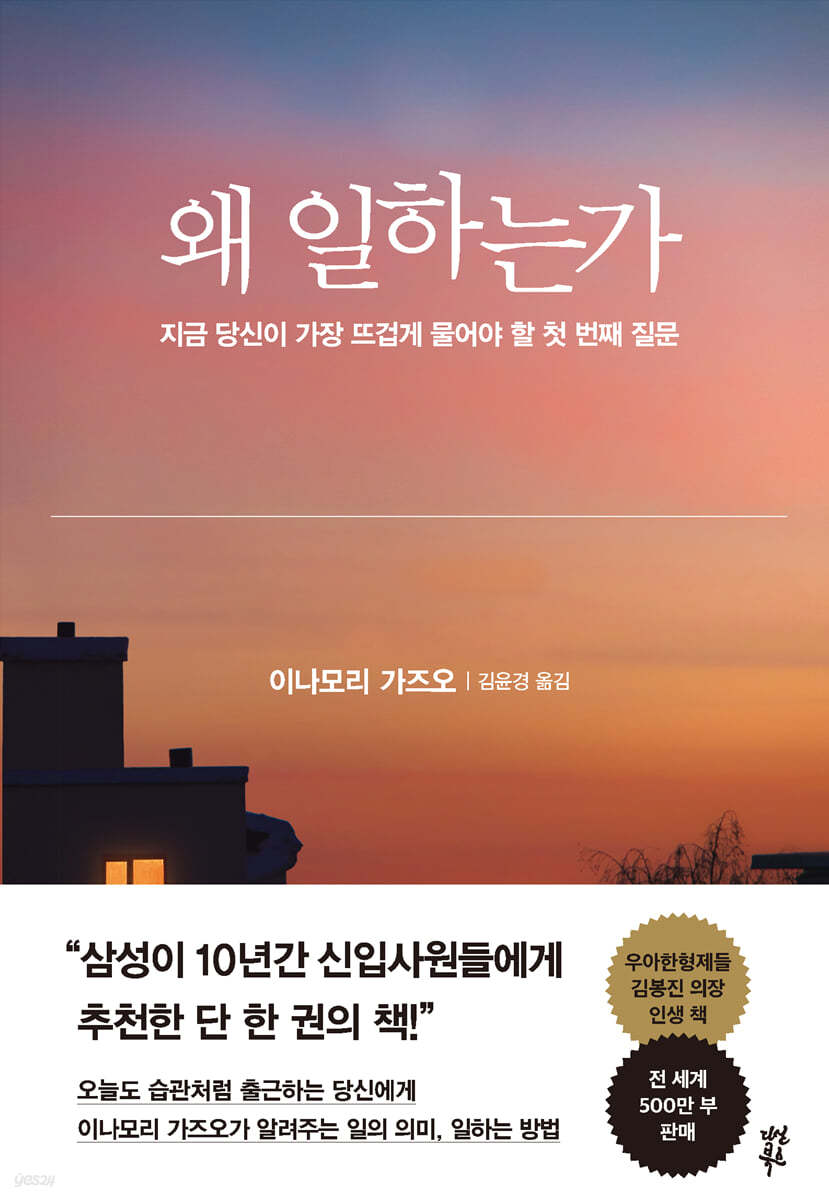
Why do we work?
 |
Description
Book Introduction
The only book Samsung has recommended to new employees for 10 years! I ask you, who goes to work every day as a habit. “What do you do? What do you hope to achieve through your work?” There is a book that sold hundreds of thousands of copies without any promotion, just with the topic of work. This book, which was first introduced in Korea in 2010, was immediately nicknamed the “book of life” by Woowa Brothers Chairman Kim Bong-jin and LS Group Chairman Koo Ja-kyul, and there were even rumors that famous CEOs were spending their own money to buy the book and give it as gifts to their employees. A representative of a Samsung Group affiliate has been recommending this book to new employees for 10 years. What kind of book is it that has ignited the hearts of so many managers and office workers? "Why Work" is a book that compiles the earnest concerns and attitudes toward work and life that a young man, who barely managed to get a job at a small business on the verge of bankruptcy and lived day to day like a defeated soldier, has accumulated over the past 60 years, until he founded a cutting-edge electronic components manufacturing company that became one of the world's top 100 companies and became the head of an organization with annual sales of 16 trillion won. The author of this book, which has overturned the perspective on work among office workers over the past decade, is Kazuo Inamori, the living "god of management" of the East. “My body was at the company, but my mind was not mine. "I lived like a corpse, dreamless, as if this life were over." How did Kazuo Inamori, a seemingly ordinary young man who dreaded even the ringing of the office phone for fear of being caught speaking in a dialect, confront his life head-on, unleash his potential, and become the master of his work? And what transformed his ordinary life into something extraordinary? In this book, the author poses this question to all working people in Korea, whose present is stifling and whose future is uncertain. "What do you do? Why do you do it? What do you hope to become as you do it?" |
- You can preview some of the book's contents.
Preview
index
prolog
To live a truly valuable life / If you dream of a happier me tomorrow
Chapter 1: Why We Work
Building a house with a thousand years in mind / The meaning of work learned in New Britain / Earnest immersion changes your life / Until God reaches out / There is no happiness that is given for free / Controlling anger through work
Chapter 2 Do you love your work?
Change your mindset first / If you want to be loved, love first / Be deeply moved by small things / With enough affection to want to hug the product / Listen to the product's cry / Become someone who burns themselves out
Chapter 3: What Do You Dream of?
There is no one whose dream is to come in second place / Make up your mind to achieve it / Opportunity will come the moment it touches your subconscious / Have you done all you can as a human being? / You can't arrive first if you run at the same speed / With the momentum of a weed sprouting from a crack in a rock
Chapter 4: Continued Effort
The power of persistence that transforms the ordinary into the extraordinary / Go one step further than yesterday / Kyocera does not look 10 years ahead / There is nothing that cannot be done, just not done / The moment you want to give up is a new starting point / Neither hardship nor luck lasts forever / The more difficult the task, the closer the summit / The steeper the mountain, the closer the summit
Chapter 5: Are you satisfied with the present?
If you're going to do it, do it perfectly / 99 percent isn't enough / You can't erase a mistake with an eraser / The more trivial the task, the more careful you must be / If you're going to do something, do it perfectly enough to cut your hand / The more vividly you draw it, the closer your dream comes / Sharpen your delicate senses / Dream of perfection, not the best
Chapter 6: Working Creatively
Take the road less traveled / Today cannot be the same as yesterday / Why non-experts succeed more than experts / Are your motives good and selfless / Think brightly, plan meticulously / The surest path to innovation
Epilogue
The Life Equation that Opens Tomorrow
To live a truly valuable life / If you dream of a happier me tomorrow
Chapter 1: Why We Work
Building a house with a thousand years in mind / The meaning of work learned in New Britain / Earnest immersion changes your life / Until God reaches out / There is no happiness that is given for free / Controlling anger through work
Chapter 2 Do you love your work?
Change your mindset first / If you want to be loved, love first / Be deeply moved by small things / With enough affection to want to hug the product / Listen to the product's cry / Become someone who burns themselves out
Chapter 3: What Do You Dream of?
There is no one whose dream is to come in second place / Make up your mind to achieve it / Opportunity will come the moment it touches your subconscious / Have you done all you can as a human being? / You can't arrive first if you run at the same speed / With the momentum of a weed sprouting from a crack in a rock
Chapter 4: Continued Effort
The power of persistence that transforms the ordinary into the extraordinary / Go one step further than yesterday / Kyocera does not look 10 years ahead / There is nothing that cannot be done, just not done / The moment you want to give up is a new starting point / Neither hardship nor luck lasts forever / The more difficult the task, the closer the summit / The steeper the mountain, the closer the summit
Chapter 5: Are you satisfied with the present?
If you're going to do it, do it perfectly / 99 percent isn't enough / You can't erase a mistake with an eraser / The more trivial the task, the more careful you must be / If you're going to do something, do it perfectly enough to cut your hand / The more vividly you draw it, the closer your dream comes / Sharpen your delicate senses / Dream of perfection, not the best
Chapter 6: Working Creatively
Take the road less traveled / Today cannot be the same as yesterday / Why non-experts succeed more than experts / Are your motives good and selfless / Think brightly, plan meticulously / The surest path to innovation
Epilogue
The Life Equation that Opens Tomorrow
Detailed image

Into the book
There is an abundance of techniques and manuals for doing a good job.
It has become a world where you can get results and get paid just by doing what is set in place without having to think about why you are working or how you are working.
So there is no need to wonder why you work or what you work for.
We spend most of our waking hours working, but we rarely think deeply about the fundamental reasons why we work.
--- p.26, from “Prologue, To Live a Truly Valuable Life”
In Western society, there was a widespread perception that 'work is hard work'.
(…) Adam and Eve, the progenitors of mankind, were banished from the Garden of Eden, a paradise, for eating the fruit of the tree of the knowledge of good and evil that God had forbidden.
When we lived in paradise, we didn't have to work, but after we were banished, we had to work hard to earn our keep.
(…) Westerners consider work to be full of suffering and therefore an activity to be avoided.
It can be thought that this is where the labor philosophy of 'getting work done in the shortest possible time and getting paid as much as possible' originated.
Unlike the West, the East did not have this kind of labor philosophy.
Work certainly involves hardship, but I consider it a dignified act that brings joy, pride, and a sense of fulfillment in life that outweighs the hardship.
--- p.48, from “Chapter 1, The Meaning of What I Learned in New Britain”
So, love what you are doing now more than anything else.
Immerse yourself in it.
Then, even going home after work will feel like a waste.
Even if others don't recognize you, you won't find it difficult to work on it all night.
I feel like I am the thing and the thing becomes me.
Anyone would jump for joy like a child in front of the results achieved through such a process.
--- p.96~97, from “Chapter 2, Affection Enough to Want to Embrace the Product”
Materials include flammable materials that burn when brought near fire, non-flammable materials that do not burn when brought near fire, and natural materials that burn easily on their own.
The same goes for people.
A combustible person acts only when influenced by those around him, while a non-combustible person not only rarely burns, but also extinguishes the sparks of others.
In contrast, natural human beings are spontaneous and take action.
--- p.109, from “Chapter 2, Become a Person Who Burns Yourself”
There is not a single plant that does not live with all its might.
A plant that doesn't work hard won't survive.
The same goes for animals.
Whether carnivore or herbivore, if you don't work hard and desperately to eat and preserve your species, you won't be able to survive.
That is the law of nature.
However, we humans alone think of things like ‘making an effort that is not inferior to anyone else’ or ‘living diligently’ as special things that are far removed from us.
You don't have to work hard just to be successful.
Life itself is a series of fierce efforts.
Because that is the providence of nature and the providence by which humans become human.
--- p.148, from “Chapter 3, With the momentum of weeds sprouting even in the crevices of rocks”
No one can accurately predict what will happen three or five years from now.
But if it happens a year later, you can read it in advance without much error.
(…) ‘Let’s do our best today.
If you work hard today, you will see tomorrow.' 'Let's do our best this month.
If you work hard this month, you will see next month.' 'Let's work hard this year.
If you live this year faithfully, you will see the next year.' (...) Isn't what you're doing now the very thing you doubted a few years ago, asking, "Can I really do this?" But aren't you doing it now with flying colors? God designed humans to be capable of progress in every way.
--- p.167~170, from “Chapter 4, Kyocera Does Not Look 10 Years Ahead”
“Of course, it may have met the requirements in terms of performance.
But this is not a finished product.
(…) Ceramics should originally be pure white.
The appearance should also be beautiful enough to make you afraid that your hand might get cut if you touch it.
“If the appearance is that great, then the performance must be top-notch as well.” So I appealed once again to create a ‘product that would cut your hand.’
I really wanted to convey the idea that we should pursue a product that is so perfect and so excellent that it feels like it could be cut if you touch it.
(…) Spare no effort until you create a product that you can be sure is better than this one.
That's the spirit of perfectionism.
Moreover, this spirit is the mindset absolutely necessary for those who aim to reach the summit of the high mountain of creation.
--- p.217~218, from “Chapter 5, If you are going to do something, do it perfectly enough to cut your hand”
'A good idea came to me.
It may be lacking now, but if you try desperately, you will definitely succeed.
So, let's start again.' People with this kind of optimistic mindset can take big strides toward success.
(…) But it is dangerous to leave everything to the optimists.
When you get to the stage of planning your idea concretely, you need the help of a pessimist.
Optimists are driven by strong impulses, but sometimes they run wild and go down the wrong path.
So, it's better to have the pessimist, who takes things seriously and calmly, anticipate the risks that may arise, and then carefully and carefully develop a practical plan of action.
(…) And when it comes time to put that plan into action, we leave it to the optimists again.
It opens the way for you to boldly pursue your dreams.
“Conceive optimistically, plan pessimistically, and execute optimistically again.” This is the most ideal system for taking on new challenges, and it is the principle that has allowed Kyocera to successfully develop new products without a single failure.
It has become a world where you can get results and get paid just by doing what is set in place without having to think about why you are working or how you are working.
So there is no need to wonder why you work or what you work for.
We spend most of our waking hours working, but we rarely think deeply about the fundamental reasons why we work.
--- p.26, from “Prologue, To Live a Truly Valuable Life”
In Western society, there was a widespread perception that 'work is hard work'.
(…) Adam and Eve, the progenitors of mankind, were banished from the Garden of Eden, a paradise, for eating the fruit of the tree of the knowledge of good and evil that God had forbidden.
When we lived in paradise, we didn't have to work, but after we were banished, we had to work hard to earn our keep.
(…) Westerners consider work to be full of suffering and therefore an activity to be avoided.
It can be thought that this is where the labor philosophy of 'getting work done in the shortest possible time and getting paid as much as possible' originated.
Unlike the West, the East did not have this kind of labor philosophy.
Work certainly involves hardship, but I consider it a dignified act that brings joy, pride, and a sense of fulfillment in life that outweighs the hardship.
--- p.48, from “Chapter 1, The Meaning of What I Learned in New Britain”
So, love what you are doing now more than anything else.
Immerse yourself in it.
Then, even going home after work will feel like a waste.
Even if others don't recognize you, you won't find it difficult to work on it all night.
I feel like I am the thing and the thing becomes me.
Anyone would jump for joy like a child in front of the results achieved through such a process.
--- p.96~97, from “Chapter 2, Affection Enough to Want to Embrace the Product”
Materials include flammable materials that burn when brought near fire, non-flammable materials that do not burn when brought near fire, and natural materials that burn easily on their own.
The same goes for people.
A combustible person acts only when influenced by those around him, while a non-combustible person not only rarely burns, but also extinguishes the sparks of others.
In contrast, natural human beings are spontaneous and take action.
--- p.109, from “Chapter 2, Become a Person Who Burns Yourself”
There is not a single plant that does not live with all its might.
A plant that doesn't work hard won't survive.
The same goes for animals.
Whether carnivore or herbivore, if you don't work hard and desperately to eat and preserve your species, you won't be able to survive.
That is the law of nature.
However, we humans alone think of things like ‘making an effort that is not inferior to anyone else’ or ‘living diligently’ as special things that are far removed from us.
You don't have to work hard just to be successful.
Life itself is a series of fierce efforts.
Because that is the providence of nature and the providence by which humans become human.
--- p.148, from “Chapter 3, With the momentum of weeds sprouting even in the crevices of rocks”
No one can accurately predict what will happen three or five years from now.
But if it happens a year later, you can read it in advance without much error.
(…) ‘Let’s do our best today.
If you work hard today, you will see tomorrow.' 'Let's do our best this month.
If you work hard this month, you will see next month.' 'Let's work hard this year.
If you live this year faithfully, you will see the next year.' (...) Isn't what you're doing now the very thing you doubted a few years ago, asking, "Can I really do this?" But aren't you doing it now with flying colors? God designed humans to be capable of progress in every way.
--- p.167~170, from “Chapter 4, Kyocera Does Not Look 10 Years Ahead”
“Of course, it may have met the requirements in terms of performance.
But this is not a finished product.
(…) Ceramics should originally be pure white.
The appearance should also be beautiful enough to make you afraid that your hand might get cut if you touch it.
“If the appearance is that great, then the performance must be top-notch as well.” So I appealed once again to create a ‘product that would cut your hand.’
I really wanted to convey the idea that we should pursue a product that is so perfect and so excellent that it feels like it could be cut if you touch it.
(…) Spare no effort until you create a product that you can be sure is better than this one.
That's the spirit of perfectionism.
Moreover, this spirit is the mindset absolutely necessary for those who aim to reach the summit of the high mountain of creation.
--- p.217~218, from “Chapter 5, If you are going to do something, do it perfectly enough to cut your hand”
'A good idea came to me.
It may be lacking now, but if you try desperately, you will definitely succeed.
So, let's start again.' People with this kind of optimistic mindset can take big strides toward success.
(…) But it is dangerous to leave everything to the optimists.
When you get to the stage of planning your idea concretely, you need the help of a pessimist.
Optimists are driven by strong impulses, but sometimes they run wild and go down the wrong path.
So, it's better to have the pessimist, who takes things seriously and calmly, anticipate the risks that may arise, and then carefully and carefully develop a practical plan of action.
(…) And when it comes time to put that plan into action, we leave it to the optimists again.
It opens the way for you to boldly pursue your dreams.
“Conceive optimistically, plan pessimistically, and execute optimistically again.” This is the most ideal system for taking on new challenges, and it is the principle that has allowed Kyocera to successfully develop new products without a single failure.
--- p.250~252, from “Chapter 6, Think Brightly, Plan Meticulously”
Publisher's Review
★ 5 million copies sold worldwide ★
★ Completely revised and republished after 10 years ★
Reviews from readers whose lives were changed after reading this book 10 years ago
“A book I keep in my office drawer and read whenever I feel uneasy.” -he******
“It was a miracle that I came across this book when the future was vague and scary.” -tj****
“I am grateful and sorry that the wisdom the author learned through a lifetime of hardship was crammed into a single book.” -yu*****
“When I was wandering around for a while after leaving the company,
“I have been able to keep working without giving up since I came across this book.”
Kim Bong-jin (Chairman of Woowa Brothers)
“The success or failure of a task begins with ‘why’, not ‘how’!”
The secret to becoming CEO of a company with annual sales of 16 trillion won, even though I started out at a local small business.
'How long must I waste my life doing something I don't even like?'
'I feel like I'm working like crazy all day, but nothing is accumulating inside me.'
'I don't know why I work so hard.'
There are countless methods and manuals out there on how to do things well.
People are constantly exploring and studying how to achieve results and how to reach their goals as quickly as possible, and they are constantly striving to 'do things better.'
But no one ever asks themselves 'why do we do things' or seeks the answer.
Because I have no confidence or reason for my work, I sway back and forth like a rootless tree even with the slightest breeze.
Kazuo Inamori was no different from modern people living today.
After graduating from an unknown local university with mediocre grades after failing to secure a place, he began his career by getting a job at a small to medium-sized company on the verge of bankruptcy at the recommendation of a professor.
His colleagues moved to better companies one after another, but he was not given any opportunities.
However, he quietly devoted himself to his work in one place, and has been active as one of the most influential managers in Japan for over 60 years.
What made him the most respected CEO and a great professional? For over half a century, there was only one question on his mind.
“Why am I doing this?” And this was the answer he found.
“I work to train myself, refine my mind, and discover the value of life.
That's all."
As someone who has been running a business for over 60 years and has only dug one well, the author has a unique perspective and view on work.
If you've been applying the so-called "Silicon Valley-style work methods" imported from overseas to your work and management but haven't been able to achieve results or "real satisfaction" from your work, consider the advice of Kazuo Inamori, who views work not simply as a result but as a tool for performance.
By following his unique ideas about work, such as “Conceive optimistically, plan pessimistically, and execute optimistically again,” “Don’t avoid the whirlpool, jump into its midst,” and “Compete with today, not with the unknown five years from now,” you will soon be able to seriously consider a “better way of working” that is perfect for you and your organization.
“Have you ever been so intense and meticulous about your work, even for just one day?”
The most pressing question you should be asking right now as you dream of success.
There was a book that became a hot topic among executives of affiliated companies at the 2014 Samsung Group employee book bazaar.
It is ‘Why do we work?’
Although the book had been out for several years, word of mouth spread with the description, "A must-read for office workers who dream of success," and on that day, a copy of "Why Work," owned by former Samsung C&T CEO Kim Shin, was sold at auction for the highest price among economics and management books.
In an age where the value of work is increasingly being devalued, the reason why experienced workers have responded so enthusiastically to this book that asks the question of the meaning of "work" is perhaps because it has brought back to mind the possibilities and meaning of work that we had briefly forgotten.
This book is not a book that teaches you the methodology of 'doing this to get better at your job.'
They don't scold you by saying, "You shouldn't work like that," nor do they comfort you by saying, "You've done well enough so far, so it's okay to take a break now."
It's just an honest confession of the struggles and journey of an ordinary man who, instead of running away from life, burned himself out and became the best.
“Why do we work?” If you are someone who works hard but cannot easily answer the question, if you have ever been suddenly overcome by a sense of emptiness while riding the subway home after a tireless day at work, if you have lived diligently but feel helpless at the wealth gap that has suddenly widened, I hope you will read this book and confront the most important question in life before it is too late.
This book, which has been called "the most recommended book by Samsung employees" for the past 10 years, "the book that is always given as a gift to employees at New Year's," and "the book with the most reviews from businesspeople," is still talked about and talked about by countless people.
The newly released Korean edition is the latest revision, with a new design that enhances its collection value, and the translation has been revised and edited to enhance the completeness of the text.
After reading all 40 chapters, which contain the perspectives of a master who has practiced in one place for over 60 years, you will confirm that your life and work, which have been lived each day to the fullest with the pure desire to "do better," were never wrong.
★ Completely revised and republished after 10 years ★
Reviews from readers whose lives were changed after reading this book 10 years ago
“A book I keep in my office drawer and read whenever I feel uneasy.” -he******
“It was a miracle that I came across this book when the future was vague and scary.” -tj****
“I am grateful and sorry that the wisdom the author learned through a lifetime of hardship was crammed into a single book.” -yu*****
“When I was wandering around for a while after leaving the company,
“I have been able to keep working without giving up since I came across this book.”
Kim Bong-jin (Chairman of Woowa Brothers)
“The success or failure of a task begins with ‘why’, not ‘how’!”
The secret to becoming CEO of a company with annual sales of 16 trillion won, even though I started out at a local small business.
'How long must I waste my life doing something I don't even like?'
'I feel like I'm working like crazy all day, but nothing is accumulating inside me.'
'I don't know why I work so hard.'
There are countless methods and manuals out there on how to do things well.
People are constantly exploring and studying how to achieve results and how to reach their goals as quickly as possible, and they are constantly striving to 'do things better.'
But no one ever asks themselves 'why do we do things' or seeks the answer.
Because I have no confidence or reason for my work, I sway back and forth like a rootless tree even with the slightest breeze.
Kazuo Inamori was no different from modern people living today.
After graduating from an unknown local university with mediocre grades after failing to secure a place, he began his career by getting a job at a small to medium-sized company on the verge of bankruptcy at the recommendation of a professor.
His colleagues moved to better companies one after another, but he was not given any opportunities.
However, he quietly devoted himself to his work in one place, and has been active as one of the most influential managers in Japan for over 60 years.
What made him the most respected CEO and a great professional? For over half a century, there was only one question on his mind.
“Why am I doing this?” And this was the answer he found.
“I work to train myself, refine my mind, and discover the value of life.
That's all."
As someone who has been running a business for over 60 years and has only dug one well, the author has a unique perspective and view on work.
If you've been applying the so-called "Silicon Valley-style work methods" imported from overseas to your work and management but haven't been able to achieve results or "real satisfaction" from your work, consider the advice of Kazuo Inamori, who views work not simply as a result but as a tool for performance.
By following his unique ideas about work, such as “Conceive optimistically, plan pessimistically, and execute optimistically again,” “Don’t avoid the whirlpool, jump into its midst,” and “Compete with today, not with the unknown five years from now,” you will soon be able to seriously consider a “better way of working” that is perfect for you and your organization.
“Have you ever been so intense and meticulous about your work, even for just one day?”
The most pressing question you should be asking right now as you dream of success.
There was a book that became a hot topic among executives of affiliated companies at the 2014 Samsung Group employee book bazaar.
It is ‘Why do we work?’
Although the book had been out for several years, word of mouth spread with the description, "A must-read for office workers who dream of success," and on that day, a copy of "Why Work," owned by former Samsung C&T CEO Kim Shin, was sold at auction for the highest price among economics and management books.
In an age where the value of work is increasingly being devalued, the reason why experienced workers have responded so enthusiastically to this book that asks the question of the meaning of "work" is perhaps because it has brought back to mind the possibilities and meaning of work that we had briefly forgotten.
This book is not a book that teaches you the methodology of 'doing this to get better at your job.'
They don't scold you by saying, "You shouldn't work like that," nor do they comfort you by saying, "You've done well enough so far, so it's okay to take a break now."
It's just an honest confession of the struggles and journey of an ordinary man who, instead of running away from life, burned himself out and became the best.
“Why do we work?” If you are someone who works hard but cannot easily answer the question, if you have ever been suddenly overcome by a sense of emptiness while riding the subway home after a tireless day at work, if you have lived diligently but feel helpless at the wealth gap that has suddenly widened, I hope you will read this book and confront the most important question in life before it is too late.
This book, which has been called "the most recommended book by Samsung employees" for the past 10 years, "the book that is always given as a gift to employees at New Year's," and "the book with the most reviews from businesspeople," is still talked about and talked about by countless people.
The newly released Korean edition is the latest revision, with a new design that enhances its collection value, and the translation has been revised and edited to enhance the completeness of the text.
After reading all 40 chapters, which contain the perspectives of a master who has practiced in one place for over 60 years, you will confirm that your life and work, which have been lived each day to the fullest with the pure desire to "do better," were never wrong.
GOODS SPECIFICS
- Publication date: April 12, 2021
- Format: Hardcover book binding method guide
- Page count, weight, size: 268 pages | 426g | 137*195*21mm
- ISBN13: 9791130637037
- ISBN10: 1130637034
You may also like
카테고리
korean


korean

![GQ KOREA Mark (Monthly): December [2025]](http://librairie.coreenne.fr/cdn/shop/files/8ef265dbbfbf186523ed75ba7319009d.jpg?v=1765340328&width=3840)


