

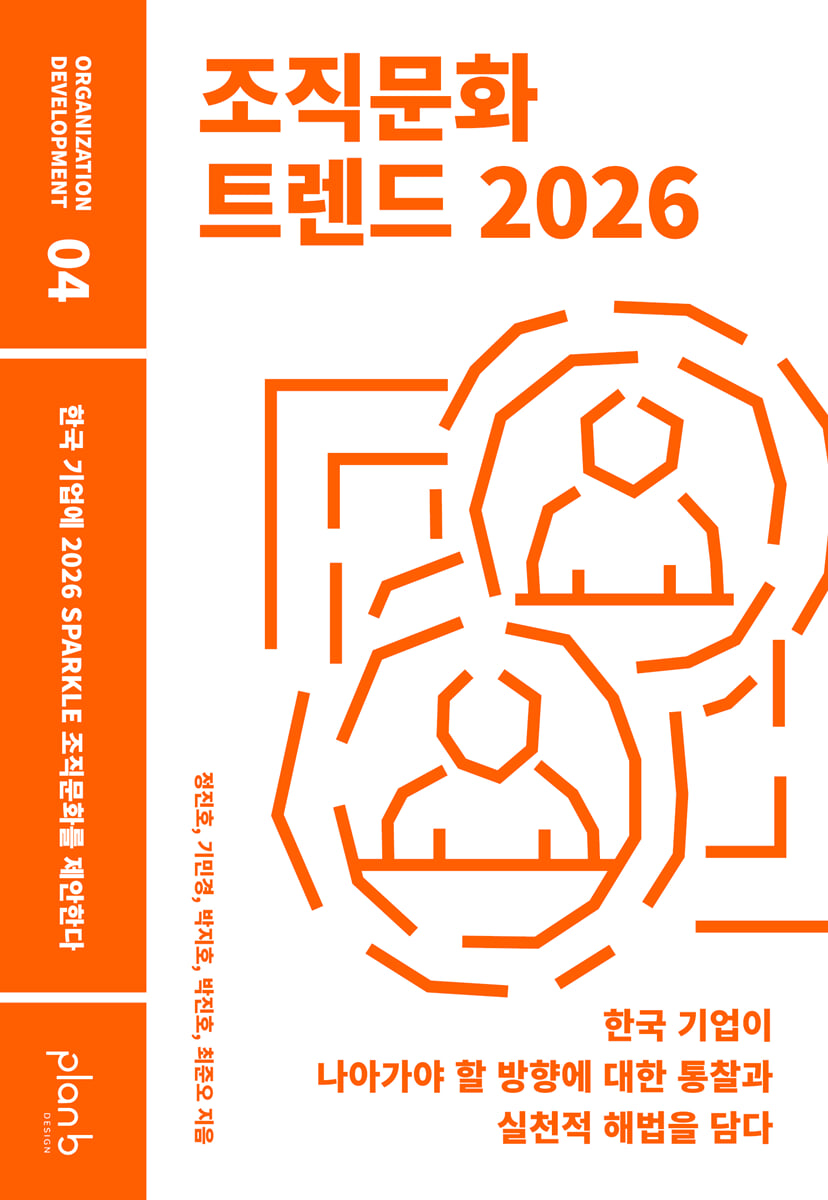
Organizational Culture Trends 2026
 |
Description
Book Introduction
Rewriting the Future of Organizational Culture in a Crisis
When a company is struggling, its members become discouraged and the organizational atmosphere becomes rigid.
In fact, the Korean economy in 2025 faced a crisis due to external uncertainty and an economic slowdown, which had a direct impact on many companies.
In response to the worsening business environment, companies are showing a tendency to return to old ways of doing things, such as more management, performance pressure, and tighter control.
But this approach no longer works effectively for members.
And companies that have sensed this change are designing new organizational cultures by proposing "autonomy-based organizational culture" and "empowering leadership."
Accordingly, 『Organizational Culture Trends 2026』 focuses on introducing organizational culture trends and seven signals of change that are shaking up organizational culture: 'SPARKLE (Self-driven Work, Platform with Care-centered Value, AI-Human Collaboration, Rehumanization, Knowledge Gap, Life-Work Integration, Empowered Belonging)'.
These signals are 'the era of self-directed work', 'care right now', 'is AI a colleague or a competitor', 'restoring lost humanity', 'coexistence of XYZ generation, overcoming the knowledge gap', 'breaking down boundaries between work and life', and 'after the sense of ownership, the era of belonging'. They will serve as practical guides for breaking away from existing methods, quickly and accurately identifying signals of change, and setting a direction for response.
In addition, it contains a selection of the latest core theories of organizational culture, trends in organizational culture, key tasks, and important points that organizational culture should consider.
In particular, it will be helpful in designing organizational culture by presenting a wealth of examples of innovative organizational cultures from companies.
For those seeking to enhance their organization's competitiveness, leadership, and AI application capabilities, "Organizational Culture Trends 2026" will provide the right direction for establishing a 2026 organizational culture roadmap.
When a company is struggling, its members become discouraged and the organizational atmosphere becomes rigid.
In fact, the Korean economy in 2025 faced a crisis due to external uncertainty and an economic slowdown, which had a direct impact on many companies.
In response to the worsening business environment, companies are showing a tendency to return to old ways of doing things, such as more management, performance pressure, and tighter control.
But this approach no longer works effectively for members.
And companies that have sensed this change are designing new organizational cultures by proposing "autonomy-based organizational culture" and "empowering leadership."
Accordingly, 『Organizational Culture Trends 2026』 focuses on introducing organizational culture trends and seven signals of change that are shaking up organizational culture: 'SPARKLE (Self-driven Work, Platform with Care-centered Value, AI-Human Collaboration, Rehumanization, Knowledge Gap, Life-Work Integration, Empowered Belonging)'.
These signals are 'the era of self-directed work', 'care right now', 'is AI a colleague or a competitor', 'restoring lost humanity', 'coexistence of XYZ generation, overcoming the knowledge gap', 'breaking down boundaries between work and life', and 'after the sense of ownership, the era of belonging'. They will serve as practical guides for breaking away from existing methods, quickly and accurately identifying signals of change, and setting a direction for response.
In addition, it contains a selection of the latest core theories of organizational culture, trends in organizational culture, key tasks, and important points that organizational culture should consider.
In particular, it will be helpful in designing organizational culture by presenting a wealth of examples of innovative organizational cultures from companies.
For those seeking to enhance their organization's competitiveness, leadership, and AI application capabilities, "Organizational Culture Trends 2026" will provide the right direction for establishing a 2026 organizational culture roadmap.
- You can preview some of the book's contents.
Preview
index
PART 1.
7 Signals of Change That Shaken Organizational Culture: SPARKLE
1.
Self-driven Work: Beyond the Age of Control, Enter the Age of Self-Directed Work
2.
Platform with Care-Centered Value: Care for Now, Not the Future
3. AI-Human Collaboration: Is AI a Competitor or a Colleague?
4.
Rehumanization: Restoring the Lost Humanity in Organizations
5.
Knowledge Gap: Coexistence of Generation XYZ, Overcoming the Knowledge Gap
6.
Life-Work Integration: Blurring the Boundaries Between Work and Life
7.
Empowered Belonging: After Ownership, the Era of Belonging
PART 2.
Core Theories of Organizational Culture
1.
Definition of organizational culture
2.
Components of organizational culture
3.
Diagnosis of organizational culture
4.
Three Elements of Organizational Culture Activities
PART 3.
Key issues in organizational culture
1.
Values: Companies Establishing a 2030 Vision
2.
CoC 2.0: Three Key Words: Data-Centricity, Rapid Execution, and Accountability
3.
Leveraging Generative AI: Changing the Operating System of Organizations: The Efficiency Trap vs. the Future of Augmentation
4.
Leadership: A Shift in the Leadership Paradigm, Calling for New Leadership
5.
Performance Management: From Control to Growth! How OKRs Are Changing Performance Management
PART 4. DEIB 2.0: Proposing a Korean-style K-DEIB
1.
Why DEIB now?
2.
Global Trends and Korean Companies' Responses
3.
Design of the Korean K-DEIB
4.
Suggestions for implementing the Korean version of K-DEIB
Epilogue
7 Signals of Change That Shaken Organizational Culture: SPARKLE
1.
Self-driven Work: Beyond the Age of Control, Enter the Age of Self-Directed Work
2.
Platform with Care-Centered Value: Care for Now, Not the Future
3. AI-Human Collaboration: Is AI a Competitor or a Colleague?
4.
Rehumanization: Restoring the Lost Humanity in Organizations
5.
Knowledge Gap: Coexistence of Generation XYZ, Overcoming the Knowledge Gap
6.
Life-Work Integration: Blurring the Boundaries Between Work and Life
7.
Empowered Belonging: After Ownership, the Era of Belonging
PART 2.
Core Theories of Organizational Culture
1.
Definition of organizational culture
2.
Components of organizational culture
3.
Diagnosis of organizational culture
4.
Three Elements of Organizational Culture Activities
PART 3.
Key issues in organizational culture
1.
Values: Companies Establishing a 2030 Vision
2.
CoC 2.0: Three Key Words: Data-Centricity, Rapid Execution, and Accountability
3.
Leveraging Generative AI: Changing the Operating System of Organizations: The Efficiency Trap vs. the Future of Augmentation
4.
Leadership: A Shift in the Leadership Paradigm, Calling for New Leadership
5.
Performance Management: From Control to Growth! How OKRs Are Changing Performance Management
PART 4. DEIB 2.0: Proposing a Korean-style K-DEIB
1.
Why DEIB now?
2.
Global Trends and Korean Companies' Responses
3.
Design of the Korean K-DEIB
4.
Suggestions for implementing the Korean version of K-DEIB
Epilogue
Into the book
Ultimately, as anxiety grows in the AI era, employees find renewed motivation in care-centered purposes that convey the message, "You are valued," rather than directives to "perform."
This type of 'care-centered platform' is gradually becoming a reality in Korean corporate culture as well.
Through the three pillars of growth support, daily care, and a sense of value at work, employees are experiencing the feeling that they are respected and growing even at this very moment.
--- p.30
In 2026, the standard organizational culture will be a collaborative culture where AI and humans work together to create synergy.
When organizations move beyond fear and design for coexistence with AI, it will become a driving force for sustainable innovation.
--- p.46
When emotional motivation and challenging goal setting meet, a vision becomes more than just empty rhetoric; it becomes a realistic roadmap that the entire organization can work toward.
Managing organizations in this changing era demands an integrated approach that is practical, measurable, and emotionally engaging.
The evolution of the vision slogan can be said to be a natural flow that reflects the changes in the business environment.
This type of 'care-centered platform' is gradually becoming a reality in Korean corporate culture as well.
Through the three pillars of growth support, daily care, and a sense of value at work, employees are experiencing the feeling that they are respected and growing even at this very moment.
--- p.30
In 2026, the standard organizational culture will be a collaborative culture where AI and humans work together to create synergy.
When organizations move beyond fear and design for coexistence with AI, it will become a driving force for sustainable innovation.
--- p.46
When emotional motivation and challenging goal setting meet, a vision becomes more than just empty rhetoric; it becomes a realistic roadmap that the entire organization can work toward.
Managing organizations in this changing era demands an integrated approach that is practical, measurable, and emotionally engaging.
The evolution of the vision slogan can be said to be a natural flow that reflects the changes in the business environment.
--- p.134
Publisher's Review
For those concerned about organizational culture management or planning organizational innovation, "Organizational Culture Trends 2026" offers practical solutions to address fundamental issues.
Accordingly, this book proposes an organizational operation framework called DEIB.
This should be understood as a core paradigm of today's corporate culture, as it comprehensively considers Diversity, Equity, Inclusion, and Belonging.
Furthermore, DEIB is not simply about improving organizational culture; it also serves as a strategic tool for improving management performance, talent acquisition, and organizational operational efficiency. The ultimate goal of DEIB is a sense of belonging.
A sense of belonging is the ultimate outcome of achieving diversity, fairness, and inclusion, and it is also a key driving force leading to organizational performance.
So, how can we establish DEIB in our company?
First, we need an approach that recognizes the individual's context, rather than providing formal opportunities.
We also need to create a culture that fosters psychological safety, provides autonomy, and naturally fosters a sense of responsibility.
This type of operating method is a new approach that is different from the existing Korean corporate culture.
However, if you design an organizational culture that effectively utilizes DEIB, you can achieve employee engagement, organizational innovation, and performance simultaneously.
Accordingly, this book proposes an organizational operation framework called DEIB.
This should be understood as a core paradigm of today's corporate culture, as it comprehensively considers Diversity, Equity, Inclusion, and Belonging.
Furthermore, DEIB is not simply about improving organizational culture; it also serves as a strategic tool for improving management performance, talent acquisition, and organizational operational efficiency. The ultimate goal of DEIB is a sense of belonging.
A sense of belonging is the ultimate outcome of achieving diversity, fairness, and inclusion, and it is also a key driving force leading to organizational performance.
So, how can we establish DEIB in our company?
First, we need an approach that recognizes the individual's context, rather than providing formal opportunities.
We also need to create a culture that fosters psychological safety, provides autonomy, and naturally fosters a sense of responsibility.
This type of operating method is a new approach that is different from the existing Korean corporate culture.
However, if you design an organizational culture that effectively utilizes DEIB, you can achieve employee engagement, organizational innovation, and performance simultaneously.
GOODS SPECIFICS
- Date of issue: November 27, 2025
- Page count, weight, size: 260 pages | 145*210*20mm
- ISBN13: 9791168322219
- ISBN10: 1168322219
You may also like
카테고리
korean


korean

![GQ KOREA Mark (Monthly): December [2025]](http://librairie.coreenne.fr/cdn/shop/files/8ef265dbbfbf186523ed75ba7319009d.jpg?v=1765340328&width=3840)


