

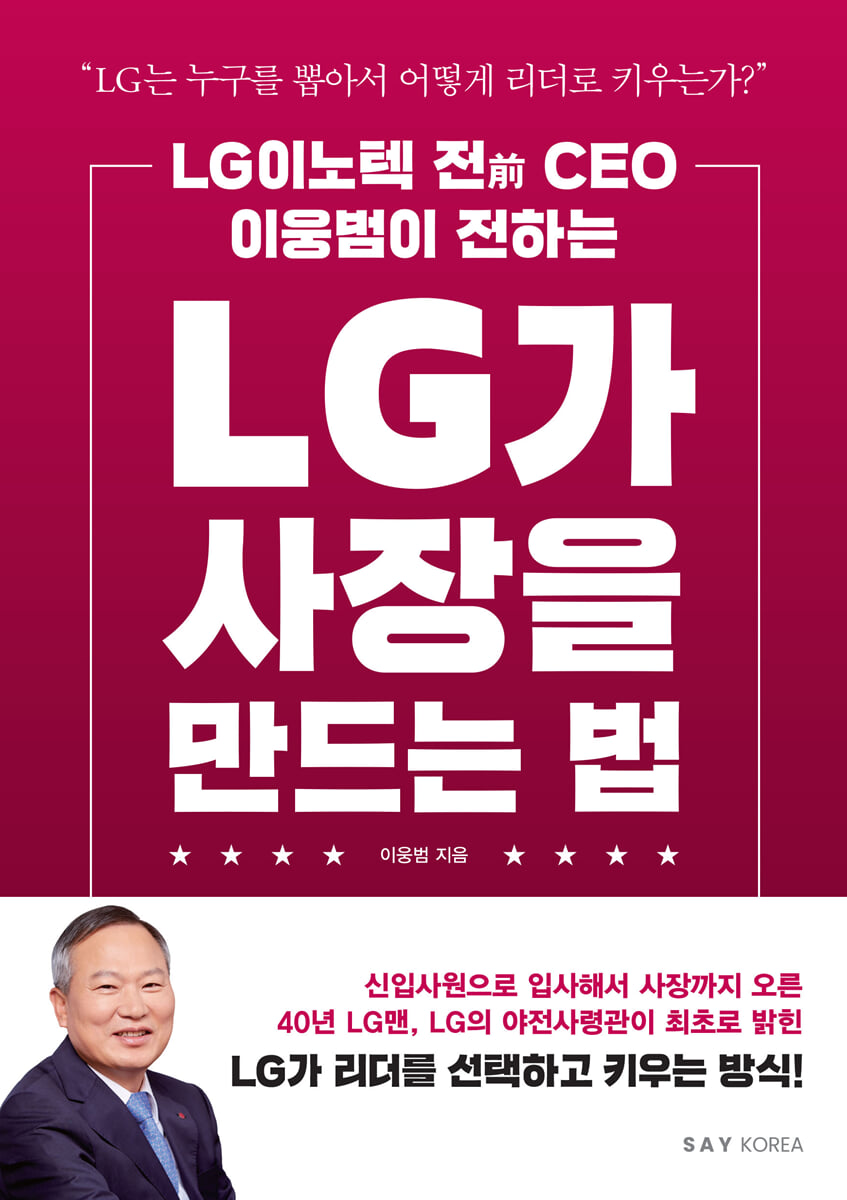
How LG Makes a CEO
 |
Description
Book Introduction
“There is a way to think haphazardly, to pursue goals that seem impossible.”
“The answer to our problem lies in the field.”
“When you are in need, you change, and when you change, you get along.”
“You must be able to nurture to raise, and those who know how to follow also know how to lead.”
...
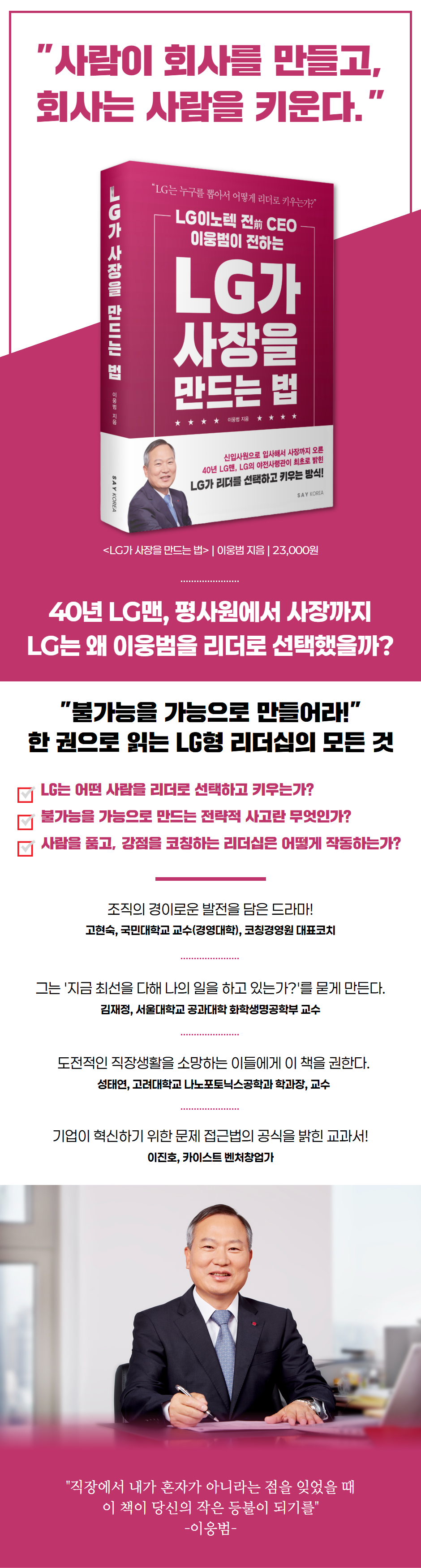
President Lee Woong-beom's growth is the very way LG develops leaders!
Why did LG select a regular employee from a night school and develop him into a leader?
Setting goals that seem impossible and finally achieving them
How is 'LG-style leadership' created?
Loved for his passionate advice based on vivid experience
The revised edition of "How LG Creates a CEO" by former LG Innotek CEO Lee Woong-beom has been published!
If you are curious about the growth formula of those whom LG calls 'leaders',
If you want to know the dedication LG puts into its talent, there's only one book that will answer your question!
Former LG Innotek CEO Lee Woong-beom, a 40-year LG man and a representative figure of LG-type talent, has published a revised edition with richer content to mark the third anniversary of the publication of "How LG Makes a CEO," a book that summarizes LG's talent recruitment and leader development methods.
As organizations' desired leadership requirements have changed significantly from the past, this revised edition contains the core of the new leadership required to meet these changes.
“The answer to our problem lies in the field.”
“When you are in need, you change, and when you change, you get along.”
“You must be able to nurture to raise, and those who know how to follow also know how to lead.”
...
President Lee Woong-beom's growth is the very way LG develops leaders!
Why did LG select a regular employee from a night school and develop him into a leader?
Setting goals that seem impossible and finally achieving them
How is 'LG-style leadership' created?
Loved for his passionate advice based on vivid experience
The revised edition of "How LG Creates a CEO" by former LG Innotek CEO Lee Woong-beom has been published!
If you are curious about the growth formula of those whom LG calls 'leaders',
If you want to know the dedication LG puts into its talent, there's only one book that will answer your question!
Former LG Innotek CEO Lee Woong-beom, a 40-year LG man and a representative figure of LG-type talent, has published a revised edition with richer content to mark the third anniversary of the publication of "How LG Makes a CEO," a book that summarizes LG's talent recruitment and leader development methods.
As organizations' desired leadership requirements have changed significantly from the past, this revised edition contains the core of the new leadership required to meet these changes.
- You can preview some of the book's contents.
Preview
index
Preface to the Revised Edition
Recommendation
Introduction
Chapter 1: Strategic Thinking: Make the Fish Find the Net
Catch a Big Fish: Apple's Large Order
[LG Innovation] There are no labor-management relations at LG.
When gold is booming, they make jeans.
Please stop working
Why Ants Fail to Innovate
[LG's Innovation] 5% is impossible, but 30% is possible.
A shark that doesn't swim is a dead shark.
Chapter 2: Listening: The Answer to the Problem Lies on the Spot
If you think backwards, you can see the path
[LG's Innovation] Accidental Thinking
The answer to our problem lies in the field.
I don't know the head, but I know the fingertips
If you keep your ears open, you'll get rice cakes even while you sleep.
That summer was the hottest in my life
If you're curious about the path ahead, look back.
Chapter 3: Flexible Crisis Management: When times are tough, change, and when change happens, success comes.
A new business in a dilemma
There is no face to be gained in the fight for survival.
I quit smoking, but I can't make a profit.
Juliet visits the Montague family
If necessary, even deceive allies
Fire!
Chapter 4: The Evolution of Leadership: Those Who Know How to Follow Also Know How to Lead
Qualifications of a leader
Followers who help leaders, leaders who nurture followers
[LG Innovation] LG's Entrepreneur Development
Who will become LG's leader?
Who will become LG's talent?
[LG's Innovation] A Quiet Revolution: Breaking Through Purity
Leader Image Evaluation that Changed Me
Chapter 5: The Generosity of Embracing People: You Must Be Able to Embrace to Raise
Chairman Koo Bon-moo: Leadership of Consideration and Encouragement
All of the bosses
Employee performance rewards the family
Sowing the Seeds of the Future
When we work together, we are all equal colleagues
Someday we will meet again
Even parents don't know their children well.
Chapter 6: Leadership from Strength: Leading Your Organization to Strength
What are my strengths?
Strengths Coaching to Transform Your Organization
Building an Engaging Strengths Organization
Work is the happiness of the worker.
Conclusion
supplement
From a Night School Graduate to a CEO
CEO Lee Woong-beom shares his tips for a smart work life.
Recommendation
Introduction
Chapter 1: Strategic Thinking: Make the Fish Find the Net
Catch a Big Fish: Apple's Large Order
[LG Innovation] There are no labor-management relations at LG.
When gold is booming, they make jeans.
Please stop working
Why Ants Fail to Innovate
[LG's Innovation] 5% is impossible, but 30% is possible.
A shark that doesn't swim is a dead shark.
Chapter 2: Listening: The Answer to the Problem Lies on the Spot
If you think backwards, you can see the path
[LG's Innovation] Accidental Thinking
The answer to our problem lies in the field.
I don't know the head, but I know the fingertips
If you keep your ears open, you'll get rice cakes even while you sleep.
That summer was the hottest in my life
If you're curious about the path ahead, look back.
Chapter 3: Flexible Crisis Management: When times are tough, change, and when change happens, success comes.
A new business in a dilemma
There is no face to be gained in the fight for survival.
I quit smoking, but I can't make a profit.
Juliet visits the Montague family
If necessary, even deceive allies
Fire!
Chapter 4: The Evolution of Leadership: Those Who Know How to Follow Also Know How to Lead
Qualifications of a leader
Followers who help leaders, leaders who nurture followers
[LG Innovation] LG's Entrepreneur Development
Who will become LG's leader?
Who will become LG's talent?
[LG's Innovation] A Quiet Revolution: Breaking Through Purity
Leader Image Evaluation that Changed Me
Chapter 5: The Generosity of Embracing People: You Must Be Able to Embrace to Raise
Chairman Koo Bon-moo: Leadership of Consideration and Encouragement
All of the bosses
Employee performance rewards the family
Sowing the Seeds of the Future
When we work together, we are all equal colleagues
Someday we will meet again
Even parents don't know their children well.
Chapter 6: Leadership from Strength: Leading Your Organization to Strength
What are my strengths?
Strengths Coaching to Transform Your Organization
Building an Engaging Strengths Organization
Work is the happiness of the worker.
Conclusion
supplement
From a Night School Graduate to a CEO
CEO Lee Woong-beom shares his tips for a smart work life.
Detailed image
Into the book
“A low target of 5% actually hinders innovative thinking.
That is, if you set a goal of 5%, people will try to achieve the goal by improving existing methods.
However, existing methods have often already reached their limits of improvement.
However, if you try to find a solution using existing methods, you will end up not even achieving the 5% goal.
Conversely, if you set your goal at 50%, you'll realize early on that you can't achieve it with conventional methods and try an innovative approach."
--- p.70
When we predict the future, we tend to think, 'It has changed this way so far, so it must be like this.'
But the world doesn't go as planned.
The unimaginable pace of technological development and the various variables that arise give rise to unexpected events.
It's cruel, but change happens regardless of our current circumstances.
Therefore, to respond to this, we need to continuously develop new ideas that have never been seen before, rather than extending them from reality.
One way to come up with new ideas is through 'accidental thinking'.
…rather than thinking in terms of an extension of the origin, set some point to the right as an ideal goal, and from this point, completely re-examine all current conditions.
When thinking about the ideal, it is important to think about where the big gap is, what needs to be changed to bring reality closer to the ideal, and what other ways to reach the ideal are there.
--- p.91~93
Leaders must understand the difference between ability and competence, knowledge and wisdom.
Competence refers to the qualifications required to perform a job well, such as education, work experience, knowledge, and skills.
In the past, having this ability alone did not hinder achievement.
In fact, in the past, when hiring employees, most HR managers judged them based on visible abilities such as certificates and foreign language scores.
However, in today's rapidly changing business environment, members who are based on ability and possess 'capability' are more helpful.
Competence refers to the power to immediately put one's abilities into action and connect them to results.
In other words, competency is the power to continuously execute differentiated strategies that have a decisive impact on performance.
--- p.175
To ensure that members work with a sense of ownership, they must be allowed to take ownership of their work.
Only when you accept your own work can you have an area where you can fully demonstrate your abilities.
Tasks must be clearly divided and assigned to members.
This is empowerment.
There are important things to consider when assigning work to members.
The point is that each person should be given a job that suits them.
There is a saying that says, "Right person, right job, right place." Work should be assigned according to the person.
This means that you should give the person a job that he or she is good at, a job that suits his or her strengths.
--- p.177
There are four types of members I am reluctant to work with.
People who talk before they act, people who say things can't be done without even trying or offering an alternative, people who care more about themselves than the organization, and people who incite conflict in the organization through gossip.
--- p.183
To systematically develop entrepreneurs, LG selects candidates with a long-term perspective and supports them to acquire the qualities necessary for entrepreneurship.
First, we assess the leadership and competencies necessary to lead an organization as a businessperson. We then provide feedback on strengths and weaknesses. Then, we support them through expanded work experience, mentoring, leadership coaching, and various training programs to enhance their preparedness as businesspeople. LG manages candidates for management positions from every stage of the businessperson development process.
--- p.189
LG divides its leadership styles into four categories.
It is ‘people’-centered, ‘work’-centered, ‘management’-centered, and ‘change’-centered.
The 'people'-centered type is a virtuous type with consideration and tolerance, and the 'work'-centered type is a proactive and driven type with strong drive.
A 'management'-focused leader is described as 'emphasizing risk management through thorough data analysis and meticulous preparation.'
A 'change'-focused leader is described as 'emphasizing risk-taking to seize opportunities even in uncertain or risky situations.'
Which leadership style is better? There's no such thing as superior or inferior.
This is because the leadership style required varies depending on the situation the organization is in.
--- p.193
Despite changes in hiring methods, some things remain constant.
This is the basic virtue or attitude required of any LG man.
This is broadly divided into four categories.
Those who dream and are passionate about challenging themselves to be the best in the world, those who put customers first and strive for constant innovation, those who work autonomously and creatively while fostering teamwork, and those who consistently cultivate their skills and compete fairly.
Each requirement aligns with the leadership evaluation areas of customer value, respect for people, and quality management.
--- p.203
Unlike typical personality or behavioral assessments, the Clifton Strengths Assessment helps us understand what potential already exists in us and how it applies to our lives and work.
As our self-awareness increases, we stop trying to be someone we are not in order to succeed and gain the confidence to be our true selves.
--- p.276
Coaching plays a role in bringing out solutions within the other person through questions like this.
In this respect, coaching differs from teaching.
Coaching is an activity that brings out what is inside, and teaching is an activity that puts knowledge that is outside into the other person.
The expression that coaching 'brings out what's inside the other person' needs to be explained more precisely.
The coach's role is to 'help the other person think and find the solution within themselves' through questions.
--- p.287
"What if I had discovered strengths coaching sooner?" This is a frequent regret I have as a strengths coach.
“Weaknesses never become strengths, but strengths can be developed infinitely.” Strengths coaching begins with this fundamental principle.
If he were a manager who knew strengths coaching, he would have been able to identify the talents of the members he worked with and help them develop their strengths more effectively.
By increasing the employees' work engagement, performance will improve and company life will become happier than before.
That is, if you set a goal of 5%, people will try to achieve the goal by improving existing methods.
However, existing methods have often already reached their limits of improvement.
However, if you try to find a solution using existing methods, you will end up not even achieving the 5% goal.
Conversely, if you set your goal at 50%, you'll realize early on that you can't achieve it with conventional methods and try an innovative approach."
--- p.70
When we predict the future, we tend to think, 'It has changed this way so far, so it must be like this.'
But the world doesn't go as planned.
The unimaginable pace of technological development and the various variables that arise give rise to unexpected events.
It's cruel, but change happens regardless of our current circumstances.
Therefore, to respond to this, we need to continuously develop new ideas that have never been seen before, rather than extending them from reality.
One way to come up with new ideas is through 'accidental thinking'.
…rather than thinking in terms of an extension of the origin, set some point to the right as an ideal goal, and from this point, completely re-examine all current conditions.
When thinking about the ideal, it is important to think about where the big gap is, what needs to be changed to bring reality closer to the ideal, and what other ways to reach the ideal are there.
--- p.91~93
Leaders must understand the difference between ability and competence, knowledge and wisdom.
Competence refers to the qualifications required to perform a job well, such as education, work experience, knowledge, and skills.
In the past, having this ability alone did not hinder achievement.
In fact, in the past, when hiring employees, most HR managers judged them based on visible abilities such as certificates and foreign language scores.
However, in today's rapidly changing business environment, members who are based on ability and possess 'capability' are more helpful.
Competence refers to the power to immediately put one's abilities into action and connect them to results.
In other words, competency is the power to continuously execute differentiated strategies that have a decisive impact on performance.
--- p.175
To ensure that members work with a sense of ownership, they must be allowed to take ownership of their work.
Only when you accept your own work can you have an area where you can fully demonstrate your abilities.
Tasks must be clearly divided and assigned to members.
This is empowerment.
There are important things to consider when assigning work to members.
The point is that each person should be given a job that suits them.
There is a saying that says, "Right person, right job, right place." Work should be assigned according to the person.
This means that you should give the person a job that he or she is good at, a job that suits his or her strengths.
--- p.177
There are four types of members I am reluctant to work with.
People who talk before they act, people who say things can't be done without even trying or offering an alternative, people who care more about themselves than the organization, and people who incite conflict in the organization through gossip.
--- p.183
To systematically develop entrepreneurs, LG selects candidates with a long-term perspective and supports them to acquire the qualities necessary for entrepreneurship.
First, we assess the leadership and competencies necessary to lead an organization as a businessperson. We then provide feedback on strengths and weaknesses. Then, we support them through expanded work experience, mentoring, leadership coaching, and various training programs to enhance their preparedness as businesspeople. LG manages candidates for management positions from every stage of the businessperson development process.
--- p.189
LG divides its leadership styles into four categories.
It is ‘people’-centered, ‘work’-centered, ‘management’-centered, and ‘change’-centered.
The 'people'-centered type is a virtuous type with consideration and tolerance, and the 'work'-centered type is a proactive and driven type with strong drive.
A 'management'-focused leader is described as 'emphasizing risk management through thorough data analysis and meticulous preparation.'
A 'change'-focused leader is described as 'emphasizing risk-taking to seize opportunities even in uncertain or risky situations.'
Which leadership style is better? There's no such thing as superior or inferior.
This is because the leadership style required varies depending on the situation the organization is in.
--- p.193
Despite changes in hiring methods, some things remain constant.
This is the basic virtue or attitude required of any LG man.
This is broadly divided into four categories.
Those who dream and are passionate about challenging themselves to be the best in the world, those who put customers first and strive for constant innovation, those who work autonomously and creatively while fostering teamwork, and those who consistently cultivate their skills and compete fairly.
Each requirement aligns with the leadership evaluation areas of customer value, respect for people, and quality management.
--- p.203
Unlike typical personality or behavioral assessments, the Clifton Strengths Assessment helps us understand what potential already exists in us and how it applies to our lives and work.
As our self-awareness increases, we stop trying to be someone we are not in order to succeed and gain the confidence to be our true selves.
--- p.276
Coaching plays a role in bringing out solutions within the other person through questions like this.
In this respect, coaching differs from teaching.
Coaching is an activity that brings out what is inside, and teaching is an activity that puts knowledge that is outside into the other person.
The expression that coaching 'brings out what's inside the other person' needs to be explained more precisely.
The coach's role is to 'help the other person think and find the solution within themselves' through questions.
--- p.287
"What if I had discovered strengths coaching sooner?" This is a frequent regret I have as a strengths coach.
“Weaknesses never become strengths, but strengths can be developed infinitely.” Strengths coaching begins with this fundamental principle.
If he were a manager who knew strengths coaching, he would have been able to identify the talents of the members he worked with and help them develop their strengths more effectively.
By increasing the employees' work engagement, performance will improve and company life will become happier than before.
--- p.290
Publisher's Review
“Accidental thinking”, “Woo-mun-hyeon-dap”, “When you’re in a difficult situation, you change, and when you change, you get through”…
The mindset and practical principles that create LG-style leadership
“Pursue goals that seem impossible.”
“The answer to our problem lies in the field.”
“He who knows how to follow also knows how to lead.”
These sentences are not just slogans.
This is the mindset and practical principles that permeate LG's leadership, which has risen to become a global leader through constant innovation. LG fosters innovation by setting seemingly impossible goals.
Low goals actually hinder innovation.
When you set a goal that seems difficult to achieve, you find ways to change everything about yourself.
This reverse thinking, which changes the current conditions from the target point, is how LG innovates.
The principle that trials create stronger resilience can be applied not only to how companies achieve innovation, but also to the process of developing managers.
In this way, within LG, there is a person who started out as a rank-and-file employee and rose to the position of president through LG's method.
This is the author of this book, Lee Woong-beom. LG boldly selected Lee Woong-beom, a graduate of a night school, and in the process, he personally embodied the principles of "seeing people, waiting for them, and nurturing them," thereby growing into a leader.
Lee Woong-beom, LG's Field Commander, who led LG Innotek and LG Chem.
Leadership Notes Documenting Moments of Crisis, Transition, and Growth
Former President Lee Woong-beom served as CEO of LG Innotek and LG Chem during the most intense periods of global competitiveness, laying the foundation for their organizations. His leadership was instrumental in LG Innotek's explosive growth, beginning with its supply of camera modules to Apple, and LG Chem's rise to global leadership in the electric vehicle battery market. Throughout his career at LG Group, Lee was known as "LG's Field Commander."
"How LG Creates a CEO" records the countless crises and moments of transition he faced, as well as the "strategic thinking that makes the impossible possible," in the language of the field.
This book contains the methods he used to cope with successive crises, his operational know-how to optimize efficiency, his leadership skills to manage the organization and guide others, the bond he built with his team members while breathing life into the field, and the remarkable achievements he achieved from these experiences.
Why did LG choose Lee Woong-beom as CEO?
The selection criteria and training methods for "LG-type leaders" are revealed for the first time.
LG has focused on nurturing former President Lee Woong-beom within the organization, developing him from an employee to an executive, and then from an executive to a president.
In this book, former CEO Lee Woong-beom reveals for the first time, with real-life examples, what kind of people LG considers talented, what criteria are used to select and evaluate leadership candidates, and what challenges and hurdles lie ahead in developing them into leaders.
He suggests six key qualities that leaders who rise to the top of their careers must possess:
● Strategic thinking that turns the impossible into possible
● An attitude of listening without missing the scene
● Flexible crisis management that overcomes inertia and irrationality
● Changing leadership that knows the balance between when to follow and when to lead
● The generosity to embrace and nurture people
● A weapon forged from your own strengths
These six qualities are the common foundation for creating outstanding leaders in virtually any company or position.
Two key new themes highlighted in the revised edition: coaching leadership and happiness at work.
21st century businesses need new leadership and values!
This revised edition includes two new insights gained by former CEO Lee Woong-beom while coaching various organizations and leaders since his retirement.
One is the ‘power of coaching leadership.’
Coaching leadership focuses on and fosters the strengths of organizational members, and inevitably requires close communication between leaders and members.
When a leader has a narrow perspective, the 10 different strengths of 10 members are mostly useless, but when a leader has an inclusive perspective, the 10 strengths of 10 people can be helpful to the organization as 100 strengths.
Building a strengths-based organizational culture is especially crucial for leaders who must lead the MZ generation, which values communication and has strong individuality.
Another is ‘the meaning of happiness at work.’
It's often said that Generation MZ doesn't find happiness in work, but this is simply a misconception. Generation MZ simply finds happiness in work differently than previous generations.
They feel happy when they feel they are growing in the organization, when they feel their work is meaningful, when they are recognized by their colleagues, and when they feel they are treated fairly.
Therefore, they need leaders who motivate them to find meaning in their work, provide recognition and support, and show them how to grow.
And the only way to demonstrate this kind of leadership is through coaching leadership.
This book offers practical answers to the question of how leaders can foster the growth of their members and lead their organizations to health, especially at a time when companies must consider "workplace happiness."
“I hope this book will be a little light for you when you forget for a moment that you are not alone at work, when you forget that work is about making you happy.”
These words, included by former CEO Lee Woong-beom at the end of the preface to the revised edition, once again demonstrate that the essence of leadership is 'responsibility for people.'
"How LG Creates CEOs" is a book that provides insight and strategy to managers and direction and courage to those who dream of becoming leaders.
If you want to know how LG views people, how it develops them, and how it cultivates them into leaders, this book will provide the answer.
The mindset and practical principles that create LG-style leadership
“Pursue goals that seem impossible.”
“The answer to our problem lies in the field.”
“He who knows how to follow also knows how to lead.”
These sentences are not just slogans.
This is the mindset and practical principles that permeate LG's leadership, which has risen to become a global leader through constant innovation. LG fosters innovation by setting seemingly impossible goals.
Low goals actually hinder innovation.
When you set a goal that seems difficult to achieve, you find ways to change everything about yourself.
This reverse thinking, which changes the current conditions from the target point, is how LG innovates.
The principle that trials create stronger resilience can be applied not only to how companies achieve innovation, but also to the process of developing managers.
In this way, within LG, there is a person who started out as a rank-and-file employee and rose to the position of president through LG's method.
This is the author of this book, Lee Woong-beom. LG boldly selected Lee Woong-beom, a graduate of a night school, and in the process, he personally embodied the principles of "seeing people, waiting for them, and nurturing them," thereby growing into a leader.
Lee Woong-beom, LG's Field Commander, who led LG Innotek and LG Chem.
Leadership Notes Documenting Moments of Crisis, Transition, and Growth
Former President Lee Woong-beom served as CEO of LG Innotek and LG Chem during the most intense periods of global competitiveness, laying the foundation for their organizations. His leadership was instrumental in LG Innotek's explosive growth, beginning with its supply of camera modules to Apple, and LG Chem's rise to global leadership in the electric vehicle battery market. Throughout his career at LG Group, Lee was known as "LG's Field Commander."
"How LG Creates a CEO" records the countless crises and moments of transition he faced, as well as the "strategic thinking that makes the impossible possible," in the language of the field.
This book contains the methods he used to cope with successive crises, his operational know-how to optimize efficiency, his leadership skills to manage the organization and guide others, the bond he built with his team members while breathing life into the field, and the remarkable achievements he achieved from these experiences.
Why did LG choose Lee Woong-beom as CEO?
The selection criteria and training methods for "LG-type leaders" are revealed for the first time.
LG has focused on nurturing former President Lee Woong-beom within the organization, developing him from an employee to an executive, and then from an executive to a president.
In this book, former CEO Lee Woong-beom reveals for the first time, with real-life examples, what kind of people LG considers talented, what criteria are used to select and evaluate leadership candidates, and what challenges and hurdles lie ahead in developing them into leaders.
He suggests six key qualities that leaders who rise to the top of their careers must possess:
● Strategic thinking that turns the impossible into possible
● An attitude of listening without missing the scene
● Flexible crisis management that overcomes inertia and irrationality
● Changing leadership that knows the balance between when to follow and when to lead
● The generosity to embrace and nurture people
● A weapon forged from your own strengths
These six qualities are the common foundation for creating outstanding leaders in virtually any company or position.
Two key new themes highlighted in the revised edition: coaching leadership and happiness at work.
21st century businesses need new leadership and values!
This revised edition includes two new insights gained by former CEO Lee Woong-beom while coaching various organizations and leaders since his retirement.
One is the ‘power of coaching leadership.’
Coaching leadership focuses on and fosters the strengths of organizational members, and inevitably requires close communication between leaders and members.
When a leader has a narrow perspective, the 10 different strengths of 10 members are mostly useless, but when a leader has an inclusive perspective, the 10 strengths of 10 people can be helpful to the organization as 100 strengths.
Building a strengths-based organizational culture is especially crucial for leaders who must lead the MZ generation, which values communication and has strong individuality.
Another is ‘the meaning of happiness at work.’
It's often said that Generation MZ doesn't find happiness in work, but this is simply a misconception. Generation MZ simply finds happiness in work differently than previous generations.
They feel happy when they feel they are growing in the organization, when they feel their work is meaningful, when they are recognized by their colleagues, and when they feel they are treated fairly.
Therefore, they need leaders who motivate them to find meaning in their work, provide recognition and support, and show them how to grow.
And the only way to demonstrate this kind of leadership is through coaching leadership.
This book offers practical answers to the question of how leaders can foster the growth of their members and lead their organizations to health, especially at a time when companies must consider "workplace happiness."
“I hope this book will be a little light for you when you forget for a moment that you are not alone at work, when you forget that work is about making you happy.”
These words, included by former CEO Lee Woong-beom at the end of the preface to the revised edition, once again demonstrate that the essence of leadership is 'responsibility for people.'
"How LG Creates CEOs" is a book that provides insight and strategy to managers and direction and courage to those who dream of becoming leaders.
If you want to know how LG views people, how it develops them, and how it cultivates them into leaders, this book will provide the answer.
GOODS SPECIFICS
- Date of issue: November 25, 2025
- Page count, weight, size: 348 pages | 148*210*30mm
- ISBN13: 9791193239391
- ISBN10: 1193239397
You may also like
카테고리
korean


korean

![GQ KOREA Mark (Monthly): December [2025]](http://librairie.coreenne.fr/cdn/shop/files/8ef265dbbfbf186523ed75ba7319009d.jpg?v=1765340328&width=3840)


