

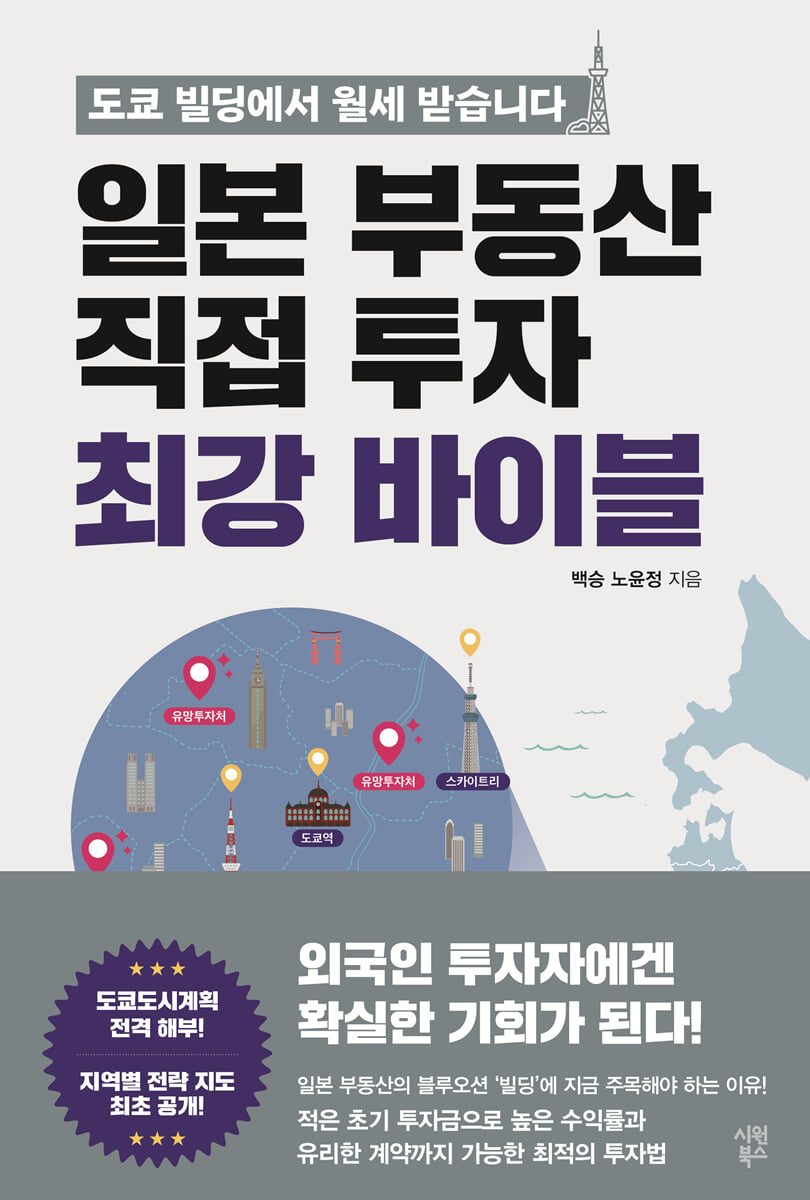
The Ultimate Bible for Direct Investment in Japanese Real Estate
 |
Description
Book Introduction
In 2019, he first invested in Japanese real estate, which had been quiet, and achieved an astonishing profit of 900 million won in just three years.
Japanese professional investor Baek Seung's Tokyo real estate investment strategy!
"This will be a clear opportunity for foreign investors in the future!"
There are clear reasons to look at Japanese real estate now.
This is because, rather than being a 'stable market' where only monthly rent is received, a rising market has already begun where one can simultaneously pursue monthly rent income and capital gains.
With ultra-low interest rates, a weak yen, and explosive tourism demand all at once, Japanese real estate is offering Korean investors a rare opportunity.
"The Japanese Real Estate Direct Investment Bible" specifically targets small commercial buildings that attract less local Japanese capital and are therefore relatively undervalued.
Instead of overheated competition for housing, this investment in buildings offers the benefits of high deposits, landlord-friendly contract structures, and a recovering commercial district, directly demonstrating "why now, why Japan, why buildings?"
This book provides a three-dimensional analysis of Tokyo's core commercial districts and the Tokyo Bay Area, drawing on statistics from the Ministry of Land, Infrastructure, Transport and Tourism, Tokyo's urban planning, and railway and urban regeneration projects. It presents a step-by-step guide for foreign investors on how to target and plan a comprehensive plan from acquisition to operation and exit.
The author is a real-life investor who realized approximately 900 million won in profits in just three years from a commercial-residential building in Tokyo that was built over 30 years ago. This author verifies the full-cycle strategy used throughout the process, from site selection, leasing and remodeling operations, to developer sales, using figures and case studies to provide readers with a highly reliable guide.
Japanese professional investor Baek Seung's Tokyo real estate investment strategy!
"This will be a clear opportunity for foreign investors in the future!"
There are clear reasons to look at Japanese real estate now.
This is because, rather than being a 'stable market' where only monthly rent is received, a rising market has already begun where one can simultaneously pursue monthly rent income and capital gains.
With ultra-low interest rates, a weak yen, and explosive tourism demand all at once, Japanese real estate is offering Korean investors a rare opportunity.
"The Japanese Real Estate Direct Investment Bible" specifically targets small commercial buildings that attract less local Japanese capital and are therefore relatively undervalued.
Instead of overheated competition for housing, this investment in buildings offers the benefits of high deposits, landlord-friendly contract structures, and a recovering commercial district, directly demonstrating "why now, why Japan, why buildings?"
This book provides a three-dimensional analysis of Tokyo's core commercial districts and the Tokyo Bay Area, drawing on statistics from the Ministry of Land, Infrastructure, Transport and Tourism, Tokyo's urban planning, and railway and urban regeneration projects. It presents a step-by-step guide for foreign investors on how to target and plan a comprehensive plan from acquisition to operation and exit.
The author is a real-life investor who realized approximately 900 million won in profits in just three years from a commercial-residential building in Tokyo that was built over 30 years ago. This author verifies the full-cycle strategy used throughout the process, from site selection, leasing and remodeling operations, to developer sales, using figures and case studies to provide readers with a highly reliable guide.
- You can preview some of the book's contents.
Preview
index
Prologue: Rental Income and Capital Gains: Proven Results for Japanese Real Estate Investment
Chapter 1: Let's Get Started with a Good Understanding of Japanese Real Estate
01 Set a profit goal: income gain vs. capital gain
The winds of change that have been blowing through the real estate market since 2020
02 The Crossroads of Investment Strategy: Housing or Commercial Properties?
Why Commercial Real Estate Investment Is Flooding in Korea
Why Housing Investment is a Top Priority in Japan
3 Reasons Why Commercial Real Estate is an Opportunity
03 Management outsourcing is not an option, it is a necessity.
Basic management
Renewal of contract and name
Confirm restoration to original condition upon moving out
Fire inspection and maintenance
High fees are a disadvantage
Top 10 Management Companies in Tokyo
Chapter 2: Japan's Commercial Buildings: Unfolding the Map of Opportunity
01 The world of Japanese buildings, different from that of Korea
Why Tokyo's Buildings Can Get Taller
Is it also effective for commercial use with limited land?
02 Pros and Cons of Each Building Type: Where to Invest
What are the types of real estate investments in Japan and Korea?
What are the appeals of mixed-use rental housing, a commercial-residential complex?
03 Tokyo Commercial Building Investment Strategies Based on Location
Demand, operational strategy, and transportation network that determine location
How to understand Japan's real estate landscape
04 Recommended Areas to Read with Policy
First, see Tokyo's future and invest in it in advance.
Second, pay attention to the changes in the railways connecting the country.
Third, let's look at the major routes narrowed down to Tokyo.
05 Profit Map Created by Railway Lines
Tokyo, a city densely connected to the center
A faster national transportation network
Case Study 06 - Tokyo Bay, the Hottest Stage
The significance of the Tokyo Bay Area
Changes in price increase that can be confirmed through public notice
The biggest weakness is natural disasters
Chapter 3: My First Japanese Real Estate Investment Management Story
01 An Unexpected Crisis: The Coronavirus Outbreak
In the early days, when I didn't know much about Japanese business culture,
The coronavirus crisis began simultaneously with the building's purchase.
02 Fighting Vacancy and Developing Countermeasures
The first step to dealing with vacancies is facing reality.
I asked the local Japanese person in charge for his opinion.
Deciding to Reform Despite Concerns
How much did it cost to remodel?
Successfully increased profitability by 10% through reform
03 Successful Renewal! The Secret to Raising Your Rent
A fresh perspective on raising rents
A win-win situation with a new tenant
04 Receive an unexpected sale offer
The Korean real estate market moved in the opposite direction to Japan's.
Why I hesitated to sell the building
The value of space is being rekindled after the pandemic.
05 A sales strategy that achieved 150% returns in 3 years
Developers who build bigger and better buildings with their capital
The value of land revealed in the case of Azabu Dai Hills
The basis for price negotiations is "what comes next after investment."
Good real estate is the first thing others come to ask to sell.
A new goal I found through selling
Chapter 4: A New Perspective on the Second Investment
01 Re-establishing the listing criteria
Start looking for new investment opportunities in Japan
In a rising market, you have to act quickly.
02 Changes felt on the ground, the vitality of the tourism industry
Checking the vitality of the tourism industry on site
It is forbidden to always look at things positively.
03 A newly visible commercial building
A new form of real estate catches the eye
The vacancy rate you need to be most careful about
Deciding on a second investment in a commercial building
Commercial real estate is all about people moving through it.
Chapter 5: Investment know-how to create profits, capital gains, and even a life plan with a single building
01 The Secret to Increasing Value, Value Up
Reform Value-Up that Brings Immediate Change to Profits
Developers' development value-up strategy to maximize the potential value of real estate.
Be a smart investor who aims for both.
02 From purchase to sale, the flow of execution
The first step to investing in overseas real estate
Ultimately, the most important difference comes from here.
Don't study real estate, do it.
03 Who Will Buy: Selling Strategy
How to Find Properties That Will Appreciate Over Time
Think from the perspectives of end users, investors, and developers.
Let's not forget the criterion of nationality.
04 The Impact of Exchange Rates on Investment
Income-generating real estate: How to beat exchange rates
How to Interpret Exchange Rates to Help You Invest
05 A long-term strategy that considers both investment and migration.
Can Real Estate Investment Help You Immigrate?
Two important criteria to consider
Summary of key tables and data in the text
The power to choose, move forward, and ultimately grow
Chapter 1: Let's Get Started with a Good Understanding of Japanese Real Estate
01 Set a profit goal: income gain vs. capital gain
The winds of change that have been blowing through the real estate market since 2020
02 The Crossroads of Investment Strategy: Housing or Commercial Properties?
Why Commercial Real Estate Investment Is Flooding in Korea
Why Housing Investment is a Top Priority in Japan
3 Reasons Why Commercial Real Estate is an Opportunity
03 Management outsourcing is not an option, it is a necessity.
Basic management
Renewal of contract and name
Confirm restoration to original condition upon moving out
Fire inspection and maintenance
High fees are a disadvantage
Top 10 Management Companies in Tokyo
Chapter 2: Japan's Commercial Buildings: Unfolding the Map of Opportunity
01 The world of Japanese buildings, different from that of Korea
Why Tokyo's Buildings Can Get Taller
Is it also effective for commercial use with limited land?
02 Pros and Cons of Each Building Type: Where to Invest
What are the types of real estate investments in Japan and Korea?
What are the appeals of mixed-use rental housing, a commercial-residential complex?
03 Tokyo Commercial Building Investment Strategies Based on Location
Demand, operational strategy, and transportation network that determine location
How to understand Japan's real estate landscape
04 Recommended Areas to Read with Policy
First, see Tokyo's future and invest in it in advance.
Second, pay attention to the changes in the railways connecting the country.
Third, let's look at the major routes narrowed down to Tokyo.
05 Profit Map Created by Railway Lines
Tokyo, a city densely connected to the center
A faster national transportation network
Case Study 06 - Tokyo Bay, the Hottest Stage
The significance of the Tokyo Bay Area
Changes in price increase that can be confirmed through public notice
The biggest weakness is natural disasters
Chapter 3: My First Japanese Real Estate Investment Management Story
01 An Unexpected Crisis: The Coronavirus Outbreak
In the early days, when I didn't know much about Japanese business culture,
The coronavirus crisis began simultaneously with the building's purchase.
02 Fighting Vacancy and Developing Countermeasures
The first step to dealing with vacancies is facing reality.
I asked the local Japanese person in charge for his opinion.
Deciding to Reform Despite Concerns
How much did it cost to remodel?
Successfully increased profitability by 10% through reform
03 Successful Renewal! The Secret to Raising Your Rent
A fresh perspective on raising rents
A win-win situation with a new tenant
04 Receive an unexpected sale offer
The Korean real estate market moved in the opposite direction to Japan's.
Why I hesitated to sell the building
The value of space is being rekindled after the pandemic.
05 A sales strategy that achieved 150% returns in 3 years
Developers who build bigger and better buildings with their capital
The value of land revealed in the case of Azabu Dai Hills
The basis for price negotiations is "what comes next after investment."
Good real estate is the first thing others come to ask to sell.
A new goal I found through selling
Chapter 4: A New Perspective on the Second Investment
01 Re-establishing the listing criteria
Start looking for new investment opportunities in Japan
In a rising market, you have to act quickly.
02 Changes felt on the ground, the vitality of the tourism industry
Checking the vitality of the tourism industry on site
It is forbidden to always look at things positively.
03 A newly visible commercial building
A new form of real estate catches the eye
The vacancy rate you need to be most careful about
Deciding on a second investment in a commercial building
Commercial real estate is all about people moving through it.
Chapter 5: Investment know-how to create profits, capital gains, and even a life plan with a single building
01 The Secret to Increasing Value, Value Up
Reform Value-Up that Brings Immediate Change to Profits
Developers' development value-up strategy to maximize the potential value of real estate.
Be a smart investor who aims for both.
02 From purchase to sale, the flow of execution
The first step to investing in overseas real estate
Ultimately, the most important difference comes from here.
Don't study real estate, do it.
03 Who Will Buy: Selling Strategy
How to Find Properties That Will Appreciate Over Time
Think from the perspectives of end users, investors, and developers.
Let's not forget the criterion of nationality.
04 The Impact of Exchange Rates on Investment
Income-generating real estate: How to beat exchange rates
How to Interpret Exchange Rates to Help You Invest
05 A long-term strategy that considers both investment and migration.
Can Real Estate Investment Help You Immigrate?
Two important criteria to consider
Summary of key tables and data in the text
The power to choose, move forward, and ultimately grow
Publisher's Review
Japanese real estate is shifting from a profit-driven to a price-based model. Why now is the time.
Japanese real estate has long been perceived as a profit-oriented market focused on 'income gains (monthly rental income).'
However, starting in 2013, land prices began to rise again, and starting in 2022, a full-scale upward trend will unfold, centered around Tokyo, regardless of whether it is new or existing construction.
With low interest rates, a weak yen, an influx of foreign capital, and an explosive recovery in tourism, the Japanese real estate market is no longer focused solely on monthly rents.
The author, based on his experience of generating monthly rental income by taking advantage of low fixed interest rates and the weak yen, and even realizing capital gains by selling during a bull market, says that the goal for Japanese real estate should be set at "50% income gain and 50% capital gain."
This book provides a guide, using data and real-world examples, to illustrate the new opportunities in Japanese real estate, open to foreign investors, in the booming market that will unfold after 2022.
Why a commercial "mini-building" instead of a residential one?
The main character of the real estate corner of Japanese bookstores is still 'Ildong Apartment (Ildong Mansion)'.
With a high proportion of single-person households and steady demand for housing, housing remains the most familiar investment target for Japanese investors, with low vacancy risk.
So, in the real market, housing stock sells out quickly, but commercial buildings face relatively less competition.
The author sees this point as a 'niche' given to Korean investors.
The book compares residential and commercial properties by dividing them into deposits, lease types, repairs and restorations, and tax and profit structures.
Even for a building with the same monthly rent of 100 million yen, the deposit and repayment amount for a residential building is around 3 million yen, while for a commercial building, the deposit alone can be as much as 10 million yen. This structure is shown in actual numbers, and it explains that this deposit is a powerful leverage that reduces the initial equity capital.
It also provides examples of how landlords' re-rental and eviction strategies are designed to be much more advantageous.
With the number of tourists hitting record highs since the pandemic, and downtown and tourist areas rapidly reviving, the author emphasizes that "the real opportunity in Japan right now lies not in residential buildings, but in small commercial buildings."
Beyond Tokyo's Five Wards: A Location Strategy Through Policy, Railways, and Urban Regeneration
The author, who was preparing for his first investment, like other investors, focused only on the five wards of Tokyo (Chiyoda, Chuo, Minato, Shinjuku, and Shibuya).
However, after going through the process of purchasing, operating, and selling my first building nearly 30 years ago, I was able to broaden my horizons to all of Tokyo when looking for a second property.
Because it was a commercial building, expansion was possible.
The greatest strength of this book is that the author's field experience and data analysis are combined with a structural perspective on "Tokyo urban planning, policy, railway network, and urban regeneration."
Based on data from the Japanese Ministry of Land, Infrastructure, Transport and Tourism and Tokyo Metropolitan City Planning Documents,
- Large-scale redevelopment and zoning changes that will change Tokyo's future
- Transportation infrastructure plans, including a nationwide railway network, Shinkansen extension, and Haneda Airport Access Line.
- Changes to key routes that densely connect downtown Tokyo and its surrounding areas.
It analyzes the area in three dimensions and shows you on a map which area you should enter.
Through the strategic maps and data produced by the author, you can see a location analysis method that goes beyond simply saying "which neighborhood is hot" and reads policy, railway, and demand structures together.
This 30-year-old building's operational know-how helped it navigate pandemic vacancies and raise rents by 10%.
The author's first building was not a new construction, but a commercial-residential building that had been completed over 30 years ago.
According to Japanese real estate regulations, the sale price drops over time, and due to the COVID-19 outbreak right after the purchase in 2019, I was unable to go to Japan and had to resolve vacancies and various other issues remotely.
This book specifically discloses the operational know-how accumulated during the process of overcoming this crisis.
This book explains, through real-life examples, the management outsourcing structure and Japanese-style leasing practices, the division of responsibilities with local management companies for contract renewals, evictions, restoration checks, fire inspections, and facility maintenance, as well as the reform strategy that was attempted despite opposition from management companies because it was a foreign investor.
In particular, the author's process of renovating the second and fourth floors and putting them on the market at a higher monthly rent, thereby increasing the yield by approximately 10%, provides practical implications for overseas investors.
The Japanese manager said, "It's not a good fit for the market," but the author pushed forward with his experience in Korea and his conviction in the "demand for slightly cleaner, better-maintained spaces," and as a result, he succeeded by precisely exploiting a gap in the real estate market.
This book shows how to turn the weakness of being a foreign investor into an advantage by reading demand and positions that local investors cannot see.
The Japanese real estate landscape is designed to be sold, not just bought and held.
Many investors only think about buying and operating, leaving selling for 'when the time is right'.
However, the author says that foreign investors' investment in Japanese real estate ultimately ends with an 'exit.'
The most dramatic scene in the book is how he sold his first building, purchased in 2019, to a downtown Tokyo developer for a profit of about 150% in just three years.
From the beginning, the author calculated a structure that would be successful when reselling the property by looking at the building's exterior and structure, the land shape and road access, and the floor area ratio and building coverage ratio. As a result, the property caught the eye of a developer who was looking for a site with development potential, and negotiations that started with a single email led to a profit of 900 million won.
In the final chapter, the author presents a framework for analyzing real estate simultaneously from three perspectives: end users, investors, and developers.
Before purchasing, it is necessary to check whether the property is 'good to live in' for the end user, 'how well it is being managed' for the investor, and 'how much more can it be grown' for the developer, so that when it comes time to sell, someone can create a building that they are willing to pay a higher price for.
The final message of this book is not simply a dream of "buying a building in Japan," but a long-term strategy that encompasses profits, market prices, and even life planning.
Japanese real estate has long been perceived as a profit-oriented market focused on 'income gains (monthly rental income).'
However, starting in 2013, land prices began to rise again, and starting in 2022, a full-scale upward trend will unfold, centered around Tokyo, regardless of whether it is new or existing construction.
With low interest rates, a weak yen, an influx of foreign capital, and an explosive recovery in tourism, the Japanese real estate market is no longer focused solely on monthly rents.
The author, based on his experience of generating monthly rental income by taking advantage of low fixed interest rates and the weak yen, and even realizing capital gains by selling during a bull market, says that the goal for Japanese real estate should be set at "50% income gain and 50% capital gain."
This book provides a guide, using data and real-world examples, to illustrate the new opportunities in Japanese real estate, open to foreign investors, in the booming market that will unfold after 2022.
Why a commercial "mini-building" instead of a residential one?
The main character of the real estate corner of Japanese bookstores is still 'Ildong Apartment (Ildong Mansion)'.
With a high proportion of single-person households and steady demand for housing, housing remains the most familiar investment target for Japanese investors, with low vacancy risk.
So, in the real market, housing stock sells out quickly, but commercial buildings face relatively less competition.
The author sees this point as a 'niche' given to Korean investors.
The book compares residential and commercial properties by dividing them into deposits, lease types, repairs and restorations, and tax and profit structures.
Even for a building with the same monthly rent of 100 million yen, the deposit and repayment amount for a residential building is around 3 million yen, while for a commercial building, the deposit alone can be as much as 10 million yen. This structure is shown in actual numbers, and it explains that this deposit is a powerful leverage that reduces the initial equity capital.
It also provides examples of how landlords' re-rental and eviction strategies are designed to be much more advantageous.
With the number of tourists hitting record highs since the pandemic, and downtown and tourist areas rapidly reviving, the author emphasizes that "the real opportunity in Japan right now lies not in residential buildings, but in small commercial buildings."
Beyond Tokyo's Five Wards: A Location Strategy Through Policy, Railways, and Urban Regeneration
The author, who was preparing for his first investment, like other investors, focused only on the five wards of Tokyo (Chiyoda, Chuo, Minato, Shinjuku, and Shibuya).
However, after going through the process of purchasing, operating, and selling my first building nearly 30 years ago, I was able to broaden my horizons to all of Tokyo when looking for a second property.
Because it was a commercial building, expansion was possible.
The greatest strength of this book is that the author's field experience and data analysis are combined with a structural perspective on "Tokyo urban planning, policy, railway network, and urban regeneration."
Based on data from the Japanese Ministry of Land, Infrastructure, Transport and Tourism and Tokyo Metropolitan City Planning Documents,
- Large-scale redevelopment and zoning changes that will change Tokyo's future
- Transportation infrastructure plans, including a nationwide railway network, Shinkansen extension, and Haneda Airport Access Line.
- Changes to key routes that densely connect downtown Tokyo and its surrounding areas.
It analyzes the area in three dimensions and shows you on a map which area you should enter.
Through the strategic maps and data produced by the author, you can see a location analysis method that goes beyond simply saying "which neighborhood is hot" and reads policy, railway, and demand structures together.
This 30-year-old building's operational know-how helped it navigate pandemic vacancies and raise rents by 10%.
The author's first building was not a new construction, but a commercial-residential building that had been completed over 30 years ago.
According to Japanese real estate regulations, the sale price drops over time, and due to the COVID-19 outbreak right after the purchase in 2019, I was unable to go to Japan and had to resolve vacancies and various other issues remotely.
This book specifically discloses the operational know-how accumulated during the process of overcoming this crisis.
This book explains, through real-life examples, the management outsourcing structure and Japanese-style leasing practices, the division of responsibilities with local management companies for contract renewals, evictions, restoration checks, fire inspections, and facility maintenance, as well as the reform strategy that was attempted despite opposition from management companies because it was a foreign investor.
In particular, the author's process of renovating the second and fourth floors and putting them on the market at a higher monthly rent, thereby increasing the yield by approximately 10%, provides practical implications for overseas investors.
The Japanese manager said, "It's not a good fit for the market," but the author pushed forward with his experience in Korea and his conviction in the "demand for slightly cleaner, better-maintained spaces," and as a result, he succeeded by precisely exploiting a gap in the real estate market.
This book shows how to turn the weakness of being a foreign investor into an advantage by reading demand and positions that local investors cannot see.
The Japanese real estate landscape is designed to be sold, not just bought and held.
Many investors only think about buying and operating, leaving selling for 'when the time is right'.
However, the author says that foreign investors' investment in Japanese real estate ultimately ends with an 'exit.'
The most dramatic scene in the book is how he sold his first building, purchased in 2019, to a downtown Tokyo developer for a profit of about 150% in just three years.
From the beginning, the author calculated a structure that would be successful when reselling the property by looking at the building's exterior and structure, the land shape and road access, and the floor area ratio and building coverage ratio. As a result, the property caught the eye of a developer who was looking for a site with development potential, and negotiations that started with a single email led to a profit of 900 million won.
In the final chapter, the author presents a framework for analyzing real estate simultaneously from three perspectives: end users, investors, and developers.
Before purchasing, it is necessary to check whether the property is 'good to live in' for the end user, 'how well it is being managed' for the investor, and 'how much more can it be grown' for the developer, so that when it comes time to sell, someone can create a building that they are willing to pay a higher price for.
The final message of this book is not simply a dream of "buying a building in Japan," but a long-term strategy that encompasses profits, market prices, and even life planning.
GOODS SPECIFICS
- Date of issue: November 26, 2025
- Page count, weight, size: 240 pages | 152*225*20mm
- ISBN13: 9791175500372
- ISBN10: 1175500372
You may also like
카테고리
korean


korean

![GQ KOREA Mark (Monthly): December [2025]](http://librairie.coreenne.fr/cdn/shop/files/8ef265dbbfbf186523ed75ba7319009d.jpg?v=1765340328&width=3840)


