

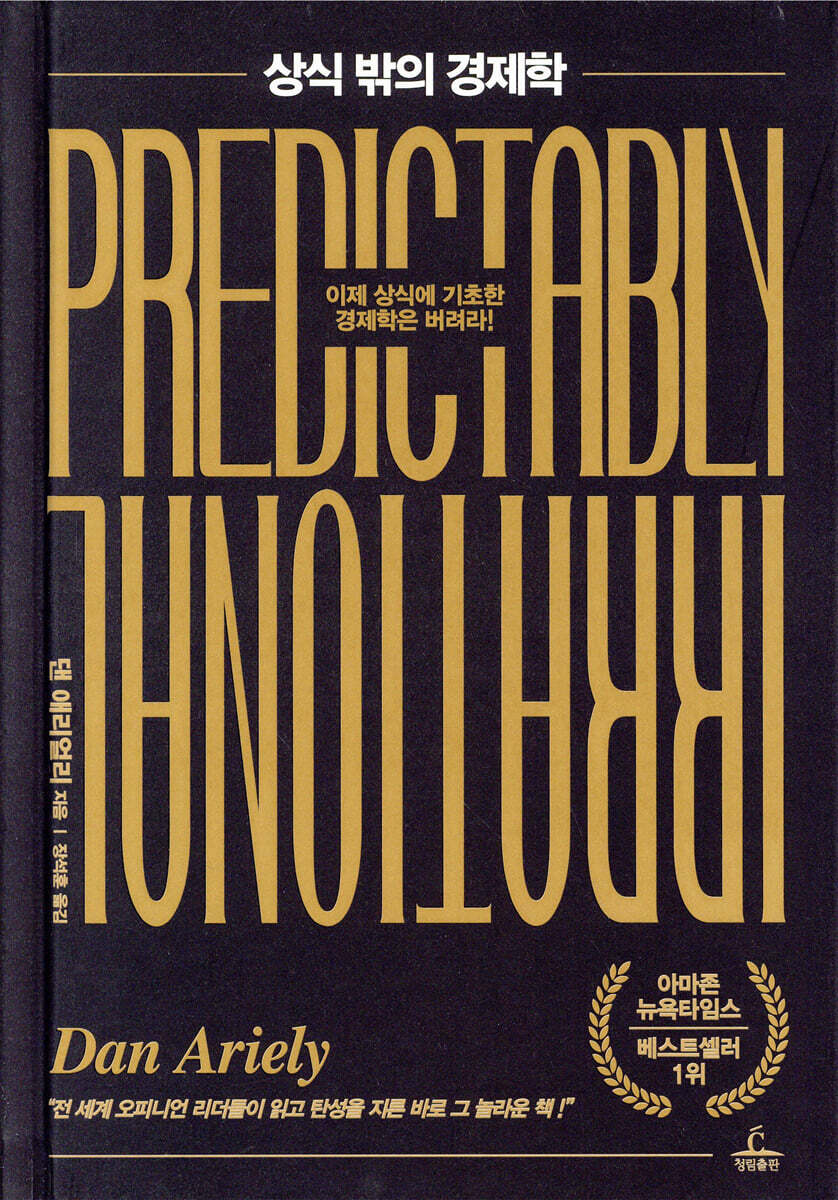
10th Anniversary Edition of Economics Beyond Common Sense
 |
Description
Book Introduction
The Copernican Revolution in Economics: The Decade That Followed
"Unconventional Economics," which became the bible of behavioral economics, shook up the economics world when it was published, with praise saying, "It will be the most influential book of the year."
Professor Dan Ariely, the author of this book, argued for human irrationality, saying of the 2008 financial market crash, “We are a prime example of evidence of irrationality.”
How have we changed in the ten years since then? Has the world become a little more rational? In his preface to the 10th-anniversary Korean edition of "Unconventional Economics," Professor Dan Ariely states, "Unfortunately, the world doesn't seem to be moving in a rational direction," reaffirming the importance of our surroundings.
The fundamental premise of the capitalist system that currently dominates the world is that 'humans are rational beings, and the market moves on its own by these rational humans.'
However, if the author's argument is correct, this premise is shattered.
This is the moment when the fatal flaws of capitalism are exposed.
In fact, the author's argument is currently being proven to be valid.
Therefore, in the current situation where the existing system must be torn down and a new economic system established in its place, the new arguments presented in this book are bound to be more persuasive.
Sparkling with both wit and sharp insight, "Economics Beyond Common Sense" offers a completely new economics approach that will replace conventional economics, offering a fresh alternative to the economics profession navigating a sea of confusion and uncertainty.
This is a must-read for any businessperson who must create new strategies in times of crisis.
"Unconventional Economics," which became the bible of behavioral economics, shook up the economics world when it was published, with praise saying, "It will be the most influential book of the year."
Professor Dan Ariely, the author of this book, argued for human irrationality, saying of the 2008 financial market crash, “We are a prime example of evidence of irrationality.”
How have we changed in the ten years since then? Has the world become a little more rational? In his preface to the 10th-anniversary Korean edition of "Unconventional Economics," Professor Dan Ariely states, "Unfortunately, the world doesn't seem to be moving in a rational direction," reaffirming the importance of our surroundings.
The fundamental premise of the capitalist system that currently dominates the world is that 'humans are rational beings, and the market moves on its own by these rational humans.'
However, if the author's argument is correct, this premise is shattered.
This is the moment when the fatal flaws of capitalism are exposed.
In fact, the author's argument is currently being proven to be valid.
Therefore, in the current situation where the existing system must be torn down and a new economic system established in its place, the new arguments presented in this book are bound to be more persuasive.
Sparkling with both wit and sharp insight, "Economics Beyond Common Sense" offers a completely new economics approach that will replace conventional economics, offering a fresh alternative to the economics profession navigating a sea of confusion and uncertainty.
This is a must-read for any businessperson who must create new strategies in times of crisis.
- You can preview some of the book's contents.
Preview
index
Preface to the 10th Anniversary of the Korean Edition of "Economics Beyond Common Sense"
To Korean readers
preface
Chapter 1 People love to compare
We live by fishing every day / The surprising effect of one bait / Are you even selective in your comparisons? / George Clooney or Brad Pitt, which one do you choose? / What's the use if you're not better than others! / Break the cycle of comparison
Chapter 2: Everything is decided by first impressions.
The Law of Little Goslings, Which Also Apply to Humans / The Influence of Anchors on Purchasing Decisions / How Much Does Noise Cost? / First Impressions Last / Why We're So Enthusiastic About Expensive Starbucks / Even Play Becomes Work the Moment You Get Paid / An Unreflective Life Is Not Worth Living / Do Supply and Demand Determine Market Prices? / What if Economic Policy Were Considering Human Characteristics?
Chapter 3: Free is the most expensive
The Interesting History of Zero / The Paralyzing Allure of Free / Why Did You Choose Something You Didn't Really Need? / Are You Sure You Won't Be Swayed by Freebies? / The Deadly Trap of Freebies / Use Freebie Strategies
Chapter 4: Things Money Can't Solve
The most expensive sex is sex without money / I'd rather not take money than get a cheap one! / What would happen if you gave gifts instead of cash? / Don't talk about food expenses in front of your loved ones / Imposing fines is also an issue to consider / The delicate balance between social norms and market rules / What if you gave special rewards to employees who worked hard? / To create a happy workplace where people work with enthusiasm / You can't buy a sense of mission with money / Seeing the future at Burning Man, the imagination powerhouse in the desert
Chapter 5: How to Deal with Your Inner Dr. Jekyll and Mr. Hyde
How do sexual impulses affect decision-making? / Studying sex, still taboo / Roy participates in the experiment / Shocking results from the sexual impulse experiment / Dr. Jekyll and Mr. Hyde live inside me / Save yourself from impulses / Acknowledge the Mr. Hyde inside me
Chapter 6: Why We Fail at Diets
Why do we always put off important tasks? / How to overcome the habit of procrastination / Use self-control tools / Ordering a health checkup is as simple as ordering a hamburger / If there was a credit card that helped me control my spending
Chapter 7: Memories are also included
The different dreams of the haves and have-nots / Three irrational habits born of the sense of ownership / The peculiarity of thinking you already own something / Even if there is something you want to buy, keep a distance between yourself and it
Chapter 8: I Can't Give Up Anything
People who are obsessed with other possibilities / When the door of possibility is large, the problem is simple / Loss cannot be tolerated / Everyone has a door, big or small, that must be closed decisively / What we miss while looking at other doors
Chapter 9: The Impact of Stereotypes on Judgment
The Truth Revealed in the Beer Experiment / How About a Cup of Paprika Coffee? / The Before and After of Knowing Information Are 180 Degrees Different / The Higher Your Expectations, the Better Your Food Tastes / Marketing Can Change Our Satisfaction / The Terrifying Power of Stereotypes / Conflict Resolution Made Easy by the Absence of Prior Information
Chapter 10: The Power of the Mind to Heal Disease
Do I really need surgery? / Do you know about the ointment made from mummies? / Your condition can improve just by the sincerity shown by a doctor. / Are expensive drugs more effective? / Cheap is not always a good deal. / Is it simple psychology or scientific treatment? / Consider the opportunity cost of placebo experiments.
Chapter 11: On Our Honesty
The irresistible temptation to cheat / Cheating is not done out of thin air / People who turn a blind eye to petty wrongdoing / The problem of enforcing honesty / The power of the Ten Commandments / Signs of corruption everywhere / Remember your oath to professional ethics / Solutions and remaining problems for an honest society
Chapter 12: The Difference Between Having Money and Not Having Money
Pen works, but money doesn't? / We can all be shameless / Things that lead us astray / Money is being stolen without us knowing / How can we stop corruption when cash disappears?
Chapter 13: Beer and Free Lunch
My beer has to be different! / Which one would you choose? / Revise your perspective on human nature / The key to a free lunch is that everyone benefits / The infinite puzzle of human behavior
To Korean readers
preface
Chapter 1 People love to compare
We live by fishing every day / The surprising effect of one bait / Are you even selective in your comparisons? / George Clooney or Brad Pitt, which one do you choose? / What's the use if you're not better than others! / Break the cycle of comparison
Chapter 2: Everything is decided by first impressions.
The Law of Little Goslings, Which Also Apply to Humans / The Influence of Anchors on Purchasing Decisions / How Much Does Noise Cost? / First Impressions Last / Why We're So Enthusiastic About Expensive Starbucks / Even Play Becomes Work the Moment You Get Paid / An Unreflective Life Is Not Worth Living / Do Supply and Demand Determine Market Prices? / What if Economic Policy Were Considering Human Characteristics?
Chapter 3: Free is the most expensive
The Interesting History of Zero / The Paralyzing Allure of Free / Why Did You Choose Something You Didn't Really Need? / Are You Sure You Won't Be Swayed by Freebies? / The Deadly Trap of Freebies / Use Freebie Strategies
Chapter 4: Things Money Can't Solve
The most expensive sex is sex without money / I'd rather not take money than get a cheap one! / What would happen if you gave gifts instead of cash? / Don't talk about food expenses in front of your loved ones / Imposing fines is also an issue to consider / The delicate balance between social norms and market rules / What if you gave special rewards to employees who worked hard? / To create a happy workplace where people work with enthusiasm / You can't buy a sense of mission with money / Seeing the future at Burning Man, the imagination powerhouse in the desert
Chapter 5: How to Deal with Your Inner Dr. Jekyll and Mr. Hyde
How do sexual impulses affect decision-making? / Studying sex, still taboo / Roy participates in the experiment / Shocking results from the sexual impulse experiment / Dr. Jekyll and Mr. Hyde live inside me / Save yourself from impulses / Acknowledge the Mr. Hyde inside me
Chapter 6: Why We Fail at Diets
Why do we always put off important tasks? / How to overcome the habit of procrastination / Use self-control tools / Ordering a health checkup is as simple as ordering a hamburger / If there was a credit card that helped me control my spending
Chapter 7: Memories are also included
The different dreams of the haves and have-nots / Three irrational habits born of the sense of ownership / The peculiarity of thinking you already own something / Even if there is something you want to buy, keep a distance between yourself and it
Chapter 8: I Can't Give Up Anything
People who are obsessed with other possibilities / When the door of possibility is large, the problem is simple / Loss cannot be tolerated / Everyone has a door, big or small, that must be closed decisively / What we miss while looking at other doors
Chapter 9: The Impact of Stereotypes on Judgment
The Truth Revealed in the Beer Experiment / How About a Cup of Paprika Coffee? / The Before and After of Knowing Information Are 180 Degrees Different / The Higher Your Expectations, the Better Your Food Tastes / Marketing Can Change Our Satisfaction / The Terrifying Power of Stereotypes / Conflict Resolution Made Easy by the Absence of Prior Information
Chapter 10: The Power of the Mind to Heal Disease
Do I really need surgery? / Do you know about the ointment made from mummies? / Your condition can improve just by the sincerity shown by a doctor. / Are expensive drugs more effective? / Cheap is not always a good deal. / Is it simple psychology or scientific treatment? / Consider the opportunity cost of placebo experiments.
Chapter 11: On Our Honesty
The irresistible temptation to cheat / Cheating is not done out of thin air / People who turn a blind eye to petty wrongdoing / The problem of enforcing honesty / The power of the Ten Commandments / Signs of corruption everywhere / Remember your oath to professional ethics / Solutions and remaining problems for an honest society
Chapter 12: The Difference Between Having Money and Not Having Money
Pen works, but money doesn't? / We can all be shameless / Things that lead us astray / Money is being stolen without us knowing / How can we stop corruption when cash disappears?
Chapter 13: Beer and Free Lunch
My beer has to be different! / Which one would you choose? / Revise your perspective on human nature / The key to a free lunch is that everyone benefits / The infinite puzzle of human behavior
Into the book
Why do we promise ourselves we'll go on a diet every day? Then, when dessert catches our eye, the thought vanishes? Why do we indulge in impulse buying of things we don't really need? Why does a 5-cent aspirin still give us a headache, while a 50-cent aspirin instantly clears it up? There are also things like this.
When we are asked if we know what the Ten Commandments are, an honest answer comes out faster than a painful lie.
The fact that work ethics regulations actually reduce corruption in the workplace is a phenomenon in the same vein.
Why Does This Happen? _p.7 「Introduction」
Let's say you're single.
How can you impress attractive potential dates at your upcoming singles meetup? My advice is to bring a friend who shares your basic physical characteristics—hair color, body type, facial features—but is a bit less attractive.
Why? Because people can easily judge how good you are when they have someone to compare you to.
If you can compare yourself to a decoy friend who looks like you, you will not only look better compared to that decoy friend, but you will also look better compared to everyone else in the room.
_p.
42 "People love to compare."
As we move up the consumption curve, where paying more for coffee becomes the norm, other changes become easier to make.
Your coffee choices shift from a small cup for $2.20 to a medium cup for $3.50, or a large cup for $4.15.
Even if you don't know how you got into the expensive price range, I think it's very rational to drink a lot of coffee at a relatively expensive price.
Then, you will move horizontally to other Starbucks menu items such as Cafe Americano, Cafe Misto, Macchiato, and Frappuccino.
If you stop and reflect on yourself for a moment, you might not understand why you spend so much money at Starbucks instead of getting a cheaper coffee at Dunkin' Donuts or a free coffee at the office.
But no one is worried about that.
Since I've already decided to drink there several times, I just assume I'll spend the same amount in the future.
He had been herding sheep on his own, and now he has become one of the sheep in the flock.
_pp.
70-71 "Everything is decided by first impressions."
There are countless examples showing that people work harder for a cause rather than for money.
A few years ago, the American Association of Retired Persons (AARP) asked several lawyers if they would provide legal services to needy retirees for as little as $30 an hour.
The lawyers refused.
After that incident, the program director at the American Association of Retired Persons had a bright idea.
He asked the lawyers again if they would provide free legal services to poor retirees.
Surprisingly, the lawyers agreed.
What the heck is going on? How can something free be better than $30? When money is mentioned, lawyers apply market rules and assume the offered amount is too small compared to their income.
But when money isn't mentioned, lawyers are more willing to give their time, applying social norms.
_p.
113 "Things Money Can't Solve"
Let's recall a scene from a movie.
In the film "Gone with the Wind," when Rhett Butler tries to leave Scarlett O'Hara, she clings to him and pleads with him.
"Where do you want me to go? What do you want me to do?"
Rhett, who had been patient enough to tolerate Scarlett's behavior, says:
“Honestly, it’s none of my business.”
What made this line so memorable to so many people was that Rhett had so decisively closed the 'door'.
This line reminded us that everyone has doors, big or small, that need to be closed.
There's no need to go to meetings that waste time.
You can stop sending Christmas cards to people you no longer associate with closely.
When going to watch a basketball game or playing golf or squash, you have to consider whether you have time to spend with your family.
Perhaps sports will have to be put on hold for a while.
Because it can take away our energy and will to move forward towards the truly important door.
_pp.
214-215 "I Can't Give Up Anything"
When we are asked if we know what the Ten Commandments are, an honest answer comes out faster than a painful lie.
The fact that work ethics regulations actually reduce corruption in the workplace is a phenomenon in the same vein.
Why Does This Happen? _p.7 「Introduction」
Let's say you're single.
How can you impress attractive potential dates at your upcoming singles meetup? My advice is to bring a friend who shares your basic physical characteristics—hair color, body type, facial features—but is a bit less attractive.
Why? Because people can easily judge how good you are when they have someone to compare you to.
If you can compare yourself to a decoy friend who looks like you, you will not only look better compared to that decoy friend, but you will also look better compared to everyone else in the room.
_p.
42 "People love to compare."
As we move up the consumption curve, where paying more for coffee becomes the norm, other changes become easier to make.
Your coffee choices shift from a small cup for $2.20 to a medium cup for $3.50, or a large cup for $4.15.
Even if you don't know how you got into the expensive price range, I think it's very rational to drink a lot of coffee at a relatively expensive price.
Then, you will move horizontally to other Starbucks menu items such as Cafe Americano, Cafe Misto, Macchiato, and Frappuccino.
If you stop and reflect on yourself for a moment, you might not understand why you spend so much money at Starbucks instead of getting a cheaper coffee at Dunkin' Donuts or a free coffee at the office.
But no one is worried about that.
Since I've already decided to drink there several times, I just assume I'll spend the same amount in the future.
He had been herding sheep on his own, and now he has become one of the sheep in the flock.
_pp.
70-71 "Everything is decided by first impressions."
There are countless examples showing that people work harder for a cause rather than for money.
A few years ago, the American Association of Retired Persons (AARP) asked several lawyers if they would provide legal services to needy retirees for as little as $30 an hour.
The lawyers refused.
After that incident, the program director at the American Association of Retired Persons had a bright idea.
He asked the lawyers again if they would provide free legal services to poor retirees.
Surprisingly, the lawyers agreed.
What the heck is going on? How can something free be better than $30? When money is mentioned, lawyers apply market rules and assume the offered amount is too small compared to their income.
But when money isn't mentioned, lawyers are more willing to give their time, applying social norms.
_p.
113 "Things Money Can't Solve"
Let's recall a scene from a movie.
In the film "Gone with the Wind," when Rhett Butler tries to leave Scarlett O'Hara, she clings to him and pleads with him.
"Where do you want me to go? What do you want me to do?"
Rhett, who had been patient enough to tolerate Scarlett's behavior, says:
“Honestly, it’s none of my business.”
What made this line so memorable to so many people was that Rhett had so decisively closed the 'door'.
This line reminded us that everyone has doors, big or small, that need to be closed.
There's no need to go to meetings that waste time.
You can stop sending Christmas cards to people you no longer associate with closely.
When going to watch a basketball game or playing golf or squash, you have to consider whether you have time to spend with your family.
Perhaps sports will have to be put on hold for a while.
Because it can take away our energy and will to move forward towards the truly important door.
_pp.
214-215 "I Can't Give Up Anything"
--- From the text
GOODS SPECIFICS
- Date of publication: October 18, 2018
- Format: Hardcover book binding method guide
- Page count, weight, size: 334 pages | 662g | 148*215*24mm
- ISBN13: 9788935212323
- ISBN10: 8935212326
You may also like
카테고리
korean


korean

![GQ KOREA Mark (Monthly): December [2025]](http://librairie.coreenne.fr/cdn/shop/files/8ef265dbbfbf186523ed75ba7319009d.jpg?v=1765340328&width=3840)


