

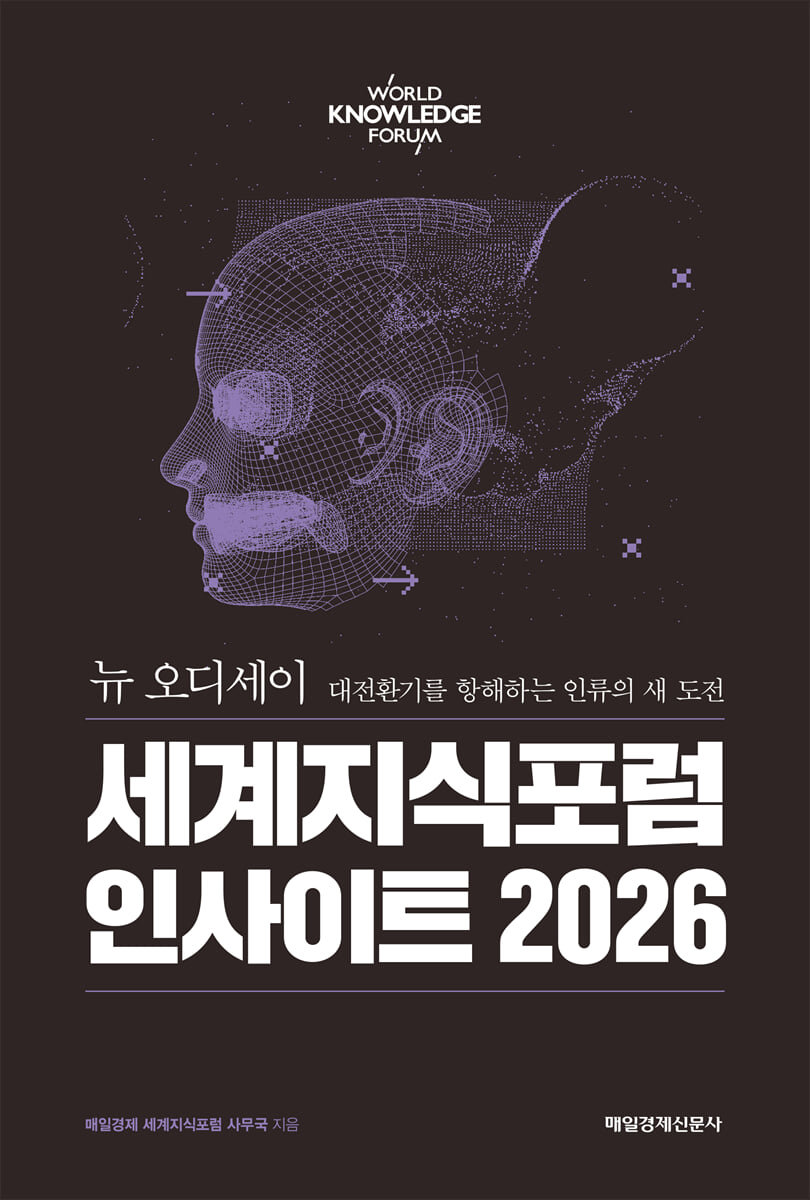
World Knowledge Forum Insights 2026
 |
Description
Book Introduction
“In the era of AI transformation, wisely choose a new path
“Future Strategies of Pioneering Global Leaders”
Regime change.
It is a word that will permeate Korea and the world in 2024 and 2025.
The wave that began in late 2024, signaling the start of US President Donald Trump's second term, has brought about a major shift in leadership, with the leaders of the Group of Seven (G7) countries, including Canada, the United Kingdom, Germany, and Japan, being replaced one after another.
In particular, the martial law situation that occurred in Korea demanded a tsunami-like change of attitude from the secretariat preparing for the next World Knowledge Forum.
Moreover, the world has been unable to prevent two wars for years: Russia's invasion of Ukraine and the conflict between Israel and Palestine in the Gaza Strip.
The newly inaugurated Trump administration has shattered the free trade framework that was the global standard under the WTO system through a tariff war.
The world was shaken by the policy of imposing unilateral tariffs of tens of percent not only on enemies but also on allies.
The technological security competition driven by artificial intelligence (AI), cybersecurity, immigration and visa issues, the breakdown of the ESG framework, and the rise of the far right have all grown to a level of agenda too large to be resolved simply through international cooperation.
Amidst growing chaos and conflict, AI, which was expected to revolutionize the world, has been used as a deepfake and hacking tool, causing further negative side effects. There are also concerns that AI technology is developing further as a weapon of war rather than a driver of productivity and technological innovation.
Rather than responding to global regime changes, it was a time when a 'Great Transition' was needed, one that would innovate the fundamental system.
So, we decided to set the new theme of this year's World Knowledge Forum as 'New Odyssey: Navigating the Great Transition.'
“Future Strategies of Pioneering Global Leaders”
Regime change.
It is a word that will permeate Korea and the world in 2024 and 2025.
The wave that began in late 2024, signaling the start of US President Donald Trump's second term, has brought about a major shift in leadership, with the leaders of the Group of Seven (G7) countries, including Canada, the United Kingdom, Germany, and Japan, being replaced one after another.
In particular, the martial law situation that occurred in Korea demanded a tsunami-like change of attitude from the secretariat preparing for the next World Knowledge Forum.
Moreover, the world has been unable to prevent two wars for years: Russia's invasion of Ukraine and the conflict between Israel and Palestine in the Gaza Strip.
The newly inaugurated Trump administration has shattered the free trade framework that was the global standard under the WTO system through a tariff war.
The world was shaken by the policy of imposing unilateral tariffs of tens of percent not only on enemies but also on allies.
The technological security competition driven by artificial intelligence (AI), cybersecurity, immigration and visa issues, the breakdown of the ESG framework, and the rise of the far right have all grown to a level of agenda too large to be resolved simply through international cooperation.
Amidst growing chaos and conflict, AI, which was expected to revolutionize the world, has been used as a deepfake and hacking tool, causing further negative side effects. There are also concerns that AI technology is developing further as a weapon of war rather than a driver of productivity and technological innovation.
Rather than responding to global regime changes, it was a time when a 'Great Transition' was needed, one that would innovate the fundamental system.
So, we decided to set the new theme of this year's World Knowledge Forum as 'New Odyssey: Navigating the Great Transition.'
- You can preview some of the book's contents.
Preview
index
Publisher's Note: A New Challenge for Humanity Navigating a Great Turning Point
Preface? Preface to the book?
Part 1: The New Order
Chapter 1 Inclusive Growth
· Inclusive growth led by APEC
- Justin Trudeau, Lee Cheol-woo
· World economic order and APEC development plan
- John Mearsheimer, Robin Niblett, Henry Haggard?
· Exploring and challenging new Korea-US relations
- Ryu Jin, Joseph Yoon, Henry Haggard?
Lessons from the Ukrainian War
- Dmytro Kuleba, Henry Haggard?
Chapter 2: Conditions for Prosperity
· New Odyssey: Maps and Rules for a Great Transition
- Jared Diamond, James Robinson, and Lee Na-kyung
· An Age of Transition: The Fall of Civilization and the Path to Prosperity
- Jared Diamond
· Europe at a Crossroads: The Path to Revival
- Charles Michel, Thierry de Montbrial
Global Geopolitical Outlook 2026
- Hal Brands, Terry Martin
· Egypt, the key to rebuilding the Gaza Strip
- Ibrahim Mahlab, Kim Jong-do
Chapter 3: Survival Strategies in the Strongman Era
· America First policies proposed by Trump's think tank
- Chad Wolf, Ahn Ho-young
· Trump 2.0 and MAGA economic policies
- Orange Cass?
· Understanding Xi Jinping and the Chinese Communist Party
- Joseph Torridgean
· Northeast Asia in the midst of a power struggle, the path to survival
Andrew Kim, Kazuto Suzuki, Michael Reiterer, Hoyoung Ahn
The World of Washington Lobbyists
- Jim Moran, Robert Wexler, Shin Woo-jin
Part 2: Investing for the Future
Chapter 1: The Guru's Perspective
· AI and the Future of Investment
- Robert Smith, Yoon Je-seong?
· The rise and fall of nations amidst a global transformation
- James Robinson, Jang Yu-sun?
· Markets that global private equity funds are paying attention to
- Kurt Bioklund, Kim Yong-seok?
Monetary Policy: Strategies to Reduce Income Inequality
- Jang Yu-sun, Lee Su-hyeong?
Chapter 2: Fluctuations in the Market Environment
· Global trade order and future prospects
- Yeo Han-gu, Hal Brands, Terry Martin
Global Economic Outlook 2026
- Torsten Slök, Larry Hathaway, William Lee
The Future of Tariffs and Trade Wars
- Wendy Cutler, Zong Yuan Joy Liu, Fu Shan Dutt, Ingo Walter?
· U.S. trade policy and supply chain restructuring
- Penelope Goldberg, Wendy Cutler, William Lee, Park Ji-hyung?
Chapter 3: Asia on the Rise
· India, the land of opportunity, is rising.
- Ashish Kumar Chauhan, Jeong Eun-bo, Hwang Se-woon
· 30 Years of the Japanese Economy: Lessons from Long-Term Stagnation
-?Shirakawa Masaaki, Park Ki-young
· Investment destinations that open up Asia's future
- Sear Riti, Purpturz Boucholon, Lee Sung-ki, Stella Seo
· Fintech Opportunities in Asia
- What about Tawaramara, Michael Jin, Lee Cheol-won, and Park Jeong-hoon?
· National City Competitiveness Ranking: A Plan for Balanced National Development
- Ni Pengfei, Jo Dongseong, Yang Heedong, Park Kichan, Lee Yuncheol?
Chapter 4: Cryptocurrency and IT Investment
The Power of Cryptocurrency, a Future Asset
- Richard Teng, Park Seon-yeong?
The Crypto Revolution: Institutionalization and Market Restructuring
- Marius Scuodis, Kenix Chan, Lee Young-ro, Lee Seong-san, Oh Jong-wook?
China's Digital Silk Road vs. US Silicon Valley
- Zhang Weining, Anindia Goz, Michael Jeon?
· Silicon Valley's AI Investment World
- Jeff Herbst, Jaehoon Eum, Keith Lee?
Part 3: AI Transition
Chapter 1: Seize AI Hegemony
· The AI Hegemony War: National Strategy, the Starting Point for Innovation
- Jang Ya-chin, Ian Horrocks, Jack Cass, Park Kyung-ryeol
· The Journey to Sovereign AI
- Martin Cohn, Park Sung-hyun, Hong Dae-soon
· Meeting of global leaders in quantum computing
- Subodh Kulkarni, Kim Jeong-sang, Fabio Donati
· Competitiveness in the AX Era: Innovation Driven by Open Source
- Kim Yeon-su
Chapter 2: AI Prerequisites
· At the forefront of hacking in the AI era
- Simon Green
AI and the Energy Transition: Opportunities in the US Nuclear Power Market
- Bridget Posey, Robert DeKnight Jr., Park In-sik, Bae Jun-beom
· End-to-end security and AI
- Philippe Vallee
· SMR, AI takes flight
- Benjamin Lainke, Stephen Hellman, Kim Jong-woo, Choi Il-kyung, Ahn Yu-jin
Chapter 3: Humans and AI
The Limits of Artificial Intelligence and the Rise of Humanistic AI
- Toby Walsh, Brad Harris, Kim Jong-yoon
· The ideal talent for the AI era and future education
- Won Jong-pil, Eric Do, Jake Baskin, Jung Woo-sung
· Redefining the Boundaries: Education and Human Values in the AI Era
- Lee Su-in, Eom Eun-sang, and Lim Cheol-il
Creative Intelligence: AI Reshaping Culture and Media
- Alex Mashrabov, Stephen Piron, Devin Mancuso, Arieh Fisher, Richard Zhang?
AI and Diversity: The Strengths of People on the Autism Spectrum
- Tal Bardi
Chapter 4: Changes That Have Already Begun
· AI Today and Tomorrow
- Yoon Song-i, Anton Borzoff, Michael Jeon, Fleur Pellerin, Richard Jang, Summer Kim?
· AI's Great Transformation in New Drug Development
- John Wing Yui Chan, Huggle
· Current status of AI diagnostic treatment
- Seo Beom-seok, Kim Seon-woo, Seok Cha-ok, Kim Chi-won
· K-Startups heading to the world
- Jeon Dong-geun, Lee Seong-ho, Lee Sang-hyun, Lee Chang-soo, Lee Da-hoon, Jenny Joo
· Protecting ownership and IP from AI
- Yair Adato
The Great Voyage of Industry, Part 4
Chapter 1: Reestablishing Grand Strategy
· Corporate Risk Response Strategies in an Age of Uncertainty
- Anne Corona, Craig Tozios
A major shift in trade, capital, and industrial strategies
- Olivia White, Sung Jeong-min, and Goo Won-mo
· New opportunities for digital transformation and venture investment
- Ignacio García Alves, Yigal Erlich, Fleur Pellerin, Hong Dae-soon
· Conditions for strategic advantage
- Harry Wingo, Queen Lee, Lee Min-goo
Chapter 2: The Wave of Decarbonization
· E-mobility, a game changer for future industries
- Herbert Deiss, Liu Xueliang, Gregorio Bustos
The Future of Innovative Cleantech
- Shin Hak-cheol, Jens Orfeldt, Anil Achiuta, Murali Subramanian, Oh Seong-ik
· Trump's Second Term Cleantech Outlook
- Mike Boots, Samuel Morillon, Kim Seong-woo
The return of the golden age of shipbuilding
- James Fosdyke, Hevijörn Hanson, Lee Jin-soo, Jin Dae-hwa, Oh Mi-yeon
Energy Transition: Batteries
- Kim Je-young
Chapter 3: Security Competition and the Defense Industry
· Restart of the European arms race
- Wouter Panbers, Dmytro Kuleba, Kim Jin-hoon, Terry Martin
· Global land, sea, and air defense industry outlook
- Lee Won-jae, Kim Hyung-taek, Dylan Jones, Mike Stets
· Evolution of the Iron Dome, the shield of the sky
- Induced base key
Chapter 4 New Opportunities
· Pathways to Korea-Japan Corporate Cooperation on the 60th Anniversary of Diplomatic Relations
- Kenichi Tamatsuka, Woohyun Lee, Sangsik Jang
· Korea-Japan mechatronics cooperation
- Yamada Seigo, Shin Dong-jo, Jeong Cheol
The power of AI to revolutionize industry
- Pascal Dalrose
The future of cell therapy
- Cha Gwang-ryeol
Smart livestock farming evolving with AI
- Robert Hoste, Seo Man-hyung, Kim Chang-gil
Part 5: Culture and Humanity
Chapter 1 The Joy of Life
· Content is King: Everything You Need to Know About Filmmaking
- Sanford Panich, Jeffrey Godsick?
· Edward Lee's Food and Culture
- Edward Lee, Na Seung-yeon?
The Era of Emerging K-Beauty Powerhouses
- Cheon Ju-hyeok, Mr. Scene?
· K-pop with the wings of technology
- Are you sure, Yoon Sang-bo, Lee Jong-moo?
Chapter 2: Moving the Heart
· The Secrets of Obama's Captivating Speeches
- Cody Keenan, Jo Seon-yeong
· The paradox of dopamine, the unstoppable pleasure
- Anna Lemke
· Eliminate fake labor
- Denis Nörmark
· The era of management without managers
- Henry Stewart, Kang Young-cheol
Chapter 3: Cooperation and Coexistence
· Asking the sick humanity of Earth
- Oh Young-hoon, Mike Boots, Sven Utermollen, Gulshan Vasista, Jo Hyeong-jin
Innovation, Inclusion, and Sustainability
- Nazir Razak, Marisa Ciarabanon, Jeong Ui-hye
· A Turkish startup ecosystem for global investors
- Burak Daololu, Barsi Ojistech, Zenk Bayrakdar, Hanung
Preface? Preface to the book?
Part 1: The New Order
Chapter 1 Inclusive Growth
· Inclusive growth led by APEC
- Justin Trudeau, Lee Cheol-woo
· World economic order and APEC development plan
- John Mearsheimer, Robin Niblett, Henry Haggard?
· Exploring and challenging new Korea-US relations
- Ryu Jin, Joseph Yoon, Henry Haggard?
Lessons from the Ukrainian War
- Dmytro Kuleba, Henry Haggard?
Chapter 2: Conditions for Prosperity
· New Odyssey: Maps and Rules for a Great Transition
- Jared Diamond, James Robinson, and Lee Na-kyung
· An Age of Transition: The Fall of Civilization and the Path to Prosperity
- Jared Diamond
· Europe at a Crossroads: The Path to Revival
- Charles Michel, Thierry de Montbrial
Global Geopolitical Outlook 2026
- Hal Brands, Terry Martin
· Egypt, the key to rebuilding the Gaza Strip
- Ibrahim Mahlab, Kim Jong-do
Chapter 3: Survival Strategies in the Strongman Era
· America First policies proposed by Trump's think tank
- Chad Wolf, Ahn Ho-young
· Trump 2.0 and MAGA economic policies
- Orange Cass?
· Understanding Xi Jinping and the Chinese Communist Party
- Joseph Torridgean
· Northeast Asia in the midst of a power struggle, the path to survival
Andrew Kim, Kazuto Suzuki, Michael Reiterer, Hoyoung Ahn
The World of Washington Lobbyists
- Jim Moran, Robert Wexler, Shin Woo-jin
Part 2: Investing for the Future
Chapter 1: The Guru's Perspective
· AI and the Future of Investment
- Robert Smith, Yoon Je-seong?
· The rise and fall of nations amidst a global transformation
- James Robinson, Jang Yu-sun?
· Markets that global private equity funds are paying attention to
- Kurt Bioklund, Kim Yong-seok?
Monetary Policy: Strategies to Reduce Income Inequality
- Jang Yu-sun, Lee Su-hyeong?
Chapter 2: Fluctuations in the Market Environment
· Global trade order and future prospects
- Yeo Han-gu, Hal Brands, Terry Martin
Global Economic Outlook 2026
- Torsten Slök, Larry Hathaway, William Lee
The Future of Tariffs and Trade Wars
- Wendy Cutler, Zong Yuan Joy Liu, Fu Shan Dutt, Ingo Walter?
· U.S. trade policy and supply chain restructuring
- Penelope Goldberg, Wendy Cutler, William Lee, Park Ji-hyung?
Chapter 3: Asia on the Rise
· India, the land of opportunity, is rising.
- Ashish Kumar Chauhan, Jeong Eun-bo, Hwang Se-woon
· 30 Years of the Japanese Economy: Lessons from Long-Term Stagnation
-?Shirakawa Masaaki, Park Ki-young
· Investment destinations that open up Asia's future
- Sear Riti, Purpturz Boucholon, Lee Sung-ki, Stella Seo
· Fintech Opportunities in Asia
- What about Tawaramara, Michael Jin, Lee Cheol-won, and Park Jeong-hoon?
· National City Competitiveness Ranking: A Plan for Balanced National Development
- Ni Pengfei, Jo Dongseong, Yang Heedong, Park Kichan, Lee Yuncheol?
Chapter 4: Cryptocurrency and IT Investment
The Power of Cryptocurrency, a Future Asset
- Richard Teng, Park Seon-yeong?
The Crypto Revolution: Institutionalization and Market Restructuring
- Marius Scuodis, Kenix Chan, Lee Young-ro, Lee Seong-san, Oh Jong-wook?
China's Digital Silk Road vs. US Silicon Valley
- Zhang Weining, Anindia Goz, Michael Jeon?
· Silicon Valley's AI Investment World
- Jeff Herbst, Jaehoon Eum, Keith Lee?
Part 3: AI Transition
Chapter 1: Seize AI Hegemony
· The AI Hegemony War: National Strategy, the Starting Point for Innovation
- Jang Ya-chin, Ian Horrocks, Jack Cass, Park Kyung-ryeol
· The Journey to Sovereign AI
- Martin Cohn, Park Sung-hyun, Hong Dae-soon
· Meeting of global leaders in quantum computing
- Subodh Kulkarni, Kim Jeong-sang, Fabio Donati
· Competitiveness in the AX Era: Innovation Driven by Open Source
- Kim Yeon-su
Chapter 2: AI Prerequisites
· At the forefront of hacking in the AI era
- Simon Green
AI and the Energy Transition: Opportunities in the US Nuclear Power Market
- Bridget Posey, Robert DeKnight Jr., Park In-sik, Bae Jun-beom
· End-to-end security and AI
- Philippe Vallee
· SMR, AI takes flight
- Benjamin Lainke, Stephen Hellman, Kim Jong-woo, Choi Il-kyung, Ahn Yu-jin
Chapter 3: Humans and AI
The Limits of Artificial Intelligence and the Rise of Humanistic AI
- Toby Walsh, Brad Harris, Kim Jong-yoon
· The ideal talent for the AI era and future education
- Won Jong-pil, Eric Do, Jake Baskin, Jung Woo-sung
· Redefining the Boundaries: Education and Human Values in the AI Era
- Lee Su-in, Eom Eun-sang, and Lim Cheol-il
Creative Intelligence: AI Reshaping Culture and Media
- Alex Mashrabov, Stephen Piron, Devin Mancuso, Arieh Fisher, Richard Zhang?
AI and Diversity: The Strengths of People on the Autism Spectrum
- Tal Bardi
Chapter 4: Changes That Have Already Begun
· AI Today and Tomorrow
- Yoon Song-i, Anton Borzoff, Michael Jeon, Fleur Pellerin, Richard Jang, Summer Kim?
· AI's Great Transformation in New Drug Development
- John Wing Yui Chan, Huggle
· Current status of AI diagnostic treatment
- Seo Beom-seok, Kim Seon-woo, Seok Cha-ok, Kim Chi-won
· K-Startups heading to the world
- Jeon Dong-geun, Lee Seong-ho, Lee Sang-hyun, Lee Chang-soo, Lee Da-hoon, Jenny Joo
· Protecting ownership and IP from AI
- Yair Adato
The Great Voyage of Industry, Part 4
Chapter 1: Reestablishing Grand Strategy
· Corporate Risk Response Strategies in an Age of Uncertainty
- Anne Corona, Craig Tozios
A major shift in trade, capital, and industrial strategies
- Olivia White, Sung Jeong-min, and Goo Won-mo
· New opportunities for digital transformation and venture investment
- Ignacio García Alves, Yigal Erlich, Fleur Pellerin, Hong Dae-soon
· Conditions for strategic advantage
- Harry Wingo, Queen Lee, Lee Min-goo
Chapter 2: The Wave of Decarbonization
· E-mobility, a game changer for future industries
- Herbert Deiss, Liu Xueliang, Gregorio Bustos
The Future of Innovative Cleantech
- Shin Hak-cheol, Jens Orfeldt, Anil Achiuta, Murali Subramanian, Oh Seong-ik
· Trump's Second Term Cleantech Outlook
- Mike Boots, Samuel Morillon, Kim Seong-woo
The return of the golden age of shipbuilding
- James Fosdyke, Hevijörn Hanson, Lee Jin-soo, Jin Dae-hwa, Oh Mi-yeon
Energy Transition: Batteries
- Kim Je-young
Chapter 3: Security Competition and the Defense Industry
· Restart of the European arms race
- Wouter Panbers, Dmytro Kuleba, Kim Jin-hoon, Terry Martin
· Global land, sea, and air defense industry outlook
- Lee Won-jae, Kim Hyung-taek, Dylan Jones, Mike Stets
· Evolution of the Iron Dome, the shield of the sky
- Induced base key
Chapter 4 New Opportunities
· Pathways to Korea-Japan Corporate Cooperation on the 60th Anniversary of Diplomatic Relations
- Kenichi Tamatsuka, Woohyun Lee, Sangsik Jang
· Korea-Japan mechatronics cooperation
- Yamada Seigo, Shin Dong-jo, Jeong Cheol
The power of AI to revolutionize industry
- Pascal Dalrose
The future of cell therapy
- Cha Gwang-ryeol
Smart livestock farming evolving with AI
- Robert Hoste, Seo Man-hyung, Kim Chang-gil
Part 5: Culture and Humanity
Chapter 1 The Joy of Life
· Content is King: Everything You Need to Know About Filmmaking
- Sanford Panich, Jeffrey Godsick?
· Edward Lee's Food and Culture
- Edward Lee, Na Seung-yeon?
The Era of Emerging K-Beauty Powerhouses
- Cheon Ju-hyeok, Mr. Scene?
· K-pop with the wings of technology
- Are you sure, Yoon Sang-bo, Lee Jong-moo?
Chapter 2: Moving the Heart
· The Secrets of Obama's Captivating Speeches
- Cody Keenan, Jo Seon-yeong
· The paradox of dopamine, the unstoppable pleasure
- Anna Lemke
· Eliminate fake labor
- Denis Nörmark
· The era of management without managers
- Henry Stewart, Kang Young-cheol
Chapter 3: Cooperation and Coexistence
· Asking the sick humanity of Earth
- Oh Young-hoon, Mike Boots, Sven Utermollen, Gulshan Vasista, Jo Hyeong-jin
Innovation, Inclusion, and Sustainability
- Nazir Razak, Marisa Ciarabanon, Jeong Ui-hye
· A Turkish startup ecosystem for global investors
- Burak Daololu, Barsi Ojistech, Zenk Bayrakdar, Hanung
Into the book
Regarding economic cooperation, it was predicted that the scope of Korean investment in the U.S. could be expanded through exchanges in shipbuilding, civilian nuclear power, and cultural products.
“There are many nuclear power markets, including Saudi Arabia and the United Arab Emirates,” said Deputy Ambassador Joseph Yoon. “South Korea and the United States can work together to build nuclear reactors worth hundreds of billions of dollars.”
“Small modular reactors (SMRs) could power facilities like data centers,” said Deputy Ambassador Joseph Yoon, adding that “many Korean companies want to build SMRs in the United States.”
Chairman Ryu Jin also said, “Korea-U.S. cooperation can be expanded in cultural fields, such as K-culture and K-food,” adding, “It was not politicians but people of all ages who enjoy culture that brought us closer together.”
--- From "Inclusive Growth: Exploring and Challenges for a New Korea-U.S. Relationship"
In his book Guns, Germs, and Steel, Professor Diamond argued that the development of a nation is determined not by the superiority or inferiority of race or ethnicity, but by differences in geography and environment.
The gap in national development is the result of accumulated environmental accidents.
On the other hand, Professor Robinson finds the driving force of national development in political and economic systems.
His theory is that inclusive institutions promote national prosperity and that inclusive institutions can be sustained when state power and social power maintain a balance through constant checks and balances.
Professor Diamond first introduced the perception of past American officials toward Korea.
When asked about the three countries of Korea, the Philippines, and Ghana, "Which country will become wealthy in the next few decades?", American officials' answer was reportedly clear.
“Korea will remain poor forever, while the Philippines and Ghana will become rich.” But what actually happened was just the opposite.
South Korea has become wealthy, while the Philippines and Ghana remain poor.
Professor Diamond found the background of this difference in its historical foundation.
Korea has a deep historical foundation that dates back 1,500 years.
It has maintained a 'national government' for a long time and has Hangul, the world's best writing system.
Metal technology has also been developed over a long period of time.
The Philippines and Ghana had neither metallurgy, nor their own writing system, nor any national institutions.
Professor Diamond assessed that “Korea’s historical foundation has become the driving force behind its rise to the ranks of today’s great powers.”
This is an argument that clearly reveals his theoretical background.
--- From "Conditions for Prosperity: The New Odyssey, the Map and Rules Needed for a Great Transition"
“Trump 2.0 is an attempt at a paradigm shift to increase productivity in the United States.” The analysis is that the background of the “Make America Great Again” policy, which advocates America First, is because the American economy is being eroded due to aversion to production.
The economy is growing, but more and more Americans are becoming poorer, without a proper return of capital to workers and communities.
Therefore, it is the Trump administration's responsibility to increase the financial stability of Americans.
Oren Cass, founder and chief economist of American Compass, who spoke at the 26th World Knowledge Forum session on “Trump 2.0 and MAGA Economic Policy,” stated that the Trump administration’s core policy direction is to prevent “corporate erosion.”
He is a conservative commentator who influences high-ranking officials in the current U.S. administration, including President Donald Trump.
The point is that while the capitalist system has enriched the coffers of corporations, it has actually made workers' wallets thinner.
This is a warning that companies that have generated a lot of operating profit are hesitant to invest and thus fail to create added value for society.
Cass described this phenomenon as “companies doing nothing.”
Cass continued, “The United States is clearly the most powerful economy in the world.
“Growth is strong and unemployment is low,” he said, “but the problem is that those results are not readily apparent to ordinary workers.”
--- From "Survival Strategies in the Strongman Era: Trump 2.0 and MAGA Economic Policy"
Amidst the rapid restructuring of the global economic order, India is emerging as a new economic powerhouse. The NSE, which has grown to become the world's seventh-largest exchange, is recognized as driving innovation and development in the Indian capital market.
At the 26th World Knowledge Forum session titled "India, the Land of Opportunity, is Rising," NSE CEO Ashish Kumar Chauhan and Korea Exchange Chairman Eun-bo Jeong discussed the future of their two countries' capital markets and explored the potential for strategic cooperation.
CEO Chauhan summarized India's core competitiveness into four keywords.
Consumer demand, population structure, technology, and infrastructure.
First, CEO Chauhan emphasized that it is necessary to note that India's economic structure is consumption-oriented.
He argues that despite being a low-income country, India has a large purchasing power, which inevitably leads to active participation in capital markets.
In fact, in India, savings amounting to $1 trillion are flowing into financial markets every year.
He also diagnosed that India's young population structure will be a scarce resource and a key to improving productivity in the aging phenomenon.
“India has the youngest population among major countries in the world, with an average age of around 29,” he explained. “This means that the working population will steadily increase over the next 30 to 40 years, simultaneously increasing economic productivity and growth potential.”
--- From "Asia on the Rise: India, the Land of Opportunity, Rises"
Who will win the AI hegemony war? The US, which is pursuing a private sector-led strategy, and China, which is opting for government-led growth.
Which country will achieve AI hegemony? Amidst the fierce competition between the United States and China for AI technological supremacy, the 26th World Knowledge Forum offered an answer to this question at its session, "Competition for AI Hegemony: National Strategy, the Starting Point of Innovation."
Global AI experts unanimously agree that no single country or company can emerge victorious in the race to develop AI technology. The pace of change in AI technology is so rapid that it's practically impossible for any one country, like the US or China, to develop all AI-related technologies.
This means that tectonic shifts will continue to occur, with Europe, Korea, and other Asian countries accelerating the development of AI technology, and certain countries gaining the upper hand in certain technologies.
“Many people are paying attention to the AI technology competition between the U.S. and China, but the AI technology competition structure is not simple but complex,” said Zhang Yaqin, director of the Artificial Intelligence Industry Research Institute at Tsinghua University. “Looking at the U.S. alone, American AI companies are competing not only with domestic AI companies but also with AI companies from many countries around the world.”
He added, “The situation is similar in China. At one point, 200 companies in China alone were competing fiercely to develop LLMs.”
The point is that approaching it as a two-power competition between the United States and China is an extremely short-sighted perspective.
--- From "Seize the Hegemony: The AI Hegemony War, National Strategy, and the Starting Point of Innovation"
Pascal Daloz, CEO of French AI virtual twin company Dassault Systèmes, proposed the 'generative economy' as a new economic paradigm and predicted that in the era of the generative economy, intellectual property will soon become a new investment asset.
This is because the importance of intellectual property is expected to increase as we move away from a manufacturing-centered society and products and services are defined around software.
Daloz CEO made this claim during the session titled “The Power of AI to Transform Industries” held at the 26th World Knowledge Forum.
The generative economy he proposed is a knowledge-based software economy that pursues both preservation and innovation.
The generative economy is different from the existing economic model.
Rather than a structure that is mass-produced and then discarded, we pursue optimized production from the beginning through virtual design.
It focuses on a sustainable circular economic structure.
The core of the generative economy is the power to create reality from the virtual.
CEO Dalrose introduced 'virtual twin' technology as a key infrastructure for the transition to a generative economy.
Virtual twin is a technology that creates a twin of a real object in a virtual space, conducts simulations, predicts the results, and avoids danger.
--- From "New Opportunities: The Power of AI to Revolutionize Industries"
“A Korean cosmetics company with a market capitalization of 100 trillion won will be born.
It's just a matter of time, it will come out eventually.
“If a 100 trillion won company is born, I hope it will be Gudai Global.” (Chun Joo-hyuk, CEO of Gudai Global) These days, if you go to any shopping mall in Tokyo, Japan, you can easily purchase Korean cosmetics.
Cosmetics from various Korean brands are displayed everywhere, to the point where you might feel as if you are in an Olive Young store operated by CJ Olive Young, a core affiliate of CJ Group.
There are quite a few places that hold 'K-cosmetics special exhibitions' where they only sell Korean cosmetics.
The number of stores selling Korean cosmetics is increasing not only in New York, USA, but also in Paris, France, Milan, Italy, which represent the fashion and beauty industries, and in Southeast Asia, including Vietnam, Thailand, and Indonesia.
This is the so-called 'golden age of K-beauty'.
In fact, the status of Korean cosmetics, or K-beauty, is rising day by day.
According to the Ministry of Food and Drug Safety, Korea's cosmetics exports in the first half of 2025 reached $5.5 billion, a 14% increase from the previous year.
--- From "The Joy of Life: The Era of K-Beauty's Rising Powerhouse"
“Turkey is not a technological paradise.
“But it is a paradise for technology companies,” said Cenk Bayrakdar, founding partner and representative of Revo Capital, one of the largest venture capital firms in Turkey, introducing Turkey at the 26th World Knowledge Forum.
“In Turkey, tech companies don’t have to pay corporate tax or value-added tax,” said CEO Bayrakdar, speaking at the session “Expanding Beyond Borders: The Turkish Startup Ecosystem for Global Investors.” He added, “We don’t have to pay income tax on employee salaries; we just pay them net salaries.”
Marketing costs are also supported by the Turkish government.
If you are a game company, application (app) development company, or business-to-business (B2B) SaaS company, you can receive 60% of your marketing costs.
He explained, “The limit per application is $300,000 (about 420 million won),” and “If a company operates 10 games, it can receive $3 million (about 4.2 billion won) per year.”
“There are many nuclear power markets, including Saudi Arabia and the United Arab Emirates,” said Deputy Ambassador Joseph Yoon. “South Korea and the United States can work together to build nuclear reactors worth hundreds of billions of dollars.”
“Small modular reactors (SMRs) could power facilities like data centers,” said Deputy Ambassador Joseph Yoon, adding that “many Korean companies want to build SMRs in the United States.”
Chairman Ryu Jin also said, “Korea-U.S. cooperation can be expanded in cultural fields, such as K-culture and K-food,” adding, “It was not politicians but people of all ages who enjoy culture that brought us closer together.”
--- From "Inclusive Growth: Exploring and Challenges for a New Korea-U.S. Relationship"
In his book Guns, Germs, and Steel, Professor Diamond argued that the development of a nation is determined not by the superiority or inferiority of race or ethnicity, but by differences in geography and environment.
The gap in national development is the result of accumulated environmental accidents.
On the other hand, Professor Robinson finds the driving force of national development in political and economic systems.
His theory is that inclusive institutions promote national prosperity and that inclusive institutions can be sustained when state power and social power maintain a balance through constant checks and balances.
Professor Diamond first introduced the perception of past American officials toward Korea.
When asked about the three countries of Korea, the Philippines, and Ghana, "Which country will become wealthy in the next few decades?", American officials' answer was reportedly clear.
“Korea will remain poor forever, while the Philippines and Ghana will become rich.” But what actually happened was just the opposite.
South Korea has become wealthy, while the Philippines and Ghana remain poor.
Professor Diamond found the background of this difference in its historical foundation.
Korea has a deep historical foundation that dates back 1,500 years.
It has maintained a 'national government' for a long time and has Hangul, the world's best writing system.
Metal technology has also been developed over a long period of time.
The Philippines and Ghana had neither metallurgy, nor their own writing system, nor any national institutions.
Professor Diamond assessed that “Korea’s historical foundation has become the driving force behind its rise to the ranks of today’s great powers.”
This is an argument that clearly reveals his theoretical background.
--- From "Conditions for Prosperity: The New Odyssey, the Map and Rules Needed for a Great Transition"
“Trump 2.0 is an attempt at a paradigm shift to increase productivity in the United States.” The analysis is that the background of the “Make America Great Again” policy, which advocates America First, is because the American economy is being eroded due to aversion to production.
The economy is growing, but more and more Americans are becoming poorer, without a proper return of capital to workers and communities.
Therefore, it is the Trump administration's responsibility to increase the financial stability of Americans.
Oren Cass, founder and chief economist of American Compass, who spoke at the 26th World Knowledge Forum session on “Trump 2.0 and MAGA Economic Policy,” stated that the Trump administration’s core policy direction is to prevent “corporate erosion.”
He is a conservative commentator who influences high-ranking officials in the current U.S. administration, including President Donald Trump.
The point is that while the capitalist system has enriched the coffers of corporations, it has actually made workers' wallets thinner.
This is a warning that companies that have generated a lot of operating profit are hesitant to invest and thus fail to create added value for society.
Cass described this phenomenon as “companies doing nothing.”
Cass continued, “The United States is clearly the most powerful economy in the world.
“Growth is strong and unemployment is low,” he said, “but the problem is that those results are not readily apparent to ordinary workers.”
--- From "Survival Strategies in the Strongman Era: Trump 2.0 and MAGA Economic Policy"
Amidst the rapid restructuring of the global economic order, India is emerging as a new economic powerhouse. The NSE, which has grown to become the world's seventh-largest exchange, is recognized as driving innovation and development in the Indian capital market.
At the 26th World Knowledge Forum session titled "India, the Land of Opportunity, is Rising," NSE CEO Ashish Kumar Chauhan and Korea Exchange Chairman Eun-bo Jeong discussed the future of their two countries' capital markets and explored the potential for strategic cooperation.
CEO Chauhan summarized India's core competitiveness into four keywords.
Consumer demand, population structure, technology, and infrastructure.
First, CEO Chauhan emphasized that it is necessary to note that India's economic structure is consumption-oriented.
He argues that despite being a low-income country, India has a large purchasing power, which inevitably leads to active participation in capital markets.
In fact, in India, savings amounting to $1 trillion are flowing into financial markets every year.
He also diagnosed that India's young population structure will be a scarce resource and a key to improving productivity in the aging phenomenon.
“India has the youngest population among major countries in the world, with an average age of around 29,” he explained. “This means that the working population will steadily increase over the next 30 to 40 years, simultaneously increasing economic productivity and growth potential.”
--- From "Asia on the Rise: India, the Land of Opportunity, Rises"
Who will win the AI hegemony war? The US, which is pursuing a private sector-led strategy, and China, which is opting for government-led growth.
Which country will achieve AI hegemony? Amidst the fierce competition between the United States and China for AI technological supremacy, the 26th World Knowledge Forum offered an answer to this question at its session, "Competition for AI Hegemony: National Strategy, the Starting Point of Innovation."
Global AI experts unanimously agree that no single country or company can emerge victorious in the race to develop AI technology. The pace of change in AI technology is so rapid that it's practically impossible for any one country, like the US or China, to develop all AI-related technologies.
This means that tectonic shifts will continue to occur, with Europe, Korea, and other Asian countries accelerating the development of AI technology, and certain countries gaining the upper hand in certain technologies.
“Many people are paying attention to the AI technology competition between the U.S. and China, but the AI technology competition structure is not simple but complex,” said Zhang Yaqin, director of the Artificial Intelligence Industry Research Institute at Tsinghua University. “Looking at the U.S. alone, American AI companies are competing not only with domestic AI companies but also with AI companies from many countries around the world.”
He added, “The situation is similar in China. At one point, 200 companies in China alone were competing fiercely to develop LLMs.”
The point is that approaching it as a two-power competition between the United States and China is an extremely short-sighted perspective.
--- From "Seize the Hegemony: The AI Hegemony War, National Strategy, and the Starting Point of Innovation"
Pascal Daloz, CEO of French AI virtual twin company Dassault Systèmes, proposed the 'generative economy' as a new economic paradigm and predicted that in the era of the generative economy, intellectual property will soon become a new investment asset.
This is because the importance of intellectual property is expected to increase as we move away from a manufacturing-centered society and products and services are defined around software.
Daloz CEO made this claim during the session titled “The Power of AI to Transform Industries” held at the 26th World Knowledge Forum.
The generative economy he proposed is a knowledge-based software economy that pursues both preservation and innovation.
The generative economy is different from the existing economic model.
Rather than a structure that is mass-produced and then discarded, we pursue optimized production from the beginning through virtual design.
It focuses on a sustainable circular economic structure.
The core of the generative economy is the power to create reality from the virtual.
CEO Dalrose introduced 'virtual twin' technology as a key infrastructure for the transition to a generative economy.
Virtual twin is a technology that creates a twin of a real object in a virtual space, conducts simulations, predicts the results, and avoids danger.
--- From "New Opportunities: The Power of AI to Revolutionize Industries"
“A Korean cosmetics company with a market capitalization of 100 trillion won will be born.
It's just a matter of time, it will come out eventually.
“If a 100 trillion won company is born, I hope it will be Gudai Global.” (Chun Joo-hyuk, CEO of Gudai Global) These days, if you go to any shopping mall in Tokyo, Japan, you can easily purchase Korean cosmetics.
Cosmetics from various Korean brands are displayed everywhere, to the point where you might feel as if you are in an Olive Young store operated by CJ Olive Young, a core affiliate of CJ Group.
There are quite a few places that hold 'K-cosmetics special exhibitions' where they only sell Korean cosmetics.
The number of stores selling Korean cosmetics is increasing not only in New York, USA, but also in Paris, France, Milan, Italy, which represent the fashion and beauty industries, and in Southeast Asia, including Vietnam, Thailand, and Indonesia.
This is the so-called 'golden age of K-beauty'.
In fact, the status of Korean cosmetics, or K-beauty, is rising day by day.
According to the Ministry of Food and Drug Safety, Korea's cosmetics exports in the first half of 2025 reached $5.5 billion, a 14% increase from the previous year.
--- From "The Joy of Life: The Era of K-Beauty's Rising Powerhouse"
“Turkey is not a technological paradise.
“But it is a paradise for technology companies,” said Cenk Bayrakdar, founding partner and representative of Revo Capital, one of the largest venture capital firms in Turkey, introducing Turkey at the 26th World Knowledge Forum.
“In Turkey, tech companies don’t have to pay corporate tax or value-added tax,” said CEO Bayrakdar, speaking at the session “Expanding Beyond Borders: The Turkish Startup Ecosystem for Global Investors.” He added, “We don’t have to pay income tax on employee salaries; we just pay them net salaries.”
Marketing costs are also supported by the Turkish government.
If you are a game company, application (app) development company, or business-to-business (B2B) SaaS company, you can receive 60% of your marketing costs.
He explained, “The limit per application is $300,000 (about 420 million won),” and “If a company operates 10 games, it can receive $3 million (about 4.2 billion won) per year.”
--- From "Collaboration and Coexistence: The Turkish Startup Ecosystem for Global Investors"
Publisher's Review
New Odyssey
: A new challenge for humanity navigating a great turning point
Canadian Prime Minister Justin Trudeau / UCLA Professor Emeritus Jared Diamond / Former European Council President Charles Michel / University of Chicago Professor John Mearsheimer / Vista Equity Partners Chairman Robert Smith / Infineon Chairman Herbert Deiss / Stanford University Professor Anna Lemke / Sony Pictures Motion Picture Group President Sanford Panich / Rigetti Computing CEO Subodh Kulkarni / Former White House Speech Secretary Cody Keenan / Binance CEO Richard Teng
This book is organized into five knowledge pillars that contain the keys to overcoming chaos: New Order, Invest the Future, AI Transition, Industrial Odyssey, and Culture & Human.
"New Order" addresses leadership changes, the reorganization of the security landscape, and the race for technological supremacy, all in a new direction to overcome the turbulent times.
It also included changes in the new international business environment, including tariffs and supply chains, and a shift in the geopolitical paradigm.
The key speaker was undoubtedly former Canadian Prime Minister Justin Trudeau.
Former Prime Minister Trudeau captivated an audience of approximately 1,500 with his keynote address at the opening ceremony of the 26th World Knowledge Forum, addressing the topic of "Leadership and Resilience in Transition."
The 'New Order' pillar was shared by world-renowned scholars such as Professor Emeritus Jared Diamond of UCLA, Professor John Mearsheimer of the University of Chicago, Professor James Robinson of the University of Chicago, winner of the 2024 Nobel Prize in Economics, as well as Charles Michel, former President of the European Council and Prime Minister of Belgium, and Chad Wolf, Senior Vice President of the America First Policy Institute (former Acting Under Secretary of Homeland Security).
The 'Investment for the Future' pillar brought together speakers who dominate Wall Street in New York, USA.
Robert Smith, Chairman of Vista Equity Partners, known as the world's best tech fund, along with Torsten Slök, Chief Economist of Apollo Global Management, and Larry Hathaway, Chief Economist of Franklin Templeton Research Center, presented the latest investment trends and economic outlook for 2026.
Additionally, Kurt Björklund, Chairman of Permira, one of Europe's top three private equity funds, and Masaaki Shirakawa, former Governor of the Bank of Japan, held in-depth sessions on the economy and investment.
Additionally, Richard Teng, CEO of Binance, the world's largest virtual asset exchange, also held a solo session.
The industry and business sessions were filled with AI experts.
From the session on quantum computers, a cutting-edge technology, to C-level executives from the top two companies in the US Nasdaq, we invited world-renowned speakers, including the founder of Cohere, Canada's number one AI company, OpenAI, which is leading the AI revolution, and Palo Alto Networks, the world's number one cybersecurity company.
Small modular reactors (SMRs), which are attracting attention as the most essential energy source for AI to gain power, were also visited by C-level executives from two of the world's top three companies at the World Knowledge Forum.
BYD, which has surpassed Tesla to become the world's largest electric vehicle seller, and Zhang Yaqin, former president of Baidu and director of the Artificial Intelligence Industry Research Institute at Tsinghua University, a hub for AI in China, also had an open discussion with the audience about the red tech industry.
Finally, the cultural session was filled with the enthusiasm of a more packed audience than ever before.
With keynote speakers including popular chef Edward Lee, Sony Pictures President Sanford Panich, who produced Netflix's hit series "K-Pop Demon Hunters," and Stanford University professor Anna Lemke, author of the best-selling book "Dopamine Nation," the sessions were attended by an audience of nearly 3,000 people at the Jangchung Arena.
The World Knowledge Forum, which began in 2000 under the theme of “Shaping the New Millennium with Knowledge,” has continuously strived to open a new knowledge-based future.
2025 'New Odyssey: Navigating the Great Transition'
This book contains over 90 sessions brought together by the world's leading experts on the topic.
We look forward to sharing our insights and working together to create a better odyssey based on them.
Top 10 Messages from the 26th World Knowledge Forum
1.
Inclusion and Resilience: Solutions for a Global Transition
2.
Tariffs and anti-immigration measures raise stagflation warning signs.
3. In the AI era, energy, infrastructure, and agentic AI are gaining attention.
4. The APEC Summit Will Be a Turning Point for Global Cooperation
5.
The Industrial AI Transformation: Talent and Sovereign AI Are Key
6.
A New Era for Korea and the US: Drawing the Big Picture for Supply Chains
7.
K-Bio to be in the global top 5 when deregulation becomes more flexible.
: A new challenge for humanity navigating a great turning point
Canadian Prime Minister Justin Trudeau / UCLA Professor Emeritus Jared Diamond / Former European Council President Charles Michel / University of Chicago Professor John Mearsheimer / Vista Equity Partners Chairman Robert Smith / Infineon Chairman Herbert Deiss / Stanford University Professor Anna Lemke / Sony Pictures Motion Picture Group President Sanford Panich / Rigetti Computing CEO Subodh Kulkarni / Former White House Speech Secretary Cody Keenan / Binance CEO Richard Teng
This book is organized into five knowledge pillars that contain the keys to overcoming chaos: New Order, Invest the Future, AI Transition, Industrial Odyssey, and Culture & Human.
"New Order" addresses leadership changes, the reorganization of the security landscape, and the race for technological supremacy, all in a new direction to overcome the turbulent times.
It also included changes in the new international business environment, including tariffs and supply chains, and a shift in the geopolitical paradigm.
The key speaker was undoubtedly former Canadian Prime Minister Justin Trudeau.
Former Prime Minister Trudeau captivated an audience of approximately 1,500 with his keynote address at the opening ceremony of the 26th World Knowledge Forum, addressing the topic of "Leadership and Resilience in Transition."
The 'New Order' pillar was shared by world-renowned scholars such as Professor Emeritus Jared Diamond of UCLA, Professor John Mearsheimer of the University of Chicago, Professor James Robinson of the University of Chicago, winner of the 2024 Nobel Prize in Economics, as well as Charles Michel, former President of the European Council and Prime Minister of Belgium, and Chad Wolf, Senior Vice President of the America First Policy Institute (former Acting Under Secretary of Homeland Security).
The 'Investment for the Future' pillar brought together speakers who dominate Wall Street in New York, USA.
Robert Smith, Chairman of Vista Equity Partners, known as the world's best tech fund, along with Torsten Slök, Chief Economist of Apollo Global Management, and Larry Hathaway, Chief Economist of Franklin Templeton Research Center, presented the latest investment trends and economic outlook for 2026.
Additionally, Kurt Björklund, Chairman of Permira, one of Europe's top three private equity funds, and Masaaki Shirakawa, former Governor of the Bank of Japan, held in-depth sessions on the economy and investment.
Additionally, Richard Teng, CEO of Binance, the world's largest virtual asset exchange, also held a solo session.
The industry and business sessions were filled with AI experts.
From the session on quantum computers, a cutting-edge technology, to C-level executives from the top two companies in the US Nasdaq, we invited world-renowned speakers, including the founder of Cohere, Canada's number one AI company, OpenAI, which is leading the AI revolution, and Palo Alto Networks, the world's number one cybersecurity company.
Small modular reactors (SMRs), which are attracting attention as the most essential energy source for AI to gain power, were also visited by C-level executives from two of the world's top three companies at the World Knowledge Forum.
BYD, which has surpassed Tesla to become the world's largest electric vehicle seller, and Zhang Yaqin, former president of Baidu and director of the Artificial Intelligence Industry Research Institute at Tsinghua University, a hub for AI in China, also had an open discussion with the audience about the red tech industry.
Finally, the cultural session was filled with the enthusiasm of a more packed audience than ever before.
With keynote speakers including popular chef Edward Lee, Sony Pictures President Sanford Panich, who produced Netflix's hit series "K-Pop Demon Hunters," and Stanford University professor Anna Lemke, author of the best-selling book "Dopamine Nation," the sessions were attended by an audience of nearly 3,000 people at the Jangchung Arena.
The World Knowledge Forum, which began in 2000 under the theme of “Shaping the New Millennium with Knowledge,” has continuously strived to open a new knowledge-based future.
2025 'New Odyssey: Navigating the Great Transition'
This book contains over 90 sessions brought together by the world's leading experts on the topic.
We look forward to sharing our insights and working together to create a better odyssey based on them.
Top 10 Messages from the 26th World Knowledge Forum
1.
Inclusion and Resilience: Solutions for a Global Transition
2.
Tariffs and anti-immigration measures raise stagflation warning signs.
3. In the AI era, energy, infrastructure, and agentic AI are gaining attention.
4. The APEC Summit Will Be a Turning Point for Global Cooperation
5.
The Industrial AI Transformation: Talent and Sovereign AI Are Key
6.
A New Era for Korea and the US: Drawing the Big Picture for Supply Chains
7.
K-Bio to be in the global top 5 when deregulation becomes more flexible.
GOODS SPECIFICS
- Date of issue: November 28, 2025
- Page count, weight, size: 384 pages | 152*225*19mm
- ISBN13: 9791164848355
You may also like
카테고리
korean


korean

![GQ KOREA Mark (Monthly): December [2025]](http://librairie.coreenne.fr/cdn/shop/files/8ef265dbbfbf186523ed75ba7319009d.jpg?v=1765340328&width=3840)


