

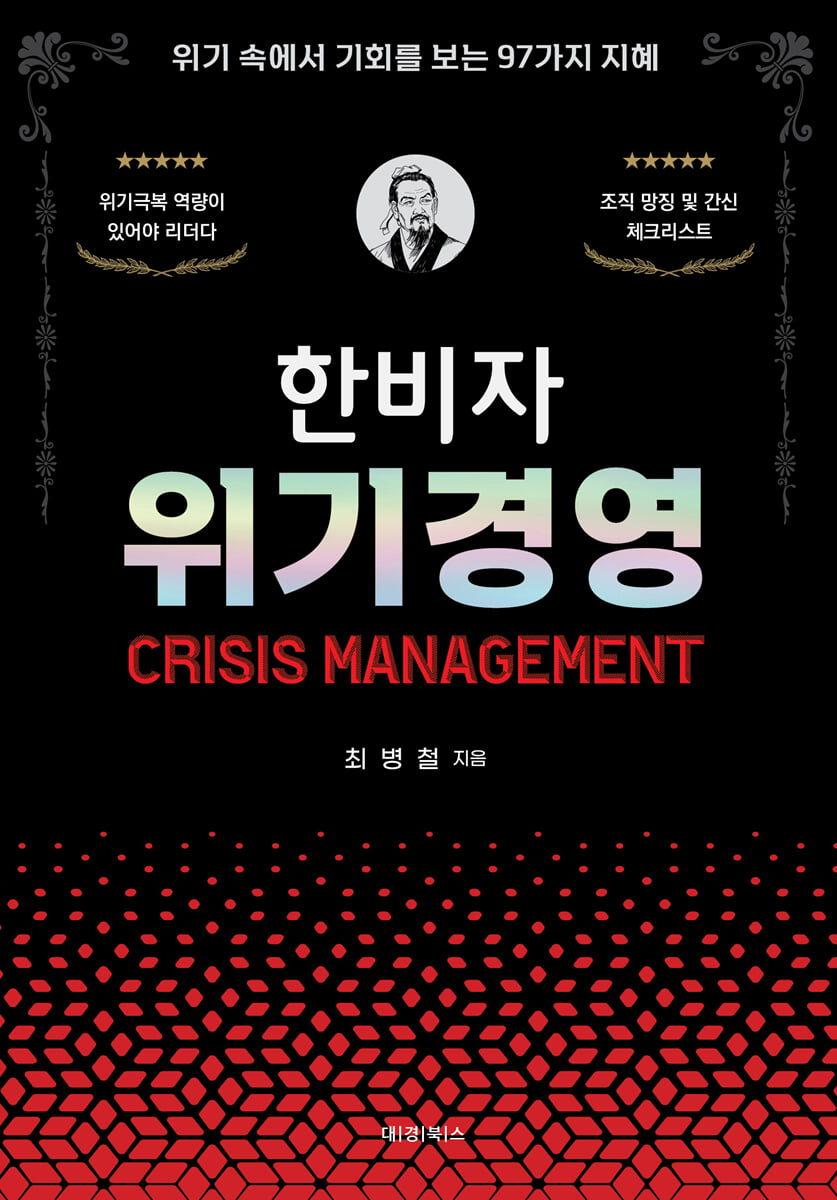
Hanbi Visa Crisis Management
 |
Description
Book Introduction
A fresh look at safety management, drawing on Han Feizi's wisdom.
We are now in the era of the AI revolution.
All the value systems and systems that have existed so far are collapsing.
Things that were once safe are being pushed to the edge, and things that were once looked down upon are now being treated well.
The struggles of those being driven out are witnessed everywhere.
It's a revolution.
The period of greatest uncertainty and confusion in history was the Spring and Autumn Period and the Warring States Period.
We look back on the present state of safety and crisis management and prepare for the future through the Legalist thought that brought an end to the chaos.
We are now in the era of the AI revolution.
All the value systems and systems that have existed so far are collapsing.
Things that were once safe are being pushed to the edge, and things that were once looked down upon are now being treated well.
The struggles of those being driven out are witnessed everywhere.
It's a revolution.
The period of greatest uncertainty and confusion in history was the Spring and Autumn Period and the Warring States Period.
We look back on the present state of safety and crisis management and prepare for the future through the Legalist thought that brought an end to the chaos.
- You can preview some of the book's contents.
Preview
index
Prologue 3
Part 1: What the AI Revolution and the Iron Age Revolution Have in Common: The Emergence of "New Risks"
01.
19 Reasons to Learn Crisis Management from Han Feizi
02. 24 Commonalities Between the AI Revolution and the Iron Age
03.
Lessons from Han Feizi's Death: The Recheck System 28
04.
Responsibility vs Accountability 31
05.
Three Ways to Overcome a Crisis: Law, Alcohol, and Tax 34
06.
The Virtuous Function of Evil and Safety Culture 38
07.
How to Find Out the Truth from Meng Sang-gun, Part 43
08.
The Triangle of Tension, Fear, and Insecurity 46
09.
3 Reasons Why We Become Desensitized to Risk 49
10.
The Difference Between Insensitivity and Safety Insensitivity 52
11.
How to get people involved? 55
12.
Delegate authority? Pass responsibility? 59
13.
Can you spot a false report? 61
14.
What qualifications does a dying prime minister have for a responsible person? 64
15.
Is the problem with the Severe Punishment Act? Or with the person exercising the power to punish? 70
16.
The Robbens Report: The UK Debate on Regulation and Punishment, Autonomy and Participation 73
17.
Do you suppress your desires or use them? 77
18.
Is there a reward commensurate with the punishment? 80
19.
What's the secret to turning a farmer into a brave soldier? 83
20.
The scars on your face in the mirror are not the mirror's fault. 86
21.
Why do tangerines become tangerines? 88
22.
What do executives and practitioners do and how do they move? 91
23.
Purity is often criticized as being weak-hearted. 94
24.
Risk Elimination and Risk Appropriateness 97
Part 2: Is human rationality always right?
25.
Desire Overshadows Reason 104
26.
107 Factors That Paralyze Human Reason
27.
What else overwhelms desire? 110
28.
Love is guarded by the most unlovable things 113
29.
The Conflict of Values and Common Values 115
30.
It's a lie to say that every bird is right. 117
31.
Authority, Roles, Empowerment, and Delegation 120
32.
Does Law Slow the Pace of Change? 125
33.
The Limitations of the Serious Disaster Punishment Act: Lessons from the Fraudulent Net Worth Story 129
34.
Aggressive Safety Management: Lessons from Yoo Bang and Han Shin 134
35.
Why Do We Hate Rewards and Punishments? 138
36.
He who has no desires cannot control 141
37.
Beyond Desire: What is Desire? 146
38.
Differences Between Mencius, Zhuangzi, and Han Feizi on Risk 149
39.
What Makes Insight Possible? 153
40.
Types of Disasters in the Han Feizi 156
41.
Han Feizi and Other Thinkers' Views on Natural Disasters 159
42.
Is there a heated debate about safety management and safety culture? 163
43.
Do you communicate with a sense of life-and-death tension? 167
44.
Can you convince them of safety? Or is it simply coercion? 171
45.
Safety Persuasion Negotiation Skills Learned from Jang Yi 1 174
46.
Safety Negotiation Skills from Jang Yi 2 178
47.
Jang's Psychological Warfare and Negotiation Skills 3 182
48.
Negotiation Skills Learned from Jang Yi 4 192
49.
Negotiation Skills 5: Learning from Jang Yi's Theory of Horizontal and Vertical Connections 198
50.
Persuasion Skills Learned from Sojin 1 203
51.
Persuasion Skills from Sojin 2 206
52.
Persuasion Skills Learned from Sojin 3 210
53.
Persuasion Skills Learned from Sojin 4 217
54.
Persuasion Skills Learned from Sojin 5 223
Part 3: Learning to Judge Crisis Situations from Han Feizi
55.
There was a time when nagging alone was enough to ensure safety. 231
56.
When circumstances change, so do risks, but what if our response remains the same? 234
57.
Are there any criteria for judging the severity of a risk? 238
58.
Are the actions of the sitter consistent with safety management? 243
59.
Safety Management: Which Prioritizes Situation or Skill? 246
60.
When three people argue, even a monarch is fooled. 250
61.
Urgent need to train safety professionals 254
62.
What does appropriate action mean? 257
63.
Does the end justify the means? 261
64.
How do safety officials prepare to persuade the highest decision-makers? 264
65.
Why Don't Safety Managers Learn Persuasion Skills? 267
Part 4: Choice and Decision
66.
Conditions for Choice and Decision 275
67.
The Golden Time and Timing of Safety Management 280
68.
Kindness, cruelty, and moderation in risk factors 284
69.
Should people be subject to principled cruelty? 287
70.
Types of Decisions and Conditions for Immediate Decisions 290
71.
If you have to regret this or that, which regret will you choose? 294
Part 5: Performance Management of Safety Management
72.
Regret and sadness don't solve problems 300
73.
Don't teach your beloved disciple the art of recognizing a thousand-mile horse. 305
74.
What are you trying to achieve by taking three years to draw on chopsticks? 308
75.
Is "No Disaster" a goblin, or something like a dog or a horse? 311
76.
The conflict between the powerful theorists and the field experts who know the answers 314
77.
No achievement is made at a desk 318
78.
Wisdom is knowing that you are useless. 320
79.
Relying on machines loses its intrinsic value 322
80.
Even a thousand miles of rocky ground isn't rich. 326
81.
What are the key success factors and key performance indicators? 330
82.
Can we call what is right and what is wrong? 333
83.
Five Types of Bugs That Eat Tissues 337
84.
The Importance of Performance Measurement: "Does Enjoying Something Make You Good at It?" 340
Part 6: Learning the Wisdom of Safety Management from Sunwoogon and Insangyeo
85.
Key Elements for Safety Innovation 346
86.
Do you want all the blessings in the world for a bottle of wine and a pig's foot? 352
87.
Safety Communication and Role Collaboration 355
88.
Is intentionality bad? 358
89.
Amputee with Two Legs and Expert Opinion 363
90.
Problem Solving Fundamentals from Insang Yeo 367
91.
Perfection and Plan B: Lessons from Insang Yeo 371
92.
Mungyeongjigyo 375
93.
A person who is not envied or jealous is a person who does not work. 380
94.
383 Reasons Why Safety Culture Doesn't Develop
95.
Organizational Mangjin Checklist 388
96.
10 Checklists for Identifying Traitors from the Han Feizi 390
97.
10 Examples of "Skills" in the Han Feizi (Han Feizi) 392
Epilogue 395
Part 1: What the AI Revolution and the Iron Age Revolution Have in Common: The Emergence of "New Risks"
01.
19 Reasons to Learn Crisis Management from Han Feizi
02. 24 Commonalities Between the AI Revolution and the Iron Age
03.
Lessons from Han Feizi's Death: The Recheck System 28
04.
Responsibility vs Accountability 31
05.
Three Ways to Overcome a Crisis: Law, Alcohol, and Tax 34
06.
The Virtuous Function of Evil and Safety Culture 38
07.
How to Find Out the Truth from Meng Sang-gun, Part 43
08.
The Triangle of Tension, Fear, and Insecurity 46
09.
3 Reasons Why We Become Desensitized to Risk 49
10.
The Difference Between Insensitivity and Safety Insensitivity 52
11.
How to get people involved? 55
12.
Delegate authority? Pass responsibility? 59
13.
Can you spot a false report? 61
14.
What qualifications does a dying prime minister have for a responsible person? 64
15.
Is the problem with the Severe Punishment Act? Or with the person exercising the power to punish? 70
16.
The Robbens Report: The UK Debate on Regulation and Punishment, Autonomy and Participation 73
17.
Do you suppress your desires or use them? 77
18.
Is there a reward commensurate with the punishment? 80
19.
What's the secret to turning a farmer into a brave soldier? 83
20.
The scars on your face in the mirror are not the mirror's fault. 86
21.
Why do tangerines become tangerines? 88
22.
What do executives and practitioners do and how do they move? 91
23.
Purity is often criticized as being weak-hearted. 94
24.
Risk Elimination and Risk Appropriateness 97
Part 2: Is human rationality always right?
25.
Desire Overshadows Reason 104
26.
107 Factors That Paralyze Human Reason
27.
What else overwhelms desire? 110
28.
Love is guarded by the most unlovable things 113
29.
The Conflict of Values and Common Values 115
30.
It's a lie to say that every bird is right. 117
31.
Authority, Roles, Empowerment, and Delegation 120
32.
Does Law Slow the Pace of Change? 125
33.
The Limitations of the Serious Disaster Punishment Act: Lessons from the Fraudulent Net Worth Story 129
34.
Aggressive Safety Management: Lessons from Yoo Bang and Han Shin 134
35.
Why Do We Hate Rewards and Punishments? 138
36.
He who has no desires cannot control 141
37.
Beyond Desire: What is Desire? 146
38.
Differences Between Mencius, Zhuangzi, and Han Feizi on Risk 149
39.
What Makes Insight Possible? 153
40.
Types of Disasters in the Han Feizi 156
41.
Han Feizi and Other Thinkers' Views on Natural Disasters 159
42.
Is there a heated debate about safety management and safety culture? 163
43.
Do you communicate with a sense of life-and-death tension? 167
44.
Can you convince them of safety? Or is it simply coercion? 171
45.
Safety Persuasion Negotiation Skills Learned from Jang Yi 1 174
46.
Safety Negotiation Skills from Jang Yi 2 178
47.
Jang's Psychological Warfare and Negotiation Skills 3 182
48.
Negotiation Skills Learned from Jang Yi 4 192
49.
Negotiation Skills 5: Learning from Jang Yi's Theory of Horizontal and Vertical Connections 198
50.
Persuasion Skills Learned from Sojin 1 203
51.
Persuasion Skills from Sojin 2 206
52.
Persuasion Skills Learned from Sojin 3 210
53.
Persuasion Skills Learned from Sojin 4 217
54.
Persuasion Skills Learned from Sojin 5 223
Part 3: Learning to Judge Crisis Situations from Han Feizi
55.
There was a time when nagging alone was enough to ensure safety. 231
56.
When circumstances change, so do risks, but what if our response remains the same? 234
57.
Are there any criteria for judging the severity of a risk? 238
58.
Are the actions of the sitter consistent with safety management? 243
59.
Safety Management: Which Prioritizes Situation or Skill? 246
60.
When three people argue, even a monarch is fooled. 250
61.
Urgent need to train safety professionals 254
62.
What does appropriate action mean? 257
63.
Does the end justify the means? 261
64.
How do safety officials prepare to persuade the highest decision-makers? 264
65.
Why Don't Safety Managers Learn Persuasion Skills? 267
Part 4: Choice and Decision
66.
Conditions for Choice and Decision 275
67.
The Golden Time and Timing of Safety Management 280
68.
Kindness, cruelty, and moderation in risk factors 284
69.
Should people be subject to principled cruelty? 287
70.
Types of Decisions and Conditions for Immediate Decisions 290
71.
If you have to regret this or that, which regret will you choose? 294
Part 5: Performance Management of Safety Management
72.
Regret and sadness don't solve problems 300
73.
Don't teach your beloved disciple the art of recognizing a thousand-mile horse. 305
74.
What are you trying to achieve by taking three years to draw on chopsticks? 308
75.
Is "No Disaster" a goblin, or something like a dog or a horse? 311
76.
The conflict between the powerful theorists and the field experts who know the answers 314
77.
No achievement is made at a desk 318
78.
Wisdom is knowing that you are useless. 320
79.
Relying on machines loses its intrinsic value 322
80.
Even a thousand miles of rocky ground isn't rich. 326
81.
What are the key success factors and key performance indicators? 330
82.
Can we call what is right and what is wrong? 333
83.
Five Types of Bugs That Eat Tissues 337
84.
The Importance of Performance Measurement: "Does Enjoying Something Make You Good at It?" 340
Part 6: Learning the Wisdom of Safety Management from Sunwoogon and Insangyeo
85.
Key Elements for Safety Innovation 346
86.
Do you want all the blessings in the world for a bottle of wine and a pig's foot? 352
87.
Safety Communication and Role Collaboration 355
88.
Is intentionality bad? 358
89.
Amputee with Two Legs and Expert Opinion 363
90.
Problem Solving Fundamentals from Insang Yeo 367
91.
Perfection and Plan B: Lessons from Insang Yeo 371
92.
Mungyeongjigyo 375
93.
A person who is not envied or jealous is a person who does not work. 380
94.
383 Reasons Why Safety Culture Doesn't Develop
95.
Organizational Mangjin Checklist 388
96.
10 Checklists for Identifying Traitors from the Han Feizi 390
97.
10 Examples of "Skills" in the Han Feizi (Han Feizi) 392
Epilogue 395
Detailed image

Into the book
Unless safety drives performance, it will remain a matter of controversy rather than a focus for growth.
And controversy always only increases confusion.
Therefore, safety should be addressed not to legal experts, but to practitioners who have sweated and struggled in the field.
They convey the truth with harsh language rather than flowery language.
However, because his voice is not refined, he is often ignored.
This is similar to the situation that Han Fei was in.
Hanbi was slow to speak.
What makes Han Fei's Legalist thought different from that of his teacher Xun Zi is its practicality.
Ideas always shine in times and spaces where change occurs.
Safety management must also be based on practicality and reality.
It must start not with flashy banners and slogans, but with voices learned from the field.
--- p.23
In addition, safety insensitivity is always like a 'licorice' in the cause analysis of accidents after a major accident occurs.
The view is that safety insensitivity is a matter of someone's will.
However, insensitivity is a psychological phenomenon.
The chronic problem of looking at psychological phenomena only from a rational perspective still persists.
Being ignorant and being insensitive or dull are two very different things.
If we do a risk assessment and analysis, we can see that the risks are repetitive and regular enough to be predictable.
However, it is unclear when that risk will become a reality.
Eventually, the tension cannot be sustained, or our body's algorithm begins to recognize and react to the tension in a way that relieves the burden on the body at some point.
This is why safety is not addressed in the clear-cut realm of science.
--- p.48
There are two main types of lies in safety management.
One is about cause and the other is about effect.
As for the cause, it is to hide the cause of the accident.
It is a general cause rather than a specific cause that carries responsibility, or it is disguised as a cause whose subject is unclear.
For example, falsely reporting the cause of an accident due to unsafe behavior as an unsafe condition, social environment, or personal defect of the victim.
The results are related to the number of accidents and accident rates.
The number of accidents that are not officially reported as industrial accidents is being omitted.
--- p.63
So how can we elevate our desire for safety to the level of our needs for recognition, benefit, or esteem? According to Maslow's hierarchy of needs, safety is the most basic, lower-level need.
The need for safety is always less intense than the desire for achievement or respect.
According to Han Feizi's logic, we must use a positive strategy in pursuing our desires.
Rather than trying to suppress the motivation for achievement, we must integrate the motivation for safety and the motivation for achievement so that safety becomes achievement.
In short, it proves that “safety equals money” or “if you are good at safety, you will be promoted.”
--- p.81
From this perspective, advanced safety countries or advanced safety companies are not places where risks have been eliminated, but rather places where risks are controlled at an appropriate level.
Ultimately, we arrive at the word 'appropriateness'.
The question is who will determine its appropriateness and how.
Regarding this ambiguous part, Han Feizi provides a fairly clear standard.
The act of blowing hair with one's mouth to find skin is considered excessive.
For a while in our country, when asked “What is political retaliation?”, the answer was “targeted investigation,” which is similar to what Han Feizi said about “chwimoguheum.”
The emphasis on safety management has never won over the excuse of 'reducing corporate activities'.
When a new management team takes over, the theory of justification may initially seem to have the upper hand, but as time passes, it quickly loses its momentum.
This problem can only be overcome through social consensus among all members.
--- p.99
Safety management is also fundamentally a matter of conflicting values.
The values of increasing profits and pursuing convenience and the value of respecting life are always in conflict.
True safety management begins with the choice to always prioritize the common value of "life" when various values collide.
Safety becomes established as a system and culture only when an organization remains unshaken and maintains the philosophical determination that "life is a non-negotiable value."
--- p.116
Hanbija says to 'control' the external system.
Han Feizi accepts as an unchangeable fact that humans are beings who pursue profit and avoid harm.
He had no expectations whatsoever of individual morality (Mencius) or enlightenment (Zhuangzi).
For him, the only subjects of solution are the state and the monarch.
Han Feizi's solution is to acknowledge human selfish desires, but to redirect those desires toward the benefit of the nation through a clear legal system of rewards and punishments.
--- p.152
Although communication tools such as smartphones and social media have developed, the most difficult thing is actually communication.
I've received so much communication training, but it doesn't improve at all.
Rather, as we focus on formalities, the essence of communication is obscured or hidden.
The conversations we have are not really about life and death.
So there is no trace of intense agony in it.
The same goes for safety communication.
Communication can easily become superficial, even when it comes to life-or-death matters or injury-or-non-injury issues.
A representative space for safety communication is safety education time.
In this respect, the stories of the guests introduced in Hanbija have great implications in terms of safety education and safety communication.
--- p.170
In fact, the role of a third party is very important in most of the problems that arise in our lives.
From a management perspective, a third party is a consultant, i.e. an external expert.
This is where their opinions are needed.
Reflection is taking a step back and looking.
But it is not easy to take a step back and look at yourself.
But you absolutely must see it.
Only then can you clearly understand yourself.
Only by understanding the current situation can we improve the problem and turn the risk into an opportunity.
--- p.201
The messages of death left behind by countless people who died in the disaster are disappearing.
It may be an attempt to uncover the cause of the accident and prevent further casualties.
It may have been meant to say that he did his best for his beloved family.
It may be that he cannot bear to say that a momentary mistake or oversight of his own caused such a huge accident.
Anyway, death has a message.
Leveraging it is more persuasive than anything else.
The dead speak not.
Because of this, the message is distorted, hidden, and concealed.
Death soon becomes a question of responsibility, responsibility becomes evasion, and evasion becomes a distortion of essence.
In the end, the message of death disappears.
80% of accidents occur at workplaces where accidents occur.
Workplaces where major accidents have occurred have a disaster rate five times higher than those where no accidents have occurred.
--- p.225
Ultimately, it's all about timing.
Decision making is about choice, and choice is about timing.
Time + Action (ing) = Timing, that is, performing an action at time.
Here, ing, that is, some action, we call choice.
Safety management is ultimately about making timely choices about risks.
The problem is that this choice conflicts with other areas.
The choice of the foreskin can be summarized as an act of seeking to gain profit through sacrifice and damage.
This would have caused much greater damage to the Jin and Jing states.
This runs counter to the essence of safety management, which is to prevent damage.
However, from my country's perspective, it can be seen that the effectiveness of my country's national security management was maximized in that it minimized losses by presenting a very appropriate timing.
--- p.244
Persuasion skills are not simply a list of methods.
As we can see from Hanbija, the problem is that we do not put in enough effort to manage safety despite knowing that it is difficult.
They work hard to secure a little more budget and try marketing.
But why don't they confidently attempt persuasion and negotiation when it comes to saving lives and preventing injury? Could it be because they lack confidence in the effectiveness of their actions? If so, it's a matter of skill.
It is difficult to achieve results if you lack confidence and skills.
And because we didn't define performance precisely.
--- p.270
Sometimes, things can lead to good results while you hesitate and cannot make a decision.
However, in risk areas, this is rare.
If you decide to take safety measures against a risk, but nothing happens, you may end up regretting it and thinking, "I did it for nothing!"
Conversely, if an accident occurs, you will bitterly regret not taking safety measures.
In the end, regret is unavoidable.
In that case, it is right to choose the option that minimizes losses.
There's one more thing needed here.
Legal regulations must be strengthened to ensure that losses exceed the costs of not taking safety measures.
Even if no accident occurs, failure to take the prescribed safety measures can result in significant losses.
This way, you will reduce the regret of ‘I spent money for nothing.’
The desire to ‘free ride’ must be eliminated.
--- p.296
Han Feizi tells us not to make the mistake of appointing intellectuals armed with brilliant rhetoric while neglecting those who can produce practical results.
As mentioned earlier, this is a passage that makes us think again about the lack of training of skilled personnel in the safety field.
From a national and social perspective, it is a serious problem that experts with no practical experience but only academic qualifications are using their positions to give weight to wrong opinions.
Especially when public opinion that accepts their opinions joins in, the essence is obscured and strange results are often produced.
We must create a society and organization where they are treated as top experts based on their practical skills, and where their voices are given equal power.
It is difficult to expect advanced results in this area where harmony is lacking.
--- p.316
Management should be measured and evaluated from a holistic perspective rather than short-term utility.
Approaching the realm of safety from a short-term and improvisational perspective only adds to the confusion.
This is precisely why, after several years, the cycle of reviewing from the beginning continues.
In the AI era, sales volume is not important.
Productivity per capita becomes more important.
If you only consider safety as a cost, you cannot talk about performance.
We must make profits through safety.
‘Safety technology commercialization’ becomes important.
--- p.329
What we want in safety management is zero accidents.
What we have in hand is only formal safety training and wearing protective gear.
It's like a farmer holding a pig's foot and a cup of wine and praying for a good harvest and all kinds of blessings.
It is similar to King Wei, who requested reinforcements with 100 geun of gold and 10 carriages in a situation where the fate of the nation was at stake before war.
How much staff, budget, and time are devoted to safety? The size of your investment is everything.
--- p.353
To get people to listen when they don't want to, you need a different approach.
Google's '5-3-2 Rule' is an example.
This system allows employees to divide their working hours into two-week periods.
'5' means investing 50% of your working hours in your main tasks (core projects).
'3' means that 30% is used for joint projects or collaborative work designated by the company.
'2' means dedicating 20% to personal projects or independent assignments that interest you.
Through this, the company encourages employees to achieve a balance of core performance, collaboration, and creativity.
The key is to go beyond saying, “We need to do things differently than we did yesterday,” and create the conditions that make it necessary to do things differently.
--- p.362
This same principle is also clearly demonstrated in the organizational culture of modern companies.
Southwest Airlines has led service innovation based on a culture that believes that "employee happiness equals customer satisfaction."
Unilever has placed sustainability and social responsibility at the heart of its corporate culture.
We created an environment where employees naturally participate in environmental protection and social contribution.
Edwards Lifesciences has a patient-centered culture of values.
We created an organizational culture where even new employees take it for granted to be considerate of patients.
The reason why even mugwort cannot grow like a horse is because the bad tiger has grown wings.
--- p.387
Life and history are ultimately about crisis management.
It is a trace of survival.
Because whatever our actions are, they are a game of risk, crisis, and danger.
How we respond to that risk or discomfort becomes a business and money for some.
They call it an opportunity.
Those who succumb to that danger become losers.
Sometimes that defeat turns into an opportunity.
Whether it's an individual, an organization, or a nation, the ultimate goal is sustainability.
Sustainability is ultimately about risk management.
This wisdom is undoubtedly best learned from those who lived through the most perilous of times. The AI era is akin to the Iron Age civilization of the Spring and Autumn Period.
It's confusing and unpredictable all the same.
So, instead of guessing, we should learn from what already exists.
And controversy always only increases confusion.
Therefore, safety should be addressed not to legal experts, but to practitioners who have sweated and struggled in the field.
They convey the truth with harsh language rather than flowery language.
However, because his voice is not refined, he is often ignored.
This is similar to the situation that Han Fei was in.
Hanbi was slow to speak.
What makes Han Fei's Legalist thought different from that of his teacher Xun Zi is its practicality.
Ideas always shine in times and spaces where change occurs.
Safety management must also be based on practicality and reality.
It must start not with flashy banners and slogans, but with voices learned from the field.
--- p.23
In addition, safety insensitivity is always like a 'licorice' in the cause analysis of accidents after a major accident occurs.
The view is that safety insensitivity is a matter of someone's will.
However, insensitivity is a psychological phenomenon.
The chronic problem of looking at psychological phenomena only from a rational perspective still persists.
Being ignorant and being insensitive or dull are two very different things.
If we do a risk assessment and analysis, we can see that the risks are repetitive and regular enough to be predictable.
However, it is unclear when that risk will become a reality.
Eventually, the tension cannot be sustained, or our body's algorithm begins to recognize and react to the tension in a way that relieves the burden on the body at some point.
This is why safety is not addressed in the clear-cut realm of science.
--- p.48
There are two main types of lies in safety management.
One is about cause and the other is about effect.
As for the cause, it is to hide the cause of the accident.
It is a general cause rather than a specific cause that carries responsibility, or it is disguised as a cause whose subject is unclear.
For example, falsely reporting the cause of an accident due to unsafe behavior as an unsafe condition, social environment, or personal defect of the victim.
The results are related to the number of accidents and accident rates.
The number of accidents that are not officially reported as industrial accidents is being omitted.
--- p.63
So how can we elevate our desire for safety to the level of our needs for recognition, benefit, or esteem? According to Maslow's hierarchy of needs, safety is the most basic, lower-level need.
The need for safety is always less intense than the desire for achievement or respect.
According to Han Feizi's logic, we must use a positive strategy in pursuing our desires.
Rather than trying to suppress the motivation for achievement, we must integrate the motivation for safety and the motivation for achievement so that safety becomes achievement.
In short, it proves that “safety equals money” or “if you are good at safety, you will be promoted.”
--- p.81
From this perspective, advanced safety countries or advanced safety companies are not places where risks have been eliminated, but rather places where risks are controlled at an appropriate level.
Ultimately, we arrive at the word 'appropriateness'.
The question is who will determine its appropriateness and how.
Regarding this ambiguous part, Han Feizi provides a fairly clear standard.
The act of blowing hair with one's mouth to find skin is considered excessive.
For a while in our country, when asked “What is political retaliation?”, the answer was “targeted investigation,” which is similar to what Han Feizi said about “chwimoguheum.”
The emphasis on safety management has never won over the excuse of 'reducing corporate activities'.
When a new management team takes over, the theory of justification may initially seem to have the upper hand, but as time passes, it quickly loses its momentum.
This problem can only be overcome through social consensus among all members.
--- p.99
Safety management is also fundamentally a matter of conflicting values.
The values of increasing profits and pursuing convenience and the value of respecting life are always in conflict.
True safety management begins with the choice to always prioritize the common value of "life" when various values collide.
Safety becomes established as a system and culture only when an organization remains unshaken and maintains the philosophical determination that "life is a non-negotiable value."
--- p.116
Hanbija says to 'control' the external system.
Han Feizi accepts as an unchangeable fact that humans are beings who pursue profit and avoid harm.
He had no expectations whatsoever of individual morality (Mencius) or enlightenment (Zhuangzi).
For him, the only subjects of solution are the state and the monarch.
Han Feizi's solution is to acknowledge human selfish desires, but to redirect those desires toward the benefit of the nation through a clear legal system of rewards and punishments.
--- p.152
Although communication tools such as smartphones and social media have developed, the most difficult thing is actually communication.
I've received so much communication training, but it doesn't improve at all.
Rather, as we focus on formalities, the essence of communication is obscured or hidden.
The conversations we have are not really about life and death.
So there is no trace of intense agony in it.
The same goes for safety communication.
Communication can easily become superficial, even when it comes to life-or-death matters or injury-or-non-injury issues.
A representative space for safety communication is safety education time.
In this respect, the stories of the guests introduced in Hanbija have great implications in terms of safety education and safety communication.
--- p.170
In fact, the role of a third party is very important in most of the problems that arise in our lives.
From a management perspective, a third party is a consultant, i.e. an external expert.
This is where their opinions are needed.
Reflection is taking a step back and looking.
But it is not easy to take a step back and look at yourself.
But you absolutely must see it.
Only then can you clearly understand yourself.
Only by understanding the current situation can we improve the problem and turn the risk into an opportunity.
--- p.201
The messages of death left behind by countless people who died in the disaster are disappearing.
It may be an attempt to uncover the cause of the accident and prevent further casualties.
It may have been meant to say that he did his best for his beloved family.
It may be that he cannot bear to say that a momentary mistake or oversight of his own caused such a huge accident.
Anyway, death has a message.
Leveraging it is more persuasive than anything else.
The dead speak not.
Because of this, the message is distorted, hidden, and concealed.
Death soon becomes a question of responsibility, responsibility becomes evasion, and evasion becomes a distortion of essence.
In the end, the message of death disappears.
80% of accidents occur at workplaces where accidents occur.
Workplaces where major accidents have occurred have a disaster rate five times higher than those where no accidents have occurred.
--- p.225
Ultimately, it's all about timing.
Decision making is about choice, and choice is about timing.
Time + Action (ing) = Timing, that is, performing an action at time.
Here, ing, that is, some action, we call choice.
Safety management is ultimately about making timely choices about risks.
The problem is that this choice conflicts with other areas.
The choice of the foreskin can be summarized as an act of seeking to gain profit through sacrifice and damage.
This would have caused much greater damage to the Jin and Jing states.
This runs counter to the essence of safety management, which is to prevent damage.
However, from my country's perspective, it can be seen that the effectiveness of my country's national security management was maximized in that it minimized losses by presenting a very appropriate timing.
--- p.244
Persuasion skills are not simply a list of methods.
As we can see from Hanbija, the problem is that we do not put in enough effort to manage safety despite knowing that it is difficult.
They work hard to secure a little more budget and try marketing.
But why don't they confidently attempt persuasion and negotiation when it comes to saving lives and preventing injury? Could it be because they lack confidence in the effectiveness of their actions? If so, it's a matter of skill.
It is difficult to achieve results if you lack confidence and skills.
And because we didn't define performance precisely.
--- p.270
Sometimes, things can lead to good results while you hesitate and cannot make a decision.
However, in risk areas, this is rare.
If you decide to take safety measures against a risk, but nothing happens, you may end up regretting it and thinking, "I did it for nothing!"
Conversely, if an accident occurs, you will bitterly regret not taking safety measures.
In the end, regret is unavoidable.
In that case, it is right to choose the option that minimizes losses.
There's one more thing needed here.
Legal regulations must be strengthened to ensure that losses exceed the costs of not taking safety measures.
Even if no accident occurs, failure to take the prescribed safety measures can result in significant losses.
This way, you will reduce the regret of ‘I spent money for nothing.’
The desire to ‘free ride’ must be eliminated.
--- p.296
Han Feizi tells us not to make the mistake of appointing intellectuals armed with brilliant rhetoric while neglecting those who can produce practical results.
As mentioned earlier, this is a passage that makes us think again about the lack of training of skilled personnel in the safety field.
From a national and social perspective, it is a serious problem that experts with no practical experience but only academic qualifications are using their positions to give weight to wrong opinions.
Especially when public opinion that accepts their opinions joins in, the essence is obscured and strange results are often produced.
We must create a society and organization where they are treated as top experts based on their practical skills, and where their voices are given equal power.
It is difficult to expect advanced results in this area where harmony is lacking.
--- p.316
Management should be measured and evaluated from a holistic perspective rather than short-term utility.
Approaching the realm of safety from a short-term and improvisational perspective only adds to the confusion.
This is precisely why, after several years, the cycle of reviewing from the beginning continues.
In the AI era, sales volume is not important.
Productivity per capita becomes more important.
If you only consider safety as a cost, you cannot talk about performance.
We must make profits through safety.
‘Safety technology commercialization’ becomes important.
--- p.329
What we want in safety management is zero accidents.
What we have in hand is only formal safety training and wearing protective gear.
It's like a farmer holding a pig's foot and a cup of wine and praying for a good harvest and all kinds of blessings.
It is similar to King Wei, who requested reinforcements with 100 geun of gold and 10 carriages in a situation where the fate of the nation was at stake before war.
How much staff, budget, and time are devoted to safety? The size of your investment is everything.
--- p.353
To get people to listen when they don't want to, you need a different approach.
Google's '5-3-2 Rule' is an example.
This system allows employees to divide their working hours into two-week periods.
'5' means investing 50% of your working hours in your main tasks (core projects).
'3' means that 30% is used for joint projects or collaborative work designated by the company.
'2' means dedicating 20% to personal projects or independent assignments that interest you.
Through this, the company encourages employees to achieve a balance of core performance, collaboration, and creativity.
The key is to go beyond saying, “We need to do things differently than we did yesterday,” and create the conditions that make it necessary to do things differently.
--- p.362
This same principle is also clearly demonstrated in the organizational culture of modern companies.
Southwest Airlines has led service innovation based on a culture that believes that "employee happiness equals customer satisfaction."
Unilever has placed sustainability and social responsibility at the heart of its corporate culture.
We created an environment where employees naturally participate in environmental protection and social contribution.
Edwards Lifesciences has a patient-centered culture of values.
We created an organizational culture where even new employees take it for granted to be considerate of patients.
The reason why even mugwort cannot grow like a horse is because the bad tiger has grown wings.
--- p.387
Life and history are ultimately about crisis management.
It is a trace of survival.
Because whatever our actions are, they are a game of risk, crisis, and danger.
How we respond to that risk or discomfort becomes a business and money for some.
They call it an opportunity.
Those who succumb to that danger become losers.
Sometimes that defeat turns into an opportunity.
Whether it's an individual, an organization, or a nation, the ultimate goal is sustainability.
Sustainability is ultimately about risk management.
This wisdom is undoubtedly best learned from those who lived through the most perilous of times. The AI era is akin to the Iron Age civilization of the Spring and Autumn Period.
It's confusing and unpredictable all the same.
So, instead of guessing, we should learn from what already exists.
--- p.398
Publisher's Review
We discuss crisis management by borrowing the wisdom of Legalist thinkers, including Han Feizi.
It was after the enactment of the Serious Disaster Punishment Act that companies began to recognize safety as an owner's risk.
The slogan “Safety First” has been around for over a decade, but rarely has corporate response been so sensitive.
Immediately after the law went into effect, many companies established dedicated organizations and appointed Chief Safety Officers (CSOs).
There was some opposition that it would stifle business activities, but with the government showing strong will, safety management has once again emerged as a core management agenda.
The experience of major accidents like the Sewol Ferry and Itaewon disasters, which sapped the nation's momentum and even led to a change in government, clearly shows that safety accidents have become the biggest variable threatening governments.
It is impossible for a company to ignore the interests of the highest echelons of power.
With this problem in mind, Professor Choi Byeong-cheol, the author of this book, published “Asking Mencius and Zhuangzi About Risk Management.”
I learned about safety management from Mencius's 'No-hang-san-no-hang-sim' and safety culture from Zhuangzi's idea that 'Putting a nose ring on something is not culture'.
And this time, considering the nature of the law that emphasizes principles and regulations, we tried to apply Han Feizi, the essence of Legalist thought, to safety management.
The current Industrial Safety and Health Act and the Serious Punishment Act strongly emphasize the perception of ‘obligation,’ ‘coercion,’ and ‘punishment.’
However, the point that safety management must reach is culture.
A high-quality culture cannot be created through coercion and punishment alone.
In this respect, I believe it is a meaningful attempt to apply the ideas and systems of the Spring and Autumn Period and the Warring States Period, which ended 500 years of chaos, to safety management.
In today's world, where law is seen as a symbol of injustice and convenience rather than a symbol of justice, it is urgent to reexamine Legalist thought.
Among the numerous schools of thought during the Spring and Autumn Period and the Warring States Period, the ultimate winners were Xun Zi and Han Feizi of the Legalists.
The fact that all countries and organizations today have adopted the rule of law proves the superiority of Legalist thought.
The very name of the law of corporal punishment evokes fear.
Because it originated from the Corporate Manslaughter and Homicide Act, it includes the intent of punishing murderers.
The question is how effective and sustainable these punishments and enforcements are.
The actual side effects are also significant.
In the field, more time and money is being spent on preparing documents to avoid legal liability than on preventing accidents.
Safety officials are even complaining that “there is no time to inspect the site.”
Fragmented responsibilities lead to a fragmentation of roles, with a significant portion of the work falling to frontline workers.
This is inevitable in a situation where there is no additional manpower.
However, decentralization of responsibility soon leads to decentralization of authority, and increased ambiguity soon leads to confusion.
During the Spring and Autumn Period and the Warring States Period, numerous heroes and scholars of the Hundred Schools of Thought proposed various theories, but none of them were able to usher in a world of peace.
However, in 221 BC, the Qin Dynasty put an end to the chaos based on Legalist thought.
'How to achieve sustainability?' is a challenge for all organizations, not just individuals.
However, it is clear that ‘sincerity’ and ‘will’ alone have limitations.
Although the efforts of one or two people are possible, it is difficult for the entire society to maintain consistent will.
This is also why safety culture and safety management have recently fallen into disarray.
We still rely on the yardstick of will and punishment and raise our voices.
But is it really effective? How long will it last?
Han Feizi's thought provides an answer here.
Confucius and Laozi appealed to human cultivation and education, but this led to competition and division.
On the other hand, Han Feizi said:
“A person who works hard sincerely is already overflowing with talent.
Don't say, 'You have to do it,' but make it so that you have no choice but to do it.
“Instead of saying ‘I had to do it,’ you should be able to say ‘I ended up here because I kept doing it.’”
In our society, the shadows cast behind achievements are as big and dark as the glamor of achievements.
There are many people working hard and making efforts on the front lines.
There are countless others, including soldiers, firefighters, police officers, doctors, nurses, safety managers, health managers, facility safety inspectors, and engineers who build machine protection devices.
They always take on difficult tasks in front of the word responsibility, but they do not shine.
Whenever an accident happens, he holds his breath as if he has committed a sin or done something wrong.
But accidents aren't just one person's problem.
I hope this helps a little in making that known.
Life and history are ultimately about crisis management.
It is a trace of survival.
Because whatever our actions are, they are a game of risk, crisis, and danger.
How we respond to that risk or discomfort becomes a business and money for some.
They call it an opportunity.
Those who succumb to that danger become losers.
Sometimes that defeat turns into an opportunity.
Whether it's an individual, an organization, or a nation, the ultimate goal is sustainability.
Sustainability is ultimately about risk management.
This wisdom is undoubtedly best learned from those who lived through the most perilous of times. The AI era is akin to the Iron Age civilization of the Spring and Autumn Period.
It's confusing and unpredictable all the same.
So, instead of guessing, we should learn from what already exists.
The leadership and organizational management ideas of Han Feizi, known as the Machiavelli of the East, have already contributed greatly.
If so, wouldn't it also be possible to contribute to safety management and safety culture, which are pointed out as the most vulnerable areas?
Our country's safety is by no means backward in terms of technology or facilities.
However, the problem lies in the system, the consciousness of its members, and the cultural level of society as a whole.
I hope this book will go a little way toward bridging that gap.
It was after the enactment of the Serious Disaster Punishment Act that companies began to recognize safety as an owner's risk.
The slogan “Safety First” has been around for over a decade, but rarely has corporate response been so sensitive.
Immediately after the law went into effect, many companies established dedicated organizations and appointed Chief Safety Officers (CSOs).
There was some opposition that it would stifle business activities, but with the government showing strong will, safety management has once again emerged as a core management agenda.
The experience of major accidents like the Sewol Ferry and Itaewon disasters, which sapped the nation's momentum and even led to a change in government, clearly shows that safety accidents have become the biggest variable threatening governments.
It is impossible for a company to ignore the interests of the highest echelons of power.
With this problem in mind, Professor Choi Byeong-cheol, the author of this book, published “Asking Mencius and Zhuangzi About Risk Management.”
I learned about safety management from Mencius's 'No-hang-san-no-hang-sim' and safety culture from Zhuangzi's idea that 'Putting a nose ring on something is not culture'.
And this time, considering the nature of the law that emphasizes principles and regulations, we tried to apply Han Feizi, the essence of Legalist thought, to safety management.
The current Industrial Safety and Health Act and the Serious Punishment Act strongly emphasize the perception of ‘obligation,’ ‘coercion,’ and ‘punishment.’
However, the point that safety management must reach is culture.
A high-quality culture cannot be created through coercion and punishment alone.
In this respect, I believe it is a meaningful attempt to apply the ideas and systems of the Spring and Autumn Period and the Warring States Period, which ended 500 years of chaos, to safety management.
In today's world, where law is seen as a symbol of injustice and convenience rather than a symbol of justice, it is urgent to reexamine Legalist thought.
Among the numerous schools of thought during the Spring and Autumn Period and the Warring States Period, the ultimate winners were Xun Zi and Han Feizi of the Legalists.
The fact that all countries and organizations today have adopted the rule of law proves the superiority of Legalist thought.
The very name of the law of corporal punishment evokes fear.
Because it originated from the Corporate Manslaughter and Homicide Act, it includes the intent of punishing murderers.
The question is how effective and sustainable these punishments and enforcements are.
The actual side effects are also significant.
In the field, more time and money is being spent on preparing documents to avoid legal liability than on preventing accidents.
Safety officials are even complaining that “there is no time to inspect the site.”
Fragmented responsibilities lead to a fragmentation of roles, with a significant portion of the work falling to frontline workers.
This is inevitable in a situation where there is no additional manpower.
However, decentralization of responsibility soon leads to decentralization of authority, and increased ambiguity soon leads to confusion.
During the Spring and Autumn Period and the Warring States Period, numerous heroes and scholars of the Hundred Schools of Thought proposed various theories, but none of them were able to usher in a world of peace.
However, in 221 BC, the Qin Dynasty put an end to the chaos based on Legalist thought.
'How to achieve sustainability?' is a challenge for all organizations, not just individuals.
However, it is clear that ‘sincerity’ and ‘will’ alone have limitations.
Although the efforts of one or two people are possible, it is difficult for the entire society to maintain consistent will.
This is also why safety culture and safety management have recently fallen into disarray.
We still rely on the yardstick of will and punishment and raise our voices.
But is it really effective? How long will it last?
Han Feizi's thought provides an answer here.
Confucius and Laozi appealed to human cultivation and education, but this led to competition and division.
On the other hand, Han Feizi said:
“A person who works hard sincerely is already overflowing with talent.
Don't say, 'You have to do it,' but make it so that you have no choice but to do it.
“Instead of saying ‘I had to do it,’ you should be able to say ‘I ended up here because I kept doing it.’”
In our society, the shadows cast behind achievements are as big and dark as the glamor of achievements.
There are many people working hard and making efforts on the front lines.
There are countless others, including soldiers, firefighters, police officers, doctors, nurses, safety managers, health managers, facility safety inspectors, and engineers who build machine protection devices.
They always take on difficult tasks in front of the word responsibility, but they do not shine.
Whenever an accident happens, he holds his breath as if he has committed a sin or done something wrong.
But accidents aren't just one person's problem.
I hope this helps a little in making that known.
Life and history are ultimately about crisis management.
It is a trace of survival.
Because whatever our actions are, they are a game of risk, crisis, and danger.
How we respond to that risk or discomfort becomes a business and money for some.
They call it an opportunity.
Those who succumb to that danger become losers.
Sometimes that defeat turns into an opportunity.
Whether it's an individual, an organization, or a nation, the ultimate goal is sustainability.
Sustainability is ultimately about risk management.
This wisdom is undoubtedly best learned from those who lived through the most perilous of times. The AI era is akin to the Iron Age civilization of the Spring and Autumn Period.
It's confusing and unpredictable all the same.
So, instead of guessing, we should learn from what already exists.
The leadership and organizational management ideas of Han Feizi, known as the Machiavelli of the East, have already contributed greatly.
If so, wouldn't it also be possible to contribute to safety management and safety culture, which are pointed out as the most vulnerable areas?
Our country's safety is by no means backward in terms of technology or facilities.
However, the problem lies in the system, the consciousness of its members, and the cultural level of society as a whole.
I hope this book will go a little way toward bridging that gap.
GOODS SPECIFICS
- Date of issue: November 25, 2025
- Page count, weight, size: 400 pages | 150*215*30mm
- ISBN13: 9791171681228
- ISBN10: 1171681224
You may also like
카테고리
korean


korean

![GQ KOREA Mark (Monthly): December [2025]](http://librairie.coreenne.fr/cdn/shop/files/8ef265dbbfbf186523ed75ba7319009d.jpg?v=1765340328&width=3840)


