

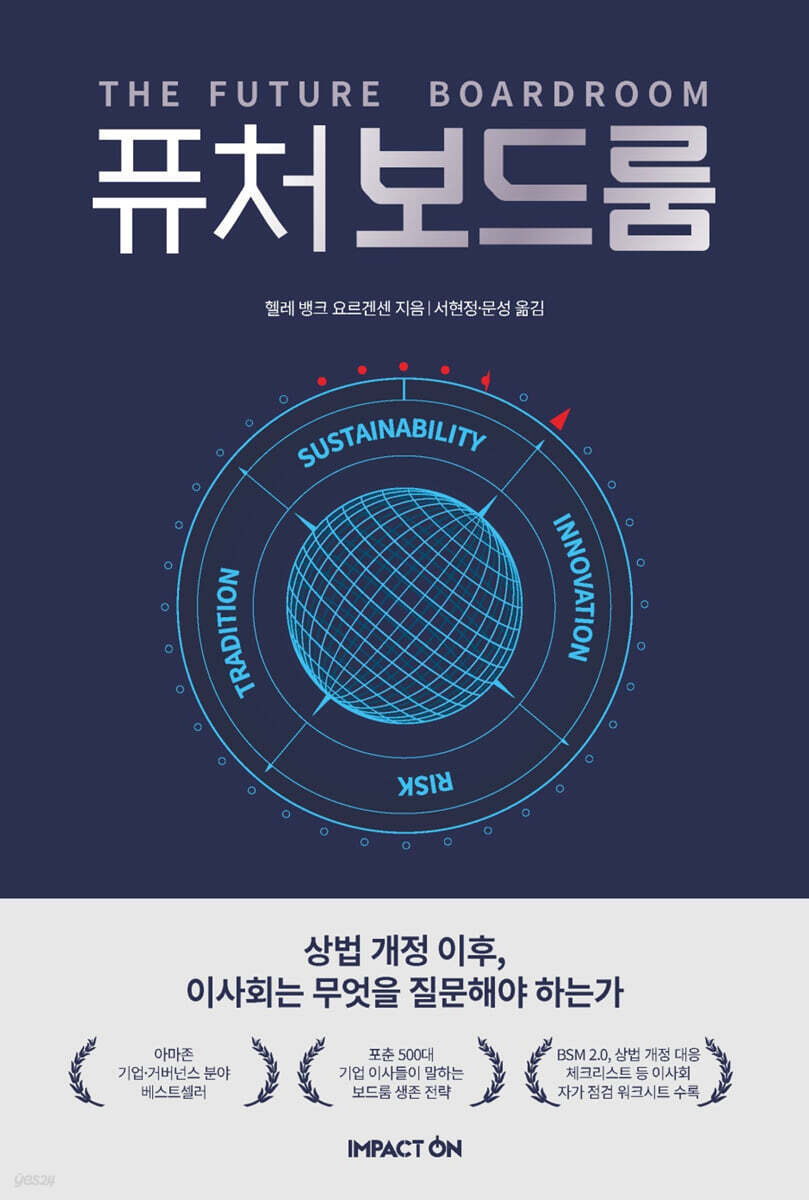
Future Boardroom
 |
Description
Book Introduction
The era of the "rubber band" is over. What questions should boards ask?
With the revision of the Commercial Act in July 2025, the scope of directors' duty of loyalty was expanded from the existing 'company' to 'the company and shareholders.'
Outside directors have been renamed “independent directors,” and their responsibilities have been significantly strengthened.
If an independent director violates his or her duty of loyalty or duty of fairness, all shareholders, including minority shareholders, can file a lawsuit.
The market environment is also complex.
In an era of intersecting uncertainties, including nationalism, hegemonic competition, the proliferation of AI, and stakeholder risk, boards of directors that simply repeat formal procedures are limited in their ability to respond.
The board of directors has now established itself as a key governance body that determines the survival and sustainability of a company.
Drawing on the experiences of Fortune 500 board members and global best practices, The Future Boardroom offers specific guidance on the questions boards should ask and the decisions they should make in this era of turbulent change.
Author Helle Bank Jorgensen is CEO and founder of Competent Boards, an international board training and certification organization, and a governance expert who has trained thousands of directors and CEOs in 55 countries.
He emphasizes the adaptability and resilience that boards must demonstrate amidst overlapping challenges such as geopolitical risks, protectionism, climate change, AI, and Generation Z.
This book has been recommended by global leaders such as André Hoffmann, Vice Chairman of Roche Holding, Paul Polman, former CEO of Unilever, Jane Deeplock, Director of the Global Reporting Initiative, and Jingdong Hua, Vice Chair of the International Sustainability Standards Board.
With the revision of the Commercial Act in July 2025, the scope of directors' duty of loyalty was expanded from the existing 'company' to 'the company and shareholders.'
Outside directors have been renamed “independent directors,” and their responsibilities have been significantly strengthened.
If an independent director violates his or her duty of loyalty or duty of fairness, all shareholders, including minority shareholders, can file a lawsuit.
The market environment is also complex.
In an era of intersecting uncertainties, including nationalism, hegemonic competition, the proliferation of AI, and stakeholder risk, boards of directors that simply repeat formal procedures are limited in their ability to respond.
The board of directors has now established itself as a key governance body that determines the survival and sustainability of a company.
Drawing on the experiences of Fortune 500 board members and global best practices, The Future Boardroom offers specific guidance on the questions boards should ask and the decisions they should make in this era of turbulent change.
Author Helle Bank Jorgensen is CEO and founder of Competent Boards, an international board training and certification organization, and a governance expert who has trained thousands of directors and CEOs in 55 countries.
He emphasizes the adaptability and resilience that boards must demonstrate amidst overlapping challenges such as geopolitical risks, protectionism, climate change, AI, and Generation Z.
This book has been recommended by global leaders such as André Hoffmann, Vice Chairman of Roche Holding, Paul Polman, former CEO of Unilever, Jane Deeplock, Director of the Global Reporting Initiative, and Jingdong Hua, Vice Chair of the International Sustainability Standards Board.
index
Publisher's Note: Park Ran-hee, CEO of Impact On
Before we begin, Seo Hyun-jung, CEO of Competent Board Korea
Competency Board - What Does a Global Board Ask?
Chapter 1.
A storm of change has swept over the board of directors.
Chapter 2.
When it's time to make a new plate
Chapter 3.
The changing governance environment
Chapter 4.
Roadmap to the future
Chapter 5.
Competence, curiosity, courage, and empathy
Chapter 6.
Who will be on the board of directors of the future?
Chapter 7.
Technology: To Control or Be Controlled
Chapter 8.
From shareholders to stakeholders
Chapter 9.
Chairman, architect of the board
Chapter 10.
Execution Strategy
Boardroom Executive Notes
What Should Boards of Directors Ask After the Commercial Act Amendment? _Yulchon Law Firm Partner Moon Seong
Self-Check Worksheet for Strategic Boards
Board Competency Matrix 2.0
Practical Regulatory Response Checklist
References
Before we begin, Seo Hyun-jung, CEO of Competent Board Korea
Competency Board - What Does a Global Board Ask?
Chapter 1.
A storm of change has swept over the board of directors.
Chapter 2.
When it's time to make a new plate
Chapter 3.
The changing governance environment
Chapter 4.
Roadmap to the future
Chapter 5.
Competence, curiosity, courage, and empathy
Chapter 6.
Who will be on the board of directors of the future?
Chapter 7.
Technology: To Control or Be Controlled
Chapter 8.
From shareholders to stakeholders
Chapter 9.
Chairman, architect of the board
Chapter 10.
Execution Strategy
Boardroom Executive Notes
What Should Boards of Directors Ask After the Commercial Act Amendment? _Yulchon Law Firm Partner Moon Seong
Self-Check Worksheet for Strategic Boards
Board Competency Matrix 2.0
Practical Regulatory Response Checklist
References
Into the book
Boards are now faced with a challenge that goes beyond mere management; they must redesign the entire business model, products, supply chain, organizational culture, and control systems.
And we are only at the beginning of that change.
--- p.34, Chapter 1.
From “The Storm of Change that Covered the Board of Directors”
Regulators around the world are taking a closer look at key issues such as board oversight, corporate transparency, and disclosure quality, and non-governmental organizations that set standards across borders are becoming more active.
In this context, the board of directors must closely monitor changes in the regulatory environment and, if possible, establish a response strategy one step ahead.
--- p.46, Chapter 1.
From “The Storm of Change that Covered the Board of Directors”
Above all, the threshold for entry into the board of directors is becoming increasingly higher.
As the demand for diversity grows stronger, the trend toward preferring "generalists" with broad perspectives and insight over specialists in specific fields is also becoming more evident.
Competition for positions is bound to become fiercer.
--- p.73, Chapter 2.
From "When to Make a New Board"
The first thing a board of directors should do is establish a Board Competency Matrix (BSM).
The starting point is to clearly define what expertise and experience is required and then select the right person based on those criteria.
The size of the board of directors and the authority of its committees may be determined thereafter.
--- p.117, Chapter 4.
From “Roadmap to the Future”
The influence of the National Pension Service goes beyond simple checks and balances.
Currently, the company holds approximately 160 trillion won in domestic stocks for long-term, and there are over 280 listed companies in which it holds more than 5% of shares.
The average shareholding ratio per company is also over 6%, effectively functioning as a 'shareholder with veto power' in many listed companies.
In fact, some companies are experiencing a growing sense of crisis that a single vote of opposition from the National Pension Service could lead to the failure of director appointments.
--- p.253, from “Boardroom Implementation Notes”
This revision expands the scope of application from "the company" to "all shareholders" and adds the phrases "fair treatment of all shareholders" and "protection of the interests of majority shareholders," thereby elevating the protection of minority shareholders to an explicit responsibility of the board of directors.
In particular, in situations where the interests of controlling and general shareholders conflict, if a director makes a decision based on a specific benefit without a reasonable basis, legal liability, such as a shareholder derivative suit or breach of trust, may become a reality.
--- p.254, from “Boardroom Implementation Notes”
Now, the general meeting of shareholders is no longer a formality to pass bills.
It is a place where a company's judgment is proven to be trustworthy in front of the market.
What matters is not 'what was decided', but whether 'why that decision was made' can be structurally explained.
Without a system in place to do this, no board can survive a crisis.
And we are only at the beginning of that change.
--- p.34, Chapter 1.
From “The Storm of Change that Covered the Board of Directors”
Regulators around the world are taking a closer look at key issues such as board oversight, corporate transparency, and disclosure quality, and non-governmental organizations that set standards across borders are becoming more active.
In this context, the board of directors must closely monitor changes in the regulatory environment and, if possible, establish a response strategy one step ahead.
--- p.46, Chapter 1.
From “The Storm of Change that Covered the Board of Directors”
Above all, the threshold for entry into the board of directors is becoming increasingly higher.
As the demand for diversity grows stronger, the trend toward preferring "generalists" with broad perspectives and insight over specialists in specific fields is also becoming more evident.
Competition for positions is bound to become fiercer.
--- p.73, Chapter 2.
From "When to Make a New Board"
The first thing a board of directors should do is establish a Board Competency Matrix (BSM).
The starting point is to clearly define what expertise and experience is required and then select the right person based on those criteria.
The size of the board of directors and the authority of its committees may be determined thereafter.
--- p.117, Chapter 4.
From “Roadmap to the Future”
The influence of the National Pension Service goes beyond simple checks and balances.
Currently, the company holds approximately 160 trillion won in domestic stocks for long-term, and there are over 280 listed companies in which it holds more than 5% of shares.
The average shareholding ratio per company is also over 6%, effectively functioning as a 'shareholder with veto power' in many listed companies.
In fact, some companies are experiencing a growing sense of crisis that a single vote of opposition from the National Pension Service could lead to the failure of director appointments.
--- p.253, from “Boardroom Implementation Notes”
This revision expands the scope of application from "the company" to "all shareholders" and adds the phrases "fair treatment of all shareholders" and "protection of the interests of majority shareholders," thereby elevating the protection of minority shareholders to an explicit responsibility of the board of directors.
In particular, in situations where the interests of controlling and general shareholders conflict, if a director makes a decision based on a specific benefit without a reasonable basis, legal liability, such as a shareholder derivative suit or breach of trust, may become a reality.
--- p.254, from “Boardroom Implementation Notes”
Now, the general meeting of shareholders is no longer a formality to pass bills.
It is a place where a company's judgment is proven to be trustworthy in front of the market.
What matters is not 'what was decided', but whether 'why that decision was made' can be structurally explained.
Without a system in place to do this, no board can survive a crisis.
--- p.262, from “Boardroom Implementation Notes”
Publisher's Review
A practical guide with global insights and Korean solutions.
"Future Boardroom" is more than just a theoretical book. It addresses core issues that boards cannot afford to ignore, such as ESG, supply chain human rights and the environment, data responsibility, cybersecurity, stakeholder disclosure, and sustainable AI, through real-world examples and critical questions.
Worksheets and checklists at the end of each chapter allow readers to self-assess their own boards and develop implementation strategies.
In particular, an appendix for domestic readers has been added to the Korean version.
Its usability has been enhanced by including checklists and practical materials addressing the practical challenges facing Korean companies, such as the strengthened responsibilities of independent directors due to the revision of the Commercial Act and strategies for responding to ESG disclosures and regulations.
While this book stands alone, it serves as the starting point for a learning package that will expand into training, workshops, and consulting in conjunction with the Global Certification Course (GCB.D) offered by Competent Board Korea.
A must-read for current and prospective independent directors, board secretaries, and ESG practitioners.
"Future Boardroom" presents the first step for Korean companies to move beyond simply following global trends and establish proactive governance.
"Future Boardroom" is more than just a theoretical book. It addresses core issues that boards cannot afford to ignore, such as ESG, supply chain human rights and the environment, data responsibility, cybersecurity, stakeholder disclosure, and sustainable AI, through real-world examples and critical questions.
Worksheets and checklists at the end of each chapter allow readers to self-assess their own boards and develop implementation strategies.
In particular, an appendix for domestic readers has been added to the Korean version.
Its usability has been enhanced by including checklists and practical materials addressing the practical challenges facing Korean companies, such as the strengthened responsibilities of independent directors due to the revision of the Commercial Act and strategies for responding to ESG disclosures and regulations.
While this book stands alone, it serves as the starting point for a learning package that will expand into training, workshops, and consulting in conjunction with the Global Certification Course (GCB.D) offered by Competent Board Korea.
A must-read for current and prospective independent directors, board secretaries, and ESG practitioners.
"Future Boardroom" presents the first step for Korean companies to move beyond simply following global trends and establish proactive governance.
GOODS SPECIFICS
- Date of issue: October 20, 2025
- Page count, weight, size: 294 pages | 152*225*14mm
- ISBN13: 9791198635310
- ISBN10: 1198635312
You may also like
카테고리
korean


korean

![GQ KOREA Mark (Monthly): December [2025]](http://librairie.coreenne.fr/cdn/shop/files/8ef265dbbfbf186523ed75ba7319009d.jpg?v=1765340328&width=3840)


