

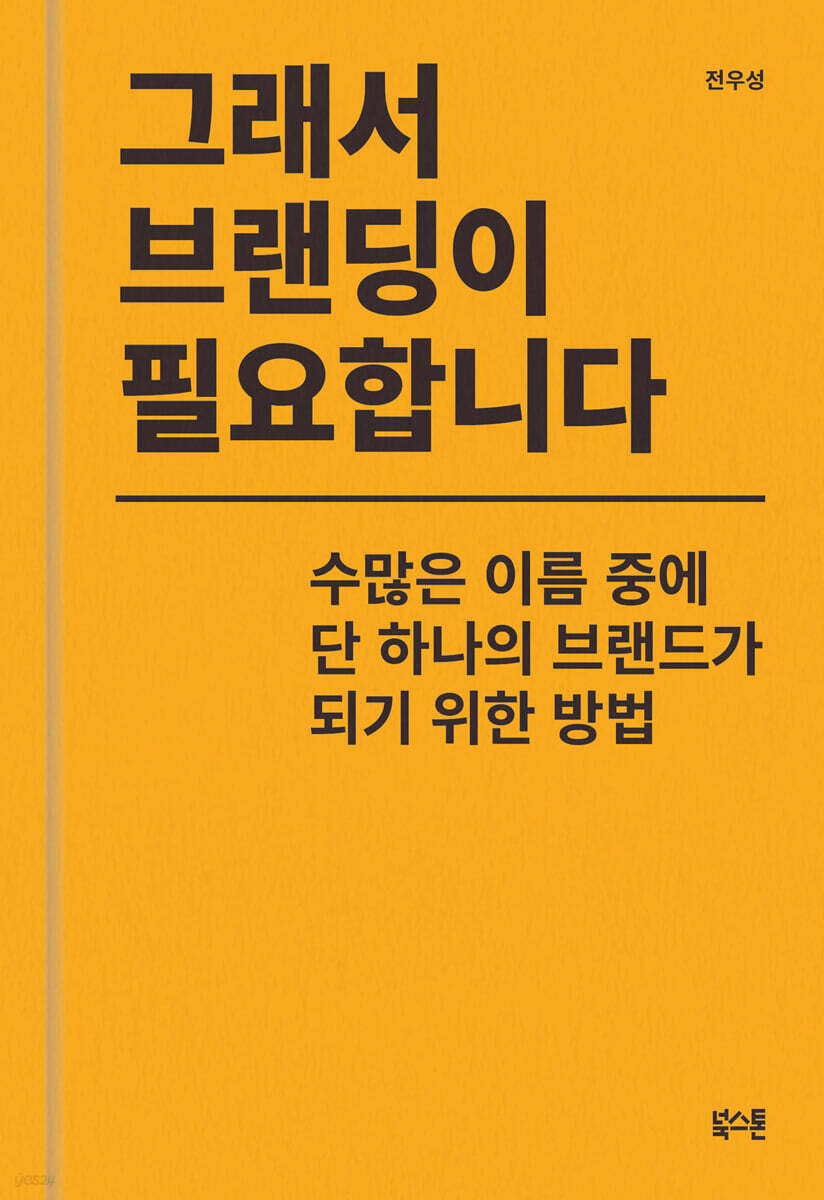
That's why branding is necessary.
 |
Description
Book Introduction
Want to create a brand that will be loved for a long time?
Branding Director Jeon Woo-seong's Experience and Thoughts on Branding
Branding isn't simply about creating a logo and planning a campaign. It's about defining your brand and designing experiences that will last in your customers' minds.
The author begins by asking the necessary questions for branding, and covers everything from differentiation strategies to building a sustainable fandom.
"That's Why Branding Is Necessary" provides clear direction and practical solutions to anyone considering branding.
For those new to branding, this book provides basic concepts and practical guidance, and for those working with branding in practice, it serves as a solid practical guide.
Branding Director Jeon Woo-seong's Experience and Thoughts on Branding
Branding isn't simply about creating a logo and planning a campaign. It's about defining your brand and designing experiences that will last in your customers' minds.
The author begins by asking the necessary questions for branding, and covers everything from differentiation strategies to building a sustainable fandom.
"That's Why Branding Is Necessary" provides clear direction and practical solutions to anyone considering branding.
For those new to branding, this book provides basic concepts and practical guidance, and for those working with branding in practice, it serves as a solid practical guide.
- You can preview some of the book's contents.
Preview
index
Author's Note
With the release of a new revised edition
prolog
For those who are thinking about branding
Why do you need branding?
Brands and Branding
One person who is enthusiastic is better than 100 people who know a little bit.
NOTE: Emotion comes from unexpected details.
Branding is not part of marketing.
NOTE: Branding, what moves the heart
Questions for Branding
Brand Identity: Defining Your Brand
Defining your brand mission and core experiences
Different
Make yourself known differently from others
Even common giveaway events are different from others
Is it possible to brand with unique events alone?
To remain in people's memories for a long time
NOTE Authenticity, the sincerity of a brand is powerful.
Putting a period in people's hearts
NOTE What is a brand experience?
Make an impression with an unexpected appearance
NOTE Why your last experience matters
What kind of relationship will you have with your customers?
NOTE: Segment customers by lifestyle, not gender or age.
Can't PBs also incorporate brand identity?
Communicate your message with a brand campaign
NOTE Our brand's unique wit and sense
Let's spread the word about successful branding results.
NOTE: There is no plan that satisfies everyone.
Why We Need to Define 'Next'
NOTE Thoughts on Internal Branding
Brand value is corporate value
A great brand remains in the hearts of customers even after death.
NOTE Branding is not a design term.
For those starting out with branding
NOTE: Logic and rules do not apply to branding.
Habits Needed for Good Branding Planning
NOTE Why I Don't Blindly Trust Case Studies
Things to Avoid When Planning a Branding
Branding vs. Performance Marketing
The Role of a Branding Director
Qualities of a Good Brand Marketer
NOTE: A brief reflection on personal branding
To become a brand that will be loved for a long time
Epilogue
With the release of a new revised edition
prolog
For those who are thinking about branding
Why do you need branding?
Brands and Branding
One person who is enthusiastic is better than 100 people who know a little bit.
NOTE: Emotion comes from unexpected details.
Branding is not part of marketing.
NOTE: Branding, what moves the heart
Questions for Branding
Brand Identity: Defining Your Brand
Defining your brand mission and core experiences
Different
Make yourself known differently from others
Even common giveaway events are different from others
Is it possible to brand with unique events alone?
To remain in people's memories for a long time
NOTE Authenticity, the sincerity of a brand is powerful.
Putting a period in people's hearts
NOTE What is a brand experience?
Make an impression with an unexpected appearance
NOTE Why your last experience matters
What kind of relationship will you have with your customers?
NOTE: Segment customers by lifestyle, not gender or age.
Can't PBs also incorporate brand identity?
Communicate your message with a brand campaign
NOTE Our brand's unique wit and sense
Let's spread the word about successful branding results.
NOTE: There is no plan that satisfies everyone.
Why We Need to Define 'Next'
NOTE Thoughts on Internal Branding
Brand value is corporate value
A great brand remains in the hearts of customers even after death.
NOTE Branding is not a design term.
For those starting out with branding
NOTE: Logic and rules do not apply to branding.
Habits Needed for Good Branding Planning
NOTE Why I Don't Blindly Trust Case Studies
Things to Avoid When Planning a Branding
Branding vs. Performance Marketing
The Role of a Branding Director
Qualities of a Good Brand Marketer
NOTE: A brief reflection on personal branding
To become a brand that will be loved for a long time
Epilogue
Into the book
A brand is a name that represents a country (even if that name is not necessarily my real name) and a symbol that symbolizes me.
Here, the symbol can be a face, or it can be a title that represents me, such as my affiliation or job title.
So what is branding? It's the entire process of making my name and symbol known to people.
To do that, I must first think carefully about what is my true self and how I will be remembered, and in the process, I must clearly define my unique differences from others.
It needs to be clearly defined.
If we apply this to me, I am called by the name of ‘Jeon Woo-seong.’
And my name says 'Branding Director'
I express myself externally by attaching symbols to it.
So the brand is now complete.
Because I have a name that people call me by, and a symbol that people use to represent me.
That is, I myself defined myself as this brand.
--- From "Brands and Branding"
If you're in charge of branding at a company, rather than approaching it as a marketing tool simply to generate immediate sales, you should look back at the points where customers interact with your brand and identify the ones that will leave the most distinctive impression.
If not, we need to redesign it and think about how to present and communicate it.
Rather than simply replacing a company's logo and symbol with a new design under the guise of "rebranding," it is far more important to think about these aspects and find solutions for branding.
Whether the answer lies in the realm of technology, UX, customer service and delivery, or the founding story or philosophy.
--- From "Branding is not part of marketing"
We also wanted to differentiate our communication methods for announcing and delivering events.
We designed a recruitment poster that resembled a wall poster to convey the exciting missions and prize news of this event.
In other words, rather than the typical communication method of asking people to participate in such events, we started to inform people by putting the message on posters that said, 'We are looking for someone who can spend all 10 million won within a month.'
This type of delivery method has further aroused people's curiosity and desire for challenge.
--- From "Making Myself Known as Different from Others"
There is a term called 'The Peak-End Rule'.
As you can see from the combined words, this is a theory that when evaluating the experience of a specific object, it is determined by the average of the peak experience (or memory) and the last experience, rather than the sum of the accumulated experiences about the object.
To put it simply, when we evaluate someone, it is not all the memories accumulated from the moment we first met them until now that create that person's image, but rather the experience (or memory) of the moment that left the greatest impression on me (whether positive or negative) and the last experience I had with that person that have the greatest influence on my image.
This can equally apply to the products or brands we use.
--- From "Why Your Last Experience Matters"
Nowadays, even most e-commerce companies are releasing their own Private Brand (PB) products.
However, it is not easy to infuse ‘brand identity’ into the product.
This is because most people have not been able to perfectly define ‘brand identity.’
It's not just about matching design colors with the brand's tone and manner.
If the goal is to sell the product permanently as a brand, rather than to create and sell (or give away) a limited-time product for a promotion or special event, and especially if the product is sold with the brand name on it, the brand identity must be reflected in it in some way.
The launch of such products will soon lead to an expansion of branding, which will help differentiate the company in a highly competitive market.
--- From "Can't we incorporate brand identity into private label?"
Branding directors plan the big picture—the brand's identity, positioning, philosophy, and message to customers—and focus on how to differentiate themselves from the competition and build a unique brand experience.
Brand marketers, on the other hand, focus on managing touchpoints with consumers through various media based on this big picture and effectively communicating the brand message.
--- From "The Role of a Branding Director"
There's a question I always ask when I interview people.
We ask you what you think branding is and whether there are any specific experiences or reasons that led you to that idea.
As a brand marketer, you should be able to clearly articulate your own thoughts on this question.
But unfortunately, there are not many interviewees who will tell you in detail what they think the answer is.
Just by answering this question clearly, you can immediately tell how much the person is interested in branding in general.
Therefore, it is extremely important for brand marketers to be clear about their own thoughts on branding.
This way, we can better align with each other, and since we have an understanding of branding, we can create good synergy.
Here, the symbol can be a face, or it can be a title that represents me, such as my affiliation or job title.
So what is branding? It's the entire process of making my name and symbol known to people.
To do that, I must first think carefully about what is my true self and how I will be remembered, and in the process, I must clearly define my unique differences from others.
It needs to be clearly defined.
If we apply this to me, I am called by the name of ‘Jeon Woo-seong.’
And my name says 'Branding Director'
I express myself externally by attaching symbols to it.
So the brand is now complete.
Because I have a name that people call me by, and a symbol that people use to represent me.
That is, I myself defined myself as this brand.
--- From "Brands and Branding"
If you're in charge of branding at a company, rather than approaching it as a marketing tool simply to generate immediate sales, you should look back at the points where customers interact with your brand and identify the ones that will leave the most distinctive impression.
If not, we need to redesign it and think about how to present and communicate it.
Rather than simply replacing a company's logo and symbol with a new design under the guise of "rebranding," it is far more important to think about these aspects and find solutions for branding.
Whether the answer lies in the realm of technology, UX, customer service and delivery, or the founding story or philosophy.
--- From "Branding is not part of marketing"
We also wanted to differentiate our communication methods for announcing and delivering events.
We designed a recruitment poster that resembled a wall poster to convey the exciting missions and prize news of this event.
In other words, rather than the typical communication method of asking people to participate in such events, we started to inform people by putting the message on posters that said, 'We are looking for someone who can spend all 10 million won within a month.'
This type of delivery method has further aroused people's curiosity and desire for challenge.
--- From "Making Myself Known as Different from Others"
There is a term called 'The Peak-End Rule'.
As you can see from the combined words, this is a theory that when evaluating the experience of a specific object, it is determined by the average of the peak experience (or memory) and the last experience, rather than the sum of the accumulated experiences about the object.
To put it simply, when we evaluate someone, it is not all the memories accumulated from the moment we first met them until now that create that person's image, but rather the experience (or memory) of the moment that left the greatest impression on me (whether positive or negative) and the last experience I had with that person that have the greatest influence on my image.
This can equally apply to the products or brands we use.
--- From "Why Your Last Experience Matters"
Nowadays, even most e-commerce companies are releasing their own Private Brand (PB) products.
However, it is not easy to infuse ‘brand identity’ into the product.
This is because most people have not been able to perfectly define ‘brand identity.’
It's not just about matching design colors with the brand's tone and manner.
If the goal is to sell the product permanently as a brand, rather than to create and sell (or give away) a limited-time product for a promotion or special event, and especially if the product is sold with the brand name on it, the brand identity must be reflected in it in some way.
The launch of such products will soon lead to an expansion of branding, which will help differentiate the company in a highly competitive market.
--- From "Can't we incorporate brand identity into private label?"
Branding directors plan the big picture—the brand's identity, positioning, philosophy, and message to customers—and focus on how to differentiate themselves from the competition and build a unique brand experience.
Brand marketers, on the other hand, focus on managing touchpoints with consumers through various media based on this big picture and effectively communicating the brand message.
--- From "The Role of a Branding Director"
There's a question I always ask when I interview people.
We ask you what you think branding is and whether there are any specific experiences or reasons that led you to that idea.
As a brand marketer, you should be able to clearly articulate your own thoughts on this question.
But unfortunately, there are not many interviewees who will tell you in detail what they think the answer is.
Just by answering this question clearly, you can immediately tell how much the person is interested in branding in general.
Therefore, it is extremely important for brand marketers to be clear about their own thoughts on branding.
This way, we can better align with each other, and since we have an understanding of branding, we can create good synergy.
--- From "Qualities of a Good Brand Marketer"
Publisher's Review
A journey to define and promote your own brand.
Branding is no longer an option, it is a necessity for survival.
In an era where product differentiation is becoming increasingly difficult and consumers' eyes are becoming increasingly discerning, defining a brand's identity and value determines its success or failure in the market.
This book begins with questions about branding, but it doesn't stop there.
The author provides concrete examples and methodologies based on his own experience, helping readers define and promote their own brands.
What is our brand identity?
Are we providing a differentiated experience for our customers?
Are the messages and actions your brand conveys consistent and authentic?
Are you building a loyal community and fandom through customer interactions?
Are you pursuing sustainable branding that aims for long-term, not short-term, results?
The author details his personal experiences with various brands in his daily life, as well as his own branding projects he planned while working at Style Share and 29CM.
From defining your brand identity to determining your brand mission and core experience, how to create one passionate fan rather than a hundred who know you vaguely, the process of building brand fandom by utilizing detailed touchpoints with customers, the habits necessary for good branding planning, and the conditions for becoming a brand marketer, we have systematically organized them all.
Branding is a difficult and long journey.
However, if you can establish your brand's unique identity through differentiation and connect it to a touching customer experience, you can go beyond simply securing customers and create a passionate fan base.
"So You Need Branding" is a practical guide that demonstrates this process.
This book will provide guidance to brand marketers who need to promote their products and services, individuals and businesses seeking a new turning point for their brands, and those contemplating brand identity and fandom.
Branding is ultimately about moving people's hearts.
The author defines branding as 'the work of moving people's hearts.'
This is why we emphasize that we must focus on the authenticity and value of the brand, as well as the impression it leaves on people, rather than just focusing on short-term sales increases.
“Branding is the process of touching people’s hearts and turning them into fans of our brand.
There is no such thing as logic or laws in moving the human heart.
If such a thing existed, everyone would be successful in their relationships and everyone would get what they want from each other.
There is no way to win people's hearts other than by constantly appealing to them, constantly interacting with them, persuading them, and showing sincerity.
“The same goes for branding.” - From the text.
The growing need for branding stems from the reality that digital advertising is becoming less effective and simple marketing activities are increasingly difficult to use to gain consumer trust.
"That's why branding is necessary" clearly states that the goal of branding is to "create one person who is enthusiastic rather than 100 who vaguely know," and preaches the importance of branding from a long-term perspective.
Ultimately, branding is about moving the heart, and fandom is what proves and broadens the depth of that heart.
Fandom drives true branding success by creating an emotional connection between brand and consumer, beyond simple product consumption.
That's why I recommend this book to anyone who wants to explore the essence of branding and create a brand that will remain in people's hearts for a long time.
7 Tips for Sustainable Branding
1.
It's better to have one person who is enthusiastic than 100 who know a little.
The goal of branding is not to be vaguely known to many people, but to secure even one customer who becomes an ardent fan of the brand.
These fans become evangelists for the brand.
2.
Find emotion in the details
Customers feel the brand's sincerity and value in the small details.
Design details that touch your customers' hearts at unexpected moments.
3.
Branding is not marketing.
Branding goes beyond selling products; it's a long-term strategy that delivers consistent experiences and value across all touchpoints with customers.
This is distinct from short-term performance.
4.
Define your brand's look
The beginning of branding is defining for yourself, "What should our brand look like?"
Clarify your brand identity and values, and design all your activities to reflect them.
5.
Authenticity is the most powerful weapon
The brand's sincerity is conveyed directly to customers.
Pretentious and flashy branding doesn't last long.
To gain customer trust, compete with sincerity.
6.
There is no survival without differentiation.
Branding is the process of showing your differences from others.
Clearly differentiate yourself from other brands and express this consistently.
A brand's 'difference' is essential for survival.
7.
Branding never ends
Branding is a work in progress.
Because customers and markets are constantly changing, brands must also continue to change and evolve.
You will achieve more if you enjoy the process of growing rather than aiming for perfection.
This book is a revised edition of "So, Branding Is Necessary," published in 2021.
Branding is no longer an option, it is a necessity for survival.
In an era where product differentiation is becoming increasingly difficult and consumers' eyes are becoming increasingly discerning, defining a brand's identity and value determines its success or failure in the market.
This book begins with questions about branding, but it doesn't stop there.
The author provides concrete examples and methodologies based on his own experience, helping readers define and promote their own brands.
What is our brand identity?
Are we providing a differentiated experience for our customers?
Are the messages and actions your brand conveys consistent and authentic?
Are you building a loyal community and fandom through customer interactions?
Are you pursuing sustainable branding that aims for long-term, not short-term, results?
The author details his personal experiences with various brands in his daily life, as well as his own branding projects he planned while working at Style Share and 29CM.
From defining your brand identity to determining your brand mission and core experience, how to create one passionate fan rather than a hundred who know you vaguely, the process of building brand fandom by utilizing detailed touchpoints with customers, the habits necessary for good branding planning, and the conditions for becoming a brand marketer, we have systematically organized them all.
Branding is a difficult and long journey.
However, if you can establish your brand's unique identity through differentiation and connect it to a touching customer experience, you can go beyond simply securing customers and create a passionate fan base.
"So You Need Branding" is a practical guide that demonstrates this process.
This book will provide guidance to brand marketers who need to promote their products and services, individuals and businesses seeking a new turning point for their brands, and those contemplating brand identity and fandom.
Branding is ultimately about moving people's hearts.
The author defines branding as 'the work of moving people's hearts.'
This is why we emphasize that we must focus on the authenticity and value of the brand, as well as the impression it leaves on people, rather than just focusing on short-term sales increases.
“Branding is the process of touching people’s hearts and turning them into fans of our brand.
There is no such thing as logic or laws in moving the human heart.
If such a thing existed, everyone would be successful in their relationships and everyone would get what they want from each other.
There is no way to win people's hearts other than by constantly appealing to them, constantly interacting with them, persuading them, and showing sincerity.
“The same goes for branding.” - From the text.
The growing need for branding stems from the reality that digital advertising is becoming less effective and simple marketing activities are increasingly difficult to use to gain consumer trust.
"That's why branding is necessary" clearly states that the goal of branding is to "create one person who is enthusiastic rather than 100 who vaguely know," and preaches the importance of branding from a long-term perspective.
Ultimately, branding is about moving the heart, and fandom is what proves and broadens the depth of that heart.
Fandom drives true branding success by creating an emotional connection between brand and consumer, beyond simple product consumption.
That's why I recommend this book to anyone who wants to explore the essence of branding and create a brand that will remain in people's hearts for a long time.
7 Tips for Sustainable Branding
1.
It's better to have one person who is enthusiastic than 100 who know a little.
The goal of branding is not to be vaguely known to many people, but to secure even one customer who becomes an ardent fan of the brand.
These fans become evangelists for the brand.
2.
Find emotion in the details
Customers feel the brand's sincerity and value in the small details.
Design details that touch your customers' hearts at unexpected moments.
3.
Branding is not marketing.
Branding goes beyond selling products; it's a long-term strategy that delivers consistent experiences and value across all touchpoints with customers.
This is distinct from short-term performance.
4.
Define your brand's look
The beginning of branding is defining for yourself, "What should our brand look like?"
Clarify your brand identity and values, and design all your activities to reflect them.
5.
Authenticity is the most powerful weapon
The brand's sincerity is conveyed directly to customers.
Pretentious and flashy branding doesn't last long.
To gain customer trust, compete with sincerity.
6.
There is no survival without differentiation.
Branding is the process of showing your differences from others.
Clearly differentiate yourself from other brands and express this consistently.
A brand's 'difference' is essential for survival.
7.
Branding never ends
Branding is a work in progress.
Because customers and markets are constantly changing, brands must also continue to change and evolve.
You will achieve more if you enjoy the process of growing rather than aiming for perfection.
This book is a revised edition of "So, Branding Is Necessary," published in 2021.
GOODS SPECIFICS
- Date of issue: January 22, 2025
- Format: Hardcover book binding method guide
- Page count, weight, size: 248 pages | 370g | 135*194*18mm
- ISBN13: 9791193063750
- ISBN10: 1193063752
You may also like
카테고리
korean


korean

![GQ KOREA Mark (Monthly): December [2025]](http://librairie.coreenne.fr/cdn/shop/files/8ef265dbbfbf186523ed75ba7319009d.jpg?v=1765340328&width=3840)


