

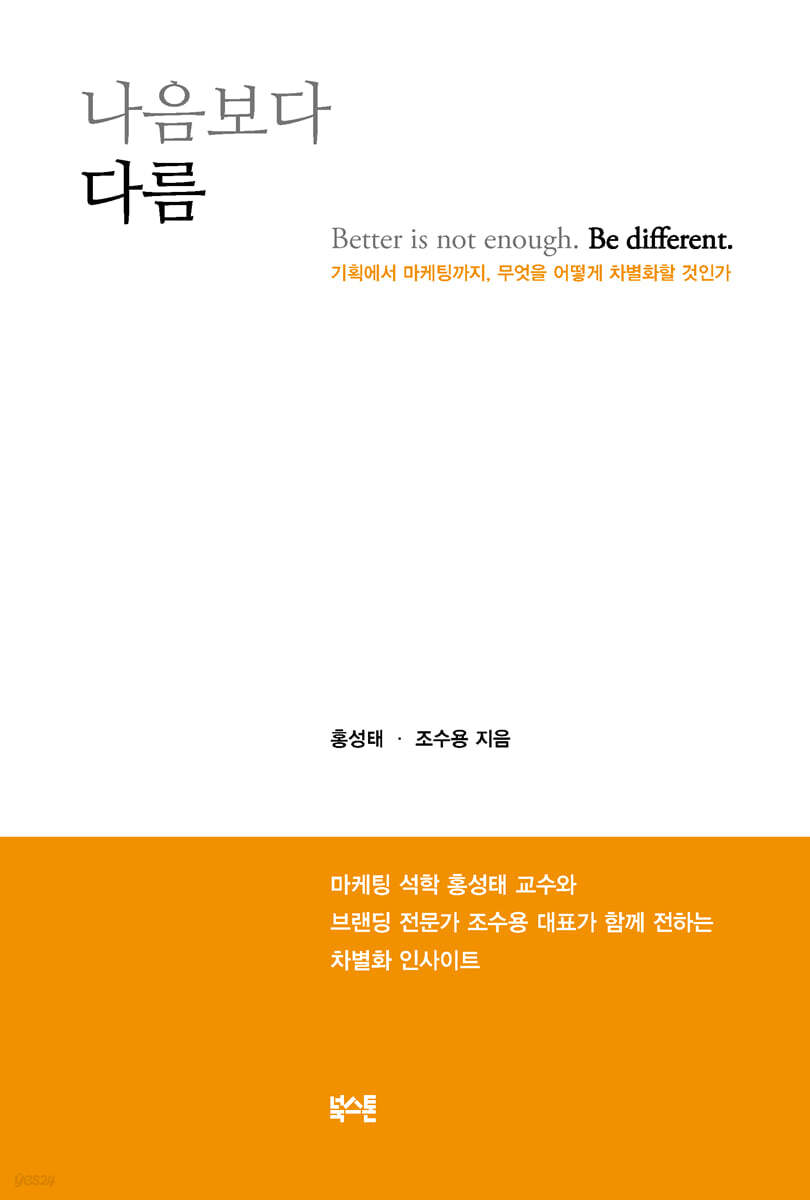
Different than better
 |
Description
Book Introduction
It's not 'better' that wins, it's 'different'!
Products that are so similar that it’s hard to tell them apart unless you look closely, stores that have slightly different names but similar tastes and atmospheres… .
In today's world, where countless products and brands are emerging every day, everyone's concern is, "How can I sell better?"
The answer is obvious.
It's okay to be different from others.
So, all companies are racking their brains to come up with differentiated products.
In the conference room, the boss keeps asking, “Don’t you have any sharp ideas?” and the engineers stay up all night aiming for a product that doesn’t exist in the world.
But the public doesn't budge unless something is quite different.
Even if a groundbreaking idea or new product emerges that can turn the world upside down, it is easy to quickly fall behind because technology has become so similar.
Still, there will certainly be brands that survive and beloved companies.
So how can we survive in this cutthroat competition? How can we achieve differentiation? This book is about that.
There is something you must keep in mind at this time.
If you become obsessed with differentiation, you can easily fall into the 'innovation trap'.
Whether we know it or not, when we talk about differentiation, we seem to feel a compulsion to create something new and groundbreaking.
However, just as important as the 'actual difference' in quality or technology is the 'difference in perception'.
Physical differences can be quickly overcome by competitors, but perceptual differences, once ingrained in people's minds, are much more difficult to replicate.
In other words, true differentiation takes place in people's minds, through 'perception'.
The 'difference' discussed in this book is not something bigger or better, but rather the process of 'making people aware of' very small differences.
Products that are so similar that it’s hard to tell them apart unless you look closely, stores that have slightly different names but similar tastes and atmospheres… .
In today's world, where countless products and brands are emerging every day, everyone's concern is, "How can I sell better?"
The answer is obvious.
It's okay to be different from others.
So, all companies are racking their brains to come up with differentiated products.
In the conference room, the boss keeps asking, “Don’t you have any sharp ideas?” and the engineers stay up all night aiming for a product that doesn’t exist in the world.
But the public doesn't budge unless something is quite different.
Even if a groundbreaking idea or new product emerges that can turn the world upside down, it is easy to quickly fall behind because technology has become so similar.
Still, there will certainly be brands that survive and beloved companies.
So how can we survive in this cutthroat competition? How can we achieve differentiation? This book is about that.
There is something you must keep in mind at this time.
If you become obsessed with differentiation, you can easily fall into the 'innovation trap'.
Whether we know it or not, when we talk about differentiation, we seem to feel a compulsion to create something new and groundbreaking.
However, just as important as the 'actual difference' in quality or technology is the 'difference in perception'.
Physical differences can be quickly overcome by competitors, but perceptual differences, once ingrained in people's minds, are much more difficult to replicate.
In other words, true differentiation takes place in people's minds, through 'perception'.
The 'difference' discussed in this book is not something bigger or better, but rather the process of 'making people aware of' very small differences.
- You can preview some of the book's contents.
Preview
index
preface
"How can I sell better?" / "I know you're a good person."
prolog.
Small differences lead to big success
Part 1: Adding 'Difference' to Familiarity
- What are the triggers that determine a purchase?
First, satisfy the law of minimum quantity / Even if it is 'slightly' different, you can dominate the market / Who will be your competition / Why can't we tell the difference between black people's faces / You need to be good at comparing to make the difference stand out / People like to categorize / Any product can be recognized as unique / The crisis of extinction is a new opportunity for evolution
Part 2.
How to 'make' difference
- Can you survive with 'low prices'?
"We need to achieve both cost and volume" / A low-price strategy that's never easy to succeed / Our market is too small to survive on low prices alone /
Can we compete on the basis of value for money?
"Good books at affordable prices" / The value of "quality for the price" / In an era where "good enough is good enough" is the standard / Efficiency is key to achieving high cost-effectiveness.
- Can it appeal with a unique 'feature'?
"What kind of sneakers does Jobs wear?" / A 'small' feature that moves one person's heart / Ideas emerge from customer annoyance.
- Can you achieve the best 'quality'?
"Beyond Convenience, There's Craftsmanship." / Three Elements That Measure Quality / Realizing the Dream of a Premium Brand
- Are you confident that you can create a 'fame'?
"We're not selling time-telling machines." / A good image never develops on its own. / Once a customer is tamed, they don't leave easily. / A good company is a strong company.
- What should I do to promote my brand?
Five Competitive Advantages of Differentiation
Part 3.
How to 'show' the difference
- Does it seem like the first?
"Sunglasses that have become originals" / Instill the perception that you started before others / "They'll be old fashioned in two weeks" / Instill the perception that you're the latest / "What's better than a truck tarp?" / Instill the perception that you embody the philosophy of the times
- Does it seem like there is only one?
"Cheap sandals as a fashion item?" / Create the perception that you have a unique design / "Are you a pharmacy or a cosmetics store?" / Create the perception that you are a specialist in a specific field / "I ride a bike that I designed" / Create the perception that this is "my own product" that I created
- Does it look like the best in one field?
"One #1 brand is better than 10 #2 brands" / Instill the perception that this is a successful product / "Ask someone who knows something" / Instill the perception that this is a product favored by celebrities / "We sell a history that spans over 100 years" / Instill the perception that this is a product with a long history
- In what direction will it be shown?
From a consumer's perspective, it seems / Double the stakes / The narrower your target, the bigger the market becomes / Good ideas don't come alone
Part 4: How to 'maintain' difference
- Which category will you occupy?
The Brand Galaxy in Consumers' Minds / Finding the Stars to Develop Marketing
- Keep the brand on track
Maintain the 'essence' but keep changing the 'shell' / Occupy the stars in the hearts of consumers / Ultimately, branding is the key to all businesses / A brand must embody a philosophy to survive / The 'market' exists anytime, anywhere
Part 5.
How to 'check' the difference
- Products that have successfully differentiated themselves have something in common.
"Why are eco-friendly products fragrance-free?" / All differentiated products have 3D.
Differentiation is ultimately a "psychological" challenge.
Only when something is pleasing to the heart can it become a desirable characteristic: Desirable / Uniqueness that others do not have is life: Distinctive / Constant change is necessary to last: Durable / “We do not advertise how sharp our swords are” / All differentiation is up to the ‘heart to judge’
Epilogue: A World-Class Brand Created by Despair
"Look at the sole before you buy" / Humans are the only animals that change themselves.
"How can I sell better?" / "I know you're a good person."
prolog.
Small differences lead to big success
Part 1: Adding 'Difference' to Familiarity
- What are the triggers that determine a purchase?
First, satisfy the law of minimum quantity / Even if it is 'slightly' different, you can dominate the market / Who will be your competition / Why can't we tell the difference between black people's faces / You need to be good at comparing to make the difference stand out / People like to categorize / Any product can be recognized as unique / The crisis of extinction is a new opportunity for evolution
Part 2.
How to 'make' difference
- Can you survive with 'low prices'?
"We need to achieve both cost and volume" / A low-price strategy that's never easy to succeed / Our market is too small to survive on low prices alone /
Can we compete on the basis of value for money?
"Good books at affordable prices" / The value of "quality for the price" / In an era where "good enough is good enough" is the standard / Efficiency is key to achieving high cost-effectiveness.
- Can it appeal with a unique 'feature'?
"What kind of sneakers does Jobs wear?" / A 'small' feature that moves one person's heart / Ideas emerge from customer annoyance.
- Can you achieve the best 'quality'?
"Beyond Convenience, There's Craftsmanship." / Three Elements That Measure Quality / Realizing the Dream of a Premium Brand
- Are you confident that you can create a 'fame'?
"We're not selling time-telling machines." / A good image never develops on its own. / Once a customer is tamed, they don't leave easily. / A good company is a strong company.
- What should I do to promote my brand?
Five Competitive Advantages of Differentiation
Part 3.
How to 'show' the difference
- Does it seem like the first?
"Sunglasses that have become originals" / Instill the perception that you started before others / "They'll be old fashioned in two weeks" / Instill the perception that you're the latest / "What's better than a truck tarp?" / Instill the perception that you embody the philosophy of the times
- Does it seem like there is only one?
"Cheap sandals as a fashion item?" / Create the perception that you have a unique design / "Are you a pharmacy or a cosmetics store?" / Create the perception that you are a specialist in a specific field / "I ride a bike that I designed" / Create the perception that this is "my own product" that I created
- Does it look like the best in one field?
"One #1 brand is better than 10 #2 brands" / Instill the perception that this is a successful product / "Ask someone who knows something" / Instill the perception that this is a product favored by celebrities / "We sell a history that spans over 100 years" / Instill the perception that this is a product with a long history
- In what direction will it be shown?
From a consumer's perspective, it seems / Double the stakes / The narrower your target, the bigger the market becomes / Good ideas don't come alone
Part 4: How to 'maintain' difference
- Which category will you occupy?
The Brand Galaxy in Consumers' Minds / Finding the Stars to Develop Marketing
- Keep the brand on track
Maintain the 'essence' but keep changing the 'shell' / Occupy the stars in the hearts of consumers / Ultimately, branding is the key to all businesses / A brand must embody a philosophy to survive / The 'market' exists anytime, anywhere
Part 5.
How to 'check' the difference
- Products that have successfully differentiated themselves have something in common.
"Why are eco-friendly products fragrance-free?" / All differentiated products have 3D.
Differentiation is ultimately a "psychological" challenge.
Only when something is pleasing to the heart can it become a desirable characteristic: Desirable / Uniqueness that others do not have is life: Distinctive / Constant change is necessary to last: Durable / “We do not advertise how sharp our swords are” / All differentiation is up to the ‘heart to judge’
Epilogue: A World-Class Brand Created by Despair
"Look at the sole before you buy" / Humans are the only animals that change themselves.
Into the book
We seem to be suffering from a neurosis that, whether we know it or not, we must create something new and groundbreaking to differentiate ourselves.
However, if you become obsessed with the idea of being ahead of others, you can easily fall into the trap of innovation.
While creating a 'realistic difference' in quality or technology is important, creating a 'perceptual difference' is equally important.
Physical differences can be quickly overcome by competitors, but perceptual differences, once ingrained in people's minds, are much more difficult to replicate.
This is why the many books on differentiation on the market can be both interesting and sometimes frustrating.
The examples of differentiation in such books are truly astonishingly unique, and are full of products created with ingenious ideas or technologies that only a genius could have come up with.
But the real differentiation we need is how to make people realize that our chicken restaurant is different from the chicken restaurant next door.
The same goes for large corporations.
Occasionally, a surprising and novel product is born that turns the world upside down, but even the most outstanding companies cannot consistently produce world-changing innovations.
Perhaps the essence of marketing lies hidden in this dilemma.
Isn't the true role of marketing to create small improvements in the marketing that takes place every day and to 'make people aware' of them as meaningful differentiation?
- Prologue.
Small differences lead to big success
Seoul is well-known worldwide now, but when I was studying in the United States, my foreign friends knew almost nothing about Seoul.
I often got asked by them what Seoul was like, but it was difficult to describe Seoul in one word to a friend who had never been to Korea, especially in the 1980s.
I couldn't explain it by going back to the Joseon Dynasty, and just talking about the geographical location felt like something was missing.
So after much thought, I answered, "It's like Tokyo, but a more vibrant city." Surprisingly, they understood and used it to good effect.
Because Tokyo is more widely known than Seoul, most foreigners have a template for Tokyo.
Perhaps it is the image of an 'exotic Asian city'.
In other words, the leader in the category of 'exotic Asian cities' is Tokyo.
The description 'a place like Tokyo' is a way of using the point of parity (POP) with that image.
Next, we talk about the Point of Difference (POD).
'More vibrant' is exactly that.
When I joke that “Tokyo people go home at 11 p.m., but Seoul people come out of their houses at that time, so it’s a city that never sleeps,” people’s eyes widen and they immediately understand.
A simple sentence like, 'It's like Tokyo, but a more vibrant city' makes it easy to understand Seoul.
This is a way to highlight Seoul by using images of Tokyo.
- Part 1.
From ‘Adding Difference to Familiarity’
Jacoby's, a handmade burger restaurant in Itaewon, is famous for its 'gut-destroying burger.'
This burger, which has three slices of cheese, grilled onions, tomatoes, and chili sauce between two thick patties, is said to have been given this name because its stomach-destroying portion is so enormous.
This hamburger is so huge that people come from far and wide to hear about it, so you have to wait in a long line to eat it.
Malinho and Jacobis are undoubtedly unique and distinctive products that attract people's attention.
But I wonder how big of a brand these will grow into.
Products with strong differentiation characteristics start in niche markets.
While these products can become market-dominating brands, many times they disappear without anyone noticing.
In other words, even if a product is a hot topic due to its differentiation, if there is no strong driving force to keep it on a certain track, it is only a matter of time before it leaves the market.
There are five competitive advantages that can put a brand on track: price, value for money, functionality, quality, and reputation.
Which of these will serve as a differentiating force for our company depends on each company's capabilities and resources, such as its ability to raise funds, develop technology, and promote its image.
- Part 2.
How to make a difference
'How to make a real difference' is the driving force behind differentiation and the real competitive edge of a brand.
Trying to differentiate without making any real difference is like building a house on sand.
However, in addition to this, another level of differentiation is needed: 'how to create a difference in perception.'
Differentiation is only possible when these two dimensions are considered simultaneously and a double-track is laid.
The basic directions for demonstrating differentiation mostly fall into the nine communication scopes.
It may have two or more of the nine characteristics.
But don't be greedy and try to assert two or three things at the same time.
Most of what I'm good at, my competitors are good at too.
Instead, present one or two points concisely and powerfully.
The smaller the focus, the bigger the brand.
Resisting the temptation to expand your focus is the path to becoming a wise marketer.
This positioning is naturally closely related to targeting.
Sometimes people come to me with new products and ask for my advice on marketing.
The first question I ask then is, “Who is the main target?”
Surprisingly, many marketers want to include everyone in their basket, saying, "This product is primarily targeted at young people, but it's also good for older people, and it's used by men as well as women at various times."
However, the ideal target must be narrowed down.
-Part 3.
How to show 'difference'
What did Nike do right and what did Reebok do wrong? Nike never lost strategic focus.
And to maintain the concept of “Just Do It,” we continued to release new products.
Nike has continuously created products that appeal to teenagers who follow its signature spirit of challenge and middle-aged and older people who want to maintain their youthful appearance without neglecting exercise.
In short, the shell has changed, but the essence that runs through all products has not changed.
In contrast, Reebok was busy creating trend-following 'products' without a clear brand 'concept'.
Also, in an attempt to increase market share, they simplified the functions and design and sold it at a low price. In the short term, the market responded, but in the long term, those strengths ended up holding them back.
Such models had no room for new variations and could not be raised in price.
Moreover, their main target, housewives, have a significantly longer repurchase cycle than teenagers.
These factors combined to cause sales to decline.
It's definitely worthwhile to look at niche markets and try to stay abreast of trends.
However, it is difficult for it to take priority over the company's philosophy or consumer needs.
To stay on track, you have to constantly change, but if you lose your 'authenticity' and just follow trends, you will end up neither eating nor drinking.
To consistently differentiate yourself, you need to think deeply about your consumers and your products, not just look for gaps in the market.
Before changing the product's appearance, or "shell," the brand's core concept, its "essence," must be clearly defined and serious reflection on its uniqueness must be conducted.
-Part 4.
How to maintain 'difference'
Differentiation should not stop at simply being different from others, but should be thought of as a process of continuously creating '~ness'.
What comes to mind when you think of "Apple"? Everyone knows that Apple is creative.
How do we know? Because creativity is constantly being demonstrated in various forms.
The advertising alone is diverse, from the famous 1984 Macintosh commercial to those featuring celebrities including Pablo Picasso, Jim Henson, and Alfred Hitchcock.
But Apple's message of 'Think Different' remains unchanged.
Through its packaging, its products, and even its in-store customer service (Genius Bar), Apple delivers a consistent message of creativity.
Thanks to that, whether we like the message they put out or not, we can see what kind of company Apple is.
True differentiation comes from creating a brand's own image, philosophy, and feel.
It is no exaggeration to say that a brand that does not evoke a specific person when first seen, that is, a brand without feeling, is a failure.
When I see a good brand, I feel like I'm dealing with someone with clear values.
Aren't there people who stand out without having to dress up extravagantly, people who are memorable even without being handsome? Brands are no exception.
No matter how excellent the quality is, if it doesn't have its own unique color, it will be easily forgotten.
Conversely, even if the quality is not top-notch, if you can create a consistent image with your own color, you can become a long-lasting brand.
- Part 5.
How to 'check' the difference
However, if you become obsessed with the idea of being ahead of others, you can easily fall into the trap of innovation.
While creating a 'realistic difference' in quality or technology is important, creating a 'perceptual difference' is equally important.
Physical differences can be quickly overcome by competitors, but perceptual differences, once ingrained in people's minds, are much more difficult to replicate.
This is why the many books on differentiation on the market can be both interesting and sometimes frustrating.
The examples of differentiation in such books are truly astonishingly unique, and are full of products created with ingenious ideas or technologies that only a genius could have come up with.
But the real differentiation we need is how to make people realize that our chicken restaurant is different from the chicken restaurant next door.
The same goes for large corporations.
Occasionally, a surprising and novel product is born that turns the world upside down, but even the most outstanding companies cannot consistently produce world-changing innovations.
Perhaps the essence of marketing lies hidden in this dilemma.
Isn't the true role of marketing to create small improvements in the marketing that takes place every day and to 'make people aware' of them as meaningful differentiation?
- Prologue.
Small differences lead to big success
Seoul is well-known worldwide now, but when I was studying in the United States, my foreign friends knew almost nothing about Seoul.
I often got asked by them what Seoul was like, but it was difficult to describe Seoul in one word to a friend who had never been to Korea, especially in the 1980s.
I couldn't explain it by going back to the Joseon Dynasty, and just talking about the geographical location felt like something was missing.
So after much thought, I answered, "It's like Tokyo, but a more vibrant city." Surprisingly, they understood and used it to good effect.
Because Tokyo is more widely known than Seoul, most foreigners have a template for Tokyo.
Perhaps it is the image of an 'exotic Asian city'.
In other words, the leader in the category of 'exotic Asian cities' is Tokyo.
The description 'a place like Tokyo' is a way of using the point of parity (POP) with that image.
Next, we talk about the Point of Difference (POD).
'More vibrant' is exactly that.
When I joke that “Tokyo people go home at 11 p.m., but Seoul people come out of their houses at that time, so it’s a city that never sleeps,” people’s eyes widen and they immediately understand.
A simple sentence like, 'It's like Tokyo, but a more vibrant city' makes it easy to understand Seoul.
This is a way to highlight Seoul by using images of Tokyo.
- Part 1.
From ‘Adding Difference to Familiarity’
Jacoby's, a handmade burger restaurant in Itaewon, is famous for its 'gut-destroying burger.'
This burger, which has three slices of cheese, grilled onions, tomatoes, and chili sauce between two thick patties, is said to have been given this name because its stomach-destroying portion is so enormous.
This hamburger is so huge that people come from far and wide to hear about it, so you have to wait in a long line to eat it.
Malinho and Jacobis are undoubtedly unique and distinctive products that attract people's attention.
But I wonder how big of a brand these will grow into.
Products with strong differentiation characteristics start in niche markets.
While these products can become market-dominating brands, many times they disappear without anyone noticing.
In other words, even if a product is a hot topic due to its differentiation, if there is no strong driving force to keep it on a certain track, it is only a matter of time before it leaves the market.
There are five competitive advantages that can put a brand on track: price, value for money, functionality, quality, and reputation.
Which of these will serve as a differentiating force for our company depends on each company's capabilities and resources, such as its ability to raise funds, develop technology, and promote its image.
- Part 2.
How to make a difference
'How to make a real difference' is the driving force behind differentiation and the real competitive edge of a brand.
Trying to differentiate without making any real difference is like building a house on sand.
However, in addition to this, another level of differentiation is needed: 'how to create a difference in perception.'
Differentiation is only possible when these two dimensions are considered simultaneously and a double-track is laid.
The basic directions for demonstrating differentiation mostly fall into the nine communication scopes.
It may have two or more of the nine characteristics.
But don't be greedy and try to assert two or three things at the same time.
Most of what I'm good at, my competitors are good at too.
Instead, present one or two points concisely and powerfully.
The smaller the focus, the bigger the brand.
Resisting the temptation to expand your focus is the path to becoming a wise marketer.
This positioning is naturally closely related to targeting.
Sometimes people come to me with new products and ask for my advice on marketing.
The first question I ask then is, “Who is the main target?”
Surprisingly, many marketers want to include everyone in their basket, saying, "This product is primarily targeted at young people, but it's also good for older people, and it's used by men as well as women at various times."
However, the ideal target must be narrowed down.
-Part 3.
How to show 'difference'
What did Nike do right and what did Reebok do wrong? Nike never lost strategic focus.
And to maintain the concept of “Just Do It,” we continued to release new products.
Nike has continuously created products that appeal to teenagers who follow its signature spirit of challenge and middle-aged and older people who want to maintain their youthful appearance without neglecting exercise.
In short, the shell has changed, but the essence that runs through all products has not changed.
In contrast, Reebok was busy creating trend-following 'products' without a clear brand 'concept'.
Also, in an attempt to increase market share, they simplified the functions and design and sold it at a low price. In the short term, the market responded, but in the long term, those strengths ended up holding them back.
Such models had no room for new variations and could not be raised in price.
Moreover, their main target, housewives, have a significantly longer repurchase cycle than teenagers.
These factors combined to cause sales to decline.
It's definitely worthwhile to look at niche markets and try to stay abreast of trends.
However, it is difficult for it to take priority over the company's philosophy or consumer needs.
To stay on track, you have to constantly change, but if you lose your 'authenticity' and just follow trends, you will end up neither eating nor drinking.
To consistently differentiate yourself, you need to think deeply about your consumers and your products, not just look for gaps in the market.
Before changing the product's appearance, or "shell," the brand's core concept, its "essence," must be clearly defined and serious reflection on its uniqueness must be conducted.
-Part 4.
How to maintain 'difference'
Differentiation should not stop at simply being different from others, but should be thought of as a process of continuously creating '~ness'.
What comes to mind when you think of "Apple"? Everyone knows that Apple is creative.
How do we know? Because creativity is constantly being demonstrated in various forms.
The advertising alone is diverse, from the famous 1984 Macintosh commercial to those featuring celebrities including Pablo Picasso, Jim Henson, and Alfred Hitchcock.
But Apple's message of 'Think Different' remains unchanged.
Through its packaging, its products, and even its in-store customer service (Genius Bar), Apple delivers a consistent message of creativity.
Thanks to that, whether we like the message they put out or not, we can see what kind of company Apple is.
True differentiation comes from creating a brand's own image, philosophy, and feel.
It is no exaggeration to say that a brand that does not evoke a specific person when first seen, that is, a brand without feeling, is a failure.
When I see a good brand, I feel like I'm dealing with someone with clear values.
Aren't there people who stand out without having to dress up extravagantly, people who are memorable even without being handsome? Brands are no exception.
No matter how excellent the quality is, if it doesn't have its own unique color, it will be easily forgotten.
Conversely, even if the quality is not top-notch, if you can create a consistent image with your own color, you can become a long-lasting brand.
- Part 5.
How to 'check' the difference
--- From the text
Publisher's Review
It's not 'better' that wins, it's 'different'!
Products that are so similar that it’s hard to tell them apart unless you look closely, stores that have slightly different names but similar tastes and atmospheres… .
In today's world, where countless products and brands are emerging every day, everyone's concern is, "How can I sell better?"
The answer is obvious.
It's okay to be different from others.
So, all companies are racking their brains to come up with differentiated products.
In the conference room, the boss keeps asking, “Don’t you have any sharp ideas?” and the engineers stay up all night aiming for a product that doesn’t exist in the world.
But the public doesn't budge unless something is quite different.
Even if a groundbreaking idea or new product emerges that can turn the world upside down, it is easy to quickly fall behind because technology has become so similar.
Still, there will certainly be brands that survive and beloved companies.
So how can we survive in this cutthroat competition? How can we achieve differentiation? This book is about that.
There is something you must keep in mind at this time.
If you become obsessed with differentiation, you can easily fall into the 'innovation trap'.
Whether we know it or not, when we talk about differentiation, we seem to feel a compulsion to create something new and groundbreaking.
However, just as important as the 'actual difference' in quality or technology is the 'difference in perception'.
Physical differences can be quickly overcome by competitors, but perceptual differences, once ingrained in people's minds, are much more difficult to replicate.
In other words, true differentiation takes place in people's minds, through 'perception'.
The 'difference' discussed in this book is not something bigger or better, but rather the process of 'making people aware of' very small differences.
A roadmap for differentiation, built on small differences
The authors of this book are Professor Hong Seong-tae of Hanyang University's School of Business, known as a "marketing guru" for his outstanding lectures and research activities, and Jo Su-yong, CEO of JOH, which operates in various businesses such as the ad-free magazine "B", restaurants, and hotels.
It is noteworthy simply for the fact that it is a meeting between the best marketing professor and an unrivaled branding expert.
This book begins with the regret that existing examples of differentiation are “all products created with novel ideas or technologies that only a genius could come up with.”
True differentiation means being able to provide a roadmap for companies that are struggling with questions ranging from small things like, "I want to open a beer house, but how can I do it differently?" to larger ones like, "Where and how should I start differentiating myself?"
Therefore, this book is structured to lead you step by step, from the ‘principle of differentiation’ to ‘methods for maintaining differentiation.’
From how to create a real "difference" through the five competitive advantages of price, cost-effectiveness, function, quality, and reputation, to effective communication methods to recognize that "difference," to how to maintain a "difference" that is sustainable rather than a one-time thing, this book contains all the "differentiation strategies" that will turn an ordinary product into an "excellent" product.
Moreover, the success stories of differentiation discussed in this book are even more meaningful because they mainly deal with brands selected by the magazine B.
Rather than relying on highly innovative technologies or investing enormous amounts of money, these are small, solid brands with their own solid concepts. After reading this book, you will learn the "ultimate differentiation" that makes customers come to you on their own.
Moreover, unlike other differentiated books that begin from the perspective of business managers, this book focuses on providing more realistic and practical help to practitioners in the field.
The process of creating "difference" described in this book can be applied to creating differentiated corporate or product brands, as well as personal brands.
This book will help anyone—from planners and marketers to ordinary employees, CEOs, and even individuals and students interested in branding—achieve their own unique differentiation.
The 5 Commandments of Differentiation that will make you truly different!
As a book that combines the strategic and creative mindset of a practitioner with the solid theory of a scholar, it persuasively presents true differentiation strategies through abundant examples.
Here are five of the most important ones briefly introduced.
1.
Differentiation is not better.
Differentiation is something else.
2.
Differentiation is not a flashy idea.
Differentiation is a systematic and logical process.
3.
It doesn't have to be a uniquely differentiated product.
A '1% difference' makes a difference.
4.
Differentiation is not a fundamental difference.
Differentiation is made by a 1% difference.
5.
Differentiation is not a one-time event.
Differentiation is a continuous process.
Products that are so similar that it’s hard to tell them apart unless you look closely, stores that have slightly different names but similar tastes and atmospheres… .
In today's world, where countless products and brands are emerging every day, everyone's concern is, "How can I sell better?"
The answer is obvious.
It's okay to be different from others.
So, all companies are racking their brains to come up with differentiated products.
In the conference room, the boss keeps asking, “Don’t you have any sharp ideas?” and the engineers stay up all night aiming for a product that doesn’t exist in the world.
But the public doesn't budge unless something is quite different.
Even if a groundbreaking idea or new product emerges that can turn the world upside down, it is easy to quickly fall behind because technology has become so similar.
Still, there will certainly be brands that survive and beloved companies.
So how can we survive in this cutthroat competition? How can we achieve differentiation? This book is about that.
There is something you must keep in mind at this time.
If you become obsessed with differentiation, you can easily fall into the 'innovation trap'.
Whether we know it or not, when we talk about differentiation, we seem to feel a compulsion to create something new and groundbreaking.
However, just as important as the 'actual difference' in quality or technology is the 'difference in perception'.
Physical differences can be quickly overcome by competitors, but perceptual differences, once ingrained in people's minds, are much more difficult to replicate.
In other words, true differentiation takes place in people's minds, through 'perception'.
The 'difference' discussed in this book is not something bigger or better, but rather the process of 'making people aware of' very small differences.
A roadmap for differentiation, built on small differences
The authors of this book are Professor Hong Seong-tae of Hanyang University's School of Business, known as a "marketing guru" for his outstanding lectures and research activities, and Jo Su-yong, CEO of JOH, which operates in various businesses such as the ad-free magazine "B", restaurants, and hotels.
It is noteworthy simply for the fact that it is a meeting between the best marketing professor and an unrivaled branding expert.
This book begins with the regret that existing examples of differentiation are “all products created with novel ideas or technologies that only a genius could come up with.”
True differentiation means being able to provide a roadmap for companies that are struggling with questions ranging from small things like, "I want to open a beer house, but how can I do it differently?" to larger ones like, "Where and how should I start differentiating myself?"
Therefore, this book is structured to lead you step by step, from the ‘principle of differentiation’ to ‘methods for maintaining differentiation.’
From how to create a real "difference" through the five competitive advantages of price, cost-effectiveness, function, quality, and reputation, to effective communication methods to recognize that "difference," to how to maintain a "difference" that is sustainable rather than a one-time thing, this book contains all the "differentiation strategies" that will turn an ordinary product into an "excellent" product.
Moreover, the success stories of differentiation discussed in this book are even more meaningful because they mainly deal with brands selected by the magazine B.
Rather than relying on highly innovative technologies or investing enormous amounts of money, these are small, solid brands with their own solid concepts. After reading this book, you will learn the "ultimate differentiation" that makes customers come to you on their own.
Moreover, unlike other differentiated books that begin from the perspective of business managers, this book focuses on providing more realistic and practical help to practitioners in the field.
The process of creating "difference" described in this book can be applied to creating differentiated corporate or product brands, as well as personal brands.
This book will help anyone—from planners and marketers to ordinary employees, CEOs, and even individuals and students interested in branding—achieve their own unique differentiation.
The 5 Commandments of Differentiation that will make you truly different!
As a book that combines the strategic and creative mindset of a practitioner with the solid theory of a scholar, it persuasively presents true differentiation strategies through abundant examples.
Here are five of the most important ones briefly introduced.
1.
Differentiation is not better.
Differentiation is something else.
2.
Differentiation is not a flashy idea.
Differentiation is a systematic and logical process.
3.
It doesn't have to be a uniquely differentiated product.
A '1% difference' makes a difference.
4.
Differentiation is not a fundamental difference.
Differentiation is made by a 1% difference.
5.
Differentiation is not a one-time event.
Differentiation is a continuous process.
GOODS SPECIFICS
- Date of issue: May 1, 2015
- Page count, weight, size: 284 pages | 536g | 152*224*20mm
- ISBN13: 9791195463824
- ISBN10: 1195463820
You may also like
카테고리
korean


korean

![GQ KOREA Mark (Monthly): December [2025]](http://librairie.coreenne.fr/cdn/shop/files/8ef265dbbfbf186523ed75ba7319009d.jpg?v=1765340328&width=3840)


