

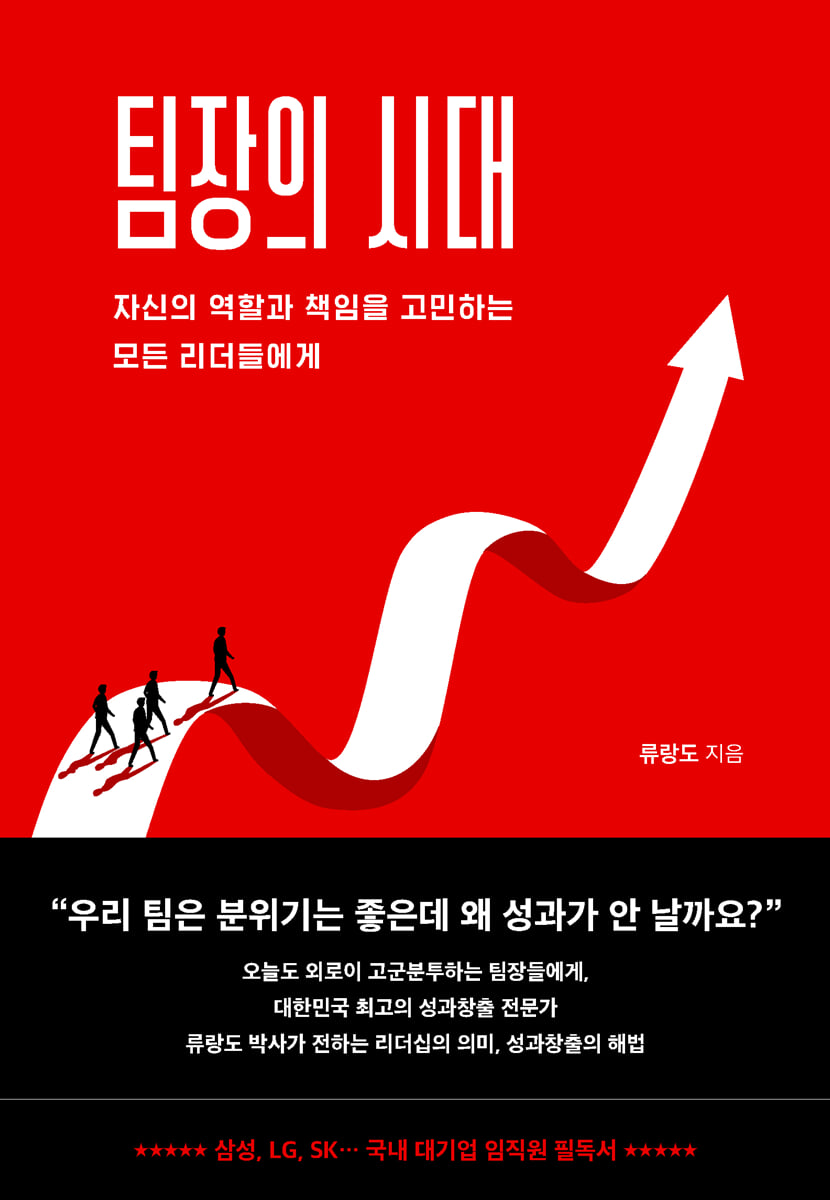
The era of team leaders
 |
Description
Book Introduction
“Our team has a good atmosphere, but why aren’t we getting results?”
★★★ A must-read for executives and employees of major domestic companies like Samsung, LG, SK, and KT&G.
★★★ A leadership textbook that has transformed the performance of Korean team leaders over the past 28 years.
To the team leaders who are struggling alone today,
Dr. Ryu Rang-do, Korea's top performance creation expert, shares his thoughts.
The meaning of leadership, the solution to creating outstanding performance!
Many team leaders strive to be good leaders, but the more they work, the more dissatisfied their team members become, and they feel anxious because it feels like they are working in a system-less, old-fashioned way, and performance is declining.
When he was a team member who focused solely on practical work, he achieved brilliant results, but after becoming a team leader, he faced a completely new set of difficulties.
In times like these, it would be nice to be able to ask someone for advice, but perhaps because of my title as team leader and my reputation, it's not easy to readily ask for help.
I often lose sleep over thoughts like, 'Am I lacking the qualities to be a team leader?' or 'Is there something wrong with my leadership?'
Dr. Ryu Rang-do, the author of this book and a man who has transformed the performance of numerous organizations in Korea for the past 28 years, asserts before discussing the qualities and leadership of a team leader that "any team leader can produce results if they properly understand their role and responsibilities and execute them correctly."
And in this book, “The Era of Team Leaders,” the five core roles that every team leader must possess and perform—“standard communication,” “empowerment,” “performance coaching,” “delegate,” and “performance evaluation and feedback”—are each explained in detail, showing how all work and communication within the team can be connected to performance, and how both the team leader and team members can work while developing their capabilities and feeling a sense of accomplishment.
★★★ A must-read for executives and employees of major domestic companies like Samsung, LG, SK, and KT&G.
★★★ A leadership textbook that has transformed the performance of Korean team leaders over the past 28 years.
To the team leaders who are struggling alone today,
Dr. Ryu Rang-do, Korea's top performance creation expert, shares his thoughts.
The meaning of leadership, the solution to creating outstanding performance!
Many team leaders strive to be good leaders, but the more they work, the more dissatisfied their team members become, and they feel anxious because it feels like they are working in a system-less, old-fashioned way, and performance is declining.
When he was a team member who focused solely on practical work, he achieved brilliant results, but after becoming a team leader, he faced a completely new set of difficulties.
In times like these, it would be nice to be able to ask someone for advice, but perhaps because of my title as team leader and my reputation, it's not easy to readily ask for help.
I often lose sleep over thoughts like, 'Am I lacking the qualities to be a team leader?' or 'Is there something wrong with my leadership?'
Dr. Ryu Rang-do, the author of this book and a man who has transformed the performance of numerous organizations in Korea for the past 28 years, asserts before discussing the qualities and leadership of a team leader that "any team leader can produce results if they properly understand their role and responsibilities and execute them correctly."
And in this book, “The Era of Team Leaders,” the five core roles that every team leader must possess and perform—“standard communication,” “empowerment,” “performance coaching,” “delegate,” and “performance evaluation and feedback”—are each explained in detail, showing how all work and communication within the team can be connected to performance, and how both the team leader and team members can work while developing their capabilities and feeling a sense of accomplishment.
- You can preview some of the book's contents.
Preview
index
Prologue│Not all team leaders are the same.
PART 1 Team Leader's Conditions
[1] The reason for the team leader's existence _Role
Why do I do this?
Does the position of team leader make a person?
What role does the CEO expect from our team?
What do you expect our team to look like in a year?
How team members can take ownership of their work
[2] What it means to take responsibility _Responsibility
“I take full responsibility and step down from this position.”
First, draw the final state when the work is finished.
How to draw a performance goal overview?
Why are there so many incompetent team members in our team?
PART 2: 5 Core Roles of a Team Leader
[1] Criteria Communication
Why is our team having trouble communicating?
How to accurately convey what your team leader says
How should we communicate to increase team member autonomy?
Can communication skills also be improved through training?
The kind of team leader that team members truly desire
[2] Empowerment
Who should be entrusted with what task?
How do we assess the abilities and capabilities of our team members?
How to Identify the Best Talent
Team leader-specific tasks that can never be delegated
[3] Performance Coaching
Why do team members only do what they are told?
Planning and execution skills to create expected results
How to Coach Performance with Sketchpaper
Define performance-oriented role behaviors
[4] Delegation
The best technique for trusting and nurturing team members
What criteria should I use to delegate work?
Let them figure out their own strategies and methods.
Team members' creativity emerges from autonomy.
[5] Performance evaluation and feedback
What are we dealing with the company?
Evaluate competency, not ability
Evaluate performance, not results
The true purpose of evaluation is growth and development.
Epilogue│From today, you are a team leader, not a manager.
PART 1 Team Leader's Conditions
[1] The reason for the team leader's existence _Role
Why do I do this?
Does the position of team leader make a person?
What role does the CEO expect from our team?
What do you expect our team to look like in a year?
How team members can take ownership of their work
[2] What it means to take responsibility _Responsibility
“I take full responsibility and step down from this position.”
First, draw the final state when the work is finished.
How to draw a performance goal overview?
Why are there so many incompetent team members in our team?
PART 2: 5 Core Roles of a Team Leader
[1] Criteria Communication
Why is our team having trouble communicating?
How to accurately convey what your team leader says
How should we communicate to increase team member autonomy?
Can communication skills also be improved through training?
The kind of team leader that team members truly desire
[2] Empowerment
Who should be entrusted with what task?
How do we assess the abilities and capabilities of our team members?
How to Identify the Best Talent
Team leader-specific tasks that can never be delegated
[3] Performance Coaching
Why do team members only do what they are told?
Planning and execution skills to create expected results
How to Coach Performance with Sketchpaper
Define performance-oriented role behaviors
[4] Delegation
The best technique for trusting and nurturing team members
What criteria should I use to delegate work?
Let them figure out their own strategies and methods.
Team members' creativity emerges from autonomy.
[5] Performance evaluation and feedback
What are we dealing with the company?
Evaluate competency, not ability
Evaluate performance, not results
The true purpose of evaluation is growth and development.
Epilogue│From today, you are a team leader, not a manager.
Into the book
To shatter the complacency that comes with being armed with past experiences and knowledge, we cannot help but emphasize the importance of the field.
In any industry, results can only be achieved through a proper understanding of the field based on objective and factual information.
It's not just about being there in the field, but about getting involved and actually putting the work into practice.
You can't set goals or strategies without understanding who your customers are, what's happening on the ground, and any anticipated risk factors.
Therefore, as a team leader, you must increase your understanding of the field to identify fundamental problems and effectively reflect them in the team's performance goals, performance-creation strategies, and implementation methods.
--- p.57, from “The Reason for the Team Leader’s Existence: How Team Members Can Work with Ownership”
A unilateral order from a team leader to follow is not a goal.
A goal is a 'target result for which one must be responsible through work', and the team leader and team members must be able to agree on what result they want to achieve through that work.
When team members empathize with the outcome, they can proactively decide and devise ways to achieve results.
Therefore, team leaders should ask team members about the value they gain from their work and what their work contributes to the team, and give them the opportunity to think for themselves.
Then, team members can work proactively with intrinsic motivation.
--- p.72, from “What it means to take responsibility: Draw the final state when the work is finished”
Communications that direct work must have a reasonable basis, that is, a sound logic.
Only then will the person executing it understand and be convinced.
If there is no logic as to why something should be done, team members will do it without being convinced.
If you do this, it is easy to make wrong judgments or mistakes during the work process.
Because there was neither logical agreement nor emotional empathy as to why this was being done.
Team leaders often believe that only their own experiences and judgments are correct and are obsessed with them.
The more outstanding and recognized a team leader's performance in the field is, the stronger his or her self-confidence is.
Because of this, there is a great risk of pushing things forward unilaterally.
Team leaders with this type of disposition should reflect on their own work instruction style and check whether they provided sufficient background information and made sure that team members understood properly.
--- p.101, from “Why is our team not communicating well?”
We no longer live in an era where people can be judged solely on their academic background or qualifications.
The first thing to do is to determine whether you have the skills and competencies suitable for the job.
A job is the scope of work that an individual does.
If team members have a clear understanding of the scope of work they are expected to accomplish within the team, the team will be more effective.
You need to be able to see the entire process of performing a task, including whether you demonstrated optimal capabilities when assigned a task, whether you had sufficient knowledge, skills, and job experience, and what your attitude was during the process of performing the task.
--- p.157, from “How to Identify the Best Talent for Empowerment”
Until now, superiors have been instructing and controlling subordinates on how to carry out their duties.
I worked from the perspective of 'work instructions'.
On the other hand, 'performance coaching' does not instruct the person on the task or the method of execution, but rather the person taking the initiative in thinking about the method to create results.
At this time, the superior performs the role of a leader rather than a boss, and the executor performs the role of a self-directed performance manager rather than a subordinate.
In this way, the team leader, as a superior leader, coaches team members on their performance, and the team members themselves can coach their own performance. This is necessary to establish an 'internal performance coach' system to enable team member development.
--- p.172, from “Performance Coaching: Why Do Team Members Only Do What They Are Told to Do?”
You should clearly set standards for the outcomes your team members are expected to meet, but you should not control how they actually perform.
You must clearly communicate in advance the expected outcomes, scope of authority, execution timeframe, team members who can collaborate, the deliverables to be created, and available resources, and give the team members the choice to decide on the work methods and procedures.
Then, team members take ownership of their work and become the main actors in its progress.
--- p.234, from “The creativity of the delegation team members is expressed through autonomy”
The purpose of evaluation is to create results, whether short-term or long-term.
The purpose of doing work is the same.
It is about creating desired results by prioritizing limited resources over a set period of time and allocating them to causal strategies and methods for creating results.
Likewise, evaluations should focus on how well an individual has performed in the given role based on their limited abilities within a given period of time.
In any industry, results can only be achieved through a proper understanding of the field based on objective and factual information.
It's not just about being there in the field, but about getting involved and actually putting the work into practice.
You can't set goals or strategies without understanding who your customers are, what's happening on the ground, and any anticipated risk factors.
Therefore, as a team leader, you must increase your understanding of the field to identify fundamental problems and effectively reflect them in the team's performance goals, performance-creation strategies, and implementation methods.
--- p.57, from “The Reason for the Team Leader’s Existence: How Team Members Can Work with Ownership”
A unilateral order from a team leader to follow is not a goal.
A goal is a 'target result for which one must be responsible through work', and the team leader and team members must be able to agree on what result they want to achieve through that work.
When team members empathize with the outcome, they can proactively decide and devise ways to achieve results.
Therefore, team leaders should ask team members about the value they gain from their work and what their work contributes to the team, and give them the opportunity to think for themselves.
Then, team members can work proactively with intrinsic motivation.
--- p.72, from “What it means to take responsibility: Draw the final state when the work is finished”
Communications that direct work must have a reasonable basis, that is, a sound logic.
Only then will the person executing it understand and be convinced.
If there is no logic as to why something should be done, team members will do it without being convinced.
If you do this, it is easy to make wrong judgments or mistakes during the work process.
Because there was neither logical agreement nor emotional empathy as to why this was being done.
Team leaders often believe that only their own experiences and judgments are correct and are obsessed with them.
The more outstanding and recognized a team leader's performance in the field is, the stronger his or her self-confidence is.
Because of this, there is a great risk of pushing things forward unilaterally.
Team leaders with this type of disposition should reflect on their own work instruction style and check whether they provided sufficient background information and made sure that team members understood properly.
--- p.101, from “Why is our team not communicating well?”
We no longer live in an era where people can be judged solely on their academic background or qualifications.
The first thing to do is to determine whether you have the skills and competencies suitable for the job.
A job is the scope of work that an individual does.
If team members have a clear understanding of the scope of work they are expected to accomplish within the team, the team will be more effective.
You need to be able to see the entire process of performing a task, including whether you demonstrated optimal capabilities when assigned a task, whether you had sufficient knowledge, skills, and job experience, and what your attitude was during the process of performing the task.
--- p.157, from “How to Identify the Best Talent for Empowerment”
Until now, superiors have been instructing and controlling subordinates on how to carry out their duties.
I worked from the perspective of 'work instructions'.
On the other hand, 'performance coaching' does not instruct the person on the task or the method of execution, but rather the person taking the initiative in thinking about the method to create results.
At this time, the superior performs the role of a leader rather than a boss, and the executor performs the role of a self-directed performance manager rather than a subordinate.
In this way, the team leader, as a superior leader, coaches team members on their performance, and the team members themselves can coach their own performance. This is necessary to establish an 'internal performance coach' system to enable team member development.
--- p.172, from “Performance Coaching: Why Do Team Members Only Do What They Are Told to Do?”
You should clearly set standards for the outcomes your team members are expected to meet, but you should not control how they actually perform.
You must clearly communicate in advance the expected outcomes, scope of authority, execution timeframe, team members who can collaborate, the deliverables to be created, and available resources, and give the team members the choice to decide on the work methods and procedures.
Then, team members take ownership of their work and become the main actors in its progress.
--- p.234, from “The creativity of the delegation team members is expressed through autonomy”
The purpose of evaluation is to create results, whether short-term or long-term.
The purpose of doing work is the same.
It is about creating desired results by prioritizing limited resources over a set period of time and allocating them to causal strategies and methods for creating results.
Likewise, evaluations should focus on how well an individual has performed in the given role based on their limited abilities within a given period of time.
--- p.249, from “Performance Evaluation and Feedback: What Are We Dealing with the Company?”
Publisher's Review
“Are you a boss-type team leader?
Are you a leader-type team leader?
Now that the era of the team leader has arrived, beyond the era of the department head, let's talk about the leadership that team leaders must possess.
“How can our team achieve results?”
Dr. Ryu Rang-do, who has lectured in numerous organizations for the past 28 years, has observed firsthand the difficulties experienced by team leaders in the field.
When I was a team member, I just had to work hard on my own work and I was able to achieve results, but after becoming a team leader, I had to look after the performance of my team members and also look after the CEO and general manager, who I had to be mindful of, so it was literally 'the taste of death.'
Faced with these team leaders' struggles, Dr. Ryu Lang-do poses a very simple yet essential question to them.
“What role does a team leader play?”
“What kind of team leader does the organization want to develop?”
Although each organization may have various roles assigned to team leaders, essentially, a team leader is 'a person who takes responsibility for the team's performance on behalf of the CEO.'
If executives are responsible for future performance, team leaders are responsible for short-term performance, that is, current performance, while also playing a role in developing team members.
And he emphasizes that the 'directive', 'controlling', and 'boss-type team leader' we have experienced so far, who views team members only as subordinates, will no longer be able to achieve results in the newly changed management environment.
Not all team leaders are the same.
Team leaders are divided into boss-type team leaders and leader-type team leaders.
The most important criterion for distinguishing these is
These are the ‘standards for looking at people’ and the ‘standards for decision-making.’
Now, all team leaders must transform into ‘leader-type team leaders.’
Rather than viewing your teammates as "tools for your own performance," you should recognize and treat them as "collaborating partners who create team performance."
Rather than directing and controlling based on your past experiences, you should make decisions based on objective facts and data.
In this day and age, where team leaders can never achieve results solely through their individual talents, team leaders must transform into leader-type leaders, working in step with their MZ generation team members to fulfill their respective roles and responsibilities, and present specific ways for them to grow together.
And in this book, “The Age of Team Leaders,” I have introduced in detail the role and responsibility of a team leader, which no one had clearly taught, but which existed vaguely but clearly.
In the era of the "team leader," where the "team leader" has finally established himself as the key and main character in creating results, the secret method of how to connect all of a team leader's work and communication to creating results has been revealed.
“I am able to achieve results while also helping my team members grow.
“How does the team leader work?”
Five Roles and Responsibilities Every Team Leader Must Know
There are already many books for team leaders on the market, but if you look closely, most of them stop at comforting the team leader's difficult feelings or introduce the organizational culture and leadership of global companies, making it difficult to apply them directly in the field.
What a team leader, who is fighting an invisible battle every moment, really needs isn't warm comfort or grandiose work tools, but rather specific ways to improve this month's performance right now and communication skills with the team members they face today.
Dr. Ryu Rang-do, who has heard the real-life struggles of team leaders in the field, presents five roles and responsibilities of team leaders that help them grow while also helping their team members and the organization grow: 'standard communication', 'empowerment', 'performance coaching', 'delegate', and 'performance evaluation and feedback'.
This book provides a concrete and realistic explanation of the roles and responsibilities that team leaders encounter in their daily work but have never properly learned, such as how to reduce errors in work by communicating the team's goals and strategies with team members in advance (standard communication), how to trust people, entrust them with work, and delegate roles (empowerment), how to coach team members to motivate themselves (performance coaching), how to guarantee team members the autonomy of performance-creating strategies and execution methods (delegation), and how to provide proper feedback on the intermediate process and final performance of work (performance evaluation and feedback).
Above all, it provides clear answers to various concerns that team leaders have in their hearts but cannot bring themselves to say out loud, such as, "Why are there so many team members who are incompetent in our team?", "Why is communication so difficult in our team?", and "Why do team members only do what they are told?"
The company doesn't appoint just anyone as a team leader.
Working as a team leader is a stepping stone to becoming a general manager or CEO.
It means that you have been accepted to the ‘Management Training Course’.
In other words, the role of team leader is to support self-growth and development.
You could call it an on-site training program.
More people than you might think become team leaders without preparation.
Why do some succeed as team leaders, while others, driven by work and people, ultimately give up and give up? It's a question of "method."
If you understand the five core roles of a team leader, your team members who were previously passive can become self-sufficient and even create organizational results.
Above all, since the standards for ‘communication’, ‘work’, ‘delegation’, ‘evaluation’, and ‘feedback’ are clear, emotional dissatisfaction among team members can be completely resolved.
If you work harder than anyone else, but your team members don't keep up and you're getting tired because the results aren't coming in, and if you feel like you've gone from a competent worker to an incompetent team leader and feel a sense of inferiority, I recommend reading this book, "The Age of Team Leaders," right now.
You will be able to experience the 'best team leader lessons' that are specific and clear, and that you will not be able to learn anywhere else.
Are you a leader-type team leader?
Now that the era of the team leader has arrived, beyond the era of the department head, let's talk about the leadership that team leaders must possess.
“How can our team achieve results?”
Dr. Ryu Rang-do, who has lectured in numerous organizations for the past 28 years, has observed firsthand the difficulties experienced by team leaders in the field.
When I was a team member, I just had to work hard on my own work and I was able to achieve results, but after becoming a team leader, I had to look after the performance of my team members and also look after the CEO and general manager, who I had to be mindful of, so it was literally 'the taste of death.'
Faced with these team leaders' struggles, Dr. Ryu Lang-do poses a very simple yet essential question to them.
“What role does a team leader play?”
“What kind of team leader does the organization want to develop?”
Although each organization may have various roles assigned to team leaders, essentially, a team leader is 'a person who takes responsibility for the team's performance on behalf of the CEO.'
If executives are responsible for future performance, team leaders are responsible for short-term performance, that is, current performance, while also playing a role in developing team members.
And he emphasizes that the 'directive', 'controlling', and 'boss-type team leader' we have experienced so far, who views team members only as subordinates, will no longer be able to achieve results in the newly changed management environment.
Not all team leaders are the same.
Team leaders are divided into boss-type team leaders and leader-type team leaders.
The most important criterion for distinguishing these is
These are the ‘standards for looking at people’ and the ‘standards for decision-making.’
Now, all team leaders must transform into ‘leader-type team leaders.’
Rather than viewing your teammates as "tools for your own performance," you should recognize and treat them as "collaborating partners who create team performance."
Rather than directing and controlling based on your past experiences, you should make decisions based on objective facts and data.
In this day and age, where team leaders can never achieve results solely through their individual talents, team leaders must transform into leader-type leaders, working in step with their MZ generation team members to fulfill their respective roles and responsibilities, and present specific ways for them to grow together.
And in this book, “The Age of Team Leaders,” I have introduced in detail the role and responsibility of a team leader, which no one had clearly taught, but which existed vaguely but clearly.
In the era of the "team leader," where the "team leader" has finally established himself as the key and main character in creating results, the secret method of how to connect all of a team leader's work and communication to creating results has been revealed.
“I am able to achieve results while also helping my team members grow.
“How does the team leader work?”
Five Roles and Responsibilities Every Team Leader Must Know
There are already many books for team leaders on the market, but if you look closely, most of them stop at comforting the team leader's difficult feelings or introduce the organizational culture and leadership of global companies, making it difficult to apply them directly in the field.
What a team leader, who is fighting an invisible battle every moment, really needs isn't warm comfort or grandiose work tools, but rather specific ways to improve this month's performance right now and communication skills with the team members they face today.
Dr. Ryu Rang-do, who has heard the real-life struggles of team leaders in the field, presents five roles and responsibilities of team leaders that help them grow while also helping their team members and the organization grow: 'standard communication', 'empowerment', 'performance coaching', 'delegate', and 'performance evaluation and feedback'.
This book provides a concrete and realistic explanation of the roles and responsibilities that team leaders encounter in their daily work but have never properly learned, such as how to reduce errors in work by communicating the team's goals and strategies with team members in advance (standard communication), how to trust people, entrust them with work, and delegate roles (empowerment), how to coach team members to motivate themselves (performance coaching), how to guarantee team members the autonomy of performance-creating strategies and execution methods (delegation), and how to provide proper feedback on the intermediate process and final performance of work (performance evaluation and feedback).
Above all, it provides clear answers to various concerns that team leaders have in their hearts but cannot bring themselves to say out loud, such as, "Why are there so many team members who are incompetent in our team?", "Why is communication so difficult in our team?", and "Why do team members only do what they are told?"
The company doesn't appoint just anyone as a team leader.
Working as a team leader is a stepping stone to becoming a general manager or CEO.
It means that you have been accepted to the ‘Management Training Course’.
In other words, the role of team leader is to support self-growth and development.
You could call it an on-site training program.
More people than you might think become team leaders without preparation.
Why do some succeed as team leaders, while others, driven by work and people, ultimately give up and give up? It's a question of "method."
If you understand the five core roles of a team leader, your team members who were previously passive can become self-sufficient and even create organizational results.
Above all, since the standards for ‘communication’, ‘work’, ‘delegation’, ‘evaluation’, and ‘feedback’ are clear, emotional dissatisfaction among team members can be completely resolved.
If you work harder than anyone else, but your team members don't keep up and you're getting tired because the results aren't coming in, and if you feel like you've gone from a competent worker to an incompetent team leader and feel a sense of inferiority, I recommend reading this book, "The Age of Team Leaders," right now.
You will be able to experience the 'best team leader lessons' that are specific and clear, and that you will not be able to learn anywhere else.
GOODS SPECIFICS
- Date of issue: September 23, 2025
- Format: Hardcover book binding method guide
- Page count, weight, size: 312 pages | 472g | 135*195*23mm
- ISBN13: 9791130670829
- ISBN10: 1130670821
You may also like
카테고리
korean


korean

![GQ KOREA Mark (Monthly): December [2025]](http://librairie.coreenne.fr/cdn/shop/files/8ef265dbbfbf186523ed75ba7319009d.jpg?v=1765340328&width=3840)


