

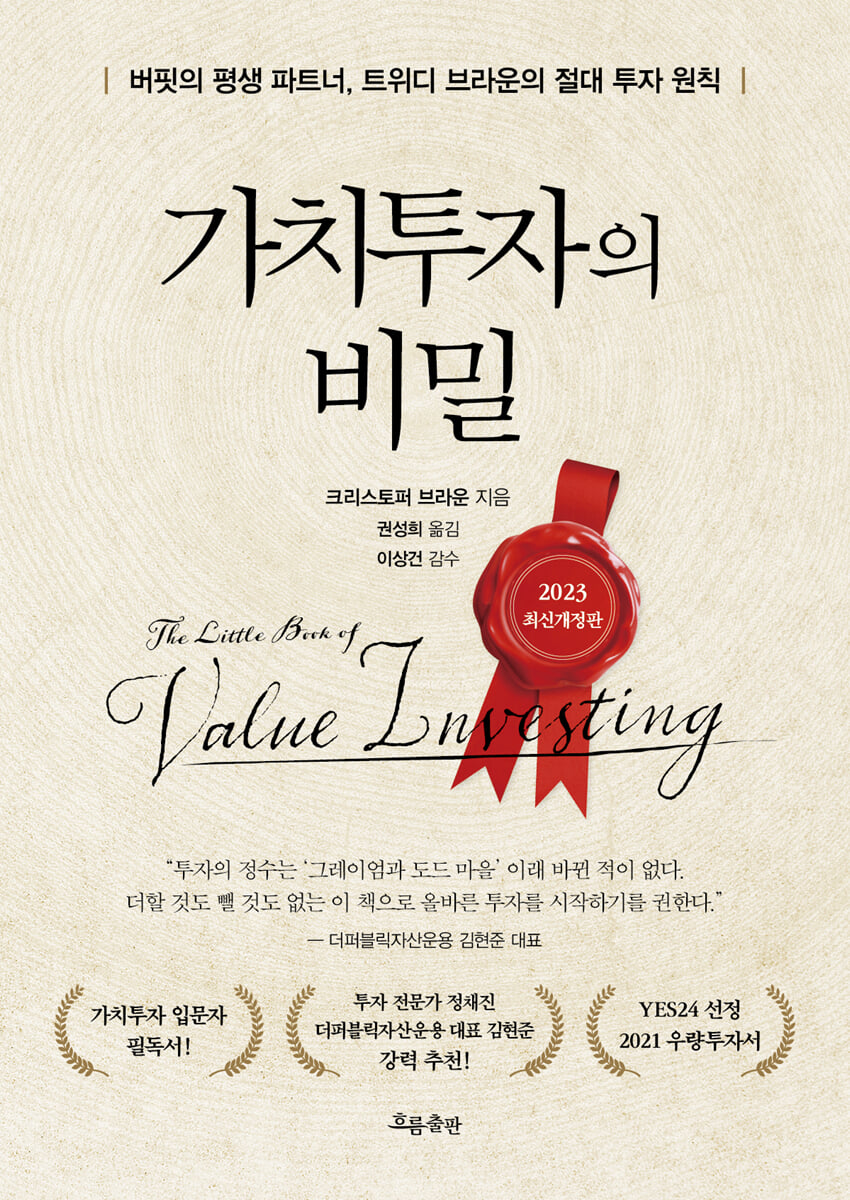
The Secret of Value Investing
 |
Description
Book Introduction
Domestic and international analysts and investors choose
A true investment classic
A steady seller for 15 consecutive years, the introductory book to value investing, "The Secret of Value Investing," has returned with a new, revised edition.
This book, which reminds successful investment experts of their original intentions and is easy to read for those completely new to investing, is an investment classic that anyone can read, regardless of their investment style or skill level.
Author Christopher Browne is considered the eldest son of Benjamin Graham, the father of value investing.
He worked as a fund manager for Tweedy, Brown, a renowned value investor, and has successfully traded stocks with top American investors such as Benjamin Graham, Walter Schloss, and Warren Buffett.
This book, based on decades of experience, introduces how to find undervalued stocks, strategies for responding to falling stock prices, timing purchases, data from top investors, and a stable investment mindset in a rollercoaster market.
There are many investment books in the world.
But it's rare to find a book that has easy-to-understand sentences and explanations, deep philosophy, and an appropriate length that won't bore the reader.
If you review the investment strategies presented by Christopher Browne, you'll understand why investment experts at home and abroad consistently cite this book as a classic investment guide.
A true investment classic
A steady seller for 15 consecutive years, the introductory book to value investing, "The Secret of Value Investing," has returned with a new, revised edition.
This book, which reminds successful investment experts of their original intentions and is easy to read for those completely new to investing, is an investment classic that anyone can read, regardless of their investment style or skill level.
Author Christopher Browne is considered the eldest son of Benjamin Graham, the father of value investing.
He worked as a fund manager for Tweedy, Brown, a renowned value investor, and has successfully traded stocks with top American investors such as Benjamin Graham, Walter Schloss, and Warren Buffett.
This book, based on decades of experience, introduces how to find undervalued stocks, strategies for responding to falling stock prices, timing purchases, data from top investors, and a stable investment mindset in a rollercoaster market.
There are many investment books in the world.
But it's rare to find a book that has easy-to-understand sentences and explanations, deep philosophy, and an appropriate length that won't bore the reader.
If you review the investment strategies presented by Christopher Browne, you'll understand why investment experts at home and abroad consistently cite this book as a classic investment guide.
- You can preview some of the book's contents.
Preview
index
Editor's Note | Lee Sang-geon, Director of Mirae Asset Investment & Pension Center
Acknowledgements
Recommended Reading | Roger Lowenstein
Enter | You should invest
Chapter 1: Basic Principles of Value Investing
1.
Treat stock investing like shopping.
This is the only way to beat the stock market.
2.
How do I know which stocks are on sale?
Focus on intrinsic value
3.
Never lose money
Keep a safe distance when investing
4.
Buy stocks that are cheap compared to their earnings.
Low PER yields high returns
5.
Buy stocks cheaper than the company's assets
How to seize the best investment opportunities without risk
Chapter 2: Finding Golden Value Stocks
6.
Stocks falling like crazy
A falling stock price is a double-edged sword.
If there are bad points, there are also good points.
7.
Buy when corporate insiders buy
No one knows the business better than they do.
8.
Seek and you will find.
How to find discounted stocks?
9.
There are stocks that are "cheap but expensive."
Look at why the stock price is cheap.
10.
Corporate Health Checkup I
To avoid investment mistakes, check the company's fundamentals.
11.
Corporate Health Checkup II
If the company's fundamentals are sound, check how much profit it is making.
12.
Corporate Health Checkup III
Assess your company's future with 16 questions.
Chapter 3: Look Overseas
13.
Looking abroad doubles your opportunities.
Overseas investment diversifies risk
14.
When in Rome, do as the Romans do.
If you want to invest in foreign stocks, understand foreign accounting standards.
15.
Another variable in overseas investment: exchange rates
Forget the idea of making a profit from exchange rates.
16.
Invest in developed countries
The principle of never losing money applies to overseas investments as well.
Chapter 4 How to Win in the Market
17.
Investing is a marathon, not a sprint.
What matters is not the timing of the rise and fall.
You should always stay in the stock market.
18.
Buy and hold? Really?
Stocks or bonds, where should I invest?
19.
What if only experts could do it?
How to choose a fund manager?
20.
Resist the temptation of a thrilling roller coaster ride
Have the courage to stick to your principles
21.
As time goes by, methods also change.
But the principle remains unchanged
Translator's Note
Acknowledgements
Recommended Reading | Roger Lowenstein
Enter | You should invest
Chapter 1: Basic Principles of Value Investing
1.
Treat stock investing like shopping.
This is the only way to beat the stock market.
2.
How do I know which stocks are on sale?
Focus on intrinsic value
3.
Never lose money
Keep a safe distance when investing
4.
Buy stocks that are cheap compared to their earnings.
Low PER yields high returns
5.
Buy stocks cheaper than the company's assets
How to seize the best investment opportunities without risk
Chapter 2: Finding Golden Value Stocks
6.
Stocks falling like crazy
A falling stock price is a double-edged sword.
If there are bad points, there are also good points.
7.
Buy when corporate insiders buy
No one knows the business better than they do.
8.
Seek and you will find.
How to find discounted stocks?
9.
There are stocks that are "cheap but expensive."
Look at why the stock price is cheap.
10.
Corporate Health Checkup I
To avoid investment mistakes, check the company's fundamentals.
11.
Corporate Health Checkup II
If the company's fundamentals are sound, check how much profit it is making.
12.
Corporate Health Checkup III
Assess your company's future with 16 questions.
Chapter 3: Look Overseas
13.
Looking abroad doubles your opportunities.
Overseas investment diversifies risk
14.
When in Rome, do as the Romans do.
If you want to invest in foreign stocks, understand foreign accounting standards.
15.
Another variable in overseas investment: exchange rates
Forget the idea of making a profit from exchange rates.
16.
Invest in developed countries
The principle of never losing money applies to overseas investments as well.
Chapter 4 How to Win in the Market
17.
Investing is a marathon, not a sprint.
What matters is not the timing of the rise and fall.
You should always stay in the stock market.
18.
Buy and hold? Really?
Stocks or bonds, where should I invest?
19.
What if only experts could do it?
How to choose a fund manager?
20.
Resist the temptation of a thrilling roller coaster ride
Have the courage to stick to your principles
21.
As time goes by, methods also change.
But the principle remains unchanged
Translator's Note
Detailed image
Into the book
Investment performance is usually evaluated by comparing it with a benchmark, a representative index of the stock market.
For example, in the US stock market, the S&P 500 index is primarily used as a standard for evaluating investment performance.
Each country has a representative stock market index, such as the S&P 500 index.
Numerous pieces of evidence have confirmed that value investing has outperformed the stock market's representative index, or benchmark, over the long term.
Moreover, value investing is easy to understand and practice.
--- p.34
When everyone else praises something, you feel like investing too, and even if the stock price continues to rise, you start to think you should buy it before it's too late.
Since it is a stock that will grow in the future, I believe that the stock price will continue to rise no matter how much I buy it at now.
This investor sentiment drives up growth stock prices to levels that make them difficult to sustain.
However, no company can sustain hyper-growth.
At some point, the rate of growth slows down.
As sales and profits increase, the growth rate is bound to decrease.
When the growth rate begins to slow, stock prices, which had already risen as high as they could, begin to falter and fall, and investors who bought stocks when prices were at their peak suffer losses.
--- p.47
When stock prices fall, most investors become afraid to invest in stocks.
They think there must be a reason why others are selling their stocks, so they follow suit and try to escape with the 'safe' cash without any risk of loss.
The danger is not the stock price falling.
What's dangerous is the price you pay when you buy the stock.
If you buy stocks at a price that is significantly higher than the company's intrinsic value, that is risky.
If you bought a stock at a price lower than its intrinsic value, there is no risk even if the price falls.
--- p.90
So far, we've introduced methods for selecting cheap and good companies through analysis of the price-to-book ratio (PBR), price-to-earnings ratio (PER), balance sheet, and income statement.
But if you could succeed in stock investing just by knowing a few mechanical formulas, everyone in the world could easily become rich by picking stocks that would rise.
Unfortunately, investing in stocks isn't that easy.
Just because the number of companies has been solid so far, there is no guarantee that it will continue to be so in the future.
Therefore, to more thoroughly understand whether a company is truly worth investing in, it is necessary to understand its position in the competitive market and its growth prospects.
--- p.138
The timeless principle of value investing is to buy stocks below their intrinsic value and sell them when the stock price approaches the company's true value.
Value investing is easier than any other investment strategy.
Value investing doesn't require you to sit in front of a stock trading system every day, buying and selling stocks with great enthusiasm.
All you have to do is buy stocks with a margin of safety at a price lower than their intrinsic value and wait patiently.
Then, you will experience that a value investing strategy is the best way to consistently beat the stock market index over the long term and steadily increase your wealth.
For example, in the US stock market, the S&P 500 index is primarily used as a standard for evaluating investment performance.
Each country has a representative stock market index, such as the S&P 500 index.
Numerous pieces of evidence have confirmed that value investing has outperformed the stock market's representative index, or benchmark, over the long term.
Moreover, value investing is easy to understand and practice.
--- p.34
When everyone else praises something, you feel like investing too, and even if the stock price continues to rise, you start to think you should buy it before it's too late.
Since it is a stock that will grow in the future, I believe that the stock price will continue to rise no matter how much I buy it at now.
This investor sentiment drives up growth stock prices to levels that make them difficult to sustain.
However, no company can sustain hyper-growth.
At some point, the rate of growth slows down.
As sales and profits increase, the growth rate is bound to decrease.
When the growth rate begins to slow, stock prices, which had already risen as high as they could, begin to falter and fall, and investors who bought stocks when prices were at their peak suffer losses.
--- p.47
When stock prices fall, most investors become afraid to invest in stocks.
They think there must be a reason why others are selling their stocks, so they follow suit and try to escape with the 'safe' cash without any risk of loss.
The danger is not the stock price falling.
What's dangerous is the price you pay when you buy the stock.
If you buy stocks at a price that is significantly higher than the company's intrinsic value, that is risky.
If you bought a stock at a price lower than its intrinsic value, there is no risk even if the price falls.
--- p.90
So far, we've introduced methods for selecting cheap and good companies through analysis of the price-to-book ratio (PBR), price-to-earnings ratio (PER), balance sheet, and income statement.
But if you could succeed in stock investing just by knowing a few mechanical formulas, everyone in the world could easily become rich by picking stocks that would rise.
Unfortunately, investing in stocks isn't that easy.
Just because the number of companies has been solid so far, there is no guarantee that it will continue to be so in the future.
Therefore, to more thoroughly understand whether a company is truly worth investing in, it is necessary to understand its position in the competitive market and its growth prospects.
--- p.138
The timeless principle of value investing is to buy stocks below their intrinsic value and sell them when the stock price approaches the company's true value.
Value investing is easier than any other investment strategy.
Value investing doesn't require you to sit in front of a stock trading system every day, buying and selling stocks with great enthusiasm.
All you have to do is buy stocks with a margin of safety at a price lower than their intrinsic value and wait patiently.
Then, you will experience that a value investing strategy is the best way to consistently beat the stock market index over the long term and steadily increase your wealth.
--- p.229
Publisher's Review
The most outstanding investor in American history
Tweedy Brown, partner of Benjamin Graham, Warren Buffett, and Walter Schloss
Investment principles based on 100 years of experience
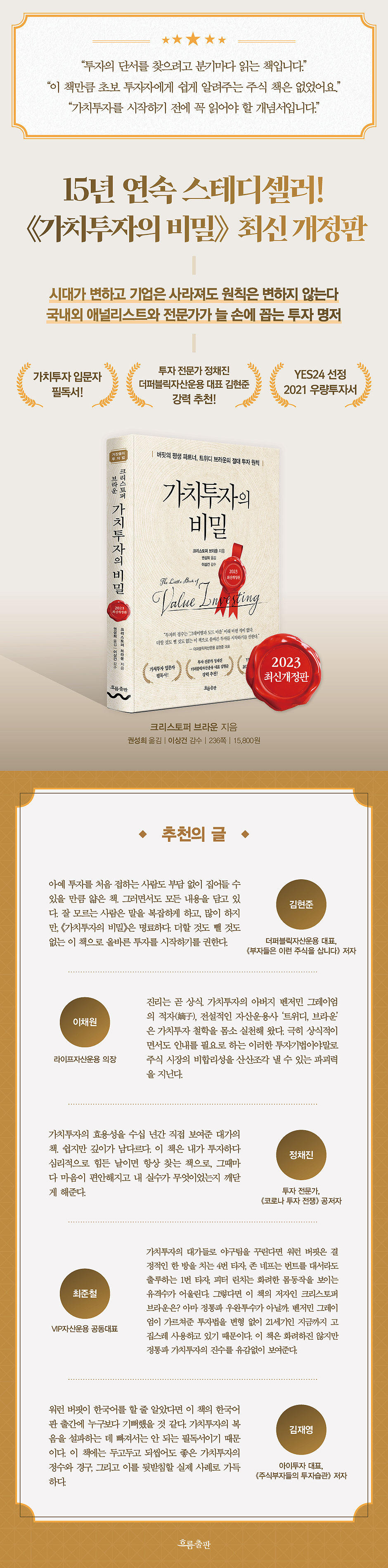
"The Secret of Value Investing" is consistently loved as a must-read introductory book for stock investors.
A revised edition of this book, which has been a steady seller for 15 years since its publication, has been published.
In this revised edition, we have supplemented some of the content from the previous edition and improved the design to make it easier to read.
Peter Lynch, a Wall Street legend who earned 2,700% returns over 13 years, and Warren Buffett, who bought Berkshire Hathaway stock at $8 and made $90,000.
What they have in common is that they invested in value and were clients of the American asset management firm Tweedy Brown.
Value investing is a simple but reliable formula: buy low and sell high.
Christopher Brown, CEO of Tweedy Browne, a living history of value investing, introduces investment principles that are guaranteed to succeed in this book.
Clients who invested in funds following the example of top investors like Peter Lynch should have seen huge profits.
However, more than half of the fund's clients actually suffer losses.
The reason this happens is simple.
This is because I invested when the returns were the best and sold them right away when the returns were bad.
It's not just individual investors.
Even self-proclaimed investment experts who have invested a lot fall into this trap countless times.
90% of the returns from stock investment occur during the first 2% of the investment period.
This is what Tweedy Brown has discovered through over 100 years of investment experience.
So, can you achieve high returns by only entering the market during favorable periods? Unfortunately, that's not the case.
The author says:
“The worst part is that if you invest based on market timing, the risk of loss is almost twice the potential return.” The author suggests two principles for achieving high returns.
First, treat stock investing like shopping.
What matters is the price at which you buy the stock.
Second, stay in the market as long as possible.
This is the essence of value investing.
Forget investing based on feelings!
An investment methodology based on evidence proven over decades
Why do we feel anxious and unsettled by the ups and downs of the stock market?
This is because your own investment strategy and criteria are not clear.
This book provides the basic knowledge to help you invest based on common sense, not just intuition.
In Chapter 1, “The Basic Principles of Value Investing,” the author begins by saying, “Invest like you’re shopping.”
This chapter, as the title suggests, covers the principles of value investing, which involves finding stocks that are cheaper than their actual value.
It emphasizes the investment mindset from a value investor's perspective and what to keep in mind before investing.
Chapter 2, "Finding Golden Value Stocks," teaches you how to select stocks worth buying and how to weed out bad stocks.
Especially chapter 2 verse 12.
The "16-Point Checklist for Validating Value Stocks" section of the corporate health checkup was cited unanimously by investors who previewed the manuscript, saying, "This alone makes the book worth reading."
Chapter 3, “Look Overseas,” contains advice from those who have traveled the world, including Europe and Japan, to buy stocks.
Even if you don't invest directly in foreign stocks, this is a must-see for investors interested in foreign funds.
Chapter 4, "How to Win in the Market," discusses the mindset necessary for successful value investing.
Those already investing can use this book to check whether they are making truly profitable investments, and beginner investors can gain investment advice that will last a lifetime.
The effectiveness of value investing has been consistently proven across time, so why are so few people truly practicing it? Roger Lowenstein, author of "The Origins of Bubbles," said this in his "Foreword."
“There is no need to wonder why so few people are using value investing.
“Because many people are impatient and impatient, investment opportunities are created for the few.” Warren Buffett, who became rich solely through investing, has never had the highest return in a year.
Value investors have proven that patience is the only way to beat the stock market.
There is no royal road to investing.
But there is a degree to it.
This book, which offers investment insights beyond simple stock recommendations, becomes even more meaningful as a fundamental guide to investing in times of market turmoil.
Tweedy Brown, partner of Benjamin Graham, Warren Buffett, and Walter Schloss
Investment principles based on 100 years of experience
"The Secret of Value Investing" is consistently loved as a must-read introductory book for stock investors.
A revised edition of this book, which has been a steady seller for 15 years since its publication, has been published.
In this revised edition, we have supplemented some of the content from the previous edition and improved the design to make it easier to read.
Peter Lynch, a Wall Street legend who earned 2,700% returns over 13 years, and Warren Buffett, who bought Berkshire Hathaway stock at $8 and made $90,000.
What they have in common is that they invested in value and were clients of the American asset management firm Tweedy Brown.
Value investing is a simple but reliable formula: buy low and sell high.
Christopher Brown, CEO of Tweedy Browne, a living history of value investing, introduces investment principles that are guaranteed to succeed in this book.
Clients who invested in funds following the example of top investors like Peter Lynch should have seen huge profits.
However, more than half of the fund's clients actually suffer losses.
The reason this happens is simple.
This is because I invested when the returns were the best and sold them right away when the returns were bad.
It's not just individual investors.
Even self-proclaimed investment experts who have invested a lot fall into this trap countless times.
90% of the returns from stock investment occur during the first 2% of the investment period.
This is what Tweedy Brown has discovered through over 100 years of investment experience.
So, can you achieve high returns by only entering the market during favorable periods? Unfortunately, that's not the case.
The author says:
“The worst part is that if you invest based on market timing, the risk of loss is almost twice the potential return.” The author suggests two principles for achieving high returns.
First, treat stock investing like shopping.
What matters is the price at which you buy the stock.
Second, stay in the market as long as possible.
This is the essence of value investing.
Forget investing based on feelings!
An investment methodology based on evidence proven over decades
Why do we feel anxious and unsettled by the ups and downs of the stock market?
This is because your own investment strategy and criteria are not clear.
This book provides the basic knowledge to help you invest based on common sense, not just intuition.
In Chapter 1, “The Basic Principles of Value Investing,” the author begins by saying, “Invest like you’re shopping.”
This chapter, as the title suggests, covers the principles of value investing, which involves finding stocks that are cheaper than their actual value.
It emphasizes the investment mindset from a value investor's perspective and what to keep in mind before investing.
Chapter 2, "Finding Golden Value Stocks," teaches you how to select stocks worth buying and how to weed out bad stocks.
Especially chapter 2 verse 12.
The "16-Point Checklist for Validating Value Stocks" section of the corporate health checkup was cited unanimously by investors who previewed the manuscript, saying, "This alone makes the book worth reading."
Chapter 3, “Look Overseas,” contains advice from those who have traveled the world, including Europe and Japan, to buy stocks.
Even if you don't invest directly in foreign stocks, this is a must-see for investors interested in foreign funds.
Chapter 4, "How to Win in the Market," discusses the mindset necessary for successful value investing.
Those already investing can use this book to check whether they are making truly profitable investments, and beginner investors can gain investment advice that will last a lifetime.
The effectiveness of value investing has been consistently proven across time, so why are so few people truly practicing it? Roger Lowenstein, author of "The Origins of Bubbles," said this in his "Foreword."
“There is no need to wonder why so few people are using value investing.
“Because many people are impatient and impatient, investment opportunities are created for the few.” Warren Buffett, who became rich solely through investing, has never had the highest return in a year.
Value investors have proven that patience is the only way to beat the stock market.
There is no royal road to investing.
But there is a degree to it.
This book, which offers investment insights beyond simple stock recommendations, becomes even more meaningful as a fundamental guide to investing in times of market turmoil.
GOODS SPECIFICS
- Date of issue: January 2, 2023
- Format: Hardcover book binding method guide
- Page count, weight, size: 236 pages | 446g | 148*210*18mm
- ISBN13: 9788965965497
- ISBN10: 8965965497
You may also like
카테고리
korean


korean

![GQ KOREA Mark (Monthly): December [2025]](http://librairie.coreenne.fr/cdn/shop/files/8ef265dbbfbf186523ed75ba7319009d.jpg?v=1765340328&width=3840)


