

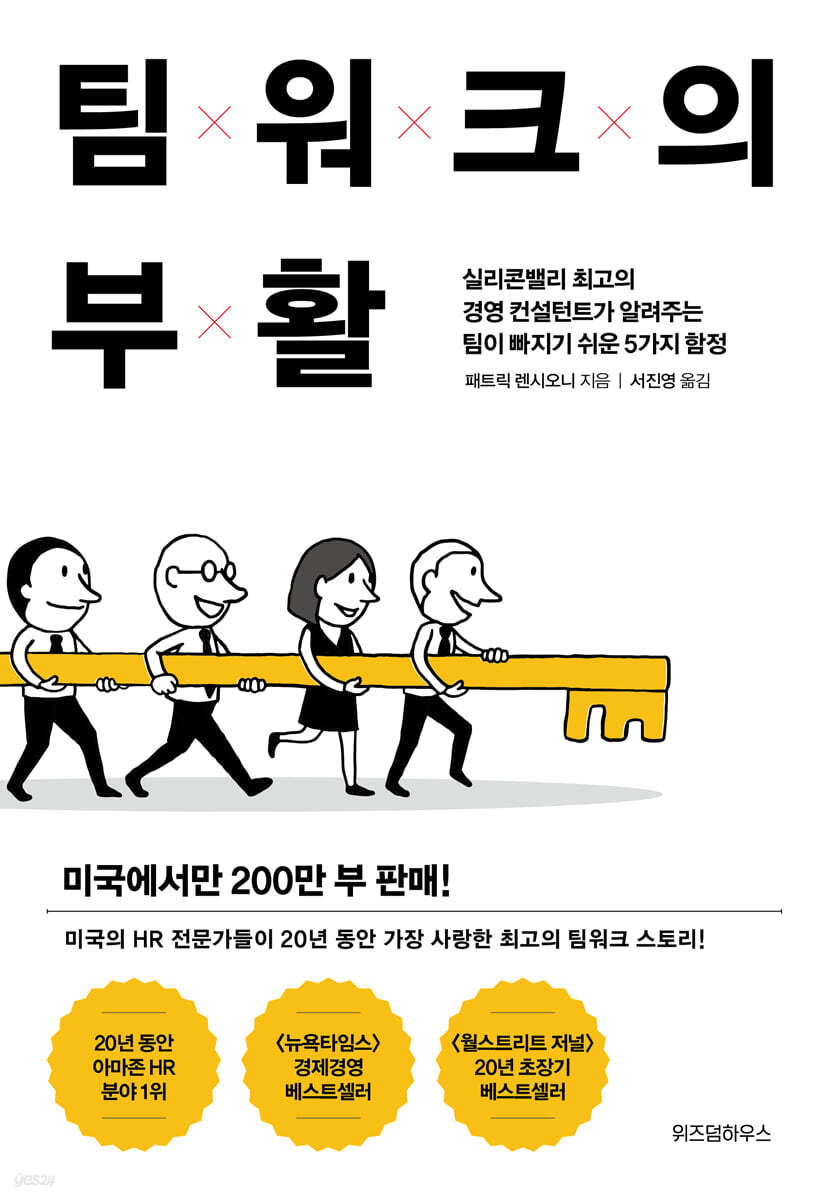
The revival of teamwork
 |
Description
Book Introduction
If a group of talented people gather together and the results fall short of expectations, the problem lies in teamwork.
Over 2 million copies sold in the US alone! #1 on Amazon's HR category!
Patrick Lencioni, Silicon Valley's top management consultant.
Having consulted with a wide range of organizations, including Fortune 500 companies, professional sports teams, the military, non-profits, universities, and churches, he realized that having a team of talented people doesn't always lead to great results.
After that, he began to study teamwork in earnest, and this book, "The Resurrection of Teamwork," is the result.
In this book, the author identifies five chronic problems of a team that is made up of talented individuals but who become squeaky when they come together, using the fictional company DecisionTech as a backdrop, and proposes solutions to these problems.
In this book, readers will learn five pitfalls teams can easily fall into and how to revive shaky teamwork.
Over 2 million copies sold in the US alone! #1 on Amazon's HR category!
Patrick Lencioni, Silicon Valley's top management consultant.
Having consulted with a wide range of organizations, including Fortune 500 companies, professional sports teams, the military, non-profits, universities, and churches, he realized that having a team of talented people doesn't always lead to great results.
After that, he began to study teamwork in earnest, and this book, "The Resurrection of Teamwork," is the result.
In this book, the author identifies five chronic problems of a team that is made up of talented individuals but who become squeaky when they come together, using the fictional company DecisionTech as a backdrop, and proposes solutions to these problems.
In this book, readers will learn five pitfalls teams can easily fall into and how to revive shaky teamwork.
- You can preview some of the book's contents.
Preview
index
preface
PART 01 STORY_The Secret of Teamwork
Background story
CHAPTER 01 Performance below ability
Luck | New CEO | Talent | Discontent | Observation | Staff
CHAPTER 02 Light the Fire
An email | Lunch | A call from the chairman | The first workshop | The start | The crash | Focus | Knowing your personal history | The rough edges | Mikey | Reaction | Finding strengths and weaknesses | Shared success | Cross-checking | Each person's circumstances | Attack | Revealing all the traps | Like a movie | Top priority
CHAPTER 03 It's hard, but it has to be done
Green Banana | Confession | Fire Alarm Meeting | Leak | Second Workshop | Difficulty | Taking a Step Forward | Responsibility | Personal Contribution | Decision | Leaving | Unexpected Reaction | Catherine's Confession | Recovery
CHAPTER 04 Moving Forward Together
Final Workshop | Change | Moving Forward, Moving Forward
PART 02 Theory: The Law of Teamwork Revival
Breaking free from traps and building teamwork
What are the 'Five Traps'?
Diagnose your team
Understanding the Five Traps and Revitalizing Teamwork
Catherine's Time Management
Acknowledgements
PART 01 STORY_The Secret of Teamwork
Background story
CHAPTER 01 Performance below ability
Luck | New CEO | Talent | Discontent | Observation | Staff
CHAPTER 02 Light the Fire
An email | Lunch | A call from the chairman | The first workshop | The start | The crash | Focus | Knowing your personal history | The rough edges | Mikey | Reaction | Finding strengths and weaknesses | Shared success | Cross-checking | Each person's circumstances | Attack | Revealing all the traps | Like a movie | Top priority
CHAPTER 03 It's hard, but it has to be done
Green Banana | Confession | Fire Alarm Meeting | Leak | Second Workshop | Difficulty | Taking a Step Forward | Responsibility | Personal Contribution | Decision | Leaving | Unexpected Reaction | Catherine's Confession | Recovery
CHAPTER 04 Moving Forward Together
Final Workshop | Change | Moving Forward, Moving Forward
PART 02 Theory: The Law of Teamwork Revival
Breaking free from traps and building teamwork
What are the 'Five Traps'?
Diagnose your team
Understanding the Five Traps and Revitalizing Teamwork
Catherine's Time Management
Acknowledgements
Into the book
A company's ability to maintain its competitive edge does not come from excellent financial management.
It doesn't come from strategy or technology.
That power comes from teamwork.
This is because teamwork is a very powerful force, but it is also difficult to find a team that actually demonstrates excellent teamwork.
A friend of mine, the founder of a company with annual sales of over 1 trillion won, once told me the following story.
I think that friend's words best illustrate what teamwork is.
“If you can get everyone in your organization to row in the same direction, you can beat all the competition and become the ultimate winner, no matter what industry you choose or what market you enter.”
--- pp.5~6
Employees simply referred to DecisionTech executives as "staff."
No one saw them as a team.
And there was good reason for the employees to see it that way.
Despite their exceptional intelligence and academic credentials, their attitude during the executive meeting was worse than anything Catherine had ever seen before.
Although he did not openly display hostility or nitpick at his colleagues, there was a pervasive sense of discontent and tension behind the scenes.
The discussion was slow and tedious, with little substantive exchange of ideas.
It was obvious that everyone present at the meeting was just waiting for the meeting to end quickly.
But while they were a mess as a team, when you look at them individually, they all seem like reasonable people with good intentions.
Of course, there are some exceptions.
--- pp.27~28
“But my job is to make sure this organization runs smoothly.
And the current situation, as you know, is not like that at all.” Jeff seemed unsure whether to contradict Catherine or humbly accept her words.
“I’m not trying to criticize what you’ve done so far.
“I don’t think anyone cares about the company as much as you do.”
Catherine continued the conversation, bolstering Jeff's self-esteem.
“But from a team perspective, we’re in the worst shape.
Above all, we must overcome the teamwork issues that are holding back our company.
“Unless we address this issue, one performance will not significantly impact our future.”
--- pp.44~45
“There is only one reason we come to work and gather here: to achieve results.
Performance is the true measure of a team, and it will be the focus of everything we do going forward.
I expect that in the next year or two, we will be able to look back and smile at our profitability, growth, profit margins, market share, and debt repayments.
If the market conditions are right, we could even go public.
But none of that fun would be possible if we didn't work as a team." Catherine paused.
He gave executives time to understand the simple and clear message he had delivered.
“Through my past experiences, I've concluded that the reason organizations with excellent team members fail to thrive is because they fall into five traps.”
--- p.55
"no.
Trust is different from thinking that everyone is on your side.
Just because you trust each other doesn't mean you don't have to pressure each other.
Trust is when team members know exactly when to pressure their colleagues.
“I do it because I love the team,” Nick clarified.
“But you shouldn’t pressure your colleagues in a way that upsets them.”
His remark sounded exactly like a question.
So Catherine answered.
"you're right.
There must be pressure, but also respect.
And you have to keep in mind that even if it wasn't me, someone else would have done it.
But press on anyway.
“You must never hesitate.”
--- p.197
Trust is the heart of any organic, cohesive team.
Building teamwork without trust is just empty talk.
Unfortunately, the word 'trust' has been used so often that it has lost its original meaning and is now considered somewhat of a cliché.
In the context of building strong teamwork, trust is the confidence that team members have in the belief that their colleagues' intentions are fundamentally benign and that there is no reason to be particularly defensive or cautious in dealing with one another.
Essentially, teammates should not feel uncomfortable criticizing each other.
However, trust, by dictionary definition, has to do with the ability to predict someone's behavior based on past experience.
For example, we 'trust' that a teammate will do well in the future because he or she has always done well in the past.
While this explanation is true, when trust is used to describe the characteristics of a great team, team members should not hide their vulnerabilities from their colleagues.
By trusting each other, we gain confidence that our vulnerabilities will not be exploited maliciously by our colleagues.
The vulnerabilities mentioned here include flaws, lack of talent, poor interpersonal relationships, mistakes, and calls for help.
--- pp.254~255
When people are reluctant to engage in honest debate and disagreement about important issues, they often resort to personal attacks that take place behind the scenes.
It is a very unpleasant and harmful act that cannot even be compared to a heated debate.
It is also ironic that so many people avoid conflict in the name of efficiency.
Because healthy conflict actually saves time.
The idea that teams waste time and energy by arguing is completely wrong.
Conversely, teams that avoid conflict end up dealing with the same problems over and over again without actually finding any solutions, which ends up being a huge waste of time and energy.
Usually, in such teams, when a problem arises, team members are asked to meet separately and deal with it quietly.
While it may sound nice, it's no different than not addressing the important issues properly, and will only lead to the issue being raised again at the next meeting.
It doesn't come from strategy or technology.
That power comes from teamwork.
This is because teamwork is a very powerful force, but it is also difficult to find a team that actually demonstrates excellent teamwork.
A friend of mine, the founder of a company with annual sales of over 1 trillion won, once told me the following story.
I think that friend's words best illustrate what teamwork is.
“If you can get everyone in your organization to row in the same direction, you can beat all the competition and become the ultimate winner, no matter what industry you choose or what market you enter.”
--- pp.5~6
Employees simply referred to DecisionTech executives as "staff."
No one saw them as a team.
And there was good reason for the employees to see it that way.
Despite their exceptional intelligence and academic credentials, their attitude during the executive meeting was worse than anything Catherine had ever seen before.
Although he did not openly display hostility or nitpick at his colleagues, there was a pervasive sense of discontent and tension behind the scenes.
The discussion was slow and tedious, with little substantive exchange of ideas.
It was obvious that everyone present at the meeting was just waiting for the meeting to end quickly.
But while they were a mess as a team, when you look at them individually, they all seem like reasonable people with good intentions.
Of course, there are some exceptions.
--- pp.27~28
“But my job is to make sure this organization runs smoothly.
And the current situation, as you know, is not like that at all.” Jeff seemed unsure whether to contradict Catherine or humbly accept her words.
“I’m not trying to criticize what you’ve done so far.
“I don’t think anyone cares about the company as much as you do.”
Catherine continued the conversation, bolstering Jeff's self-esteem.
“But from a team perspective, we’re in the worst shape.
Above all, we must overcome the teamwork issues that are holding back our company.
“Unless we address this issue, one performance will not significantly impact our future.”
--- pp.44~45
“There is only one reason we come to work and gather here: to achieve results.
Performance is the true measure of a team, and it will be the focus of everything we do going forward.
I expect that in the next year or two, we will be able to look back and smile at our profitability, growth, profit margins, market share, and debt repayments.
If the market conditions are right, we could even go public.
But none of that fun would be possible if we didn't work as a team." Catherine paused.
He gave executives time to understand the simple and clear message he had delivered.
“Through my past experiences, I've concluded that the reason organizations with excellent team members fail to thrive is because they fall into five traps.”
--- p.55
"no.
Trust is different from thinking that everyone is on your side.
Just because you trust each other doesn't mean you don't have to pressure each other.
Trust is when team members know exactly when to pressure their colleagues.
“I do it because I love the team,” Nick clarified.
“But you shouldn’t pressure your colleagues in a way that upsets them.”
His remark sounded exactly like a question.
So Catherine answered.
"you're right.
There must be pressure, but also respect.
And you have to keep in mind that even if it wasn't me, someone else would have done it.
But press on anyway.
“You must never hesitate.”
--- p.197
Trust is the heart of any organic, cohesive team.
Building teamwork without trust is just empty talk.
Unfortunately, the word 'trust' has been used so often that it has lost its original meaning and is now considered somewhat of a cliché.
In the context of building strong teamwork, trust is the confidence that team members have in the belief that their colleagues' intentions are fundamentally benign and that there is no reason to be particularly defensive or cautious in dealing with one another.
Essentially, teammates should not feel uncomfortable criticizing each other.
However, trust, by dictionary definition, has to do with the ability to predict someone's behavior based on past experience.
For example, we 'trust' that a teammate will do well in the future because he or she has always done well in the past.
While this explanation is true, when trust is used to describe the characteristics of a great team, team members should not hide their vulnerabilities from their colleagues.
By trusting each other, we gain confidence that our vulnerabilities will not be exploited maliciously by our colleagues.
The vulnerabilities mentioned here include flaws, lack of talent, poor interpersonal relationships, mistakes, and calls for help.
--- pp.254~255
When people are reluctant to engage in honest debate and disagreement about important issues, they often resort to personal attacks that take place behind the scenes.
It is a very unpleasant and harmful act that cannot even be compared to a heated debate.
It is also ironic that so many people avoid conflict in the name of efficiency.
Because healthy conflict actually saves time.
The idea that teams waste time and energy by arguing is completely wrong.
Conversely, teams that avoid conflict end up dealing with the same problems over and over again without actually finding any solutions, which ends up being a huge waste of time and energy.
Usually, in such teams, when a problem arises, team members are asked to meet separately and deal with it quietly.
While it may sound nice, it's no different than not addressing the important issues properly, and will only lead to the issue being raised again at the next meeting.
--- p.264
Publisher's Review
***** Amazon's Best Sellers Reverse-Running After COVID-19
***** No. 1 in Amazon HR for 20 years
***** New York Times Economics and Management Bestseller
***** 〈Wall Street Journal〉 20-year long-term bestseller
'How is your team doing now?'
A book for those struggling with teamwork after COVID-19, due to remote work and other factors.
Like Korean companies, many organizations in the United States are concerned about the breakdown in teamwork as face-to-face interactions have shifted to remote work and working from the office has become the norm since COVID-19.
The job of HR managers, who are responsible for everything from talent selection to organizational culture, has become more difficult.
There is a book that has recently become a hot topic among American HR managers.
This is the book “The Resurrection of Teamwork” written by Patrick Lencioni, a top management consultant in Silicon Valley, which has made a comeback and become a bestseller on Amazon. “If you can get everyone in your organization to row in the same direction, you can beat all the competition and become the ultimate winner, no matter what industry you choose or what market you enter.” In this book, Lencioni points out five chronic problems of teams that are clearly talented individuals but squeak when they come together, and suggests solutions.
This book has been ranked number one in Amazon's HR category for 20 years and is called a "classic on teamwork" because it easily addresses the concerns about teamwork that any organization can face in a story format.
It's teamwork, not stars, that leads to victory!
Five Traps That Undermine Teamwork in Your Organization—and How to Avoid Them
There are many cases where excellent employees are hired after going through a difficult recruitment process, but end up as underperformers in the actual organization.
It's not that they can't pick the right members for the team, it's that they can't create proper teamwork.
You can't solve problems by focusing on individual performances without addressing teamwork issues.
Patrick Lencioni says most organizations fall into five traps that prevent them from fostering effective teamwork.
Here are five pitfalls he says are harming teamwork in organizations:
1) Lack of trust: Team members who lack trust tend to hide their weaknesses and mistakes and are reluctant to accept criticism from colleagues.
Also, if they think it is not their responsibility, they do not try to help each other.
2) Fear of conflict: When people are reluctant to engage in honest debate and disagreement about important issues, they resort to defensive rhetoric.
Instead, an atmosphere of political discord and personal attacks runs rampant behind the scenes.
3) Lack of commitment: Because they are unable to coordinate their opinions in the midst of fierce conflict, they are unable to sincerely accept the decisions given.
I think all decisions are 'their job' and not 'my job'.
4) Avoiding responsibility: Not only do they not take responsibility for their own results, but they also do not hold their colleagues accountable for results that go against the team's goals.
5) Indifference to the results: Since we cannot hold each other accountable, we become indifferent to the results.
As a result, team members tend to prioritize their personal desires, such as career advancement or public recognition, over the common goal.
Teamwork is ultimately built when you recognize these five traps, find ways to avoid them, and consistently practice them.
A team's success depends not on mastering well-crafted theories, but on putting them into practice with consistent practice and patience.
Lancioni says of teamwork:
“The true power of teamwork is achieving more than what you could achieve alone.” Through this book, you too will be able to realize the true power of teamwork and create it yourself.
The best teamwork story loved by American HR professionals for 20 years!
《The Resurrection of Teamwork》 is composed of Part 1: Story and Part 2: Theory.
In Part 1, Patrick Lencioni explains why he uses storytelling techniques:
“I believe the message will be most effectively conveyed when readers are immersed in the story and empathize with the characters.”
Part 1 of the story begins at the fictional company DecisionTech in Silicon Valley.
DecisionTech, a promising startup in Silicon Valley, faced various challenges despite its numerous strengths.
The mutual slander among executives had long since gone too far, and there was no sense of team unity or camaraderie to be found.
As the problem continues to grow, co-founder and CEO Jeff steps down to take responsibility, and Catherine, who has no practical experience in the high-tech industry, is appointed as the new CEO.
Catherine was appointed CEO because she was believed to be the perfect fixer-upper for DecisionTech's creaking, broken organization, and because she possessed a natural talent for reviving broken teamwork.
Afterwards, Catherine and her team members find the five traps that the team called Decision Tech is trapped in, and they escape from them to reunite Decision Tech as one team.
Part 2 provides guidance on how to diagnose your team's current state and ways to overcome any issues that may be plaguing your team.
Readers will find it helpful in solving problems in their own organizations.
***** No. 1 in Amazon HR for 20 years
***** New York Times Economics and Management Bestseller
***** 〈Wall Street Journal〉 20-year long-term bestseller
'How is your team doing now?'
A book for those struggling with teamwork after COVID-19, due to remote work and other factors.
Like Korean companies, many organizations in the United States are concerned about the breakdown in teamwork as face-to-face interactions have shifted to remote work and working from the office has become the norm since COVID-19.
The job of HR managers, who are responsible for everything from talent selection to organizational culture, has become more difficult.
There is a book that has recently become a hot topic among American HR managers.
This is the book “The Resurrection of Teamwork” written by Patrick Lencioni, a top management consultant in Silicon Valley, which has made a comeback and become a bestseller on Amazon. “If you can get everyone in your organization to row in the same direction, you can beat all the competition and become the ultimate winner, no matter what industry you choose or what market you enter.” In this book, Lencioni points out five chronic problems of teams that are clearly talented individuals but squeak when they come together, and suggests solutions.
This book has been ranked number one in Amazon's HR category for 20 years and is called a "classic on teamwork" because it easily addresses the concerns about teamwork that any organization can face in a story format.
It's teamwork, not stars, that leads to victory!
Five Traps That Undermine Teamwork in Your Organization—and How to Avoid Them
There are many cases where excellent employees are hired after going through a difficult recruitment process, but end up as underperformers in the actual organization.
It's not that they can't pick the right members for the team, it's that they can't create proper teamwork.
You can't solve problems by focusing on individual performances without addressing teamwork issues.
Patrick Lencioni says most organizations fall into five traps that prevent them from fostering effective teamwork.
Here are five pitfalls he says are harming teamwork in organizations:
1) Lack of trust: Team members who lack trust tend to hide their weaknesses and mistakes and are reluctant to accept criticism from colleagues.
Also, if they think it is not their responsibility, they do not try to help each other.
2) Fear of conflict: When people are reluctant to engage in honest debate and disagreement about important issues, they resort to defensive rhetoric.
Instead, an atmosphere of political discord and personal attacks runs rampant behind the scenes.
3) Lack of commitment: Because they are unable to coordinate their opinions in the midst of fierce conflict, they are unable to sincerely accept the decisions given.
I think all decisions are 'their job' and not 'my job'.
4) Avoiding responsibility: Not only do they not take responsibility for their own results, but they also do not hold their colleagues accountable for results that go against the team's goals.
5) Indifference to the results: Since we cannot hold each other accountable, we become indifferent to the results.
As a result, team members tend to prioritize their personal desires, such as career advancement or public recognition, over the common goal.
Teamwork is ultimately built when you recognize these five traps, find ways to avoid them, and consistently practice them.
A team's success depends not on mastering well-crafted theories, but on putting them into practice with consistent practice and patience.
Lancioni says of teamwork:
“The true power of teamwork is achieving more than what you could achieve alone.” Through this book, you too will be able to realize the true power of teamwork and create it yourself.
The best teamwork story loved by American HR professionals for 20 years!
《The Resurrection of Teamwork》 is composed of Part 1: Story and Part 2: Theory.
In Part 1, Patrick Lencioni explains why he uses storytelling techniques:
“I believe the message will be most effectively conveyed when readers are immersed in the story and empathize with the characters.”
Part 1 of the story begins at the fictional company DecisionTech in Silicon Valley.
DecisionTech, a promising startup in Silicon Valley, faced various challenges despite its numerous strengths.
The mutual slander among executives had long since gone too far, and there was no sense of team unity or camaraderie to be found.
As the problem continues to grow, co-founder and CEO Jeff steps down to take responsibility, and Catherine, who has no practical experience in the high-tech industry, is appointed as the new CEO.
Catherine was appointed CEO because she was believed to be the perfect fixer-upper for DecisionTech's creaking, broken organization, and because she possessed a natural talent for reviving broken teamwork.
Afterwards, Catherine and her team members find the five traps that the team called Decision Tech is trapped in, and they escape from them to reunite Decision Tech as one team.
Part 2 provides guidance on how to diagnose your team's current state and ways to overcome any issues that may be plaguing your team.
Readers will find it helpful in solving problems in their own organizations.
GOODS SPECIFICS
- Publication date: October 6, 2021
- Page count, weight, size: 292 pages | 460g | 145*210*20mm
- ISBN13: 9791168120112
- ISBN10: 116812011X
You may also like
카테고리
korean


korean

![GQ KOREA Mark (Monthly): December [2025]](http://librairie.coreenne.fr/cdn/shop/files/8ef265dbbfbf186523ed75ba7319009d.jpg?v=1765340328&width=3840)


