

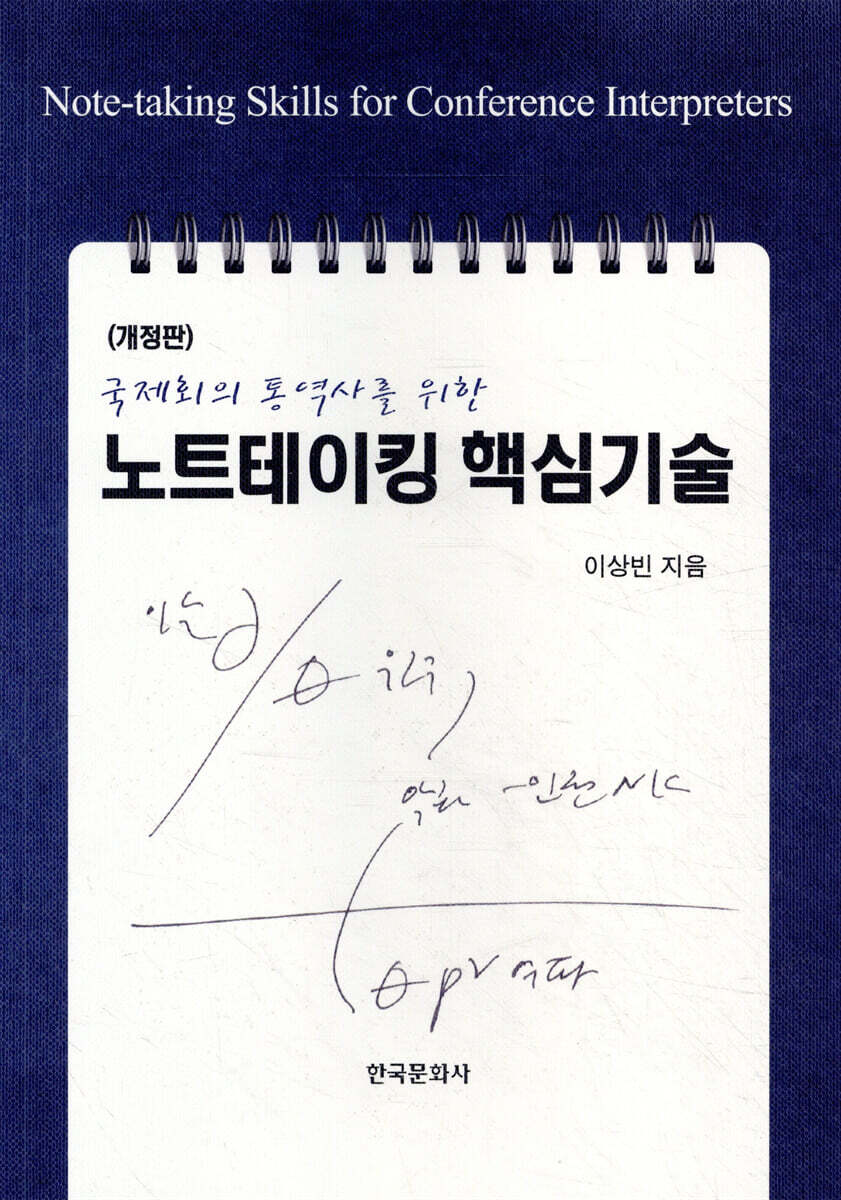
Core Notetaking Skills for International Conference Interpreters
 |
Description
Book Introduction
Consecutive interpreting is one of the interpretation methods that constitutes international conference interpreting along with simultaneous interpreting. It refers to translating the content of the speaker's speech into another language after listening to it.
At this time, the unit of interpretation, that is, the time until the speaker pauses for interpretation, can vary depending on the interpretation situation, the interpreter's ability, time constraints, the speaker's speaking style, and even how familiar the speaker is with interpretation services.
Usually, each interpretation takes anywhere from a few seconds to over 5 minutes. If you can listen to a conversation for about 5 minutes and interpret it without difficulty, it is considered that you can overcome time constraints in other interpretations as well.
So, domestic and international interpretation graduate schools train in consecutive interpretation using texts of about 5 minutes.
Consecutive interpreting is required in a variety of situations and environments.
The most classic example is a gathering such as a banquet.
In these settings, since the participants exchange short speeches or conversations, consecutive interpretation is more appropriate than simultaneous interpretation, which requires cumbersome equipment.
Second, consecutive interpretation is used in small-scale business meetings, interviews, bilateral talks, and entertaining foreign guests.
Although simultaneous interpretation has been increasingly used in recent years due to its convenience and time-saving advantages, consecutive interpretation is still preferred in small meetings where using interpretation equipment, especially booths, is inconvenient.
Third, in situations where fixed facilities such as booths cannot be used, such as escort interpreting for field trips, tours, and guided tours, consecutive interpreting is undoubtedly preferred.
Of course, in situations like this, a simultaneous interpretation method called 'whispered interpreting' is sometimes used, but consecutive interpreting is still actively used.
At this time, the unit of interpretation, that is, the time until the speaker pauses for interpretation, can vary depending on the interpretation situation, the interpreter's ability, time constraints, the speaker's speaking style, and even how familiar the speaker is with interpretation services.
Usually, each interpretation takes anywhere from a few seconds to over 5 minutes. If you can listen to a conversation for about 5 minutes and interpret it without difficulty, it is considered that you can overcome time constraints in other interpretations as well.
So, domestic and international interpretation graduate schools train in consecutive interpretation using texts of about 5 minutes.
Consecutive interpreting is required in a variety of situations and environments.
The most classic example is a gathering such as a banquet.
In these settings, since the participants exchange short speeches or conversations, consecutive interpretation is more appropriate than simultaneous interpretation, which requires cumbersome equipment.
Second, consecutive interpretation is used in small-scale business meetings, interviews, bilateral talks, and entertaining foreign guests.
Although simultaneous interpretation has been increasingly used in recent years due to its convenience and time-saving advantages, consecutive interpretation is still preferred in small meetings where using interpretation equipment, especially booths, is inconvenient.
Third, in situations where fixed facilities such as booths cannot be used, such as escort interpreting for field trips, tours, and guided tours, consecutive interpreting is undoubtedly preferred.
Of course, in situations like this, a simultaneous interpretation method called 'whispered interpreting' is sometimes used, but consecutive interpreting is still actively used.
- You can preview some of the book's contents.
Preview
index
Part 1: Building the Basics
1.
What is consecutive interpreting?
2.
Listening and analyzing for consecutive interpretation
3.
What is note-taking?
4.
Preparation for note-taking
5.
Is note-taking a distraction?
6.
Learn through practice
7.
Things to Consider for Note-Taking Practice (Interpretation Study)
8.
Want to learn shorthand?
9.
Note-taking and short-term memory (how much notes you take)
10.
mind map
11.
Reading notes
12.
Do you write in Korean or English? (The Language of Notetaking)
13.
What do you write?
14.
Note the subject, verb, and object
15.
Note the 'concepts' and 'meanings', not the words.
Part 2: The Art of Note-Taking
16.
Note diagonally
17.
Take notes vertically
18.
Draw a horizontal line
19.
Note the connecting words
20.
What is a symbol?
21.
When creating a symbol… (Six conditions for a symbol)
22.
Concepts that should be made into symbols
23.
Types of Symbols: Possible Examples 1
24.
Types of Symbols: Two Possible Examples
25.
organic symbols
26.
Chinese character symbols
27.
Symbols for connecting words
28.
abbreviations, acronyms
29.
Use short, simple words
30.
Arrow
31.
comparative and superlative
32.
Indicating verb tense
33.
Marking of viewpoint and auxiliary verbs
34.
Where can I find the symbol?
35.
Avoid repetition
36.
Change the writing order
37.
Note what you missed?
38.
Note the numbers
39.
Notes on long messages (handling relative pronouns)
40.
Write down what you hear, write down the spelling incorrectly
41.
Emphasize
42.
negation
43.
numbering
44.
Active vs. Passive Voice
45.
Take simple notes using background knowledge
46.
prompter
47.
Note down idioms
48.
Beginning and Ending of a Speech
49.
Differences in Note-Taking Depending on the Type of Interpretation
50.
The last part of the note
Appendix 1 - Note-Taking Guidelines for Interpreters
Jean-François Lausanne
Danica Celescovici
James Nolan
Christopher Thierry
Walter Kaiser
Kwak Jung-cheol
Choi Jeong-hwa
Appendix 2 - Actual Note-Taking by Two International Conference Interpreters
Interpreter A
Interpreter B
References
1.
What is consecutive interpreting?
2.
Listening and analyzing for consecutive interpretation
3.
What is note-taking?
4.
Preparation for note-taking
5.
Is note-taking a distraction?
6.
Learn through practice
7.
Things to Consider for Note-Taking Practice (Interpretation Study)
8.
Want to learn shorthand?
9.
Note-taking and short-term memory (how much notes you take)
10.
mind map
11.
Reading notes
12.
Do you write in Korean or English? (The Language of Notetaking)
13.
What do you write?
14.
Note the subject, verb, and object
15.
Note the 'concepts' and 'meanings', not the words.
Part 2: The Art of Note-Taking
16.
Note diagonally
17.
Take notes vertically
18.
Draw a horizontal line
19.
Note the connecting words
20.
What is a symbol?
21.
When creating a symbol… (Six conditions for a symbol)
22.
Concepts that should be made into symbols
23.
Types of Symbols: Possible Examples 1
24.
Types of Symbols: Two Possible Examples
25.
organic symbols
26.
Chinese character symbols
27.
Symbols for connecting words
28.
abbreviations, acronyms
29.
Use short, simple words
30.
Arrow
31.
comparative and superlative
32.
Indicating verb tense
33.
Marking of viewpoint and auxiliary verbs
34.
Where can I find the symbol?
35.
Avoid repetition
36.
Change the writing order
37.
Note what you missed?
38.
Note the numbers
39.
Notes on long messages (handling relative pronouns)
40.
Write down what you hear, write down the spelling incorrectly
41.
Emphasize
42.
negation
43.
numbering
44.
Active vs. Passive Voice
45.
Take simple notes using background knowledge
46.
prompter
47.
Note down idioms
48.
Beginning and Ending of a Speech
49.
Differences in Note-Taking Depending on the Type of Interpretation
50.
The last part of the note
Appendix 1 - Note-Taking Guidelines for Interpreters
Jean-François Lausanne
Danica Celescovici
James Nolan
Christopher Thierry
Walter Kaiser
Kwak Jung-cheol
Choi Jeong-hwa
Appendix 2 - Actual Note-Taking by Two International Conference Interpreters
Interpreter A
Interpreter B
References
Into the book
Consecutive interpreting is one of the interpretation methods that constitutes international conference interpreting along with simultaneous interpreting. It refers to interpreting that translates the content of the speaker's speech (broadly speaking, 'speaker') into another language.
At this time, the unit of interpretation, that is, the time until the speaker pauses for interpretation, can vary depending on the interpretation situation, the interpreter's ability, time constraints, the speaker's speaking style, and even how familiar the speaker is with interpretation services.
Usually, each interpretation takes anywhere from a few seconds to over 5 minutes, and it is considered that someone who can listen to a 5-minute conversation and interpret it without difficulty can overcome even greater time constraints.
So, domestic and international interpretation graduate schools train in consecutive interpretation using texts of about 3 to 5 minutes.
Consecutive interpretation is required in a variety of situations and environments.
The most classic example is a gathering such as a banquet.
In these settings, since the participants exchange short speeches or conversations, consecutive interpretation is more appropriate than simultaneous interpretation, which requires cumbersome equipment.
Second, consecutive interpretation is used in small business meetings, interviews, bilateral talks, and entertaining foreign guests.
Although simultaneous interpretation has been increasingly used in recent years due to its time-saving advantages, consecutive interpretation is still preferred in small meetings where using interpretation equipment, especially booths, is inconvenient (installing simultaneous interpretation equipment requires a considerable amount of money).
Third, in situations where fixed facilities such as booths cannot be used, such as escort interpreting for field trips, tours, and guided tours, consecutive interpreting is preferred.
Of course, whispered interpreting is used in situations like this, but consecutive interpreting is still actively used.
The expectations for consecutive interpreting are much higher than those for simultaneous interpreting.
Of course, simultaneous interpretation also needs to be of the highest standard, but from the perspective of the general audience, simultaneous interpretation is a far superior technique than consecutive interpretation (there are even audience members who come to the booth and ask, “How on earth do you do this?”).
In the case of consecutive interpretation, the speaker's speech and interpretation are performed sequentially, so the general audience naturally compares the speaker's speech and interpretation.
Especially, people who are good at the foreign language and like to interfere, or who think they heard more accurately than the interpreter, may go to the interpreter directly to check the interpretation or raise an issue with the interpretation through official channels.
[ Explanation of related terms]
Native English speakers also use both words when they mean 'interpreting'.
However, in interpretation practice, especially in academia, these two terms are used differently.
The former, interpreting, means 'interpretation', while the latter, interpretation, has the meaning of 'interpretation' as well as 'interpretation' and 'result of interpretation'.
In particular, scholars who distinguish between the two terms define the former in terms of the activity and process of interpretation, and explain the latter as the product of interpretation.
Conference interpreting refers to interpretation at international conferences through consecutive or simultaneous interpreting.
Although it is written as “international conference,” international conference interpreters do not literally only interpret at international conferences.
Since even small events and gatherings require top-notch interpretation, the term “international conference” mentioned above can be safely understood to refer to any type of meeting that requires a high level of interpretation.
That's why some people call international conference interpreters "conference interpreters."
To become an international conference interpreter in Korea, you must graduate from a graduate school of interpretation (also known as “interpretation and interpretation graduate school”).
In other words, those who have endured the rigorous training of interpretation graduate schools and passed the graduation exam (certification test) are international conference interpreters.
The general public calls international conference interpreters “simultaneous interpreters.”
Strictly speaking, this is not an accurate use of the term.
Because simultaneous interpretation is a type of interpretation method.
What could be more absurd than calling an international conference interpreter who is performing consecutive interpretation a “simultaneous interpreter”?
International conference interpreters and interpretation graduate students refer to consecutive and simultaneous interpretation as “consecutive” and “simultaneous,” respectively.
In English, instead of consecutive interpreting and simultaneous interpreting, they are shortened to “consecutive” and “simultaneous.”
It is literally interpretation done while performing.
Simultaneous interpretation is when the interpreter is positioned next to or behind the client, speaks into their ear, and speaks in a voice that only they can understand.
It is often used in situations where individual interpretation services are required or equipment installation is impossible.
In other words, it is called.
At this time, the unit of interpretation, that is, the time until the speaker pauses for interpretation, can vary depending on the interpretation situation, the interpreter's ability, time constraints, the speaker's speaking style, and even how familiar the speaker is with interpretation services.
Usually, each interpretation takes anywhere from a few seconds to over 5 minutes, and it is considered that someone who can listen to a 5-minute conversation and interpret it without difficulty can overcome even greater time constraints.
So, domestic and international interpretation graduate schools train in consecutive interpretation using texts of about 3 to 5 minutes.
Consecutive interpretation is required in a variety of situations and environments.
The most classic example is a gathering such as a banquet.
In these settings, since the participants exchange short speeches or conversations, consecutive interpretation is more appropriate than simultaneous interpretation, which requires cumbersome equipment.
Second, consecutive interpretation is used in small business meetings, interviews, bilateral talks, and entertaining foreign guests.
Although simultaneous interpretation has been increasingly used in recent years due to its time-saving advantages, consecutive interpretation is still preferred in small meetings where using interpretation equipment, especially booths, is inconvenient (installing simultaneous interpretation equipment requires a considerable amount of money).
Third, in situations where fixed facilities such as booths cannot be used, such as escort interpreting for field trips, tours, and guided tours, consecutive interpreting is preferred.
Of course, whispered interpreting is used in situations like this, but consecutive interpreting is still actively used.
The expectations for consecutive interpreting are much higher than those for simultaneous interpreting.
Of course, simultaneous interpretation also needs to be of the highest standard, but from the perspective of the general audience, simultaneous interpretation is a far superior technique than consecutive interpretation (there are even audience members who come to the booth and ask, “How on earth do you do this?”).
In the case of consecutive interpretation, the speaker's speech and interpretation are performed sequentially, so the general audience naturally compares the speaker's speech and interpretation.
Especially, people who are good at the foreign language and like to interfere, or who think they heard more accurately than the interpreter, may go to the interpreter directly to check the interpretation or raise an issue with the interpretation through official channels.
[ Explanation of related terms]
Native English speakers also use both words when they mean 'interpreting'.
However, in interpretation practice, especially in academia, these two terms are used differently.
The former, interpreting, means 'interpretation', while the latter, interpretation, has the meaning of 'interpretation' as well as 'interpretation' and 'result of interpretation'.
In particular, scholars who distinguish between the two terms define the former in terms of the activity and process of interpretation, and explain the latter as the product of interpretation.
Conference interpreting refers to interpretation at international conferences through consecutive or simultaneous interpreting.
Although it is written as “international conference,” international conference interpreters do not literally only interpret at international conferences.
Since even small events and gatherings require top-notch interpretation, the term “international conference” mentioned above can be safely understood to refer to any type of meeting that requires a high level of interpretation.
That's why some people call international conference interpreters "conference interpreters."
To become an international conference interpreter in Korea, you must graduate from a graduate school of interpretation (also known as “interpretation and interpretation graduate school”).
In other words, those who have endured the rigorous training of interpretation graduate schools and passed the graduation exam (certification test) are international conference interpreters.
The general public calls international conference interpreters “simultaneous interpreters.”
Strictly speaking, this is not an accurate use of the term.
Because simultaneous interpretation is a type of interpretation method.
What could be more absurd than calling an international conference interpreter who is performing consecutive interpretation a “simultaneous interpreter”?
International conference interpreters and interpretation graduate students refer to consecutive and simultaneous interpretation as “consecutive” and “simultaneous,” respectively.
In English, instead of consecutive interpreting and simultaneous interpreting, they are shortened to “consecutive” and “simultaneous.”
It is literally interpretation done while performing.
Simultaneous interpretation is when the interpreter is positioned next to or behind the client, speaks into their ear, and speaks in a voice that only they can understand.
It is often used in situations where individual interpretation services are required or equipment installation is impossible.
In other words, it is called.
---「1.
From "What is Consecutive Interpreting"
From "What is Consecutive Interpreting"
Publisher's Review
"Notetaking Core Skills for International Conference Interpreters" is a practical textbook based on the author's interpretation lecture notes, and is the most detailed book on notetaking among books published in Korea.
"Notetaking Core Techniques" introduces notetaking techniques that have been passed down in Europe and other countries for decades, and also includes techniques that the author has acquired in the Korean context.
Although this book is based on English-Korean interpretation, it also contains useful content for those majoring in other languages, and can be helpful not only to interpretation majors but also to students preparing for various foreign language exams.
The features of this revised edition are as follows:
First, by presenting actual note results, we added realism to the theoretical discussion.
In particular, some of the images are actual notes taken during interpretation classes, so they could serve as useful examples for students majoring in consecutive interpretation.
Additionally, the newly added [Appendix 2] contains the notes and commentary of two international conference interpreters, which will allow you to see the 'real' side of notes that cannot be seen in existing textbooks or theory books.
Second, the theory was reinforced by referring to the author's lecture content and domestic and international academic papers.
That is, I added content that I often mentioned in my interpretation classes at Hankuk University of Foreign Studies, and reviewed note-taking papers published in recent years to include meaningful examples.
Third, we highlighted content related to domestic reality.
As some readers may be aware, existing theories on note-taking have largely been framed from a Eurocentric perspective.
Therefore, in this revised edition, we added examples of notes from domestic undergraduate and graduate schools to emphasize the context of English-Korean interpretation.
Finally, I would like to express my gratitude to those who worked hard on this revised edition.
First, I would like to express my deepest gratitude to Professors Lee Jun-ho and Hong Seol-young for their generous advice and practical examples regarding note-taking.
I would also like to express my gratitude to the students and professors of the EICC Department at Hankuk University of Foreign Studies who helped me to recognize the shortcomings of the first edition.
I would like to express my sincere gratitude to K1, K2, L, and P, who kindly provided me with their notes.
Without these people, the publication of this revised edition would not have been possible.
May 8, 2019
Author Lee Sang-bin
"Notetaking Core Techniques" introduces notetaking techniques that have been passed down in Europe and other countries for decades, and also includes techniques that the author has acquired in the Korean context.
Although this book is based on English-Korean interpretation, it also contains useful content for those majoring in other languages, and can be helpful not only to interpretation majors but also to students preparing for various foreign language exams.
The features of this revised edition are as follows:
First, by presenting actual note results, we added realism to the theoretical discussion.
In particular, some of the images are actual notes taken during interpretation classes, so they could serve as useful examples for students majoring in consecutive interpretation.
Additionally, the newly added [Appendix 2] contains the notes and commentary of two international conference interpreters, which will allow you to see the 'real' side of notes that cannot be seen in existing textbooks or theory books.
Second, the theory was reinforced by referring to the author's lecture content and domestic and international academic papers.
That is, I added content that I often mentioned in my interpretation classes at Hankuk University of Foreign Studies, and reviewed note-taking papers published in recent years to include meaningful examples.
Third, we highlighted content related to domestic reality.
As some readers may be aware, existing theories on note-taking have largely been framed from a Eurocentric perspective.
Therefore, in this revised edition, we added examples of notes from domestic undergraduate and graduate schools to emphasize the context of English-Korean interpretation.
Finally, I would like to express my gratitude to those who worked hard on this revised edition.
First, I would like to express my deepest gratitude to Professors Lee Jun-ho and Hong Seol-young for their generous advice and practical examples regarding note-taking.
I would also like to express my gratitude to the students and professors of the EICC Department at Hankuk University of Foreign Studies who helped me to recognize the shortcomings of the first edition.
I would like to express my sincere gratitude to K1, K2, L, and P, who kindly provided me with their notes.
Without these people, the publication of this revised edition would not have been possible.
May 8, 2019
Author Lee Sang-bin
GOODS SPECIFICS
- Date of issue: January 23, 2020
- Page count, weight, size: 288 pages | 469g | 175*250*20mm
- ISBN13: 9788968178313
- ISBN10: 8968178313
You may also like
카테고리
korean


korean

![GQ KOREA Mark (Monthly): December [2025]](http://librairie.coreenne.fr/cdn/shop/files/8ef265dbbfbf186523ed75ba7319009d.jpg?v=1765340328&width=3840)


