

Kim Kyo-shin Ilbo
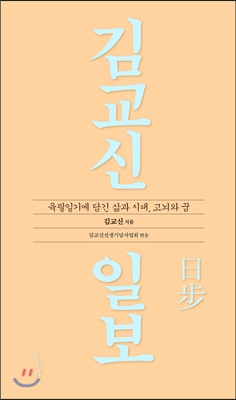 |
Description
Book Introduction
Handwritten Journal of Correspondence - The First and Last Maritime Version
Kim Kyo-shin's handwritten diary is finally translated and introduced.
The Kim Kyo-shin Memorial Society published a reprint of [Kim Kyo-shin Ilbo] in the spring of 2015 to commemorate the 70th anniversary of Kim Kyo-shin's death.
This book has been published today after approximately one year and nine months of translation work prior to its publication.
Through the records of daily life written down word by word with a pen, we can encounter Kim Kyo-shin as he truly was, and get a clear glimpse into aspects of the times during the late Japanese colonial period.
The traces of time spent with those who had an ideological influence on him, such as Ham Seok-heon and Ryu Yeong-mo, his friends including his childhood friend Han Lim, and his students during his Yangjeong days, such as Son Gi-jeong, Yun Seok-jung, and Ryu Dal-yeong, and the sharing they did, were vividly brought back to life.
During the translation process, we paid particular attention to being faithful to the original text and enhancing its value as a source text.
To ensure that today's readers can easily read and understand the original text without damaging it as much as possible, difficult Chinese characters were explained, old words were corrected to modern language, and footnotes were added where necessary.
In particular, we had a lot of discussions to try to bring out his simple yet enterprising writing style.
Due to the nature of the original text, which was a handwritten manuscript, some letters that could not be read or phrases whose meaning was not clearly understood were inevitably left as they were.
Kim Kyo-shin's handwritten diary is finally translated and introduced.
The Kim Kyo-shin Memorial Society published a reprint of [Kim Kyo-shin Ilbo] in the spring of 2015 to commemorate the 70th anniversary of Kim Kyo-shin's death.
This book has been published today after approximately one year and nine months of translation work prior to its publication.
Through the records of daily life written down word by word with a pen, we can encounter Kim Kyo-shin as he truly was, and get a clear glimpse into aspects of the times during the late Japanese colonial period.
The traces of time spent with those who had an ideological influence on him, such as Ham Seok-heon and Ryu Yeong-mo, his friends including his childhood friend Han Lim, and his students during his Yangjeong days, such as Son Gi-jeong, Yun Seok-jung, and Ryu Dal-yeong, and the sharing they did, were vividly brought back to life.
During the translation process, we paid particular attention to being faithful to the original text and enhancing its value as a source text.
To ensure that today's readers can easily read and understand the original text without damaging it as much as possible, difficult Chinese characters were explained, old words were corrected to modern language, and footnotes were added where necessary.
In particular, we had a lot of discussions to try to bring out his simple yet enterprising writing style.
Due to the nature of the original text, which was a handwritten manuscript, some letters that could not be read or phrases whose meaning was not clearly understood were inevitably left as they were.
- You can preview some of the book's contents.
Preview
index
Publisher/ Lee Man-yeol
January-June 1932 / July-December 1932 / January-June 1933 / July-December 1933 / January-August 1934
Preface/ Kim Cheol-woong, People around Kim Kyo-shin/ Jeon In-su
January-June 1932 / July-December 1932 / January-June 1933 / July-December 1933 / January-August 1934
Preface/ Kim Cheol-woong, People around Kim Kyo-shin/ Jeon In-su
Into the book
· In the afternoon, Ryu Dal-young came to my house to discuss things after graduation.
I advise you to give up on becoming a teacher and earn a salary, and to make a living through farming after graduating from a vocational school.
I said it because I was confident that it was the right decision.
… Today, a letter from Brother Ham (*Ham Seok-heon) arrived.
They say you've crossed the Rubicon.
Praying for the future of Osan School.
(32.
2. 13)
· After class, a regular tennis match between Yangjeong and Baejae staff was held at the Yangjeong court, and Yangjeong won.
Athletes Kim Eun-bae, Son Ki-jeong, and Kwon Tae-ha arrived in Gyeongseong at 7 p.m. after completing the Tokyo preliminaries, and were greeted by staff and many students.
(32.
6. 2)
· Attend the preparatory course at Cheongnyangni University at 8:00 AM and attend lectures.
On the way back, I went to see Mr. Kim Jeong-sik at address 54.
In the evening, Mr. Ryu Yeong-mo came and talked.
The excitement continued until 11:30.
Thank you so much for visiting.
(32.
7. 25)
· After waking up in the duty room at around 1:00 AM, I couldn't fall asleep again until around 4:00 AM because I was daydreaming and fantasizing about the publication of the Bible Chosun and the lives of my comrades.
After getting up and taking a cold shower in the museum, I was so moved that I had to swallow my tears several times while reading Psalms 102 and 137. Then, when I sang Japanese hymns 321, 233, and 35, tears flowed like a fountain (流淚如泉).
The emotion was so intense that I wondered if it was pathological or not.
(32.
10.
8)
· Going to school, on duty.
Attendance at afternoon German class.
I worked hard until 2 a.m. last night to send an article titled “Joseon Peninsula” to Yoon Seok-jung of the children’s publishing company.
This is my first time sending an article to a general magazine.
(33.
6. 26)
· Wake up before 5 o'clock and think of Hanrim and pray for him.
After finishing breakfast early, I went to the gate of Seodaemun Prison to greet the soldier who was being released after serving his four and a half year sentence. It was 7:10.
Dozens of relatives and friends, including Han In-suk, Han Jin-heon, Han Heung, Ryu Seung-heum, and Joo Jong-seon, gathered and waited.
Since he didn't come out until 8 o'clock, I went to school and after class, I went back to the Gyeongil Inn to meet him and shake his hand.
I am surprised that he was healthy both physically and mentally despite living in poverty for six years after the war.
(33.
9. 6)
· Passed censorship of the Bible Chosun.
The weather is getting warmer day by day, and the ice is scattered and the road is muddy.
Another month passed without anything happening.
The work hasn't even started yet, and a twelfth of the time has already passed.
365-31=334.
From Thursday, April 18, 1901 (Sin-Chu, February 30, Byeong-In, Byeong-In) to today
8+365×32+(13+31+30+31+31+30+31+30+62) = 11977 (34.
1. 31)
· The more I see the piles of slogans from the Sermon on the Mount and the Bible Chosun, the more I want to give up publishing and devote myself to sweet potato farming.
Anyone can give a sweet potato, and if given, they will be grateful, but that is not the case with publications.
(34.
8. 10)
I advise you to give up on becoming a teacher and earn a salary, and to make a living through farming after graduating from a vocational school.
I said it because I was confident that it was the right decision.
… Today, a letter from Brother Ham (*Ham Seok-heon) arrived.
They say you've crossed the Rubicon.
Praying for the future of Osan School.
(32.
2. 13)
· After class, a regular tennis match between Yangjeong and Baejae staff was held at the Yangjeong court, and Yangjeong won.
Athletes Kim Eun-bae, Son Ki-jeong, and Kwon Tae-ha arrived in Gyeongseong at 7 p.m. after completing the Tokyo preliminaries, and were greeted by staff and many students.
(32.
6. 2)
· Attend the preparatory course at Cheongnyangni University at 8:00 AM and attend lectures.
On the way back, I went to see Mr. Kim Jeong-sik at address 54.
In the evening, Mr. Ryu Yeong-mo came and talked.
The excitement continued until 11:30.
Thank you so much for visiting.
(32.
7. 25)
· After waking up in the duty room at around 1:00 AM, I couldn't fall asleep again until around 4:00 AM because I was daydreaming and fantasizing about the publication of the Bible Chosun and the lives of my comrades.
After getting up and taking a cold shower in the museum, I was so moved that I had to swallow my tears several times while reading Psalms 102 and 137. Then, when I sang Japanese hymns 321, 233, and 35, tears flowed like a fountain (流淚如泉).
The emotion was so intense that I wondered if it was pathological or not.
(32.
10.
8)
· Going to school, on duty.
Attendance at afternoon German class.
I worked hard until 2 a.m. last night to send an article titled “Joseon Peninsula” to Yoon Seok-jung of the children’s publishing company.
This is my first time sending an article to a general magazine.
(33.
6. 26)
· Wake up before 5 o'clock and think of Hanrim and pray for him.
After finishing breakfast early, I went to the gate of Seodaemun Prison to greet the soldier who was being released after serving his four and a half year sentence. It was 7:10.
Dozens of relatives and friends, including Han In-suk, Han Jin-heon, Han Heung, Ryu Seung-heum, and Joo Jong-seon, gathered and waited.
Since he didn't come out until 8 o'clock, I went to school and after class, I went back to the Gyeongil Inn to meet him and shake his hand.
I am surprised that he was healthy both physically and mentally despite living in poverty for six years after the war.
(33.
9. 6)
· Passed censorship of the Bible Chosun.
The weather is getting warmer day by day, and the ice is scattered and the road is muddy.
Another month passed without anything happening.
The work hasn't even started yet, and a twelfth of the time has already passed.
365-31=334.
From Thursday, April 18, 1901 (Sin-Chu, February 30, Byeong-In, Byeong-In) to today
8+365×32+(13+31+30+31+31+30+31+30+62) = 11977 (34.
1. 31)
· The more I see the piles of slogans from the Sermon on the Mount and the Bible Chosun, the more I want to give up publishing and devote myself to sweet potato farming.
Anyone can give a sweet potato, and if given, they will be grateful, but that is not the case with publications.
(34.
8. 10)
--- From the text
Publisher's Review
A national teacher who survived the Japanese colonial period with the soul of Jesus,
Why should we remember Kim Kyo-shin?
1.
Kim Kyo-shin, a 'true Joseon person'
Kim Kyo-shin (1901-1945), who loved Joseon, the Korean people, and the Korean language.
He was a believer who sought to establish 'the Bible on Joseon' and 'Joseon on the Bible', and he advocated for Joseon-made Christianity and Joseon-style Christianity movements.
He was called a 'non-church person' and tried to break free from the framework and system of the established church by criticizing and reforming it, which was becoming stale.
As a layman, not a pastor, his spirituality and practice of love, which were thorough in his life of words and prayer, had a deep impact and influence on many disciples through his life as a dedicated educator, and he continues to be a true example to us today as a teacher.
2.
Kim Kyo-shin's Handwritten Diary - The First and Last Maritime Edition
Kim Kyo-shin's handwritten diary is finally translated and introduced.
The Kim Kyo-shin Memorial Society published a reprint of [Kim Kyo-shin Ilbo] in the spring of 2015 to commemorate the 70th anniversary of Kim Kyo-shin's death.
This book has been published today after approximately one year and nine months of translation work prior to its publication.
Through the records of daily life written down word by word with a pen, we can encounter Kim Kyo-shin as he truly was, and get a clear glimpse into aspects of the times during the late Japanese colonial period.
The traces of time spent with those who had an ideological influence on him, such as Ham Seok-heon and Ryu Yeong-mo, his friends including his childhood friend Han Lim, and his students during his Yangjeong days, such as Son Gi-jeong, Yun Seok-jung, and Ryu Dal-yeong, and the sharing they did, were vividly brought back to life.
During the translation process, we paid particular attention to being faithful to the original text and enhancing its value as a source text.
To ensure that today's readers can easily read and understand the original text without damaging it as much as possible, difficult Chinese characters were explained, old words were corrected to modern language, and footnotes were added where necessary.
In particular, we had a lot of discussions to try to bring out his simple yet enterprising writing style.
Due to the nature of the original text, which is a handwritten manuscript, some letters that could not be read or phrases whose meaning was not clearly understood were inevitably left as they were.
· The teacher's term for the diary as "daily step" is understood to mean that Uchimura "interpreted the daily life principle with his own eschatological Christian view and tried to be faithful to each day of his life."
There must be a reason why the teacher placed importance on the 'day' seen in the 'Ilbo'.
(Omitted) By looking back and measuring our lives before God every day, we can understand that the word “daily” here is related to our spiritual life.
_Lee Man-yeol, from the publishing company
· Although he confessed throughout his diary that he was an unforgivable sinner and a wicked person, it only reminded him of Job's final appearance, when he laid down everything and knelt before God in obedience.
…I hope that through this ‘Ilbo,’ the scope of understanding of Kim Kyo-shin will broaden and that more people will sympathize with his faith.
So, I hope that this will be helpful in establishing 'Joseon (Korea) on the Bible' as Kim Kyo-shin dreamed.
_Kim Cheol-woong, in the preface
Kim Kyo-shin and his diary
Kim Kyo-shin had been keeping a diary since he was 10 years old, but with the outbreak of the Second Sino-Japanese War (1937) and the strengthening of Japan's wartime system, he had to burn his diaries out of fear of a pen accident.
This book is the 28th and 29th volumes of the 30 or so diaries he kept, two of which were not burned. (While a significant portion of his diary remains in [Bible Joseon], it has been proofread according to Korean spelling rules, has been refined to avoid censorship by the Governor-General, and contains elements of public notice, making it different in nature from this handwritten diary.)
Afterwards, this diary was reprinted as a separate volume of [Bible Chosun] in 1982, and although there were several attempts to translate it, it was never completed due to difficulties in deciphering the original text.
After many twists and turns, the remaining two volumes of handwritten diaries were reborn in modern language and brought to us after 80 years.
The diary covers the period from January 1932 to August 1934, during which time Kim Kyo-shin worked as a teacher at Yangjeong High School and focused on publishing [Seongseo Chosun].
Kim Kyo-shin's appearance reflected in the diary
As you read this diary, you will vividly see the daily life of Kim Kyo-shin, who tried to live each day as if it were his lifetime, as well as his devout heart, through the lines.
①Dedicated educator.
Not only classes, but also grades, home visits, basketball coaching and games, guidance of suspended students, parent meetings, career guidance, field trips, and off-campus guidance were all done without any neglect.
②Loyal father.
He was willing to take on a high level of work that went beyond just helping with housework.
Even in economic hardship, he found joy and fulfillment in his work, and sometimes, while doing his best to treat his family's illnesses, he reflected on himself, wondering if the illnesses might have been caused by his faithless lifestyle.
③[Bible Chosun] Publisher.
The publication of [Bible Chosun], which he poured all his energy into in order to establish 'Joseon on the Bible', had to overcome numerous hardships.
He single-handedly handled editing, production, and sales, battling various difficulties, including censorship and deletion by the Governor-General, difficulties large and small during the production and delivery process, and financial pressure due to poor sales.
④ Non-church person.
As is well known, he was an anarchist, but he never fought against the church, but rather against non-religious issues within the church.
He truly cherished and loved the church and worked hard for it.
Through his appearance as a believer, we can see that he was a simple human being who was naturally compassionate and especially expressed his intense emotions with tears when he was touched by divine influence.
Why should we remember Kim Kyo-shin?
1.
Kim Kyo-shin, a 'true Joseon person'
Kim Kyo-shin (1901-1945), who loved Joseon, the Korean people, and the Korean language.
He was a believer who sought to establish 'the Bible on Joseon' and 'Joseon on the Bible', and he advocated for Joseon-made Christianity and Joseon-style Christianity movements.
He was called a 'non-church person' and tried to break free from the framework and system of the established church by criticizing and reforming it, which was becoming stale.
As a layman, not a pastor, his spirituality and practice of love, which were thorough in his life of words and prayer, had a deep impact and influence on many disciples through his life as a dedicated educator, and he continues to be a true example to us today as a teacher.
2.
Kim Kyo-shin's Handwritten Diary - The First and Last Maritime Edition
Kim Kyo-shin's handwritten diary is finally translated and introduced.
The Kim Kyo-shin Memorial Society published a reprint of [Kim Kyo-shin Ilbo] in the spring of 2015 to commemorate the 70th anniversary of Kim Kyo-shin's death.
This book has been published today after approximately one year and nine months of translation work prior to its publication.
Through the records of daily life written down word by word with a pen, we can encounter Kim Kyo-shin as he truly was, and get a clear glimpse into aspects of the times during the late Japanese colonial period.
The traces of time spent with those who had an ideological influence on him, such as Ham Seok-heon and Ryu Yeong-mo, his friends including his childhood friend Han Lim, and his students during his Yangjeong days, such as Son Gi-jeong, Yun Seok-jung, and Ryu Dal-yeong, and the sharing they did, were vividly brought back to life.
During the translation process, we paid particular attention to being faithful to the original text and enhancing its value as a source text.
To ensure that today's readers can easily read and understand the original text without damaging it as much as possible, difficult Chinese characters were explained, old words were corrected to modern language, and footnotes were added where necessary.
In particular, we had a lot of discussions to try to bring out his simple yet enterprising writing style.
Due to the nature of the original text, which is a handwritten manuscript, some letters that could not be read or phrases whose meaning was not clearly understood were inevitably left as they were.
· The teacher's term for the diary as "daily step" is understood to mean that Uchimura "interpreted the daily life principle with his own eschatological Christian view and tried to be faithful to each day of his life."
There must be a reason why the teacher placed importance on the 'day' seen in the 'Ilbo'.
(Omitted) By looking back and measuring our lives before God every day, we can understand that the word “daily” here is related to our spiritual life.
_Lee Man-yeol, from the publishing company
· Although he confessed throughout his diary that he was an unforgivable sinner and a wicked person, it only reminded him of Job's final appearance, when he laid down everything and knelt before God in obedience.
…I hope that through this ‘Ilbo,’ the scope of understanding of Kim Kyo-shin will broaden and that more people will sympathize with his faith.
So, I hope that this will be helpful in establishing 'Joseon (Korea) on the Bible' as Kim Kyo-shin dreamed.
_Kim Cheol-woong, in the preface
Kim Kyo-shin and his diary
Kim Kyo-shin had been keeping a diary since he was 10 years old, but with the outbreak of the Second Sino-Japanese War (1937) and the strengthening of Japan's wartime system, he had to burn his diaries out of fear of a pen accident.
This book is the 28th and 29th volumes of the 30 or so diaries he kept, two of which were not burned. (While a significant portion of his diary remains in [Bible Joseon], it has been proofread according to Korean spelling rules, has been refined to avoid censorship by the Governor-General, and contains elements of public notice, making it different in nature from this handwritten diary.)
Afterwards, this diary was reprinted as a separate volume of [Bible Chosun] in 1982, and although there were several attempts to translate it, it was never completed due to difficulties in deciphering the original text.
After many twists and turns, the remaining two volumes of handwritten diaries were reborn in modern language and brought to us after 80 years.
The diary covers the period from January 1932 to August 1934, during which time Kim Kyo-shin worked as a teacher at Yangjeong High School and focused on publishing [Seongseo Chosun].
Kim Kyo-shin's appearance reflected in the diary
As you read this diary, you will vividly see the daily life of Kim Kyo-shin, who tried to live each day as if it were his lifetime, as well as his devout heart, through the lines.
①Dedicated educator.
Not only classes, but also grades, home visits, basketball coaching and games, guidance of suspended students, parent meetings, career guidance, field trips, and off-campus guidance were all done without any neglect.
②Loyal father.
He was willing to take on a high level of work that went beyond just helping with housework.
Even in economic hardship, he found joy and fulfillment in his work, and sometimes, while doing his best to treat his family's illnesses, he reflected on himself, wondering if the illnesses might have been caused by his faithless lifestyle.
③[Bible Chosun] Publisher.
The publication of [Bible Chosun], which he poured all his energy into in order to establish 'Joseon on the Bible', had to overcome numerous hardships.
He single-handedly handled editing, production, and sales, battling various difficulties, including censorship and deletion by the Governor-General, difficulties large and small during the production and delivery process, and financial pressure due to poor sales.
④ Non-church person.
As is well known, he was an anarchist, but he never fought against the church, but rather against non-religious issues within the church.
He truly cherished and loved the church and worked hard for it.
Through his appearance as a believer, we can see that he was a simple human being who was naturally compassionate and especially expressed his intense emotions with tears when he was touched by divine influence.
GOODS SPECIFICS
- Publication date: November 10, 2016
- Page count, weight, size: 300 pages | 428g | 135*228*20mm
- ISBN13: 9788936503413
- ISBN10: 8936503413
You may also like
카테고리
korean


korean

![GQ KOREA Mark (Monthly): December [2025]](http://librairie.coreenne.fr/cdn/shop/files/8ef265dbbfbf186523ed75ba7319009d.jpg?v=1765340328&width=3840)


