

Shin Ui-jin's Encyclopedia of Child Psychology (300,000-Copy Commemorative New Expanded Edition, Compilation)
 |
Description
Book Introduction
★Latest expanded edition commemorating the 300,000-copy milestone★
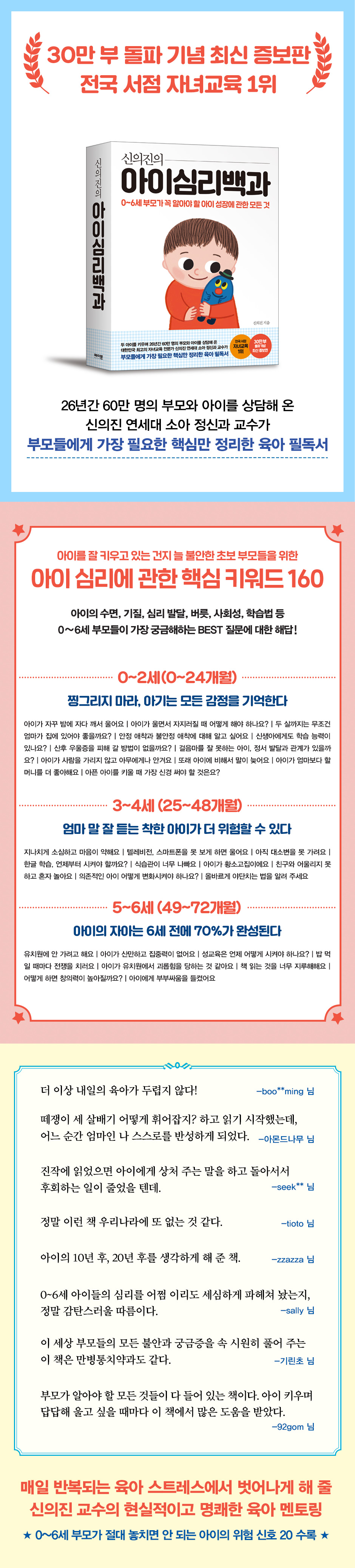
Korea's leading child education expert, who has counseled 600,000 parents and children for 26 years.
Everything you need to know about the growth of children ages 0-6, compiled by Professor Shin Eui-jin of the Department of Child Psychiatry at Yonsei University.
Professor Shin Eui-jin of Yonsei University's Department of Child Psychiatry has compiled everything parents of children aged 0-6 must know about child psychology into 160 key words based on 26 years of clinical records and proven developmental theories.
What should I do when my child cries and shivers? Is it always best for the mother to stay home until the child is two? My child will hug anyone without any reservations, is slower to speak than their peers, is overly timid and weak-willed, cries when I take their smartphone away, is stubborn, is distracted and has trouble concentrating. Please teach me how to scold them properly…
We've compiled 160 of the most common questions about child development that new parents, always anxious about whether they're raising their children well, are curious about. We've also provided accurate information, useful solutions, and the right attitudes parents should maintain.
This book contains the core of parenting that parents should not miss during the critical period of development of a child's self, from 0 to 6 years of age.
Also, the latest expanded edition, commemorating the 300,000-copy milestone, includes '20 warning signs that parents of children aged 0-6 should never miss' so that parents can diagnose their children's development on their own.
You can find help by looking at it moment by moment whenever you encounter questions while raising a child.
Korea's leading child education expert, who has counseled 600,000 parents and children for 26 years.
Everything you need to know about the growth of children ages 0-6, compiled by Professor Shin Eui-jin of the Department of Child Psychiatry at Yonsei University.
Professor Shin Eui-jin of Yonsei University's Department of Child Psychiatry has compiled everything parents of children aged 0-6 must know about child psychology into 160 key words based on 26 years of clinical records and proven developmental theories.
What should I do when my child cries and shivers? Is it always best for the mother to stay home until the child is two? My child will hug anyone without any reservations, is slower to speak than their peers, is overly timid and weak-willed, cries when I take their smartphone away, is stubborn, is distracted and has trouble concentrating. Please teach me how to scold them properly…
We've compiled 160 of the most common questions about child development that new parents, always anxious about whether they're raising their children well, are curious about. We've also provided accurate information, useful solutions, and the right attitudes parents should maintain.
This book contains the core of parenting that parents should not miss during the critical period of development of a child's self, from 0 to 6 years of age.
Also, the latest expanded edition, commemorating the 300,000-copy milestone, includes '20 warning signs that parents of children aged 0-6 should never miss' so that parents can diagnose their children's development on their own.
You can find help by looking at it moment by moment whenever you encounter questions while raising a child.
- You can preview some of the book's contents.
Preview
index
Publishing a 300,000 copy commemorative edition
Prologue | There is no period as crucial as the years 0-6.
Top 40 Questions Parents of Children Ages 0-6 Ask
Q1 Is there any way to avoid postpartum depression?
Q2 Do newborns have the ability to learn?
Q3 Is it always better for the mother to stay at home until the child is two years old?
Q4 I want to know about secure and insecure attachment.
Q5. Is there a relationship between a child's slow behavior and difficulty walking and his/her emotional development?
Q6 My child keeps waking up at night and crying.
Q7 What should I do when my child cries and falls asleep?
Q8 My child hugs anyone without any discrimination.
Q9 My child likes his grandmother more than his mother.
Q10 What is the most important thing to keep in mind when raising a sick child?
Q11 My speech is delayed compared to other children my age.
Q12 Are there any special stress management methods for mothers who balance work and childcare?
Q13 I cry if I'm not allowed to watch TV or use my smartphone.
Q14 I still can't control my bowel movements.
Q15 I get bored easily and don't like learning new things.
Q16 My baby masturbates
Q17 Should I take my child to the hospital because he/she has many problems?
Q18 When should I start learning Korean?
Q19 My eating habits are really bad
Q20 My child is very stubborn.
Q21 I am overly timid and weak-minded.
Q22 Brothers fight a lot
Q23 I can't hang out with friends and play alone.
Q24 You keep lying
Q25 I have to hit my child to get him to listen.
Q26 My child looks down on me
Q27 How can I change a dependent child?
Q28 Dad is too busy to play with the child.
Q29 My husband and I have very different ideas about childcare.
Q30 Please tell me how to scold properly.
Q31 I don't want to go to kindergarten.
Q32 My child is distracted and has difficulty concentrating.
Q33 I have to be away from my child for some reason. Is that okay?
Q34 Every time I feed you, there's a war going on
Q35 When and how should sex education be provided?
Q36 Should I reward my child for helping with housework?
Q37 I think my child is being bullied at kindergarten.
Q38 I find reading books so boring.
Q39 My child caught me fighting with my husband.
Q40 Are there any educational tips that parents with sons should know?
1 year old (0-12 months)
Characteristics of 1-Year-Old Children That Parents Must Know
baby crying
-If you keep holding a crying child, will it become a bad habit?
-If the child cries so much that he or she can't breathe
-I cry every night.
-I don't know why the child is crying.
sleep problems
-When can I start sleeping separately?
-I wake up at least once in the middle of the night.
-The sleepwalking is too intense.
-How to deal with sleep problems by month
Shyness & Separation Anxiety
-I can't move because of the child.
-I'm really shy. Will that be okay?
-It's a problem if the child doesn't show any shyness at all.
-I'm extremely afraid of unfamiliar things.
-The child rejects his father.
habit
-The child cries whenever he can't see the teddy bear.
-If you just take off the diaper, you can touch the pepper.
-When I get angry, I throw things and hit my head on the floor.
-Don't worry if your child sucks his or her thumb.
Personality & Temperament
-Don't just accept it as an innate trait.
-My child is so picky and sensitive, it's driving me crazy.
-If your child is particularly irritable
-If you don't change their diapers often, will their personality get worse?
-My personality became more sensitive while I was sick.
-Even children who are just a stone away from home get stressed.
Parenting attitude & environment
-I get depressed just looking at the child.
-I have no choice but to leave my child somewhere else.
Growth & Development
-Is my child growing well?
-Is it because my development is slow, or am I being impatient?
2 years old (13-24 months)
Characteristics of 2-Year-Old Children That Parents Must Know
Parents' attitude
-I feel sorry and worried because I don't have much time to spend with my child.
-I keep getting angry at my child.
-We had a fight in front of the child.
-I ended up hitting the child in a fit of anger.
Growth & Development
-They say you have to form attachments well, but I don't know how.
-Don't force yourself to wean from breast milk or bottles.
-How should I start potty training?
-You can ruin your child by trying to foster independence.
-The child can't even say 'mom' or 'dad'.
habit
-How can I correct my picky eating habits?
-We fight every day like a habit
-I hate playing with friends.
-I solve everything by crying.
self-consciousness
-They threaten to take other people's things, saying, "It's mine."
-I live with the word “no” on my lips
-I become a rascal whenever I go to public places.
-Is my child suffering from autism spectrum disorder?
personality
-Please tell me how to raise a child with a good personality.
-I have no motivation and am timid.
-Why is my child so distracted?
-Children who are very fearful, could this be a problem with their emotional development?
Play & Learn
-They say play is good for children, but why is that?
-How can I make my child smart?
3-4 years old (25-48 months)
Characteristics of 3-4 year old children that parents must know
Bowel Movement & Sleep
-The child is still wearing diapers.
-Hold back the anger or do it in secret
- Startled while sleeping, crying or waking up and walking around
self-regulation
- Distracted children, it could be because of their parents
-The child's hands move before he speaks.
-He keeps throwing tantrums, demanding to be bought no matter what.
-When I get angry, I cry and make a fuss.
-I'm too obsessed with one thing.
-I wonder if my child has ADHD?
word
-I'm slower to speak than my peers.
-Don't scold me for stuttering.
-My child lives with swear words on his lips.
-You lie as easily as you eat.
habit
-You just make a mess and don't clean up at all.
-I don't greet adults.
-I never give up anything, saying it's 'mine'
-I still suck my thumb.
-You keep taking other people's stuff.
-My child can't live without a television or smartphone.
Play & Toys
- Are teaching materials that are said to be good for brain development really effective?
-What kind of toy should I buy?
-Enjoy destructive play
-Play with your genitals
educational institutions
-Are there any points to keep in mind when sending your child to a childcare facility or educational institution such as a daycare center or kindergarten?
-Child under 36 months, does not want to go to the playroom
-After 36 months, the child does not want to go to kindergarten.
sibling relationship
-Maybe because he's an only child, he's stubborn.
-You're making my younger sibling suffer.
-No matter what my brother does, he interferes with everything.
-How can I mediate frequent quarrels between siblings?
Confidence & Sociability
-My friends are teasing me, but I feel like an idiot and can't say anything.
-Say "I can't" to everything.
-I'm too shy
Parents and children
-I'm sick of hearing you say that.
-Can I hit a disobedient child?
A child raised by his grandmother avoids his mother.
-I can't communicate with my child. Is it my problem?
-What I want to say to working moms
5-6 years old (49-72 months)
Characteristics of 5-6 year old children that parents must know
learning problems
-My child runs away when he sees a workbook.
-Every time I teach a child, my stomach turns.
-I don't think the child has a concept of numbers.
-No matter what you learn, you can easily give up.
Wise education
-Early education, is it really necessary to not provide it?
-Private education, what should I do?
-They say creativity is important, but how can we foster it?
-Is a child's self-esteem that important?
Proper sex education
-The child gives me peppers everywhere.
-If you have an awkward question, say it like this.
-My child masturbates. Does this mean he or she has a mental problem?
-If your child has been sexually abused
-You found out about Mom and Dad's sex life?
good habits
-The child isn't eating.
-What should I do with a child who is addicted to games?
-I always talk back to my mom.
-How can I break a bad habit?
self-expression
-The child is mumbling and cannot speak.
-I have no presentation skills.
-You act like you know everything
Kindergarten life
-He hits and teases other children.
-I hate losing and I have to be the best at everything.
-My child has been attending the same daycare for three years. Would it be a good idea to switch?
-I don't have any friends.
-The kindergarten teacher said there was a problem with the child.
Reading a book
-I hate reading books.
-I have no interest in anything around me and I only like books.
Admission preparation
-What preparations should I make before entering elementary school?
-I still can't read Korean.
-Do I need to teach writing separately?
Parents' hearts
-I love the second one more than the first one.
-I have to hold back my anger, but I'm not very good at it.
Appendix | 20 Warning Signs Parents of Children Ages 0-6 Should Never Ignore
Prologue | There is no period as crucial as the years 0-6.
Top 40 Questions Parents of Children Ages 0-6 Ask
Q1 Is there any way to avoid postpartum depression?
Q2 Do newborns have the ability to learn?
Q3 Is it always better for the mother to stay at home until the child is two years old?
Q4 I want to know about secure and insecure attachment.
Q5. Is there a relationship between a child's slow behavior and difficulty walking and his/her emotional development?
Q6 My child keeps waking up at night and crying.
Q7 What should I do when my child cries and falls asleep?
Q8 My child hugs anyone without any discrimination.
Q9 My child likes his grandmother more than his mother.
Q10 What is the most important thing to keep in mind when raising a sick child?
Q11 My speech is delayed compared to other children my age.
Q12 Are there any special stress management methods for mothers who balance work and childcare?
Q13 I cry if I'm not allowed to watch TV or use my smartphone.
Q14 I still can't control my bowel movements.
Q15 I get bored easily and don't like learning new things.
Q16 My baby masturbates
Q17 Should I take my child to the hospital because he/she has many problems?
Q18 When should I start learning Korean?
Q19 My eating habits are really bad
Q20 My child is very stubborn.
Q21 I am overly timid and weak-minded.
Q22 Brothers fight a lot
Q23 I can't hang out with friends and play alone.
Q24 You keep lying
Q25 I have to hit my child to get him to listen.
Q26 My child looks down on me
Q27 How can I change a dependent child?
Q28 Dad is too busy to play with the child.
Q29 My husband and I have very different ideas about childcare.
Q30 Please tell me how to scold properly.
Q31 I don't want to go to kindergarten.
Q32 My child is distracted and has difficulty concentrating.
Q33 I have to be away from my child for some reason. Is that okay?
Q34 Every time I feed you, there's a war going on
Q35 When and how should sex education be provided?
Q36 Should I reward my child for helping with housework?
Q37 I think my child is being bullied at kindergarten.
Q38 I find reading books so boring.
Q39 My child caught me fighting with my husband.
Q40 Are there any educational tips that parents with sons should know?
1 year old (0-12 months)
Characteristics of 1-Year-Old Children That Parents Must Know
baby crying
-If you keep holding a crying child, will it become a bad habit?
-If the child cries so much that he or she can't breathe
-I cry every night.
-I don't know why the child is crying.
sleep problems
-When can I start sleeping separately?
-I wake up at least once in the middle of the night.
-The sleepwalking is too intense.
-How to deal with sleep problems by month
Shyness & Separation Anxiety
-I can't move because of the child.
-I'm really shy. Will that be okay?
-It's a problem if the child doesn't show any shyness at all.
-I'm extremely afraid of unfamiliar things.
-The child rejects his father.
habit
-The child cries whenever he can't see the teddy bear.
-If you just take off the diaper, you can touch the pepper.
-When I get angry, I throw things and hit my head on the floor.
-Don't worry if your child sucks his or her thumb.
Personality & Temperament
-Don't just accept it as an innate trait.
-My child is so picky and sensitive, it's driving me crazy.
-If your child is particularly irritable
-If you don't change their diapers often, will their personality get worse?
-My personality became more sensitive while I was sick.
-Even children who are just a stone away from home get stressed.
Parenting attitude & environment
-I get depressed just looking at the child.
-I have no choice but to leave my child somewhere else.
Growth & Development
-Is my child growing well?
-Is it because my development is slow, or am I being impatient?
2 years old (13-24 months)
Characteristics of 2-Year-Old Children That Parents Must Know
Parents' attitude
-I feel sorry and worried because I don't have much time to spend with my child.
-I keep getting angry at my child.
-We had a fight in front of the child.
-I ended up hitting the child in a fit of anger.
Growth & Development
-They say you have to form attachments well, but I don't know how.
-Don't force yourself to wean from breast milk or bottles.
-How should I start potty training?
-You can ruin your child by trying to foster independence.
-The child can't even say 'mom' or 'dad'.
habit
-How can I correct my picky eating habits?
-We fight every day like a habit
-I hate playing with friends.
-I solve everything by crying.
self-consciousness
-They threaten to take other people's things, saying, "It's mine."
-I live with the word “no” on my lips
-I become a rascal whenever I go to public places.
-Is my child suffering from autism spectrum disorder?
personality
-Please tell me how to raise a child with a good personality.
-I have no motivation and am timid.
-Why is my child so distracted?
-Children who are very fearful, could this be a problem with their emotional development?
Play & Learn
-They say play is good for children, but why is that?
-How can I make my child smart?
3-4 years old (25-48 months)
Characteristics of 3-4 year old children that parents must know
Bowel Movement & Sleep
-The child is still wearing diapers.
-Hold back the anger or do it in secret
- Startled while sleeping, crying or waking up and walking around
self-regulation
- Distracted children, it could be because of their parents
-The child's hands move before he speaks.
-He keeps throwing tantrums, demanding to be bought no matter what.
-When I get angry, I cry and make a fuss.
-I'm too obsessed with one thing.
-I wonder if my child has ADHD?
word
-I'm slower to speak than my peers.
-Don't scold me for stuttering.
-My child lives with swear words on his lips.
-You lie as easily as you eat.
habit
-You just make a mess and don't clean up at all.
-I don't greet adults.
-I never give up anything, saying it's 'mine'
-I still suck my thumb.
-You keep taking other people's stuff.
-My child can't live without a television or smartphone.
Play & Toys
- Are teaching materials that are said to be good for brain development really effective?
-What kind of toy should I buy?
-Enjoy destructive play
-Play with your genitals
educational institutions
-Are there any points to keep in mind when sending your child to a childcare facility or educational institution such as a daycare center or kindergarten?
-Child under 36 months, does not want to go to the playroom
-After 36 months, the child does not want to go to kindergarten.
sibling relationship
-Maybe because he's an only child, he's stubborn.
-You're making my younger sibling suffer.
-No matter what my brother does, he interferes with everything.
-How can I mediate frequent quarrels between siblings?
Confidence & Sociability
-My friends are teasing me, but I feel like an idiot and can't say anything.
-Say "I can't" to everything.
-I'm too shy
Parents and children
-I'm sick of hearing you say that.
-Can I hit a disobedient child?
A child raised by his grandmother avoids his mother.
-I can't communicate with my child. Is it my problem?
-What I want to say to working moms
5-6 years old (49-72 months)
Characteristics of 5-6 year old children that parents must know
learning problems
-My child runs away when he sees a workbook.
-Every time I teach a child, my stomach turns.
-I don't think the child has a concept of numbers.
-No matter what you learn, you can easily give up.
Wise education
-Early education, is it really necessary to not provide it?
-Private education, what should I do?
-They say creativity is important, but how can we foster it?
-Is a child's self-esteem that important?
Proper sex education
-The child gives me peppers everywhere.
-If you have an awkward question, say it like this.
-My child masturbates. Does this mean he or she has a mental problem?
-If your child has been sexually abused
-You found out about Mom and Dad's sex life?
good habits
-The child isn't eating.
-What should I do with a child who is addicted to games?
-I always talk back to my mom.
-How can I break a bad habit?
self-expression
-The child is mumbling and cannot speak.
-I have no presentation skills.
-You act like you know everything
Kindergarten life
-He hits and teases other children.
-I hate losing and I have to be the best at everything.
-My child has been attending the same daycare for three years. Would it be a good idea to switch?
-I don't have any friends.
-The kindergarten teacher said there was a problem with the child.
Reading a book
-I hate reading books.
-I have no interest in anything around me and I only like books.
Admission preparation
-What preparations should I make before entering elementary school?
-I still can't read Korean.
-Do I need to teach writing separately?
Parents' hearts
-I love the second one more than the first one.
-I have to hold back my anger, but I'm not very good at it.
Appendix | 20 Warning Signs Parents of Children Ages 0-6 Should Never Ignore
Detailed image
Into the book
According to child development experts, 70 percent of a child's self is developed by the age of six.
This also means that 70 percent of the foundation for living life is laid during this period.
The period from 0 to 6 years old is an important period for children.
It's not just physical growth.
Along with brain development, the mind, or psychological growth, also occurs at a rapid pace.
However, if parents are not aware of this psychological growth process in their children, their daily life with them will inevitably become a battle.
Because we don't know what changes are happening in a child's mind or what developmental processes they are going through, we end up judging and forcing all their actions from an adult's perspective.
Therefore, parents must first find out 'why' their children behave that way.
Only then can we properly find the answer to the question 'how' to deal with it.
--- From the "Prologue"
If you keep hugging a crying child, will it become a bad habit?
Holding a crying child doesn't make them bad manners.
Rather, if you leave your child alone when he or she cries, he or she may grow up to be a child with a bad personality.
What if your child cries because he or she is hungry, has a wet diaper, or misses his or her mom, but she comes home late or you suddenly hear a loud vacuum cleaner?
If you continue to experience this kind of unfulfilled desire, you will become disappointed and frustrated, and as mentioned earlier, you will lose faith in the world.
You start to think, 'Maybe my mom doesn't love me', 'I'm not that important.'
Ultimately, the child grows up to be a person who views the world negatively, is timid, and lacks confidence in anything.
In order to instill positive thoughts and feelings in your child, you must respond immediately to his or her crying.
The child hugs anyone without discrimination.
Not being shy at all can be a more serious problem than being extremely shy.
If you are easily hugged by anyone, it is possible that you have not formed a good attachment to your mother.
If you love your mother the most and don't show interest in other people while giving her a lot of hugs, it may be that you don't feel anything towards people around you due to your distrust of the world.
So, if your child is not shy at all, you should check to see if there is a problem with his or her usual attachment to his or her mother.
In addition, if you leave your child at a daycare center too early, they may be exposed to an environment where they are cared for by more people than other children, which may make them less shy.
It may be because they meet nanny teachers before they even develop an attachment to their mother, so they don't perceive their mother as a special person.
In such cases, it is better to spend enough time with the child when he or she returns home, hug him or her, and play with him or her.
Among children who are not shy, there are some who have autism spectrum disorder.
These children have autism spectrum disorder, which prevents them from properly connecting with their mothers and perceiving the world.
As a result, they become less social and less aware of others, making them shy.
Also, even if the intelligence is low, shyness is delayed or less.
Their brains are not developed enough to properly distinguish between their mother and other people.
If your child does not show any shyness around 8 months of age despite being well-cared for and spending ample time with him or her, you may need to get him or her evaluated for developmental abnormalities.
Is my development slow or am I being impatient?
To properly understand development, we must at least consider it as language, cognitive, motor, social, and emotional development.
It is important to note that there are important and less important variables that can explain development depending on age.
For example, speaking a lot is not a very important variable in explaining mental development, but understanding speech is a very important variable.
For motor development, head support and independent walking are very important variables, but rolling over and crawling are less crucial variables compared to the former.
If motor development is slow, emotional development will also be slow.
Likewise, if emotional development is slow, motor development will also be slow.
As such, motor development and emotional development cannot be considered separately.
And for children under the age of 3, when neural network formation is active, if there is a problem in one area of development, it can spread to developmental problems in other areas.
I'm late in speaking compared to other children my age.
First, check to see if you are communicating nonverbally, such as through gestures or facial expressions.
If your child can communicate his or her thoughts and feelings through eye contact or imitation, you don't have to worry too much about his or her difficulty speaking.
Secondly, you need to make sure that your child does not have any intellectual problems.
Since language development is also a cognitive ability, when intelligence is low, language development is often also slow.
To find out about your child's intellectual development, you can look at whether your child is playing games appropriate for his or her age.
For example, if a child around the age of 3 is unable to engage in imaginative play, such as pretend play, and only engages in simple physical play, there is a possibility that their intelligence is low.
Thirdly, we need to check whether social development is normal.
Since language is a means of communication between people, if you are not interested in other people, your language development will be slow.
The person who has the greatest influence on a child's social development is the primary caregiver.
If the relationship with the primary caregiver is not smooth or unstable, the child may close his or her heart to others.
Finally, because language development is closely related to a child's emotional state, it is important to check whether the child is experiencing emotional problems.
Children show significant differences in their language expression depending on their mood.
If your child understands what others say, but is usually depressed and doesn't speak much, you may need to look into emotional issues.
A child who is separated from his mother unprepared and is shocked or ostracized by his friends may become psychologically depressed and have delayed emotional development.
In this case, language development is also delayed.
It is recommended that you carefully observe your child's surroundings and consult a professional if emotional problems are affecting language development.
If you don't let me watch TV or watch my smartphone, I cry.
There was a time when children's television programs were all the rage.
These programs are quite addictive and children love them, but there is no evidence that they are good for the development of intellectual abilities, including language.
Many mothers question whether educational computer programs are effective.
Although not much research has been conducted on this yet, previous research suggests that it is not very effective.
In particular, it is very dangerous to have your child watch English programs all day long in the hopes of teaching him or her English.
Language does not develop by repeating fragments of information.
It must be based on the ability to think critically about the situation.
Because of this, repeated viewing can actually hinder thinking skills and delay language development.
A 2017 domestic study found that most (95 percent) of infants with delayed language development had their first exposure to digital devices before 24 months of age, and 63 percent of them used digital devices for more than two hours a day.
That's why I tell parents never to let their children have a smartphone until they are two years old.
It is also not recommended to allow children over three years old to use smartphones.
Not only is it a problem to constantly look at your smartphone, but there are also concerns about the negative side effects, such as reduced physical activity and not playing with friends.
I still can't control my bowels.
The age at which children begin to learn to potty train is usually between 18 and 30 months, but this can vary greatly from child to child.
There is no correlation between being able to potty train quickly and being intelligent.
So, as long as potty training is completed within 36 months, you can assume there will be no problem.
The problem is the parents' impatience.
There are cases where parents ignore their child's developmental level and forcefully potty train their child, thinking, "The kid next door has already potty trained, so why is my kid so late?" This is absolutely not good for the child.
If you force training on a child who is not developmentally ready, the child will become stressed and will reject the training.
They are afraid to sit on or approach the toilet and intentionally hold in their stool, eventually causing it to leak.
Moreover, the hard, hard stool that comes out at this time causes pain, which results in the child holding in the stool even more.
In addition to the fear and dread of being scolded by mom and dad, children are more likely to exhibit violent and aggressive behavior due to rebelliousness and hostility.
When potty training, it is best to sit your child on the toilet and perform the straining motion with them. If your child follows along well, praise them for the job well done.
When a child sees his mother's satisfied face, he becomes happy too, and the pleasant feeling of having a bowel movement remains in his mind, which helps him control his bowel movements in the future.
My child is stubborn.
When a child does not listen to their mother and only asserts their own opinions, they are often referred to as being 'stubborn' or 'throwing a tantrum.'
These are words with a largely negative connotation.
However, from a developmental perspective, this means that the child has a strong self-concept and a firm will.
However, because their ability to express themselves is immature, they express it with definitive words like “I don’t like it” or “I won’t do it”, or with extreme actions like banging their head on the ground.
Therefore, when a child is being stubborn, rather than judging from the parent's perspective, we must first consider the child's position as he or she is still in the process of growing.
Rather than focusing on the stubbornness itself, we should focus on finding the hidden motive behind the stubbornness.
As time goes by, children will naturally learn to be considerate of others and will naturally let go of their stubbornness.
If this process is not followed, the child may grow up to be an adult who cannot properly express his or her own opinions.
I can't hang out with friends and play alone.
The first thing to consider is the relationship between mother and child.
Children who get along well with their mothers and play well with others when they go out.
Through my mother, I realized that the world is a fun and worthwhile place to live in, and little by little, I expanded that scope.
On the other hand, a child who fights with his mother every day at home and gets scolded only has a hard time making friends when he goes out.
It is also necessary to examine relationships with other family members, such as father and siblings.
Family can be said to be the first society a child encounters.
Therefore, we need to check whether the child is establishing primary social relationships well within the family.
Look at whether you are expressing what you want and don't want to do in front of your family.
Also, pay attention to whether you are considerate of your siblings and can compromise with them.
If you have these basic skills at home, you will have no trouble making friends.
Are teaching aids that are said to be good for brain development really effective?
When parents ask me about early childhood education, I tell them straight up:
'Education before the age of six is just a hobby for mom and dad.'
Children under the age of 6 have not yet developed cognitive abilities, so education is not effective, and there is no guarantee that education received at that age will have an impact when they grow up.
A child's brain develops evenly across all areas, without focusing on any one area.
So, education that focuses only on visual stimulation, like textbooks that are said to be good for brain development, is not good.
For example, if you want to teach your child about fish, it is more effective to go to an aquarium or pond together and let them see the size of the fish and touch them, rather than simply showing them a picture book or video.
And during this period, emotional development is important, so we need to make sure that the child can live happily.
Only then will you learn more about the world, which will in turn lead to brain development.
Share warm skin-to-skin contact with your child often.
Hugging, making eye contact, and spending happy times together are the most basic ways to bring emotional stability and develop the brain.
This also means that 70 percent of the foundation for living life is laid during this period.
The period from 0 to 6 years old is an important period for children.
It's not just physical growth.
Along with brain development, the mind, or psychological growth, also occurs at a rapid pace.
However, if parents are not aware of this psychological growth process in their children, their daily life with them will inevitably become a battle.
Because we don't know what changes are happening in a child's mind or what developmental processes they are going through, we end up judging and forcing all their actions from an adult's perspective.
Therefore, parents must first find out 'why' their children behave that way.
Only then can we properly find the answer to the question 'how' to deal with it.
--- From the "Prologue"
If you keep hugging a crying child, will it become a bad habit?
Holding a crying child doesn't make them bad manners.
Rather, if you leave your child alone when he or she cries, he or she may grow up to be a child with a bad personality.
What if your child cries because he or she is hungry, has a wet diaper, or misses his or her mom, but she comes home late or you suddenly hear a loud vacuum cleaner?
If you continue to experience this kind of unfulfilled desire, you will become disappointed and frustrated, and as mentioned earlier, you will lose faith in the world.
You start to think, 'Maybe my mom doesn't love me', 'I'm not that important.'
Ultimately, the child grows up to be a person who views the world negatively, is timid, and lacks confidence in anything.
In order to instill positive thoughts and feelings in your child, you must respond immediately to his or her crying.
The child hugs anyone without discrimination.
Not being shy at all can be a more serious problem than being extremely shy.
If you are easily hugged by anyone, it is possible that you have not formed a good attachment to your mother.
If you love your mother the most and don't show interest in other people while giving her a lot of hugs, it may be that you don't feel anything towards people around you due to your distrust of the world.
So, if your child is not shy at all, you should check to see if there is a problem with his or her usual attachment to his or her mother.
In addition, if you leave your child at a daycare center too early, they may be exposed to an environment where they are cared for by more people than other children, which may make them less shy.
It may be because they meet nanny teachers before they even develop an attachment to their mother, so they don't perceive their mother as a special person.
In such cases, it is better to spend enough time with the child when he or she returns home, hug him or her, and play with him or her.
Among children who are not shy, there are some who have autism spectrum disorder.
These children have autism spectrum disorder, which prevents them from properly connecting with their mothers and perceiving the world.
As a result, they become less social and less aware of others, making them shy.
Also, even if the intelligence is low, shyness is delayed or less.
Their brains are not developed enough to properly distinguish between their mother and other people.
If your child does not show any shyness around 8 months of age despite being well-cared for and spending ample time with him or her, you may need to get him or her evaluated for developmental abnormalities.
Is my development slow or am I being impatient?
To properly understand development, we must at least consider it as language, cognitive, motor, social, and emotional development.
It is important to note that there are important and less important variables that can explain development depending on age.
For example, speaking a lot is not a very important variable in explaining mental development, but understanding speech is a very important variable.
For motor development, head support and independent walking are very important variables, but rolling over and crawling are less crucial variables compared to the former.
If motor development is slow, emotional development will also be slow.
Likewise, if emotional development is slow, motor development will also be slow.
As such, motor development and emotional development cannot be considered separately.
And for children under the age of 3, when neural network formation is active, if there is a problem in one area of development, it can spread to developmental problems in other areas.
I'm late in speaking compared to other children my age.
First, check to see if you are communicating nonverbally, such as through gestures or facial expressions.
If your child can communicate his or her thoughts and feelings through eye contact or imitation, you don't have to worry too much about his or her difficulty speaking.
Secondly, you need to make sure that your child does not have any intellectual problems.
Since language development is also a cognitive ability, when intelligence is low, language development is often also slow.
To find out about your child's intellectual development, you can look at whether your child is playing games appropriate for his or her age.
For example, if a child around the age of 3 is unable to engage in imaginative play, such as pretend play, and only engages in simple physical play, there is a possibility that their intelligence is low.
Thirdly, we need to check whether social development is normal.
Since language is a means of communication between people, if you are not interested in other people, your language development will be slow.
The person who has the greatest influence on a child's social development is the primary caregiver.
If the relationship with the primary caregiver is not smooth or unstable, the child may close his or her heart to others.
Finally, because language development is closely related to a child's emotional state, it is important to check whether the child is experiencing emotional problems.
Children show significant differences in their language expression depending on their mood.
If your child understands what others say, but is usually depressed and doesn't speak much, you may need to look into emotional issues.
A child who is separated from his mother unprepared and is shocked or ostracized by his friends may become psychologically depressed and have delayed emotional development.
In this case, language development is also delayed.
It is recommended that you carefully observe your child's surroundings and consult a professional if emotional problems are affecting language development.
If you don't let me watch TV or watch my smartphone, I cry.
There was a time when children's television programs were all the rage.
These programs are quite addictive and children love them, but there is no evidence that they are good for the development of intellectual abilities, including language.
Many mothers question whether educational computer programs are effective.
Although not much research has been conducted on this yet, previous research suggests that it is not very effective.
In particular, it is very dangerous to have your child watch English programs all day long in the hopes of teaching him or her English.
Language does not develop by repeating fragments of information.
It must be based on the ability to think critically about the situation.
Because of this, repeated viewing can actually hinder thinking skills and delay language development.
A 2017 domestic study found that most (95 percent) of infants with delayed language development had their first exposure to digital devices before 24 months of age, and 63 percent of them used digital devices for more than two hours a day.
That's why I tell parents never to let their children have a smartphone until they are two years old.
It is also not recommended to allow children over three years old to use smartphones.
Not only is it a problem to constantly look at your smartphone, but there are also concerns about the negative side effects, such as reduced physical activity and not playing with friends.
I still can't control my bowels.
The age at which children begin to learn to potty train is usually between 18 and 30 months, but this can vary greatly from child to child.
There is no correlation between being able to potty train quickly and being intelligent.
So, as long as potty training is completed within 36 months, you can assume there will be no problem.
The problem is the parents' impatience.
There are cases where parents ignore their child's developmental level and forcefully potty train their child, thinking, "The kid next door has already potty trained, so why is my kid so late?" This is absolutely not good for the child.
If you force training on a child who is not developmentally ready, the child will become stressed and will reject the training.
They are afraid to sit on or approach the toilet and intentionally hold in their stool, eventually causing it to leak.
Moreover, the hard, hard stool that comes out at this time causes pain, which results in the child holding in the stool even more.
In addition to the fear and dread of being scolded by mom and dad, children are more likely to exhibit violent and aggressive behavior due to rebelliousness and hostility.
When potty training, it is best to sit your child on the toilet and perform the straining motion with them. If your child follows along well, praise them for the job well done.
When a child sees his mother's satisfied face, he becomes happy too, and the pleasant feeling of having a bowel movement remains in his mind, which helps him control his bowel movements in the future.
My child is stubborn.
When a child does not listen to their mother and only asserts their own opinions, they are often referred to as being 'stubborn' or 'throwing a tantrum.'
These are words with a largely negative connotation.
However, from a developmental perspective, this means that the child has a strong self-concept and a firm will.
However, because their ability to express themselves is immature, they express it with definitive words like “I don’t like it” or “I won’t do it”, or with extreme actions like banging their head on the ground.
Therefore, when a child is being stubborn, rather than judging from the parent's perspective, we must first consider the child's position as he or she is still in the process of growing.
Rather than focusing on the stubbornness itself, we should focus on finding the hidden motive behind the stubbornness.
As time goes by, children will naturally learn to be considerate of others and will naturally let go of their stubbornness.
If this process is not followed, the child may grow up to be an adult who cannot properly express his or her own opinions.
I can't hang out with friends and play alone.
The first thing to consider is the relationship between mother and child.
Children who get along well with their mothers and play well with others when they go out.
Through my mother, I realized that the world is a fun and worthwhile place to live in, and little by little, I expanded that scope.
On the other hand, a child who fights with his mother every day at home and gets scolded only has a hard time making friends when he goes out.
It is also necessary to examine relationships with other family members, such as father and siblings.
Family can be said to be the first society a child encounters.
Therefore, we need to check whether the child is establishing primary social relationships well within the family.
Look at whether you are expressing what you want and don't want to do in front of your family.
Also, pay attention to whether you are considerate of your siblings and can compromise with them.
If you have these basic skills at home, you will have no trouble making friends.
Are teaching aids that are said to be good for brain development really effective?
When parents ask me about early childhood education, I tell them straight up:
'Education before the age of six is just a hobby for mom and dad.'
Children under the age of 6 have not yet developed cognitive abilities, so education is not effective, and there is no guarantee that education received at that age will have an impact when they grow up.
A child's brain develops evenly across all areas, without focusing on any one area.
So, education that focuses only on visual stimulation, like textbooks that are said to be good for brain development, is not good.
For example, if you want to teach your child about fish, it is more effective to go to an aquarium or pond together and let them see the size of the fish and touch them, rather than simply showing them a picture book or video.
And during this period, emotional development is important, so we need to make sure that the child can live happily.
Only then will you learn more about the world, which will in turn lead to brain development.
Share warm skin-to-skin contact with your child often.
Hugging, making eye contact, and spending happy times together are the most basic ways to bring emotional stability and develop the brain.
--- From the text
Publisher's Review
Children's sleep, temperament, psychological development, habits, sociality, learning methods, etc.
160 Key Keywords About Child Psychology That Parents Are Most Curious About
I don't know why my child is crying, he or she hugs anyone without discrimination, his or her speech is delayed compared to other children of the same age, he or she is overly timid and weak-willed, he or she cries when I keep him or her away from his or her smartphone, he or she is not potty trained yet, his or her eating habits are very bad, he or she is very stubborn, he or she cannot socialize with friends and plays alone, he or she is very distracted and has difficulty concentrating, when should I start giving him or her sex education?
Professor Shin Ui-jin of Yonsei University's Department of Child Psychiatry has organized the core of childcare for children aged 0 to 6 into 160 keywords, divided by age, including the child's personality and temperament, parenting attitude and environment, sociality, and education.
Every parent wants to raise their child well.
But the reality is the exact opposite.
It's frustrating not knowing why the child is crying or throwing a tantrum.
If you fight with your child every day, your daily life becomes a battle, and you will often say and do things that hurt your child and regret it later.
Professor Shin Ui-jin tells these parents that there is only one reason why parenting is difficult.
This is because parents do not know their child's developmental process and psychological state.
This book contains 40 of the most frequently asked questions by parents, as well as easy-to-understand explanations of common conflicts parents face with their children in a question-and-answer format.
You can find help by looking at it moment by moment whenever you encounter questions while raising a child.
“There is no period as important as the ages 0 to 6.”
The key to parenting that parents must not miss during the critical period when a child's ego is being developed.
According to child development experts, 70 percent of a child's self is developed by the age of six.
This means that 70 percent of the foundation for living life is laid during this period.
It's not just physical growth.
Along with brain development, the mind, or psychological growth, also occurs at a rapid pace.
However, if parents are not aware of this psychological growth process in their children, their daily life with them will inevitably become a battle.
Because we don't know what changes are happening in the child's mind or what developmental process the child is going through, we end up judging and forcing all actions from an adult's perspective.
Therefore, parents must first find out 'why' their children behave that way.
Only then can we properly find the answer to the question ‘how’ to deal with it.
Don't frown, the child remembers all the emotions: Characteristics of children aged 0-2
One year after birth.
This is a time when the child's body and mind are not separated, and physical development means psychological development.
Therefore, it is most important to feed the child on time, let him poop on time, and clean up right away so that he can maintain the best condition.
At the same time, we must build a strong love line that will not be broken by anything.
Also, as the child turns one year old, he begins to throw tantrums twelve times a day, which means that he has developed a sense of self.
At this time, parents should try not to arbitrarily break the child's will and help the child develop a positive self-image.
Good children who listen well to their mothers may be more at risk: Characteristics of 3-4 year olds
It is no exaggeration to say that children during this period do everything they can to accomplish the ultimate task of self-formation.
The group grows out of control and their self-assertion becomes much stronger.
Therefore, parents must establish principles and accept their child's requests if they are deemed worthy of acceptance, and never accept requests that are not worthy of acceptance.
Children like these principles because they see them as showing concern for themselves.
-70% of a child's ego is completed before the age of 6: Characteristics of children aged 5 to 6
Children at this age learn to rationally control their emotions, and their intelligence develops, making them capable of learning.
But the important learning at this time is not English or math.
It is at this time that we must lay the foundations necessary for living in the world, such as emotional control, impulse control, concentration, empathy, morality, sociality, and curiosity.
These are not things you can learn by sitting down.
It is something that children naturally come to understand through playing with peers, interacting with their parents, and actually seeing and experiencing a wider variety of situations.
So, rather than just sitting at a desk, we need to help them experience the wider world.
“Whenever I feel like crying because I’m frustrated with raising a child, this book helps me a lot!”
Realistic and clear parenting mentoring that will help you escape the daily stress of parenting.
The answer to parenting lies elsewhere.
If you think from the child's perspective, all your questions will be answered and you will see the answer to how to raise your child.
Professor Shin Ui-jin has selected the most frequently asked questions by parents of children aged 0-6, based on his medical records from counseling hundreds of thousands of parents and articles posted on various parenting websites, and has written down answers to those questions.
The book was written based on my experience as a mother of two children, as well as theories of infant and toddler psychological development and clinical experience.
This book contains the hope that parents who are burdened by the image of a perfect parent who must do more for their children and are anxious and impatient will regain the happiness of parenting by making eye contact with their children every day.
Because that is true education that thinks about the child's future 20 years from now.
160 Key Keywords About Child Psychology That Parents Are Most Curious About
I don't know why my child is crying, he or she hugs anyone without discrimination, his or her speech is delayed compared to other children of the same age, he or she is overly timid and weak-willed, he or she cries when I keep him or her away from his or her smartphone, he or she is not potty trained yet, his or her eating habits are very bad, he or she is very stubborn, he or she cannot socialize with friends and plays alone, he or she is very distracted and has difficulty concentrating, when should I start giving him or her sex education?
Professor Shin Ui-jin of Yonsei University's Department of Child Psychiatry has organized the core of childcare for children aged 0 to 6 into 160 keywords, divided by age, including the child's personality and temperament, parenting attitude and environment, sociality, and education.
Every parent wants to raise their child well.
But the reality is the exact opposite.
It's frustrating not knowing why the child is crying or throwing a tantrum.
If you fight with your child every day, your daily life becomes a battle, and you will often say and do things that hurt your child and regret it later.
Professor Shin Ui-jin tells these parents that there is only one reason why parenting is difficult.
This is because parents do not know their child's developmental process and psychological state.
This book contains 40 of the most frequently asked questions by parents, as well as easy-to-understand explanations of common conflicts parents face with their children in a question-and-answer format.
You can find help by looking at it moment by moment whenever you encounter questions while raising a child.
“There is no period as important as the ages 0 to 6.”
The key to parenting that parents must not miss during the critical period when a child's ego is being developed.
According to child development experts, 70 percent of a child's self is developed by the age of six.
This means that 70 percent of the foundation for living life is laid during this period.
It's not just physical growth.
Along with brain development, the mind, or psychological growth, also occurs at a rapid pace.
However, if parents are not aware of this psychological growth process in their children, their daily life with them will inevitably become a battle.
Because we don't know what changes are happening in the child's mind or what developmental process the child is going through, we end up judging and forcing all actions from an adult's perspective.
Therefore, parents must first find out 'why' their children behave that way.
Only then can we properly find the answer to the question ‘how’ to deal with it.
Don't frown, the child remembers all the emotions: Characteristics of children aged 0-2
One year after birth.
This is a time when the child's body and mind are not separated, and physical development means psychological development.
Therefore, it is most important to feed the child on time, let him poop on time, and clean up right away so that he can maintain the best condition.
At the same time, we must build a strong love line that will not be broken by anything.
Also, as the child turns one year old, he begins to throw tantrums twelve times a day, which means that he has developed a sense of self.
At this time, parents should try not to arbitrarily break the child's will and help the child develop a positive self-image.
Good children who listen well to their mothers may be more at risk: Characteristics of 3-4 year olds
It is no exaggeration to say that children during this period do everything they can to accomplish the ultimate task of self-formation.
The group grows out of control and their self-assertion becomes much stronger.
Therefore, parents must establish principles and accept their child's requests if they are deemed worthy of acceptance, and never accept requests that are not worthy of acceptance.
Children like these principles because they see them as showing concern for themselves.
-70% of a child's ego is completed before the age of 6: Characteristics of children aged 5 to 6
Children at this age learn to rationally control their emotions, and their intelligence develops, making them capable of learning.
But the important learning at this time is not English or math.
It is at this time that we must lay the foundations necessary for living in the world, such as emotional control, impulse control, concentration, empathy, morality, sociality, and curiosity.
These are not things you can learn by sitting down.
It is something that children naturally come to understand through playing with peers, interacting with their parents, and actually seeing and experiencing a wider variety of situations.
So, rather than just sitting at a desk, we need to help them experience the wider world.
“Whenever I feel like crying because I’m frustrated with raising a child, this book helps me a lot!”
Realistic and clear parenting mentoring that will help you escape the daily stress of parenting.
The answer to parenting lies elsewhere.
If you think from the child's perspective, all your questions will be answered and you will see the answer to how to raise your child.
Professor Shin Ui-jin has selected the most frequently asked questions by parents of children aged 0-6, based on his medical records from counseling hundreds of thousands of parents and articles posted on various parenting websites, and has written down answers to those questions.
The book was written based on my experience as a mother of two children, as well as theories of infant and toddler psychological development and clinical experience.
This book contains the hope that parents who are burdened by the image of a perfect parent who must do more for their children and are anxious and impatient will regain the happiness of parenting by making eye contact with their children every day.
Because that is true education that thinks about the child's future 20 years from now.
GOODS SPECIFICS
- Publication date: November 8, 2021
- Page count, weight, size: 584 pages | 1,140g | 185*236*37mm
- ISBN13: 9791190538404
- ISBN10: 1190538407
You may also like
카테고리
korean


korean

![GQ KOREA Mark (Monthly): December [2025]](http://librairie.coreenne.fr/cdn/shop/files/8ef265dbbfbf186523ed75ba7319009d.jpg?v=1765340328&width=3840)


