

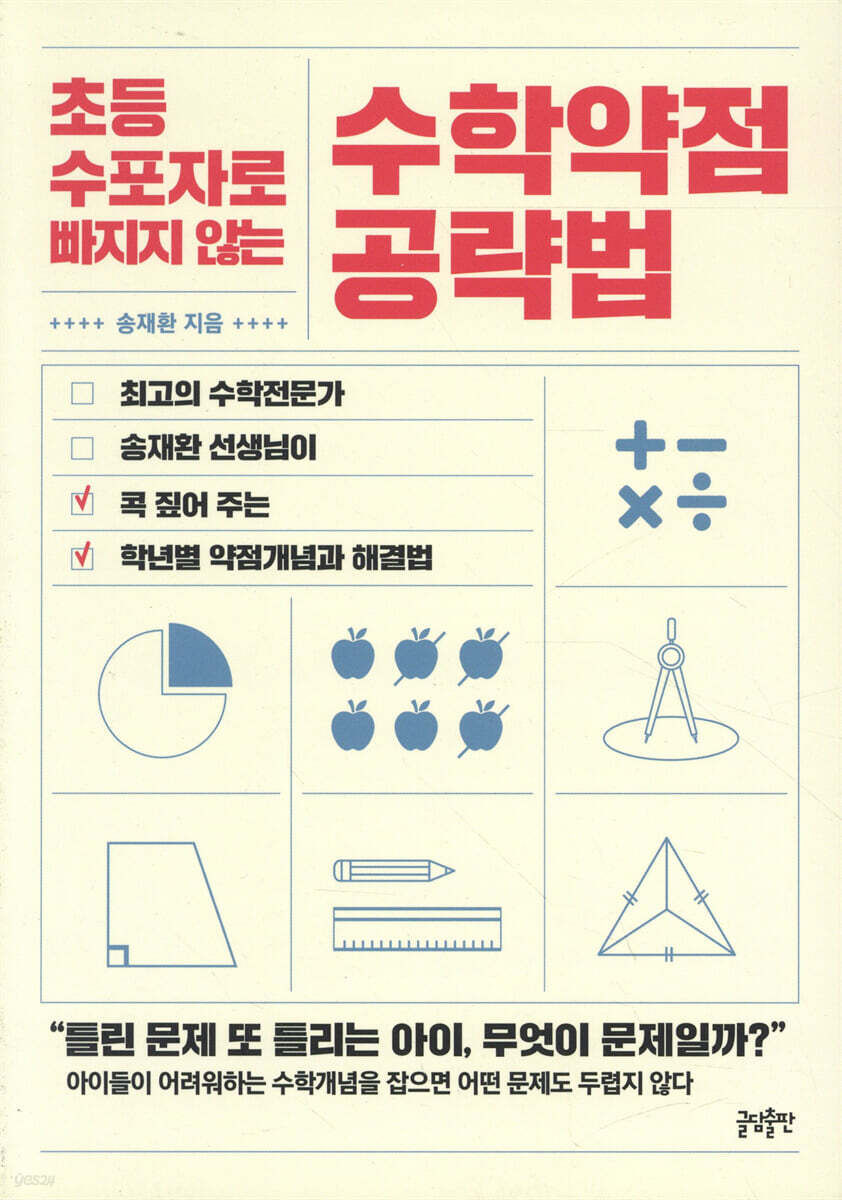
How to overcome your math weaknesses without falling into the trap of being an elementary school dropout
 |
Description
Book Introduction
The secret to raising a child who likes and is good at math even as he or she advances in grade level.
Catch your math weaknesses!
Math is the subject we spend the most time studying. Why do only a small number of students achieve perfect scores? Why is it that as students advance in grade level, it becomes increasingly rare to find a child who loves math? This book reveals that the reason children dislike and give up on math is their weaknesses in math, and introduces weaknesses and strategies for each grade level.
Teacher Song Jae-hwan, a math expert with over 20 years of experience teaching in the field, analyzed and systematically organized textbooks based on the math learning patterns observed in children.
If you always get one or two questions wrong every time you take a test, if you frequently make minor calculation mistakes, if you struggle with certain concepts, or if you can't answer correctly when asked how to solve a problem, it means you have a learning gap.
Even with a perfect score on a test paper, you can't feel at ease.
For example, even if you don't fully understand the concept of division, it's not a problem if the calculations are simple and the problems are easy.
The period when a child's math weakness begins to seriously hinder his or her math grades begins in the 4th grade.
As the arithmetic operations based on division of fractions become more complex, grades plummet.
At this time, you shouldn't just study fractions.
The division needs to be corrected.
This is also why sending your child to an academy does not solve math problems.
We need to find and address not only the obvious math weaknesses, but also the real causes.
To achieve this, we need to be able to diagnose whether the child is learning math properly from the first grade and provide effective assistance.
This book analyzes children's math weaknesses by grade, area, and study type and introduces the most effective learning methods.
Catch your math weaknesses!
Math is the subject we spend the most time studying. Why do only a small number of students achieve perfect scores? Why is it that as students advance in grade level, it becomes increasingly rare to find a child who loves math? This book reveals that the reason children dislike and give up on math is their weaknesses in math, and introduces weaknesses and strategies for each grade level.
Teacher Song Jae-hwan, a math expert with over 20 years of experience teaching in the field, analyzed and systematically organized textbooks based on the math learning patterns observed in children.
If you always get one or two questions wrong every time you take a test, if you frequently make minor calculation mistakes, if you struggle with certain concepts, or if you can't answer correctly when asked how to solve a problem, it means you have a learning gap.
Even with a perfect score on a test paper, you can't feel at ease.
For example, even if you don't fully understand the concept of division, it's not a problem if the calculations are simple and the problems are easy.
The period when a child's math weakness begins to seriously hinder his or her math grades begins in the 4th grade.
As the arithmetic operations based on division of fractions become more complex, grades plummet.
At this time, you shouldn't just study fractions.
The division needs to be corrected.
This is also why sending your child to an academy does not solve math problems.
We need to find and address not only the obvious math weaknesses, but also the real causes.
To achieve this, we need to be able to diagnose whether the child is learning math properly from the first grade and provide effective assistance.
This book analyzes children's math weaknesses by grade, area, and study type and introduces the most effective learning methods.
- You can preview some of the book's contents.
Preview
index
prolog
The most studied subject is mathematics,
Why do only a very small number of children get perfect scores?
Part 1.
Math Weaknesses by Grade Level ∥ Focus on weaker sections based on each grade's characteristics.
First grade math feels too easy
First-grade math isn't suited to desk work | Grouping and dividing are the foundations of addition and subtraction | The ability to choose and express precise terms | Terms and symbols that first-grade students must know | Units that are often weak points in first-grade math
Second grade math that builds important foundations
There are subtle differences in computational speed | How to understand the hidden stacking tree | What math prodigies have in common | Why children struggle with descriptive problems | Terms and symbols you must know in second grade | Units that are often weak in second grade math
3rd Grade Math: Multiplication and Division Get More Complex
Third-Grade Math: Parental Attention | Children who master the four basic operations of natural numbers will excel at math | How to avoid repeating mistakes | Essential third-grade terms and symbols | Units that are often weak in third-grade math
4th grade math that requires grasping shapes
Why 4th Grade Math Feels Difficult | Essential 4th Grade Terms and Symbols | Units That Can Be a Weak Point in 4th Grade Math
The Ice Age of Elementary Math: Fifth Grade Math
Fifth graders desperately need praise and encouragement | Expand your child's world by challenging them to competitions | Is pre-learning essential in fifth grade? | Essential terms and symbols for fifth graders | Units that are often weak in fifth grade math
6th grade math to prepare for middle school
Last Chance to Spark Math Interest | Use Vacation to Build Elementary Math | Find Your Child's Own Math Study Method | Essential 6th Grade Terms and Symbols | Units That Can Be a Weak Point in 6th Grade Math
Part 2.
Math Weaknesses by Area ∥Understand the pitfalls of each area and adopt appropriate study methods.
'Numbers and operations' that require speed and accuracy
You must study thoroughly and step by step | You must understand the calculation principles | Why exam time is running out
'Shapes' that must be memorized by heart
You need to know the system of shapes to draw them at a glance | Problems that arise when you neglect memorizing concepts | An easy way to study shapes: Make a concept notebook | How to remember formulas for a long time without forgetting them | Complete shapes through hands-on activities
Brother area
Measuring through body
A proper understanding of units is crucial | Explain units at a child's level | Understand the interrelationships between units | Children who only learned the concept of units through text
'Regularity' that forms the basis of functions
Discover Hidden Patterns in Everyday Life | Study Tips to Improve Your Child's Mathematical Thinking | Master 7 Problem-Solving Strategies | If Your Scores Stop Improving, Check Your Problem Understanding
Learning about 'data and possibilities' in everyday life
Grab your second-year statistics | Connect statistics to real-life situations
Part 3.
18 Math Weaknesses by Study Type ∥Diagnose and Treat Your Child's Weaknesses Through Specific Case Studies
A child whose scores fluctuate every time they take a test | A child who can't find the answer in their own solutions | A child who always makes calculation mistakes | A child who dislikes math as they advance in grade | A child who finds a particular section particularly difficult | A child who tries to solve only workbooks without looking at the math textbook | A child who gives up if a problem gets even slightly longer | A child who solves a problem well but writes the wrong answer | A child who can't finish a problem because they're pressed for time | A child who finds workbooks boring | A child who can't demonstrate their skills in math competitions | A child who studies with workbooks that don't suit them | A child who has no test preparation skills | A child who solves problems mechanically without thinking | A child who relies too much on academies | A child who becomes anxious when seeing math problems | A child who can't concentrate in math class | A child who studies math like English
Epilogue
Don't let your child struggle with his weaknesses alone.
The most studied subject is mathematics,
Why do only a very small number of children get perfect scores?
Part 1.
Math Weaknesses by Grade Level ∥ Focus on weaker sections based on each grade's characteristics.
First grade math feels too easy
First-grade math isn't suited to desk work | Grouping and dividing are the foundations of addition and subtraction | The ability to choose and express precise terms | Terms and symbols that first-grade students must know | Units that are often weak points in first-grade math
Second grade math that builds important foundations
There are subtle differences in computational speed | How to understand the hidden stacking tree | What math prodigies have in common | Why children struggle with descriptive problems | Terms and symbols you must know in second grade | Units that are often weak in second grade math
3rd Grade Math: Multiplication and Division Get More Complex
Third-Grade Math: Parental Attention | Children who master the four basic operations of natural numbers will excel at math | How to avoid repeating mistakes | Essential third-grade terms and symbols | Units that are often weak in third-grade math
4th grade math that requires grasping shapes
Why 4th Grade Math Feels Difficult | Essential 4th Grade Terms and Symbols | Units That Can Be a Weak Point in 4th Grade Math
The Ice Age of Elementary Math: Fifth Grade Math
Fifth graders desperately need praise and encouragement | Expand your child's world by challenging them to competitions | Is pre-learning essential in fifth grade? | Essential terms and symbols for fifth graders | Units that are often weak in fifth grade math
6th grade math to prepare for middle school
Last Chance to Spark Math Interest | Use Vacation to Build Elementary Math | Find Your Child's Own Math Study Method | Essential 6th Grade Terms and Symbols | Units That Can Be a Weak Point in 6th Grade Math
Part 2.
Math Weaknesses by Area ∥Understand the pitfalls of each area and adopt appropriate study methods.
'Numbers and operations' that require speed and accuracy
You must study thoroughly and step by step | You must understand the calculation principles | Why exam time is running out
'Shapes' that must be memorized by heart
You need to know the system of shapes to draw them at a glance | Problems that arise when you neglect memorizing concepts | An easy way to study shapes: Make a concept notebook | How to remember formulas for a long time without forgetting them | Complete shapes through hands-on activities
Brother area
Measuring through body
A proper understanding of units is crucial | Explain units at a child's level | Understand the interrelationships between units | Children who only learned the concept of units through text
'Regularity' that forms the basis of functions
Discover Hidden Patterns in Everyday Life | Study Tips to Improve Your Child's Mathematical Thinking | Master 7 Problem-Solving Strategies | If Your Scores Stop Improving, Check Your Problem Understanding
Learning about 'data and possibilities' in everyday life
Grab your second-year statistics | Connect statistics to real-life situations
Part 3.
18 Math Weaknesses by Study Type ∥Diagnose and Treat Your Child's Weaknesses Through Specific Case Studies
A child whose scores fluctuate every time they take a test | A child who can't find the answer in their own solutions | A child who always makes calculation mistakes | A child who dislikes math as they advance in grade | A child who finds a particular section particularly difficult | A child who tries to solve only workbooks without looking at the math textbook | A child who gives up if a problem gets even slightly longer | A child who solves a problem well but writes the wrong answer | A child who can't finish a problem because they're pressed for time | A child who finds workbooks boring | A child who can't demonstrate their skills in math competitions | A child who studies with workbooks that don't suit them | A child who has no test preparation skills | A child who solves problems mechanically without thinking | A child who relies too much on academies | A child who becomes anxious when seeing math problems | A child who can't concentrate in math class | A child who studies math like English
Epilogue
Don't let your child struggle with his weaknesses alone.
Detailed image

Publisher's Review
The secret to the increasing number of students dropping out of school as they advance lies in their weakness in math.
Math weaknesses by grade level that hinder your child's math performance and strategies to overcome them.
Elementary school teachers unanimously say, “There are math concepts that children commonly find difficult.”
Depending on the child's personality, such as active children, quiet children, children with a humanities tendency, or children with a science tendency, there are concepts that are easy to accept and concepts that are difficult, but in general, there are concepts that all children find difficult.
Teacher Song Jae-hwan, who has been working in the elementary education field for over 20 years, says that children can be raised to be good at math just by helping them understand these concepts in advance and learn them sufficiently.
To this end, we collect and introduce the weak concepts that children find difficult by grade and area, and introduce effective strategies for conquering them.
It helps you identify not only your obvious weaknesses but also your potential weaknesses, such as how to spot them in frequently repeated mistakes on a 100-point test.
Six years of elementary school, there is no grade where you can let your guard down.
Math weaknesses by grade level that need to be addressed starting from the first grade
To address your math weaknesses, you must first make sure you have a good understanding of the math appropriate to your grade level.
Many people assume that first grade math is too easy, but many children get confused just by changing the way addition and subtraction are expressed.
It may seem easy, but children's actual skills often fall short of their learning level.
Also, while third graders can easily understand 'continuous fractions' that deal with uncountable quantities, they have a very difficult time with 'discrete fractions' that deal with countable quantities such as apples and bread.
This book points out the math concepts that children find difficult at each grade level, as well as the math terms and symbols that they must learn, and teaches them how to master them perfectly.
If you want to address your child's weaknesses, focus on math weaknesses by area.
Each child has areas of math that they find particularly difficult, such as those that are weak in calculations or those that are weak in shapes.
If you want to address your child's weaknesses, you can find the answer in math weaknesses by area.
Elementary mathematics is comprised of five areas: 'numbers and operations, shapes, measurement, regularity, and data and possibility.'
Because these contents are learned separately for six years in elementary school, it is very difficult to study related concepts comprehensively.
If you don't fully understand the interrelated content, you will have difficulty applying and deepening the knowledge.
It helps you avoid traps by organizing the content by area systematically and teaching you appropriate study methods.
Why on earth is this happening? Through the typical study patterns of children.
Diagnose math problems and find solutions!
It teaches us how to address our weaknesses in math by examining the study styles of children, such as children who solve problems correctly but write incorrect answers, children who make mistakes because they can't find the answer to a problem they solved, and children who make mistakes because they write incorrectly.
If you've been worried about your child's math scores, or if your child's test scores aren't as good as they should be, you might find a clue to solving the problem.
Math weaknesses by grade level that hinder your child's math performance and strategies to overcome them.
Elementary school teachers unanimously say, “There are math concepts that children commonly find difficult.”
Depending on the child's personality, such as active children, quiet children, children with a humanities tendency, or children with a science tendency, there are concepts that are easy to accept and concepts that are difficult, but in general, there are concepts that all children find difficult.
Teacher Song Jae-hwan, who has been working in the elementary education field for over 20 years, says that children can be raised to be good at math just by helping them understand these concepts in advance and learn them sufficiently.
To this end, we collect and introduce the weak concepts that children find difficult by grade and area, and introduce effective strategies for conquering them.
It helps you identify not only your obvious weaknesses but also your potential weaknesses, such as how to spot them in frequently repeated mistakes on a 100-point test.
Six years of elementary school, there is no grade where you can let your guard down.
Math weaknesses by grade level that need to be addressed starting from the first grade
To address your math weaknesses, you must first make sure you have a good understanding of the math appropriate to your grade level.
Many people assume that first grade math is too easy, but many children get confused just by changing the way addition and subtraction are expressed.
It may seem easy, but children's actual skills often fall short of their learning level.
Also, while third graders can easily understand 'continuous fractions' that deal with uncountable quantities, they have a very difficult time with 'discrete fractions' that deal with countable quantities such as apples and bread.
This book points out the math concepts that children find difficult at each grade level, as well as the math terms and symbols that they must learn, and teaches them how to master them perfectly.
If you want to address your child's weaknesses, focus on math weaknesses by area.
Each child has areas of math that they find particularly difficult, such as those that are weak in calculations or those that are weak in shapes.
If you want to address your child's weaknesses, you can find the answer in math weaknesses by area.
Elementary mathematics is comprised of five areas: 'numbers and operations, shapes, measurement, regularity, and data and possibility.'
Because these contents are learned separately for six years in elementary school, it is very difficult to study related concepts comprehensively.
If you don't fully understand the interrelated content, you will have difficulty applying and deepening the knowledge.
It helps you avoid traps by organizing the content by area systematically and teaching you appropriate study methods.
Why on earth is this happening? Through the typical study patterns of children.
Diagnose math problems and find solutions!
It teaches us how to address our weaknesses in math by examining the study styles of children, such as children who solve problems correctly but write incorrect answers, children who make mistakes because they can't find the answer to a problem they solved, and children who make mistakes because they write incorrectly.
If you've been worried about your child's math scores, or if your child's test scores aren't as good as they should be, you might find a clue to solving the problem.
GOODS SPECIFICS
- Publication date: March 23, 2021
- Page count, weight, size: 280 pages | 460g | 150*210*15mm
- ISBN13: 9791191309041
- ISBN10: 1191309045
You may also like
카테고리
korean


korean

![GQ KOREA Mark (Monthly): December [2025]](http://librairie.coreenne.fr/cdn/shop/files/8ef265dbbfbf186523ed75ba7319009d.jpg?v=1765340328&width=3840)


