

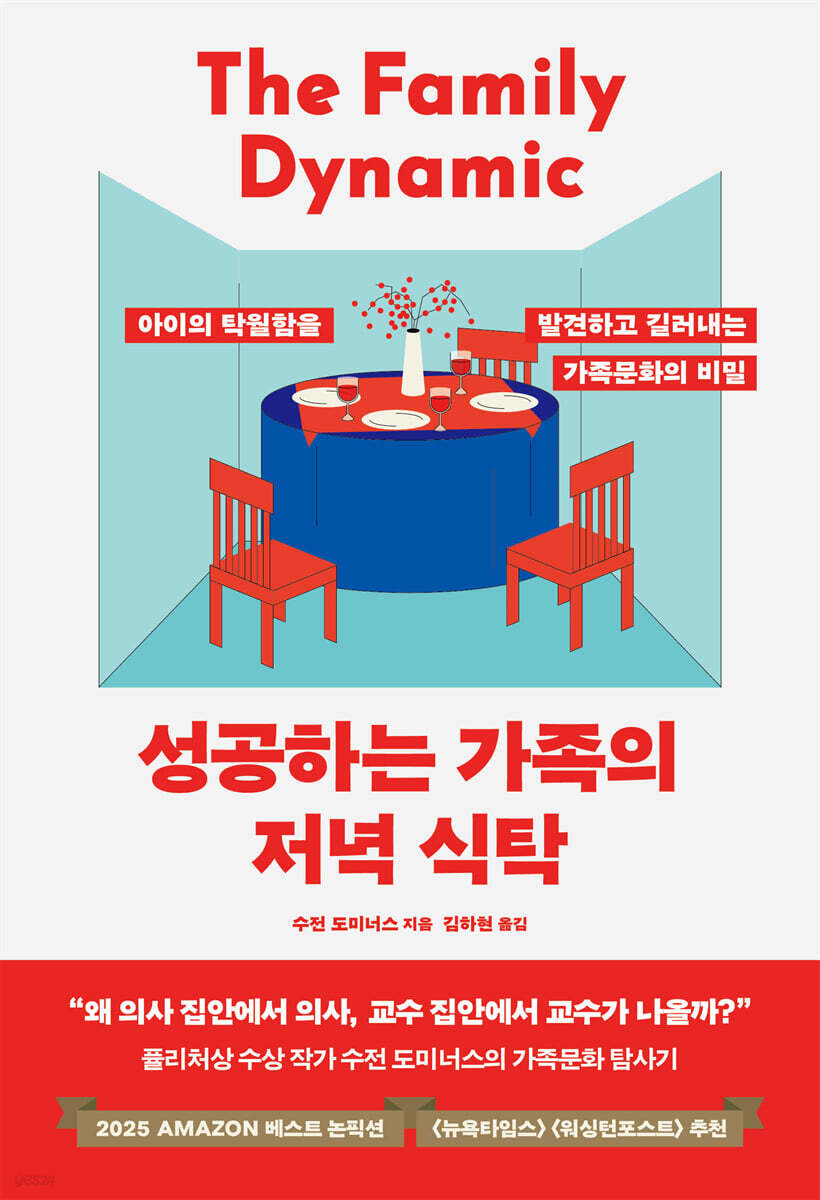
The dinner table of a successful family
 |
Description
Book Introduction
Why do doctors come from families of doctors, and artists come from families of artists? Why do all the children in some families display exceptional talent? Is it only successful parents who raise successful children? Susan Dominus, journalist and author of "The Successful Family Dinner Table," sets out to answer these questions and uncover the secrets of families that achieve academically and professionally.
The subject of 'family' has always piqued her curiosity.
Susan Dominus reveals that this interest stems from her childhood experiences.
While I was left at another family's house for a few days due to my father's business trip, I realized that the scene of the family discussing various topics at the dinner table every evening was quite different from my own home where I would quickly finish my meal and go watch a TV sitcom.
Since then, she has often asked herself this question:
“If I had grown up in a home where we debated every night at dinner, would my life have been different?”
Each household has its own unique family culture.
Factors like shared family values, how families spend time together, parental expectations, and sibling rivalries can alter a family's path in unexpected ways.
The author follows the lives of six families from diverse cultural, social, and economic backgrounds, exploring how differences in family culture impact their children's success and how they inspire and guide each other as they grow together.
This book reveals the incredible influence of the invisible force created by the family environment and the mark it leaves on an individual's life.
The subject of 'family' has always piqued her curiosity.
Susan Dominus reveals that this interest stems from her childhood experiences.
While I was left at another family's house for a few days due to my father's business trip, I realized that the scene of the family discussing various topics at the dinner table every evening was quite different from my own home where I would quickly finish my meal and go watch a TV sitcom.
Since then, she has often asked herself this question:
“If I had grown up in a home where we debated every night at dinner, would my life have been different?”
Each household has its own unique family culture.
Factors like shared family values, how families spend time together, parental expectations, and sibling rivalries can alter a family's path in unexpected ways.
The author follows the lives of six families from diverse cultural, social, and economic backgrounds, exploring how differences in family culture impact their children's success and how they inspire and guide each other as they grow together.
This book reveals the incredible influence of the invisible force created by the family environment and the mark it leaves on an individual's life.
- You can preview some of the book's contents.
Preview
index
Entering: "What's going on at that table?"
Chapter 1: The Groff Family: The Power of Self-Drive
Children who want to prove their courage│The driving force called competition│"Mother never gets tired"│How to become complete through defeat
Chapter 2: How to Unleash the Engine Within Your Child
Excellence isn't innate, it's practice. │What motivates people to work hard? │The courage not to help a child.
Chapter 3: The Holyfield Family: When There Is No Way, Make One
A family where success itself becomes resistance│Even if it's a difficult path, if you want it│Brothers and sisters open the door to choice│We won't forget the path we've walked.
Chapter 4: What Expectations Should We Set?
Expectations are not one-way, but reciprocal. │Expectancy-value theory and the role of parents. │The only son of the Brontë family.
Chapter 5 The Murgia Family: Becoming Each Other's Ladders
A landscape of a large family with no time for silence│The trajectory of life changed by a coin toss│They nurtured ambition together│Accepting the visible cracks
Chapter 6: Luck and Destiny: What We Can't Control
Twin Studies Reveal the Interplay of Genes and Environment│Two Babies Switched in Hospital│Does Birth Order Affect Personality?
Chapter 7 The Chen Family: Harsh but Devoted
Escaping home in a frenzy│The one thing parents busy with making a living never gave up│A house where we grow up teaching each other│Complex emotions mixed with respect and resentment toward my mother
Chapter 8: Finding the Influence of Parenting
Parental Genes Influence Even When They're Not Inherited│The Importance of Individualized Mentoring
Chapter 9: The Paulus Family: Raising an Artist
Enriching the senses rather than the material │ Quality interest without any conditions or sway │ Allowing the freedom to pursue art │ When you wish your children the dreams you could not achieve
Chapter 10: Suspicious Attitude and Intense Curiosity
Openness to Experience│Is it possible to cultivate a specific quality?
Chapter 11 The Wojcicki Family: Ambition to Change the World
Think for yourself and believe in your own thoughts│"If it's hard to change your child's behavior, change yourself."│The impact of having a male sibling on a woman's career.
Chapter 12 "Good, Better, Best"
How Family Characteristics Affect Individual Lives│It's Unknown Where Parenting Ends
Chapter 1: The Groff Family: The Power of Self-Drive
Children who want to prove their courage│The driving force called competition│"Mother never gets tired"│How to become complete through defeat
Chapter 2: How to Unleash the Engine Within Your Child
Excellence isn't innate, it's practice. │What motivates people to work hard? │The courage not to help a child.
Chapter 3: The Holyfield Family: When There Is No Way, Make One
A family where success itself becomes resistance│Even if it's a difficult path, if you want it│Brothers and sisters open the door to choice│We won't forget the path we've walked.
Chapter 4: What Expectations Should We Set?
Expectations are not one-way, but reciprocal. │Expectancy-value theory and the role of parents. │The only son of the Brontë family.
Chapter 5 The Murgia Family: Becoming Each Other's Ladders
A landscape of a large family with no time for silence│The trajectory of life changed by a coin toss│They nurtured ambition together│Accepting the visible cracks
Chapter 6: Luck and Destiny: What We Can't Control
Twin Studies Reveal the Interplay of Genes and Environment│Two Babies Switched in Hospital│Does Birth Order Affect Personality?
Chapter 7 The Chen Family: Harsh but Devoted
Escaping home in a frenzy│The one thing parents busy with making a living never gave up│A house where we grow up teaching each other│Complex emotions mixed with respect and resentment toward my mother
Chapter 8: Finding the Influence of Parenting
Parental Genes Influence Even When They're Not Inherited│The Importance of Individualized Mentoring
Chapter 9: The Paulus Family: Raising an Artist
Enriching the senses rather than the material │ Quality interest without any conditions or sway │ Allowing the freedom to pursue art │ When you wish your children the dreams you could not achieve
Chapter 10: Suspicious Attitude and Intense Curiosity
Openness to Experience│Is it possible to cultivate a specific quality?
Chapter 11 The Wojcicki Family: Ambition to Change the World
Think for yourself and believe in your own thoughts│"If it's hard to change your child's behavior, change yourself."│The impact of having a male sibling on a woman's career.
Chapter 12 "Good, Better, Best"
How Family Characteristics Affect Individual Lives│It's Unknown Where Parenting Ends
Detailed image

Into the book
As the only girl in the house, I was free to throw tantrums and even a little bit of misbehavior, but when my parents came home, I felt an immense sense of relief.
I soon returned to my original comfortable mealtime.
There were only two tasks my parents asked of me.
Emptying your plate cleanly and chewing with your mouth closed.
At the same time, I was mulling over other possibilities that I had just learned about.
This is because I personally realized how diverse family cultures can be in terms of parental expectations and ability development.
I had a hard time with math.
But what if I had solved math problems at the dinner table every night? What if I had been accustomed to expressing my opinions and defending my positions on the day's events? What would I be like now? Are these demands a blessing and a gift, or a burden and a constant, subtle pressure?
--- From "Entering"
“If parents are stars in a child’s universe—unseen, distant, yet constant—then siblings are comets, dazzlingly, sometimes scorchingly zooming past,” says developmental psychologist Allison Gopnik.
The Groffs' children all speak with admiration of their parents' hard work and accomplishments.
However, on the other hand, it is argued that siblings have as much influence on shaping each other as parents.
They sharpened or softened each other's sharp edges, and shaped each other into a form that could coexist within the space called family.
--- From "Chapter 1, The Groff Family: The Power of Pushing Yourself"
In her research, Julia found that children were most persistent when “the adult both succeeded at the task and followed through on what he said—that is, when he emphasized the value of effort by putting in the effort himself.”
It wasn't enough to just say, "It's important to work hard."
Children were most motivated to work hard themselves when they saw their parents practicing the principles and achieving beneficial results.
--- From "Chapter 2, How to Awaken the Engine Within Your Child"
Siblings are low-ranking collaborators within the family, but they also constantly observe each other, assessing each other's strengths and weaknesses, each trying to please the adults, deflect criticism, and seek praise.
Also, outside the home, they watch other siblings interact freely without the supervision of their parents or other adults.
How will my siblings fare in a larger group? Are they likeable leaders? Parents love their children blindly, but children, in turn, view their siblings with a sharper, more critical eye.
--- From "Chapter 3, The Holyfield Family"
Imagine if we could set the perfect standard for our children—one that's high enough to encourage them to believe in themselves and push themselves, but not so high that it becomes unproductive or threatening to their mental health.
Even if expectations are effectively communicated to children so that they can accept and internalize them, psychologists have believed since the 1970s that this alone is not enough to motivate children.
According to this theory, known as expectancy-value theory, we are more likely to achieve a given goal when we believe we can achieve it and when we consider the goal to be worthwhile.
--- From "Chapter 4, What Expectations Should We Set?"
The Murgia siblings continued to have a profound impact on each other's careers, making connections for each other and jointly cultivating new ambitions when new plans for the future were needed.
For years, when the youngest four all lived in Kansas City, they would sit around the dinner table at their parents' house every Sunday evening and talk late into the night.
We made phone calls when we were in different areas.
Janet could have spoken at Ramon's fundraiser and introduced him to someone in the siblings' extensive network.
Who has recently been promoted in their world, and how can they help those they believe deserve a promotion?
--- From "Chapter 5, The Murgia Family"
Emma Zhang, a sociology professor at Yale University, realized that by examining the random factor of children's birthdays and school dates, she could understand the causal relationship between sibling relationships.
After analyzing data from thousands of students who entered school in North Carolina between 1988 and 2003, Zhang found three significant findings.
As expected, children born shortly after the kindergarten entrance cutoff date of October 16th—those who had to wait almost a year to enter kindergarten—achieved higher grades in middle school than their classmates born later.
However, Jang found that younger siblings of students born earlier than their peers also benefited from the achievements of their oldest siblings.
These children outperformed their siblings who started school later, regardless of when their birthdays fell.
Finally, the study found that these effects were greater for children attending high-poverty schools.
--- From "Chapter 6, Luck and Destiny, What We Cannot Control"
“My mother knew how to look deeply without desire.
It was the complete opposite of my parents' expectations.
There are mothers who are like managers who push and teach their children.
It's an all too common story among kids who become star athletes or gymnasts.
Such mothers push their children away.
My mother had a very Zen Buddhist attitude, looking on without desire, but she was always there for me.
If no one is looking at me, I can't have my existence confirmed.
“My mother has done that for me my whole life, and I think it’s because of her that I’ve developed a sense of inner confidence and self-worth.”
--- From "Chapter 9, The Paulus Family"
It's fascinating to try to figure out the right combination of nurture and nature that will make the path to family success easier.
However, it is also good to consider the role of luck that pours down not only on siblings but also on the entire family.
Even due to the simple laws of probability, some families are bound to be exceptional cases of more than their fair share of good fortune.
When I first called Princeton University sociologist Dalton Conley and asked him what he thought of families with many siblings who were highly successful, he said:
“If you pull the slot enough times, sometimes, although very rarely, all the cherries will appear.”
I soon returned to my original comfortable mealtime.
There were only two tasks my parents asked of me.
Emptying your plate cleanly and chewing with your mouth closed.
At the same time, I was mulling over other possibilities that I had just learned about.
This is because I personally realized how diverse family cultures can be in terms of parental expectations and ability development.
I had a hard time with math.
But what if I had solved math problems at the dinner table every night? What if I had been accustomed to expressing my opinions and defending my positions on the day's events? What would I be like now? Are these demands a blessing and a gift, or a burden and a constant, subtle pressure?
--- From "Entering"
“If parents are stars in a child’s universe—unseen, distant, yet constant—then siblings are comets, dazzlingly, sometimes scorchingly zooming past,” says developmental psychologist Allison Gopnik.
The Groffs' children all speak with admiration of their parents' hard work and accomplishments.
However, on the other hand, it is argued that siblings have as much influence on shaping each other as parents.
They sharpened or softened each other's sharp edges, and shaped each other into a form that could coexist within the space called family.
--- From "Chapter 1, The Groff Family: The Power of Pushing Yourself"
In her research, Julia found that children were most persistent when “the adult both succeeded at the task and followed through on what he said—that is, when he emphasized the value of effort by putting in the effort himself.”
It wasn't enough to just say, "It's important to work hard."
Children were most motivated to work hard themselves when they saw their parents practicing the principles and achieving beneficial results.
--- From "Chapter 2, How to Awaken the Engine Within Your Child"
Siblings are low-ranking collaborators within the family, but they also constantly observe each other, assessing each other's strengths and weaknesses, each trying to please the adults, deflect criticism, and seek praise.
Also, outside the home, they watch other siblings interact freely without the supervision of their parents or other adults.
How will my siblings fare in a larger group? Are they likeable leaders? Parents love their children blindly, but children, in turn, view their siblings with a sharper, more critical eye.
--- From "Chapter 3, The Holyfield Family"
Imagine if we could set the perfect standard for our children—one that's high enough to encourage them to believe in themselves and push themselves, but not so high that it becomes unproductive or threatening to their mental health.
Even if expectations are effectively communicated to children so that they can accept and internalize them, psychologists have believed since the 1970s that this alone is not enough to motivate children.
According to this theory, known as expectancy-value theory, we are more likely to achieve a given goal when we believe we can achieve it and when we consider the goal to be worthwhile.
--- From "Chapter 4, What Expectations Should We Set?"
The Murgia siblings continued to have a profound impact on each other's careers, making connections for each other and jointly cultivating new ambitions when new plans for the future were needed.
For years, when the youngest four all lived in Kansas City, they would sit around the dinner table at their parents' house every Sunday evening and talk late into the night.
We made phone calls when we were in different areas.
Janet could have spoken at Ramon's fundraiser and introduced him to someone in the siblings' extensive network.
Who has recently been promoted in their world, and how can they help those they believe deserve a promotion?
--- From "Chapter 5, The Murgia Family"
Emma Zhang, a sociology professor at Yale University, realized that by examining the random factor of children's birthdays and school dates, she could understand the causal relationship between sibling relationships.
After analyzing data from thousands of students who entered school in North Carolina between 1988 and 2003, Zhang found three significant findings.
As expected, children born shortly after the kindergarten entrance cutoff date of October 16th—those who had to wait almost a year to enter kindergarten—achieved higher grades in middle school than their classmates born later.
However, Jang found that younger siblings of students born earlier than their peers also benefited from the achievements of their oldest siblings.
These children outperformed their siblings who started school later, regardless of when their birthdays fell.
Finally, the study found that these effects were greater for children attending high-poverty schools.
--- From "Chapter 6, Luck and Destiny, What We Cannot Control"
“My mother knew how to look deeply without desire.
It was the complete opposite of my parents' expectations.
There are mothers who are like managers who push and teach their children.
It's an all too common story among kids who become star athletes or gymnasts.
Such mothers push their children away.
My mother had a very Zen Buddhist attitude, looking on without desire, but she was always there for me.
If no one is looking at me, I can't have my existence confirmed.
“My mother has done that for me my whole life, and I think it’s because of her that I’ve developed a sense of inner confidence and self-worth.”
--- From "Chapter 9, The Paulus Family"
It's fascinating to try to figure out the right combination of nurture and nature that will make the path to family success easier.
However, it is also good to consider the role of luck that pours down not only on siblings but also on the entire family.
Even due to the simple laws of probability, some families are bound to be exceptional cases of more than their fair share of good fortune.
When I first called Princeton University sociologist Dalton Conley and asked him what he thought of families with many siblings who were highly successful, he said:
“If you pull the slot enough times, sometimes, although very rarely, all the cherries will appear.”
--- From Chapter 12, “Good, Better, Best”
Publisher's Review
“If I had grown up in a different family culture, would my life be different now?”
Pulitzer Prize-winning author Susan Dominus' exploration of family culture
★2025 Amazon Best Nonfiction★ Recommended by The New York Times and The Washington Post
Why do doctors come from families of doctors, and artists come from families of artists? Why do all the children in some families display exceptional talent? Is it only successful parents who raise successful children? Susan Dominus, journalist and author of "The Successful Family Dinner Table," sets out to answer these questions and uncover the secrets of families that achieve academically and professionally.
The subject of 'family' has always piqued her curiosity.
Susan Dominus reveals that this interest stems from her childhood experiences.
While I was left at another family's house for a few days due to my father's business trip, I realized that the scene of the family discussing various topics at the dinner table every evening was quite different from my own home where I would quickly finish my meal and go watch a TV sitcom.
Since then, she has often asked herself this question:
“If I had grown up in a home where we debated every night at dinner, would my life have been different?”
Each household has its own unique family culture.
Factors like shared family values, how families spend time together, parental expectations, and sibling rivalries can alter a family's path in unexpected ways.
The author follows the lives of six families from diverse cultural, social, and economic backgrounds, exploring how differences in family culture impact their children's success and the dynamics of how they inspire and guide each other as they grow together.
Additionally, through research in developmental psychology and genetics, we take a scientific approach to unravel how subtle differences in parenting styles and genetic factors intertwine to change children's behavior.
This book, which interweaves rich stories based on real-life examples of modern families with academic research, was praised as “a model of literary nonfiction and a benchmark for family psychology” (Jennifer Senior), and was selected as an Amazon Best Nonfiction Book of 2025.
This book reveals the incredible influence of the invisible force created by the family environment and the mark it leaves on an individual's life.
“True courage is letting a child fall on his own.”
Common patterns in family culture that discover and nurture children's excellence
Susan Dominus, a Pulitzer Prize and National Magazine Award-winning journalist, says she has always been fascinated by stories of "successful families."
I have always been interested in the stories of extraordinary families, such as the Brontë family, which produced two great novelist sisters, or the Kennedy family, a prominent political family.
The author, who wanted to explore the commonalities of these unique families, searched for a book on this topic, but ultimately failed to find one. After ten years of research and investigation, he decided to write his own.
The book features the stories of six families, including the Murgia family, who led the American legal and political world, and the Wojcicki family, who made a name for themselves in the STEM field.
The author finds several common patterns among the parents in this family.
One of them is that parents do not prevent their children from failing, and that they themselves live toward their goals.
The case of the Groff family is a symbolic example of this.
One Sunday morning, 14-year-old Sarah Groff told her family she wanted to swim across the 14-kilometer lake near her home.
Anyone would expect a response like, “That’s a ridiculous and dangerous idea,” or “Let’s try it after practicing swimming more.”
But Sarah's father, Jerry Groff, instead followed her in a boat while she swam to help her daughter with her challenge.
Eventually, Sarah swam across the lake and set a village record.
Today, Sarah is a two-time Olympian and professional triathlete.
Her older brother Adam grew up to be a successful entrepreneur, and her older sister Lauren grew up to be an acclaimed novelist.
Most parents are extremely reluctant to allow their children to experience failure.
However, the parents the author met all had one thing in common: they knew how to catch the moment when their child's will was rising and they restrained themselves from interfering too much.
Several studies over a long period of time have shown that parental intervention in children's puzzle-solving tasks can actually reduce their motivation.
Also, even when they were told that an adult would intervene in a game where several people take turns (even when they knew that the adult was not intervening because they did not trust their abilities), they did not work as hard on the next task or game given to them as before.
Because it is not easy to quickly reverse such a decline in motivation, when and how parents intervene has a very important impact on the child's motivation.
Another reason why the parents in this book did not interfere excessively with their children was because they were confident that they could set a strong example for their children.
Parents who live for their goals send a clear message to their children without saying a word.
“You too can pursue your own goals.” The Wojcicki sisters’ mother, Esther Wojcicki, raised her daughters to become YouTube CEOs, medical professors, and founders of genetic analysis companies, respectively.
Esther herself had three master's degrees and was a car repair person who took apart the car interior and repaired it herself.
As a high school writing teacher, she would write a lot of feedback in red on her daughters' homework reports, saying things like, "You can either turn this in as is and get a C or D, or you can rewrite it," as neutrally as possible.
The daughters all rewrote their reports.
“Now I can get a B,” she said.
The daughters revised it again and eventually got an A.
Esther Wojcicki never once forced her children to rewrite their assignments, but she quietly and forcefully hinted at what she expected from them and how close they were to achieving their goals.
The closest competitors and each other's ladder
How do siblings evaluate, encourage, and grow together?
As Susan Dominus continues her reporting, she discovers that sibling relationships are just as important a variable as parental relationships.
The case of the Brontë sisters in particular illustrates this dramatically.
After Charlotte Brontë became a famous novelist with Jane Eyre, she read her sisters' poems and convinced them that they should publish them, which gave Emily and Anne a chance to start their careers as writers.
In this way, brothers and sisters are the first to see each other's potential.
On the other hand, talent can also grow further through competition between siblings.
The real reason Sarah, a member of the Groff family, started swimming was because she wanted to beat her older sister, Lauren.
Sarah's desire also came from her passionate longing for her older sister.
“I wanted to beat my sister.
But on the other hand, I wanted to be like my sister.” A research team surveyed 257 players training for the U.S. women’s national soccer team and found that about three-quarters of the female players were younger siblings.
Researchers speculate that they may have had to develop their skills to avoid being pushed around by their older siblings, and Wharton School professor Jonah Berger interprets this as a result of sports being a niche where they can stand out from their older siblings.
There is also a growing body of evidence supporting the notion that siblings have a significant influence on life choices, particularly educational choices.
Another research team reported in a 2019 National Bureau of Economic Research report that in families where college is not a given, if the eldest child chooses to attend a prestigious university, the likelihood that younger siblings will apply to the same university or another university with a higher graduation rate increases significantly.
In the case of the Murgia brothers, younger brother Carlos always had a desire to follow in the footsteps of his older brother Alfred and become the 'first in our family'.
The older brother protected and guided the younger brother, and the younger brother used those expectations as a springboard to forge his own path, becoming the first Latino student body president and valedictorian.
In the end, the two went to the same university.
In this way, the interaction between siblings is very unique in that they share the same environment, time, and resources, and build deep solidarity while constantly comparing, imitating, and competing with each other.
There is no single formula for success.
What the Complexity of Genetics, Environment, and Chance Tells Us
The interplay of genetics, environment, and luck is a key axis that allows us to more deeply understand the essence of 'family culture' as revealed in 'The Dinner Table of Successful Families.'
The various studies presented in the book repeatedly demonstrate that heredity is a force that cannot be ignored.
Large-scale twin studies have shown that genetics exerts a surprisingly consistent influence on many key traits, including personality, intelligence, and temperament.
However, as in the Max Planck Institute's experiment, even genetically identical mice showed completely different brain plasticity, learning ability, and adaptation methods depending on the environmental stimuli they received, and this is also observed in human development.
Individual experiences—such as encountering a difficult teacher, a particular moment of injury, or a chance encounter—interact with one's genetic makeup and gradually reshape the course of an individual's life.
This is where the unique power of a successful family comes into play.
The parents in this book don't try to control or perfect their children.
Instead, we create a 'culture' that operates continuously in everyday life so that children have the courage to jump into new stimuli or try again even if they fail.
This family environment acts like a switch that activates genetic potential, helping each child's temperament to develop in various directions, such as social skills, creativity, and concentration.
Designing daily life so that genetic predispositions can find their own direction within the stimuli of reality, without predetermining the child's potential, without being overly fearful of chance.
This kind of parental attitude will serve as a solid foundation that will help a person develop his or her potential to the fullest.
The journey toward achievement is also a journey of loss.
Beyond success, to answer the question, ‘What kind of person should I live as?’
Is there any parent who doesn't want to raise their child to be a good child? This book asks.
“Are we exposing our children to enough experiences, encouraging them enough, and enriching them enough?” The author says he started writing the book to study families who achieved great things, but as he continued to research, the book ultimately became a story about “families who don’t set limits.”
The children featured in the book ultimately achieved socially acceptable "success," but that wasn't their parents' initial goal.
They simply strived to empower their children to lead more proactive and enriching lives.
Sometimes the solution was to want children to experience more of the beauty of music in their lives, to support them in their pursuits, even if those goals seemed a bit far-fetched, and to give them quality, unconditional attention.
The author also arrives at the conclusion of this journey that “greatness comes with sacrifice.”
The lives of high-achieving families have always included some degree of loss.
The price was things like peace of mind, love, leisure, and wholesome family time.
But they taught the children one thing clearly.
More important than worldly success is the question, 'What kind of person do I want to be?'
"The Dinner Table of a Successful Family" is not simply a checklist of parenting methods. It is a detailed exploration of the "mutually nurturing relationship" that is family, and it will serve as a source of new inspiration for parents who are concerned about the kind of environment they should provide for their children so that they can fully develop their innate abilities.
Pulitzer Prize-winning author Susan Dominus' exploration of family culture
★2025 Amazon Best Nonfiction★ Recommended by The New York Times and The Washington Post
Why do doctors come from families of doctors, and artists come from families of artists? Why do all the children in some families display exceptional talent? Is it only successful parents who raise successful children? Susan Dominus, journalist and author of "The Successful Family Dinner Table," sets out to answer these questions and uncover the secrets of families that achieve academically and professionally.
The subject of 'family' has always piqued her curiosity.
Susan Dominus reveals that this interest stems from her childhood experiences.
While I was left at another family's house for a few days due to my father's business trip, I realized that the scene of the family discussing various topics at the dinner table every evening was quite different from my own home where I would quickly finish my meal and go watch a TV sitcom.
Since then, she has often asked herself this question:
“If I had grown up in a home where we debated every night at dinner, would my life have been different?”
Each household has its own unique family culture.
Factors like shared family values, how families spend time together, parental expectations, and sibling rivalries can alter a family's path in unexpected ways.
The author follows the lives of six families from diverse cultural, social, and economic backgrounds, exploring how differences in family culture impact their children's success and the dynamics of how they inspire and guide each other as they grow together.
Additionally, through research in developmental psychology and genetics, we take a scientific approach to unravel how subtle differences in parenting styles and genetic factors intertwine to change children's behavior.
This book, which interweaves rich stories based on real-life examples of modern families with academic research, was praised as “a model of literary nonfiction and a benchmark for family psychology” (Jennifer Senior), and was selected as an Amazon Best Nonfiction Book of 2025.
This book reveals the incredible influence of the invisible force created by the family environment and the mark it leaves on an individual's life.
“True courage is letting a child fall on his own.”
Common patterns in family culture that discover and nurture children's excellence
Susan Dominus, a Pulitzer Prize and National Magazine Award-winning journalist, says she has always been fascinated by stories of "successful families."
I have always been interested in the stories of extraordinary families, such as the Brontë family, which produced two great novelist sisters, or the Kennedy family, a prominent political family.
The author, who wanted to explore the commonalities of these unique families, searched for a book on this topic, but ultimately failed to find one. After ten years of research and investigation, he decided to write his own.
The book features the stories of six families, including the Murgia family, who led the American legal and political world, and the Wojcicki family, who made a name for themselves in the STEM field.
The author finds several common patterns among the parents in this family.
One of them is that parents do not prevent their children from failing, and that they themselves live toward their goals.
The case of the Groff family is a symbolic example of this.
One Sunday morning, 14-year-old Sarah Groff told her family she wanted to swim across the 14-kilometer lake near her home.
Anyone would expect a response like, “That’s a ridiculous and dangerous idea,” or “Let’s try it after practicing swimming more.”
But Sarah's father, Jerry Groff, instead followed her in a boat while she swam to help her daughter with her challenge.
Eventually, Sarah swam across the lake and set a village record.
Today, Sarah is a two-time Olympian and professional triathlete.
Her older brother Adam grew up to be a successful entrepreneur, and her older sister Lauren grew up to be an acclaimed novelist.
Most parents are extremely reluctant to allow their children to experience failure.
However, the parents the author met all had one thing in common: they knew how to catch the moment when their child's will was rising and they restrained themselves from interfering too much.
Several studies over a long period of time have shown that parental intervention in children's puzzle-solving tasks can actually reduce their motivation.
Also, even when they were told that an adult would intervene in a game where several people take turns (even when they knew that the adult was not intervening because they did not trust their abilities), they did not work as hard on the next task or game given to them as before.
Because it is not easy to quickly reverse such a decline in motivation, when and how parents intervene has a very important impact on the child's motivation.
Another reason why the parents in this book did not interfere excessively with their children was because they were confident that they could set a strong example for their children.
Parents who live for their goals send a clear message to their children without saying a word.
“You too can pursue your own goals.” The Wojcicki sisters’ mother, Esther Wojcicki, raised her daughters to become YouTube CEOs, medical professors, and founders of genetic analysis companies, respectively.
Esther herself had three master's degrees and was a car repair person who took apart the car interior and repaired it herself.
As a high school writing teacher, she would write a lot of feedback in red on her daughters' homework reports, saying things like, "You can either turn this in as is and get a C or D, or you can rewrite it," as neutrally as possible.
The daughters all rewrote their reports.
“Now I can get a B,” she said.
The daughters revised it again and eventually got an A.
Esther Wojcicki never once forced her children to rewrite their assignments, but she quietly and forcefully hinted at what she expected from them and how close they were to achieving their goals.
The closest competitors and each other's ladder
How do siblings evaluate, encourage, and grow together?
As Susan Dominus continues her reporting, she discovers that sibling relationships are just as important a variable as parental relationships.
The case of the Brontë sisters in particular illustrates this dramatically.
After Charlotte Brontë became a famous novelist with Jane Eyre, she read her sisters' poems and convinced them that they should publish them, which gave Emily and Anne a chance to start their careers as writers.
In this way, brothers and sisters are the first to see each other's potential.
On the other hand, talent can also grow further through competition between siblings.
The real reason Sarah, a member of the Groff family, started swimming was because she wanted to beat her older sister, Lauren.
Sarah's desire also came from her passionate longing for her older sister.
“I wanted to beat my sister.
But on the other hand, I wanted to be like my sister.” A research team surveyed 257 players training for the U.S. women’s national soccer team and found that about three-quarters of the female players were younger siblings.
Researchers speculate that they may have had to develop their skills to avoid being pushed around by their older siblings, and Wharton School professor Jonah Berger interprets this as a result of sports being a niche where they can stand out from their older siblings.
There is also a growing body of evidence supporting the notion that siblings have a significant influence on life choices, particularly educational choices.
Another research team reported in a 2019 National Bureau of Economic Research report that in families where college is not a given, if the eldest child chooses to attend a prestigious university, the likelihood that younger siblings will apply to the same university or another university with a higher graduation rate increases significantly.
In the case of the Murgia brothers, younger brother Carlos always had a desire to follow in the footsteps of his older brother Alfred and become the 'first in our family'.
The older brother protected and guided the younger brother, and the younger brother used those expectations as a springboard to forge his own path, becoming the first Latino student body president and valedictorian.
In the end, the two went to the same university.
In this way, the interaction between siblings is very unique in that they share the same environment, time, and resources, and build deep solidarity while constantly comparing, imitating, and competing with each other.
There is no single formula for success.
What the Complexity of Genetics, Environment, and Chance Tells Us
The interplay of genetics, environment, and luck is a key axis that allows us to more deeply understand the essence of 'family culture' as revealed in 'The Dinner Table of Successful Families.'
The various studies presented in the book repeatedly demonstrate that heredity is a force that cannot be ignored.
Large-scale twin studies have shown that genetics exerts a surprisingly consistent influence on many key traits, including personality, intelligence, and temperament.
However, as in the Max Planck Institute's experiment, even genetically identical mice showed completely different brain plasticity, learning ability, and adaptation methods depending on the environmental stimuli they received, and this is also observed in human development.
Individual experiences—such as encountering a difficult teacher, a particular moment of injury, or a chance encounter—interact with one's genetic makeup and gradually reshape the course of an individual's life.
This is where the unique power of a successful family comes into play.
The parents in this book don't try to control or perfect their children.
Instead, we create a 'culture' that operates continuously in everyday life so that children have the courage to jump into new stimuli or try again even if they fail.
This family environment acts like a switch that activates genetic potential, helping each child's temperament to develop in various directions, such as social skills, creativity, and concentration.
Designing daily life so that genetic predispositions can find their own direction within the stimuli of reality, without predetermining the child's potential, without being overly fearful of chance.
This kind of parental attitude will serve as a solid foundation that will help a person develop his or her potential to the fullest.
The journey toward achievement is also a journey of loss.
Beyond success, to answer the question, ‘What kind of person should I live as?’
Is there any parent who doesn't want to raise their child to be a good child? This book asks.
“Are we exposing our children to enough experiences, encouraging them enough, and enriching them enough?” The author says he started writing the book to study families who achieved great things, but as he continued to research, the book ultimately became a story about “families who don’t set limits.”
The children featured in the book ultimately achieved socially acceptable "success," but that wasn't their parents' initial goal.
They simply strived to empower their children to lead more proactive and enriching lives.
Sometimes the solution was to want children to experience more of the beauty of music in their lives, to support them in their pursuits, even if those goals seemed a bit far-fetched, and to give them quality, unconditional attention.
The author also arrives at the conclusion of this journey that “greatness comes with sacrifice.”
The lives of high-achieving families have always included some degree of loss.
The price was things like peace of mind, love, leisure, and wholesome family time.
But they taught the children one thing clearly.
More important than worldly success is the question, 'What kind of person do I want to be?'
"The Dinner Table of a Successful Family" is not simply a checklist of parenting methods. It is a detailed exploration of the "mutually nurturing relationship" that is family, and it will serve as a source of new inspiration for parents who are concerned about the kind of environment they should provide for their children so that they can fully develop their innate abilities.
GOODS SPECIFICS
- Date of issue: November 26, 2025
- Page count, weight, size: 488 pages | 650g | 147*215*24mm
- ISBN13: 9791167742537
You may also like
카테고리
korean


korean

![ELLE 엘르 스페셜 에디션 A형 : 12월 [2025]](http://librairie.coreenne.fr/cdn/shop/files/b8e27a3de6c9538896439686c6b0e8fb.jpg?v=1766436872&width=3840)


