

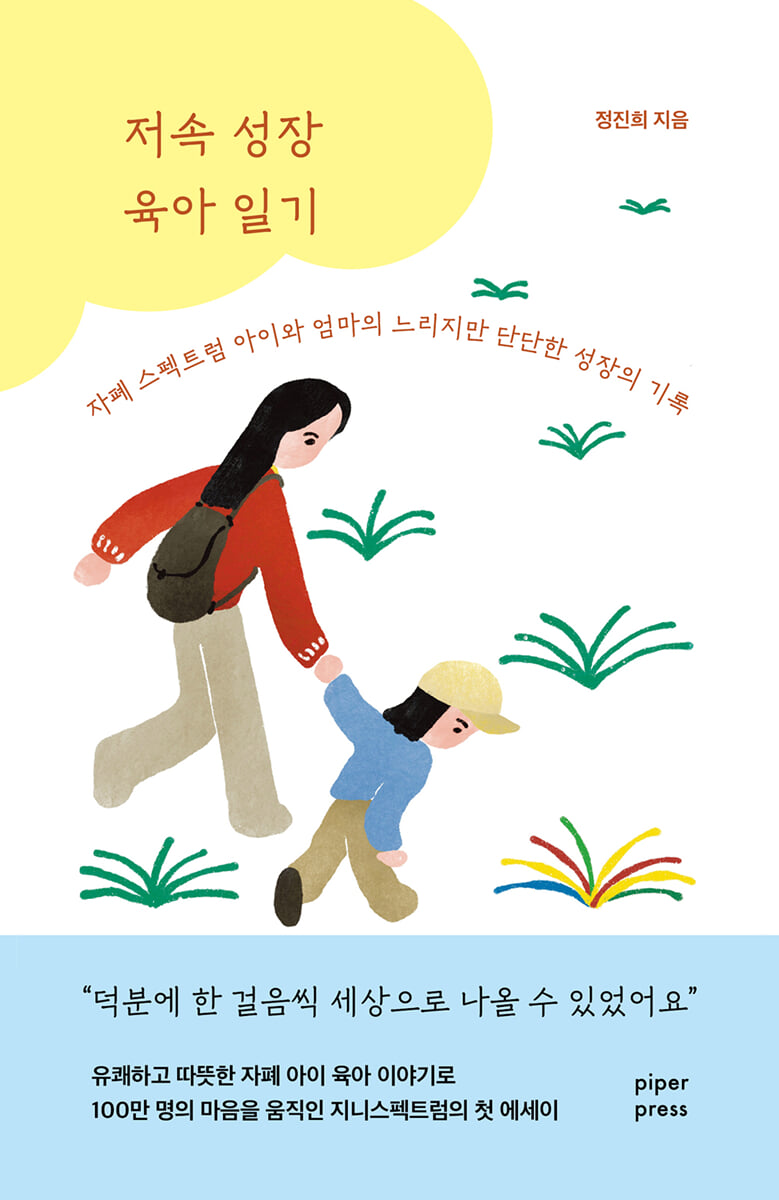
Slow-Growing Parenting Diary
 |
Description
Book Introduction
“You can love even if you don’t accept it.”
A mother's growth diary of raising a child on the autism spectrum
“My child has autism.”
It took me eight years to be able to say this one sentence comfortably.
The child's development seemed to have stopped, and the world's gaze was cold.
But Mom swallowed her tears and started over again every day.
This book is about the endless 'Day 1' that mothers raising autistic children experience.
The author calmly confesses to the process of stopping the fight to make the child normal and “giving birth” to the child again as he is.
Even amidst comparison and despair, as I follow a mother's journey of relearning the world through her child's existence, I realize that what truly matters is always right next to me.
He says.
“I’m not sure if I’ve accepted it, but I’ve definitely adapted.” The child’s noisy arm movements, his alien-like speech, and his toy are all now lovely.
"Slow-Growth Parenting Diary" talks about "adaptation" rather than "acceptance."
He proves with a light smile today that it's okay to not be perfect, and that you can still live firmly while still being unstable.
A mother's growth diary of raising a child on the autism spectrum
“My child has autism.”
It took me eight years to be able to say this one sentence comfortably.
The child's development seemed to have stopped, and the world's gaze was cold.
But Mom swallowed her tears and started over again every day.
This book is about the endless 'Day 1' that mothers raising autistic children experience.
The author calmly confesses to the process of stopping the fight to make the child normal and “giving birth” to the child again as he is.
Even amidst comparison and despair, as I follow a mother's journey of relearning the world through her child's existence, I realize that what truly matters is always right next to me.
He says.
“I’m not sure if I’ve accepted it, but I’ve definitely adapted.” The child’s noisy arm movements, his alien-like speech, and his toy are all now lovely.
"Slow-Growth Parenting Diary" talks about "adaptation" rather than "acceptance."
He proves with a light smile today that it's okay to not be perfect, and that you can still live firmly while still being unstable.
- You can preview some of the book's contents.
Preview
index
prolog.
Because I can't say 'my child has autism'
[Meeting]
second birth
- The swamp of comparison
The Sand Child
- My slow-growing friends
The television in my mind was black and white.
- Fortunately and thanks
[growth]
What I found in the typhoon-stricken sea
- How to respond to your child's senses
Today is the first day
- The art of discipline
The child is giving you a chance
- Sadness is also private property.
Woljeongsa Fir Forest
- Purpose of learning
[Learning]
We grow up
- Pride in children
Let's not distrust each other
- Apply to special schools
What is more important than treatment
- They say one of them is a genius.
If only someone had taught me
- Frequently Asked Questions
[mind]
Our safe zone
- A mother is a child's reflector.
You don't recognize me when you see me in a fake way
- Finding the forgotten Z-axis
I got off the route
- Can't I use it?
[family]
I'm having a great time right now
- Forgive me
invisible border
- A person who is a blessing to me
Durability Test
- Action is better than resolution
Even if our thoughts differ, we walk together.
- Don't become a shark
Epilogue.
Four things I regret most, four things I am most grateful for
Because I can't say 'my child has autism'
[Meeting]
second birth
- The swamp of comparison
The Sand Child
- My slow-growing friends
The television in my mind was black and white.
- Fortunately and thanks
[growth]
What I found in the typhoon-stricken sea
- How to respond to your child's senses
Today is the first day
- The art of discipline
The child is giving you a chance
- Sadness is also private property.
Woljeongsa Fir Forest
- Purpose of learning
[Learning]
We grow up
- Pride in children
Let's not distrust each other
- Apply to special schools
What is more important than treatment
- They say one of them is a genius.
If only someone had taught me
- Frequently Asked Questions
[mind]
Our safe zone
- A mother is a child's reflector.
You don't recognize me when you see me in a fake way
- Finding the forgotten Z-axis
I got off the route
- Can't I use it?
[family]
I'm having a great time right now
- Forgive me
invisible border
- A person who is a blessing to me
Durability Test
- Action is better than resolution
Even if our thoughts differ, we walk together.
- Don't become a shark
Epilogue.
Four things I regret most, four things I am most grateful for
Detailed image

Into the book
If I actively share my child's disability, someone who sees it might be motivated to disclose their own disability as well.
I thought that if there were more stories like this, the lives of lonely parents would become a little easier.
If more people learned about developmental disabilities and autism spectrum disorder, the world would be a more comfortable place for children like Logan.
--- From the prologue, “Because I Can’t Say ‘My Child Has Autism’”
I heard the doctor explain it to me, but I don't remember.
I came home and searched on my smartphone.
As I read the dire prognosis of autism as told by the encyclopedia, the countless Logans in my imagination—Judge Logan, Doctor Logan, Athlete Logan—were at a loss.
---- From "Second Birth"
People say, 'If you're jealous, you lose,' but now, jealousy doesn't leave me feeling defeated.
If you're jealous, then you're jealous.
Perhaps it is because Logan is now taken out from the prism of a huge spectrum and we walk together under the single name of ‘My son Logan.’
---- From "The Swamp of Comparison"
As the term "autistic" suggests, people with autism are sometimes described as "self-locked people."
If the child had closed off on his own, I would have been desperate to go into the world where the child was and play with him.
But I couldn't figure out where the entrance door was.
---- From "The Sand Child"
Another big change is that the tone of threatening language has been reduced.
In particular, the phrase “If you do this, I’ll go home!” was the first thing I corrected.
In the past, I would habitually say things like, “If this happens again, I’m going home,” regardless of the situation, even though it was unlikely to happen.
That statement made Logan more of a 'disobedient child' and made me more of a 'mother who can ignore things'.
In the end, it wasn't the child who was in trouble, it was me.
---- From "The Art of Discipline"
'Ah, I'm the one who has to work hard to open a gift box of joy that the child has no intention of opening.'
Teaching children to speak or write is all about helping them live more happily in this world.
I decided to never forget that one goal, never give up, and to continue to diligently open the gift boxes.
---- From "Woljeongsa Fir Forest"
Once he started using the word 'no,' Logan's life became a little easier.
There are fewer instances of people lying down and crying on the street.
I learned to say 'no' without crying or screaming when I wanted to reject something.
I can't tell you how proud I was of that.
“Is it comfortable and good that you can talk too?”
Logan doesn't answer when asked, but you can tell by looking at his expression.
Logan, who learned the word 'no', seems to be much more confident.
---- From "We Grow Up"
The most heartbreaking moment after learning of my child's disability was when I thought, 'How lonely will this child be in the future? Will he be looked down upon?'
Where did that premonition come from?
It was my past.
I have never learned about intellectual disability or autism in my life.
I know there is such a disease, but I don't know how to deal with it.
I remember the faces of a few friends from my school days who I just thought were 'stupid'.
Looking back now, those kids may have had mild autism or ADHD.
---- From "If Only Someone Had Taught Me"
Perhaps the idea of 'getting my life back while raising a child with a disability' is a pipe dream.
But now that I have a child who needs a lot of care, I'm going to try to invite him into my world more often and practice making him fit in with me.
So that we can live happily together.
---- From "In Search of the Forgotten Z-Axis"
It's already been several years since I deviated from the route.
After the days of wandering, I now spend my time walking with Logan in faraway places where the old railroad tracks are nowhere to be seen.
Sometimes we look at dandelions, sometimes we crouch down to pick out pine cones that Logan likes, and sometimes we laugh when we meet a child and their mother who are similar to us.
---- From "I've Deviated from the Route"
I often compare the feeling I had when I first received my child's autism diagnosis to a book.
It felt like I had just received a thick book that was completely uninteresting and impossible to get used to.
A book you don't want to read, but must read.
The content is difficult, the book is heavy, and progress is slow.
However, if you persevere and turn the pages one by one, you will eventually get used to it, gradually begin to understand it, and it will finally become readable.
But then someone suddenly opens the book and shows the next few chapters.
That's the worst case scenario.
---- From "I'm in a good time now"
Although my husband and I have different perspectives on our child's disability, our goals are ultimately the same.
Logan's tomorrow will be better than today, and my wife and I will live without hurting each other and caring for each other.
Sometimes it's more comfortable to leave uncertainty as it is and walk together.
---- From "Even if our thoughts differ, we walk together"
I once said on YouTube that I've never had a loud argument with my husband, and I got a lot of questions asking how I could do that.
Actually, there is no secret to it.
I don't have any special know-how when it comes to my relationship with my husband.
However, I am careful not to let any toxins seep into the air inside my home.
I thought that if there were more stories like this, the lives of lonely parents would become a little easier.
If more people learned about developmental disabilities and autism spectrum disorder, the world would be a more comfortable place for children like Logan.
--- From the prologue, “Because I Can’t Say ‘My Child Has Autism’”
I heard the doctor explain it to me, but I don't remember.
I came home and searched on my smartphone.
As I read the dire prognosis of autism as told by the encyclopedia, the countless Logans in my imagination—Judge Logan, Doctor Logan, Athlete Logan—were at a loss.
---- From "Second Birth"
People say, 'If you're jealous, you lose,' but now, jealousy doesn't leave me feeling defeated.
If you're jealous, then you're jealous.
Perhaps it is because Logan is now taken out from the prism of a huge spectrum and we walk together under the single name of ‘My son Logan.’
---- From "The Swamp of Comparison"
As the term "autistic" suggests, people with autism are sometimes described as "self-locked people."
If the child had closed off on his own, I would have been desperate to go into the world where the child was and play with him.
But I couldn't figure out where the entrance door was.
---- From "The Sand Child"
Another big change is that the tone of threatening language has been reduced.
In particular, the phrase “If you do this, I’ll go home!” was the first thing I corrected.
In the past, I would habitually say things like, “If this happens again, I’m going home,” regardless of the situation, even though it was unlikely to happen.
That statement made Logan more of a 'disobedient child' and made me more of a 'mother who can ignore things'.
In the end, it wasn't the child who was in trouble, it was me.
---- From "The Art of Discipline"
'Ah, I'm the one who has to work hard to open a gift box of joy that the child has no intention of opening.'
Teaching children to speak or write is all about helping them live more happily in this world.
I decided to never forget that one goal, never give up, and to continue to diligently open the gift boxes.
---- From "Woljeongsa Fir Forest"
Once he started using the word 'no,' Logan's life became a little easier.
There are fewer instances of people lying down and crying on the street.
I learned to say 'no' without crying or screaming when I wanted to reject something.
I can't tell you how proud I was of that.
“Is it comfortable and good that you can talk too?”
Logan doesn't answer when asked, but you can tell by looking at his expression.
Logan, who learned the word 'no', seems to be much more confident.
---- From "We Grow Up"
The most heartbreaking moment after learning of my child's disability was when I thought, 'How lonely will this child be in the future? Will he be looked down upon?'
Where did that premonition come from?
It was my past.
I have never learned about intellectual disability or autism in my life.
I know there is such a disease, but I don't know how to deal with it.
I remember the faces of a few friends from my school days who I just thought were 'stupid'.
Looking back now, those kids may have had mild autism or ADHD.
---- From "If Only Someone Had Taught Me"
Perhaps the idea of 'getting my life back while raising a child with a disability' is a pipe dream.
But now that I have a child who needs a lot of care, I'm going to try to invite him into my world more often and practice making him fit in with me.
So that we can live happily together.
---- From "In Search of the Forgotten Z-Axis"
It's already been several years since I deviated from the route.
After the days of wandering, I now spend my time walking with Logan in faraway places where the old railroad tracks are nowhere to be seen.
Sometimes we look at dandelions, sometimes we crouch down to pick out pine cones that Logan likes, and sometimes we laugh when we meet a child and their mother who are similar to us.
---- From "I've Deviated from the Route"
I often compare the feeling I had when I first received my child's autism diagnosis to a book.
It felt like I had just received a thick book that was completely uninteresting and impossible to get used to.
A book you don't want to read, but must read.
The content is difficult, the book is heavy, and progress is slow.
However, if you persevere and turn the pages one by one, you will eventually get used to it, gradually begin to understand it, and it will finally become readable.
But then someone suddenly opens the book and shows the next few chapters.
That's the worst case scenario.
---- From "I'm in a good time now"
Although my husband and I have different perspectives on our child's disability, our goals are ultimately the same.
Logan's tomorrow will be better than today, and my wife and I will live without hurting each other and caring for each other.
Sometimes it's more comfortable to leave uncertainty as it is and walk together.
---- From "Even if our thoughts differ, we walk together"
I once said on YouTube that I've never had a loud argument with my husband, and I got a lot of questions asking how I could do that.
Actually, there is no secret to it.
I don't have any special know-how when it comes to my relationship with my husband.
However, I am careful not to let any toxins seep into the air inside my home.
---- From "Don't Become a Shark"
Publisher's Review
Direction over speed, attitude over will.
A life attitude discovered through the special parenting of a cheerful mother.
Instead of accepting, adapt; instead of enduring, smile.
The mother, who was trying to get closer to normal, is reborn as she adapts to her child.
This story begins with the perspective of viewing children on the autism spectrum not as “objects to overcome,” but as “beings who live at a different pace.”
Immediately after the diagnosis, he blamed himself with endless comparisons and guilt, and went from treatment room to treatment room trying to fill the child's 'lacking'.
In the process, I was exhausted and cried, and I was hurt by the world's gaze.
But as time went by, I realized.
That it is more important to understand the speed of your child than to fight to increase that speed.
That only then can my child, me, and my family be happy.
There is no 'overcoming' or 'sacrifice' in his story.
Instead, there is honesty and routine.
I am grateful to my neighbors for providing comfort even during difficult days, and I am truly happy and do not miss the changes in my child as he grows little by little.
The reason we can smile even when we are sad, and live even when things are difficult is because we know the value of this moment, which will never come again.
"Slow Growth Parenting Diary" is more than just a story about a mother raising an autistic child; it's a record of one person's journey of growth as they reconnect with the world.
This book asks how people should treat each other and the world.
And he answers that what we need is not will, but attitude.
A life attitude discovered through the special parenting of a cheerful mother.
Instead of accepting, adapt; instead of enduring, smile.
The mother, who was trying to get closer to normal, is reborn as she adapts to her child.
This story begins with the perspective of viewing children on the autism spectrum not as “objects to overcome,” but as “beings who live at a different pace.”
Immediately after the diagnosis, he blamed himself with endless comparisons and guilt, and went from treatment room to treatment room trying to fill the child's 'lacking'.
In the process, I was exhausted and cried, and I was hurt by the world's gaze.
But as time went by, I realized.
That it is more important to understand the speed of your child than to fight to increase that speed.
That only then can my child, me, and my family be happy.
There is no 'overcoming' or 'sacrifice' in his story.
Instead, there is honesty and routine.
I am grateful to my neighbors for providing comfort even during difficult days, and I am truly happy and do not miss the changes in my child as he grows little by little.
The reason we can smile even when we are sad, and live even when things are difficult is because we know the value of this moment, which will never come again.
"Slow Growth Parenting Diary" is more than just a story about a mother raising an autistic child; it's a record of one person's journey of growth as they reconnect with the world.
This book asks how people should treat each other and the world.
And he answers that what we need is not will, but attitude.
GOODS SPECIFICS
- Date of issue: December 8, 2025
- Page count, weight, size: 200 pages | 120*188*20mm
- ISBN13: 9791194278146
- ISBN10: 1194278140
You may also like
카테고리
korean


korean

![GQ KOREA Mark (Monthly): December [2025]](http://librairie.coreenne.fr/cdn/shop/files/8ef265dbbfbf186523ed75ba7319009d.jpg?v=1765340328&width=3840)


