

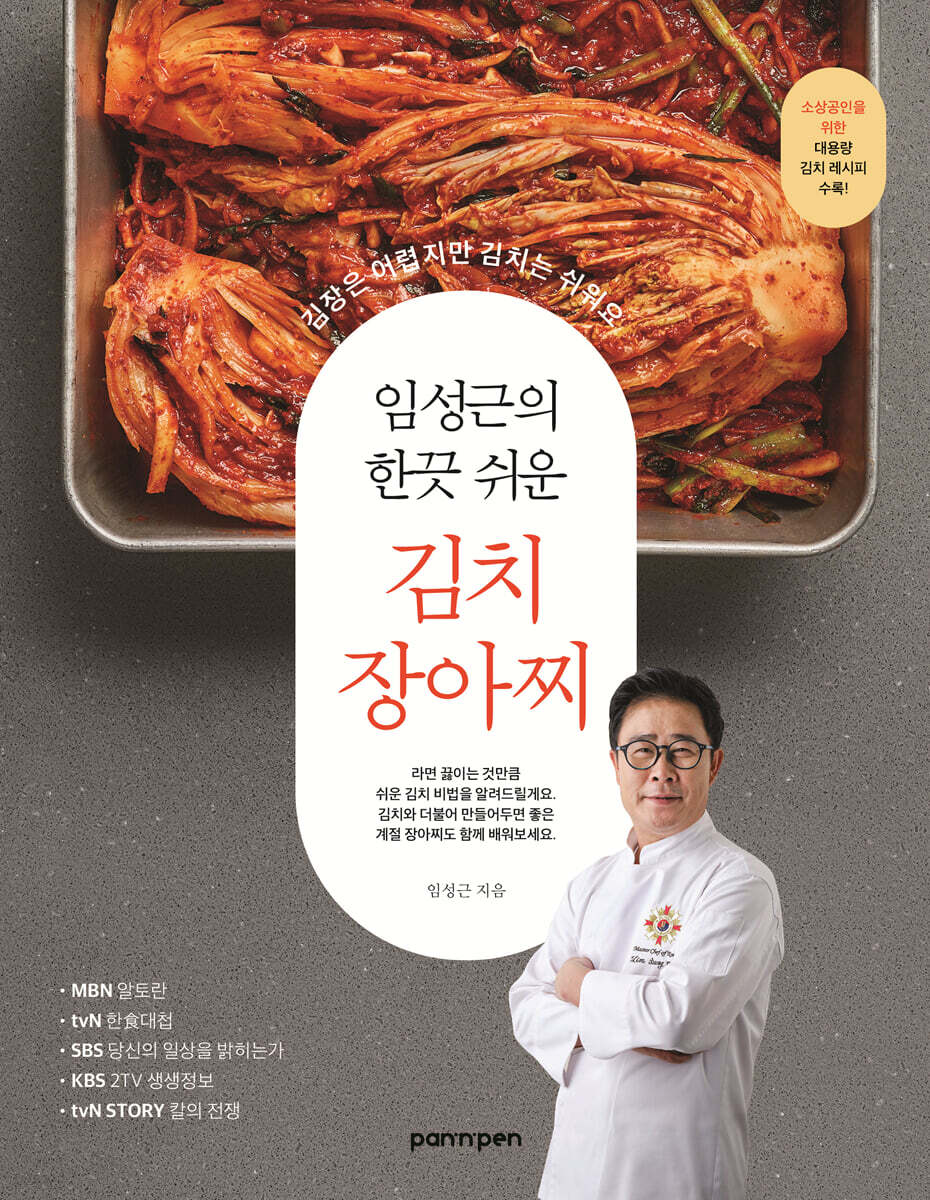
Im Seong-geun's Easy Kimchi Jangajji
 |
Description
Book Introduction
For kimchi beginners, apartment dwellers, and small-scale households
I'll teach you how to make small amounts of easy kimchi and seasonal pickles.
Includes recipes for bulk kimchi and kimchi-based recipes for beginner restaurant owners!
A collection of easy kimchi recipes
Kimchi is influenced by the secrets and tastes of each region, each household, and each person.
In some ways, this can make making kimchi seem difficult.
Rather, this book excludes all special ingredients and unique secret recipes.
We focus only on the basic flavors that anyone can make and say, "This is delicious!"
This is an easy kimchi and pickled vegetable book that focuses on subtracting ingredients and processes rather than adding them, based on Chef Im Seong-geun's countless experiences.
I'll teach you how to make small amounts of easy kimchi and seasonal pickles.
Includes recipes for bulk kimchi and kimchi-based recipes for beginner restaurant owners!
A collection of easy kimchi recipes
Kimchi is influenced by the secrets and tastes of each region, each household, and each person.
In some ways, this can make making kimchi seem difficult.
Rather, this book excludes all special ingredients and unique secret recipes.
We focus only on the basic flavors that anyone can make and say, "This is delicious!"
This is an easy kimchi and pickled vegetable book that focuses on subtracting ingredients and processes rather than adding them, based on Chef Im Seong-geun's countless experiences.
- You can preview some of the book's contents.
Preview
index
Organizing the kimchi and pickled vegetables book
How to use this book
Easy Kimchi
Things to know to make easy kimchi
A kimchi beginner asks a question, and Mr. Im Seong-geun answers.
The most basic, chili pepper
The secret to kimchi's savory flavor: salted seafood
Low-salt fish sauce that reduces fishy smell and preserves savory flavor
Garlic & ginger, which add flavor and aroma to kimchi
Salt and sweetener, which determine the taste of kimchi
Kimchi paste that is well seasoned and essential for fermentation!
Han-geut Kimchi Seasoning
Sweet and sour marinated vegetables
cabbage kimchi
The Secret to Fail-Proof Cabbage Kimchi
Pickled cabbage
cabbage kimchi
Tasty kimchi
Baechu kimchi
White kimchi without beef
Cabbage and Radish Dongchimi
Pickled cabbage
Radish kimchi
The Secret to Fail-Proof Radish Kimchi
Kakdugi
Radish soup
Oyster kimchi
Bachelor Kimchi
Napa cabbage kimchi
Dongchimi
Bachelor's radish kimchi
Radish Kimchi
Radish salad (kimchi flavor)
Radish salad (sweet and sour)
Various vegetable kimchi
The Secret to a Variety of Fail-Proof Vegetable Kimchi
Pickled rapeseed
Sedum water kimchi
Green garlic kimchi
Turnip kimchi
Turnip water kimchi
Pickled radish
Pickled turnips
Eolgal-i kimchi
Pickled Radish Kimchi
Pickled cucumber water kimchi
Clear cucumber water kimchi
Onion kimchi
cabbage kimchi
Cabbage water kimchi
Cucumber Sobagi
Cucumber squash
Pickled cucumber and chives
Cucumber Sobagi Mulkimchi
Gochusobagi
Gochusobakmi Mulkimchi
Spring chive kimchi
Autumn chive kimchi
green onion kimchi
green onion kimchi
Fresh seaweed
mustard greens kimchi
Odeulppaegi Kimchi
Kohlrabi radish kimchi
Kohlrabi salad
Kohlrabi water kimchi
Easy pickled vegetables
Basic preparation for making mouthwatering pickled vegetables
A beginner in jangajji asks a question, and Mr. Im Seong-geun answers.
Basic ingredients for pickling sauce
Container sterilization & degassing
Han-geut Jangajji Pickled Vegetables
soy sauce pickles
Pickled green garlic
Pickled water parsley
Pickled burdock root
Pickled burdock root salad
Pickled pork and potatoes
Green tomato and onion pickles
Pickled green onions
Bear's-tail pickled vegetables
Myeong-i-na-mul-jangajji
Garlic sprout pickles
Garlic pickles
Pickled melon
Cucumber pickles
Gochujangajji
Pickled chili peppers
Perilla leaf pickles
Pickled lotus root
Mujangajji
Pickled Radish
Assorted Mushroom Pickles
salt pickles
Onion salt pickles
Cucumber
Cucumber cold soup
Cucumber salad
Gochujang
Chili pepper salad
Perilla leaf salt pickles
Perilla leaf salt pickle seasoning
Restaurant recipes
Kimchi for restaurants
Pickled Radish Kimchi
Three-color water kimchi
Cucumber Sobagi
Cucumber Baek Sobak
Cucumber water kimchi
Pickled cabbage
Pickled cabbage
cabbage kimchi
Seasoned kimchi (for kimchi stew)
Cabbage water kimchi
lettuce water kimchi
Kakdugi
Dongchimi
Cold noodle dongchimi
Fresh kimchi
Freshly pickled kimchi
Oiji (sweet and sour)
cucumber pickle
Cabbage and Perilla Leaf Pickle
Dishes using kimchi
Pork Kimchi Jjagal-i
Pork Kimchi Stew
Mackerel kimchi stew
Bibimbap with beef ribs and kimchi stew
Kimchi Dongtae Jjigae
Kimchi octopus porridge
Search
Alphabetical order
Main ingredients in order
How to use this book
Easy Kimchi
Things to know to make easy kimchi
A kimchi beginner asks a question, and Mr. Im Seong-geun answers.
The most basic, chili pepper
The secret to kimchi's savory flavor: salted seafood
Low-salt fish sauce that reduces fishy smell and preserves savory flavor
Garlic & ginger, which add flavor and aroma to kimchi
Salt and sweetener, which determine the taste of kimchi
Kimchi paste that is well seasoned and essential for fermentation!
Han-geut Kimchi Seasoning
Sweet and sour marinated vegetables
cabbage kimchi
The Secret to Fail-Proof Cabbage Kimchi
Pickled cabbage
cabbage kimchi
Tasty kimchi
Baechu kimchi
White kimchi without beef
Cabbage and Radish Dongchimi
Pickled cabbage
Radish kimchi
The Secret to Fail-Proof Radish Kimchi
Kakdugi
Radish soup
Oyster kimchi
Bachelor Kimchi
Napa cabbage kimchi
Dongchimi
Bachelor's radish kimchi
Radish Kimchi
Radish salad (kimchi flavor)
Radish salad (sweet and sour)
Various vegetable kimchi
The Secret to a Variety of Fail-Proof Vegetable Kimchi
Pickled rapeseed
Sedum water kimchi
Green garlic kimchi
Turnip kimchi
Turnip water kimchi
Pickled radish
Pickled turnips
Eolgal-i kimchi
Pickled Radish Kimchi
Pickled cucumber water kimchi
Clear cucumber water kimchi
Onion kimchi
cabbage kimchi
Cabbage water kimchi
Cucumber Sobagi
Cucumber squash
Pickled cucumber and chives
Cucumber Sobagi Mulkimchi
Gochusobagi
Gochusobakmi Mulkimchi
Spring chive kimchi
Autumn chive kimchi
green onion kimchi
green onion kimchi
Fresh seaweed
mustard greens kimchi
Odeulppaegi Kimchi
Kohlrabi radish kimchi
Kohlrabi salad
Kohlrabi water kimchi
Easy pickled vegetables
Basic preparation for making mouthwatering pickled vegetables
A beginner in jangajji asks a question, and Mr. Im Seong-geun answers.
Basic ingredients for pickling sauce
Container sterilization & degassing
Han-geut Jangajji Pickled Vegetables
soy sauce pickles
Pickled green garlic
Pickled water parsley
Pickled burdock root
Pickled burdock root salad
Pickled pork and potatoes
Green tomato and onion pickles
Pickled green onions
Bear's-tail pickled vegetables
Myeong-i-na-mul-jangajji
Garlic sprout pickles
Garlic pickles
Pickled melon
Cucumber pickles
Gochujangajji
Pickled chili peppers
Perilla leaf pickles
Pickled lotus root
Mujangajji
Pickled Radish
Assorted Mushroom Pickles
salt pickles
Onion salt pickles
Cucumber
Cucumber cold soup
Cucumber salad
Gochujang
Chili pepper salad
Perilla leaf salt pickles
Perilla leaf salt pickle seasoning
Restaurant recipes
Kimchi for restaurants
Pickled Radish Kimchi
Three-color water kimchi
Cucumber Sobagi
Cucumber Baek Sobak
Cucumber water kimchi
Pickled cabbage
Pickled cabbage
cabbage kimchi
Seasoned kimchi (for kimchi stew)
Cabbage water kimchi
lettuce water kimchi
Kakdugi
Dongchimi
Cold noodle dongchimi
Fresh kimchi
Freshly pickled kimchi
Oiji (sweet and sour)
cucumber pickle
Cabbage and Perilla Leaf Pickle
Dishes using kimchi
Pork Kimchi Jjagal-i
Pork Kimchi Stew
Mackerel kimchi stew
Bibimbap with beef ribs and kimchi stew
Kimchi Dongtae Jjigae
Kimchi octopus porridge
Search
Alphabetical order
Main ingredients in order
Detailed image

Into the book
Organizing the kimchi and pickled vegetables book
I thought it would be nice if anyone could easily make and eat small amounts of kimchi, anywhere.
There is no right or wrong, or correct answer, when it comes to the taste of kimchi.
--- p.
4
A kimchi beginner asks a question, and Mr. Im Seong-geun answers.
Why do kimchi ingredients need to be salted? / What kind of salt should I use when salting kimchi? / How do I know if the brine is well-drained? / What should I do if I buy salt that doesn't have the brine well-drained? / Are there any tips for salting kimchi ingredients? / Can I grind coarse sea salt in a blender and use it? / Do I have to put starch in kimchi? / Is there kimchi that doesn't have starch? / Where can I buy salted seafood? / There are so many different types of fish sauce, which one should I buy? / Why do people put soju in kimchi? / Should I make kimchi seasoning salty or light? / I have leftover kimchi seasoning. What should I do? / I'm running low on kimchi seasoning. / How long should I ferment kimchi before putting it in the refrigerator? / What kind of kimchi container should I choose? / Why does kimchi get soft easily? / My kimchi is fermented, but it tastes strange. / I don't have a kimchi refrigerator. How should I store it? / What should I try to make my first kimchi? / I made a lot of kimchi at once. How should I store it so it stays delicious until the end? / My kimchi container is empty. What should I do?
--- pp.
14~19
The Secret to Fail-Proof Cabbage Kimchi
I like whole cabbages that are heavy and have thin stems / What is the difference between whole cabbages and cabbage leaves / Use different pickling methods depending on the condition of the cabbage / In spring, use bomdong, in summer, use cabbage, and in fall, use whole cabbage / Whole cabbages are bland in summer and savory in fall / When purchasing pickled cabbage, just drain the water / When making cabbage kimchi, prepare a basin and a colander / When storing, reduce contact with air / It takes a day to make cabbage kimchi
--- pp.
34~35
The Secret to Fail-Proof Radish Kimchi
Smooth ones are bachelor radish, and convex ones are altari radish / Adding red pepper paste when making dongchimi enhances the flavor / Choose radishes that are smooth and have a lot of green parts without fine roots / If you want to add a spicy flavor to dongchimi, use red pepper seeds / In spring, buy winter radish / Choose dongchimi radish that is the size of your palm
--- p.
56
A beginner in jangajji asks a question, and Mr. Im Seong-geun answers.
Is there anything I need to prepare before making jangajji? / It's not easy to remove all the moisture from peppers and leafy vegetables. / Why do I boil the pickling sauce and refill it? / Do I have to boil the pickling sauce and refill it every three days? / Why do I add water to the soy sauce pickling sauce? / Can I use soup soy sauce when making jangajji? / Are there different ingredients that go well with soy sauce pickles and salt pickles? / How can I enjoy various flavors in the finished jangajji? / Do I have to use sea salt in the jangajji? / Is there a way to increase the shelf life of jangajji that I want to keep for more than a year? / Are there any ingredients that shouldn't be made into jangajji? / I want to adjust the sweet and sourness of jangajji to my taste. / Why do I put heavy things on top of jangajji? / Please tell me about a side dish that goes well with rice made with jangajji. / What kind of container should I use for jangajji? / Can I make more jangajji in the leftover jangajji liquid? / Please tell me how to use the leftover jangajji liquid.
I thought it would be nice if anyone could easily make and eat small amounts of kimchi, anywhere.
There is no right or wrong, or correct answer, when it comes to the taste of kimchi.
--- p.
4
A kimchi beginner asks a question, and Mr. Im Seong-geun answers.
Why do kimchi ingredients need to be salted? / What kind of salt should I use when salting kimchi? / How do I know if the brine is well-drained? / What should I do if I buy salt that doesn't have the brine well-drained? / Are there any tips for salting kimchi ingredients? / Can I grind coarse sea salt in a blender and use it? / Do I have to put starch in kimchi? / Is there kimchi that doesn't have starch? / Where can I buy salted seafood? / There are so many different types of fish sauce, which one should I buy? / Why do people put soju in kimchi? / Should I make kimchi seasoning salty or light? / I have leftover kimchi seasoning. What should I do? / I'm running low on kimchi seasoning. / How long should I ferment kimchi before putting it in the refrigerator? / What kind of kimchi container should I choose? / Why does kimchi get soft easily? / My kimchi is fermented, but it tastes strange. / I don't have a kimchi refrigerator. How should I store it? / What should I try to make my first kimchi? / I made a lot of kimchi at once. How should I store it so it stays delicious until the end? / My kimchi container is empty. What should I do?
--- pp.
14~19
The Secret to Fail-Proof Cabbage Kimchi
I like whole cabbages that are heavy and have thin stems / What is the difference between whole cabbages and cabbage leaves / Use different pickling methods depending on the condition of the cabbage / In spring, use bomdong, in summer, use cabbage, and in fall, use whole cabbage / Whole cabbages are bland in summer and savory in fall / When purchasing pickled cabbage, just drain the water / When making cabbage kimchi, prepare a basin and a colander / When storing, reduce contact with air / It takes a day to make cabbage kimchi
--- pp.
34~35
The Secret to Fail-Proof Radish Kimchi
Smooth ones are bachelor radish, and convex ones are altari radish / Adding red pepper paste when making dongchimi enhances the flavor / Choose radishes that are smooth and have a lot of green parts without fine roots / If you want to add a spicy flavor to dongchimi, use red pepper seeds / In spring, buy winter radish / Choose dongchimi radish that is the size of your palm
--- p.
56
A beginner in jangajji asks a question, and Mr. Im Seong-geun answers.
Is there anything I need to prepare before making jangajji? / It's not easy to remove all the moisture from peppers and leafy vegetables. / Why do I boil the pickling sauce and refill it? / Do I have to boil the pickling sauce and refill it every three days? / Why do I add water to the soy sauce pickling sauce? / Can I use soup soy sauce when making jangajji? / Are there different ingredients that go well with soy sauce pickles and salt pickles? / How can I enjoy various flavors in the finished jangajji? / Do I have to use sea salt in the jangajji? / Is there a way to increase the shelf life of jangajji that I want to keep for more than a year? / Are there any ingredients that shouldn't be made into jangajji? / I want to adjust the sweet and sourness of jangajji to my taste. / Why do I put heavy things on top of jangajji? / Please tell me about a side dish that goes well with rice made with jangajji. / What kind of container should I use for jangajji? / Can I make more jangajji in the leftover jangajji liquid? / Please tell me how to use the leftover jangajji liquid.
--- pp.
144~147
144~147
Publisher's Review
Are you enjoying a warm home-cooked meal?
What if a world comes where no one makes kimchi?
Even when I was preparing the book, “Im Seong-geun’s Different Home Cooking,” the home cooking craze was still going strong.
At that time, I wrote the book with the hope that even people who were not familiar with cooking could quickly and easily make delicious home-cooked meals.
On the other hand, the book on kimchi and pickled vegetables that is being published this time seems to contain a certain sense of urgency.
The author and editorial staff, who wanted to make it easy for anyone, anywhere, to make and eat kimchi whenever they wanted, had a hidden worry about what would happen if a day came when no one made kimchi at home.
In today's dining table landscape, where various types of products are replacing home-cooked meals, it's hard to imagine making kimchi.
Creating recipes that are detailed and easy enough to experiment with
People who have tried making kimchi once will find that it is easier than they thought.
Of course, delicious kimchi, well-fermented kimchi, may be a different story, but making kimchi itself is not difficult.
Kimchi is made by mixing ingredients with seasoning.
The process includes preparing and pickling the ingredients, the ratio of the amount of ingredients and the seasoning, making the seasoning that goes well with the ingredients, and cooking.
This includes storing, etc.
We have tried to guide you through the various processes of making kimchi in detail, which are easy if you know how, but can be difficult if you don't.
During this process, Im Sin-yeong, the son of chef Im Seong-geun, joined in.
It took longer than expected to organize the ingredients and process to a level that my son, who has been working in the kitchen for a long time, could easily try, along with his taste and perspective.
The gap between Chef Lim Seong-geun, who knows the most delicious kimchi recipe, and his son, who wants an easy recipe that anyone can make, was wider than expected.
And after long communication between the two and countless recipe tests, this kimchi and pickled vegetables book was created.
The chef's answers to all kinds of questions
I thought that just as important as simply organizing kimchi and pickled vegetables recipes was teaching people how to deal with various situations.
We've compiled detailed questions about unexpected situations that may arise before, during, and after making kimchi and pickled vegetables, along with Chef Im Seong-geun's clear answers.
I think this information is good for understanding the principles that make kimchi and pickled vegetables delicious and the characteristics of the ingredients.
There are many parts that reflect the opinions of ordinary kimchi beginners, not just those of Mr. Im Seong-geun's team.
We've provided information for each recipe, including the characteristics of the ingredients used in kimchi and pickled vegetables, the seasonality of the ingredients, the time required for cooking, and the appropriate storage period, so you can visualize the time and process from making to eating.
I think these processes will give you the courage to try making kimchi lightly.
I hope this helps small business owners.
I thought that kimchi beginners are not limited to households.
Many middle-aged and older people in our country are trying to start a second life by starting their own business, especially a restaurant.
Chef Im Seong-geun says that most of the entrepreneurs he has met during his various broadcast filmings and startup advice sessions experience difficulties in mass cooking.
There were many complaints about making basic side dishes, especially kimchi, rather than the main menu served on the guest table.
The reality is that opening a small restaurant and creating your own kimchi recipe doesn't allow for the capital and time.
This is why we decided to include recipes for large-scale kimchi for restaurants and dishes using kimchi that have never been properly introduced in any book.
I sincerely hope that through this book, some people will make kimchi with a single head of autumn cabbage and share it with their families, while others will nurture the sprouts of hope by making restaurant-quality kimchi in a container as tall as their waists.
I hope that our tables will always be filled with food filled with warmth, conversation, sincerity, and love.
Let's make and eat kimchi little by little
We've created a small batch recipe so that even families with small families or without a kimchi refrigerator can make and store kimchi without any burden.
I decided to try it without any burden and decided on an amount that I could eat quickly even if the taste was a little lacking.
You can make kimchi in small quantities with 1-2 heads of cabbage and 1-2 radishes.
A delicacy made with seasonal vegetables: kimchi
We'll teach you a variety of kimchi recipes made with various vegetables available from spring to winter.
Kimchi includes small-sized cabbage kimchi and cubed radish kimchi, as well as water kimchi and white kimchi that even children can eat, as well as geotjeori that is pickled and eaten right away.
Quick and Easy Low-Salt Fermented Seafood Recipe: Easy Kimchi Paste Preparation
An introduction to the basic ingredients needed for kimchi and an easy-to-understand overview of each ingredient's characteristics are essential! We've also included a low-salt fermented seafood recipe that can be made at home and used in a variety of dishes besides kimchi, along with instructions on how to make various types of seaweed and their appropriate uses.
Planning a Kimchi-Making Day
You're wondering how much time it takes to make kimchi, taking time out of your busy schedule. We've listed the average time required for each recipe, so be sure to check it out.
In addition, we have organized each recipe so that you can see at a glance which vegetables are delicious in which season, what the characteristics of the vegetables are, and even the appropriate storage period for the finished kimchi.
All answers to emergencies
We have compiled several pages of questions and answers that beginners to kimchi and pickled vegetables might have.
In addition, we have created a separate page with 'Fail-Proof Kimchi Recipes' for each ingredient, so take a look before making kimchi.
When things are still difficult, try 'Im Seong-geun's One-Shot Seasoning'
If you don't have the confidence to try making kimchi yet, try preparing the ingredients and pickling them first, then use Chef Im Seong-geun's seasoning to make kimchi.
It is convenient because it can be used on a variety of materials.
Seasonal pickled vegetables, organized in detail and as easily as kimchi
We have organized the information on pickled vegetables with the same meticulous care we used to organize kimchi.
Jangajji is divided into soy sauce and salt.
It includes the basic ingredients needed for pickled vegetables, questions and answers about pickled vegetables, the characteristics of each vegetable, the time required to make pickled vegetables, and the appropriate storage period.
We've also included some delicious side dish recipes you can make with the pickled vegetables.
Highlight! Revealing a bulk kimchi recipe essential for restaurant owners!
Bulk kimchi is clearly different from home-cooked kimchi, starting from the ingredients used.
It is difficult to achieve the right taste using only ingredients used at home, and it is also not easy to store.
Based on Chef Im Seong-geun's extensive experience, we've compiled a detailed guide to making large quantities of kimchi.
It contains 19 special recipes, from basic kimchi and cubed radish kimchi to dongchimi for naengmyeon and kimchi for stew.
We've also prepared the best recipes using kimchi that sells well at restaurants.
Chef Im Seong-geun adds a touch of flair to every recipe.
All recipes include Im Seong-geun's helpful advice.
Add some sweet advice from Chef Seong-geun Lim, who is dedicated solely to Korean cuisine, to your own culinary delights.
Even simple and easy recipes can be transformed into foolproof kimchi, even more delicious pickled vegetables, and side dishes that can be enjoyed for a long time.
What if a world comes where no one makes kimchi?
Even when I was preparing the book, “Im Seong-geun’s Different Home Cooking,” the home cooking craze was still going strong.
At that time, I wrote the book with the hope that even people who were not familiar with cooking could quickly and easily make delicious home-cooked meals.
On the other hand, the book on kimchi and pickled vegetables that is being published this time seems to contain a certain sense of urgency.
The author and editorial staff, who wanted to make it easy for anyone, anywhere, to make and eat kimchi whenever they wanted, had a hidden worry about what would happen if a day came when no one made kimchi at home.
In today's dining table landscape, where various types of products are replacing home-cooked meals, it's hard to imagine making kimchi.
Creating recipes that are detailed and easy enough to experiment with
People who have tried making kimchi once will find that it is easier than they thought.
Of course, delicious kimchi, well-fermented kimchi, may be a different story, but making kimchi itself is not difficult.
Kimchi is made by mixing ingredients with seasoning.
The process includes preparing and pickling the ingredients, the ratio of the amount of ingredients and the seasoning, making the seasoning that goes well with the ingredients, and cooking.
This includes storing, etc.
We have tried to guide you through the various processes of making kimchi in detail, which are easy if you know how, but can be difficult if you don't.
During this process, Im Sin-yeong, the son of chef Im Seong-geun, joined in.
It took longer than expected to organize the ingredients and process to a level that my son, who has been working in the kitchen for a long time, could easily try, along with his taste and perspective.
The gap between Chef Lim Seong-geun, who knows the most delicious kimchi recipe, and his son, who wants an easy recipe that anyone can make, was wider than expected.
And after long communication between the two and countless recipe tests, this kimchi and pickled vegetables book was created.
The chef's answers to all kinds of questions
I thought that just as important as simply organizing kimchi and pickled vegetables recipes was teaching people how to deal with various situations.
We've compiled detailed questions about unexpected situations that may arise before, during, and after making kimchi and pickled vegetables, along with Chef Im Seong-geun's clear answers.
I think this information is good for understanding the principles that make kimchi and pickled vegetables delicious and the characteristics of the ingredients.
There are many parts that reflect the opinions of ordinary kimchi beginners, not just those of Mr. Im Seong-geun's team.
We've provided information for each recipe, including the characteristics of the ingredients used in kimchi and pickled vegetables, the seasonality of the ingredients, the time required for cooking, and the appropriate storage period, so you can visualize the time and process from making to eating.
I think these processes will give you the courage to try making kimchi lightly.
I hope this helps small business owners.
I thought that kimchi beginners are not limited to households.
Many middle-aged and older people in our country are trying to start a second life by starting their own business, especially a restaurant.
Chef Im Seong-geun says that most of the entrepreneurs he has met during his various broadcast filmings and startup advice sessions experience difficulties in mass cooking.
There were many complaints about making basic side dishes, especially kimchi, rather than the main menu served on the guest table.
The reality is that opening a small restaurant and creating your own kimchi recipe doesn't allow for the capital and time.
This is why we decided to include recipes for large-scale kimchi for restaurants and dishes using kimchi that have never been properly introduced in any book.
I sincerely hope that through this book, some people will make kimchi with a single head of autumn cabbage and share it with their families, while others will nurture the sprouts of hope by making restaurant-quality kimchi in a container as tall as their waists.
I hope that our tables will always be filled with food filled with warmth, conversation, sincerity, and love.
Let's make and eat kimchi little by little
We've created a small batch recipe so that even families with small families or without a kimchi refrigerator can make and store kimchi without any burden.
I decided to try it without any burden and decided on an amount that I could eat quickly even if the taste was a little lacking.
You can make kimchi in small quantities with 1-2 heads of cabbage and 1-2 radishes.
A delicacy made with seasonal vegetables: kimchi
We'll teach you a variety of kimchi recipes made with various vegetables available from spring to winter.
Kimchi includes small-sized cabbage kimchi and cubed radish kimchi, as well as water kimchi and white kimchi that even children can eat, as well as geotjeori that is pickled and eaten right away.
Quick and Easy Low-Salt Fermented Seafood Recipe: Easy Kimchi Paste Preparation
An introduction to the basic ingredients needed for kimchi and an easy-to-understand overview of each ingredient's characteristics are essential! We've also included a low-salt fermented seafood recipe that can be made at home and used in a variety of dishes besides kimchi, along with instructions on how to make various types of seaweed and their appropriate uses.
Planning a Kimchi-Making Day
You're wondering how much time it takes to make kimchi, taking time out of your busy schedule. We've listed the average time required for each recipe, so be sure to check it out.
In addition, we have organized each recipe so that you can see at a glance which vegetables are delicious in which season, what the characteristics of the vegetables are, and even the appropriate storage period for the finished kimchi.
All answers to emergencies
We have compiled several pages of questions and answers that beginners to kimchi and pickled vegetables might have.
In addition, we have created a separate page with 'Fail-Proof Kimchi Recipes' for each ingredient, so take a look before making kimchi.
When things are still difficult, try 'Im Seong-geun's One-Shot Seasoning'
If you don't have the confidence to try making kimchi yet, try preparing the ingredients and pickling them first, then use Chef Im Seong-geun's seasoning to make kimchi.
It is convenient because it can be used on a variety of materials.
Seasonal pickled vegetables, organized in detail and as easily as kimchi
We have organized the information on pickled vegetables with the same meticulous care we used to organize kimchi.
Jangajji is divided into soy sauce and salt.
It includes the basic ingredients needed for pickled vegetables, questions and answers about pickled vegetables, the characteristics of each vegetable, the time required to make pickled vegetables, and the appropriate storage period.
We've also included some delicious side dish recipes you can make with the pickled vegetables.
Highlight! Revealing a bulk kimchi recipe essential for restaurant owners!
Bulk kimchi is clearly different from home-cooked kimchi, starting from the ingredients used.
It is difficult to achieve the right taste using only ingredients used at home, and it is also not easy to store.
Based on Chef Im Seong-geun's extensive experience, we've compiled a detailed guide to making large quantities of kimchi.
It contains 19 special recipes, from basic kimchi and cubed radish kimchi to dongchimi for naengmyeon and kimchi for stew.
We've also prepared the best recipes using kimchi that sells well at restaurants.
Chef Im Seong-geun adds a touch of flair to every recipe.
All recipes include Im Seong-geun's helpful advice.
Add some sweet advice from Chef Seong-geun Lim, who is dedicated solely to Korean cuisine, to your own culinary delights.
Even simple and easy recipes can be transformed into foolproof kimchi, even more delicious pickled vegetables, and side dishes that can be enjoyed for a long time.
GOODS SPECIFICS
- Publication date: November 10, 2021
- Page count, weight, size: 268 pages | 654g | 187*240*14mm
- ISBN13: 9791191739015
- ISBN10: 1191739015
You may also like
카테고리
korean


korean

![GQ KOREA Mark (Monthly): December [2025]](http://librairie.coreenne.fr/cdn/shop/files/8ef265dbbfbf186523ed75ba7319009d.jpg?v=1765340328&width=3840)


