

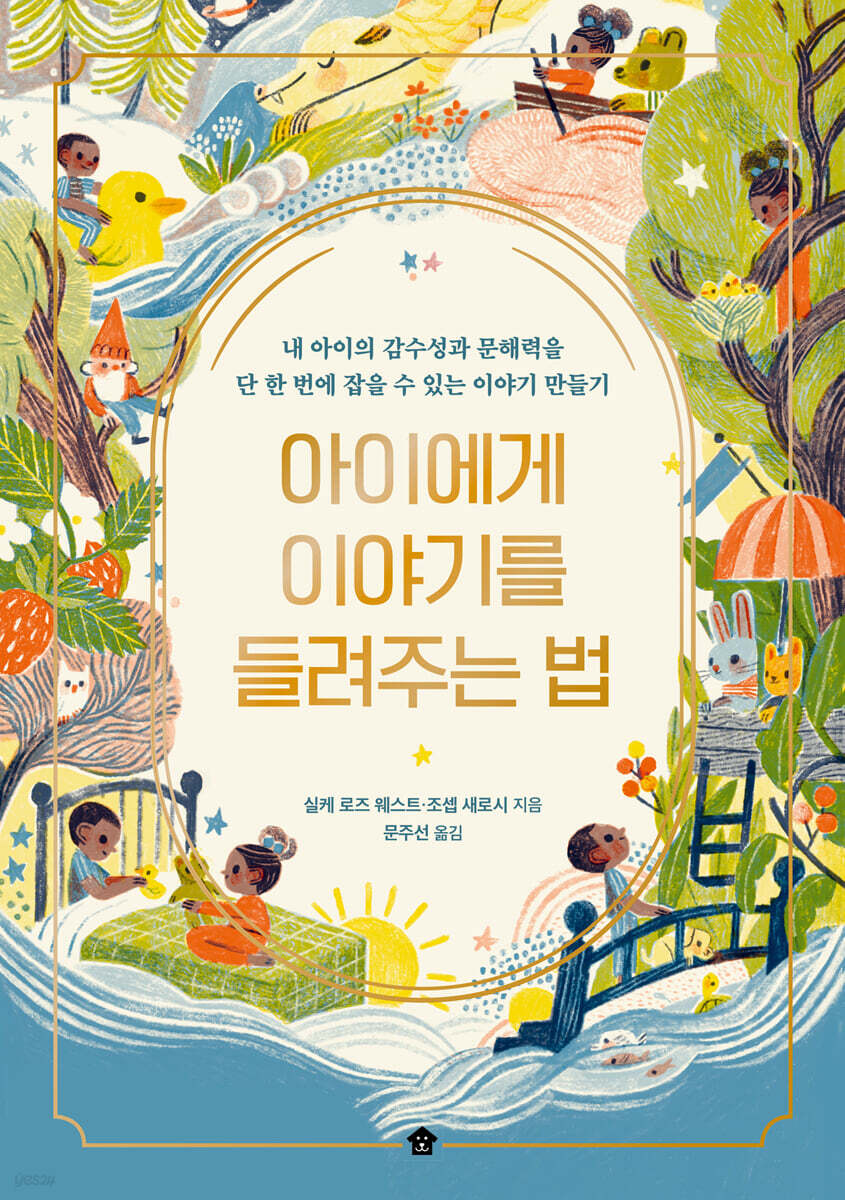
How to tell a story to a child
 |
Description
Book Introduction
To raise children with high sensitivity and literacy
The simplest and most innovative method!
"How to Tell Stories to Your Child," a book that delves into the most innovative method of strengthening your child's sensitivity and literacy, "storytelling," has been published by Baduki House.
Modern parents, living in a world overflowing with information, can access all the information they want with just a click of the mouse.
But I still struggle with the most fundamental way to understand and nurture my child's heart.
This book reawakens the human instinct to tell stories, thereby enhancing not only children's relationships and sensitivity but also their literacy skills.
The late Dr. Jane Goodall said, “Stories are the best way to imprint information or ideas deeply in the listener’s mind.
“This book will greatly contribute to the widespread use of storytelling as a core educational tool,” he praises.
Parents who tell stories well are not just providers of information to their children, but partners who interpret and explore the world together.
This book serves as a guide to finding the 'language of story' between parents and children.
The simplest and most innovative method!
"How to Tell Stories to Your Child," a book that delves into the most innovative method of strengthening your child's sensitivity and literacy, "storytelling," has been published by Baduki House.
Modern parents, living in a world overflowing with information, can access all the information they want with just a click of the mouse.
But I still struggle with the most fundamental way to understand and nurture my child's heart.
This book reawakens the human instinct to tell stories, thereby enhancing not only children's relationships and sensitivity but also their literacy skills.
The late Dr. Jane Goodall said, “Stories are the best way to imprint information or ideas deeply in the listener’s mind.
“This book will greatly contribute to the widespread use of storytelling as a core educational tool,” he praises.
Parents who tell stories well are not just providers of information to their children, but partners who interpret and explore the world together.
This book serves as a guide to finding the 'language of story' between parents and children.
- You can preview some of the book's contents.
Preview
index
introduction
PART 1_Story Link
PART 2_Talking Your Way
PART 3_Simply Talk
PART 4_Creating the Rhythm of the Story
PART 5_Basic Elements of a Story
PART 6_A Story to Soothe the Heart
PART 7_Stories that teach life
PART 8_A Story for the Whole Family
PART 9_The Art of Closing
Author's Note
Acknowledgements
References
PART 1_Story Link
PART 2_Talking Your Way
PART 3_Simply Talk
PART 4_Creating the Rhythm of the Story
PART 5_Basic Elements of a Story
PART 6_A Story to Soothe the Heart
PART 7_Stories that teach life
PART 8_A Story for the Whole Family
PART 9_The Art of Closing
Author's Note
Acknowledgements
References
Detailed image
Publisher's Review
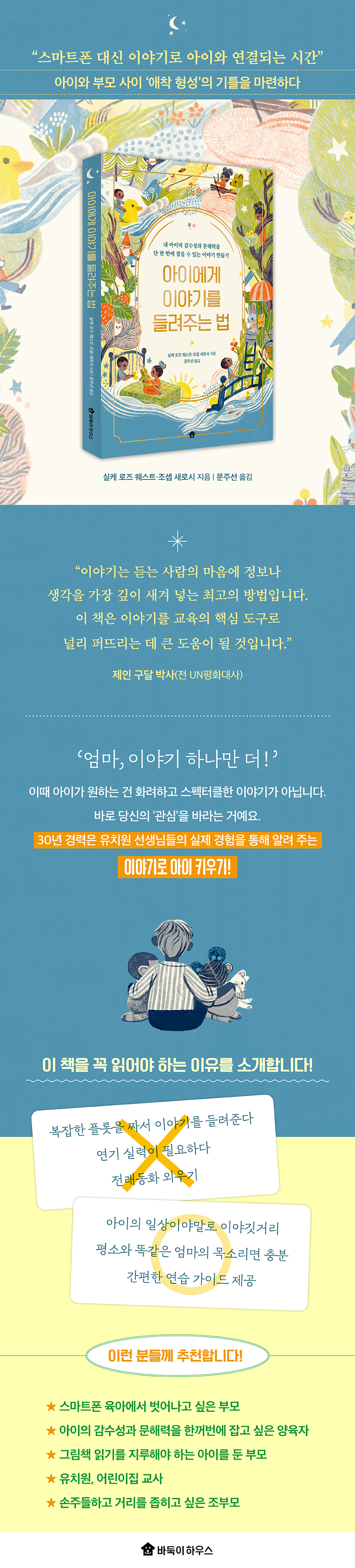
"Time to connect with your child through stories instead of smartphones."
Laying the foundation for 'attachment formation' between children and parents
This book starts from the premise that 'all parents have the ability to be storytellers.'
Of course, as a storyteller, you might wonder if you should show off your smooth speaking skills and exude charm that will captivate children.
On the one hand, I could also be concerned about what would happen if what I'm saying were trivial.
But the authors make it clear that telling stories to my children doesn't mean creating grand screenplays worthy of a movie spectacle or writing tightly woven literary works.
In other words, this book should not focus on the 'technique' of storytelling, but rather should start from the point that one can find infinite story material by 'observing' and 'empathizing' with children.
Even if it's not a fancy rhetoric, if you start the story from a topic that resonates with your child's heart, your child will develop a secure attachment to you as a parent who helps them understand the world and express themselves.
The tone, breathing, and facial expressions of parents telling stories are perceived by children as a language of stability, and the children can enjoy the events that occur in even the most trivial things as great adventures.
The most powerful force that occurs between parents and children comes not from a hierarchical relationship that leads to simple instructions, but from storytime where they laugh, feel, and imagine together.
If you gain the confidence that you are loved through this, wouldn't that become the starting point of 'attachment'?
“A child who listens well grows up to be a child who reads and writes well!”
Awaken your inner storyteller and open your child's five senses.
Today, the literacy that is a hot topic in the world is not limited to the ability to simply read and write.
It is expanding into the power to communicate with others and understand the world.
In that sense, telling or listening to stories is an act of sharing one's heart and an essential element in expanding literacy.
That's not all.
Even psychologists have recently begun to focus on "story," the language of relationships, and authors who have been educating children for decades also emphasize how important storytelling is to a child's growth.
In an age where smartphones are prevalent and we are more familiar with digital screens than books, stories provide training in reading others' minds and expressing our own thoughts clearly and verbally.
The authors say that 'telling stories is not about teaching children language, but about showing them how to read the world.'
It conveys the flow of 'being able to read by listening to stories, and being able to write by being able to read', which means not learning words through stories, but interpreting meaning and expressing one's own thoughts.
Shifting your thinking through stories can enhance your imagination, expand your vocabulary, and train your sentence structure at the same time.
If investing just five minutes a day could improve your relationship with your child, show them the greatest affection a parent can give, and even help them develop literacy skills, there's no reason not to start telling stories to your child today.
Laying the foundation for 'attachment formation' between children and parents
This book starts from the premise that 'all parents have the ability to be storytellers.'
Of course, as a storyteller, you might wonder if you should show off your smooth speaking skills and exude charm that will captivate children.
On the one hand, I could also be concerned about what would happen if what I'm saying were trivial.
But the authors make it clear that telling stories to my children doesn't mean creating grand screenplays worthy of a movie spectacle or writing tightly woven literary works.
In other words, this book should not focus on the 'technique' of storytelling, but rather should start from the point that one can find infinite story material by 'observing' and 'empathizing' with children.
Even if it's not a fancy rhetoric, if you start the story from a topic that resonates with your child's heart, your child will develop a secure attachment to you as a parent who helps them understand the world and express themselves.
The tone, breathing, and facial expressions of parents telling stories are perceived by children as a language of stability, and the children can enjoy the events that occur in even the most trivial things as great adventures.
The most powerful force that occurs between parents and children comes not from a hierarchical relationship that leads to simple instructions, but from storytime where they laugh, feel, and imagine together.
If you gain the confidence that you are loved through this, wouldn't that become the starting point of 'attachment'?
“A child who listens well grows up to be a child who reads and writes well!”
Awaken your inner storyteller and open your child's five senses.
Today, the literacy that is a hot topic in the world is not limited to the ability to simply read and write.
It is expanding into the power to communicate with others and understand the world.
In that sense, telling or listening to stories is an act of sharing one's heart and an essential element in expanding literacy.
That's not all.
Even psychologists have recently begun to focus on "story," the language of relationships, and authors who have been educating children for decades also emphasize how important storytelling is to a child's growth.
In an age where smartphones are prevalent and we are more familiar with digital screens than books, stories provide training in reading others' minds and expressing our own thoughts clearly and verbally.
The authors say that 'telling stories is not about teaching children language, but about showing them how to read the world.'
It conveys the flow of 'being able to read by listening to stories, and being able to write by being able to read', which means not learning words through stories, but interpreting meaning and expressing one's own thoughts.
Shifting your thinking through stories can enhance your imagination, expand your vocabulary, and train your sentence structure at the same time.
If investing just five minutes a day could improve your relationship with your child, show them the greatest affection a parent can give, and even help them develop literacy skills, there's no reason not to start telling stories to your child today.
GOODS SPECIFICS
- Date of issue: December 1, 2025
- Page count, weight, size: 228 pages | 370g | 148*210*13mm
- ISBN13: 9791190557566
- ISBN10: 1190557568
You may also like
카테고리
korean


korean

![GQ KOREA Mark (Monthly): December [2025]](http://librairie.coreenne.fr/cdn/shop/files/8ef265dbbfbf186523ed75ba7319009d.jpg?v=1765340328&width=3840)


