

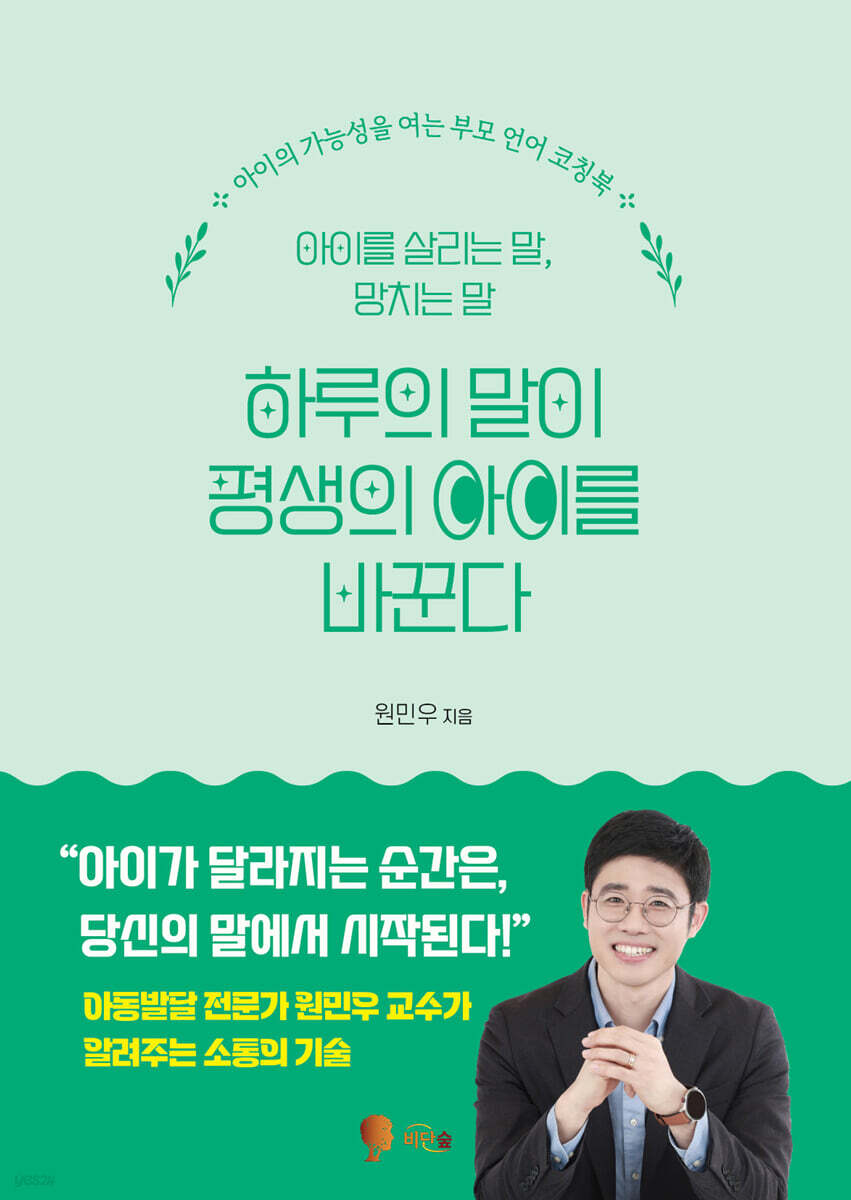
A word a day can change a child's life.
 |
Description
Book Introduction
“Parents’ words shape their children’s future.” Just one word spoken to a child every day can change their self-esteem, thinking skills, and even relationships.
This book is a “Parent Language Habit Coaching Book” by Professor Won Min-woo, a child development language therapist who has counseled thousands of parents and children for 15 years.
Based on extensive clinical experience and actual parenting cases, the author has organized the verbal skills to help children move and grow independently in a systematic and practical manner.
This book is a “Parent Language Habit Coaching Book” by Professor Won Min-woo, a child development language therapist who has counseled thousands of parents and children for 15 years.
Based on extensive clinical experience and actual parenting cases, the author has organized the verbal skills to help children move and grow independently in a systematic and practical manner.
index
prolog
Parents' Words Shape Their Children's Future
What is happening to our children?
Part 1: Words to Boost Self-Esteem
A child's ego grows from the words of his parents.
A language that focuses on respect rather than comparison and growth rather than competition.
A word from parents that makes you not afraid of failure
A conversation that respects and waits for the child's thoughts
Comprehensive Practical Guide: Mastering the Power of Words
Part 2: Words that lead to inner motivation
Parents' Questions That Arouse Curiosity
Conversational techniques to help you set your own goals
Language that fosters inner satisfaction rather than external rewards
The power of words to broaden a child's interests
Mastering Intrinsic Motivation: A Comprehensive Practical Guide
Part 3: Words that comfort the heart
Language that allows us to recognize and express emotions
Parents' Guide to Dealing with Anger and Frustration
Conversations that protect children's emotions through empathy and understanding
Speaking Habits that Build Resilience
Turning Mistakes into Recovery Words (Parent Emotion Coaching)
A Comprehensive Practical Guide to Mastering Emotional Intelligence
Part 4: Words that develop thinking skills
"You're naturally smart" is better than "You'll change if you try."
Words that help you solve a problem on your own
Questions that stimulate critical thinking
Open language that inspires creativity
Comprehensive Practical Guide: Mastering Thinking
Part 5: Words that Open a Healthy Relationship
Dialogue that resolves conflict rather than avoiding it
Words that foster a sense of “us”
A language that recognizes differences and respects diversity
Leadership and Collaboration: The Art of Speaking That Everyone Should Learn
Comprehensive Practice Guide: Mastering Social Competence
Epilogue
In the end, words are about relationships
Parents' Words Shape Their Children's Future
What is happening to our children?
Part 1: Words to Boost Self-Esteem
A child's ego grows from the words of his parents.
A language that focuses on respect rather than comparison and growth rather than competition.
A word from parents that makes you not afraid of failure
A conversation that respects and waits for the child's thoughts
Comprehensive Practical Guide: Mastering the Power of Words
Part 2: Words that lead to inner motivation
Parents' Questions That Arouse Curiosity
Conversational techniques to help you set your own goals
Language that fosters inner satisfaction rather than external rewards
The power of words to broaden a child's interests
Mastering Intrinsic Motivation: A Comprehensive Practical Guide
Part 3: Words that comfort the heart
Language that allows us to recognize and express emotions
Parents' Guide to Dealing with Anger and Frustration
Conversations that protect children's emotions through empathy and understanding
Speaking Habits that Build Resilience
Turning Mistakes into Recovery Words (Parent Emotion Coaching)
A Comprehensive Practical Guide to Mastering Emotional Intelligence
Part 4: Words that develop thinking skills
"You're naturally smart" is better than "You'll change if you try."
Words that help you solve a problem on your own
Questions that stimulate critical thinking
Open language that inspires creativity
Comprehensive Practical Guide: Mastering Thinking
Part 5: Words that Open a Healthy Relationship
Dialogue that resolves conflict rather than avoiding it
Words that foster a sense of “us”
A language that recognizes differences and respects diversity
Leadership and Collaboration: The Art of Speaking That Everyone Should Learn
Comprehensive Practice Guide: Mastering Social Competence
Epilogue
In the end, words are about relationships
Detailed image

Publisher's Review
This book is structured to help children develop self-esteem, motivation, emotional control, thinking skills, and social skills by following the parents' stages of change.
Part 1 teaches that a child's self begins with 'parental trust' and teaches them the language of respect and trust instead of comparison or evaluation.
A child's self-esteem grows with a single word from a parent, and the message, "You are good enough," becomes the foundation for growth.
In Part 2, we teach children to respond to "want-to-do" words, and we awaken their inner motivation through the language of questions and choices rather than commands and controls.
You can learn conversation techniques that foster the joy of accomplishment rather than external rewards, and develop goal setting and self-direction.
Part 3 teaches us that empathy is the best discipline, that children's emotions, when handled well, can build resilience, and that words can help us acknowledge and work through anger, frustration, and mistakes.
Parents can also learn how to manage their emotions and communicate with warm empathy.
Part 4 shows that asking for "thoughts" rather than providing the right answer develops a child's thinking ability, and that saying "If you work hard, you will change" instead of "You are naturally smart" creates a growth mindset, and teaches the technique of open-ended questions that fosters problem-solving skills, critical thinking, and creativity.
In Part 5, children's social skills grow from the family's conversational culture, and they learn how to resolve conflicts rather than avoid them, learn the language of cooperation and empathy, and develop communication skills that foster a sense of "we."
We present a method of empathetic dialogue within the home that teaches leadership, consideration, and respect for diversity.
What the author wants to convey through the book is that words are ultimately about relationships.
Words are not just a means of communication.
It is called “a bridge connecting children and parents.”
One word from you today can shape a child's tomorrow.
I recommend this book to these parents:
* Parents who always end up nagging when talking to their children
* Parents who want to develop their children's self-esteem and initiative
* Parents who want to move their children without getting angry
* Parents who need actionable conversation scripts
Part 1 teaches that a child's self begins with 'parental trust' and teaches them the language of respect and trust instead of comparison or evaluation.
A child's self-esteem grows with a single word from a parent, and the message, "You are good enough," becomes the foundation for growth.
In Part 2, we teach children to respond to "want-to-do" words, and we awaken their inner motivation through the language of questions and choices rather than commands and controls.
You can learn conversation techniques that foster the joy of accomplishment rather than external rewards, and develop goal setting and self-direction.
Part 3 teaches us that empathy is the best discipline, that children's emotions, when handled well, can build resilience, and that words can help us acknowledge and work through anger, frustration, and mistakes.
Parents can also learn how to manage their emotions and communicate with warm empathy.
Part 4 shows that asking for "thoughts" rather than providing the right answer develops a child's thinking ability, and that saying "If you work hard, you will change" instead of "You are naturally smart" creates a growth mindset, and teaches the technique of open-ended questions that fosters problem-solving skills, critical thinking, and creativity.
In Part 5, children's social skills grow from the family's conversational culture, and they learn how to resolve conflicts rather than avoid them, learn the language of cooperation and empathy, and develop communication skills that foster a sense of "we."
We present a method of empathetic dialogue within the home that teaches leadership, consideration, and respect for diversity.
What the author wants to convey through the book is that words are ultimately about relationships.
Words are not just a means of communication.
It is called “a bridge connecting children and parents.”
One word from you today can shape a child's tomorrow.
I recommend this book to these parents:
* Parents who always end up nagging when talking to their children
* Parents who want to develop their children's self-esteem and initiative
* Parents who want to move their children without getting angry
* Parents who need actionable conversation scripts
GOODS SPECIFICS
- Date of issue: December 1, 2025
- Page count, weight, size: 340 pages | 140*205*30mm
- ISBN13: 9791192357201
You may also like
카테고리
korean


korean

![GQ KOREA Mark (Monthly): December [2025]](http://librairie.coreenne.fr/cdn/shop/files/8ef265dbbfbf186523ed75ba7319009d.jpg?v=1765340328&width=3840)


