

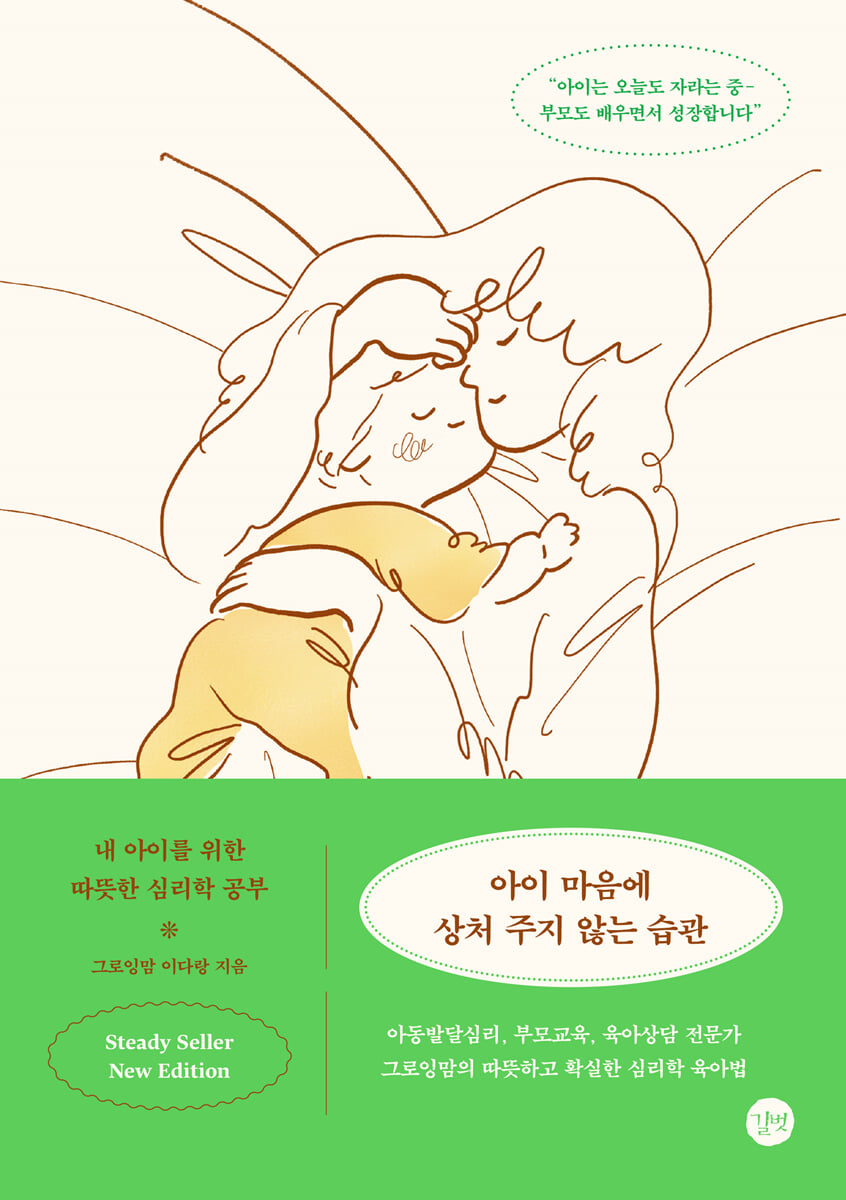
Habits That Don't Hurt Your Child: New Edition
 |
Description
Book Introduction
“The child is growing up today too -
Parents also learn and grow.”
For parents who love their children but have difficulty fully understanding them
Warm and sure comfort from psychology
“Why on earth are you like that!” My precious child, I want to understand and sympathize with them in any situation, but when they throw a tantrum or suddenly act stubbornly and do something they never did before, the anger I’ve been holding back explodes.
When you get angry at a child like this, it leaves scars not only on the child but also on the parents.
I love my child, but why do I get so upset and angry at his or her behavior?
Even if you diligently search for and read parenting books, it only lasts for a moment. For parents who struggle with self-reproach and reflection even today, 『Habits that Don't Hurt Your Child's Heart』 has returned in a new edition.
This book, which immediately won the sympathy of parents and became a steady seller upon publication, clearly and lucidly answers why we need to look at children through the lens of psychology.
As an expert in child development psychology, parenting education, and childcare counseling, the author has provided childcare education to countless parents and explains psychology in an easy-to-understand way, guiding readers through how a child's mind develops and interpreting "child behaviors that appear to be problem behaviors" that appear in the process.
In the end, it is not because parents hate their children, but because ordinary parents have not had the opportunity to properly understand the process of their children's minds growing, and also because they have not had the time to think deeply about their own mental state.
This revised edition has been made even more inclusive by incorporating feedback from readers since the first edition was published.
In response to a review that said that studying psychology for the sake of their children gave them the opportunity to love themselves as a parent and that it made parenting much easier, I added new content to help parents alleviate their guilt and look at their time as parents in a positive light.
Let's check our current state of mind through the [Parents' Mind Checklist] and start practicing fully understanding ourselves through [Good Parenting Habits].
You will be able to develop healthy parenting habits that will not hurt either your child or your parents.
Parents also learn and grow.”
For parents who love their children but have difficulty fully understanding them
Warm and sure comfort from psychology
“Why on earth are you like that!” My precious child, I want to understand and sympathize with them in any situation, but when they throw a tantrum or suddenly act stubbornly and do something they never did before, the anger I’ve been holding back explodes.
When you get angry at a child like this, it leaves scars not only on the child but also on the parents.
I love my child, but why do I get so upset and angry at his or her behavior?
Even if you diligently search for and read parenting books, it only lasts for a moment. For parents who struggle with self-reproach and reflection even today, 『Habits that Don't Hurt Your Child's Heart』 has returned in a new edition.
This book, which immediately won the sympathy of parents and became a steady seller upon publication, clearly and lucidly answers why we need to look at children through the lens of psychology.
As an expert in child development psychology, parenting education, and childcare counseling, the author has provided childcare education to countless parents and explains psychology in an easy-to-understand way, guiding readers through how a child's mind develops and interpreting "child behaviors that appear to be problem behaviors" that appear in the process.
In the end, it is not because parents hate their children, but because ordinary parents have not had the opportunity to properly understand the process of their children's minds growing, and also because they have not had the time to think deeply about their own mental state.
This revised edition has been made even more inclusive by incorporating feedback from readers since the first edition was published.
In response to a review that said that studying psychology for the sake of their children gave them the opportunity to love themselves as a parent and that it made parenting much easier, I added new content to help parents alleviate their guilt and look at their time as parents in a positive light.
Let's check our current state of mind through the [Parents' Mind Checklist] and start practicing fully understanding ourselves through [Good Parenting Habits].
You will be able to develop healthy parenting habits that will not hurt either your child or your parents.
- You can preview some of the book's contents.
Preview
index
Prologue: To parents who love their children but find it difficult to fully understand them.
[PART 1.
[Time to understand a child's mind]
01 Practice understanding your child's mind | 02 Learn to distinguish between real and fake information | 03 Reduce anxiety while raising children | 04 Develop a healthy parenting mindset through psychology
[PART 2.
[Studying Psychology for My Child]
Lecture 1.
What is a child's mental development?
01 If you know development, you can see your child | 02 Children grow in a set order
Lecture 2.
Three Perspectives on Child Development
01 You must first understand the causes of problem behavior | 02 First perspective: Psychoanalytic theory | 03 Second perspective: Behavioral theory | 04 Third perspective: Cognitive development theory | 05 The power to properly distinguish parenting information
3rd lecture.
There should be no unfulfilled needs at any stage - Freud's stages of development
01 Learning about desire | 02 Stage 1: Oral exploration | 03 Stage 2: Anal creation | 04 Stage 3: The phallic stage, a difficult one for both parents and children | 05 Stage 4: Latency and genitals
Semifinals.
As a child grows, he or she completes missions one by one - Erikson's developmental stages
01 The Seven Stages of Development in Society | 02 The First Mission: Basic Trust | 03 The Second Mission: Autonomy | 04 The Third Mission: Initiative | 05 The Fourth Mission: Diligence | 06 The Process Beyond
Lecture 5.
The way a child thinks and learns also grows - Piaget's stages of development
01 I grow by constantly changing myself | 02 Sensorimotor stage (birth to 2 years old): Time to learn about the world with my whole body | 03 Preoperational stage (2 to 7 years old): Seeing what I see | 04 Concrete operational stage and formal operational stage: Solving problems in earnest
[PART 3.
[Habits that don't hurt children's feelings]
01 Why won't my child leave me? | 02 How to know if my child has an insecure attachment | 03 If your child suddenly refuses to go to daycare | 04 The mind of a child who always blames their parents | 05 Interpreting a child's aggressive behavior | 06 A child who is obsessed with a specific object | 07 The mind of a child who insists on being number one | 08 If discipline doesn't work well
[PART 4.
[The habit of understanding my mind]
01 Parents' Heart Checklist | 02 When it's hard to love your child properly | 03 When you don't feel empathy for your child | 04 When you keep trying to control your child | 05 When you feel like you're losing yourself while raising your child | 06 When you're compared to other parents | 07 When you feel guilty toward your child
[PART 1.
[Time to understand a child's mind]
01 Practice understanding your child's mind | 02 Learn to distinguish between real and fake information | 03 Reduce anxiety while raising children | 04 Develop a healthy parenting mindset through psychology
[PART 2.
[Studying Psychology for My Child]
Lecture 1.
What is a child's mental development?
01 If you know development, you can see your child | 02 Children grow in a set order
Lecture 2.
Three Perspectives on Child Development
01 You must first understand the causes of problem behavior | 02 First perspective: Psychoanalytic theory | 03 Second perspective: Behavioral theory | 04 Third perspective: Cognitive development theory | 05 The power to properly distinguish parenting information
3rd lecture.
There should be no unfulfilled needs at any stage - Freud's stages of development
01 Learning about desire | 02 Stage 1: Oral exploration | 03 Stage 2: Anal creation | 04 Stage 3: The phallic stage, a difficult one for both parents and children | 05 Stage 4: Latency and genitals
Semifinals.
As a child grows, he or she completes missions one by one - Erikson's developmental stages
01 The Seven Stages of Development in Society | 02 The First Mission: Basic Trust | 03 The Second Mission: Autonomy | 04 The Third Mission: Initiative | 05 The Fourth Mission: Diligence | 06 The Process Beyond
Lecture 5.
The way a child thinks and learns also grows - Piaget's stages of development
01 I grow by constantly changing myself | 02 Sensorimotor stage (birth to 2 years old): Time to learn about the world with my whole body | 03 Preoperational stage (2 to 7 years old): Seeing what I see | 04 Concrete operational stage and formal operational stage: Solving problems in earnest
[PART 3.
[Habits that don't hurt children's feelings]
01 Why won't my child leave me? | 02 How to know if my child has an insecure attachment | 03 If your child suddenly refuses to go to daycare | 04 The mind of a child who always blames their parents | 05 Interpreting a child's aggressive behavior | 06 A child who is obsessed with a specific object | 07 The mind of a child who insists on being number one | 08 If discipline doesn't work well
[PART 4.
[The habit of understanding my mind]
01 Parents' Heart Checklist | 02 When it's hard to love your child properly | 03 When you don't feel empathy for your child | 04 When you keep trying to control your child | 05 When you feel like you're losing yourself while raising your child | 06 When you're compared to other parents | 07 When you feel guilty toward your child
Detailed image

Into the book
But is there really no answer to parenting? In some ways, perhaps.
Because there is no one right answer that fits all parents and children.
However, it is dangerous to think, 'There is no right answer to parenting, so you can do whatever you want!'
Although there are individual differences in specific circumstances, there is a basic direction and pace that encompasses the entire process of a child's development.
When raising a child, you can't fit them into a perfect mold, but you need to know how they develop fundamentally.
Only then can parents decide for themselves whether to wait for their child to grow or to actively support their child.
---From "If you know development, you can see the child"
At this age, children begin to express their opinions by shouting “No!” or “No!” and making hateful expressions, showing their aggression to their parents.
For most parents, this sudden change would be overwhelming and overwhelming.
But a child is born with both love and aggression.
This aggression that children display is not actually a negative change, but rather a natural manifestation of the child's development.
And because of this aggression, the child is motivated to try something, and only then does the child begin to develop into an individual.
---From "There should be no unfulfilled desires at any stage - Freud's stages of development"
Even when I was with my parents, I couldn't stack blocks as I pleased and even knock them down when I finished them. So, if another friend comes over and asks me to share toys and play together, it can feel like an unreasonable request for the child.
I have to fulfill my own needs now because I'm not sure when I'll be able to fulfill what I want, so I can't share and play with my friends.
Therefore, the child is more likely to stubbornly insist on what he or she wants or choose to play alone.
---From "The Four Stages of Development: Children Complete Missions in Order as They Grow - Erikson's Developmental Stages"
As they grow up, their egocentric thinking gradually decreases, but until the preoperational stage is completely over and operational thinking becomes possible, their ability to think logically remains immature.
As a result, when judging something, we tend to focus on only one aspect that is visible in front of us rather than comprehensively considering various attributes.
These characteristics of a child's preoperational stage may sometimes confuse and upset parents in everyday life.
Sometimes, when you give your child the same amount of milk as usual in a slightly different cup, the child gets upset or you expect the water to spill out, but the child still tries the impossible.
But if you understand your child's immature and unique cognitive developmental characteristics, you can tolerate their unreasonable stubbornness for a while.
---From "The Way Children Think and Learn - Piaget's Initiatives"
When a child entrusts their emotions to their parents, they expect that their parents will chew on these emotions to some extent and make them easier to digest before passing them on.
But what if you criticize your child by saying, "It was your fault you fell, so why are you blaming someone else and crying?" and then inflicting emotions that your child can't handle? The child will likely become overwhelmed by these feelings.
"No one will accept this overwhelming feeling (despair)" "What should I do with these growing negative feelings (anxiety)" "What if Mom and Dad abandon me? (fear)"
---From "The Heart of a Child Who Always Blames Their Parents"
The most important step to empathizing with your child's emotions is to empathize with your own emotions.
It's something you can say to your child, even if only formally, but it's not easy to say that to yourself.
However, you must first have the experience of understanding and accepting your own emotions in order to comfortably digest your child's emotions.
For example, if you hit a child because you were angry, you need to reflect on and control the behavior itself, but you also need to go through the process of acknowledging your own angry feelings.
Like, 'I was so angry that I hit my child.'
This way, you can distinguish between the feeling of anger and the action of hitting the child, and the thought, ‘Even if I was angry, I shouldn’t have hit the child…’ will lead you to control your emotions and actions respectively.
---From "If you don't empathize well with your child"
To learn about myself, I need to have contact and bump into someone.
As I realize that others influence me and I influence others, my own mind and thoughts become clearer.
In that sense, the parenting field is the best place to learn to understand myself.
It feels like a part of me, but it's through connecting with a child who is still a stranger that I come to realize my true shortcomings and needs.
So, I think that giving birth and raising a child is not about losing myself, but rather about inviting a relationship into my life that allows me to discover myself.
Because there is no one right answer that fits all parents and children.
However, it is dangerous to think, 'There is no right answer to parenting, so you can do whatever you want!'
Although there are individual differences in specific circumstances, there is a basic direction and pace that encompasses the entire process of a child's development.
When raising a child, you can't fit them into a perfect mold, but you need to know how they develop fundamentally.
Only then can parents decide for themselves whether to wait for their child to grow or to actively support their child.
---From "If you know development, you can see the child"
At this age, children begin to express their opinions by shouting “No!” or “No!” and making hateful expressions, showing their aggression to their parents.
For most parents, this sudden change would be overwhelming and overwhelming.
But a child is born with both love and aggression.
This aggression that children display is not actually a negative change, but rather a natural manifestation of the child's development.
And because of this aggression, the child is motivated to try something, and only then does the child begin to develop into an individual.
---From "There should be no unfulfilled desires at any stage - Freud's stages of development"
Even when I was with my parents, I couldn't stack blocks as I pleased and even knock them down when I finished them. So, if another friend comes over and asks me to share toys and play together, it can feel like an unreasonable request for the child.
I have to fulfill my own needs now because I'm not sure when I'll be able to fulfill what I want, so I can't share and play with my friends.
Therefore, the child is more likely to stubbornly insist on what he or she wants or choose to play alone.
---From "The Four Stages of Development: Children Complete Missions in Order as They Grow - Erikson's Developmental Stages"
As they grow up, their egocentric thinking gradually decreases, but until the preoperational stage is completely over and operational thinking becomes possible, their ability to think logically remains immature.
As a result, when judging something, we tend to focus on only one aspect that is visible in front of us rather than comprehensively considering various attributes.
These characteristics of a child's preoperational stage may sometimes confuse and upset parents in everyday life.
Sometimes, when you give your child the same amount of milk as usual in a slightly different cup, the child gets upset or you expect the water to spill out, but the child still tries the impossible.
But if you understand your child's immature and unique cognitive developmental characteristics, you can tolerate their unreasonable stubbornness for a while.
---From "The Way Children Think and Learn - Piaget's Initiatives"
When a child entrusts their emotions to their parents, they expect that their parents will chew on these emotions to some extent and make them easier to digest before passing them on.
But what if you criticize your child by saying, "It was your fault you fell, so why are you blaming someone else and crying?" and then inflicting emotions that your child can't handle? The child will likely become overwhelmed by these feelings.
"No one will accept this overwhelming feeling (despair)" "What should I do with these growing negative feelings (anxiety)" "What if Mom and Dad abandon me? (fear)"
---From "The Heart of a Child Who Always Blames Their Parents"
The most important step to empathizing with your child's emotions is to empathize with your own emotions.
It's something you can say to your child, even if only formally, but it's not easy to say that to yourself.
However, you must first have the experience of understanding and accepting your own emotions in order to comfortably digest your child's emotions.
For example, if you hit a child because you were angry, you need to reflect on and control the behavior itself, but you also need to go through the process of acknowledging your own angry feelings.
Like, 'I was so angry that I hit my child.'
This way, you can distinguish between the feeling of anger and the action of hitting the child, and the thought, ‘Even if I was angry, I shouldn’t have hit the child…’ will lead you to control your emotions and actions respectively.
---From "If you don't empathize well with your child"
To learn about myself, I need to have contact and bump into someone.
As I realize that others influence me and I influence others, my own mind and thoughts become clearer.
In that sense, the parenting field is the best place to learn to understand myself.
It feels like a part of me, but it's through connecting with a child who is still a stranger that I come to realize my true shortcomings and needs.
So, I think that giving birth and raising a child is not about losing myself, but rather about inviting a relationship into my life that allows me to discover myself.
---From "When I Feel I'm Losing Myself While Raising a Child"
Publisher's Review
Expert in child development psychology, parenting education, and childcare counseling
Growing Mom's Warm and Reliable Psychological Parenting Method
"Habits That Don't Hurt Your Child's Heart" is a book that combines the author's own experience raising children and extensive parenting counseling experience with solid psychological theory.
I majored in developmental psychology in college and graduate school and have been working in child and parent education for over 10 years. However, I have experienced that the knowledge of psychology is very different before and after having and raising a child.
The theories I had only encountered in books every day became more clearly understood as they overlapped with the growth of my child right before my eyes.
Many parents have expressed their difficulties to the author, saying, “It seems like there is no answer to parenting.” However, after raising their children, they found that their children were growing up according to the process discussed in developmental psychology.
So there was some sort of answer.
However, parents had no access to psychology for parenting.
The author, too, had a time when he watched his child's behavior change from moment to moment and wondered, "Why is my child like this?", "Is there a problem?", "What am I doing wrong?"
However, I realized that as a child's mind develops, his or her behavior may change from time to time and may even appear to regress.
When the psychological theories in the book were combined with the realities of parenting, the child's mind and current state became clearer, and the impatience toward the child and anxiety about parenting also subsided.
The frequency of getting angry and misunderstanding something because I don't understand my child's behavior has also decreased.
To share these experiences, I compiled a book of psychological theories that can be directly applied to real-life parenting, and it provided much comfort and empathy to parents who were having a hard time understanding their children's minds.
After the book was published, reviews poured in saying that it helped them understand their children's hearts as well as their own hearts as parents.
This is why we've added advice in this revised edition to help parents alleviate their guilt and look at their time as parents more positively.
Rather than just addressing the child's feelings, we wanted to help with real-world concerns such as, "It's hard to love my child perfectly," and "I feel like I'm losing myself while raising my child."
Rather than simply empathizing with parents' concerns or addressing them from above, we help them understand why they feel that way through theory, and then suggest solutions for change.
Child's mind,
It's not only when parents get angry and yell that we get hurt.
The author says that children's hearts can be wounded, big or small, not only when parents get angry or scold them, but also through habitual words thrown out without thinking.
“I don’t know why you do that!” “Why are you doing that again?” When you don’t understand what’s on their mind or don’t try to understand it, the child closes his heart.
On the other hand, when parents understand or try to understand their child's feelings, no matter how angry or scolded they are, the child will only feel temporarily discouraged and will quickly recover.
This book guides children through the process of their minds growing from 0 to 7 years old and the 'behaviors that appear to be problems' that arise as a result.
Therefore, reading this book will help you understand why your child behaves that way and reduce conflicts that arise from not understanding your child.
In other words, if the way you look at your child changes, you will be able to understand and embrace your child in a different way than before.
The habit of not hurting a child's heart begins with an effort to understand the child's heart.
GOODS SPECIFICS
- Date of issue: April 28, 2023
- Page count, weight, size: 288 pages | 148*210mm
- ISBN13: 9791140703784
- ISBN10: 1140703781
You may also like
카테고리
korean


korean

![ELLE 엘르 스페셜 에디션 A형 : 12월 [2025]](http://librairie.coreenne.fr/cdn/shop/files/b8e27a3de6c9538896439686c6b0e8fb.jpg?v=1766436872&width=3840)


