

Establishing a college entrance exam strategy for your child in advance
 |
Description
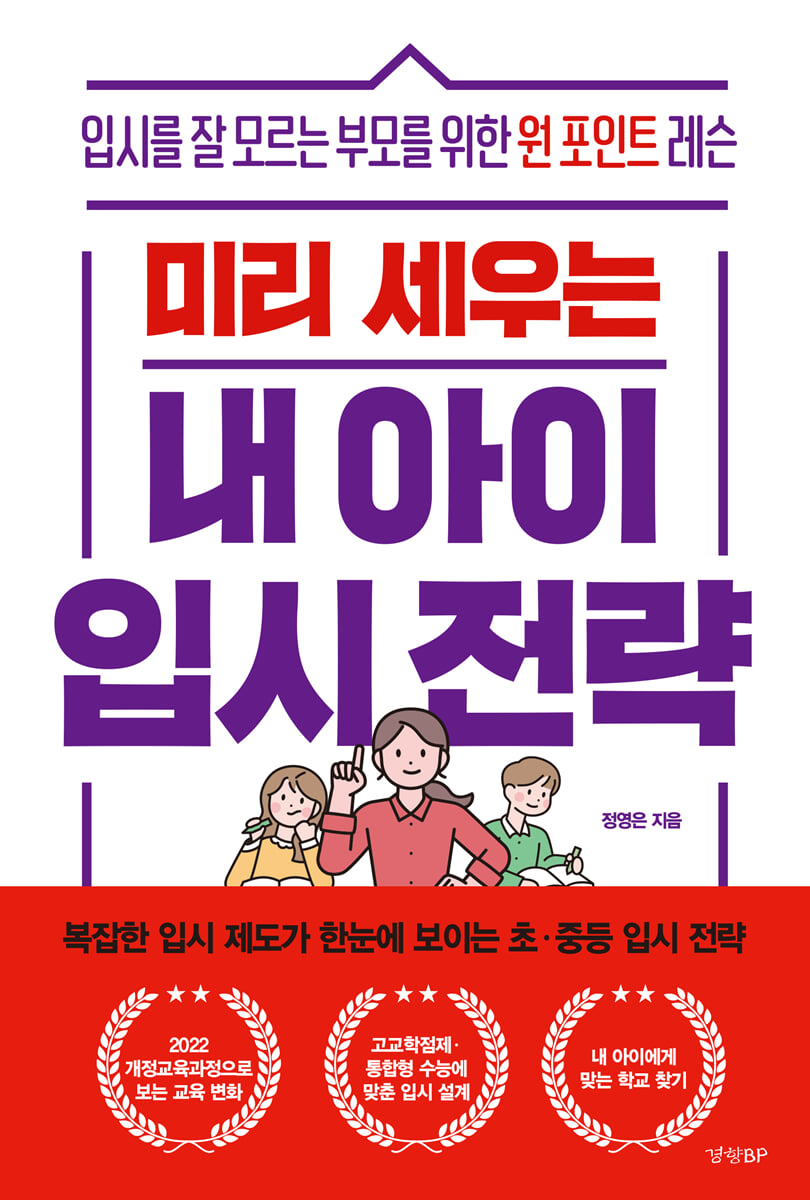
Book Introduction
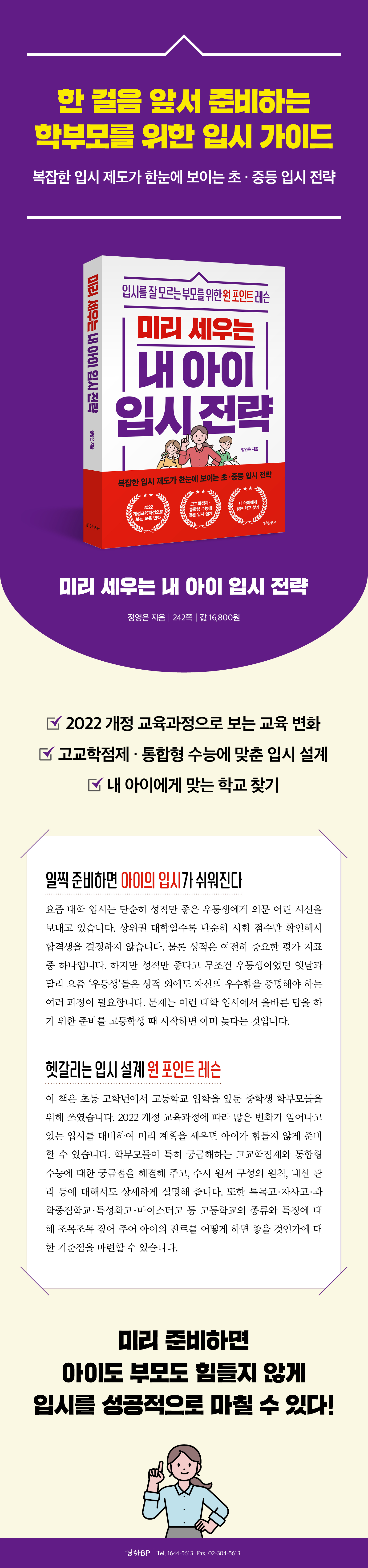
Preparing one step ahead
Admissions Guide for Parents
Elementary and secondary school admission strategies that provide a glimpse into the complex admissions system.
If you prepare in advance, both the child and the parents will
You can successfully complete the entrance exam without difficulty!
Educational Changes Seen Through the 2022 Revised Curriculum
Admissions design tailored to the high school credit system and integrated college entrance exam
Find the right school for your child
Early preparation makes college entrance exams easier for children.
These days, college admissions are looking askance at students who simply have good grades.
Top universities don't simply check test scores to decide who will be accepted.
Of course, grades are still one of the important evaluation indicators.
However, unlike in the past when students were considered honor students just because they had good grades, these days, honor students need to go through various processes to prove their excellence in addition to their grades.
The problem is that if you start preparing for college entrance exams in high school, it's already too late.
The reality of the college entrance exam we face is not so easy.
It's becoming too complex for parents to study, and it's changing at a pace that's simply too difficult to keep up with.
The college entrance exams our children will face in the future have become a long-term challenge that must enhance their future capabilities.
Therefore, if you quickly become interested in college entrance exams, you will have a higher chance of successfully fulfilling your role as a "pacemaker" that brings out your child's strengths and complements their weaknesses, rather than just being a "college entrance exam prepper."
This book introduces the integrated liberal arts and science college entrance exam and the high school credit system, and provides regret-free college entrance strategies tailored to the latest curriculum.
It's up to parents to decide whether to study and prepare in advance for the college entrance exam, which is undergoing significant changes, or to continue following the old ways.
Admissions Guide for Parents
Elementary and secondary school admission strategies that provide a glimpse into the complex admissions system.
If you prepare in advance, both the child and the parents will
You can successfully complete the entrance exam without difficulty!
Educational Changes Seen Through the 2022 Revised Curriculum
Admissions design tailored to the high school credit system and integrated college entrance exam
Find the right school for your child
Early preparation makes college entrance exams easier for children.
These days, college admissions are looking askance at students who simply have good grades.
Top universities don't simply check test scores to decide who will be accepted.
Of course, grades are still one of the important evaluation indicators.
However, unlike in the past when students were considered honor students just because they had good grades, these days, honor students need to go through various processes to prove their excellence in addition to their grades.
The problem is that if you start preparing for college entrance exams in high school, it's already too late.
The reality of the college entrance exam we face is not so easy.
It's becoming too complex for parents to study, and it's changing at a pace that's simply too difficult to keep up with.
The college entrance exams our children will face in the future have become a long-term challenge that must enhance their future capabilities.
Therefore, if you quickly become interested in college entrance exams, you will have a higher chance of successfully fulfilling your role as a "pacemaker" that brings out your child's strengths and complements their weaknesses, rather than just being a "college entrance exam prepper."
This book introduces the integrated liberal arts and science college entrance exam and the high school credit system, and provides regret-free college entrance strategies tailored to the latest curriculum.
It's up to parents to decide whether to study and prepare in advance for the college entrance exam, which is undergoing significant changes, or to continue following the old ways.
- You can preview some of the book's contents.
Preview
index
Introduction - I'm not even a high school student, and I'm taking the college entrance exam! Isn't that excessive?
Chapter 1 So, what is the entrance exam?
Skirt wind, pig mom is the entrance exam?
Career path is important, but occupation is not.
Understanding Change Reveals College Admissions
Why does education policy keep changing?
Educational Changes Seen Through the 2022 Revised Curriculum
Chapter 2: High School Credit System, So What?
The core of the high school credit system is subject selection.
Which subject to choose
Complete your career exploration before entering high school.
The grading system is different for each subject.
What if our school doesn't have the subject I want?
Appendix - Changes in High School Curriculum after the Implementation of the High School Credit System
Chapter 3: Finding the Right School for Your Child
Specialized high schools, schools for customized talent
It's a private high school, but it's actually a regular high school?
Get to know science-focused schools
Specialized High Schools vs. Meister High Schools
Preparing for middle school grades
College entrance exam, what should I prepare for?
Chapter 4: Confusing College Entrance Exam Knowledge: One-Point Lessons
Integrated CSAT: Is it advantageous to take difficult subjects?
Science students' invasion of liberal arts, should we abandon our preconceptions?
Science-focused university admissions reform! What about liberal arts-oriented students?
Will the high school blind system be effective?
Abolishing the resume! Will it be a win or a loss?
Principles for structuring early admission applications
The type of talent each university seeks varies depending on the application process.
Chapter 5: Literacy: Everyone Knows But Still Lacks It
Language governs thought
Stages of literacy development
Literacy determines test scores
Reading isn't everything
Reading comprehension techniques that affect your Korean language score on the CSAT
Are smartphones the main culprit behind declining literacy?
A new topic: digital literacy
Appendix - Developing Digital Skills with Parents
Chapter 6: A Mother's Skills for Making Her Child a Studying Child
The illusion of having studied hard
What does it take to jump from mid-tier to top-tier?
Just reading the report card carefully reveals your true abilities.
Misconceptions and Truths about Good Deeds
Homeschooling Makes All the Differences
Outgoing Article - A Child's Goals Become Parents' Goals
Chapter 1 So, what is the entrance exam?
Skirt wind, pig mom is the entrance exam?
Career path is important, but occupation is not.
Understanding Change Reveals College Admissions
Why does education policy keep changing?
Educational Changes Seen Through the 2022 Revised Curriculum
Chapter 2: High School Credit System, So What?
The core of the high school credit system is subject selection.
Which subject to choose
Complete your career exploration before entering high school.
The grading system is different for each subject.
What if our school doesn't have the subject I want?
Appendix - Changes in High School Curriculum after the Implementation of the High School Credit System
Chapter 3: Finding the Right School for Your Child
Specialized high schools, schools for customized talent
It's a private high school, but it's actually a regular high school?
Get to know science-focused schools
Specialized High Schools vs. Meister High Schools
Preparing for middle school grades
College entrance exam, what should I prepare for?
Chapter 4: Confusing College Entrance Exam Knowledge: One-Point Lessons
Integrated CSAT: Is it advantageous to take difficult subjects?
Science students' invasion of liberal arts, should we abandon our preconceptions?
Science-focused university admissions reform! What about liberal arts-oriented students?
Will the high school blind system be effective?
Abolishing the resume! Will it be a win or a loss?
Principles for structuring early admission applications
The type of talent each university seeks varies depending on the application process.
Chapter 5: Literacy: Everyone Knows But Still Lacks It
Language governs thought
Stages of literacy development
Literacy determines test scores
Reading isn't everything
Reading comprehension techniques that affect your Korean language score on the CSAT
Are smartphones the main culprit behind declining literacy?
A new topic: digital literacy
Appendix - Developing Digital Skills with Parents
Chapter 6: A Mother's Skills for Making Her Child a Studying Child
The illusion of having studied hard
What does it take to jump from mid-tier to top-tier?
Just reading the report card carefully reveals your true abilities.
Misconceptions and Truths about Good Deeds
Homeschooling Makes All the Differences
Outgoing Article - A Child's Goals Become Parents' Goals
Detailed image
Into the book
The 'career path' mentioned in the entrance exam is not a job, and career path includes everything a child has learned, values, and dreams.
A job is a means, and a career is the true goal, so I hope we don't make the mistake of forcing jobs on our children.
---p.22
In the past, it was common to have to give up things you liked in order to get good grades in subjects.
But the new school and education our children are experiencing is a little different.
In a world where aptitude and interest are becoming the first steps to successful college entrance,
---p.50
Parents of elementary and middle school students about to enter high school often find themselves wondering which school is right for their children.
This is because it is not an era where you can go to any school and just focus on your studies.
The fact that students' career paths have diversified and that the college entrance exam system has been reorganized to support these diversifications can be interpreted to mean that there are schools that are clearly more advantageous depending on the career path.
---p.77
The first thing students do before their first exam is not to buy a workbook or start taking private tutoring.
Just as you make a schedule before vacation, the best way to get used to your middle school grades, or regular exams, is to make a schedule for exams.
---p.107
The biggest problem with studying is that it's hard to know how prepared I am.
I can tell you how many pages of the workbook I've worked through, but I hesitate when asked, "How prepared are you for the exam?"
Therefore, the detailed study plan for each subject is the key item that should be given the most stars.
---p.109
Even if you have a study plan, there is a high chance that your studies will fall through the cracks and you will not be able to achieve your goals.
So, it is essential to write a review after the test.
After the exam, take some time to reflect on what you set out to do before you started preparing, and to feel proud of yourself by reviewing your plans and goals.
You will get a lot more stimulation than being scolded by your parents.
---p.110
Now, students with a strong liberal arts background are thrown into a jungle when it comes to math.
Competition between liberal arts departments no longer exists.
Parents should be very concerned if their child shows signs of being weak in math or disliking math in the early grades.
The statement, “My child is in the liberal arts,” can no longer serve as a shield.
It is difficult for a child who has once become a ‘math dropout’ and lost interest in math to like and be good at math again.
Therefore, the more a child has a strong aptitude for literature, the more we need to help them learn at a pace that is not difficult, but repetitive so that their foundation is not shaken.
---p.139
More important than getting the answer right is understanding the solution process.
So, you need to get into the habit of focusing on the solution, not the answer.
If the solution is not neat and spread out in a jumbled manner, or if you have a habit of solving problems based on arithmetic operations by randomly writing down a few numbers, it will be difficult to adapt to math that requires a long solution process as you get older.
---p.140
There is nothing that is necessarily advantageous to one side in the college entrance exam.
So, students and parents need to change their mindset from looking for a "favorable school" for their children to looking for a "school that offers more benefits than harms."
---p.152
Parents should be concerned if they discover that their child has a limited vocabulary.
If your child is still young and hasn't accumulated a wide range of vocabulary, they will gradually grow through language exposure. However, if your child's vocabulary shortage is a sign that they have entered a bad cycle of language habits, you should be on guard.
---p.175
In recent college entrance exams, students' writing and speaking skills are becoming increasingly important. Almost all curricula now require students to independently research, analyze, and reprocess data based on their interests, passions, career paths, and aptitudes, creating new outputs that reflect their own unique perspectives.
It is virtually impossible to correct poorly formed language habits after entering high school, when you begin to seriously prepare for the entrance exam.
---p.177
The schools and education our children attend are already so different from what they were before that foundational skills like literacy, critical thinking, and creativity, which once seemed like pie-in-the-sky concepts, are now having a real and powerful impact.
---p.183
Many students mistakenly believe they've "studied" hard, simply repeating the new information they've been given without even completing the first step: understanding.
It's like watching a Premier League football match with commentators and commentators explaining it to you and then feeling confident, "I'm going to use that skill to score a goal at school tomorrow when I play football with my friends."
---p.213
Even if you solve hundreds of problems and make a notebook of wrong answers, if you don't realize the difference between your initial solution and the correct answer and just look at the correct solution in the answer sheet, that's not proper studying.
A job is a means, and a career is the true goal, so I hope we don't make the mistake of forcing jobs on our children.
---p.22
In the past, it was common to have to give up things you liked in order to get good grades in subjects.
But the new school and education our children are experiencing is a little different.
In a world where aptitude and interest are becoming the first steps to successful college entrance,
---p.50
Parents of elementary and middle school students about to enter high school often find themselves wondering which school is right for their children.
This is because it is not an era where you can go to any school and just focus on your studies.
The fact that students' career paths have diversified and that the college entrance exam system has been reorganized to support these diversifications can be interpreted to mean that there are schools that are clearly more advantageous depending on the career path.
---p.77
The first thing students do before their first exam is not to buy a workbook or start taking private tutoring.
Just as you make a schedule before vacation, the best way to get used to your middle school grades, or regular exams, is to make a schedule for exams.
---p.107
The biggest problem with studying is that it's hard to know how prepared I am.
I can tell you how many pages of the workbook I've worked through, but I hesitate when asked, "How prepared are you for the exam?"
Therefore, the detailed study plan for each subject is the key item that should be given the most stars.
---p.109
Even if you have a study plan, there is a high chance that your studies will fall through the cracks and you will not be able to achieve your goals.
So, it is essential to write a review after the test.
After the exam, take some time to reflect on what you set out to do before you started preparing, and to feel proud of yourself by reviewing your plans and goals.
You will get a lot more stimulation than being scolded by your parents.
---p.110
Now, students with a strong liberal arts background are thrown into a jungle when it comes to math.
Competition between liberal arts departments no longer exists.
Parents should be very concerned if their child shows signs of being weak in math or disliking math in the early grades.
The statement, “My child is in the liberal arts,” can no longer serve as a shield.
It is difficult for a child who has once become a ‘math dropout’ and lost interest in math to like and be good at math again.
Therefore, the more a child has a strong aptitude for literature, the more we need to help them learn at a pace that is not difficult, but repetitive so that their foundation is not shaken.
---p.139
More important than getting the answer right is understanding the solution process.
So, you need to get into the habit of focusing on the solution, not the answer.
If the solution is not neat and spread out in a jumbled manner, or if you have a habit of solving problems based on arithmetic operations by randomly writing down a few numbers, it will be difficult to adapt to math that requires a long solution process as you get older.
---p.140
There is nothing that is necessarily advantageous to one side in the college entrance exam.
So, students and parents need to change their mindset from looking for a "favorable school" for their children to looking for a "school that offers more benefits than harms."
---p.152
Parents should be concerned if they discover that their child has a limited vocabulary.
If your child is still young and hasn't accumulated a wide range of vocabulary, they will gradually grow through language exposure. However, if your child's vocabulary shortage is a sign that they have entered a bad cycle of language habits, you should be on guard.
---p.175
In recent college entrance exams, students' writing and speaking skills are becoming increasingly important. Almost all curricula now require students to independently research, analyze, and reprocess data based on their interests, passions, career paths, and aptitudes, creating new outputs that reflect their own unique perspectives.
It is virtually impossible to correct poorly formed language habits after entering high school, when you begin to seriously prepare for the entrance exam.
---p.177
The schools and education our children attend are already so different from what they were before that foundational skills like literacy, critical thinking, and creativity, which once seemed like pie-in-the-sky concepts, are now having a real and powerful impact.
---p.183
Many students mistakenly believe they've "studied" hard, simply repeating the new information they've been given without even completing the first step: understanding.
It's like watching a Premier League football match with commentators and commentators explaining it to you and then feeling confident, "I'm going to use that skill to score a goal at school tomorrow when I play football with my friends."
---p.213
Even if you solve hundreds of problems and make a notebook of wrong answers, if you don't realize the difference between your initial solution and the correct answer and just look at the correct solution in the answer sheet, that's not proper studying.
---p.213
Publisher's Review
One-Point Lesson on Confusing College Entrance Exam Design
This book is written for parents of elementary school students and middle school students about to enter high school.
With the college entrance exam undergoing many changes due to the 2022 revised curriculum, planning ahead can help your child prepare without difficulty.
We answer questions parents have about the high school credit system and the integrated college entrance exam, and we also provide detailed explanations on the principles of preparing applications for early admission and managing academic records.
Additionally, by providing a detailed explanation of the types and characteristics of high schools, such as specialized high schools, autonomous private high schools, science-focused schools, specialized high schools, and Meister high schools, you can establish a baseline for your child's future career path.
In addition, we provide information on how to study math for each stage of elementary and middle school, how to understand the amount of learning required, and how to cultivate digital literacy, a hot topic in the era of the 4th Industrial Revolution, so that students can keep up without missing out on math, which has become increasingly important in college entrance exams.
This book is written for parents of elementary school students and middle school students about to enter high school.
With the college entrance exam undergoing many changes due to the 2022 revised curriculum, planning ahead can help your child prepare without difficulty.
We answer questions parents have about the high school credit system and the integrated college entrance exam, and we also provide detailed explanations on the principles of preparing applications for early admission and managing academic records.
Additionally, by providing a detailed explanation of the types and characteristics of high schools, such as specialized high schools, autonomous private high schools, science-focused schools, specialized high schools, and Meister high schools, you can establish a baseline for your child's future career path.
In addition, we provide information on how to study math for each stage of elementary and middle school, how to understand the amount of learning required, and how to cultivate digital literacy, a hot topic in the era of the 4th Industrial Revolution, so that students can keep up without missing out on math, which has become increasingly important in college entrance exams.
GOODS SPECIFICS
- Date of issue: March 22, 2023
- Page count, weight, size: 242 pages | 438g | 152*225*16mm
- ISBN13: 9788969525376
- ISBN10: 8969525378
You may also like
카테고리
korean


korean

![ELLE 엘르 스페셜 에디션 A형 : 12월 [2025]](http://librairie.coreenne.fr/cdn/shop/files/b8e27a3de6c9538896439686c6b0e8fb.jpg?v=1766436872&width=3840)


