

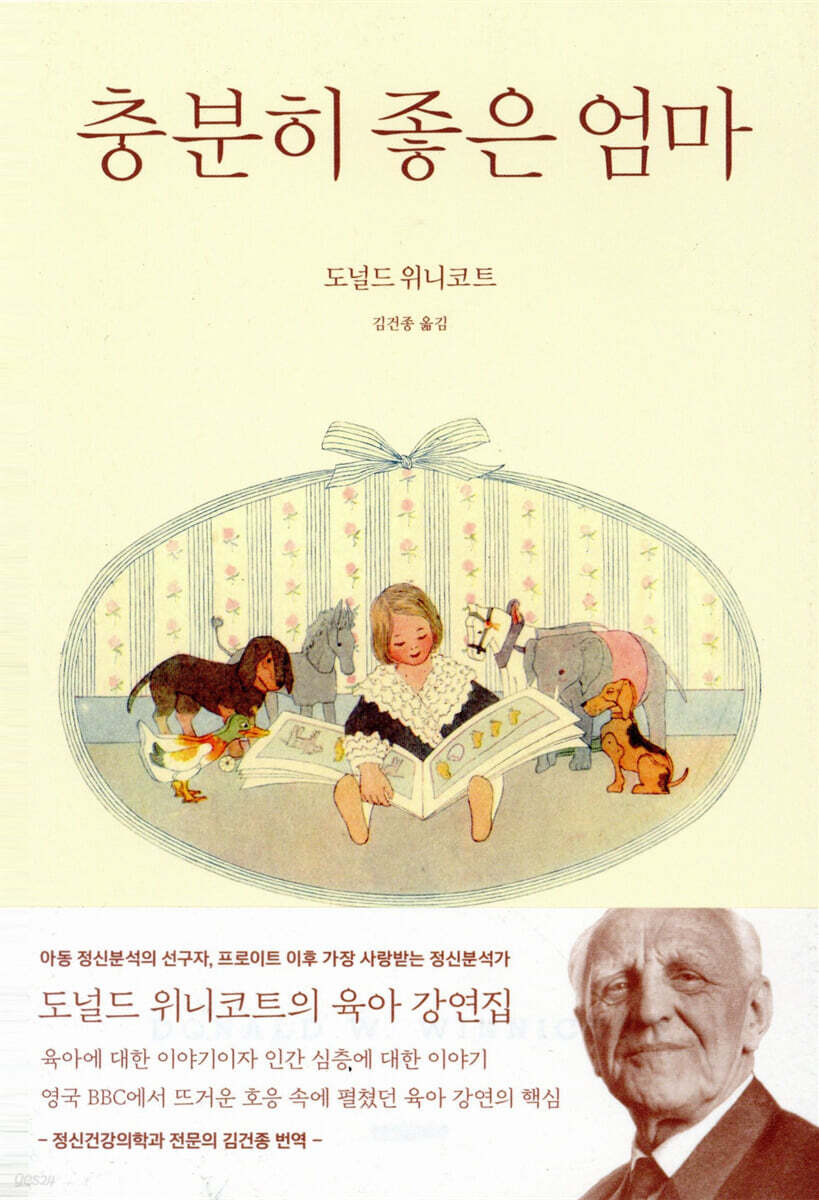
A good enough mom
 |
Description
Book Introduction
A book containing the essence of the parenting lectures given by psychoanalyst Donald Winnicott on the BBC for 20 years to great acclaim.
It is a 'reflection on parenting', an 'exploration of the inner self of a mother', and a 'story about the depths of all humanity' where love and hate, light and darkness coexist.
Donald Winnicott is called 'the most beloved psychoanalyst since Freud' in modern psychoanalysis, and his influence continues to grow even more 50 years after his death.
Winnicott believed that all mothers are born with the qualities of a mother, and that if they were present and interacted vividly with their babies, they would be "good enough mothers" for their children, better than any expert.
What he meant by 'good enough mother' is more accurately translated into Korean as 'a good enough mother' or 'a mother who is not so bad.'
This also means that it doesn't have to be perfect.
He believed that the obsession with perfection not only causes anxiety, but also hinders the child's ability to gradually separate from his mother and discover his own self and world.
Many mothers raise their children under the pressure of being a good mother and with the anxiety that they are missing out on something important for their children.
Advice about parenting can further fuel that obsession and anxiety.
This is why I hope that everyone raising children today should read Winnicott's parenting lectures, which may seem old-fashioned and naive in some ways.
It is a 'reflection on parenting', an 'exploration of the inner self of a mother', and a 'story about the depths of all humanity' where love and hate, light and darkness coexist.
Donald Winnicott is called 'the most beloved psychoanalyst since Freud' in modern psychoanalysis, and his influence continues to grow even more 50 years after his death.
Winnicott believed that all mothers are born with the qualities of a mother, and that if they were present and interacted vividly with their babies, they would be "good enough mothers" for their children, better than any expert.
What he meant by 'good enough mother' is more accurately translated into Korean as 'a good enough mother' or 'a mother who is not so bad.'
This also means that it doesn't have to be perfect.
He believed that the obsession with perfection not only causes anxiety, but also hinders the child's ability to gradually separate from his mother and discover his own self and world.
Many mothers raise their children under the pressure of being a good mother and with the anxiety that they are missing out on something important for their children.
Advice about parenting can further fuel that obsession and anxiety.
This is why I hope that everyone raising children today should read Winnicott's parenting lectures, which may seem old-fashioned and naive in some ways.
- You can preview some of the book's contents.
Preview
index
Translator's Preface / Why I Love Winnicott
1.
Why does the evil stepmother myth exist?
2.
What Your Baby's Thumb-Sucking Behavior Means
3.
Saying "No"
4.
How to view a child's jealousy
5.
Things that annoy mom
6.
Why Feeling Safe Is Important
7.
What's Hidden in a Mother's Guilt
8.
How is a sense of right and wrong developed?
9.
To be able to escape from your mother's fence
10.
It provides a trustworthy environment
Appendix / Health Education Through Broadcasting
1.
Why does the evil stepmother myth exist?
2.
What Your Baby's Thumb-Sucking Behavior Means
3.
Saying "No"
4.
How to view a child's jealousy
5.
Things that annoy mom
6.
Why Feeling Safe Is Important
7.
What's Hidden in a Mother's Guilt
8.
How is a sense of right and wrong developed?
9.
To be able to escape from your mother's fence
10.
It provides a trustworthy environment
Appendix / Health Education Through Broadcasting
Into the book
If a mother is doing her job right, she represents a world that demands many difficult things from her child, and she also gradually introduces the reality that is often the enemy of impulse.
It is absolutely certain that there is admiration and love for your mother, but there is also anger and hatred towards your mother somewhere.
--- p.
27
It is not uncommon for mothers to feel unloved and even hate their babies.
I'm talking about an ordinary mother who thinks she needs to take good care of her baby and is actually doing a good job.
I know many mothers who live in fear, afraid that they might harm their babies.
--- p.
31
There are many things deeply hidden in human nature.
I would rather be the child of a mother who harbored all the inner conflicts of human existence than grow up under a mother who felt everything easy and never doubted anything.
--- p.
31
What if we told you that holding a round object, sucking a finger or a piece of clothing, and squeezing a rag doll are all the first acts of affection a baby displays? Could anything be more important?
--- p.
42
A very young child's immature self expresses itself in the form of strange habits, such as washing clothes.
Such behavior feels real to the child.
This gives mother and baby the opportunity to develop a human relationship that is not swayed by animal instincts.
--- p.
45
Mom and Dad gradually introduce their child to reality and reality to their child.
One of those ways is prohibition.
I'm sure you're glad to know that saying "no" is "one way." Banning is one of two ways.
The foundation of saying “no” is “yes.”
--- p.
72
Children don't always want to play with only soft objects.
They also like rocks, sticks, and hard floors.
Children love being told to go away as much as they love being held.
--- p.
75
I want to start by saying without hesitation that jealousy is a normal and healthy emotion.
Jealousy arises because a child loves.
If you don't have the ability to love, you won't be jealous.
Later we need to look into the unhealthy aspects of jealousy, especially hidden jealousy.
--- p.
79
If you see people who are jealous, you probably had good reason to be jealous at least once in your childhood.
Unfortunately, however, they did not have a clear opportunity to express their anger, jealousy, and aggression during the time when they could have felt and controlled their jealousy.
If they had had that opportunity, they would have been able to get through their jealousy period and grow out of it, like most children.
--- p.
112
It's easy to idealize being a mother.
But we know that everything has its frustrations, its tedious routines, and those moments when you just can't do it anymore.
There's no way to avoid similar thoughts while caring for children.
--- p.
120
Suppressed anger damages the love that exists behind it.
I guess this is why we swear.
Once you've gathered your anger and expressed it verbally at the right moment, you can move on with what you were doing.
In my clinical practice, I have found that mothers find comfort when they are able to access their bitter anger.
--- p.
131
After talking to countless mothers and watching their children grow, I've come to truly believe that the best mothers are those who are able to surrender in the beginning.
They lose everything.
But it can be recovered over time.
--- p.
135
After the initial period of protection, the mother gradually exposes the child to the world, and the child jumps at new opportunities for free expression and impulsive behavior.
This war against safety and control continues throughout childhood.
But control is always necessary.
Parents are always ready with rules and frameworks made of stone walls and iron bars, but this is only as long as they know what kind of child their child is and are interested in their child's growth as a person.
Parents welcome rebellion.
Parents continue to act as keepers of peace, but expect lawlessness, even revolution.
--- p.
157
In the early stages, a good environment creates a sense of security, and security leads us to self-control, and if self-control is solid, then the security imposed by others is nothing more than an insult.
--- p.
159
I think it's guilt that makes moms so meticulous and question their own judgment.
I've actually met parents who don't have the ability to feel guilt, and they don't even realize when their child is sick.
--- p.
176
The feeling that something is right is clearly connected to the child's idea that 'Mom or Dad expects this of me.'
But more deeply rooted is the sense of good and bad connected to guilt.
Anything that reduces guilt feels good to the child, and anything that increases guilt feels bad.
--- p.
187
If parents become trustworthy people in the early stages when babies are experiencing life vividly, they can develop a good sense of right and wrong in their babies.
And only to the extent that the child can form his own sense of guilt can it be possible to teach him our ideas about good and bad.
--- p.
188
On one level, mothers want only one thing.
We want our children to grow up, leave the fence, go to school, and face the world.
On another level, perhaps a deeper level, mothers, though not actually conscious of it, simply cannot bear the thought of letting their children go.
At that deep level, a mother cannot give up this most precious object and her role as a mother.
--- p.
199
Some parents are struggling to make ends meet and are unable to provide for their children's needs because they are struggling to cope with their own difficult circumstances.
But kids understand all that.
Children can tolerate some tension between their parents, as long as they have the physical conditions to know and hold on tightly.
--- p.
210
To be consistent and predictable for our children, we must be ourselves.
If we become ourselves, children will know us.
If we were acting a role, we would be discovered when we took off our makeup.
--- p.
211
Typically, child caregivers are found through careful selection.
It's not something you can learn in the classroom.
Babies are very good at choosing their mothers.
At least from the perspective of primary maternal immersion, otherwise I wouldn't have any reason to value babies so highly.
It is absolutely certain that there is admiration and love for your mother, but there is also anger and hatred towards your mother somewhere.
--- p.
27
It is not uncommon for mothers to feel unloved and even hate their babies.
I'm talking about an ordinary mother who thinks she needs to take good care of her baby and is actually doing a good job.
I know many mothers who live in fear, afraid that they might harm their babies.
--- p.
31
There are many things deeply hidden in human nature.
I would rather be the child of a mother who harbored all the inner conflicts of human existence than grow up under a mother who felt everything easy and never doubted anything.
--- p.
31
What if we told you that holding a round object, sucking a finger or a piece of clothing, and squeezing a rag doll are all the first acts of affection a baby displays? Could anything be more important?
--- p.
42
A very young child's immature self expresses itself in the form of strange habits, such as washing clothes.
Such behavior feels real to the child.
This gives mother and baby the opportunity to develop a human relationship that is not swayed by animal instincts.
--- p.
45
Mom and Dad gradually introduce their child to reality and reality to their child.
One of those ways is prohibition.
I'm sure you're glad to know that saying "no" is "one way." Banning is one of two ways.
The foundation of saying “no” is “yes.”
--- p.
72
Children don't always want to play with only soft objects.
They also like rocks, sticks, and hard floors.
Children love being told to go away as much as they love being held.
--- p.
75
I want to start by saying without hesitation that jealousy is a normal and healthy emotion.
Jealousy arises because a child loves.
If you don't have the ability to love, you won't be jealous.
Later we need to look into the unhealthy aspects of jealousy, especially hidden jealousy.
--- p.
79
If you see people who are jealous, you probably had good reason to be jealous at least once in your childhood.
Unfortunately, however, they did not have a clear opportunity to express their anger, jealousy, and aggression during the time when they could have felt and controlled their jealousy.
If they had had that opportunity, they would have been able to get through their jealousy period and grow out of it, like most children.
--- p.
112
It's easy to idealize being a mother.
But we know that everything has its frustrations, its tedious routines, and those moments when you just can't do it anymore.
There's no way to avoid similar thoughts while caring for children.
--- p.
120
Suppressed anger damages the love that exists behind it.
I guess this is why we swear.
Once you've gathered your anger and expressed it verbally at the right moment, you can move on with what you were doing.
In my clinical practice, I have found that mothers find comfort when they are able to access their bitter anger.
--- p.
131
After talking to countless mothers and watching their children grow, I've come to truly believe that the best mothers are those who are able to surrender in the beginning.
They lose everything.
But it can be recovered over time.
--- p.
135
After the initial period of protection, the mother gradually exposes the child to the world, and the child jumps at new opportunities for free expression and impulsive behavior.
This war against safety and control continues throughout childhood.
But control is always necessary.
Parents are always ready with rules and frameworks made of stone walls and iron bars, but this is only as long as they know what kind of child their child is and are interested in their child's growth as a person.
Parents welcome rebellion.
Parents continue to act as keepers of peace, but expect lawlessness, even revolution.
--- p.
157
In the early stages, a good environment creates a sense of security, and security leads us to self-control, and if self-control is solid, then the security imposed by others is nothing more than an insult.
--- p.
159
I think it's guilt that makes moms so meticulous and question their own judgment.
I've actually met parents who don't have the ability to feel guilt, and they don't even realize when their child is sick.
--- p.
176
The feeling that something is right is clearly connected to the child's idea that 'Mom or Dad expects this of me.'
But more deeply rooted is the sense of good and bad connected to guilt.
Anything that reduces guilt feels good to the child, and anything that increases guilt feels bad.
--- p.
187
If parents become trustworthy people in the early stages when babies are experiencing life vividly, they can develop a good sense of right and wrong in their babies.
And only to the extent that the child can form his own sense of guilt can it be possible to teach him our ideas about good and bad.
--- p.
188
On one level, mothers want only one thing.
We want our children to grow up, leave the fence, go to school, and face the world.
On another level, perhaps a deeper level, mothers, though not actually conscious of it, simply cannot bear the thought of letting their children go.
At that deep level, a mother cannot give up this most precious object and her role as a mother.
--- p.
199
Some parents are struggling to make ends meet and are unable to provide for their children's needs because they are struggling to cope with their own difficult circumstances.
But kids understand all that.
Children can tolerate some tension between their parents, as long as they have the physical conditions to know and hold on tightly.
--- p.
210
To be consistent and predictable for our children, we must be ourselves.
If we become ourselves, children will know us.
If we were acting a role, we would be discovered when we took off our makeup.
--- p.
211
Typically, child caregivers are found through careful selection.
It's not something you can learn in the classroom.
Babies are very good at choosing their mothers.
At least from the perspective of primary maternal immersion, otherwise I wouldn't have any reason to value babies so highly.
--- p.
224
224
Publisher's Review
A reflection on parenting and an exploration of the inner self of mothers.
A story about the depths of humanity, where love and hate, light and darkness coexist.
A book containing the essence of the parenting lectures given by psychoanalyst Donald Winnicott on the BBC for 20 years to great acclaim.
As this lecture is aimed at ordinary parents, it is written in easy-to-understand everyday language, but the content is by no means light.
This book is a reflection on parenting, an exploration of a mother's inner self, and a story about the depths of all human beings, where love and hate, light and darkness coexist.
Winnicott's core concept, 'good enough mother', can be more accurately translated into Korean as 'a good enough mother' or 'a mother who is not so bad'.
Winnicott believed that all mothers are born with the qualities of a mother, and that if they were present and interacted vividly with their babies, they would be better mothers than any expert when it came to their own children.
When he says good enough, he also means it doesn't have to be perfect.
He believed that the obsession with perfection not only causes anxiety, but also hinders the child's ability to gradually separate from his mother and discover his own self and world.
The book begins with a story about the 'myth of the evil stepmother'.
It is a story about fear and hatred intertwined with the deep love between mother and child.
It also talks about mothers who suffer because they don't feel love for their newborn babies, mothers who live in fear, afraid that they might harm their babies, and mothers who struggle to raise stepchildren because they can't love them as they want.
Regarding the work of looking into the darkness within us, Winnicott says this:
“If we do not have eyes to see the nightmares, the gloom, and the doubts that befall us, we will not have eyes to understand our achievements.”
Winnicott's sensitive examination of the relationship between mother and child in the early years of life deeply empathizes with mothers' anxieties and confusion.
He consistently demonstrates a thoughtful attitude that leads us to enlightenment without hurting anyone.
This is the special power of Winnicott's parenting lectures, which transcend time and still remain vivid and touching.
Donald Winnicott is still an unfamiliar name to the general reader in our country, but he is called 'the most beloved psychoanalyst after Freud' in modern psychoanalysis, and his influence is growing even more now, 50 years after his death.
Unlike other analysts, Winnicott continued to give lectures and training to the public throughout his life.
He did not criticize his parents or try to teach them unilaterally.
Helping parents understand their own minds and actions a little more deeply was the goal he pursued.
Many mothers raise their children under the pressure of being a good mother and with the anxiety that they are missing out on something important for their children.
Advice about parenting can further fuel that obsession and anxiety.
Many parenting books just keep adding to the list of things a mother needs to know and do.
It makes being a mother feel like a daunting task for professionals, adding to the anxiety and guilt.
This is why I hope that everyone raising children today should read Winnicott's parenting lectures, which may seem old-fashioned and naive in some ways.
This book was translated by a psychiatrist who was particularly fond of Winnicott.
Translator Kim Geon-jong, while supervising the translation of Winnicott's collection of essays, confessed in the preface to the book, "I like Winnicott more than any other analyst, thinker, or novelist in the world."
I took time out of my busy schedule to translate this book, with the sole purpose of sharing the joy of reading Winnicott's sentences with others.
I translated Winnicott's text with great care, paying close attention to even the finest nuances, and added explanatory footnotes to facilitate a more accurate understanding.
In the translator's preface to this book, he wrote:
“To me, Winnicott is a brilliant psychoanalyst who understood the hearts of children and parents more deeply than anyone else, a wise philosopher who simultaneously looked into the rich possibilities of life and its subtle shades, and a lovable and admirable human being who lived a vivid life with sensitivity and timidity, but humor and optimism.
(...) Enlightenment and consolation are virtues that rarely coexist.
Realization is bound to hurt, and comfort is often nothing more than a temporary forgetting of reality.
But Winnicott's delicate prose leads us into rare moments of both enlightenment and comfort.”
A story about the depths of humanity, where love and hate, light and darkness coexist.
A book containing the essence of the parenting lectures given by psychoanalyst Donald Winnicott on the BBC for 20 years to great acclaim.
As this lecture is aimed at ordinary parents, it is written in easy-to-understand everyday language, but the content is by no means light.
This book is a reflection on parenting, an exploration of a mother's inner self, and a story about the depths of all human beings, where love and hate, light and darkness coexist.
Winnicott's core concept, 'good enough mother', can be more accurately translated into Korean as 'a good enough mother' or 'a mother who is not so bad'.
Winnicott believed that all mothers are born with the qualities of a mother, and that if they were present and interacted vividly with their babies, they would be better mothers than any expert when it came to their own children.
When he says good enough, he also means it doesn't have to be perfect.
He believed that the obsession with perfection not only causes anxiety, but also hinders the child's ability to gradually separate from his mother and discover his own self and world.
The book begins with a story about the 'myth of the evil stepmother'.
It is a story about fear and hatred intertwined with the deep love between mother and child.
It also talks about mothers who suffer because they don't feel love for their newborn babies, mothers who live in fear, afraid that they might harm their babies, and mothers who struggle to raise stepchildren because they can't love them as they want.
Regarding the work of looking into the darkness within us, Winnicott says this:
“If we do not have eyes to see the nightmares, the gloom, and the doubts that befall us, we will not have eyes to understand our achievements.”
Winnicott's sensitive examination of the relationship between mother and child in the early years of life deeply empathizes with mothers' anxieties and confusion.
He consistently demonstrates a thoughtful attitude that leads us to enlightenment without hurting anyone.
This is the special power of Winnicott's parenting lectures, which transcend time and still remain vivid and touching.
Donald Winnicott is still an unfamiliar name to the general reader in our country, but he is called 'the most beloved psychoanalyst after Freud' in modern psychoanalysis, and his influence is growing even more now, 50 years after his death.
Unlike other analysts, Winnicott continued to give lectures and training to the public throughout his life.
He did not criticize his parents or try to teach them unilaterally.
Helping parents understand their own minds and actions a little more deeply was the goal he pursued.
Many mothers raise their children under the pressure of being a good mother and with the anxiety that they are missing out on something important for their children.
Advice about parenting can further fuel that obsession and anxiety.
Many parenting books just keep adding to the list of things a mother needs to know and do.
It makes being a mother feel like a daunting task for professionals, adding to the anxiety and guilt.
This is why I hope that everyone raising children today should read Winnicott's parenting lectures, which may seem old-fashioned and naive in some ways.
This book was translated by a psychiatrist who was particularly fond of Winnicott.
Translator Kim Geon-jong, while supervising the translation of Winnicott's collection of essays, confessed in the preface to the book, "I like Winnicott more than any other analyst, thinker, or novelist in the world."
I took time out of my busy schedule to translate this book, with the sole purpose of sharing the joy of reading Winnicott's sentences with others.
I translated Winnicott's text with great care, paying close attention to even the finest nuances, and added explanatory footnotes to facilitate a more accurate understanding.
In the translator's preface to this book, he wrote:
“To me, Winnicott is a brilliant psychoanalyst who understood the hearts of children and parents more deeply than anyone else, a wise philosopher who simultaneously looked into the rich possibilities of life and its subtle shades, and a lovable and admirable human being who lived a vivid life with sensitivity and timidity, but humor and optimism.
(...) Enlightenment and consolation are virtues that rarely coexist.
Realization is bound to hurt, and comfort is often nothing more than a temporary forgetting of reality.
But Winnicott's delicate prose leads us into rare moments of both enlightenment and comfort.”
GOODS SPECIFICS
- Publication date: April 20, 2022
- Page count, weight, size: 240 pages | 260g | 135*200*15mm
- ISBN13: 9791195760961
- ISBN10: 1195760965
You may also like
카테고리
korean


korean

![ELLE 엘르 스페셜 에디션 A형 : 12월 [2025]](http://librairie.coreenne.fr/cdn/shop/files/b8e27a3de6c9538896439686c6b0e8fb.jpg?v=1766436872&width=3840)


