

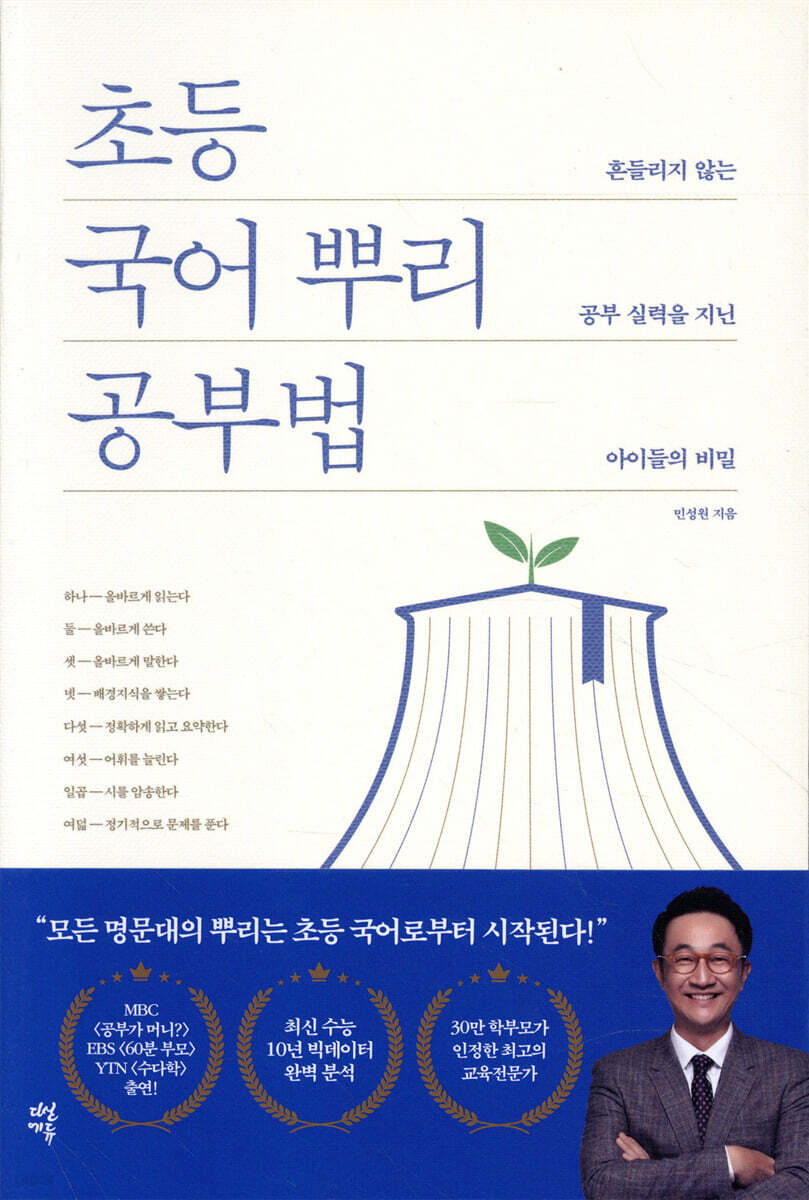
Elementary Korean language root study method
 |
Description
Book Introduction
“The roots of all prestigious universities begin with elementary Korean!”
Everything you need to know about elementary Korean language study methods, from a top education expert recognized by 300,000 parents.
Unlike in the past, the level of fingerprints has increased, content outside of the textbook has been tested, and new types of questions have emerged, so studying Korean solely through textbooks has its limitations.
Also, in the case of English or math, as the problems and vocabulary themselves become more difficult, many students have difficulty even understanding the meaning of the problem.
Strictly speaking, to be good at English and math, you need to be good at Korean.
In order to be successful in the college entrance exam, it is necessary to change the perception of the Korean language.
Author Seongwon Min, a top education expert recognized by 300,000 parents for writing numerous books on child education, including 『A Child's Study Intelligence』 and 『Seongwon Min's Study Principles and Pattern Learning Method』, has compiled all of the Korean language study methods that have guided children to prestigious schools over the past 20 years.
There are two principles for studying Korean that can help even ordinary children get into prestigious universities.
Build up your skills in Korean before high school, as it has a high downward rigidity and your grades will drop slowly once you reach the first level.
Second, it is to develop unwavering reading comprehension skills and practical sense in preparation for non-fiction books that are difficult to grade due to long texts, difficult vocabulary, and unfamiliar content.
This study method has been proven by actual cases of children who were accepted to prestigious universities and medical schools.
Ultimately, this book, which tells the important truth about the college entrance exam that the Korean language determines success or failure, serves as a guide for students and parents who are worried about the specific direction and method of studying Korean.
Everything you need to know about elementary Korean language study methods, from a top education expert recognized by 300,000 parents.
Unlike in the past, the level of fingerprints has increased, content outside of the textbook has been tested, and new types of questions have emerged, so studying Korean solely through textbooks has its limitations.
Also, in the case of English or math, as the problems and vocabulary themselves become more difficult, many students have difficulty even understanding the meaning of the problem.
Strictly speaking, to be good at English and math, you need to be good at Korean.
In order to be successful in the college entrance exam, it is necessary to change the perception of the Korean language.
Author Seongwon Min, a top education expert recognized by 300,000 parents for writing numerous books on child education, including 『A Child's Study Intelligence』 and 『Seongwon Min's Study Principles and Pattern Learning Method』, has compiled all of the Korean language study methods that have guided children to prestigious schools over the past 20 years.
There are two principles for studying Korean that can help even ordinary children get into prestigious universities.
Build up your skills in Korean before high school, as it has a high downward rigidity and your grades will drop slowly once you reach the first level.
Second, it is to develop unwavering reading comprehension skills and practical sense in preparation for non-fiction books that are difficult to grade due to long texts, difficult vocabulary, and unfamiliar content.
This study method has been proven by actual cases of children who were accepted to prestigious universities and medical schools.
Ultimately, this book, which tells the important truth about the college entrance exam that the Korean language determines success or failure, serves as a guide for students and parents who are worried about the specific direction and method of studying Korean.
- You can preview some of the book's contents.
Preview
index
Preface: “The Foundation of All Learning is the Korean Language”
Prologue: What Sends an Ordinary Child to Seoul National University?
Part 1: Why Korean Language Should Be at the Center of Elementary Education
If you lack Korean, all subjects will fall apart. | Why smart parents start with Korean. | Korean now determines success or failure in college entrance exams. | A good Korean language skills will help your child grow into a well-rounded person. | Ultimately, Korean is the root of all learning.
Part 2: 8 Habits That Will Establish Roots in the Korean Language
one.
Read correctly | Two.
Write correctly | Set.
Speak correctly | Net.
Build background knowledge | Five.
Read and summarize accurately | Six.
Expand your vocabulary | Seven.
Recite poetry | Eight.
Solve problems regularly
Part 3: A 5-Step Study Method for Establishing Korean Language Roots
Step 0: Build solid Korean language skills through step-by-step learning | Step 1: Develop sound Korean language habits | Step 2: Build a rich vocabulary by reading diversely | Step 3: Develop the ability to read deeply and summarize | Step 4: Develop a sense of reality through repeated practice | Step 5: Wrap things up with a test
Part 4: 9 Questions and Answers on Korean Language Study Methods That Parents and Students Are Most Curious About
Question 1.
Shouldn't you study math and science first to get into medical school?
Question 2.
I'm worried because my child has trouble reading.
Question 3.
Do I have to go to a private academy from elementary school to study Korean?
Question 4.
They say that studying Korean is as simple as reading books?
Question 5.
Is there a way to make studying Korean fun?
Question 6.
Is studying Korean for school grades very different from studying Korean for the CSAT?
Question 7.
How much time a week should I study Korean?
Question 8.
Please tell me some reference books for studying Korean.
Question 9.
I'm a high school student, but I don't know where to start studying Korean.
supplement
Essential Korean language concepts that must be known in elementary school
Complete analysis of the latest 10-year CSAT big data
Prologue: What Sends an Ordinary Child to Seoul National University?
Part 1: Why Korean Language Should Be at the Center of Elementary Education
If you lack Korean, all subjects will fall apart. | Why smart parents start with Korean. | Korean now determines success or failure in college entrance exams. | A good Korean language skills will help your child grow into a well-rounded person. | Ultimately, Korean is the root of all learning.
Part 2: 8 Habits That Will Establish Roots in the Korean Language
one.
Read correctly | Two.
Write correctly | Set.
Speak correctly | Net.
Build background knowledge | Five.
Read and summarize accurately | Six.
Expand your vocabulary | Seven.
Recite poetry | Eight.
Solve problems regularly
Part 3: A 5-Step Study Method for Establishing Korean Language Roots
Step 0: Build solid Korean language skills through step-by-step learning | Step 1: Develop sound Korean language habits | Step 2: Build a rich vocabulary by reading diversely | Step 3: Develop the ability to read deeply and summarize | Step 4: Develop a sense of reality through repeated practice | Step 5: Wrap things up with a test
Part 4: 9 Questions and Answers on Korean Language Study Methods That Parents and Students Are Most Curious About
Question 1.
Shouldn't you study math and science first to get into medical school?
Question 2.
I'm worried because my child has trouble reading.
Question 3.
Do I have to go to a private academy from elementary school to study Korean?
Question 4.
They say that studying Korean is as simple as reading books?
Question 5.
Is there a way to make studying Korean fun?
Question 6.
Is studying Korean for school grades very different from studying Korean for the CSAT?
Question 7.
How much time a week should I study Korean?
Question 8.
Please tell me some reference books for studying Korean.
Question 9.
I'm a high school student, but I don't know where to start studying Korean.
supplement
Essential Korean language concepts that must be known in elementary school
Complete analysis of the latest 10-year CSAT big data
Detailed image

Into the book
The status of the Korean language has now changed significantly from that of my parents' generation.
The Korean language problems that were easy to understand and solve because it was my native language have become difficult.
Since it is not easy to build skills, if you do not build up basic physical strength, it has become a subject that holds you back when you need to focus on math and English.
--- p.
7 From the preface “The foundation of all learning is the Korean language”
When you advance to high school, you will eventually experience not getting the grade 1 you thought you would get on your first mock exam.
Because Korean is our language, because we read a lot of books, because we went to cram schools in middle school or essay writing schools in elementary school, etc., if we don't build up our Korean skills solidly, Korean, which we didn't worry about, becomes a subject we have to worry about.
What this phenomenon tells us is that in order to reap the fruits of our labor in high school, we must lay a strong foundation in Korean language skills in elementary school.
--- p.
41 From “Why the Korean Language Should Be at the Center of Elementary School Studies”
Once your Korean language skills reach a high level, simply solving problems and gaining practical experience rather than learning new knowledge will be enough to maintain your grades.
You can maintain your skills by focusing on studying for a few hours once a week.
Considering this downward rigidity of the Korean language, we need to start learning Korean quickly and lay a solid foundation.
--- p.
62 From “Why the Korean Language Should Be at the Center of Elementary School Studies”
Reading is about figuring out what meaning is contained in a story, whether it's a few sentences or a page-turning piece of writing.
This reading is the core of the study.
Reading comprehension, the ability to read and understand text, is the most powerful weapon we have to deal with all the questions we encounter throughout our lives, not to mention studying other subjects including Korean.
So, reading comprehension is the root of studying.
--- p.
105 From “Part 2: 8 Habits for Taking Root in the Korean Language”
You should study dictation according to correct grammar and try to strictly follow spacing even when writing just one sentence.
If you start writing according to spelling rules like this from the first grade of elementary school, it will naturally help you develop grammar skills for your Korean language grades and college entrance exams after middle school.
The Korean language is perfected in daily life.
--- p.
114 From “Part 2: 8 Habits for Taking Root in the Korean Language”
The key to expanding your background knowledge lies in the habit of paying attention to news from around the world.
Encourage your child to approach the world with interest and curiosity, asking questions like, "Why do our lives turn out this way?", "Why did that happen?", and "Why did that person do that?"
The first step is, of course, to show and experience it as widely as possible.
--- p.
128 From “Part 2: 8 Habits for Taking Root in the Korean Language”
An effective study strategy involves assessing your child's current abilities, setting goals, and then dividing the tasks into time periods to achieve them.
Because there is a right time for every study.
Since there are different things to do and different important things to do at different times, it is important to set stages and study without missing a single moment.
All education must be timely and early to maximize its effectiveness.
--- p.
159 From “Part 3, 5-Step Study Method to Take Root in Korean”
Private education is successful only when it has clear goals and standards.
You don't necessarily have to go to an academy.
You can study Korean sufficiently even without going to an academy.
Because the Korean language is our language.
English is difficult because it's a foreign language, and math is difficult because I don't know it, but Korean is difficult because I didn't do it.
Korean is a safe subject that anyone can improve their skills by studying it.
The Korean language problems that were easy to understand and solve because it was my native language have become difficult.
Since it is not easy to build skills, if you do not build up basic physical strength, it has become a subject that holds you back when you need to focus on math and English.
--- p.
7 From the preface “The foundation of all learning is the Korean language”
When you advance to high school, you will eventually experience not getting the grade 1 you thought you would get on your first mock exam.
Because Korean is our language, because we read a lot of books, because we went to cram schools in middle school or essay writing schools in elementary school, etc., if we don't build up our Korean skills solidly, Korean, which we didn't worry about, becomes a subject we have to worry about.
What this phenomenon tells us is that in order to reap the fruits of our labor in high school, we must lay a strong foundation in Korean language skills in elementary school.
--- p.
41 From “Why the Korean Language Should Be at the Center of Elementary School Studies”
Once your Korean language skills reach a high level, simply solving problems and gaining practical experience rather than learning new knowledge will be enough to maintain your grades.
You can maintain your skills by focusing on studying for a few hours once a week.
Considering this downward rigidity of the Korean language, we need to start learning Korean quickly and lay a solid foundation.
--- p.
62 From “Why the Korean Language Should Be at the Center of Elementary School Studies”
Reading is about figuring out what meaning is contained in a story, whether it's a few sentences or a page-turning piece of writing.
This reading is the core of the study.
Reading comprehension, the ability to read and understand text, is the most powerful weapon we have to deal with all the questions we encounter throughout our lives, not to mention studying other subjects including Korean.
So, reading comprehension is the root of studying.
--- p.
105 From “Part 2: 8 Habits for Taking Root in the Korean Language”
You should study dictation according to correct grammar and try to strictly follow spacing even when writing just one sentence.
If you start writing according to spelling rules like this from the first grade of elementary school, it will naturally help you develop grammar skills for your Korean language grades and college entrance exams after middle school.
The Korean language is perfected in daily life.
--- p.
114 From “Part 2: 8 Habits for Taking Root in the Korean Language”
The key to expanding your background knowledge lies in the habit of paying attention to news from around the world.
Encourage your child to approach the world with interest and curiosity, asking questions like, "Why do our lives turn out this way?", "Why did that happen?", and "Why did that person do that?"
The first step is, of course, to show and experience it as widely as possible.
--- p.
128 From “Part 2: 8 Habits for Taking Root in the Korean Language”
An effective study strategy involves assessing your child's current abilities, setting goals, and then dividing the tasks into time periods to achieve them.
Because there is a right time for every study.
Since there are different things to do and different important things to do at different times, it is important to set stages and study without missing a single moment.
All education must be timely and early to maximize its effectiveness.
--- p.
159 From “Part 3, 5-Step Study Method to Take Root in Korean”
Private education is successful only when it has clear goals and standards.
You don't necessarily have to go to an academy.
You can study Korean sufficiently even without going to an academy.
Because the Korean language is our language.
English is difficult because it's a foreign language, and math is difficult because I don't know it, but Korean is difficult because I didn't do it.
Korean is a safe subject that anyone can improve their skills by studying it.
--- p.
233 From “9 Questions and 9 Answers on Korean Language Study Methods That Parents and Students Are Most Curious About”
233 From “9 Questions and 9 Answers on Korean Language Study Methods That Parents and Students Are Most Curious About”
Publisher's Review
“When your Korean language skills take root
“Finally, my grades in all subjects are going up!”
Leading an ordinary child to acceptance into a prestigious university
A realistic and reasonable way to study Korean
A child who has consistently received excellent academic performance evaluations up until elementary school experiences frustration in the first middle school exam and loses confidence and interest in studying.
It can be difficult to read long and difficult textbook passages properly and follow the class content.
This is a common reality that you will face if you have not studied Korean consistently since childhood.
However, many parents still believe that reading books is sufficient for studying Korean in elementary school, or that Korean is a subject that requires basic skills and is tested on.
While math and English are considered major subjects and are taught systematically from a young age, it is believed that students will naturally achieve good grades in Korean just by studying at school.
However, as students advance in grade level, the level of textbook passages and test questions becomes more difficult to understand, so it is difficult to solve math and English problems without supporting Korean language skills.
Therefore, Korean, like math and English, must be studied systematically from a young age.
"Elementary Korean Language Root Study Method" contains a comprehensive guide that covers everything from understanding what Korean language is and why it is important to specific methods for developing skills.
The author of this book, Director Min Seong-won, has taught countless students for over 20 years and has realized that Korean is a very important subject, just like math and English, and that Korean must be at the center of elementary school studies.
The specific reasons and study methods are included in this book.
Through this, parents and students are guided to realize the importance of Korean language skills and to lay a strong foundation in Korean language from elementary school.
Learning Korean in elementary school determines a child's lifelong language ability and cognitive thinking ability.
Since the parts of the brain responsible for these two cognitive abilities develop actively until elementary school, the amount of Korean language activities a child engages in during this period has a significant impact on their lifelong language abilities.
Also, since Korean language skills do not easily decline once built up, even if you study Korean in advance, your skills will not easily decline when you increase the time spent studying other subjects.
The Korean language skills built up in this way serve as nutrients for studying all subjects.
Ultimately, if you build a solid foundation of Korean language skills from elementary school, your grades in all subjects will improve.
This means that if you want to do well in other subjects such as math and English, you need to be good at Korean.
This book guides you to build unwavering study confidence as you advance through the grades.
If you have a strong foundation in Korean, you will be able to study confidently without being flustered by the increased level of Korean language tests in the first midterms of middle school or mock exams of high school.
“8 habits to improve your Korean language skills”
“Put the 5-step study method into practice!”
Establishing strong roots in the Korean language and bearing fruit through study
A training guide that presents specific methods
Korean is a subject that is difficult to build skills in a short period of time, so if you don't build up basic physical strength, it becomes a subject that holds you back when you need to focus on math and English.
This is why numerous education experts unanimously emphasize the importance of the Korean language.
Among the Korean language sections of the CSAT, which include speaking, writing, grammar, literature, and non-literature reading, the areas that particularly confuse many test-takers every year are grammar and non-literature.
Looking at the distribution of incorrect answer rates in the recent Korean language section of the College Scholastic Ability Test, the top 10 questions are all in the grammar and non-literature reading sections, indicating that these two sections have the greatest discriminatory power in college admissions.
However, it is difficult to fully prepare for grammar and non-literature reading areas through school classes alone, so it is necessary to build up proper language habits and Korean language skills in daily life from an early age.
This does not mean that you should focus only on Korean and neglect other subjects.
You just need to study Korean consistently and qualitatively every day to establish a strong foundation in the language.
This book contains practical Korean language study methods that the author has proven successful through teaching numerous students in the field.
Part 1 explains why the Korean language should be at the center of elementary school studies, and Part 2 presents eight habits that will help Korean language take root, including reading, writing, and speaking correctly, building background knowledge, reading and summarizing accurately, expanding vocabulary, memorizing poetry, and solving problems regularly.
Part 3 divides the Korean language study method into five stages, taking into account the child's intelligence and curriculum, and introduces in detail the learning process that should be focused on at each stage. Finally, Part 4 contains the nine most frequently asked questions by parents and students and solutions to those questions.
In addition, we have analyzed and organized the essential Korean language concepts that elementary school students must know and the non-literature passages from the CSAT over the past 10 years to help students prepare for the CSAT Korean language test.
Even if you study the same thing, the results can be very different depending on what, when, and how you do it.
The Korean language study method contained in this book is the most realistic and reasonable advice that anyone can immediately follow.
We made it possible for parents to empathize and directly follow along and guide their children in their daily lives.
If you firmly establish your roots in the Korean language, flowers will bloom without fail and the fruits of your studies will be born.
If you build your Korean language skills step by step by following the 5-step Korean language study method and the 8 habits contained in this book that will help you establish a strong foundation in Korean, you will grow into a child with unwavering study skills.
“Finally, my grades in all subjects are going up!”
Leading an ordinary child to acceptance into a prestigious university
A realistic and reasonable way to study Korean
A child who has consistently received excellent academic performance evaluations up until elementary school experiences frustration in the first middle school exam and loses confidence and interest in studying.
It can be difficult to read long and difficult textbook passages properly and follow the class content.
This is a common reality that you will face if you have not studied Korean consistently since childhood.
However, many parents still believe that reading books is sufficient for studying Korean in elementary school, or that Korean is a subject that requires basic skills and is tested on.
While math and English are considered major subjects and are taught systematically from a young age, it is believed that students will naturally achieve good grades in Korean just by studying at school.
However, as students advance in grade level, the level of textbook passages and test questions becomes more difficult to understand, so it is difficult to solve math and English problems without supporting Korean language skills.
Therefore, Korean, like math and English, must be studied systematically from a young age.
"Elementary Korean Language Root Study Method" contains a comprehensive guide that covers everything from understanding what Korean language is and why it is important to specific methods for developing skills.
The author of this book, Director Min Seong-won, has taught countless students for over 20 years and has realized that Korean is a very important subject, just like math and English, and that Korean must be at the center of elementary school studies.
The specific reasons and study methods are included in this book.
Through this, parents and students are guided to realize the importance of Korean language skills and to lay a strong foundation in Korean language from elementary school.
Learning Korean in elementary school determines a child's lifelong language ability and cognitive thinking ability.
Since the parts of the brain responsible for these two cognitive abilities develop actively until elementary school, the amount of Korean language activities a child engages in during this period has a significant impact on their lifelong language abilities.
Also, since Korean language skills do not easily decline once built up, even if you study Korean in advance, your skills will not easily decline when you increase the time spent studying other subjects.
The Korean language skills built up in this way serve as nutrients for studying all subjects.
Ultimately, if you build a solid foundation of Korean language skills from elementary school, your grades in all subjects will improve.
This means that if you want to do well in other subjects such as math and English, you need to be good at Korean.
This book guides you to build unwavering study confidence as you advance through the grades.
If you have a strong foundation in Korean, you will be able to study confidently without being flustered by the increased level of Korean language tests in the first midterms of middle school or mock exams of high school.
“8 habits to improve your Korean language skills”
“Put the 5-step study method into practice!”
Establishing strong roots in the Korean language and bearing fruit through study
A training guide that presents specific methods
Korean is a subject that is difficult to build skills in a short period of time, so if you don't build up basic physical strength, it becomes a subject that holds you back when you need to focus on math and English.
This is why numerous education experts unanimously emphasize the importance of the Korean language.
Among the Korean language sections of the CSAT, which include speaking, writing, grammar, literature, and non-literature reading, the areas that particularly confuse many test-takers every year are grammar and non-literature.
Looking at the distribution of incorrect answer rates in the recent Korean language section of the College Scholastic Ability Test, the top 10 questions are all in the grammar and non-literature reading sections, indicating that these two sections have the greatest discriminatory power in college admissions.
However, it is difficult to fully prepare for grammar and non-literature reading areas through school classes alone, so it is necessary to build up proper language habits and Korean language skills in daily life from an early age.
This does not mean that you should focus only on Korean and neglect other subjects.
You just need to study Korean consistently and qualitatively every day to establish a strong foundation in the language.
This book contains practical Korean language study methods that the author has proven successful through teaching numerous students in the field.
Part 1 explains why the Korean language should be at the center of elementary school studies, and Part 2 presents eight habits that will help Korean language take root, including reading, writing, and speaking correctly, building background knowledge, reading and summarizing accurately, expanding vocabulary, memorizing poetry, and solving problems regularly.
Part 3 divides the Korean language study method into five stages, taking into account the child's intelligence and curriculum, and introduces in detail the learning process that should be focused on at each stage. Finally, Part 4 contains the nine most frequently asked questions by parents and students and solutions to those questions.
In addition, we have analyzed and organized the essential Korean language concepts that elementary school students must know and the non-literature passages from the CSAT over the past 10 years to help students prepare for the CSAT Korean language test.
Even if you study the same thing, the results can be very different depending on what, when, and how you do it.
The Korean language study method contained in this book is the most realistic and reasonable advice that anyone can immediately follow.
We made it possible for parents to empathize and directly follow along and guide their children in their daily lives.
If you firmly establish your roots in the Korean language, flowers will bloom without fail and the fruits of your studies will be born.
If you build your Korean language skills step by step by following the 5-step Korean language study method and the 8 habits contained in this book that will help you establish a strong foundation in Korean, you will grow into a child with unwavering study skills.
GOODS SPECIFICS
- Publication date: April 17, 2020
- Page count, weight, size: 320 pages | 592g | 152*224*20mm
- ISBN13: 9791130629391
- ISBN10: 1130629392
You may also like
카테고리
korean


korean

![ELLE 엘르 스페셜 에디션 A형 : 12월 [2025]](http://librairie.coreenne.fr/cdn/shop/files/b8e27a3de6c9538896439686c6b0e8fb.jpg?v=1766436872&width=3840)


