

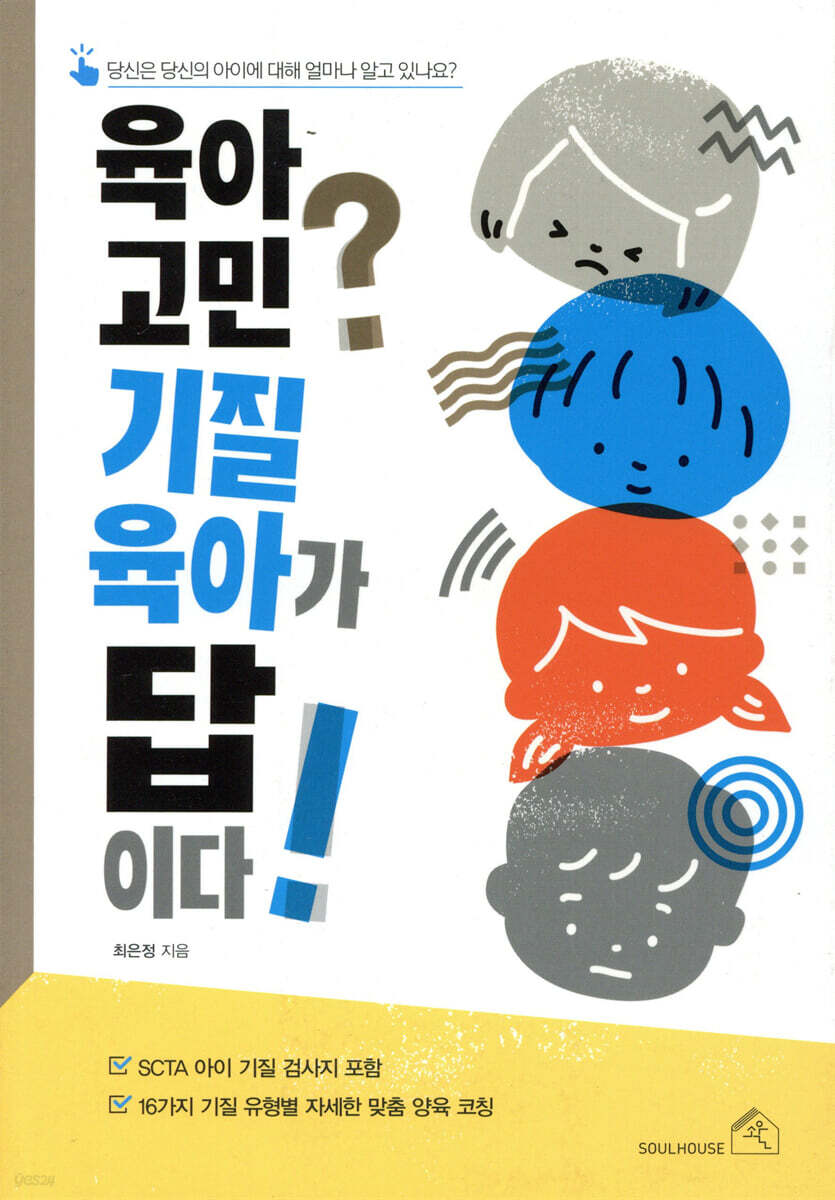
Worried about parenting? Temperament-based parenting is the answer!
 |
Description
Book Introduction
How to best understand your child, temperament.
Knowing your child's temperament can help you capitalize on their strengths and compensate for their weaknesses!
A temperament parenting report based on the results of diagnosing over 1,000 children and their parents.
Understanding temperament is essential to addressing the challenges of parenting and fostering your child's innate potential.
“He’s just naturally like that.” This is what we often say when describing children.
But even we, as parents, don't really know what our children's temperament is like.
Even teachers who teach children closest to them and psychotherapists who treat children's minds say that temperament is very important because it is a child's innate characteristic, but there is a lack of proper understanding of temperament.
This gap arises because there is little research data on infant and toddler temperament.
Temperament has been discussed in personality psychology since ancient Greece, but there has been no case of examining the temperament of infants and toddlers by dividing it into detailed types.
This is because it is very difficult to organize the concepts of individual differences and uniqueness in temperament.
Therefore, this book will be a refreshing drink that will quench the thirst of parents and teachers who want to understand children's temperaments.
"Parenting Concerns? Temperament Parenting is the Answer!" is a comprehensive guide to temperament that allows parents, teachers, and experts to directly diagnose, analyze, and even coach temperament.
First, we clearly define the nine elements that make up temperament, and then classify temperament types based on data accumulated through numerous treatments and educational clinical trials, and explain them with examples.
To enable readers to accurately diagnose their children's temperaments, the book includes the SCTA temperament test, developed and certified by the author's own research institute. It also teaches how to analyze temperaments based on the test results and the most effective parenting methods for each type.
If you've ever wondered what your child's temperament is or how to raise them in a way that's right for them, this book will help you create a new parenting paradigm.
Knowing your child's temperament can help you capitalize on their strengths and compensate for their weaknesses!
A temperament parenting report based on the results of diagnosing over 1,000 children and their parents.
Understanding temperament is essential to addressing the challenges of parenting and fostering your child's innate potential.
“He’s just naturally like that.” This is what we often say when describing children.
But even we, as parents, don't really know what our children's temperament is like.
Even teachers who teach children closest to them and psychotherapists who treat children's minds say that temperament is very important because it is a child's innate characteristic, but there is a lack of proper understanding of temperament.
This gap arises because there is little research data on infant and toddler temperament.
Temperament has been discussed in personality psychology since ancient Greece, but there has been no case of examining the temperament of infants and toddlers by dividing it into detailed types.
This is because it is very difficult to organize the concepts of individual differences and uniqueness in temperament.
Therefore, this book will be a refreshing drink that will quench the thirst of parents and teachers who want to understand children's temperaments.
"Parenting Concerns? Temperament Parenting is the Answer!" is a comprehensive guide to temperament that allows parents, teachers, and experts to directly diagnose, analyze, and even coach temperament.
First, we clearly define the nine elements that make up temperament, and then classify temperament types based on data accumulated through numerous treatments and educational clinical trials, and explain them with examples.
To enable readers to accurately diagnose their children's temperaments, the book includes the SCTA temperament test, developed and certified by the author's own research institute. It also teaches how to analyze temperaments based on the test results and the most effective parenting methods for each type.
If you've ever wondered what your child's temperament is or how to raise them in a way that's right for them, this book will help you create a new parenting paradigm.
- You can preview some of the book's contents.
Preview
index
A Letter of Recommendation: How to Make Your Great Love for a Child Reach the Heart of the Child
Temperament Parenting: Building on Strengths and Compensating for Weaknesses
PART 1.
What is temperament parenting?
1.
Why do we need to know temperament?
2.
The best way to understand your child is to understand their temperament.
3.
Knowing your child's temperament will help you build on their strengths.
4.
The desire to color one's temperament
5.
The Nine Elements of Temperament
⑴ Activity
⑵ Attention
⑶ Regularity
⑷ Sustainability
⑸ Reaction intensity
⑹ Stimulus sensitivity
⑺ Accessibility
⑻ Adaptability
⑼ Quality of mood
PART 2.
Discovering Your Child's True Self Through Temperament Traits
1.
Four temperament types based on combinations of temperament factors
⑴ Adaptable temperament type
⑵ Inhibitory substrate type
⑶ Persistent temperament type
⑷ Sensitive temperament type
2.
Breaking it down into 16 temperament types
⑴ Subtype temperament graph of the adaptable temperament
⑵ Substrate graph of detailed types of inhibitory substrates
⑶ Subtype temperament graph of persistent temperament
⑷ Subtype temperament graph of sensitive temperament
3.
The four stages of needs that appear in infancy
⑴ Physiological needs
⑵ Need for safety
⑶ Need for affection and belonging
⑷ Need for self-esteem
TEST.
Understanding Your Child's Temperament Type
⑴ SCTA Our Child Temperament Test
⑵ Drawing a temperament graph
⑶ Determining temperament type
PART 3.
Customized parenting coaching for 16 temperament types
1.
Highly active, compliant temperament
2.
Low-activity, compliant temperament
3.
Highly sociable and compliant temperament
4.
Low social and conformist temperament
5.
Highly active inhibitory substrate
6.
Inhibitory substrate with low activity
7.
Highly sociable, inhibited temperament
8.
Inhibitory temperament with low social skills
9.
Highly active, persistent temperament
10.
persistent temperament with low activity
11.
Highly social and persistent temperament
12.
persistent temperament with low social skills
13.
Highly active sensitive temperament
14.
Sensitive temperament with low activity
15.
Highly social and sensitive temperament
16.
Sensitive temperament with low social skills
Temperament types that require attention
1.
What if a child with a compliant temperament has low attention span?
2.
What if a child with an inhibited temperament is emotionally hypersensitive?
3.
What if a child with persistent temperament has poor attention span?
4.
What if a child with a sensitive temperament is overly emotional?
PART 4.
Harmony between parenting styles and child temperament
1.
Understanding Your Parenting Style
TEST.
Parenting Style Diagnostic Sheet
2.
Parenting Styles & Child Temperament Types Meet
PART 5.
How to develop temperament and solve problems
1.
How to develop temperament
⑴ Let's fill the space of the temperament graph with circles.
⑵ How to properly see a child's temperamental strengths
⑶ Let's start from the strengths and approach clockwise.
⑷ The power of supportive conversation
2.
Understanding problem behavior
⑴ What is problem behavior?
⑵ Children's problem behaviors have a function.
⑶ Incorrect parenting methods that reinforce children's problem behaviors
3.
How to Solve Problem Behavior Based on Temperament Type
Temperament Parenting: Building on Strengths and Compensating for Weaknesses
PART 1.
What is temperament parenting?
1.
Why do we need to know temperament?
2.
The best way to understand your child is to understand their temperament.
3.
Knowing your child's temperament will help you build on their strengths.
4.
The desire to color one's temperament
5.
The Nine Elements of Temperament
⑴ Activity
⑵ Attention
⑶ Regularity
⑷ Sustainability
⑸ Reaction intensity
⑹ Stimulus sensitivity
⑺ Accessibility
⑻ Adaptability
⑼ Quality of mood
PART 2.
Discovering Your Child's True Self Through Temperament Traits
1.
Four temperament types based on combinations of temperament factors
⑴ Adaptable temperament type
⑵ Inhibitory substrate type
⑶ Persistent temperament type
⑷ Sensitive temperament type
2.
Breaking it down into 16 temperament types
⑴ Subtype temperament graph of the adaptable temperament
⑵ Substrate graph of detailed types of inhibitory substrates
⑶ Subtype temperament graph of persistent temperament
⑷ Subtype temperament graph of sensitive temperament
3.
The four stages of needs that appear in infancy
⑴ Physiological needs
⑵ Need for safety
⑶ Need for affection and belonging
⑷ Need for self-esteem
TEST.
Understanding Your Child's Temperament Type
⑴ SCTA Our Child Temperament Test
⑵ Drawing a temperament graph
⑶ Determining temperament type
PART 3.
Customized parenting coaching for 16 temperament types
1.
Highly active, compliant temperament
2.
Low-activity, compliant temperament
3.
Highly sociable and compliant temperament
4.
Low social and conformist temperament
5.
Highly active inhibitory substrate
6.
Inhibitory substrate with low activity
7.
Highly sociable, inhibited temperament
8.
Inhibitory temperament with low social skills
9.
Highly active, persistent temperament
10.
persistent temperament with low activity
11.
Highly social and persistent temperament
12.
persistent temperament with low social skills
13.
Highly active sensitive temperament
14.
Sensitive temperament with low activity
15.
Highly social and sensitive temperament
16.
Sensitive temperament with low social skills
Temperament types that require attention
1.
What if a child with a compliant temperament has low attention span?
2.
What if a child with an inhibited temperament is emotionally hypersensitive?
3.
What if a child with persistent temperament has poor attention span?
4.
What if a child with a sensitive temperament is overly emotional?
PART 4.
Harmony between parenting styles and child temperament
1.
Understanding Your Parenting Style
TEST.
Parenting Style Diagnostic Sheet
2.
Parenting Styles & Child Temperament Types Meet
PART 5.
How to develop temperament and solve problems
1.
How to develop temperament
⑴ Let's fill the space of the temperament graph with circles.
⑵ How to properly see a child's temperamental strengths
⑶ Let's start from the strengths and approach clockwise.
⑷ The power of supportive conversation
2.
Understanding problem behavior
⑴ What is problem behavior?
⑵ Children's problem behaviors have a function.
⑶ Incorrect parenting methods that reinforce children's problem behaviors
3.
How to Solve Problem Behavior Based on Temperament Type
Detailed image

Into the book
How well do you know your child? Having treated numerous children and counseled parents for many years, I've realized that parents, who should understand their children better than anyone else, often don't know much about them.
Most parents don't know what their child's strengths and weaknesses are, how they are manifesting, and how they will manifest in the future.
Even though we recognize the problem, we don't know what the core of the problem is.
As a result, there are many cases where parents worry and hesitate to make decisions at every moment of parenting, and are unable to respond appropriately.
Parents who struggle to overcome their anxiety often postpone the opportunity to explore their child's strengths and weaknesses to daycare centers, kindergartens, or counseling centers.
Moreover, out of concern for the child, they try to quickly correct the weaknesses.
They are worried that their child will be hated, suffer losses, or be harmed because of his or her weaknesses, so they want to resolve those issues quickly.
The more parents perceive that their child's shortcomings are similar to their own, the more they focus on their weaknesses.
I feel like my child's weaknesses are my fault as a parent, so I force my child to overcome his or her weaknesses quickly in order to relieve my guilt and self-reproach.
So worry breeds anxiety, anxiety breeds anger, and ultimately, it leads to aggression in the child.
To break this vicious cycle and become better facilitators, parents need to understand temperament.
Understanding your child's temperament can help you identify their strengths and complement their weaknesses by leveraging their unique strengths.
It is also a natural result that the quality of childcare is improving.
---From the "Header"
There was a three-year-old boy who couldn't speak, wouldn't make eye contact, was extremely sensitive to noise, was a picky eater, and would cry and swear all day long if he didn't like something.
Because this child had no communication at all, they called him 'autistic'.
But this child is not autistic.
He was a child with a very strong 'sensitive temperament' and high desires, and he expressed the high stress he felt in a state of dissatisfaction where things did not go his way through strong gestures.
After six months of therapy that met his high needs while reducing his sensitivity to stimuli, he became a speaking, smiling, and playful child.
What if we had diagnosed this child solely based on his behavior? We would have looked solely at the parents or the environment for the cause of the problem, failing to find an appropriate solution.
However, by understanding the characteristics of the child's temperament and providing therapeutic and parenting interventions that complement the weaknesses of the child's temperament, remarkable changes can occur in a short period of time.
Like this, most of the problems or difficulties that parents complain about with their children originate from the child's temperament.
The cause of the problem and the solution are already in the temperament.
---From "Why do we need to know temperament?"
Children have all nine temperament factors described above: activity, attention, regularity, persistence, responsiveness, sensitivity, accessibility, adaptability, and quality of mood.
It's not that some elements are present and others are absent, but rather that there are differences in the strengths and weaknesses of the nine temperament elements.
Therefore, depending on which of the temperamental elements a child possesses is more clearly revealed, they can be broadly divided into four temperament types: accommodative, inhibited, persistent, and sensitive.
In order to diagnose a child's temperament more carefully, this book divides the four temperament types of 'compliant, inhibited, persistent, and sensitive' into a total of 16 types based on high and low 'activity' and 'sociability'.
‘Activity’ is a criterion for the individual dimension of temperament, and ‘sociality’ is a criterion for the social dimension of temperament, which distinguishes children’s subtle individual characteristics and social features in more detail.
These 16 temperament types have characteristic shapes when represented graphically by quantifying the nine temperament factors.
---From "Four temperament types based on combination of temperament factors"
The reason we present a temperament test in this book is to help you understand your child accurately.
It is to help parents objectively look at their children and find the best parenting method for their children and solutions to problematic situations together.
As we work through temperament test questions, most parents are surprised to discover how little they know about their children.
I have seen it with my eyes, but I have never observed it properly.
For this reason, temperament testing requires parents to focus their attention on their child and observe him or her closely to evaluate him or her.
Just focus on your child.
There is no need to brag about the results of your test or feel jealous of other children's results.
There is no such thing as good temperament or bad temperament.
Also, we do not evaluate a child's abilities based on innate tendencies.
If temperament is not accurately tested and an accurate temperament assessment is not possible, the child's true temperament cannot be identified and developed.
Therefore, in order to accurately examine the temperament, please first examine the parents' hearts.
---「TEST.
From “Understanding Your Child’s Temperament Type”
In fact, the parenting style of a parent hides the parent's temperament and desires.
These desires are, on a personal level, each person's uniqueness.
But it's different when you're a parent.
Depending on how these parental desires align with the child's temperament, the child's needs may be deficient due to the parent's desires, and the child's weaknesses may be negatively influenced by the parenting process rather than being learned.
As adults, parents have a responsibility to their children's needs.
Therefore, you must distinguish between your own needs and the role of your parents.
While loving and acknowledging your child's needs and unique temperament, you must first train yourself to be in harmony with your child and accompany him or her.
Most parents don't know what their child's strengths and weaknesses are, how they are manifesting, and how they will manifest in the future.
Even though we recognize the problem, we don't know what the core of the problem is.
As a result, there are many cases where parents worry and hesitate to make decisions at every moment of parenting, and are unable to respond appropriately.
Parents who struggle to overcome their anxiety often postpone the opportunity to explore their child's strengths and weaknesses to daycare centers, kindergartens, or counseling centers.
Moreover, out of concern for the child, they try to quickly correct the weaknesses.
They are worried that their child will be hated, suffer losses, or be harmed because of his or her weaknesses, so they want to resolve those issues quickly.
The more parents perceive that their child's shortcomings are similar to their own, the more they focus on their weaknesses.
I feel like my child's weaknesses are my fault as a parent, so I force my child to overcome his or her weaknesses quickly in order to relieve my guilt and self-reproach.
So worry breeds anxiety, anxiety breeds anger, and ultimately, it leads to aggression in the child.
To break this vicious cycle and become better facilitators, parents need to understand temperament.
Understanding your child's temperament can help you identify their strengths and complement their weaknesses by leveraging their unique strengths.
It is also a natural result that the quality of childcare is improving.
---From the "Header"
There was a three-year-old boy who couldn't speak, wouldn't make eye contact, was extremely sensitive to noise, was a picky eater, and would cry and swear all day long if he didn't like something.
Because this child had no communication at all, they called him 'autistic'.
But this child is not autistic.
He was a child with a very strong 'sensitive temperament' and high desires, and he expressed the high stress he felt in a state of dissatisfaction where things did not go his way through strong gestures.
After six months of therapy that met his high needs while reducing his sensitivity to stimuli, he became a speaking, smiling, and playful child.
What if we had diagnosed this child solely based on his behavior? We would have looked solely at the parents or the environment for the cause of the problem, failing to find an appropriate solution.
However, by understanding the characteristics of the child's temperament and providing therapeutic and parenting interventions that complement the weaknesses of the child's temperament, remarkable changes can occur in a short period of time.
Like this, most of the problems or difficulties that parents complain about with their children originate from the child's temperament.
The cause of the problem and the solution are already in the temperament.
---From "Why do we need to know temperament?"
Children have all nine temperament factors described above: activity, attention, regularity, persistence, responsiveness, sensitivity, accessibility, adaptability, and quality of mood.
It's not that some elements are present and others are absent, but rather that there are differences in the strengths and weaknesses of the nine temperament elements.
Therefore, depending on which of the temperamental elements a child possesses is more clearly revealed, they can be broadly divided into four temperament types: accommodative, inhibited, persistent, and sensitive.
In order to diagnose a child's temperament more carefully, this book divides the four temperament types of 'compliant, inhibited, persistent, and sensitive' into a total of 16 types based on high and low 'activity' and 'sociability'.
‘Activity’ is a criterion for the individual dimension of temperament, and ‘sociality’ is a criterion for the social dimension of temperament, which distinguishes children’s subtle individual characteristics and social features in more detail.
These 16 temperament types have characteristic shapes when represented graphically by quantifying the nine temperament factors.
---From "Four temperament types based on combination of temperament factors"
The reason we present a temperament test in this book is to help you understand your child accurately.
It is to help parents objectively look at their children and find the best parenting method for their children and solutions to problematic situations together.
As we work through temperament test questions, most parents are surprised to discover how little they know about their children.
I have seen it with my eyes, but I have never observed it properly.
For this reason, temperament testing requires parents to focus their attention on their child and observe him or her closely to evaluate him or her.
Just focus on your child.
There is no need to brag about the results of your test or feel jealous of other children's results.
There is no such thing as good temperament or bad temperament.
Also, we do not evaluate a child's abilities based on innate tendencies.
If temperament is not accurately tested and an accurate temperament assessment is not possible, the child's true temperament cannot be identified and developed.
Therefore, in order to accurately examine the temperament, please first examine the parents' hearts.
---「TEST.
From “Understanding Your Child’s Temperament Type”
In fact, the parenting style of a parent hides the parent's temperament and desires.
These desires are, on a personal level, each person's uniqueness.
But it's different when you're a parent.
Depending on how these parental desires align with the child's temperament, the child's needs may be deficient due to the parent's desires, and the child's weaknesses may be negatively influenced by the parenting process rather than being learned.
As adults, parents have a responsibility to their children's needs.
Therefore, you must distinguish between your own needs and the role of your parents.
While loving and acknowledging your child's needs and unique temperament, you must first train yourself to be in harmony with your child and accompany him or her.
---From "Meeting of Parenting Styles & Child Temperament Types"
Publisher's Review
I'll let you know in advance.
This book is not an easy-to-read, soft parenting book.
However, if you read it carefully and underline it, it can be a good guide for future parenting.
Parenting is really hard.
With a heavy heart, I search for parenting books with the hope that they will teach me the easy way out. However, even best-selling parenting books often offer only fleeting advice.
Even in these moments of confusion and self-reproach, we as parents, or teachers, are burdened by the weight of responsibility to properly understand our children, guide them in the right direction, and help them discover their potential.
What, exactly, is the right answer? Is there even an answer? In the face of countless challenges, the only thing that can keep us grounded and unwavering is a sound understanding of our children.
Only by properly understanding your child and guiding him or her in a way that suits him or her can we truly bring out his or her inherent potential.
White white, each child has a different light.
That's because each child is born with their own unique temperament.
If we understand our children's innate temperament rather than trying to discern right from wrong, a new paradigm opens up in parenting.
The temperament test in this book is a test that can accurately diagnose your child's temperament type.
Parents who are curious about their child's temperament type can start by taking a temperament test.
However, if you want to raise your child with proper temperament, please read Chapters 1 and 2 of this book carefully before taking the temperament test.
If you have a proper understanding of temperament, a new world will open up for you in parenting.
Many parenting books advise you to understand your child's temperament, but none of them provide a clear and detailed explanation of what your child's temperament is and under what circumstances it will manifest.
That's also why it's so difficult to give proper advice.
To help you find that difficult path, I have gone through a difficult process to publish this book.
Having gone through a long and rigorous process, I believe this book will be of real help to parents and teachers struggling through the difficult swamp of parenting.
Features of this book
- A temperament parenting report based on the results of diagnosing over 1,000 children and their parents.
- A detailed introduction to the nine elements that make up temperament and the 16 temperament types.
- Accurately diagnose your child's temperament type with the SCTA temperament test.
- Customized parenting coaching for 16 temperament types
-Provide separate advice for temperament types requiring attention
-Provide parenting style diagnosis and parenting coaching by type
- Provides ways to develop temperament and deal with problem behaviors.
This book is not an easy-to-read, soft parenting book.
However, if you read it carefully and underline it, it can be a good guide for future parenting.
Parenting is really hard.
With a heavy heart, I search for parenting books with the hope that they will teach me the easy way out. However, even best-selling parenting books often offer only fleeting advice.
Even in these moments of confusion and self-reproach, we as parents, or teachers, are burdened by the weight of responsibility to properly understand our children, guide them in the right direction, and help them discover their potential.
What, exactly, is the right answer? Is there even an answer? In the face of countless challenges, the only thing that can keep us grounded and unwavering is a sound understanding of our children.
Only by properly understanding your child and guiding him or her in a way that suits him or her can we truly bring out his or her inherent potential.
White white, each child has a different light.
That's because each child is born with their own unique temperament.
If we understand our children's innate temperament rather than trying to discern right from wrong, a new paradigm opens up in parenting.
The temperament test in this book is a test that can accurately diagnose your child's temperament type.
Parents who are curious about their child's temperament type can start by taking a temperament test.
However, if you want to raise your child with proper temperament, please read Chapters 1 and 2 of this book carefully before taking the temperament test.
If you have a proper understanding of temperament, a new world will open up for you in parenting.
Many parenting books advise you to understand your child's temperament, but none of them provide a clear and detailed explanation of what your child's temperament is and under what circumstances it will manifest.
That's also why it's so difficult to give proper advice.
To help you find that difficult path, I have gone through a difficult process to publish this book.
Having gone through a long and rigorous process, I believe this book will be of real help to parents and teachers struggling through the difficult swamp of parenting.
Features of this book
- A temperament parenting report based on the results of diagnosing over 1,000 children and their parents.
- A detailed introduction to the nine elements that make up temperament and the 16 temperament types.
- Accurately diagnose your child's temperament type with the SCTA temperament test.
- Customized parenting coaching for 16 temperament types
-Provide separate advice for temperament types requiring attention
-Provide parenting style diagnosis and parenting coaching by type
- Provides ways to develop temperament and deal with problem behaviors.
GOODS SPECIFICS
- Date of issue: January 22, 2019
- Page count, weight, size: 440 pages | 604g | 153*217*23mm
- ISBN13: 9791188915149
- ISBN10: 1188915142
You may also like
카테고리
korean


korean

![ELLE 엘르 스페셜 에디션 A형 : 12월 [2025]](http://librairie.coreenne.fr/cdn/shop/files/b8e27a3de6c9538896439686c6b0e8fb.jpg?v=1766436872&width=3840)


