

face
 |
Description
Book Introduction
The graphic novel debut of the director of "Train to Busan"!
Director Yeon Sang-ho, known for "The King of Pigs," "Train to Busan," and "Psychokinesis," now presents a graphic novel!
In 2016, the South Korean film industry welcomed a new 10 million moviegoers.
Director Yeon Sang-ho created Korea's first zombie blockbuster, "Train to Busan," by freely handling the codes and clichés of the "zombie apocalypse" genre, which deals with the protagonists' desperate struggle for survival against the backdrop of a mass outbreak of zombies and the destruction of human civilization.
"Train to Busan," which depicts the struggles of passengers on a KTX train bound for Busan departing from Seoul Station amidst an unprecedented disaster caused by a mass outbreak of zombies, achieved the feat of surpassing 5 million viewers in its first week of release and 11 million viewers in its final week, becoming the first and last film to reach 10 million viewers in 2016.
It also swept awards such as the Baeksang Arts Awards, the Blue Dragon Film Awards, and the Korean Film Critics Association Awards, receiving rave reviews from critics and the public.
The favorable reviews from domestic audiences also spread to the global market.
It was invited to the Cannes International Film Festival's late-night screenings, receiving praise that "the Korean film industry has acquired zombies and Yeon Sang-ho" (Cine21), and Stephen King said, "It's like John Woo meets the zombie apocalypse."
“It makes ‘The Walking Dead’ into a trivial drama.”) and Guillermo del Toro (“It’s a film that delivers an extreme horror experience and great immersion.
It created an amazing buzz, with world-renowned creators like “You have to see it.” tweeting their admiration.
The film, which received higher reviews than the Hollywood film of the same genre, "World War Z" starring Brad Pitt, and was re-released at the request of North American audiences, earned $45 million overseas in the fall of 2016, making Yeon Sang-ho, an animation director with a background in Western painting, a darling of the Korean film industry.
Director Yeon Sang-ho, who founded Studio Dadashow in 2004 and has been hard-pressed to find directors who have produced more than two works in the Korean creative animation industry, won three awards at the Busan International Film Festival (Asian Film Promotion Organization Award, Director's Guild of Korea Award, CGV Movie Collage Award), became the first Korean animation director to advance to the Director's Fortnight at the Cannes International Film Festival with "The King of Pigs" (2011), and won the Best Animated Film Award at the Gijon International Film Festival in Spain with "The Fake" (2013). He was a "low-budget" "independent" animation director.
However, as "The King of Pigs" and "The Fake" received attention from critics as well as the public and were successful at the box office, Director Yeon Sang-ho became an animation director recognized for both artistic quality and popularity.
The movie "Train to Busan" is a sequel to the animated film "Seoul Station."
It was originally planned as an animation along with "Seoul Station", but was produced as a live-action film at the suggestion of the film company.
The evaluation that “the power of animation overwhelms live-action” (Joo Sung-chul, editor-in-chief of Cine21) became a prophecy, and director Yeon Sang-ho, who has consistently delved into the absurdity of Korean society to a level that even live-action films cannot match, regardless of whether it is a school (“The King of Pigs”), a religious facility (“The Fake”), or the military (“The Window”), has proven in “Train to Busan” that he is the owner of imagination and a challenging spirit that transcends the limitations of the genre.
This time, he is challenging himself with cartoons.
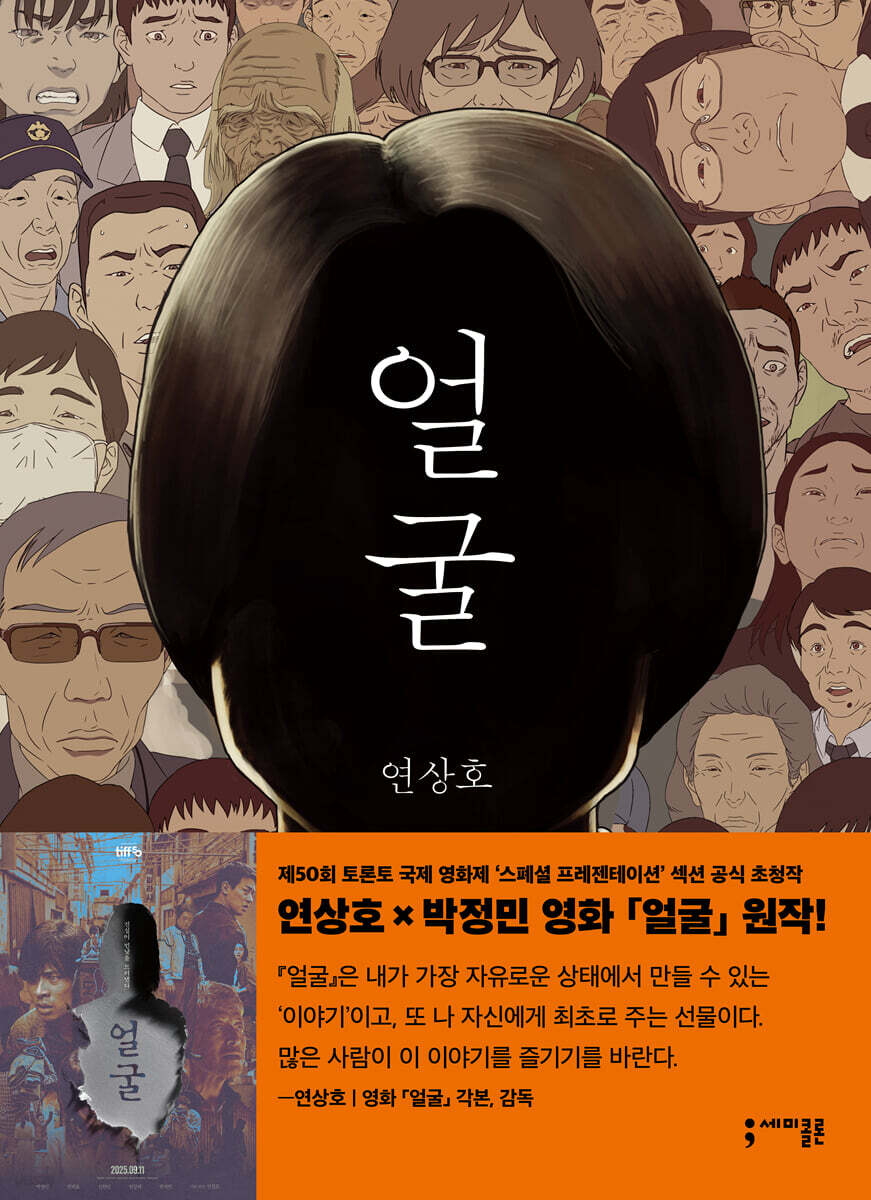
In the 1970s, when South Korea was in the midst of writing the myth of compressed growth, director Yeon Sang-ho's first graphic novel, "Face" (Semicolon, 2018), depicts the difficult life of a woman who was oppressed and forgotten amidst the contemptuous gaze of the socially disadvantaged. It is a work that preserves the taste of "Yeon Sang-ho Animation," which focused on showing extreme tragedy and despair without leaving even the smallest hope intact. It was published in a high-quality hardcover format to coincide with the release of his new work "Psychokinesis," which is challenging the 10 million box office hit of the superpower comedy genre, and is expected to be a signal flare announcing a new leap forward for Semicolon graphic novels in 2018.
Director Yeon Sang-ho, known for "The King of Pigs," "Train to Busan," and "Psychokinesis," now presents a graphic novel!
In 2016, the South Korean film industry welcomed a new 10 million moviegoers.
Director Yeon Sang-ho created Korea's first zombie blockbuster, "Train to Busan," by freely handling the codes and clichés of the "zombie apocalypse" genre, which deals with the protagonists' desperate struggle for survival against the backdrop of a mass outbreak of zombies and the destruction of human civilization.
"Train to Busan," which depicts the struggles of passengers on a KTX train bound for Busan departing from Seoul Station amidst an unprecedented disaster caused by a mass outbreak of zombies, achieved the feat of surpassing 5 million viewers in its first week of release and 11 million viewers in its final week, becoming the first and last film to reach 10 million viewers in 2016.
It also swept awards such as the Baeksang Arts Awards, the Blue Dragon Film Awards, and the Korean Film Critics Association Awards, receiving rave reviews from critics and the public.
The favorable reviews from domestic audiences also spread to the global market.
It was invited to the Cannes International Film Festival's late-night screenings, receiving praise that "the Korean film industry has acquired zombies and Yeon Sang-ho" (Cine21), and Stephen King said, "It's like John Woo meets the zombie apocalypse."
“It makes ‘The Walking Dead’ into a trivial drama.”) and Guillermo del Toro (“It’s a film that delivers an extreme horror experience and great immersion.
It created an amazing buzz, with world-renowned creators like “You have to see it.” tweeting their admiration.
The film, which received higher reviews than the Hollywood film of the same genre, "World War Z" starring Brad Pitt, and was re-released at the request of North American audiences, earned $45 million overseas in the fall of 2016, making Yeon Sang-ho, an animation director with a background in Western painting, a darling of the Korean film industry.
Director Yeon Sang-ho, who founded Studio Dadashow in 2004 and has been hard-pressed to find directors who have produced more than two works in the Korean creative animation industry, won three awards at the Busan International Film Festival (Asian Film Promotion Organization Award, Director's Guild of Korea Award, CGV Movie Collage Award), became the first Korean animation director to advance to the Director's Fortnight at the Cannes International Film Festival with "The King of Pigs" (2011), and won the Best Animated Film Award at the Gijon International Film Festival in Spain with "The Fake" (2013). He was a "low-budget" "independent" animation director.
However, as "The King of Pigs" and "The Fake" received attention from critics as well as the public and were successful at the box office, Director Yeon Sang-ho became an animation director recognized for both artistic quality and popularity.
The movie "Train to Busan" is a sequel to the animated film "Seoul Station."
It was originally planned as an animation along with "Seoul Station", but was produced as a live-action film at the suggestion of the film company.
The evaluation that “the power of animation overwhelms live-action” (Joo Sung-chul, editor-in-chief of Cine21) became a prophecy, and director Yeon Sang-ho, who has consistently delved into the absurdity of Korean society to a level that even live-action films cannot match, regardless of whether it is a school (“The King of Pigs”), a religious facility (“The Fake”), or the military (“The Window”), has proven in “Train to Busan” that he is the owner of imagination and a challenging spirit that transcends the limitations of the genre.
This time, he is challenging himself with cartoons.
In the 1970s, when South Korea was in the midst of writing the myth of compressed growth, director Yeon Sang-ho's first graphic novel, "Face" (Semicolon, 2018), depicts the difficult life of a woman who was oppressed and forgotten amidst the contemptuous gaze of the socially disadvantaged. It is a work that preserves the taste of "Yeon Sang-ho Animation," which focused on showing extreme tragedy and despair without leaving even the smallest hope intact. It was published in a high-quality hardcover format to coincide with the release of his new work "Psychokinesis," which is challenging the 10 million box office hit of the superpower comedy genre, and is expected to be a signal flare announcing a new leap forward for Semicolon graphic novels in 2018.
- You can preview some of the book's contents.
Preview
index
Chapter 1, Chapter 7
Chapter 2, 59
Chapter 3: 111
Chapter 4, 157
Chapter 5 211
Author's Note 284
Chapter 2, 59
Chapter 3: 111
Chapter 4, 157
Chapter 5 211
Author's Note 284
Detailed image

Publisher's Review
The archetype of the 'Yeon Sang-ho World' experienced through graphic novels
From his debut film "Hellbound" completed as a solo production in 2003 to "The King of Pigs" and "The Fake," director Yeon Sang-ho's works are imbued with a cold-blooded gaze toward the dark side of society.
The 'Yeon Sang-ho World', which focused on showing the cruel nature of humanity and reality as it is, which we have all experienced at least once, or perhaps many times, on this land, showed signs of change in 2016 with his live-action film debut, 'Train to Busan', which surpassed 11 million viewers.
Following "Train to Busan," which offered a glimmer of hope through family love and sacrifice in the hell of the zombie apocalypse, he took on the comedy genre in his follow-up film, "Psychokinesis," with the theme of an ordinary citizen being given superpowers overnight.
If "Train to Busan" and "Psychokinesis" symbolize his challenges in terms of subject matter (zombies, superpowers) and genre (blockbuster, comedy), "Face" is a work that, as the director himself declared that he created it in his "most free state," directly expresses the dark reality and sharp thematic consciousness characteristic of Yeon Sang-ho's animations in the challenging field of comics.
In a time when the entire Republic of Korea was running wild with the sole goal of having more or earning more, the protagonist, who has the fate of visual impairment, cannot escape the reality no matter how hard he struggles. He directs his anger that should be directed at the strong toward those weaker than himself, and the ugly lies that the entire society had buried in the darkness and that spoke louder than the truth reveal their bare faces through a shocking twist 30 years later.
Director Yeon Sang-ho's sharp perspective on the world, as seen in his animated films "The King of Pigs," "The Fake," and "Seoul Station," which were wildly popular around the world, and his unique aftertaste that lingers even days after the ending, are preserved in "Face." This work will be highly valuable not only to animation fans but also to those who came to know him through "Train to Busan" and "Psychokinesis," allowing them to experience the true essence of director Yeon Sang-ho.
Author's Note
Around the time my first feature-length animation, "The King of Pigs," was winning an award at the Busan International Film Festival and gaining public attention, I was in pre-production on my second feature-length animation, "The Fake."
Also around that time I was suffering from severe anxiety.
What made me anxious was the question of whether I could write another screenplay.
The more public attention "The King of Pigs" received, and the more work progressed on "The Fake," the more strangely my mind became empty, and the more I became anxious that I would never be able to create any more stories.
The story that came to mind around that time was ‘Face’.
It was a moment when images that had been floating around like fragments for years came together.
After that, around the time I finished working on "Fake," I thought my third full-length animation would be "Face."
But my third animation was "Seoul Station" and as many people know, I ended up making my first live-action film, "Train to Busan".
After "Train to Busan," the anxiety that had been building up around 2011 started to return.
The scenario I looked into again during such a chaotic time was also 『Face』.
Strangely enough, 『Face』 had a different meaning from my other works.
It was perhaps the work that was the furthest from the universal narrative framework that I could think of.
So it was a more free work.
The first thing I have to do before the pre-production of "Psychokinesis," which has been confirmed as my next project after "Train to Busan," is to somehow release "Face" into the world.
I thought so.
In the end, I ended up working on 『Face』 in the form of a comic book, which I had always admired.
While working on this project, I was plagued by a sense of self-loathing about how different the grammar of 'movies' and 'comics' are.
And I don't really know how complete the work "Face" is, which was eventually released into the world as a single work.
However, since this work has a special meaning to me, I put special affection and effort into completing it.
For me, who has been dedicated to creating stories for nearly 20 years, including short stories, "Face" is like a gift to me.
I can't say for sure that I've created good works, but I'm confident that I've been creating without being lazy for over 20 years.
But in the end, it is true that I was very tired as a creator.
When "Train to Busan" was released and the film attracted 10 million viewers, I wanted to give myself a gift as a creator.
"Face" is a story that I was able to create in the most free state possible, created through "comics," a creative form I have always longed for, and it is also the first gift I give to myself.
I hope many people enjoy this story.
Lastly, I would like to express my deepest gratitude to Hong Eun-pyo, Kwon Hyun-hwa, Yeon Chan-heum, and Lim Ji-hye for their collaboration on this work.
January 2018
Yeon Sang-ho
From his debut film "Hellbound" completed as a solo production in 2003 to "The King of Pigs" and "The Fake," director Yeon Sang-ho's works are imbued with a cold-blooded gaze toward the dark side of society.
The 'Yeon Sang-ho World', which focused on showing the cruel nature of humanity and reality as it is, which we have all experienced at least once, or perhaps many times, on this land, showed signs of change in 2016 with his live-action film debut, 'Train to Busan', which surpassed 11 million viewers.
Following "Train to Busan," which offered a glimmer of hope through family love and sacrifice in the hell of the zombie apocalypse, he took on the comedy genre in his follow-up film, "Psychokinesis," with the theme of an ordinary citizen being given superpowers overnight.
If "Train to Busan" and "Psychokinesis" symbolize his challenges in terms of subject matter (zombies, superpowers) and genre (blockbuster, comedy), "Face" is a work that, as the director himself declared that he created it in his "most free state," directly expresses the dark reality and sharp thematic consciousness characteristic of Yeon Sang-ho's animations in the challenging field of comics.
In a time when the entire Republic of Korea was running wild with the sole goal of having more or earning more, the protagonist, who has the fate of visual impairment, cannot escape the reality no matter how hard he struggles. He directs his anger that should be directed at the strong toward those weaker than himself, and the ugly lies that the entire society had buried in the darkness and that spoke louder than the truth reveal their bare faces through a shocking twist 30 years later.
Director Yeon Sang-ho's sharp perspective on the world, as seen in his animated films "The King of Pigs," "The Fake," and "Seoul Station," which were wildly popular around the world, and his unique aftertaste that lingers even days after the ending, are preserved in "Face." This work will be highly valuable not only to animation fans but also to those who came to know him through "Train to Busan" and "Psychokinesis," allowing them to experience the true essence of director Yeon Sang-ho.
Author's Note
Around the time my first feature-length animation, "The King of Pigs," was winning an award at the Busan International Film Festival and gaining public attention, I was in pre-production on my second feature-length animation, "The Fake."
Also around that time I was suffering from severe anxiety.
What made me anxious was the question of whether I could write another screenplay.
The more public attention "The King of Pigs" received, and the more work progressed on "The Fake," the more strangely my mind became empty, and the more I became anxious that I would never be able to create any more stories.
The story that came to mind around that time was ‘Face’.
It was a moment when images that had been floating around like fragments for years came together.
After that, around the time I finished working on "Fake," I thought my third full-length animation would be "Face."
But my third animation was "Seoul Station" and as many people know, I ended up making my first live-action film, "Train to Busan".
After "Train to Busan," the anxiety that had been building up around 2011 started to return.
The scenario I looked into again during such a chaotic time was also 『Face』.
Strangely enough, 『Face』 had a different meaning from my other works.
It was perhaps the work that was the furthest from the universal narrative framework that I could think of.
So it was a more free work.
The first thing I have to do before the pre-production of "Psychokinesis," which has been confirmed as my next project after "Train to Busan," is to somehow release "Face" into the world.
I thought so.
In the end, I ended up working on 『Face』 in the form of a comic book, which I had always admired.
While working on this project, I was plagued by a sense of self-loathing about how different the grammar of 'movies' and 'comics' are.
And I don't really know how complete the work "Face" is, which was eventually released into the world as a single work.
However, since this work has a special meaning to me, I put special affection and effort into completing it.
For me, who has been dedicated to creating stories for nearly 20 years, including short stories, "Face" is like a gift to me.
I can't say for sure that I've created good works, but I'm confident that I've been creating without being lazy for over 20 years.
But in the end, it is true that I was very tired as a creator.
When "Train to Busan" was released and the film attracted 10 million viewers, I wanted to give myself a gift as a creator.
"Face" is a story that I was able to create in the most free state possible, created through "comics," a creative form I have always longed for, and it is also the first gift I give to myself.
I hope many people enjoy this story.
Lastly, I would like to express my deepest gratitude to Hong Eun-pyo, Kwon Hyun-hwa, Yeon Chan-heum, and Lim Ji-hye for their collaboration on this work.
January 2018
Yeon Sang-ho
GOODS SPECIFICS
- Date of issue: January 23, 2018
- Format: Hardcover book binding method guide
- Page count, weight, size: 288 pages | 1,098g | 196*268*21mm
- ISBN13: 9788983718853
- ISBN10: 8983718854
You may also like
카테고리
korean


korean

![GQ KOREA Mark (Monthly): December [2025]](http://librairie.coreenne.fr/cdn/shop/files/8ef265dbbfbf186523ed75ba7319009d.jpg?v=1765340328&width=3840)


