

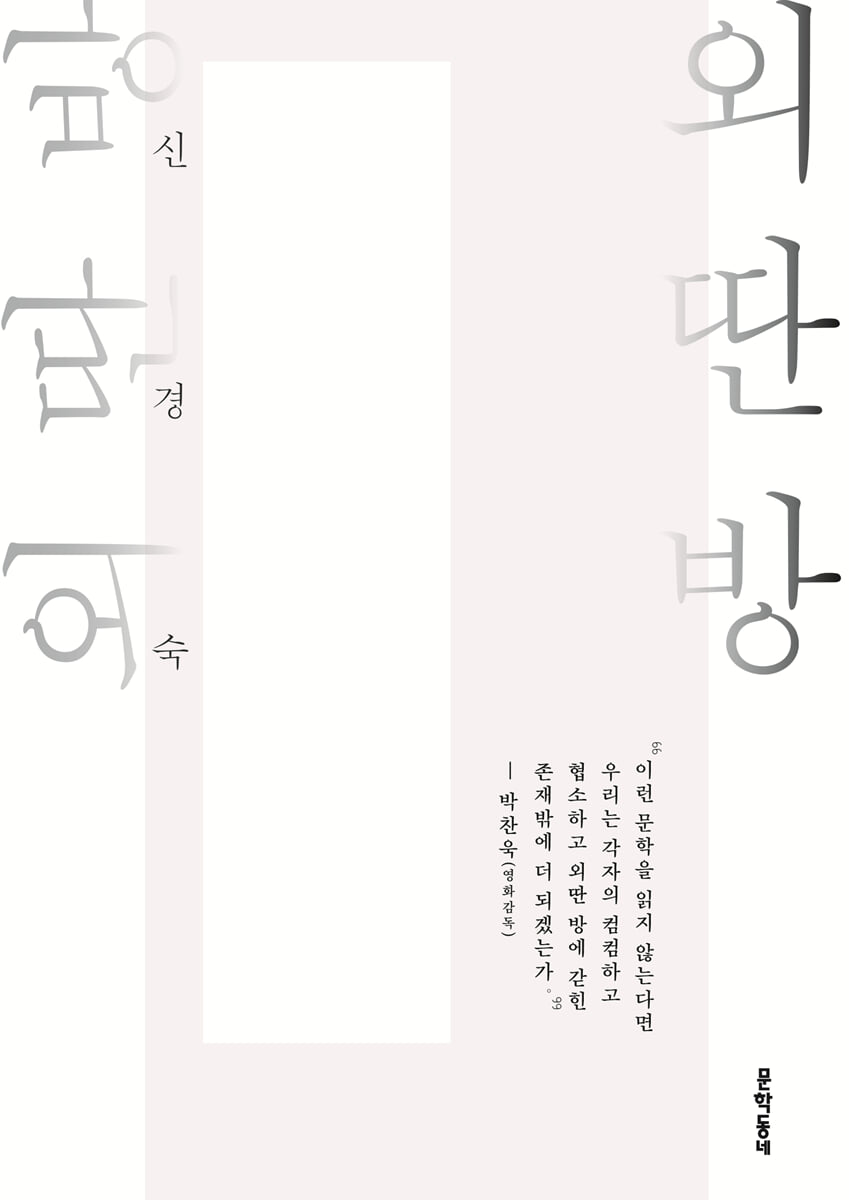
Secluded room
 |
Description
Book Introduction
If we don't read this kind of literature, we
Would we be anything more than beings confined in our own dark, narrow, and isolated rooms?
_Park Chan-wook (film director)
There was a struggle of the mind to reach its inner truth,
To express it, sentences that were experienced for the first time in the history of Korean literature were added.
Since then, it has become a literary standard.
Shin Hyeong-cheol (literary critic)
"The Lonely Room" can be seen as the starting point and literary source that made who I am today possible.
Whenever I feel lost and wandering, I open up 『The Lonely Room』.
_Park Sang-young (novelist)
The author I have loved for a long time is Shin Kyung-sook.
I can't forget the emotion and sadness I felt while reading "The Lonely Room," and the joy I felt about the novel itself.
The novel is for me a space that exists between myself and the world.
It made me aware of a thin, transparent 'membrane'.
_Kim Geum-hee (novelist)
The North Star that leisurely illuminates the path of Korean literature
Revised edition commemorating the 30th anniversary of the publication of "The Isolated Room"
Shin Kyung-sook's novel "A Lonely Room," a masterpiece that has always shone in the same place and served as a guiding light on the endless path of literature, has been revised and republished to mark its 30th anniversary.
Following the publication of Shin Kyung-sook's first novel, "Deep Sorrow" (1994), immediately after its founding in 1993, the publishing company Munhakdongne serialized the author's second novel, "A Lonely Room," for a year starting with the inaugural issue of its quarterly magazine, Munhakdongne (Winter 1994), and then published it as a book.
As she began serializing 『A Lonely Room』, which would later become a representative book that shared the same footsteps with Munhakdongne and a major achievement of her life, Shin Kyung-sook wrote the following.
“I’m going to write about what I saw and felt during the four years I first came to Seoul, from when I was sixteen to when I was twenty,” he said. “Sometimes, even if I try to force it like this, there are stories that come flooding back and tearing at my heart.”
The author decided to keep his promise to write a novel about “them” who were “always present in me,” the female factory workers who were his colleagues, and the students in the industrial special class who studied in the classroom at night after work.
『The Isolated Room』, written in this way, provides a glimpse into the intense writing process of a novelist who had already reached the ranks of a master in his early thirties.
The 'present-continuous writing' of 'The Isolated Room', which simultaneously records past memories and the influences occurring within the author as he relives them in a novel, gives the wondrous sensation that the next chapter of the story is being written immediately the moment the page is turned.
In addition to the strategy of keeping up with the author's writing pace and allowing the reader to breathe along with him, "The Outhouse" attempts a number of unique techniques and steadily enhances the work's perfection with the resulting effects.
The fact that such achievements do not feel artificial confirms that the author of this piece is already well-versed in literature and has reached a level where he instinctively selects and applies each technique.
This work abandons the basic narrative structure of introduction, development, turn, and conclusion, and secures a vivid present through frequent intrusions into the present moment of writing, and establishes the essence and meaning of the act of writing through sentences that constantly return to and advance toward the author himself.
If realism is about evoking emotions on a communal level beyond the individual level by reconstructing reality in detail and experiencing the truth of life, then 『The Outlying Room』 is considered the greatest achievement of Korean literature in the 1990s, not only meeting the conditions of traditional realism through its technical achievements, but also opening up the possibility of a new realism.
The 'new realism' presented in 'The Outlying Room' can be said to be a combination of the aspirations of realism and the style of modernism, that is, the art of capturing a human life in its entirety within a refined composition.
Shin Kyung-sook meticulously stitches together the fragments of memories of a girl who left the embrace of nature and jumped into the cold and anxious city to pursue her dream of writing, creating a grand mosaic.
In this way, 『The Isolated Room』 is a coming-of-age novel depicting a girl who achieves her dreams while maintaining the strength to discover beauty amidst the adversity of studying day and night, a labor novel that vividly captures the faces of urban female workers in the late 1970s and early 1980s, a historical novel that records in detail the politics, society, culture, and life of the time, and a novel of mourning that achieves a complete farewell to loved ones lost to life's tragedy.
In this work, the author, who is both the subject and object of writing, inscribes the following questions at the starting point and ending point of the novel.
“What does writing mean to me?” Written under this question, “The Isolated Room” contains the totality of literature that author Shin Kyung-sook sought to achieve.
"The Isolated Room," which embraces the life of an individual, a life that is ongoing and encompasses an era, is a novel that has accomplished what only literature can do, and has accomplished everything that literature can do.
If you want to enjoy literature as an example of undying vitality, you must read this book.
Just as readers have done for the past thirty years.
Would we be anything more than beings confined in our own dark, narrow, and isolated rooms?
_Park Chan-wook (film director)
There was a struggle of the mind to reach its inner truth,
To express it, sentences that were experienced for the first time in the history of Korean literature were added.
Since then, it has become a literary standard.
Shin Hyeong-cheol (literary critic)
"The Lonely Room" can be seen as the starting point and literary source that made who I am today possible.
Whenever I feel lost and wandering, I open up 『The Lonely Room』.
_Park Sang-young (novelist)
The author I have loved for a long time is Shin Kyung-sook.
I can't forget the emotion and sadness I felt while reading "The Lonely Room," and the joy I felt about the novel itself.
The novel is for me a space that exists between myself and the world.
It made me aware of a thin, transparent 'membrane'.
_Kim Geum-hee (novelist)
The North Star that leisurely illuminates the path of Korean literature
Revised edition commemorating the 30th anniversary of the publication of "The Isolated Room"
Shin Kyung-sook's novel "A Lonely Room," a masterpiece that has always shone in the same place and served as a guiding light on the endless path of literature, has been revised and republished to mark its 30th anniversary.
Following the publication of Shin Kyung-sook's first novel, "Deep Sorrow" (1994), immediately after its founding in 1993, the publishing company Munhakdongne serialized the author's second novel, "A Lonely Room," for a year starting with the inaugural issue of its quarterly magazine, Munhakdongne (Winter 1994), and then published it as a book.
As she began serializing 『A Lonely Room』, which would later become a representative book that shared the same footsteps with Munhakdongne and a major achievement of her life, Shin Kyung-sook wrote the following.
“I’m going to write about what I saw and felt during the four years I first came to Seoul, from when I was sixteen to when I was twenty,” he said. “Sometimes, even if I try to force it like this, there are stories that come flooding back and tearing at my heart.”
The author decided to keep his promise to write a novel about “them” who were “always present in me,” the female factory workers who were his colleagues, and the students in the industrial special class who studied in the classroom at night after work.
『The Isolated Room』, written in this way, provides a glimpse into the intense writing process of a novelist who had already reached the ranks of a master in his early thirties.
The 'present-continuous writing' of 'The Isolated Room', which simultaneously records past memories and the influences occurring within the author as he relives them in a novel, gives the wondrous sensation that the next chapter of the story is being written immediately the moment the page is turned.
In addition to the strategy of keeping up with the author's writing pace and allowing the reader to breathe along with him, "The Outhouse" attempts a number of unique techniques and steadily enhances the work's perfection with the resulting effects.
The fact that such achievements do not feel artificial confirms that the author of this piece is already well-versed in literature and has reached a level where he instinctively selects and applies each technique.
This work abandons the basic narrative structure of introduction, development, turn, and conclusion, and secures a vivid present through frequent intrusions into the present moment of writing, and establishes the essence and meaning of the act of writing through sentences that constantly return to and advance toward the author himself.
If realism is about evoking emotions on a communal level beyond the individual level by reconstructing reality in detail and experiencing the truth of life, then 『The Outlying Room』 is considered the greatest achievement of Korean literature in the 1990s, not only meeting the conditions of traditional realism through its technical achievements, but also opening up the possibility of a new realism.
The 'new realism' presented in 'The Outlying Room' can be said to be a combination of the aspirations of realism and the style of modernism, that is, the art of capturing a human life in its entirety within a refined composition.
Shin Kyung-sook meticulously stitches together the fragments of memories of a girl who left the embrace of nature and jumped into the cold and anxious city to pursue her dream of writing, creating a grand mosaic.
In this way, 『The Isolated Room』 is a coming-of-age novel depicting a girl who achieves her dreams while maintaining the strength to discover beauty amidst the adversity of studying day and night, a labor novel that vividly captures the faces of urban female workers in the late 1970s and early 1980s, a historical novel that records in detail the politics, society, culture, and life of the time, and a novel of mourning that achieves a complete farewell to loved ones lost to life's tragedy.
In this work, the author, who is both the subject and object of writing, inscribes the following questions at the starting point and ending point of the novel.
“What does writing mean to me?” Written under this question, “The Isolated Room” contains the totality of literature that author Shin Kyung-sook sought to achieve.
"The Isolated Room," which embraces the life of an individual, a life that is ongoing and encompasses an era, is a novel that has accomplished what only literature can do, and has accomplished everything that literature can do.
If you want to enjoy literature as an example of undying vitality, you must read this book.
Just as readers have done for the past thirty years.
- You can preview some of the book's contents.
Preview
index
Chapter 1_009
Chapter 2_139
Chapter 3_281
Chapter 4_417
Commentary | Baek Nak-cheong (literary critic) _561
What "The Lonely Room" Asks and Achieves _561
Author's Note on the First Edition, Revised Edition, and 30th Anniversary of Publication _599
Chapter 2_139
Chapter 3_281
Chapter 4_417
Commentary | Baek Nak-cheong (literary critic) _561
What "The Lonely Room" Asks and Achieves _561
Author's Note on the First Edition, Revised Edition, and 30th Anniversary of Publication _599
Into the book
A young girl stands on the edge of a ditch, looking out over the winter fields beyond.
The fields, beneath the vast white snow, embrace a flock of mallards, beneath the snowstorm that begins to blow again from the only open railroad track.
The flock of mallards searching for ears of rice in the snow, having lost seeds, tree fruits, and invertebrates, looks beautiful to the girl.
… … hungry hordes that cover the vast winter fields.
--- p.17
I constantly try to capture certain moments in words and capture them like a photograph, but the more I do so, the more I despair of realizing that there is a life flowing outside of language that literature can never approach.
The more I write, the more I feel the pain of not being able to say that literature is only moving toward what is right and toward hope.
If hope wells up within me and I can truly talk about hope, I too will be happy.
Literature is rooted in the problems of life, and the problem of life lies not only in what is right and what is hopeful, but also in what is wrong and what is unhappiness.
Isn't it life that we must live even when we are in a state of hopeless misfortune?
--- pp.81-82
No matter what my sister says, I'm going to use her.
I don't know if my sister will ever be able to return to her former self.
I thought about it sometimes.
Someday, when I can call them my friends, I want to create a dignified place for my sister and them to stay.
A socially or culturally respectable position.
To do that, I have to follow my sister's truth, my truth about my sister.
The only time I could be honest was not when I was looking into my memories or when I was looking at the remaining photos.
Those things were empty.
Only when I was lying down like this and writing down this and that did I come to know myself.
I'm trying to reach my sister by writing.
--- p.256
Why don't you know?
Why doesn't he know that no matter how much he tries to write sentences that make up a novel, he can never get ahead of the flashes that appear and disappear in life?
The limitations of sentences that can only be exaggeratedly closed and revealed without universality.
--- p.317
dawn.
The stars in the sky are falling one by one.
The son-in-law sits on the rooftop railing under the stars, as if someone might fly away at any moment.
This is Heejae.
She sits on the rooftop railing like a bird, watching the day break through the squat factory chimneys instead of the peach or apple trees.
Even through the smell of oil, the dawn light is blue.
Before dawn, everything in the world smells like soft, splendid new shoots.
Even the factory chimneys.
--- p.424
… … No matter how I went down a different path, my writing remembered that summer.
No matter how hard I pushed and pushed, that summer kept crawling up inside me.
Even in the moment I met him and smiled, that summer seeped into me.
Even when it was completely unexpected, like the night wind, like the tide, like fog.
--- p.478
Don't feel sorry for me.
I've lived in your heart for a long time.
Open your heart and think of the living.
The key to the past story is not in my hands, but in yours.
Spread the sorrows and joys of the people you met to the living.
The truth about those people will change you.
--- pp.533-534
The things I'm attached to are the ones that always end up hiding.
I believe that the truth of things that are not easily drawn out and are hidden will one day return as an aesthetic that allows us to look at life from a different angle.
No matter where or what kind of life you live, literature will never forget the nobility of its truth.
The fields, beneath the vast white snow, embrace a flock of mallards, beneath the snowstorm that begins to blow again from the only open railroad track.
The flock of mallards searching for ears of rice in the snow, having lost seeds, tree fruits, and invertebrates, looks beautiful to the girl.
… … hungry hordes that cover the vast winter fields.
--- p.17
I constantly try to capture certain moments in words and capture them like a photograph, but the more I do so, the more I despair of realizing that there is a life flowing outside of language that literature can never approach.
The more I write, the more I feel the pain of not being able to say that literature is only moving toward what is right and toward hope.
If hope wells up within me and I can truly talk about hope, I too will be happy.
Literature is rooted in the problems of life, and the problem of life lies not only in what is right and what is hopeful, but also in what is wrong and what is unhappiness.
Isn't it life that we must live even when we are in a state of hopeless misfortune?
--- pp.81-82
No matter what my sister says, I'm going to use her.
I don't know if my sister will ever be able to return to her former self.
I thought about it sometimes.
Someday, when I can call them my friends, I want to create a dignified place for my sister and them to stay.
A socially or culturally respectable position.
To do that, I have to follow my sister's truth, my truth about my sister.
The only time I could be honest was not when I was looking into my memories or when I was looking at the remaining photos.
Those things were empty.
Only when I was lying down like this and writing down this and that did I come to know myself.
I'm trying to reach my sister by writing.
--- p.256
Why don't you know?
Why doesn't he know that no matter how much he tries to write sentences that make up a novel, he can never get ahead of the flashes that appear and disappear in life?
The limitations of sentences that can only be exaggeratedly closed and revealed without universality.
--- p.317
dawn.
The stars in the sky are falling one by one.
The son-in-law sits on the rooftop railing under the stars, as if someone might fly away at any moment.
This is Heejae.
She sits on the rooftop railing like a bird, watching the day break through the squat factory chimneys instead of the peach or apple trees.
Even through the smell of oil, the dawn light is blue.
Before dawn, everything in the world smells like soft, splendid new shoots.
Even the factory chimneys.
--- p.424
… … No matter how I went down a different path, my writing remembered that summer.
No matter how hard I pushed and pushed, that summer kept crawling up inside me.
Even in the moment I met him and smiled, that summer seeped into me.
Even when it was completely unexpected, like the night wind, like the tide, like fog.
--- p.478
Don't feel sorry for me.
I've lived in your heart for a long time.
Open your heart and think of the living.
The key to the past story is not in my hands, but in yours.
Spread the sorrows and joys of the people you met to the living.
The truth about those people will change you.
--- pp.533-534
The things I'm attached to are the ones that always end up hiding.
I believe that the truth of things that are not easily drawn out and are hidden will one day return as an aesthetic that allows us to look at life from a different angle.
No matter where or what kind of life you live, literature will never forget the nobility of its truth.
--- p.545
Publisher's Review
I'm one of those people who generally believe that books have a destiny, but once an author puts an end to a book, its fate is not in his hands.
There are different types of caring hands, and I think the warmest of them all is the reader's affectionate hand.
I would like to consider this work, which has endured for thirty years since its publication, as proof of that.
Thirty years... ... When I think about it, I feel nostalgic, like when I absentmindedly look at the moon floating in the dawn sky.
If the first reader of this book had read it in their twenties, they would have been in their fifties. If they had read it in their thirties, they would have been in their sixties. Even if they had read it in their teens, they would have been in their forties.
Although we live in the same era, we have never met, and we will live different lives with little possibility of ever meeting again in the future… … At some point in the future, I hope that this work will seep into your isolated room like water, like a tree, like air, and exist as a moment of “flying without hesitation,” and it feels alive and fulfilling.
I also hope to become someone who doesn't want anything more.
I hope to continue my life of reading and writing and finally finish it quietly.
_Shin Kyung-sook, from 'Author's Note on the 30th Anniversary of Publication'
There are different types of caring hands, and I think the warmest of them all is the reader's affectionate hand.
I would like to consider this work, which has endured for thirty years since its publication, as proof of that.
Thirty years... ... When I think about it, I feel nostalgic, like when I absentmindedly look at the moon floating in the dawn sky.
If the first reader of this book had read it in their twenties, they would have been in their fifties. If they had read it in their thirties, they would have been in their sixties. Even if they had read it in their teens, they would have been in their forties.
Although we live in the same era, we have never met, and we will live different lives with little possibility of ever meeting again in the future… … At some point in the future, I hope that this work will seep into your isolated room like water, like a tree, like air, and exist as a moment of “flying without hesitation,” and it feels alive and fulfilling.
I also hope to become someone who doesn't want anything more.
I hope to continue my life of reading and writing and finally finish it quietly.
_Shin Kyung-sook, from 'Author's Note on the 30th Anniversary of Publication'
GOODS SPECIFICS
- Date of issue: October 2, 2025
- Format: Hardcover book binding method guide
- Page count, weight, size: 612 pages | 130*193*35mm
- ISBN13: 9791141613402
- ISBN10: 1141613409
You may also like
카테고리
korean


korean

![GQ KOREA Mark (Monthly): December [2025]](http://librairie.coreenne.fr/cdn/shop/files/8ef265dbbfbf186523ed75ba7319009d.jpg?v=1765340328&width=3840)


